
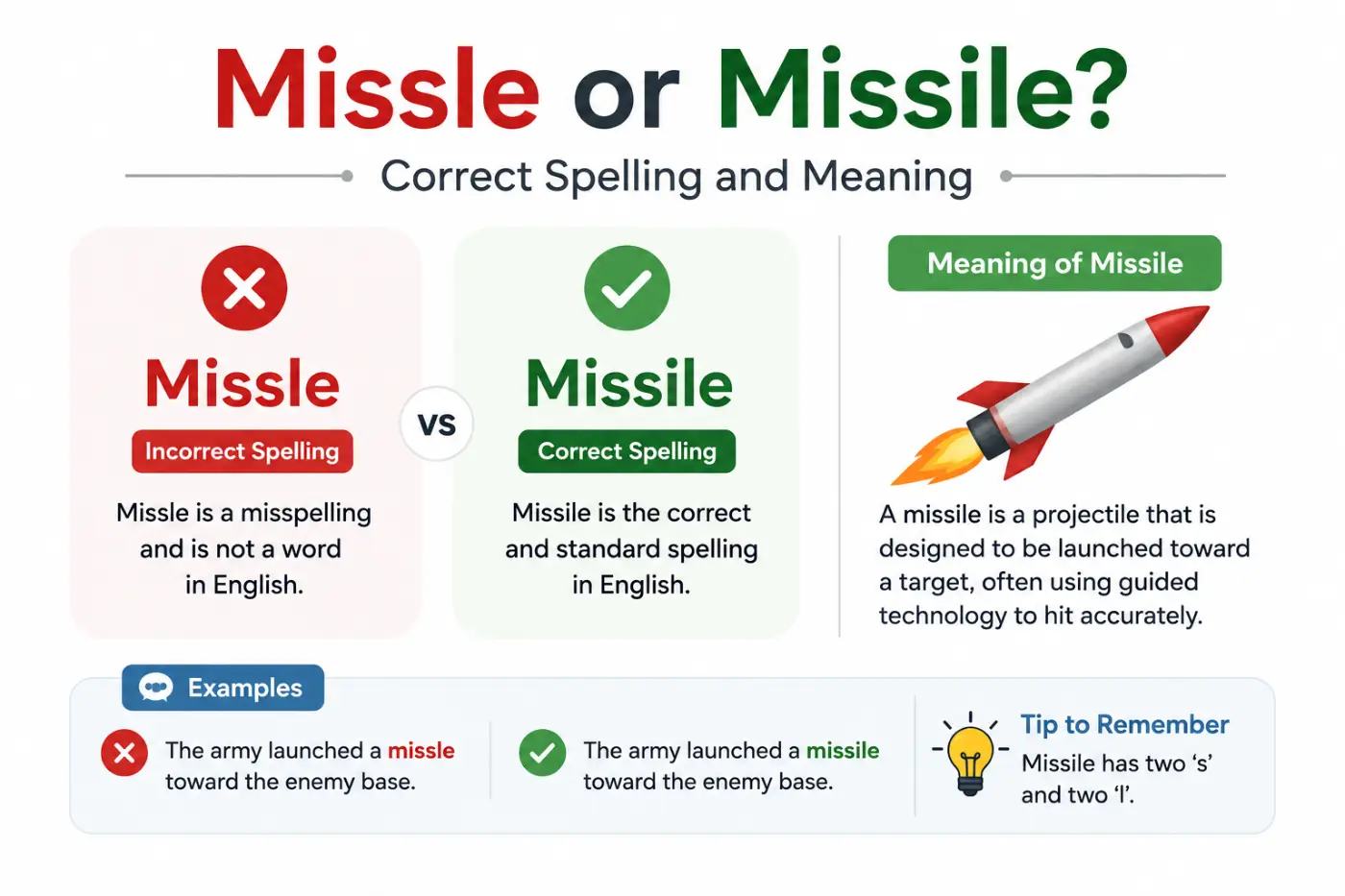
The correct spelling of missle or missile is missile. The spelling missle is a common mistake and isn’t accepted in standard American English. This confusion happens because English spelling doesn’t always match pronunciation. People often leave out the second letter i because they can’t clearly hear every sound in the word.
A missile is an object designed to be thrown or launched toward a target. In modern English the word most often refers to a weapon that travels through the air. You’ll commonly see it in news reports and discussions about military technology.
Knowing the correct spelling helps you write with confidence in school assignments and professional documents. By learning the word’s meaning and pronunciation and practicing it in sentences, you can remember the correct form and avoid this common spelling error.
Quick Answer
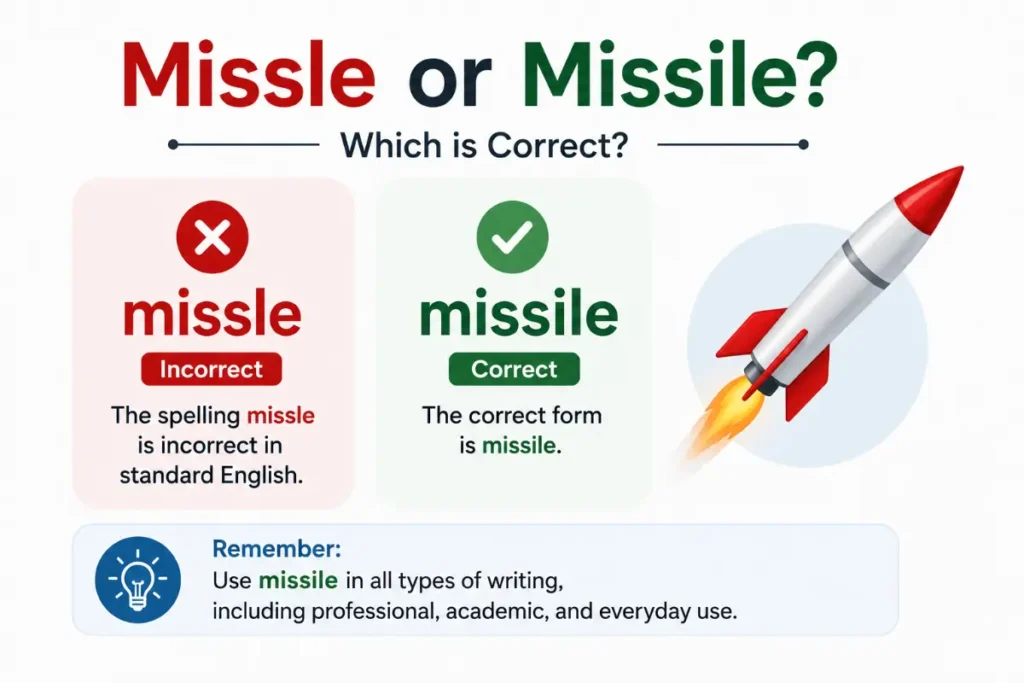
Missile is the correct spelling in standard American English. Missle is a misspelling of the same word and should be corrected in formal writing, schoolwork, and professional communication. Remember the two letters i in the middle of the correct spelling to avoid leaving one out.
Comparison Table for the Two Spellings
| Feature | Missile | Missle |
|---|---|---|
| Spelling status | Correct standard spelling | Common misspelling |
| Meaning | An object launched toward a target, often a weapon | No standard separate meaning as the intended word |
| Part of speech | Noun | Usually an accidental spelling error |
| Pronunciation | Usually pronounced MISS uhl | Intended to represent the same word |
| American English | Standard | Nonstandard |
| British English | Standard | Nonstandard |
| Formality | Suitable for formal and informal writing | Should be corrected |
| Common contexts | News, science, military writing, education | Typing errors and spelling mistakes |
| Example | The missile traveled toward its target. | The writer accidentally typed the incorrect form. |
Meaning and Definition
What Does Missile Mean
A missile is an object designed to be thrown, fired, or launched toward a target. The word has a broad meaning, but modern English often uses it to describe a weapon that travels through the air.
The term appears in military reports, international news, science lessons, and discussions about defense systems. Its exact meaning depends on the context. For example, a guided missile uses a guidance system to help it reach a target, while an unguided missile follows a less controlled path after launch.
The word can also describe an object that someone throws. In everyday language, however, people usually associate it with weapons and military technology.
Here are two examples.
- The report described how the missile reached its intended target.
- The science teacher explained that the word can describe an object launched toward something.
Is Missle a Real Word
Missle isn’t the accepted standard spelling of the common English word missile. In most cases, a writer who uses this form simply leaves out a letter by mistake.
It doesn’t have a widely recognized, separate meaning in standard American English. You might encounter it in a username, a fictional name, or an informal online post, but those uses don’t make it the standard spelling of the ordinary noun.
If you see the incorrect form in a document, correct it to missile unless the text deliberately uses it as a name or another special label.
How the Correct Word Works in Context
The meaning becomes clearer when you look at the words that commonly appear around it. Writers often use missile with verbs such as launch, fire, track, intercept, and detect. These combinations appear frequently in news reporting and technical writing.
For example, a journalist might write that a country launched a missile, while a science textbook might explain how a missile travels through the atmosphere. In both cases, the noun refers to the launched object rather than the act of launching it.
The word also appears in compound terms such as missile defense, missile system, and missile launch. These phrases describe related systems, activities, or events.
Key Differences Explained
The main difference between the two forms is spelling. They don’t represent two standard words with different meanings. One is correct, and the other is an error in ordinary English writing.
Spelling
The standard spelling contains seven letters: m, i, s, s, i, l, and e. The incorrect form leaves out the second i, which makes it shorter by one letter.
A useful way to remember the spelling is to divide the word into two spoken parts: miss and ile. This isn’t a strict linguistic division into meaningful word parts, but it can help you remember the written form.
Meaning
The correct form refers to an object that someone throws or launches toward a target. In modern news and military contexts, it usually refers to a weapon.
The misspelled form doesn’t carry a separate standard meaning. Readers will often understand the intended word from the surrounding sentence, but they may still notice the error.
Grammar
The correct form is a noun. It can function as the subject or object of a sentence, and it can appear after an article such as a or the.
For example, you can write, The missile was detected early. You can also write, The radar detected a missile. The noun performs a different grammatical role in each sentence, but its spelling stays the same.
Pronunciation
In standard American English, the word usually has two syllables, with stress on the first syllable. The first syllable sounds like the word miss, while the second has a reduced vowel sound similar to the ending of bottle in many American accents.
The letters don’t always make their pronunciation obvious to learners. This helps explain why some writers omit a letter when spelling the word from memory.
Formality and Context
The correct spelling works in every ordinary writing situation. You can use it in a casual conversation, a school essay, a newspaper report, a scientific discussion, or an official document.
The incorrect form has no place in standard edited writing. If it appears in a draft, a spelling checker may flag it, and an editor will normally correct it.
Regional Usage
American, British, Canadian, and Australian English all use the spelling missile. This isn’t a case in which one country prefers a different standard spelling.
Regional accents can affect the precise vowel sounds a speaker uses. They don’t change the accepted written form.
Which Form Is Correct
Use missile in all standard English writing. The spelling is established in modern dictionaries and general English usage. The shorter form is normally an accidental omission of the second i.
English spelling can be difficult because words don’t always follow a single reliable pattern. Some words have silent letters, while others preserve older spellings that don’t closely match modern pronunciation. However, this particular spelling doesn’t have an accepted American or British alternative that drops the second i.
If you’re editing a sentence and encounter the incorrect form, replace it with the standard spelling. You don’t need to rewrite the entire sentence unless the error also affects its grammar or meaning.
Sentence Examples
These ten examples show how to use the correct spelling in different contexts.
1. The news report said that a missile had been launched overnight.
2. The students learned how a missile differs from an ordinary projectile.
3. The newspaper published a report about the missile defense system.
4. Officials confirmed that the missile had been detected by radar.
5. The teacher asked the class to define the word missile in their own words.
6. I checked the spelling of missile before submitting my assignment.
7. The article explained how modern guidance systems help a missile follow its intended path.
8. The documentary discussed the history of missile technology.
9. The editor corrected a spelling error in the report before publication.
10. The research paper used the term missile system when discussing defense technology.
Each example uses the standard spelling. The surrounding words show how the noun appears in ordinary sentences, academic writing, journalism, and technical discussions.
Common Spelling Mistakes
Spelling mistakes often happen when a writer remembers a word’s sound but not its exact letter sequence. The following examples show errors that can arise when writing this word or discussing related terms.
Leaving Out the Second I
Incorrect form: Missle.
Correct form: Missile.
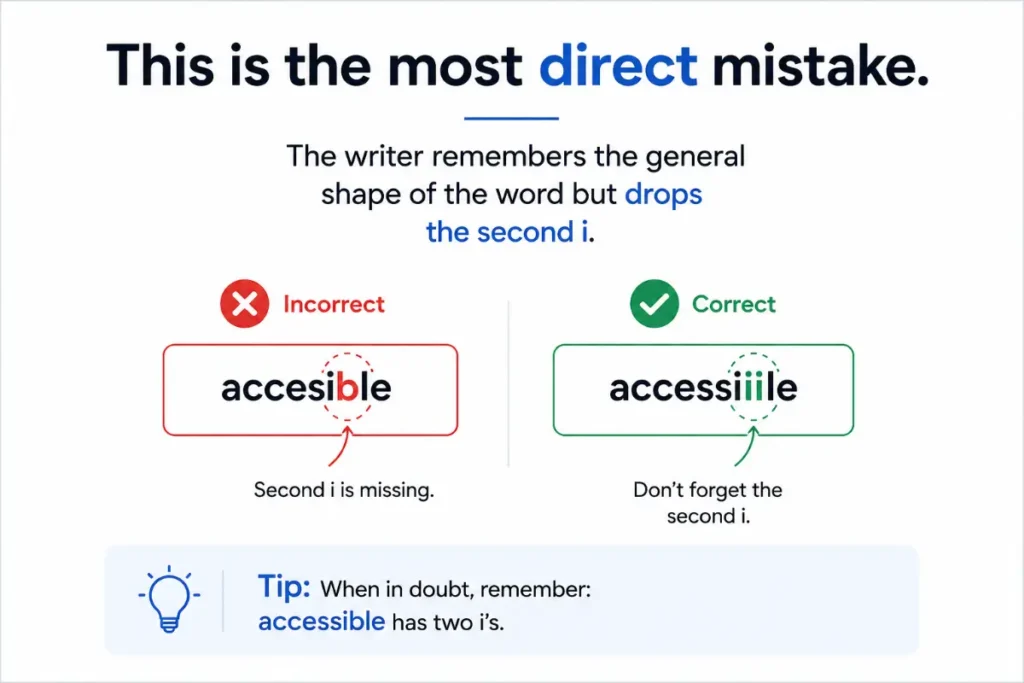
This is the main spelling error addressed in this article. The writer leaves out the second i, often because the reduced vowel sound in the final syllable makes the letter sequence harder to remember.
Example: The report described a missile launch.
Reversing the Middle Letters
Incorrect form: Mislile.
Correct form: Missile.
This error changes the order of the letters and introduces an extra letter. It can happen when someone types quickly or tries to reconstruct the spelling from memory.
The easiest fix is to check the entire word rather than correcting just the part that looks unfamiliar.
Adding an Extra S
Incorrect form: Misssile.
Correct form: Missile.
The correct spelling contains two consecutive s letters. Adding a third creates a typing error rather than a recognized spelling variant.
A quick spell check usually catches this mistake.
Confusing the Word With a Similar Technical Term
Some writers confuse missile with projectile. Both words can describe objects that move toward a target, but they don’t mean exactly the same thing.
A projectile is an object that has been thrown or launched and then moves through the air. A missile is commonly associated with a launched weapon and may use a guidance system. The words overlap in meaning, but you shouldn’t treat them as perfect substitutes in every context.
Relying Only on Sound
A writer might hear the word in conversation and try to spell it using only the sounds. This can lead to the omission of a letter, especially when an unstressed syllable contains a reduced vowel.
The solution is to learn the written form as well as the pronunciation. Reading the word in context and using it in your own sentences can make the spelling easier to recall.
Pronunciation Guide
The standard American English pronunciation is commonly represented as /ˈmɪs.aɪl/. Some dictionaries and pronunciation systems represent the second syllable with a slightly different vowel or syllable structure, so you may see minor transcription differences.
For an everyday learner, the easiest guide is MISS ile. Say the first syllable clearly and give it the main stress. The second syllable is lighter.
Syllable Breakdown
The word is commonly taught as having two syllables.
- MISS. This sounds like the word miss.
- ILE. This is the lighter second part of the word.
The written ending ile doesn’t always sound the same across English words. For that reason, don’t assume that the pronunciation of every word ending in these letters will match.
Common Pronunciation Mistakes
Some learners place too much stress on the second syllable. Others pronounce every written vowel with equal force. In ordinary American speech, the first syllable carries the main stress, and the second syllable is less prominent.
A spelling mistake can also arise from pronunciation. If a reduced vowel is difficult to hear, a writer may forget the letter that represents it. Remember that pronunciation and spelling are connected, but they aren’t identical.
Etymology and Word Origin
The English word missile comes from Latin missilis, meaning something that can be thrown or sent. It is related to the Latin verb mittere, which means to send or let go.
The word entered English through the development of scientific and technical vocabulary. Its earlier sense was broader than the modern military meaning. It could refer to an object thrown or sent through the air, not just a weapon with an advanced guidance system.
Over time, the word became strongly associated with military technology. Modern usage often refers to a weapon launched toward a target, particularly one that travels through the air. The original idea of sending or throwing something helps explain the connection between the historical meaning and its modern use.
The history also shows why the spelling deserves attention. The standard form has an established written history, and dropping the second i doesn’t reflect a recognized change in modern English spelling.
Regional Usage
The spelling stays the same across major English varieties. Differences in accent or local vocabulary don’t make the shorter form acceptable.
American English
In the United States, missile is the standard spelling. It appears in news reports, government documents, textbooks, defense discussions, and everyday writing about military events.
American speakers generally stress the first syllable. If you’re writing for a US audience, use the standard form regardless of the publication’s style preferences.
British English
British English also uses missile. There isn’t a standard British spelling that removes the second i.
Pronunciation can vary among British speakers and regional accents. These sound differences don’t affect the spelling rule.
Australian English
Australian English follows the same standard spelling. Newspapers, educational materials, and professional documents use missile when referring to the object or weapon.
There is no established Australian spelling distinction that makes the shorter form correct.
Canadian English
Canadian English uses the same spelling as American and British English. Writers should use missile in school assignments, formal documents, journalism, and technical communication.
The rule is straightforward across these regions. Remember the standard spelling rather than looking for a country specific alternative.
Grammar Rules and Part of Speech
The word missile functions as a countable noun. That means you can refer to one object or to several objects by changing the article or making the noun plural.
Singular and Plural Forms
Use missile for one object and missiles for more than one.
- Singular: The missile appeared on the radar screen.
- Plural: Several missiles appeared on the radar screen.
The plural follows the usual English rule of adding s to many countable nouns. You don’t need to change the spelling of the singular form before adding the ending.
Using Articles Correctly
Use a or an according to the opening sound of the word that follows. Since missile begins with a consonant sound, the correct phrase is a missile.
Examples include the following.
- A missile was detected near the test area.
- The missile appeared in the official report.
Use the when the reader already knows which object you’re discussing or when the context identifies it clearly.
Using the Word as a Subject
A noun can serve as the subject of a sentence. In that position, it tells the reader what performs an action or what the sentence describes.
Example: The missile traveled across the test range.
The noun appears before the verb and identifies the object being discussed. The sentence follows a common English subject and verb structure.
Using the Word as an Object
A noun can also function as the object of a verb. In this position, it receives the action expressed by the verb.
Example: The radar detected a missile.
Here, radar is the subject, detected is the verb, and missile is the object. Understanding the sentence structure helps you use the word correctly without changing its spelling.
Compound Terms
The word often appears in compound nouns and phrases. Examples include missile defense, missile warning, missile launch, and missile system.
These combinations describe activities, equipment, or systems connected with launched objects. In ordinary usage, the word missile keeps its standard spelling in each phrase.
Punctuation and Formal Writing
The word doesn’t need special punctuation. Italics may be useful when discussing the spelling itself, but ordinary sentences don’t require italics, quotation marks, or capitalization unless a specific style or title calls for them.
For instance, write, The missile appeared in the report. When explaining the spelling rule, you may write, Missile is the correct form. The formatting changes because the word is being discussed rather than used in its usual meaning.
Real Life Usage Examples
The word appears in several kinds of writing. Its meaning remains related to a launched object, but the level of technical detail changes with the audience.
Daily Conversation
In casual conversation, people often use the word while discussing a news story, documentary, or school lesson. The surrounding sentence usually provides enough context to understand the intended meaning.
- I heard a report about a missile launch on the radio.
- The documentary explained why a missile can follow a guided path.
Email and Workplace Communication
Workplace writing benefits from correct spelling because a single error can distract readers or weaken confidence in a document. In a technical or professional setting, the writer should also use terms that match the subject.
- Please check the spelling of missile before we send the report.
- The briefing includes a section on missile detection systems.
Academic Writing
Students may encounter the word in history, physics, international relations, or engineering. Academic writing should define technical terms when readers may not know their meaning.
- The paper examines the role of missile technology in modern defense systems.
- The class compared guided missiles with other types of projectiles.
News and Journalism
News reports often use the word when describing military events, defense policy, or international conflict. Journalists need accurate spelling and precise wording because readers rely on their reports to understand events.
- The report said that a missile had been detected before impact.
- Officials discussed the possible effects of the missile launch during a press conference.
Literature and Storytelling
Writers can use the word in fiction to establish a military setting, create tension, or describe a dramatic event. The best choice depends on the scene and the amount of technical detail the story needs.
- In the novel, the characters watched the missile disappear beyond the horizon.
- The author used the distant missile launch to show how quickly the conflict had escalated.
These examples demonstrate the word’s flexibility. It works in casual speech, professional communication, academic writing, news reporting, and storytelling without any change to its standard spelling.
Related and Confused Terms
Several words are connected to the meaning of missile. Some overlap in meaning, while others describe a different part of the same event.
Projectile
A projectile is an object thrown or launched through the air. The term is broader than missile and can include objects that aren’t guided weapons.
For example, a ball thrown across a field is a projectile. The term is useful in physics because it describes an object’s motion without requiring it to be a weapon.
Rocket
A rocket is a vehicle or device that moves by expelling exhaust. Rockets can carry equipment, people, or payloads, and they can serve civilian or military purposes.
A rocket and a missile aren’t identical terms. Some missiles use rocket propulsion, but the words describe different features and shouldn’t automatically replace each other.
Guided Missile
A guided missile uses a guidance system to help control its path toward a target. The guidance system may rely on different methods, depending on the design.
The word guided adds a useful distinction. It tells the reader something about how the object navigates rather than merely identifying it as a launched weapon.
Ballistic Missile
A ballistic missile follows a trajectory shaped largely by its initial launch and the effects of gravity after the powered part of its flight. Some designs also use guidance during portions of the flight.
The term is more specific than the general noun. It identifies a particular category of missile rather than every weapon that travels through the air.
Cruise Missile
A cruise missile typically uses powered flight for much of its journey and can travel through the atmosphere along a controlled route. The term describes a distinct category of missile.
Its flight pattern differs from that of a ballistic missile. The distinction matters in news reporting and technical explanations.
Interceptor
An interceptor is a system or weapon designed to stop or destroy an incoming threat. In missile defense, an interceptor may be launched to engage an incoming missile.
The term describes the defensive role, while missile identifies the broader type of launched object. The words can appear together in technical reports.
Launch
A launch is the act of sending something into motion or beginning its flight. It can refer to a missile, a rocket, a spacecraft, or another object.
The noun and verb forms appear in many contexts. For example, a report may describe a missile launch, while a sentence may say that officials plan to launch a test vehicle.
Ammunition
Ammunition refers to supplies used in weapons, including bullets, shells, and other items designed to be fired or used in combat. The term has a broader meaning than missile and doesn’t identify one specific kind of launched object.
These distinctions help writers choose the right word. Accurate vocabulary makes technical explanations clearer and reduces the risk of confusing related objects or systems.
Is Missle Ever Acceptable?
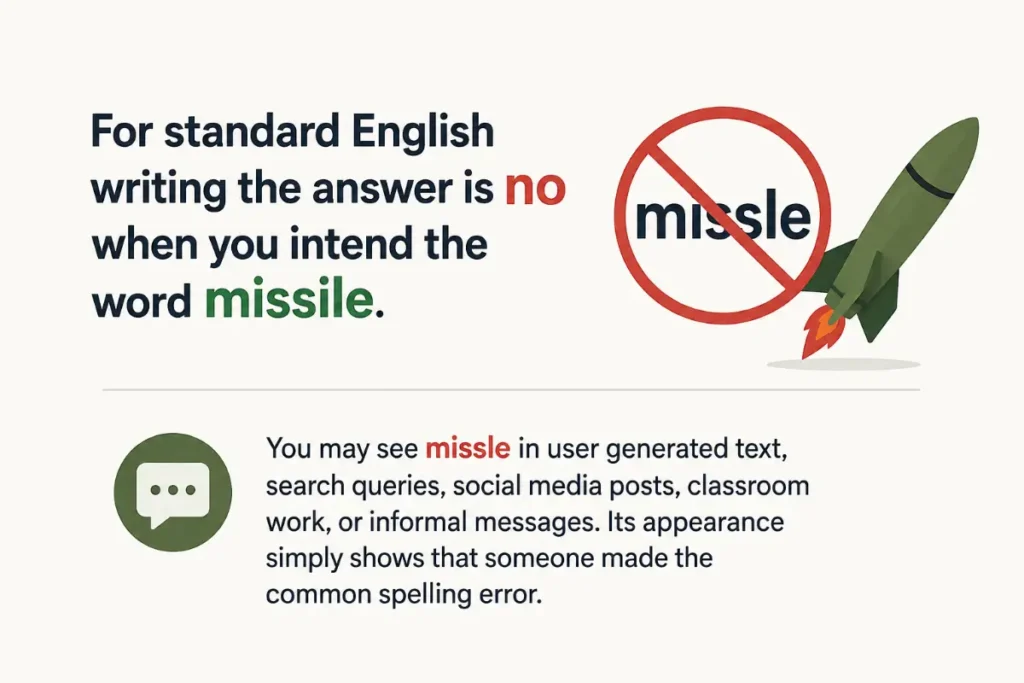
For standard English writing the answer is no when you intend the word missile. You may see missle in user generated text search queries social media posts classroom work or informal messages. Its appearance simply shows that someone made the common spelling error.
It can also appear as part of a username a business name a fictional name or another proper name created by an individual. A proper name can follow its own spelling conventions. That doesn’t make missle a standard spelling of the English noun. If you are writing an essay article report email academic paper or professional document then use missile.
Expert Editor Insight
An experienced English editor treats missile as a straightforward spelling correction rather than a difference in meaning. The mistake happens because the middle of the word is easy to misremember, especially when someone types quickly or writes from sound alone. A spelling checker may catch the error, but it can miss unusual names or specialized labels. The best editing habit is to check the word in context and confirm that the intended meaning fits the sentence. For a technical document, the editor should also check related terms so the spelling is correct and the terminology is precise.
Conclusion
The correct spelling of missle or missile is easy to remember once you learn the standard form. Missile is the accepted spelling in American English and other major English varieties. Missle is a common mistake caused by leaving out the second i. The correct word refers to an object launched toward a target and often describes a weapon in modern usage.
To remember the spelling, picture the two i letters in the middle whenever you write the word. Before submitting an essay or professional document, run a quick spell check and review any flagged words. A small correction can make your writing clearer and more professional.
FAQs
Is Missle a Real Word?
Missle isn’t the standard spelling of the common English noun missile. In ordinary writing, it is usually a typo or a spelling mistake caused by leaving out the second i. You might see it used as a fictional name or username, but that doesn’t make it an accepted alternative spelling in standard American English.
What Does Missile Mean?
A missile is an object designed to be thrown, fired, or launched toward a target. In modern English, the word most often refers to a weapon that travels through the air. The term appears in news reports, science textbooks, military discussions, and technical documents. Its exact meaning depends on the context in which the writer uses it.
Which Is Correct Missle or Missile?
Missile is correct, and missle is the common misspelling. The standard form contains two i letters, including one before the final l. There is no accepted regional spelling rule that makes the shorter form correct in American, British, Canadian, or Australian English. Use the full spelling in formal and informal writing.
How Do You Pronounce Missile?
In American English, the word is usually pronounced with two syllables and stress on the first. The opening syllable sounds like miss, and the second is lighter. A common mistake is to stress the second syllable too strongly or assume that every written vowel has a full spoken sound. Learning the pronunciation alongside the spelling can help you remember both.
Can Missile Start a Sentence?
Yes. The word can begin a sentence when it functions as the subject or appears in a suitable introductory phrase. For example, you can write, The missile appeared on the radar screen. Starting a sentence with the noun doesn’t change its spelling or grammatical role. As with any sentence, capitalize the first word and use correct punctuation.
What Is a Synonym for Missile?
The best alternative depends on the intended meaning. Projectile is a broad term for an object thrown or launched through the air. Rocket describes a propulsion device or vehicle and isn’t always interchangeable with missile. In technical writing, it’s better to use the precise term than choose a synonym simply to avoid repetition.
Why Do People Misspell Missile?
People often misspell the word because they remember how it sounds but forget the exact letter sequence. The reduced vowel in the second syllable can make the spelling less obvious, especially for people learning English. Fast typing and weak visual memory can also contribute. Reading the word regularly and checking it before submitting important writing can reduce these errors.
Is Missile Appropriate in Formal Writing?
Yes. Missile is a standard noun used in formal writing, including journalism, academic work, government reports, and technical documents. The word itself doesn’t sound informal or inappropriate. However, writers should explain specialized terms when their audience may not know them. Always use the correct spelling and choose a precise term that matches the subject being discussed.
