
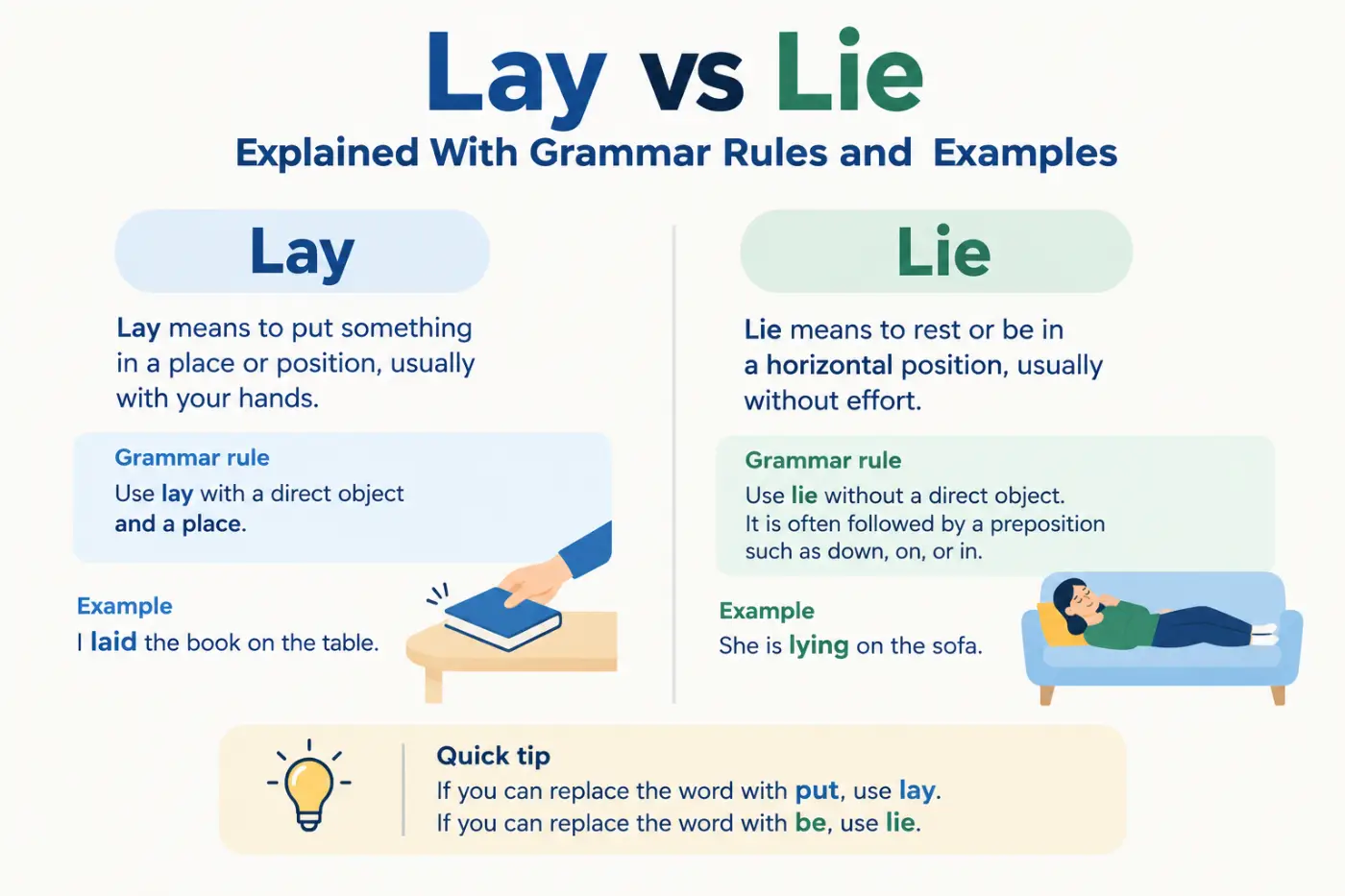
Have you ever stopped while writing a sentence because you couldn’t decide between lay vs lie? You’re not alone. These two verbs cause confusion because their meanings overlap in everyday situations, and their past tense forms make the problem even harder.
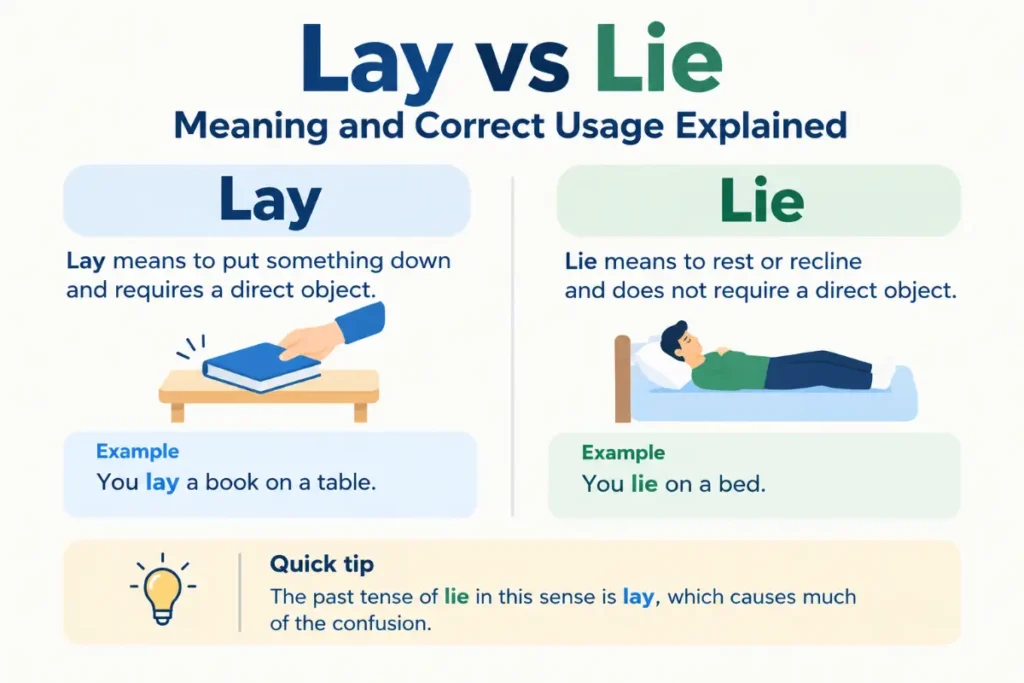
The basic rule is simple. Lay means to put something down, while lie means to rest or recline. You lay a book on a table, but you lie down on a bed. The main difference is that the first verb needs a direct object, while the second usually doesn’t.
The trouble begins when you talk about the past. The past tense of lay is laid, but the past tense of lie is lay. That means you might write, “Yesterday I lay on the couch,” even though you would say, “I lie on the couch” today. The words look similar, but they serve different grammatical roles.
Once you understand the meaning, the object rule, and the verb forms, you can make the right choice without second guessing yourself. The following examples and practical tips will help you use these verbs naturally in conversation, schoolwork, emails, and professional writing.
Quick Answer
Lay means to place or put something somewhere and usually takes a direct object. Lie means to rest, recline, or remain in a position and usually takes no direct object. The past tense of lay is laid, while the past tense of lie, when it means recline, is lay. Context tells you which form fits.
The Main Difference Between Lay and Lie
The easiest way to distinguish these verbs is to ask one question. Are you putting something somewhere, or are you resting yourself somewhere?
What Lay Means
Lay is a verb that means to put, place, or set something down. It usually acts on a person or thing called a direct object.
For example, you lay your phone on the desk, lay a blanket over your child, or lay the papers beside the printer. In each sentence, something receives the action.
You can check your sentence by asking what you are laying. If the sentence answers that question with a direct object, lay is probably the verb you need.
What Lie Means
Lie means to recline, rest, or remain in a particular position. In this sense, it doesn’t need a direct object.
You lie on the couch after work, lie in bed when you’re tired, or lie on the grass to watch the clouds. You aren’t placing another object somewhere. You’re describing your own position.
The verb can also describe the position of a person or thing. For example, “The keys lie beside the door” means the keys are resting in that location.
A Simple Way to Remember the Rule
Think of lay as an action that places something and lie as an action that describes resting or position.
- Lay the towel on the chair. You are putting the towel somewhere.
- Lie on the chair. You are resting there.
- Lay the baby in the crib. You are placing the baby in the crib.
- The baby lies in the crib. You are describing the baby’s position.
This test works well for the common meanings of these verbs. Other meanings, such as telling a lie or laying eggs, need their own context.
Comparison Table
| Feature | Lay | Lie |
|---|---|---|
| Main meaning | Put or place something | Rest or recline |
| Part of speech | Verb | Verb |
| Direct object | Usually required | Not required for the meaning of recline |
| Present tense | Lay | Lie |
| Past tense | Laid | Lay |
| Past participle | Laid | Lain |
| Present participle | Laying | Lying |
| Example | I lay the book on the desk. | I lie on the couch. |
| Common context | Placing objects or people | Resting or describing position |
| Formality | Standard English | Standard English |
Understanding the Verb Forms
The present tense is only part of the story. These verbs become easier to use once you learn their main forms together.
Forms of Lay
The main forms of lay are lay, laid, laid, and laying.
- Present: I lay my keys on the counter every evening.
- Past: I laid my keys on the counter yesterday.
- Past participle: I have laid my keys on the counter.
- Present participle: I am laying my keys on the counter now.
Notice that laid serves as both the simple past form and the past participle. You use the past participle with helping verbs such as have, has, and had.
Forms of Lie
For lie in the sense of rest or recline, the main forms are lie, lay, lain, and lying.
- Present: I lie down after lunch.
- Past: I lay down after lunch yesterday.
- Past participle: I have lain here for an hour.
- Present participle: I am lying on the bed.
The past tense is where many writers make mistakes. Lay is the present form of one verb and the past form of another. You must look at the meaning and the sentence to identify the correct choice.
Why Laid and Lain Are Different
Laid belongs to the verb lay, which means to put something down. Lain belongs to lie, which means to rest or recline.
Consider these examples.
- She has laid the folder on my desk.
- She has lain on the sofa all afternoon.
The first sentence describes placing a folder. The second describes resting on a sofa. Using laid in the second sentence would mix the two verb patterns.
Which Form Is Correct
Both words are correct. The right choice depends on the action you want to describe.
Use lay when someone puts a person or thing in a position. Use lie when someone or something rests or remains in a position without a direct object receiving the action.
For example, “Please lay the package by the door” is correct because the package is the object being placed. “Please lie down for a few minutes” is correct because the person is resting.
Grammar references and standard dictionaries recognize both verbs and their different forms. Neither is a misspelling of the other. The mistake occurs when writers use the forms as if they were interchangeable.
Ten Natural Sentence Examples
These examples show how the verbs work in everyday situations and more formal writing.
- Everyday conversation: I usually lie on the couch after dinner.
- At home: Please lay the clean towels on the bathroom shelf.
- Text message: I’m going to lie down for twenty minutes before we leave.
- At work: Lay the signed documents on my desk before the meeting.
- At school: The teacher asked us to lay our notebooks on the front table.
- Past event: I lay awake last night because the storm was so loud.
- Completed action: Marcus has laid all the tools beside the workbench.
- Academic writing: The study examines how the evidence lies within the broader historical record.
- Formal communication: Please lay the completed forms on the reception counter.
- Storytelling: The old dog lay beside the fireplace while rain tapped against the windows.
Each example follows the verb’s meaning and grammatical pattern. Pay special attention to the sixth sentence. Lay is correct there because it describes a past state of resting, not the act of placing something.
Common Mistakes and How to Fix Them
Using Lay When You Mean Lie
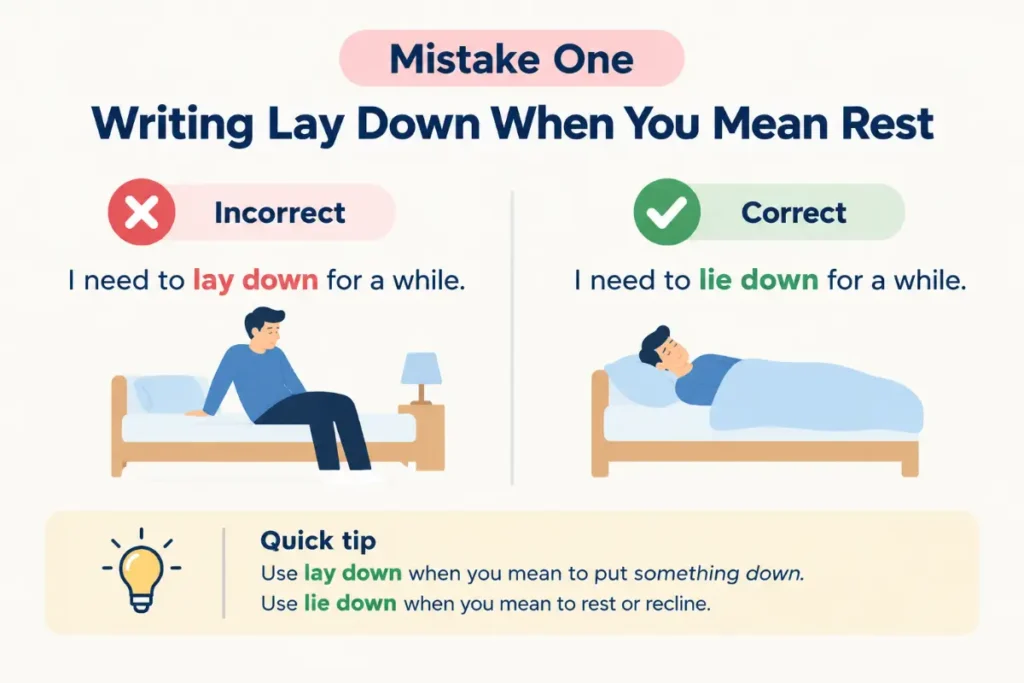
Incorrect: I want to lay down for a while.
Correct: I want to lie down for a while.
The corrected sentence describes resting. It has no direct object, so lie is the appropriate present form.
Using Lie When You Mean Lay
Incorrect: Please lie the papers on the table.
Correct: Please lay the papers on the table.
The papers receive the action. Because the sentence describes placing them somewhere, lay is correct.
Using Laid for the Past Tense of Lie
Incorrect: I laid on the beach all afternoon.
Correct: I lay on the beach all afternoon.
The sentence describes resting in the past. The past tense of lie is lay, not laid.
Using Lain Without a Helping Verb
Incorrect: I lain in bed all morning.
Correct: I have lain in bed all morning.
Lain is a past participle. It normally appears with a helping verb such as have, has, or had.
Confusing Lying With Laying
Incorrect: She is laying on the sofa.
Correct: She is lying on the sofa.
When the person is reclining, use lying. Use laying when the person is placing something, as in “She is laying the baby in the crib.”
Pronunciation Guide
The verbs sound different in their present forms but can overlap in their past forms.
| Word | IPA | Easy Guide |
|---|---|---|
| Lay | /leɪ/ | Lay, rhyming with day |
| Lie | /laɪ/ | Lie, rhyming with my |
| Laid | /leɪd/ | Layd |
| Lain | /leɪn/ | Layn |
| Lying | /ˈlaɪ.ɪŋ/ | LYE ing |
| Laying | /ˈleɪ.ɪŋ/ | LAY ing |
Lay and lie each have one syllable. Laying and lying each have two syllables, with stress on the first syllable.
A common pronunciation mistake is to treat laying and lying as the same word because their meanings can overlap in casual conversation. Listen for the vowel sound. Lay and laying use the vowel in day, while lie and lying use the vowel in my.
Word Origins
The two verbs have different historical roots, which helps explain why their forms do not follow the same pattern.
Lay comes from Old English lecgan, meaning to place or set down. Its modern forms include lay, laid, and laying. The past tense and past participle use the same form, laid.
Lie, in the sense of resting or reclining, comes from Old English licgan. Its historical forms developed into the modern pattern lie, lay, lain, and lying. The past tense lay may seem surprising today, but it reflects the verb’s older grammatical history.
English inherited many irregular verbs from earlier stages of the language. Their forms don’t always follow a neat pattern, so learning the main forms together is often more useful than trying to build them from a general rule.
The verb lie also has another meaning: to tell something untrue. That verb follows a different pattern: lie, lied, lied, and lying. For example, “He lied about the meeting.” Don’t confuse this meaning with lie as a way to describe resting.
Regional Usage
American English
Both verbs are standard in American English. In careful writing, use lay for placing something and lie for resting. In casual American speech, many people use lay in phrases such as “I’m going to lay down,” but formal and edited writing generally keeps the distinction.
British English
British English follows the same main grammar patterns. Lay means to place something, and lie means to recline. The verb forms are the same, so writers don’t need a different rule for British usage.
Australian English
Australian English also uses the standard forms and meanings. The same distinction applies in both conversation and formal writing, even though everyday speakers may sometimes use lay more broadly.
Canadian English
Canadian English generally follows the same patterns as American and British English. The difference between the verbs comes from grammar and meaning rather than a regional spelling convention.
Across these varieties, the core rule remains consistent. Regional speech may be more relaxed, but edited writing benefits from keeping the verb forms clear.
Grammar Rules and Sentence Patterns
Understanding the direct object is the most reliable way to choose between these verbs in their common meanings.
Lay Takes a Direct Object
A direct object receives the action of the verb. In “Lay the coat on the chair,” the coat is the direct object. The sentence tells you what is being placed.
The object doesn’t have to be a physical item. You can lay a foundation, lay a charge, or lay the groundwork for a project. These expressions use lay in established ways, even though the action isn’t simply putting an object on a surface.
Lie Does Not Need a Direct Object
In the reclining sense, lie describes the subject’s position or state. In “The child lies on the bed,” the child is the subject, and the sentence explains the child’s position.
A phrase such as “on the bed” gives extra information about location. It isn’t a direct object. That distinction matters because a location phrase doesn’t turn lie into a transitive verb.
Use the Correct Tense
The tense tells readers when an action or state occurs. Compare these sentences.
- Present: I lie down when I feel tired.
- Past: I lay down when I felt tired.
- Present perfect: I have lain down twice today.
- Present: I lay the blanket on the bed.
- Past: I laid the blanket on the bed.
- Present perfect: I have laid the blanket on the bed.
The key is to identify the verb first, then select its correct form for the tense. Don’t choose laid simply because the sentence describes something that happened in the past.
Watch for Helping Verbs
Helping verbs change how the main verb works in a sentence. Have, has, and had generally take a past participle when forming perfect tenses.
For example, “I have laid the book down” uses laid. “I have lain down” uses lain. The two forms are not interchangeable, even though both sentences describe completed actions.
Real Life Usage Examples
The distinction becomes clearer when you see it in different types of writing.
Daily Conversation
“I’ll lie down while the coffee brews.”
“Lay your jacket on the chair so it doesn’t wrinkle.”
The first sentence describes resting. The second tells someone where to put an item.
Email and Workplace Communication
“Please lay the invoices in the blue folder before you leave.”
“The original agreement has lain in the records room for years.”
The first sentence gives a direct instruction. The second uses the past participle of lie to describe where the agreement has remained.
Academic Writing
“The researcher laid the samples on a clean surface before testing them.”
“The results lie at the center of the paper’s main argument.”
The first example describes an action involving samples. The second uses lie to describe the position of an idea within an argument.
News and Journalism
“Investigators laid the recovered items on a table for inspection.”
“The village lies near the northern edge of the county.”
The first sentence describes placing objects. The second describes a location, a common use of lie.
Literature and Storytelling
“She lay beneath the trees and watched the afternoon light fade.”
“He laid the letter beside the lamp and walked out of the room.”
The first sentence uses the past tense of lie to show a resting position. The second uses the past tense of lay to describe placing a letter.
Related and Confused Terms
Several related words and expressions can help you express the same ideas more clearly.
- Place. Place means to put something in a particular position. It is often a useful alternative to lay when you want a simple, direct verb.
- Put. Put is a common everyday verb for moving something to a location. It generally takes a direct object, just like lay.
- Set. Set can mean to position something. For example, “Set the cup on the table” is a natural alternative to “Lay the cup on the table,” although the verbs aren’t identical in every context.
- Rest. Rest means to relax or stop activity. It can replace lie in some sentences, as in “I need to rest for a while.”
- Recline. Recline means to lean back or lie down. It is more formal than lie and often appears in descriptions of furniture or posture.
- Lied. Lied is the past tense and past participle of lie when it means to tell something untrue. “She lied about her age” has a different meaning from “She lay on the sofa.”
- Laying. Laying is the present participle of lay. It describes an ongoing act of placing something or a related action, as in “They are laying the tiles.”
- Lying. Lying is the present participle of lie. It can describe resting or telling an untruth. The sentence determines the intended meaning.
These terms aren’t perfect substitutes in every context. Choose a synonym based on the exact action, tone, and meaning you want to convey.
Expert Editor Insight
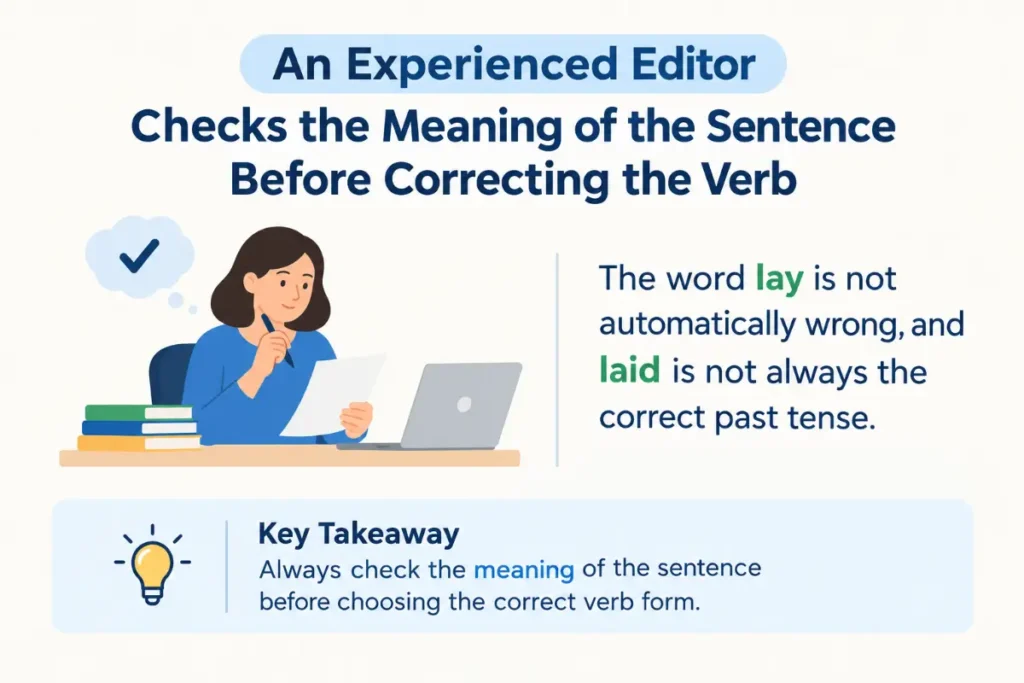
An experienced editor checks the meaning of the sentence before correcting the verb. The key question is simple: does the subject place something, or does the subject rest or remain in a position? Grammar tools may flag a form that looks unusual, but they can miss the intended meaning because lay is also the past tense of lie. Read the full sentence, identify the direct object, and check the tense before accepting an automatic correction. This quick review catches most errors without making the writing sound stiff.
Conclusion
The difference between lay vs lie comes down to meaning and grammar. Lay means to put something somewhere and usually takes a direct object. Lie means to rest or remain in a position and normally stands without a direct object in that sense. Their past forms cause most of the confusion: lay becomes laid in the past, while lie becomes lay.
The past participles are laid and lain. To choose correctly, first identify the action, then check the tense. A quick memory trick helps: you lay something down, but you lie down yourself. With a little practice, the right form will become much easier to spot.
FAQs
Is lay a real word?
Yes. Lay is a standard English verb meaning to put or place something somewhere. It is also the simple past tense of lie when lie means to rest or recline. The surrounding sentence tells you which meaning applies. For example, “Lay the book down” gives an instruction, while “I lay down yesterday” describes a past state.
What does lie mean?
Lie can mean to rest, recline, or remain in a position. For example, “I lie on the sofa after work.” It can also mean to tell something untrue, as in “He may lie to avoid trouble.” These meanings use different verb forms in the past, so context matters when choosing between lay, laid, lain, and lied.
Which is correct when talking about resting?
Use lie for the present tense when describing rest, as in “I lie down after lunch.” Use lay for the simple past, as in “I lay down yesterday.”And Use lain with a helping verb, as in “I have lain here for an hour.” In casual speech, you may hear lay used in place of lie, but standard edited writing keeps the forms distinct.
How do you pronounce lay and lie?
Lay rhymes with day and uses the vowel sound /eɪ/. Lie rhymes with my and uses the vowel sound /aɪ/. Both words have one syllable. Their different vowel sounds also appear in laying and lying, which have two syllables and stress on the first syllable. Listening for the vowel is a useful way to keep the forms separate.
Can lay start a sentence?
Yes. Lay can start an instruction or command. For example, “Lay the keys on the counter” tells someone to put the keys there. It can also start a sentence in other grammatical contexts, such as “Lay the groundwork before you begin.” In these examples, the verb means to put, set, or establish something.
What is a synonym for lie?
For lie in the sense of resting, useful synonyms include rest and recline. For example, “I need to rest” may replace “I need to lie down” in some contexts. Choose a synonym that preserves the intended sense and fits the sentence naturally.
Why do people confuse lay and lie?
People confuse these verbs because their meanings are related and the past tense of lie is lay. Everyday speech also often blurs the distinction, especially in phrases about resting. The forms don’t follow the simple pattern used by many regular verbs. Learning the full forms and checking for a direct object makes the difference much easier to remember.
Is the distinction necessary in formal writing?
Yes. In schoolwork, professional emails, reports, and edited publications, use the standard verb forms. Choose lay when placing something and lie when describing rest or position. The distinction helps readers understand the sentence without stopping to work out the intended meaning. In casual conversation, people may use the forms less strictly, but standard grammar remains the safer choice for formal writing.
