
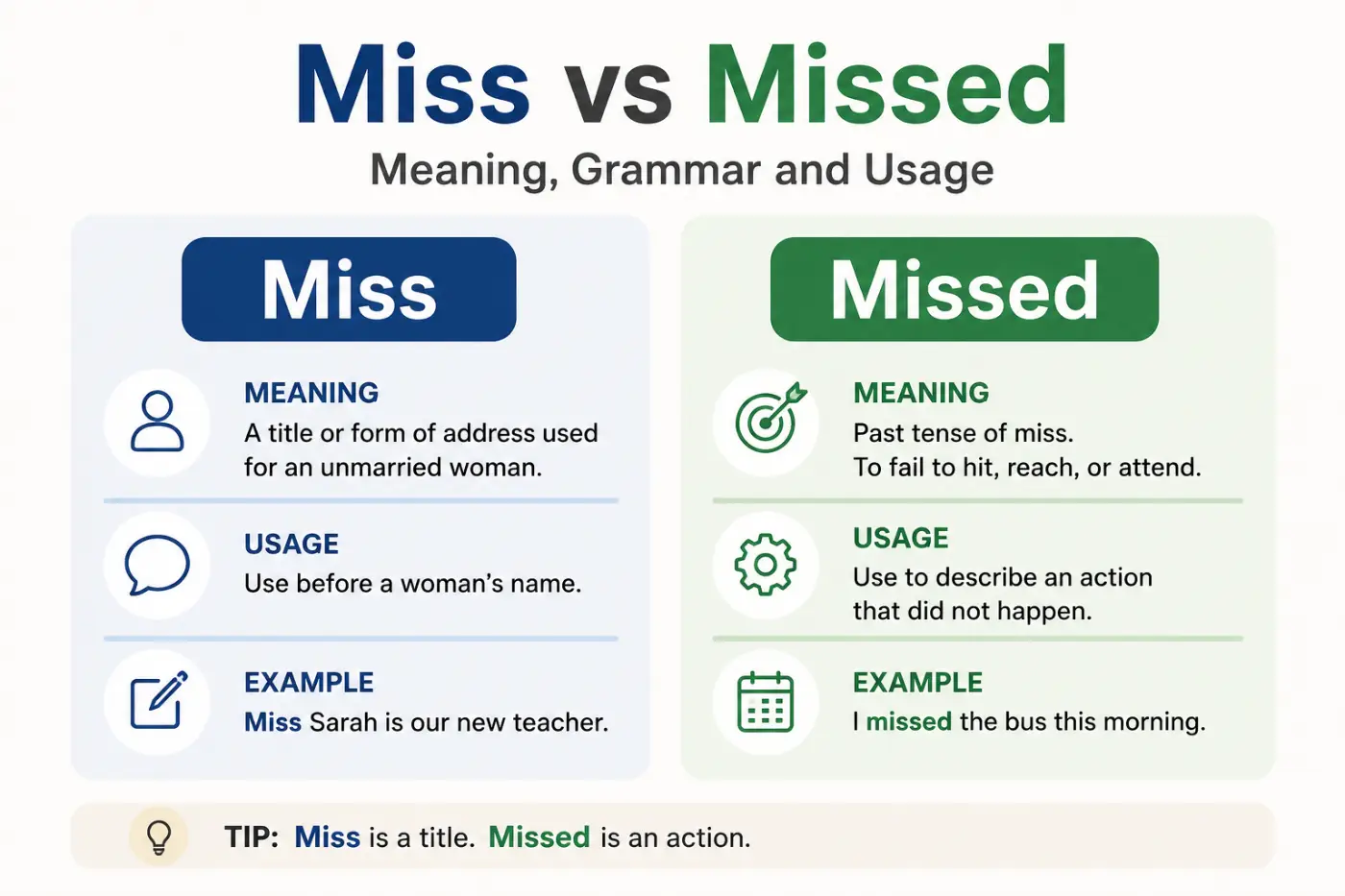
If you’re confused about miss vs missed, the key is understanding time and meaning. Both are correct English words, but they serve different purposes. Use miss for the present tense, the base form of the verb, or an action that may happen in the future. Use missed for a past action or as a past participle in certain grammatical structures.
For example, you might say, I miss my friends when they travel. If they visited you last week and you couldn’t see them, you could say, I missed my friends when they visited.
The difference becomes easier to understand when you look at the sentence around each word. The subject, helping verbs, and time expressions often tell you which form fits best. You also need to recognize that miss has several meanings. It can describe feeling someone’s absence, failing to catch transportation, failing to hit a target, or failing to notice something.
This guide explains the meaning of both forms, their grammar, pronunciation, regional usage, and common mistakes. You’ll also find practical examples that show how to choose the right word in conversation, schoolwork, emails, and professional writing.
Quick Definition
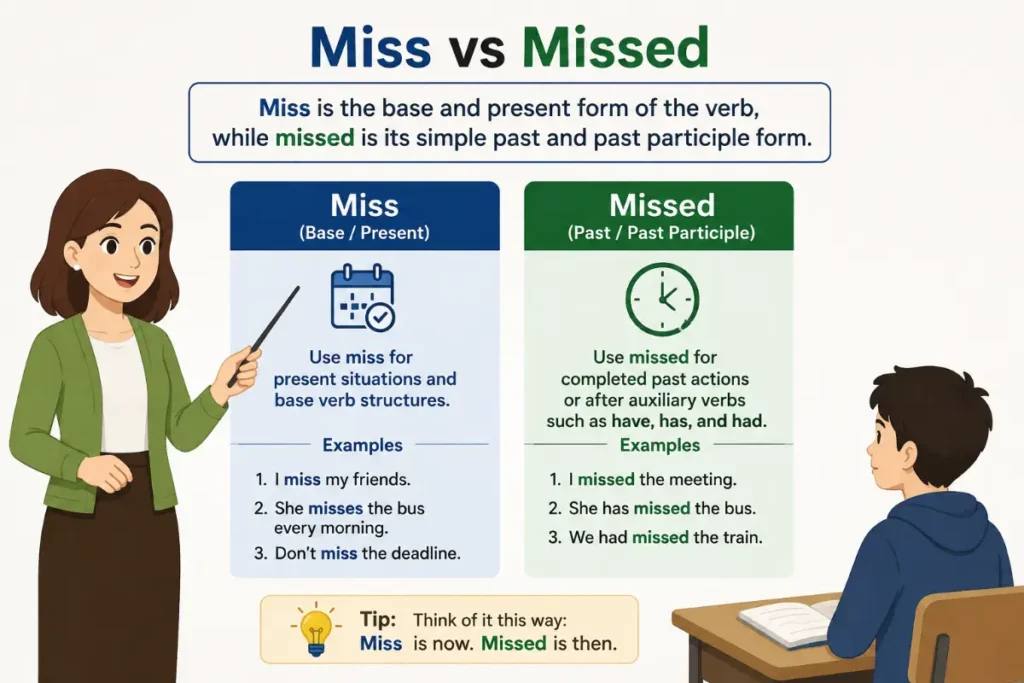
Miss is the base and present form of the verb, while missed is its simple past and past participle form. Use miss for present situations and base verb structures. Use missed for completed past actions or after auxiliary verbs such as have, has, and had.
Quick Answer
Miss is the base form of a verb and commonly describes a present feeling, a repeated action, or a possible future event. Missed is the simple past tense and past participle of the same verb. Both are correct. Choose the form that matches the time and grammatical structure of your sentence.
The Main Difference Between the Two Forms
The main difference is the time of the action and the role the word plays in a sentence. The base form describes an action without marking it as past, while the past form places the action in an earlier time or works with a helping verb.
Consider these examples.
- I miss the bus when I leave home too late.
- I missed the bus yesterday.
- I have missed the bus three times this month.
- I might miss the bus tomorrow.
Each sentence uses a form that fits its grammatical structure. The first describes a repeated situation. The second describes a completed event. The third uses the past participle with have, and the fourth uses the base form after might.
The same pattern applies to feelings and relationships.
- I miss my family.
- I missed my family during my first week away.
- I have missed my family a lot lately.
The first sentence describes a current feeling. The second places that feeling in the past. The third connects an earlier or continuing experience to the present.
Comparison Table
| Feature | Miss | Missed |
|---|---|---|
| Basic form | Base form of the verb | Past tense and past participle |
| Main use | Present, repeated, or possible future actions | Past actions and perfect verb forms |
| Part of speech | Verb | Verb |
| Pronunciation | /mɪs/ | /mɪst/ |
| Syllables | One | One |
| Example | I miss my hometown. | I missed my hometown. |
| With helping verbs | I will miss the event. | I have missed the event. |
| Formality | Standard in all settings | Standard in all settings |
| Common contexts | Feelings, travel, targets, opportunities | Past feelings, late arrivals, errors, omissions |
| Spelling status | Correct | Correct |
Neither form is more formal than the other. The sentence’s meaning and grammar determine which one you should use.
What Miss Means
Miss is a verb with several related meanings. Its exact meaning depends on the situation, but it often involves absence, failure to reach something, or failure to notice an event.
Feeling Someone’s Absence
You can use the word to describe the sadness or longing you feel when someone or something isn’t present.
For example, I miss my grandmother. The sentence means you feel her absence and wish she were with you.
You can also use it for places, experiences, and familiar routines. Someone might miss their hometown after moving away or miss their old school after graduation.
Failing to Catch Something
The verb also describes arriving too late to catch transportation or attend an event.
For example, I miss the train when I leave home too late. This sentence suggests a repeated problem.
If the event already happened, the past form is usually needed. I missed the train this morning tells the reader that you failed to catch it on a specific occasion.
Failing to Hit or Reach a Target
In sports and other activities, miss means failing to hit, reach, or achieve a target.
A basketball player might miss a shot. A person throwing a ball might miss the target. A student might miss a goal they hoped to achieve.
The word can also describe a failed opportunity. For example, you could miss a chance to apply for a job if you submit your application after the deadline.
Failing to Notice or Understand Something
You can use the verb when someone doesn’t see, hear, notice, or understand something.
For example, I didn’t hear the announcement because I missed the first part. In this sentence, the word refers to failing to experience or notice something.
It can also refer to a mistake in reading. If you skip a sentence while reviewing a document, you might miss an important detail.
What Missed Means
Missed is the simple past tense and past participle of miss. It usually describes an action or experience that happened earlier. It can also appear with helping verbs to form perfect tenses and other grammatical structures.
Missed as the Simple Past Tense
Use the past form when an action happened in the past. The action may be finished, or the sentence may describe a past situation.
For example, I missed your call last night. The sentence tells the reader that the call happened earlier and you didn’t answer it.
Here are a few more examples.
- She missed her flight on Monday.
- We missed the beginning of the movie.
- He missed an important question on the test.
- They missed their friends after moving to another state.
The word works with regular and irregular subjects in the same way. You don’t change its form based on the person or thing performing the action.
Missed as a Past Participle
The past participle is the form used with certain helping verbs. One common pattern is have, has, or had + missed.
For example, I have missed three classes this semester. The word have combines with the past participle to create the present perfect tense.
Compare these examples.
- She has missed several meetings this month.
- We had missed the exit before we noticed the sign.
- He has missed many chances to improve.
- They had missed the announcement by the time they arrived.
The helping verb affects the tense and meaning of the sentence. The form missed stays the same.
Missed in Descriptive Sentences
The past participle can also describe a person, event, or opportunity.
For example, the missed call appeared on my phone. Here, missed describes the call rather than serving as the main verb.
You might also hear phrases such as a missed deadline, a missed opportunity, or a missed connection. These expressions are common in everyday speech and professional writing.
Which Form Is Correct
Both forms are correct English. You should choose the one that matches the time of the action and the grammar of the sentence.
Use miss in the base form, in the present tense with subjects such as I, you, we, and they, and after modal verbs such as will, can, could, and might.
Use missed for the simple past and after helping verbs such as have, has, and had when forming perfect tenses.
For example, I miss my friends is correct because it describes a present feeling. I missed my friends last weekend is also correct because it describes a past experience.
A common mistake is choosing a form based only on how the sentence sounds. Instead, look at the time expression and the verb structure. Words such as yesterday, last week, and two days ago often point to the simple past. Helping verbs such as have and had can signal a perfect tense.
Grammar Rules You Should Know
Understanding a few basic rules will help you use both forms naturally.
Rule One: Use Miss for Present Feelings and Habits
Use the base form with I, you, we, and they when describing a current feeling or a repeated action.
- I miss my old neighborhood.
- You miss the bus when you leave too late.
- We miss our weekly family dinners.
- They miss their coach during the off season.
With he, she, and it in the simple present tense, the verb usually takes an es ending because the base form ends in ss.
For example, she misses her family. He misses the morning train. The correct present tense forms are miss, misses, and their related forms, not missed.
Rule Two: Use Missed for Completed Past Actions
When an action happened in the past, use the past form.
- I missed your message yesterday.
- She missed the school bus this morning.
- We missed the first half of the game.
- He missed the deadline last Friday.
You don’t need a specific time expression in every sentence. The surrounding context can make the past meaning clear. For example, I called her, but she missed my call describes a past event even without naming the exact time.
Rule Three: Use the Base Form After Modal Verbs
Modal verbs include can, could, may, might, must, should, and will. When one of these verbs directly precedes the main verb, use the base form.
Correct examples include the following.
- I might miss the meeting.
- She could miss the train.
- We will miss you.
- You should not miss this opportunity.
Avoid using the past form directly after a modal verb in these structures. For example, I will missed the meeting is incorrect. The correct sentence is I will miss the meeting.
Rule Four: Use Missed After Have Has or Had
The perfect tenses use a form of have followed by a past participle.
- I have missed two classes.
- She has missed several calls.
- They had missed the turn before the driver slowed down.
The simple past and present perfect do not always communicate the same thing. I missed three classes last month refers to a completed period in the past. I have missed three classes this month connects those absences to the current month.
Rule Five: Use Did With the Base Form
In questions and negative statements using did, the main verb returns to its base form.
Correct examples include the following.
- Did you miss the bus?
- I did not miss the announcement.
- She didn’t miss a single class.
- Why did they miss the appointment?
The helping verb did already marks the past tense. Adding the past ending to the main verb would repeat that tense marking incorrectly.
For instance, Did you missed the bus? is incorrect. Write Did you miss the bus?
Rule Six: Check the Subject in the Present Tense
The subject affects the present tense form, but it doesn’t change the simple past form.
Compare these sentences.
- I miss my hometown.
- She misses her hometown.
- We missed our hometown when we lived abroad.
- She missed her hometown when she lived abroad.
The present tense requires misses with a third person singular subject. In the simple past, missed works with every subject.
Ten Natural Sentence Examples
These examples show how the two forms work in everyday situations.
- Everyday conversation. I miss our long talks over coffee.
- Text messages. Sorry I missed your call. I’ll call you back tonight.
- Work. We missed the original deadline, so the team agreed on a new delivery date.
- School. Daniel missed class because his family had to travel.
- Academic writing. The first analysis missed an important factor in the results.
- Formal communication. I apologize for the meeting I missed yesterday.
- Family life. My parents miss having everyone at home for dinner.
- Sports. The player missed the final shot by a narrow margin.
- Online communication. I must have missed your earlier comment in the discussion.
- Future plans. If we leave late, we might miss the opening performance.
Notice how the meaning changes with the context. Sometimes the word refers to a feeling. In other sentences, it describes a missed opportunity, an absence, or a failure to notice something.
Common Grammar Mistakes
Many errors occur because English uses helping verbs to show tense. Others happen because writers focus on the past meaning and forget to adjust the main verb.
Mistake One: Using the Past Form After Will
Incorrect: I will missed the concert.
Correct: I will miss the concert.
The modal verb will takes the base form of the main verb. The same rule applies to can, could, might, and should.
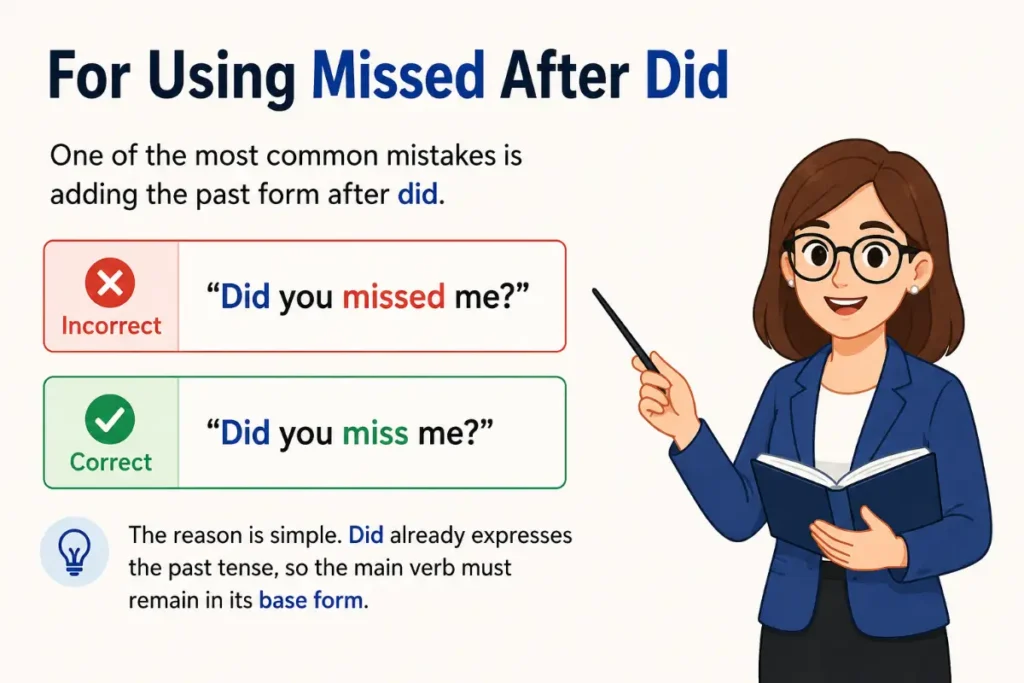
Mistake Two: Using the Past Form After Did
Incorrect: Did you missed my email?
Correct: Did you miss my email?
The word did already marks the question as past tense. Keep the main verb in its base form.
Mistake Three: Using the Base Form After Have
Incorrect: I have miss two meetings this week.
Correct: I have missed two meetings this week.
The present perfect requires the past participle after have or has. In this case, the correct form is missed.
Mistake Four: Forgetting the Third Person Ending
Incorrect: He miss his friends.
Correct: He misses his friends.
In the simple present tense, add es when the subject is he, she, or it. This rule applies to the verb in a positive statement. Questions and negatives use does or doesn’t with the base form.
For example, Does he miss his friends? and He doesn’t miss his friends are both correct.
Mistake Five: Confusing Past Time With Present Perfect
Incorrect for a completed past event: I have missed the bus yesterday.
Better: I missed the bus yesterday.
The simple past normally works with a finished time expression such as yesterday. The present perfect generally connects an experience or action to the present rather than placing it at a specific finished time.
The distinction matters most in edited writing. In casual conversation, speakers sometimes use tense forms loosely, but standard written English benefits from a clear match between tense and time.
Pronunciation Guide
The two forms sound slightly different because the past form adds a final consonant sound.
Miss
/mɪs/
One syllable. Sounds like the first part of mistake.
Missed
/mɪst/
One syllable. Ends with a clear t sound.
How to Pronounce Each Form
For miss, start with the short vowel sound in sit. Finish with the unvoiced s sound. Keep the word short and avoid adding another syllable.
For missed, use the same vowel and ending sound, then add a brief t sound. The final consonant cluster can feel tricky at first, but the word still has only one syllable.
A common pronunciation mistake is adding an extra vowel after the final consonants. In standard American English, missed doesn’t need an extra syllable. Say it in one smooth movement.
Etymology and Word Origin
The modern verb miss developed from Old English missian, which meant to miss, fail to hit, or fail to reach. The word has Germanic roots and has remained part of English for centuries.
Over time, its meaning expanded. Today, it can describe failing to reach a physical target, failing to attend an event, failing to notice something, or feeling someone’s absence.
The form missed developed through the regular English pattern for forming the past tense and past participle. English commonly adds ed to a verb to express a past action, as in walk and walked. Because miss already ends in ss, its past form adds ed without removing the existing letters.
This is why missed contains two s letters followed by ed. The spelling reflects the base verb and its regular past tense ending.
Regional Usage
The two forms are standard across major varieties of English. American, British, Canadian, and Australian English use the same spellings and follow the same basic tense rules.
American English
In the United States, both forms appear in casual conversation, school assignments, business emails, journalism, and formal writing. People commonly say I miss you to express a current feeling and I missed you to describe a past absence or encounter.
American speakers also use expressions such as missed call, missed deadline, and missed opportunity. These phrases work in both informal and professional settings.
British English
British English follows the same spelling and grammar rules. A British speaker might say I missed the train this morning or I miss my family when I’m away.
Differences in vocabulary can affect the surrounding sentence, but they don’t change the standard forms of this verb.
Australian English
Australian English also uses both forms in the same way. Everyday expressions such as missing a bus, missing a mate, or missing an appointment follow the same tense patterns.
Canadian English
Canadian English follows the same rules as American and British English for these forms. Writers don’t need a regional spelling change when choosing between the base form and the past form.
Real Life Usage Examples
The meaning becomes clearer when you see how people use the word in different situations.
Daily Conversation
- I miss having breakfast with my family every Sunday.
- We missed the last bus and had to call a ride.
The first example describes a current feeling about a familiar routine. The second describes an event that already happened.
Email and Workplace Communication
- I missed your email yesterday and apologize for the delayed response.
- The team may miss the deadline if the final review takes longer than expected.
The first sentence refers to a past oversight. The second describes a possible future problem, so it uses the base form after may.
Academic Writing
- The initial survey missed several important questions about student access.
- Researchers have missed a key detail in earlier discussions of the topic.
The first sentence reports a past limitation. The second uses the present perfect to connect an earlier oversight to the current discussion.
News and Journalism
- The candidate missed an opportunity to answer questions from voters.
- Officials said the inspection had missed a damaged section of the bridge.
The first example describes a lost opportunity. The second uses the past perfect to show that the inspection failure happened before another past event or point in the story.
Literature and Storytelling
- She missed the sound of rain against the windows of her childhood home.
- By the time he reached the station, the train had left and he had missed his chance to say goodbye.
These examples show how the verb can express emotion as well as a failed opportunity. In storytelling, the choice of tense also helps readers follow the order of events.
Related Words and Expressions
These eight terms can help you express the same ideas more precisely.
1. Missing. This is the present participle and gerund form. You might say I am missing my family or Missing one page can change the meaning of a report.
2. Misses. This is the third person singular present tense. Use it with he, she, or it in a positive present tense statement. For example, She misses her friends.
3. Absent. This describes someone who isn’t present. A student can be absent from class, but the word doesn’t automatically mean the student feels someone’s absence.
4. Overlook. This means to fail to notice or consider something. For example, the editor overlooked a spelling error. It is a useful alternative when describing an oversight.
5. Forget. This means to fail to remember something. You might forget an appointment, while you might miss it because you arrived too late. The actions can overlap, but the meanings aren’t identical.
6. Lose. This often refers to failing to keep or win something. You can lose a game or lose an opportunity. You can miss a shot during the game, but the two verbs describe different actions.
7. Skip. This means to leave something out or intentionally not take part. You might skip a chapter while reading. Missing a chapter can happen accidentally, so context determines the best choice.
8. Fail to attend. This is a more formal expression for not being present at an event. For example, She failed to attend the hearing. It can be useful in official reports when the writer wants a direct and neutral tone.
Expert Language Insight
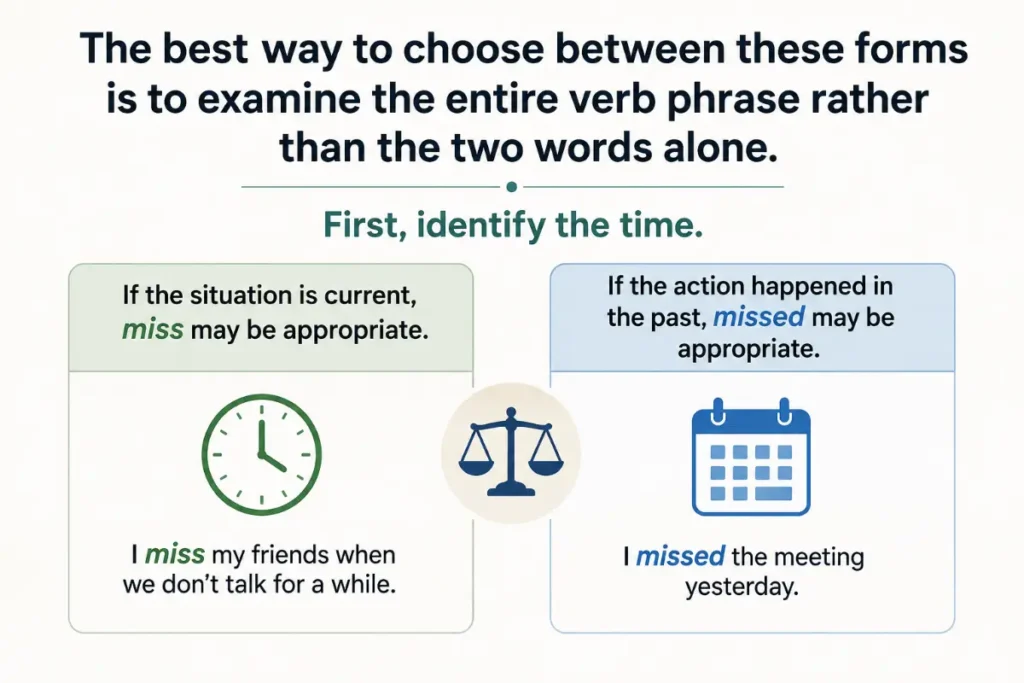
An experienced editor looks at the full sentence rather than choosing a verb form in isolation. The most common problems involve using the past form after did or will, forgetting es in the present tense, and mixing the simple past with the present perfect. Grammar tools can flag some of these errors, but they may not understand the intended meaning. Read the sentence aloud, identify the helping verb, and check the time reference before making a correction.
Conclusion
The difference between miss vs missed comes down to tense and sentence structure. Use miss for present feelings, repeated actions, and possible future events. Use missed for past actions and as a past participle with helping verbs such as have, has, and had. Both forms are correct, so you don’t need to memorize one as right and the other as wrong.
Instead, check the time reference and the helping verb before choosing. A simple editing trick is to look for words such as yesterday, will, and have. These clues often make the correct form clear and help you write with confidence.
FAQs
Is Missed a Real Word?
Yes. Missed is the standard past tense and past participle of miss. It describes an action that happened earlier or appears in a perfect tense. You can use it in sentences such as I missed the bus yesterday and I have missed three classes this month. It is not a misspelling of the base form.
What Does Miss Mean in a Sentence?
The verb can describe feeling someone’s absence, failing to catch transportation, failing to hit a target, or failing to notice something. For example, I miss my friends describes a feeling, while I miss the target describes an unsuccessful attempt. The surrounding words help readers understand the intended meaning.
Which Form Should I Use for Something That Happened Yesterday?
Use the simple past form for an action that happened yesterday. For example, write I missed the train yesterday. The word yesterday identifies a finished time in the past, so the simple past is the natural choice. Avoid using the present perfect with a specific finished time expression in standard edited English.
How Do You Pronounce Miss and Missed?
Both words have one syllable. The base form is pronounced /mɪs/, while the past form is pronounced /mɪst/. The main difference is the final t sound in the past form. Practice saying the final consonants together without adding an extra vowel or another syllable.
Can Miss Start a Sentence?
Yes. You can begin a sentence with miss when it functions as a verb in an instruction or a conditional statement. For example, Miss one payment and you could face a late fee. You can also start a sentence with the noun Miss as a title before a person’s name, depending on the context.
What Is a Synonym for Miss?
The best synonym depends on the intended meaning. Overlook works when you fail to notice something. Long for can describe the feeling of missing someone, while fail to catch can describe missing a train. These expressions aren’t interchangeable in every sentence, so choose one that preserves the original meaning.
Why Do People Confuse the Two Forms?
People often focus on the time of an event but overlook the grammar around it. For example, they may write did you missed because the event happened in the past. However, did already marks the past tense, so the main verb must remain in its base form. Checking helping verbs prevents many of these mistakes.
Is Missed Appropriate in Formal Writing?
Yes. The word is standard in formal writing and works well in academic papers, business emails, reports, and official documents. Expressions such as missed deadline, missed opportunity, and missed appointment are common. The main concern isn’t formality but accuracy. Make sure the verb agrees with the tense and grammatical structure of your sentence.
