
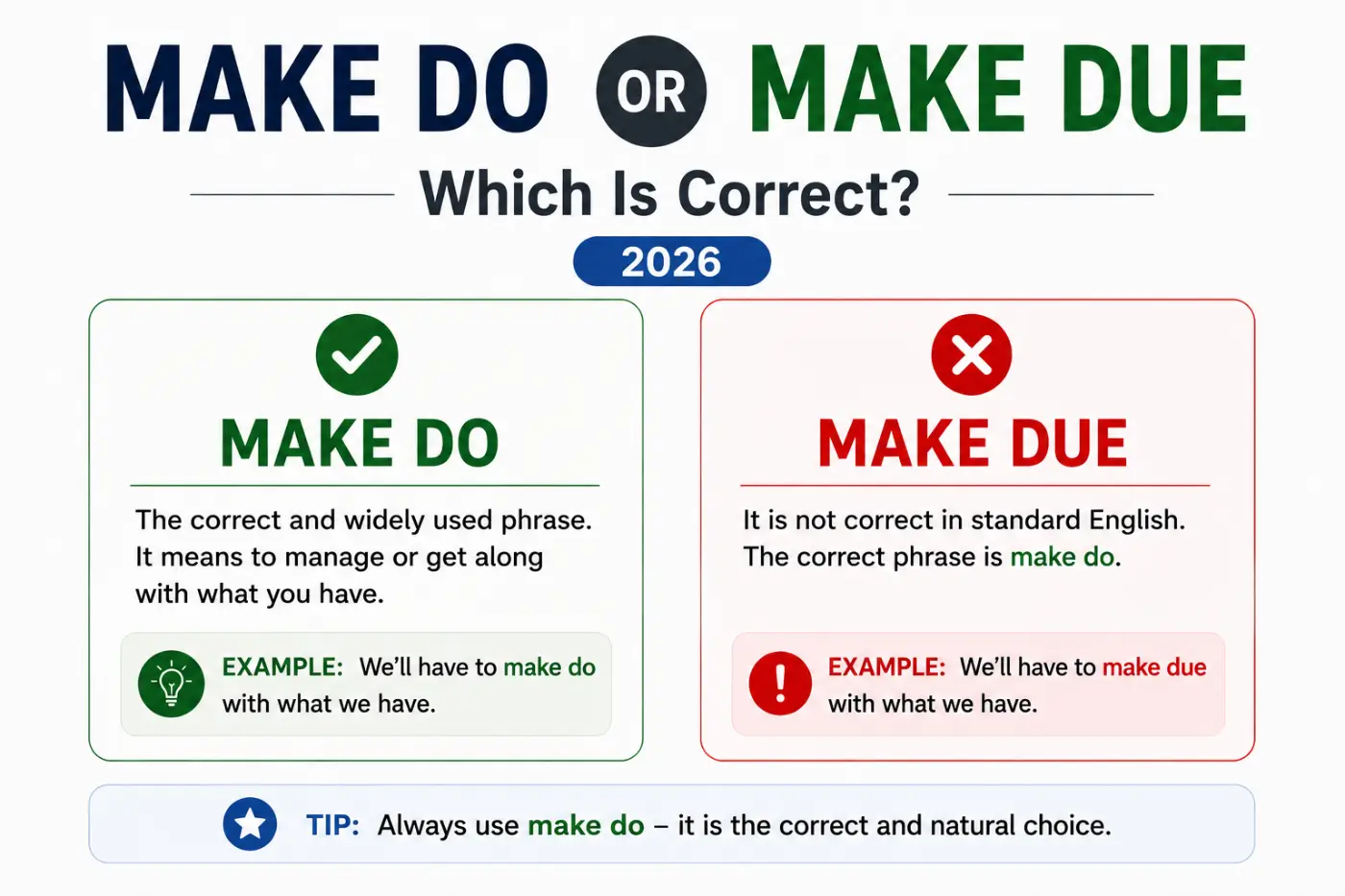
Have you ever needed to write that you made do with limited supplies but wondered if the phrase should be spelled make due? You’re not alone. The two expressions sound almost identical in American English, and both words are real English words. However, only one is standard for describing how you manage when you don’t have everything you need.
The correct phrase is make do. It means to use what is available, accept a temporary substitute, or get by without the ideal tools, money, time, or resources. You might make do with an old laptop, make do with a small budget, or make do until your regular supplies arrive. The word due, by contrast, relates to something expected, owed, deserved, or scheduled.
Understanding this difference helps you avoid a common error in emails, school assignments, articles, and everyday messages. You’ll also learn how the phrase developed, how to pronounce it, which alternatives you can use, and how to recognize the correct spelling without stopping to think about it every time.
Quick Definition
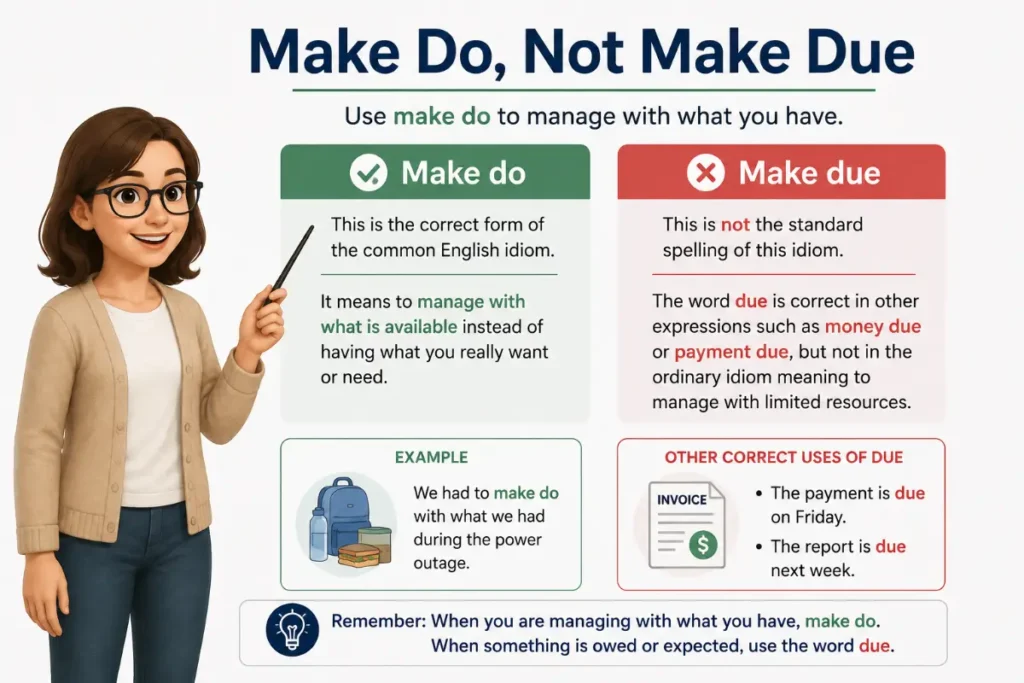
Make do is the correct form of the common English idiom. It means to manage with what is available instead of having what you really want or need. Make due is not the standard spelling of this idiom. The word due is correct in other expressions such as money due or payment due but not in the ordinary idiom meaning to manage with limited resources.
Quick Answer
Make do is the correct expression when you mean to manage with what you have, even if it isn’t ideal. For example, if your printer breaks and you finish your work by hand, you make do with the tools available. Make due is usually a spelling mistake in this context. The word due is correct in other expressions, such as a payment being due.
Meaning and Definition
What Does Make Do Mean
Make do is a fixed English expression that means to manage with the things you have instead of the things you would prefer to have. It often suggests that the available option isn’t perfect, but it is good enough for the moment.
For example, imagine you’re preparing dinner and discover that you have no fresh vegetables. You use frozen vegetables instead. You make do with what is available.
The phrase often appears when people face a shortage of money, supplies, time, space, equipment, or other resources. It can describe a small inconvenience or a serious challenge. The key idea stays the same: you find a way to manage without the ideal option.
Here are a few examples.
- We didn’t have enough chairs, so some guests made do with stools.
- I’ll make do with my old phone until I can afford a new one.
- The team made do with limited supplies during the storm.
- She had no printer, so she made do by writing the report by hand.
In each sentence, someone adapts to the situation rather than waiting for something better.
What Does Make Due Mean
Make due is not the standard spelling of the expression meaning to manage with what you have. If you write, “We had to make due with a small budget,” most readers will recognize the intended meaning, but the spelling is incorrect for that expression.
The confusion comes from the fact that due is a legitimate English word. It can describe something that is owed, expected, or scheduled to happen.
For example:
- The rent is due on Friday.
- Her baby is due in December.
- The team gave the speaker her due credit.
- The report is due tomorrow morning.
These sentences use due correctly. However, none of them uses the fixed expression make do.
The practical rule is straightforward. If you mean that someone is managing with limited resources, write make do. If you mean that something is owed, expected, or scheduled, due may be the right word in its own grammatical construction.
Comparison Table for Make Do and Make Due
| Feature | Make do | Make due |
|---|---|---|
| Standard usage | Correct expression | Incorrect for the intended meaning |
| Meaning | Manage with what is available | Does not normally express this meaning |
| Grammar | Verb phrase | Usually a mistaken substitution |
| Pronunciation | /meɪk duː/ | /meɪk duː/ in common American speech |
| Formality | Standard in formal and informal writing | Avoid as a substitute for the correct phrase |
| Common context | Limited money, supplies, time, or equipment | Confusion with the word due |
| Correct example | We made do with less money. | We made due with less money. |
| Better alternative | We managed with less money. | Use made do instead. |
The table highlights an important point: the words do and due are both valid, but they serve different purposes. In this expression, the spelling is fixed. Changing do to due changes the phrase into a nonstandard form.
Why Make Do Is Correct
The expression has an established meaning that depends on the verb do. In this context, do carries the idea of performing an action or managing a situation. The word make combines with it to form a phrase meaning to get by with what is available.
You can see the same basic verb in sentences such as these.
- I can do the job with the tools I have.
- We did what we could with the time available.
- They are doing their best with limited resources.
The phrase follows the same general idea of acting or managing under existing conditions. It doesn’t need the word due because the sentence isn’t about a debt, deadline, or expectation.
English contains many fixed expressions whose meanings depend on a particular word choice. For example, people say make sense, make progress, and make an effort. Replacing a word with another word that sounds similar can make an expression incorrect or change its meaning.
The same principle applies here. Use the established phrase rather than choosing a spelling based only on sound.
How to Use the Phrase Correctly
The expression can appear in several verb forms. The word make changes to fit the tense, but do stays the same.
Present Tense
Use make do when someone manages with the resources currently available.
- We make do with a small kitchen.
- I make do with public transportation.
- They make do with the equipment provided.
These examples describe regular habits or current situations. The phrase suggests that the available option works, even if it isn’t ideal.
Past Tense
The past tense is made do. The verb make changes to made, while do remains unchanged.
- We made do with one computer.
- She made do with a borrowed dress.
- The family made do during the power outage.
Use this form when describing something that happened in the past.
Future Tense
Use will make do to describe how someone plans to manage later.
- We’ll make do until the new supplies arrive.
- I will make do with this desk for another week.
- The staff will make do until the repairs are finished.
This form often appears when a shortage is temporary. It tells the reader that the person has a workable plan despite the limits.
Present Perfect Tense
Use have made do or has made do when the situation began earlier or has relevance to the present.
- We have made do with a small budget for years.
- She has made do without a car since moving downtown.
- The department has made do with fewer workers this month.
The form connects an earlier experience with the current situation. It also emphasizes that managing with limited resources has continued or has happened over a period of time.
Negative Sentences
You can use the phrase in negative sentences to explain that a person cannot manage with the available option.
- I can’t make do without my glasses.
- We couldn’t make do with the broken equipment.
- The school cannot make do with so few teachers.
These sentences show that the available resources are not enough. The phrase itself remains unchanged after can, could, or cannot.
Questions
The phrase can also appear in questions.
- Can we make do with the chairs we already have?
- Could you make do without an internet connection?
- How long will the team have to make do with the old system?
Questions like these are common when people are planning, solving problems, or deciding if a temporary option will work.
Ten Natural Example Sentences
The best way to learn a phrase is to see how people use it in real situations. These examples cover everyday life, school, work, and formal communication.
1. Everyday conversation: We don’t have any milk, so we’ll make do with water for now. The speaker accepts a simple substitute instead of getting the preferred item.
2. At home: I made do with a blanket because the guest room had no extra bedding. The blanket served as a temporary solution.
3. At work: Our office will make do with the old computers until the replacements arrive. The team continues working with equipment that isn’t ideal.
4. At school: The students made do with scrap paper for their art project. They used the materials they could find rather than waiting for new supplies.
5. Budget planning: We need to make do with our current budget until next quarter. The available money must cover expenses for the time being.
6. Travel: My suitcase was delayed, so I made do with the clothes in my carry on bag. The traveler managed without the missing luggage.
7. Technology: The internet was down, so the staff made do with printed copies of the documents. They found a temporary way to continue their work.
8. Social plans: We couldn’t find a large table, so we made do with two smaller ones. The group adapted to the furniture available.
9. Academic writing: The researchers made do with the data they could collect during the short study period. The sentence explains a limit on available research material.
10. Formal communication: Our department will make do with existing resources until additional funding is approved. The wording is suitable for a professional report because it clearly explains the temporary arrangement.
Notice that the phrase works in both casual conversation and formal writing. The tone changes with the rest of the sentence, but the spelling does not.
Common Mistakes and Misspellings
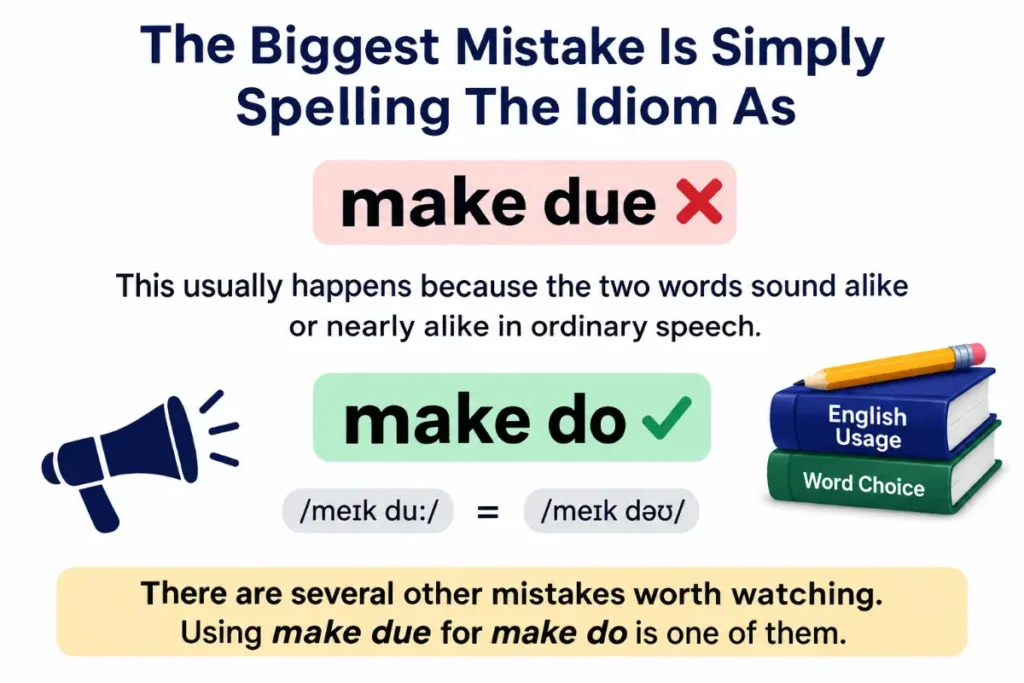
The most frequent problem is replacing do with due. Other mistakes can happen when writers change the tense or add words that don’t belong.
Mistake One: Writing Make Due With Limited Resources
Incorrect: We had to make due with the supplies we had.
Correct: We had to make do with the supplies we had.
The writer is describing how people managed with limited supplies. The sentence has nothing to do with a debt or deadline, so do is correct.
Mistake Two: Using Made Due in the Past Tense
Incorrect: She made due with an old laptop.
Correct: She made do with an old laptop.
The past tense of make is made. However, the second part of the expression remains do. The correct combination is made do.
Mistake Three: Writing Making Due
Incorrect: We are making due with the current equipment.
Correct: We are making do with the current equipment.
The ending changes because the sentence uses the continuous tense, but the verb do stays in place. The correct form is making do.
Mistake Four: Confusing the Phrase With a Deadline
Incorrect: The report is make do tomorrow.
Correct: The report is due tomorrow.
This mistake goes in the opposite direction. The sentence concerns a deadline, not a shortage of resources. The word due is correct because it means the report must be submitted by a set time.
Mistake Five: Treating Do and Due as Interchangeable
Incorrect: We will make due until the plumber arrives.
Correct: We will make do until the plumber arrives.
The two words may sound alike, but they aren’t interchangeable. In this example, the speaker needs to manage until help arrives, so the fixed expression is make do.
Pronunciation Guide
The phrase is pronounced the same way as the words make and do spoken together. In standard American English, the phrase can be represented as /meɪk duː/.
The word make has one syllable and a long vowel sound, as in day. The word do also has one syllable, with the long vowel sound heard in blue. The phrase has two syllables in total.
A simple pronunciation guide is mayk doo.
The spelling confusion often survives because do and due are homophones in many varieties of American English. Homophones are words that sound the same but have different spellings or meanings. For example, pair and pear sound alike, as do right and write.
Pronunciation alone cannot tell you which spelling belongs in this expression. You need to understand the meaning and remember the established wording.
Etymology and Word Origin
The expression developed from older English uses of make and do. Both verbs have long histories, and English has used combinations of these verbs for centuries to describe actions, results, and ways of handling a task.
In this phrase, make doesn’t mean producing a physical object. Instead, it helps form an expression about managing a situation. The verb do supplies the idea of taking action or carrying out what is possible under the circumstances.
The word due has a different history. It entered English through French and Latin forms associated with what is owed or deserved. That history helps explain its modern uses in expressions about payments, deadlines, and proper recognition.
The phrase is best learned as a fixed expression rather than through a literal word by word translation. You don’t need to study its entire history to use it correctly. Remember that the established wording for getting by with limited resources uses do.
Regional Usage in English
The spelling distinction stays the same across major English varieties. American, British, Canadian, and Australian writers use make do when they mean to manage with what is available. There is no standard regional rule that changes do to due in this expression.
American English
In the United States, people use the phrase in everyday conversation, workplace communication, news writing, and fiction. It often describes a temporary solution or a decision to work with limited resources.
For example, an American might say, “We’ll make do until payday.” The speaker means that the available money must last until more money arrives.
British English
British English uses the same spelling and meaning. A British speaker might say, “We’ll have to make do with what we’ve got.” The wording may differ slightly from common American phrasing, but the expression itself remains unchanged.
Canadian English
Canadian English also uses make do in the standard way. A Canadian writer might describe a community that made do with limited supplies during a winter storm.
Australian English
Australian English follows the same rule. Someone might say, “We’ll make do until the new parts turn up.” The phrase describes a practical response to a temporary shortage.
Across all four varieties, the important distinction is the same. Use make do for managing with available resources. Use due in its normal meanings related to payments, deadlines, expectations, and what someone deserves.
Grammar Rules and Sentence Structure
Understanding how the expression fits into a sentence makes it easier to use correctly. Make do is a verb phrase, and the verb make changes according to tense, subject, and sentence structure.
Common Grammatical Patterns
Here are several patterns you can use.
1. Make do with something. This pattern identifies the available item or resource. Example: We made do with a small refrigerator.
2. Make do without something. This pattern explains what a person lacks. Example: I can make do without a television.
3. Make do until something happens. This pattern shows that the situation is temporary. Example: We’ll make do until the delivery arrives.
4. Make do by doing something. This pattern explains how a person manages. Example: She made do by borrowing books from the library.
5. Make do as best someone can. This pattern emphasizes effort under difficult conditions. Example: The volunteers made do as best they could.
These patterns cover many everyday situations. You can use them to describe shortages, temporary substitutes, and practical solutions.
Can You Put an Object Between Make and Do
In the fixed expression, you generally keep make and do together. For example, write “We had to make do with one table,” not “We had to make one table do with.”
The words can appear separately in other grammatical constructions, but those constructions may have different meanings. For instance, “Make the old computer do the job” means to use or adapt the computer so that it performs a task. That sentence is grammatically different from the fixed expression meaning to manage with limited resources.
Can the Phrase Start a Sentence
Yes. You can start a sentence with the expression when it fits the meaning.
For example, “Make do with what you have, and replace it when you can afford to.” The sentence gives practical advice about handling limited resources.
You can also start with a related form.
“Making do with less money required careful planning.” Here, making do functions as a gerund phrase that acts as the subject of the sentence.
Is It Appropriate for Formal Writing
Yes. The expression is standard English and works in formal writing when it accurately describes the situation. A business report might say, “The department made do with existing equipment while waiting for the approved purchase.”
However, some formal contexts may call for a more precise alternative. For example, continued operations with existing resources may sound more suitable in a technical report. The choice depends on the audience and the purpose of the document.
Related Terms and Alternative Expressions
Several expressions share part of the meaning of make do. Learning them gives you more ways to communicate clearly without repeating the same phrase.
1. Get by. This means to manage or survive, often with limited money or resources. Example: We can get by until the next paycheck.
2. Manage with. This means to use the resources available. Example: The team managed with two computers.
3. Make the best of it. This means to respond positively to a situation that cannot easily be changed. Example: The weather ruined our picnic, but we made the best of it indoors.
4. Get along with. This can mean to manage using something, though it also commonly refers to having a good relationship with someone. Example: I can get along with this old phone for another month.
5. Do without. This means to continue despite lacking something. Example: We had to do without air conditioning during the repair.
6. Scrape by. This usually means to manage with very little money or other resources. Example: They scraped by on a small income.
7. Make the most of. This means to use an opportunity or resource as well as possible. Example: She made the most of her limited study time.
8. Get through. This means to survive or complete a difficult period or task. Example: We got through the week with the supplies we had.
These expressions overlap, but they aren’t exact substitutes in every sentence. Make do focuses on accepting and using what is available. Scrape by often suggests hardship, while make the most of emphasizes using an opportunity well.
Real Life Usage in Different Settings
The expression appears naturally in many forms of communication. The examples below show how context affects its tone.
Daily Conversation
“I forgot to buy coffee, so I’ll make do with tea this morning.”
The speaker uses a substitute instead of the preferred drink.
“We don’t have enough plates, but we can make do.”
The speaker believes the available plates are enough to manage the situation.
Email and Workplace Communication
“We’ll make do with the current software until the update is approved.”
This sentence is direct and suitable for a work email. It explains how the team will continue operating during a temporary delay.
“Our team made do with the available staff during the busy period.”
This sentence explains that the team completed its work despite limited staffing.
Academic Writing
“The students made do with the library’s available materials.”
The sentence explains how the students worked with limited resources.
“The study made do with a smaller sample because recruitment ended early.”
This is understandable, but an academic writer might choose a more precise alternative, such as “The study used a smaller sample because recruitment ended early.” That wording states the limitation without the informal feel of the idiom.
News Writing
“Residents made do with bottled water while repairs continued.”
The phrase summarizes how residents managed during a temporary disruption.
“Local clinics made do with limited medical supplies after the storm.”
This sentence communicates a shortage and the effort to continue providing care.
Literature and Storytelling
“With winter approaching and money running short, the family made do with their old coats.”
The expression helps establish the family’s circumstances without requiring a long explanation.
“He made do with a narrow bed and a flickering lamp until he could afford a better room.”
Here, the phrase supports the story’s description of a character living with limited comforts.
Expert Editor Insight
Experienced editors look at meaning before correcting a word that sounds wrong. When a sentence describes a person adapting to limited resources, make do is the expected expression. A spelling checker may flag make due, but an automated tool can miss context or accept a word that is valid elsewhere. Read the whole sentence and ask what the writer intends to say. If the meaning is to manage with what is available, correct the phrase to make do. If the sentence concerns an amount owed or a deadline, due may be correct.
Make Do Or Make Due In Search Questions
People searching this phrase usually want one of several answers.
They may ask:
Is it make do or make due?
The answer is make do.
They may ask:
What does make do mean?
Key Takeaways
- Make do is the standard expression for managing with what is available.
- Make due is generally a spelling error when used with that meaning.
- Do and due sound alike in many American English accents.
- The past tense is made do, and the continuous form is making do.
- The phrase works in casual conversation and formal writing.
- Due remains correct in expressions about deadlines, payments, and expectations.
- Alternatives include manage with, get by, and do without.
- The simplest memory trick is to connect make do with doing the best you can with what you have.
Conclusion
The correct expression is make do, which means to manage with the resources available instead of waiting for something better. The spelling make due is generally incorrect when used with this meaning, even though due is a valid English word in other contexts. The phrase works in everyday conversation, workplace emails, reports, and storytelling.
To remember the difference, connect do with taking action and managing a situation. Reserve due for things that are owed, expected, or scheduled. When you’re editing a sentence, focus on its meaning first. That simple check will help you choose the correct expression with confidence.
FAQs
Is make due ever correct English?
The words make due can appear next to each other in a sentence, but they are not the standard expression for managing with limited resources. In most cases where a writer intends that meaning, the correct form is make do. Use due for meanings such as owed, expected, scheduled, or deserved.
What does make do mean?
Make do means to manage with what you have, even if it isn’t the best option. For example, if your car is being repaired and you use public transportation for a few days, you’re making do. The expression often suggests that the situation is temporary or that a preferred resource is unavailable.
Why do people confuse the two spellings?
People confuse the spellings because do and due sound alike in many English accents. Both are real words, so a writer may choose the wrong one based on sound alone. Remembering the phrase as a fixed expression helps prevent this mistake. The correct wording stays make do when the meaning is to manage with what is available.
How do you pronounce make do?
In standard American English, the phrase is pronounced /meɪk duː/. It has two syllables, with one in make and one in do. The phrase sounds like the words make and do spoken naturally together. Since do and due often sound identical, pronunciation alone won’t help you choose the correct spelling.
Can you use make do in formal writing?
Yes. The phrase is standard English and can appear in professional reports, formal emails, and other serious writing. It works best when the meaning is clear and the conversational tone suits the audience. In technical or academic work, a more precise phrase such as use existing resources may sometimes communicate the point better.
What is another way to say make do?
Useful alternatives include manage with, get by, do without, and make the best of it. The best substitute depends on the context. Use manage with to describe using available resources, get by to describe coping, and make the best of it when the focus is on responding positively to an imperfect situation.
Is made do the correct past tense?
Yes. Made do is the standard past tense form. For example, “We made do with one computer while the others were repaired.” The verb make changes to made, but do remains unchanged. Forms such as made due are incorrect when the intended meaning is to manage with limited resources.
Is make do an idiom?
Yes. It is a fixed expression whose meaning goes beyond a literal reading of the individual words. It means to manage with the resources available rather than having everything you want or need. The phrase is common in everyday English and is also acceptable in professional writing when the context suits it.
