
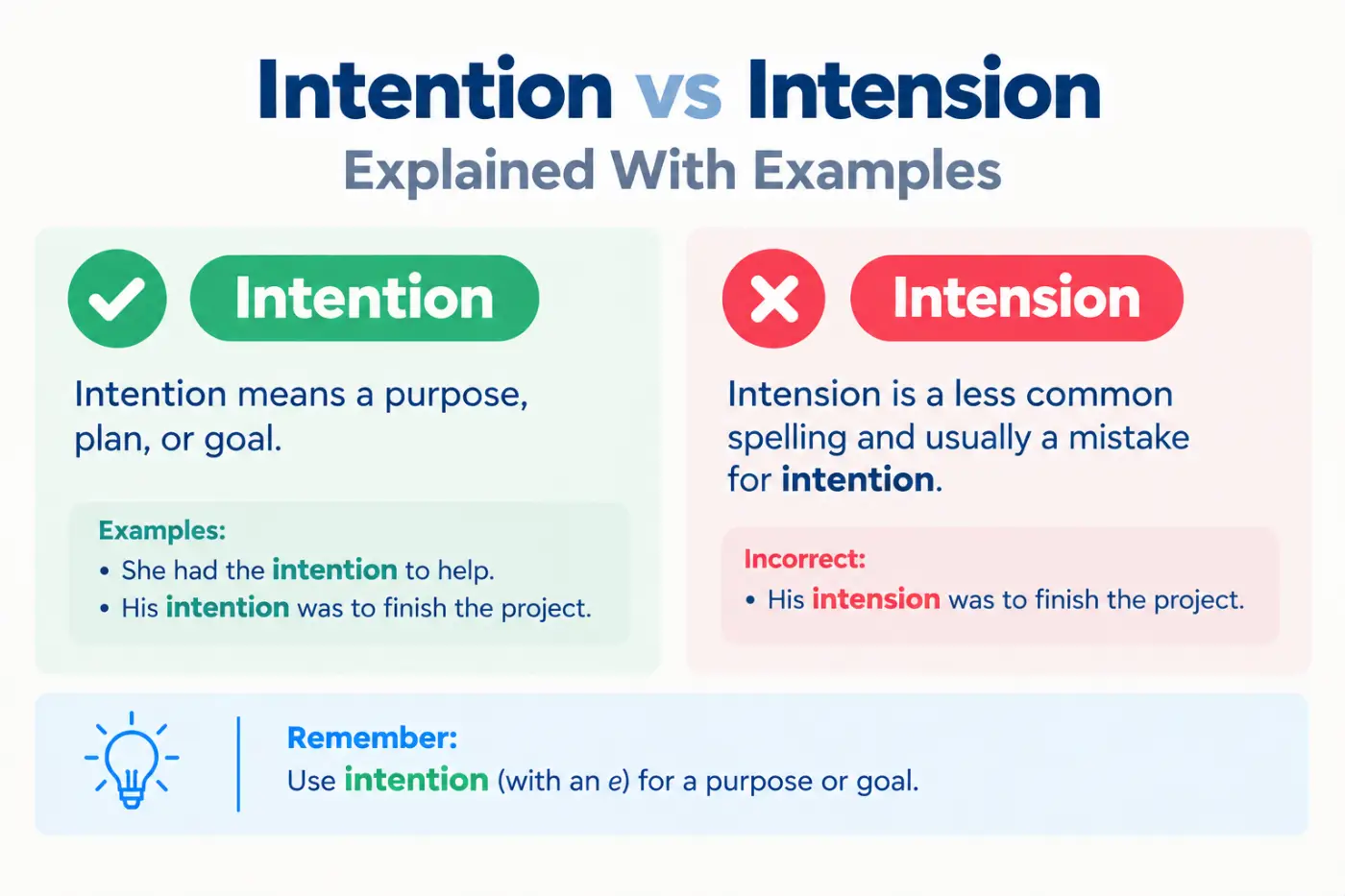
Intention vs intension can be confusing because the words look almost identical and differ by only one letter. However, their meanings are quite different. If you want to explain what someone plans to do, intention is the word you need. If you are discussing the defining properties of a concept in logic or philosophy, intension may be the correct choice.
Most people encounter intention in daily conversations, school assignments, business emails, and formal writing. For example, you might explain your intention to help a friend or describe your intention to apply for a new job. Intension appears much less often because it belongs mainly to specialized discussions about meaning, concepts, and logical relationships.
Knowing the difference helps you avoid a spelling mistake without treating a legitimate technical word as incorrect. It also makes your writing clearer because each term has a distinct purpose. Once you understand the basic definitions and see how each word works in context, choosing the right form becomes straightforward.
Quick Answer
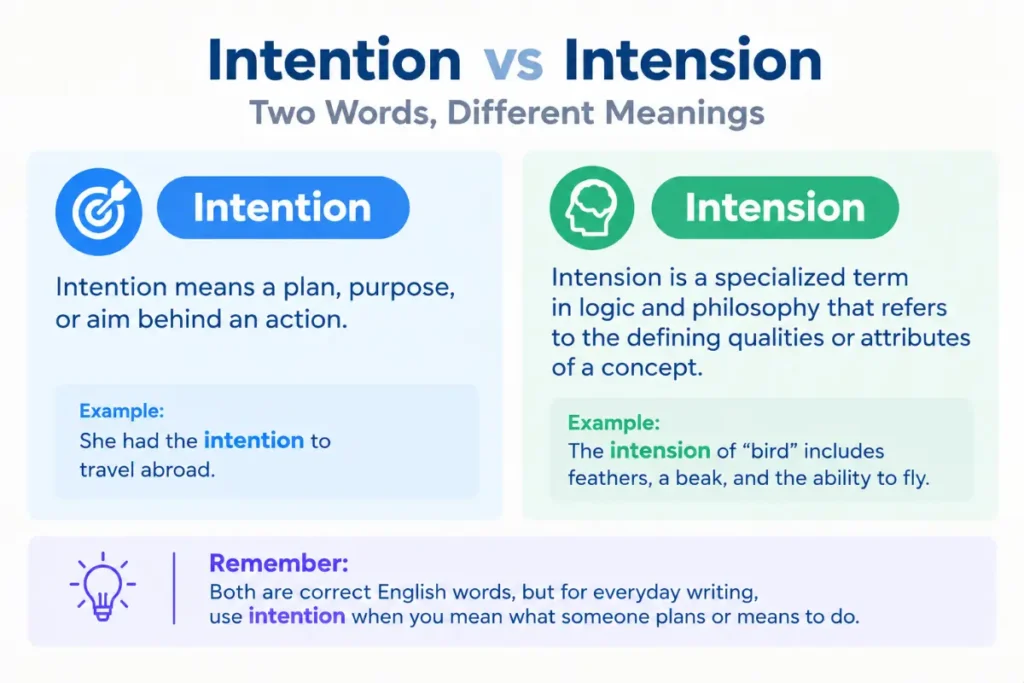
Intention means a plan, purpose, or aim behind an action. Intension is a specialized term in logic and philosophy that refers to the defining qualities or attributes of a concept. Both are correct English words, but they serve different purposes. For everyday writing, use intention when you mean what someone plans or means to do.
What Does Intention Mean
Intention is a noun that means a plan, purpose, aim, or intended result. It describes what a person means or plans to do. An intention may lead to an action, but having a plan does not guarantee that the action will happen.
For example, if you intend to finish a project by Friday, your intention is to complete it by that deadline. You may succeed, or an unexpected problem may prevent you from finishing on time. The word describes your purpose rather than the final result.
Intention often appears when people discuss decisions, goals, promises, motives, and future actions. It can describe a serious plan or a general desire to do something.
Consider these examples.
- My intention is to finish the report before lunch.
- Her intention was to help the new employee.
- He explained his intention to leave the company.
- The teacher had no intention of embarrassing the student.
- Their intention is to open a second store next year.
In each sentence, the word points to a plan or purpose. It does not describe the defining features of an abstract concept.
Common Meanings of Intention
The word has several closely related uses.
A plan for the future. An intention can describe something you expect or plan to do.
Example: I have every intention of attending the meeting.
A purpose behind an action. It can explain why someone does something.
Example: Her intention was to protect the children.
A motive or aim. It can describe what someone hopes to achieve.
Example: The proposal was written with good intentions.
A meaning behind words or behavior. It can describe what someone meant to communicate.
Example: I understood your intention, even though your message was unclear.
These meanings overlap, but the central idea remains the same. Intention concerns what someone means, plans, or aims to do.
What Does Intension Mean
Intension is a noun used mainly in logic, philosophy, semantics, and the study of concepts. It refers to the defining attributes or conditions associated with a concept. These attributes help explain what the concept means and what something must be like to fall under it.
For example, consider the concept of a triangle. Its defining properties include being a closed, two dimensional shape with three straight sides. In a discussion of formal logic or concept analysis, these defining properties can be examined as part of the triangle’s intension.
This is different from thinking about a particular triangle drawn on paper. The drawing is an individual example of the concept. The intension concerns the properties that define the concept itself.
Intension is not a common substitute for intention. You would not normally write that your intension is to study medicine or that you have no intension of leaving. Those sentences concern plans and purposes, so intention is the correct word.
How Intension Works in Logic and Philosophy
In formal discussions, intension is often contrasted with extension. These terms describe two ways of examining a concept.
Intension concerns the attributes or meaning associated with a concept. Extension concerns the objects, people, or things that fall within that concept.
Take the word bird as an example. Its intension concerns the properties used to define the concept of a bird. Its extension includes the individual creatures classified as birds, such as eagles, robins, and penguins.
The distinction helps philosophers and logicians examine how words relate to concepts and how concepts apply to things in the world.
The exact technical treatment can vary across theories. Different approaches to logic, semantics, and philosophy may define intension in more specific ways. For general English writing, however, the important point is that intension is a technical term about meaning or defining properties, not a person’s plan.
Intention vs Intension Comparison Table
| Feature | Intention | Intension |
|---|---|---|
| Main meaning | A plan, purpose, or aim | Defining attributes of a concept |
| Part of speech | Noun | Noun |
| Main context | Everyday and professional English | Logic, philosophy, and semantics |
| Typical frequency | Common | Uncommon |
| Example phrase | Good intention | Meaning and intension |
| Related term | Intent | Extension |
| Common question | What does someone plan to do? | What defines a concept? |
| Everyday use | Very common | Rare |
| Is it a real word? | Yes | Yes |
| Is it a spelling variant of the other? | No | No |
The key distinction is not spelling preference. Both forms are standard words, but they refer to different ideas. Intention is the normal choice when discussing a person’s plans or purpose. Intension belongs to technical discussions of concepts and meaning.
Key Differences Explained
Difference in Meaning
Intention refers to what someone plans, means, or aims to do. Intension refers to the defining properties or conceptual content associated with a term.
For example, a student’s intention might be to pass an exam. In a philosophy class, the intension of a concept might be examined to identify the properties that define it.
The first concerns a person’s purpose. The second concerns the meaning or definition of a concept.
Difference in Everyday Usage
Intention appears regularly in ordinary speech and writing. People use it to explain decisions, clarify misunderstandings, describe goals, and talk about future plans.
Intension is much less common. Most readers will encounter it in academic writing, especially material about logic, philosophy, language, or formal concepts.
If you are writing a normal email, personal statement, school essay, or workplace message about a plan, intention will almost always be the appropriate form.
Difference in Grammar
Both words are nouns. They can appear as subjects, objects, or complements in a sentence.
Examples of intention include the following.
- My intention is clear.
- She explained her intention.
- They acted with good intentions.
Examples of intension include the following.
- The philosopher examined the intension of the concept.
- The paper compares intension and extension.
Although their grammatical roles are similar, their meanings determine where each word belongs.
Difference in Related Words
Intention has several familiar related forms, including intend, intentional, and intentionally. These words concern planning, purpose, or deliberate action.
Intension is closely associated with extension in technical discussions of concepts. It may also appear alongside terms such as concept, definition, meaning, and logical analysis.
The related vocabulary provides a useful clue. If your sentence concerns planning or deliberate behavior, the intention family is likely the right fit. If it concerns the properties that define a concept, intension may be appropriate.
Difference in Formality
Intention works in both casual and formal English.
You can say, I didn’t intend to hurt your feelings. You can also write, The applicant stated an intention to pursue further study.
Intension is specialized rather than simply formal. It is appropriate when the subject requires the technical concept. Using it in ordinary conversation to mean a plan may confuse readers rather than make the writing sound more sophisticated.
Which Form Is Correct
Both forms are correct English words. The correct choice depends on what you want to say.
Use intention when you mean a plan, purpose, aim, or motive. Use intension when you mean the defining attributes or conceptual content of a term in a technical discussion of logic, philosophy, or semantics.
The spelling distinction is meaningful. Intension is not merely an unusual version of intention, and intention is not the general spelling of a technical concept. Replacing one with the other can change the meaning of a sentence.
For most everyday writing, intention is the correct choice. You will use it when discussing a plan, explaining why you acted, or describing what you hope to do.
For example, write, My intention is to improve my writing skills. Do not replace intention with intension in that sentence because it concerns a personal goal rather than the definition of a concept.
In a philosophy paper, however, a sentence about the intension of a term may be entirely appropriate. The technical context determines the choice.
Ten Natural Example Sentences
The following examples show how intention works in ordinary English and how intension appears in specialized writing.
Everyday Conversation
1. My intention was to make you laugh.
The speaker explains the purpose behind an action. The word refers to what the speaker meant to do.
2. I have no intention of staying out late tonight.
The sentence expresses a plan or decision about the evening. It uses a common construction with no intention of followed by a gerund.
Text Messages and Social Situations
3. I didn’t mean to sound rude, and that wasn’t my intention.
The speaker clarifies the purpose behind a message. Intention helps explain that the words were not meant to offend.
4. Her good intentions were clear, even though her advice wasn’t helpful.
The sentence separates a person’s purpose from the result. Someone can mean well without producing the outcome they hoped for.
Work and Professional Communication
5. My intention is to submit the revised proposal by Thursday.
The sentence states a work goal and a planned deadline. It is suitable for a professional message.
6. The manager explained the intention behind the new policy.
Here intention means the reason or purpose for introducing a policy. The word helps explain the decision rather than the policy’s technical definition.
School and Academic Writing
7. The researcher stated an intention to examine the effects of sleep on memory.
The sentence describes the researcher’s planned activity. Intention is suitable because it concerns a goal.
8. The philosopher discussed the intension of the concept in relation to its extension.
This sentence uses the technical word correctly. It examines the defining content of a concept and contrasts it with the things that fall under that concept.
Formal Writing and Analysis
9. The committee had every intention of completing the review before the end of the month.
The sentence expresses a firm plan. The phrase every intention of emphasizes a strong commitment or expectation.
10. The article explores how the intension of a term affects its interpretation in formal logic.
This example belongs in an academic context. Intension refers to the conceptual attributes or meaning associated with a term.
These examples show why context matters more than visual similarity. The spelling should follow the meaning you want to express.
Common Mistakes and Spelling Confusion
Because the words differ by only one letter, writers may confuse them while typing or editing. The best correction method is to check the meaning rather than rely only on a spelling checker.
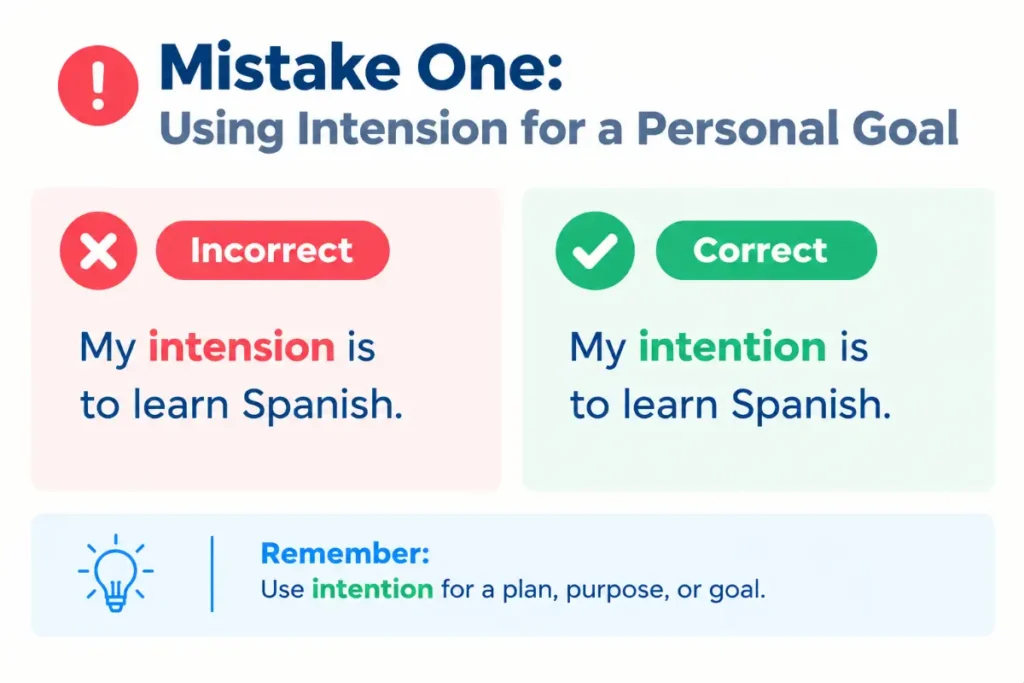
Mistake One: Using Intension for a Personal Goal
Incorrect: My intension is to learn Spanish.
Correct: My intention is to learn Spanish.
The sentence describes a plan. It does not discuss the defining features of a concept, so intention is the correct form.
Mistake Two: Using Intension to Explain a Motive
Incorrect: His intension was to help the team.
Correct: His intention was to help the team.
A motive or purpose belongs to the everyday meaning of intention. The technical term does not fit this context.
Mistake Three: Treating Intension as a Misspelling
Incorrect explanation: Intension is always wrong.
Correct explanation: Intension is a legitimate technical word, but it is not interchangeable with intention.
A word can be uncommon without being incorrect. Writers should check the context before labeling a form a misspelling.
Mistake Four: Using Intention in a Technical Definition
Potentially incorrect: The paper studies the intention of a concept in formal semantics.
Better in the intended technical sense: The paper studies the intension of a concept in formal semantics.
If the discussion concerns defining properties or conceptual content, intension may be the intended term. The exact wording should match the theory being discussed.
Mistake Five: Confusing Intention With Intentional
Incorrect: It was an intention mistake.
Better: It was an intentional mistake.
Intention is a noun, while intentional is an adjective that describes something done deliberately. The correct form depends on the grammatical role needed in the sentence.
Pronunciation Guide
The two words have similar pronunciations, which contributes to their confusion. In many varieties of English, the main spoken difference is small, and listeners often rely on context to understand which word is intended.
How to Pronounce Intention
Intention is commonly pronounced /ɪnˈtɛnʃən/ in American English.
A simple guide is in TEN shun. It has three syllables, with the strongest stress on the second syllable.
The ending sounds like the ending of words such as attention and prevention.
How to Pronounce Intension
Intension is commonly pronounced /ɪnˈtɛnʃən/ as well. Its pronunciation is very close to, and often identical with, the pronunciation of intention.
Both words have three syllables and stress the second syllable. Because the spoken forms overlap so closely, spelling and context are more useful than sound alone when deciding which word belongs in a sentence.
Pronunciation Tip
Say both words aloud, then focus on their meanings rather than trying to hear a major sound difference. If you are talking about a plan, purpose, or motive, choose intention. If you are discussing a concept’s defining properties in a technical setting, intension may be correct.
Etymology and Word Origin
Understanding the origins of these words helps explain why they look so similar despite having different modern uses.
The Origin of Intention
Intention entered English through Old French and Latin. It is connected to Latin intentio, which referred to a stretching, purpose, or directing of the mind toward something. The word developed into the modern idea of a plan, aim, or purpose.
The related verb intend comes from the same historical family. When you intend to do something, you direct your thoughts or plans toward that action.
This connection explains familiar forms such as intention, intentional, and intentionally. They share the idea of deliberate purpose or action.
The Origin of Intension
Intension also has roots in Latin and is related historically to the idea of stretching or directing toward something. In modern technical use, it became associated with the content or defining characteristics of a concept.
Its specialized meaning is especially relevant in logic and philosophy, where writers distinguish a concept’s intension from its extension. The term helps describe what a concept means or which attributes define it, rather than simply listing the things it applies to.
The shared history explains the similar spelling. Their modern meanings, however, have developed along different paths.
Regional Usage
The distinction between the two words is broadly consistent across major varieties of English. American, British, Canadian, and Australian English all use intention for a plan or purpose and recognize intension as a specialized term.
American English
In the United States, intention is the usual word in daily speech, workplace communication, and general writing. People commonly use phrases such as good intentions, clear intention, and no intention of doing something.
Intension is rare outside academic or technical contexts. Most general readers are more likely to recognize it when it appears in a discussion of logic, philosophy, or semantics.
British English
British English follows the same basic distinction. Intention refers to purpose or a plan, while intension is used in specialized discussions about concepts and meaning.
There is no standard British spelling change that makes one word a regional alternative to the other.
Canadian English
Canadian English also uses intention for plans and purposes. Intension remains a specialized term rather than a regional spelling variant.
Australian English
Australian English follows the same general pattern. The choice depends on meaning and context, not on a national spelling preference.
For general writing in any of these varieties, intention is the expected word when describing what someone plans to do.
Grammar Rules and Part of Speech
Both words are nouns, but their sentence patterns depend on their meanings.
Common Patterns With Intention
Intention appears in several common grammatical structures.
Intention to + verb. This pattern describes a planned action.
Example: She expressed an intention to resign.
Intention of + gerund. This pattern describes an action someone plans to take.
Example: I have no intention of giving up.
With the intention of + gerund. This phrase explains the purpose behind an action.
Example: He called with the intention of resolving the dispute.
Good intentions. This expression describes a positive purpose or motive.
Example: They had good intentions, but their plan failed.
By intention or design. In some contexts, intention helps explain whether an action was deliberate.
Example: The change was made by intention rather than by accident.
These patterns are common in everyday and professional English.
Common Patterns With Intension
Intension appears most often in academic statements and technical comparisons.
Examples include the following.
- The intension of a concept.
- The intension and extension of a term.
- An analysis of conceptual intension.
- The relationship between intension and meaning.
Because the term is specialized, writers should use it only when the technical meaning is relevant. If the sentence simply describes a plan or motive, intention is the appropriate noun.
Punctuation and Sentence Position
Neither word requires special punctuation. Both can appear at the beginning, middle, or end of a sentence depending on the structure.
For example, intention can begin a sentence.
Intention matters because it helps explain why a person acted.
Intension can also begin a technical sentence.
Intension refers to the defining content of a concept in the theory under discussion.
The grammar is straightforward. Meaning and context determine the choice.
Real Life Usage Examples
Daily Conversation
People often use intention to explain plans or clear up misunderstandings.
- My intention was to call you after work.
- I had no intention of making you uncomfortable.
The first sentence explains a plan. The second clarifies that an uncomfortable result was not the speaker’s purpose.
Email and Workplace Communication
In professional messages, intention can express a planned action or explain the purpose of a decision.
- My intention is to send the final draft by Monday.
- The purpose of this meeting is to explain the intention behind the schedule change.
Both sentences concern goals or reasons. Intension would not fit unless the discussion specifically involved a technical concept.
Academic Writing
Intention is common in research plans and explanations of human behavior. Intension appears in formal work on logic, philosophy, and meaning.
- The researcher stated an intention to study the effects of exercise on sleep.
- The paper examines the intension of a term within a formal system.
The first example concerns a research goal. The second concerns the content of a concept.
News and Journalism
Journalists may use intention when describing a person’s stated plans or the purpose behind an action.
- The mayor announced an intention to review the city’s housing policy.
- Investigators said they were still examining the suspect’s intentions.
Both examples concern plans or possible motives. The plural form intentions is common when several possible motives are being discussed.
Literature and Storytelling
Writers use intention to explain character motives, hidden plans, and misunderstandings.
- Her intention was to protect her brother, but her silence made matters worse.
- The narrator questions the character’s true intentions.
In both examples, the word refers to purpose or motive. Intension would be unsuitable unless the story were discussing a specialized philosophical concept.
Related and Confused Terms
Several related words can help you express plans, purposes, and meanings more precisely.
Intent
Intent is a noun that means purpose or a plan to do something. It is often close in meaning to intention.
Example: The evidence suggested that the act was deliberate and that the person had harmful intent.
Intent can sound more direct or legal in some contexts, while intention works well in everyday and formal writing.
Intend
Intend is the verb related to intention. It means to plan or mean to do something.
Example: I intend to finish the assignment tonight.
Use intend when the sentence needs an action word rather than a noun.
Intentional
Intentional is an adjective meaning deliberate or done on purpose.
Example: The delay was intentional.
Do not use intention as an adjective in this type of sentence.
Intentionally
Intentionally is an adverb meaning deliberately or on purpose.
Example: She intentionally left the door open.
It describes how an action was performed.
Purpose
Purpose means the reason for doing something or the result someone hopes to achieve.
Example: The purpose of the meeting is to set the project schedule.
Purpose is often a useful alternative to intention, especially when explaining the function of an activity.
Aim
Aim refers to a goal or desired result.
Example: The main aim of the program is to improve reading skills.
Aim often focuses on the result someone hopes to achieve.
Motive
Motive refers to the reason behind an action, especially when someone wants to understand why it happened.
Example: Investigators examined the possible motive for the theft.
Motive often emphasizes the reason behind behavior rather than the plan itself.
Extension
Extension has several meanings, but in logic and philosophy it can refer to the objects or things covered by a concept. It is commonly contrasted with intension.
Example: A discussion of the extension of the term bird might identify the creatures that count as birds.
This relationship is useful in technical writing. Intension concerns defining attributes, while extension concerns the things to which the concept applies.
Expert Editor Insight
An experienced editor checks meaning before changing a word that looks unusual. In a sentence about someone’s plans, intention is almost always the expected choice. In a philosophy or logic paper, however, intension may be a precise technical term. Spelling tools may flag an unfamiliar word or suggest a more common alternative, but they cannot always determine the intended concept. Read the entire sentence, identify the idea being expressed, and then check the spelling. This approach prevents a legitimate specialized term from being changed into a different word.
Conclusion
Intention and intension are both correct words, but they have different meanings. Intention refers to a plan, purpose, or motive and is the right choice for most everyday and professional writing. Intension refers to the defining attributes of a concept and belongs mainly to technical discussions of logic, philosophy, and semantics.
Their similar spelling and pronunciation explain the confusion, but context makes the distinction clear. Use one simple editing test: ask if the sentence describes what someone plans to do or what defines a concept. Choose intention for a plan and intension for the technical concept. That small check will help you use both words accurately.
FAQs
Is intension a real English word?
Yes. Intension is a legitimate English noun used mainly in logic, philosophy, and semantics. It refers to the defining attributes or conceptual content of a term. It is not a general alternative to intention, so it should appear only when the specialized meaning fits the subject.
Which is correct for a plan or purpose?
Intention is correct when you mean a plan, aim, purpose, or motive. For example, My intention is to finish the project today. Intension does not carry this everyday meaning. Although both spellings are valid, the context determines which word you should use.
What is the difference between intention and intension?
Intention describes what someone plans, means, or aims to do. Intension describes the defining properties or conceptual content of a term in specialized fields such as logic and philosophy. The words are similar in spelling and pronunciation, but they serve different purposes and cannot normally replace each other.
How do you pronounce intention?
Intention is commonly pronounced /ɪnˈtɛnʃən/ in American English. It has three syllables, with the main stress on the second syllable. Its pronunciation is very close to that of intension, so readers and listeners usually rely on meaning and context to distinguish the two words.
Can intention start a sentence?
Yes. Intention can begin a sentence when the sentence structure calls for it. For example, Intention matters when a person explains why an action occurred. The word remains a noun, and its position at the beginning of a sentence does not change its meaning or grammatical role.
What is a synonym for intention?
Useful alternatives include purpose, aim, plan, intent, and objective. The best choice depends on the sentence. Purpose often emphasizes the reason for an action, aim highlights a desired result, and plan suggests an intended course of action. These words overlap, but they are not perfect substitutes in every context.
Why do people confuse these two words?
The words differ by only one letter and have very similar pronunciations. Both also have historical links to the idea of directing or extending toward something. Because intention is much more common, writers may assume intension is a typo. In technical writing, however, the less common form can be correct.
Is intention appropriate in formal writing?
Yes. Intention is standard in formal writing, including reports, academic work, professional emails, and legal discussions. Intension is also appropriate in formal writing when the subject concerns its technical meaning. The goal is not to choose the more formal looking word but to choose the one that accurately expresses the intended idea.
