
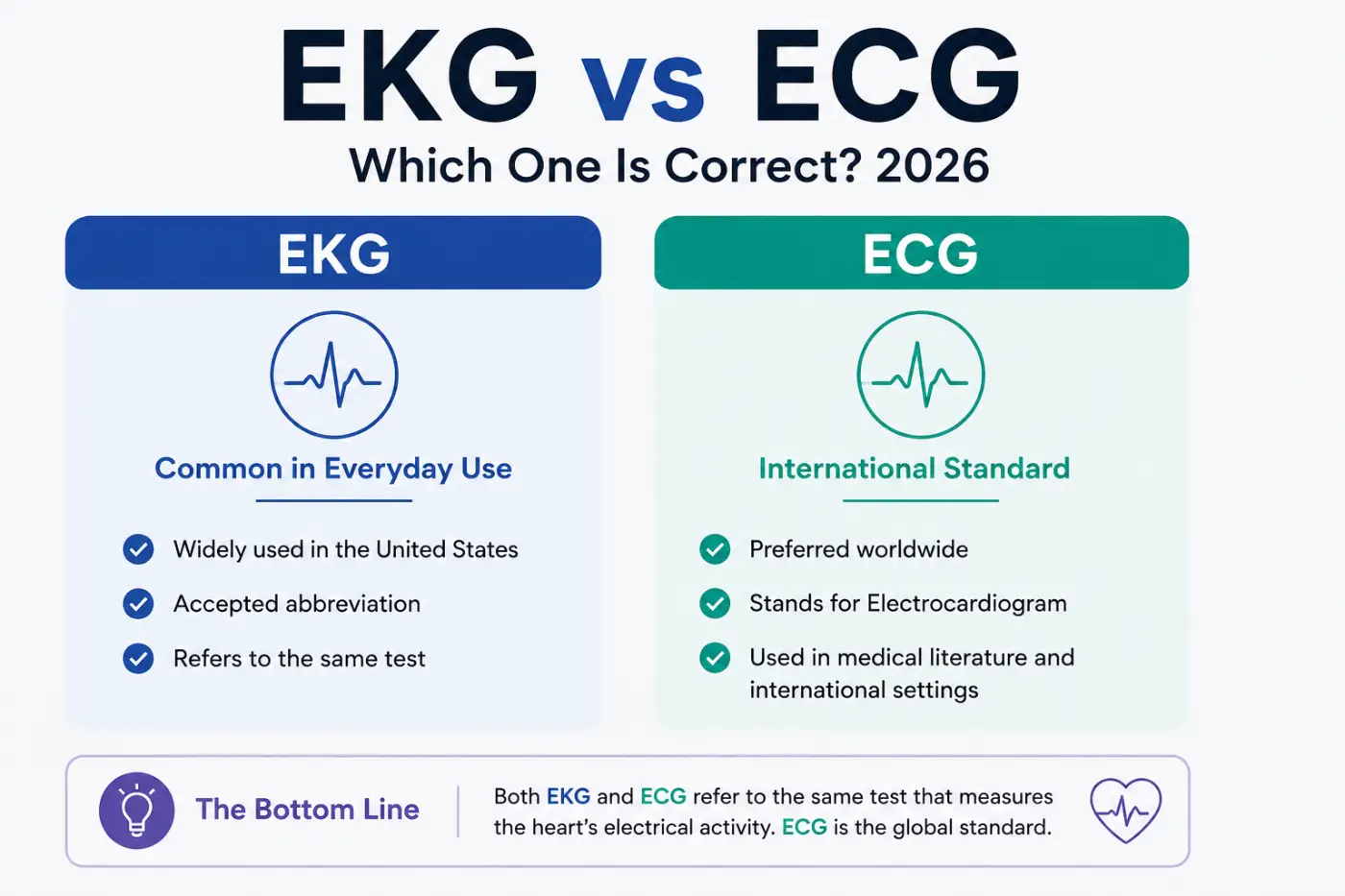
If you’ve seen both EKG and ECG on medical forms or heard doctors use both terms you may wonder if they refer to different heart tests. The short answer is that ekg vs ecg is usually not a comparison between two different tests. Both abbreviations refer to an electrocardiogram which records the electrical activity of the heart.
The confusion comes from the letters rather than the medical procedure. ECG follows the English spelling of electrocardiogram while EKG comes from the German spelling of the word where the corresponding term uses a K. Both names describe the same basic test. The test uses electrodes placed on the skin to record electrical signals produced by the heart.
Knowing this distinction can make medical records and conversations with your healthcare team much easier to understand. This guide explains why both abbreviations exist how the test works what it can show where each term is commonly used and how an electrocardiogram differs from other heart tests such as an echocardiogram. It also covers common misunderstandings and practical questions patients often have.
Quick Definition
EKG and ECG are two abbreviations for the same medical test called an electrocardiogram. The test records the heart’s electrical activity and can help healthcare professionals evaluate heart rate rhythm and certain signs of heart disease. The difference between the abbreviations comes mainly from language and historical spelling rather than from different testing methods.
Quick Answer
EKG and ECG generally mean the same thing. Both refer to an electrocardiogram which records the electrical signals produced by your heart.
The main difference is the abbreviation. ECG comes from the English spelling while EKG reflects the German form of the word. The test itself does not become different simply because a medical professional uses one abbreviation instead of the other.
Comparison Table
| Term | Full Name | What It Measures | Main Purpose | Common Usage | Typical Setting | Is It Different From the Other Term | Example |
|---|---|---|---|---|---|---|---|
| ECG | Electrocardiogram | Electrical activity of the heart | Evaluates heart rate rhythm and electrical patterns | Common internationally and in British usage | Clinics hospitals ambulances and other healthcare settings | No | The doctor ordered an ECG. |
| EKG | Electrocardiogram | Electrical activity of the heart | Evaluates heart rate rhythm and electrical patterns | Very common in the United States and also used elsewhere | Clinics hospitals emergency departments and other healthcare settings | No | The nurse performed an EKG. |
What an Electrocardiogram Actually Measures
An electrocardiogram records electrical activity produced by the heart. Every heartbeat begins with an electrical signal that travels through the heart and helps coordinate its contractions. The test captures those signals and displays them as a pattern of waves.
That distinction matters because the test does not directly take a picture of your heart. Instead it records the electrical signals that control the heartbeat.
A healthcare professional can examine the tracing for information about heart rate and rhythm. The recording can also provide clues about certain heart problems including arrhythmias and signs associated with a heart attack.
The test is quick and noninvasive. Small adhesive electrodes are placed on the skin. Wires connect those electrodes to an ECG or EKG machine which records the electrical signals. Depending on the type of examination the electrodes may be placed on the chest and sometimes the arms and legs.
The machine does not send electricity into your heart. It simply records electrical activity that is already occurring in your body. That is why a standard electrocardiogram is considered a painless test with no electrical shock from the machine.
Why Are There Two Abbreviations?
The two abbreviations exist because the word electrocardiogram has a different form in German.
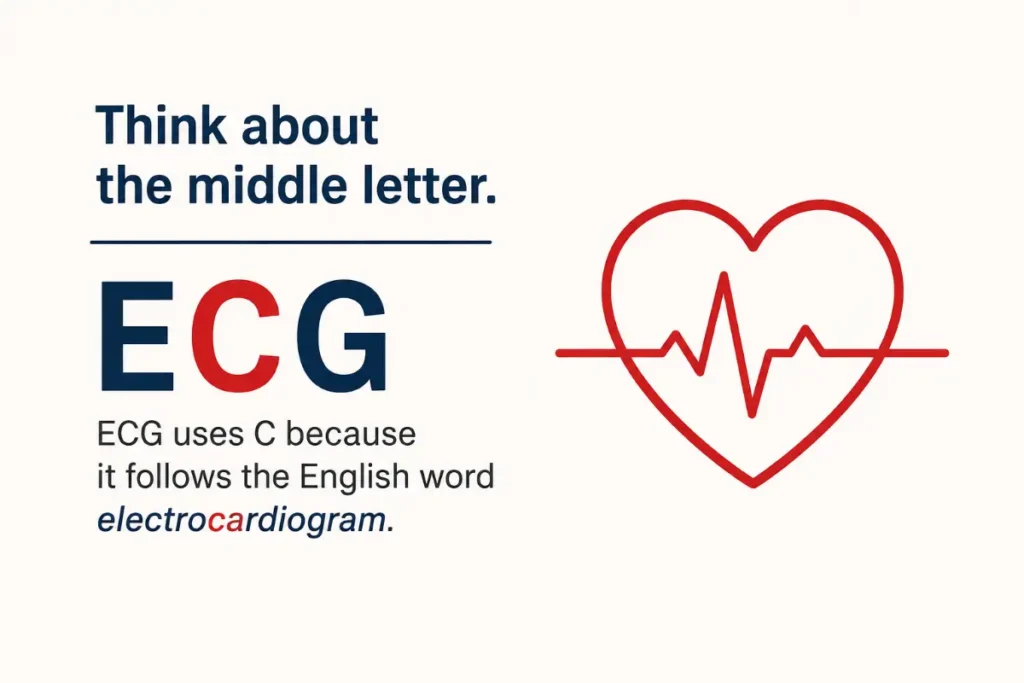
In English the abbreviation is usually formed from electrocardiogram and gives us ECG.
The German term is related to elektrokardiogram. The German word uses K where English uses C. That produces EKG.
The difference therefore comes from language rather than medical technology. NCBI medical material explains that the ECG abbreviation has a connection to German terminology and that the K form became associated with the German spelling.
This is a good example of how medical language can preserve historical influences. Medical terminology often draws from several languages and older naming traditions. A different letter in an abbreviation doesn’t necessarily mean a different procedure.
Think of ECG and EKG as two labels attached to the same test.
The label changes.
The test does not.
Key Differences Explained
The Medical Test
There is no meaningful difference in the actual test represented by the two abbreviations. An ECG and an EKG both refer to an electrocardiogram that records electrical activity from the heart.
The Abbreviation
The main difference is the letter used in the middle.
ECG follows the English form.
EKG reflects the German form.
That small spelling difference is the source of most of the confusion.
The Meaning
Both terms mean electrocardiogram. If a healthcare professional says you need an EKG or says you need an ECG they are generally referring to the same type of test.
The Pronunciation
People usually pronounce the abbreviations letter by letter.
ECG sounds like ee see gee.
EKG sounds like ee kay gee.
The difference is simply the spoken letter in the middle.
The Medical Information
Both terms describe a test that can show information about heart rate rhythm and electrical conduction. An electrocardiogram can help healthcare professionals investigate conditions such as arrhythmias and can provide information relevant to heart attacks and other heart problems.
The Region
ECG is widely used internationally. EKG is especially familiar in American healthcare. However both forms can appear in medical literature and healthcare settings across different countries.
The Formality
Neither abbreviation is inherently more formal than the other. Both are established medical abbreviations.
The Patient Experience
The patient does not undergo a different procedure based on the abbreviation. The basic experience remains the same. Electrodes are attached to the skin and the heart’s electrical activity is recorded.
Which Term Is Correct?
Both ECG and EKG are correct.
That point is worth emphasizing because people sometimes assume that one must be a mistake. It isn’t. The two abbreviations represent the same medical test.
ECG is closely tied to the English word electrocardiogram. EKG reflects the German form of the terminology. Both have become established in medical usage.
In American healthcare you may see EKG frequently. You may also see ECG in medical publications patient information and technology discussions.
If you see ECG on one document and EKG on another there is no reason to assume that you received different tests simply because the abbreviation changed.
The safest way to understand the term is to focus on the full name.
Electrocardiogram.
That is the test being described.
What Happens During the Test?
An electrocardiogram is usually a simple procedure.
You generally lie down while a healthcare professional prepares the skin and places small electrodes in the appropriate locations. The electrodes detect electrical signals from the heart and send those signals through wires to the recording device.
A standard test may use electrodes on the chest and limbs. The exact setup can depend on the type of recording and the equipment being used.
During the recording you may be asked to stay still and avoid talking. Movement can interfere with the tracing and make the recording harder to interpret.
The actual recording is usually quick. Afterward the healthcare professional reviews the tracing or sends it to someone qualified to interpret it.
The machine itself does not diagnose every possible heart problem. The tracing provides information that must be interpreted alongside symptoms medical history physical examination and other relevant findings.
That distinction is important. An electrocardiogram is a valuable diagnostic tool but it is only one part of a medical evaluation.
What Can the Test Show?
An electrocardiogram can provide several types of information about the heart.
Heart Rate
The recording can help show how fast or slow the heart is beating. Heart rate is one of the basic features assessed when an electrocardiogram is interpreted.
Heart Rhythm
The tracing can show patterns that may indicate an irregular rhythm. Arrhythmias such as atrial fibrillation can be evaluated with an electrocardiogram.
Electrical Conduction
The tracing can provide information about how electrical signals move through the heart. Certain conduction problems can produce recognizable changes on the recording.
Signs of a Heart Attack
An electrocardiogram can help healthcare professionals identify signs of a current or previous heart attack. The findings must be interpreted in the context of the patient’s symptoms and other clinical information.
Other Heart Changes
An electrocardiogram may provide clues about certain changes involving the heart. These findings can help guide further evaluation when needed.
An important limitation is that a normal result does not automatically rule out every heart condition. The test captures electrical activity during the recording period. Some heart problems may require other forms of testing or monitoring.
EKG vs ECG and the Difference From an Echocardiogram
One of the most common sources of confusion is the similarity between electrocardiogram and echocardiogram.
They are not the same test.
An electrocardiogram records the electrical activity of the heart.
An echocardiogram uses ultrasound to create images of the heart. It can show structures such as heart chambers and valves and can provide information about heart movement and blood flow.
The names sound similar because both begin with electrocardio or cardio related terminology but their technologies are very different.
A simple way to remember the distinction is this.
Electrocardiogram means electrical signals.
Echocardiogram means ultrasound images.
The first gives you an electrical tracing.
The second gives healthcare professionals images of the heart and information about its structure and movement.
A healthcare professional may order one test or both depending on the symptoms and clinical question.
Sentence Examples
Here are natural examples showing how these terms appear in everyday medical communication.
- My doctor ordered an EKG because I had been experiencing palpitations.
- The ECG showed a regular heart rhythm.
- The nurse explained that the test would only take a few minutes.
- The emergency department performed an EKG after I reported chest pain.
- The cardiologist reviewed the ECG tracing with the patient.
- An EKG can provide useful information about heart rhythm.
- The report referred to the test as an ECG rather than an EKG.
- My doctor said the ECG was only one part of the evaluation.
- The clinic uses EKG as the standard abbreviation on its patient forms.
- The physician compared the new ECG with an earlier tracing.
Notice that the sentence meaning does not change simply because EKG is replaced with ECG.
That is the key point.
Common Mistakes and Misunderstandings
Assuming One Abbreviation Is Incorrect
A common mistake is thinking that EKG must be wrong because ECG appears to follow the English word more closely.
That assumption isn’t correct. EKG is an established abbreviation that reflects the German form of the terminology.
Assuming the Tests Are Different
Some people think an ECG is one test and an EKG is another.
They are generally the same test.
The different letters can make the terminology look more complicated than it really is.
Confusing an Electrocardiogram With an Echocardiogram
The similar names can cause confusion.
An electrocardiogram records electrical signals.
An echocardiogram uses ultrasound to produce images of the heart.
Assuming a Normal Recording Rules Out Every Heart Problem
An electrocardiogram is useful but it does not answer every possible cardiac question. Some conditions require longer monitoring imaging laboratory testing or other evaluation.
For example a standard recording gives a relatively short view of electrical activity. A Holter monitor can record continuously for a much longer period and may be useful when symptoms come and go.
Treating a Machine Generated Result as a Final Diagnosis
Modern machines can generate automated interpretations. Those results can be useful but they do not replace professional clinical assessment.
The tracing should be considered alongside symptoms history examination and other appropriate information.
Pronunciation Guide
The full medical term electrocardiogram is commonly pronounced with several syllables and can feel intimidating when you first encounter it.
The abbreviations are much easier.
ECG
Pronounce it:
ee see gee
Each letter is spoken separately.
EKG
Pronounce it:
ee kay gee
Again each letter is spoken separately.
There is no special medical pronunciation rule that changes the basic pronunciation.
The most common mistake is trying to pronounce the abbreviation as a single word. In ordinary medical English people generally say the individual letters.
The full term is pronounced approximately:
ee lek troh kar dee uh gram
The exact pronunciation can vary slightly between speakers and accents.
Etymology and Word Origin
The history behind the two abbreviations explains the entire comparison.
The English word electrocardiogram combines elements related to electricity heart and recording or representation.
The abbreviation ECG follows the English spelling.
The German terminology uses a K in the corresponding word. That produced the form EKG.
NCBI material discussing electrocardiography notes the connection between ECG and the German term elektrokardiographie. Historical discussions also connect the terminology with the development of electrocardiography and the work of Willem Einthoven.
This history helps explain why the K is not a random substitution.
It is a linguistic clue.
Medical terminology often carries traces of the languages that shaped modern medicine. A single letter can preserve that history for generations.
Regional Usage
American English
In the United States both ECG and EKG are understood. EKG is particularly common in everyday clinical language and patient facing communication.
You may hear a doctor say EKG and later see ECG in a research article or educational material. The change in abbreviation does not mean the medical procedure changed.
American healthcare organizations commonly use both forms when describing an electrocardiogram.
British English
ECG is widely familiar in British medical English. The abbreviation follows the English spelling of electrocardiogram.
You may still encounter EKG because the German derived abbreviation is internationally recognized. It is not a different test.
Australian English
Australian medical English commonly uses ECG. The underlying test is the same electrocardiogram described elsewhere as an EKG.
The regional preference affects the abbreviation rather than the procedure itself.
Canadian English
Canadian healthcare writing can use ECG and EKG. The intended test remains an electrocardiogram.
The abbreviation a clinic chooses may depend on its documentation style or professional convention.
The broad regional pattern is therefore useful but not absolute. Medical professionals can recognize both forms.
Grammar and Usage
Unlike ordinary words the terms ECG and EKG function primarily as medical abbreviations.
They are usually treated as countable test names in ordinary clinical communication.
You might say:
I had an EKG yesterday.
You can also say:
The doctor ordered an ECG.
The plural form is commonly written as EKGs or ECGs.
For example:
The hospital performed several ECGs during the study.
The abbreviations are normally written in capital letters because they are initialisms.
The full term electrocardiogram is usually written as one word.
A related term is electrocardiography which refers more broadly to the recording or study of the heart’s electrical activity.
Another related term is electrocardiographic which works as an adjective.
For example:
The electrocardiographic findings were reviewed by the cardiologist.
The exact terminology can vary across medical documents but the central distinction remains stable.
Real Life Usage Examples
Daily Conversation
A patient might say:
I had an EKG at the clinic this morning.
My doctor wants me to get an ECG before the procedure.
These sentences are natural and understandable. Most people don’t need to explain the abbreviation because healthcare professionals recognize both forms.
Workplace Communication
A healthcare worker might write:
The patient received an EKG after reporting dizziness.
The ECG report was added to the patient record.
In professional settings clarity matters more than choosing one abbreviation as the only acceptable form.
Academic Writing
A medical paper might use ECG consistently throughout the document.
For example:
The ECG recordings were analyzed for changes in heart rhythm.
Academic writing usually establishes an abbreviation early and then uses it consistently.
News Writing
A health article might say:
Doctors performed an EKG after the patient arrived at the emergency department.
Another publication might write:
The ECG showed an abnormal rhythm.
Both sentences can refer to the same test.
Literature and Storytelling
In a story involving a medical setting a writer might use the more familiar patient facing term.
The nurse connected him to an EKG and waited for the tracing.
A more technical narrative might use ECG.
The choice often depends on the audience and setting rather than a difference in medical meaning.
Related and Confused Terms
Electrocardiogram
This is the full name of the test represented by both abbreviations. It records electrical activity from the heart.
Electrocardiography
This refers to the process or field involving the recording of the heart’s electrical activity.
Echocardiogram
This is a different test. It uses ultrasound to create images of the heart and can assess structures and blood flow.
Holter Monitor
A Holter monitor is a portable device that can record heart rhythm continuously for an extended period. It can provide a longer view than a standard electrocardiogram.
Heart Rhythm
Heart rhythm describes the pattern and timing of heartbeats. An electrocardiogram can provide information about rhythm.
Arrhythmia
An arrhythmia is an abnormal heart rhythm. An electrocardiogram can help identify many rhythm abnormalities.
Electrodes
Electrodes are sensors placed on the skin to detect electrical signals from the heart during the test.
Echocardiography
Echocardiography is the broader process of examining the heart using ultrasound. It differs fundamentally from electrocardiography because it creates images rather than recording the heart’s electrical activity.
Understanding these related terms makes medical conversations much easier. The names may look similar but they can describe very different tools and measurements.
What an ECG or EKG Cannot Tell You by Itself
An electrocardiogram is useful but it is not a complete picture of cardiovascular health.
The test records electrical activity during the period of monitoring. Some heart problems may not occur during that brief window. That is one reason healthcare professionals sometimes use longer monitoring devices such as Holter monitors when symptoms are intermittent.
An electrocardiogram also does not provide the same type of structural information as an echocardiogram.
For example an echocardiogram can produce images that help assess heart chambers valves movement and blood flow. An electrocardiogram instead focuses on electrical activity.
This difference is one of the most useful facts to remember.
Electrical activity means electrocardiogram.
Ultrasound images mean echocardiogram.
A healthcare professional decides which test is appropriate based on the clinical question.
Why the Test Is Commonly Used
An electrocardiogram is valuable because the heart depends on an organized electrical system to coordinate each heartbeat.
The electrical signal begins in the heart and moves through specialized tissue. This process helps the chambers contract in an organized pattern. An electrocardiogram records the resulting electrical activity from the body’s surface.
That information can help clinicians investigate symptoms such as chest pain dizziness palpitations or an unusually fast or slow heartbeat. It can also help evaluate known heart conditions and monitor some treatments.
The test is also practical. It is quick noninvasive and widely available in healthcare settings.
Still the value of the test comes from proper interpretation. A tracing is not simply a picture that can be judged correctly without context.
Expert Editor Insight
From a medical language perspective the biggest mistake is treating ECG and EKG as competing names for different procedures. They are established abbreviations for the same test and the K in EKG has a historical language explanation. Professional editors should also watch for confusion between electrocardiogram and echocardiogram because those terms sound similar but describe different technologies. A useful writing tip is to introduce the full term first in patient education content and then use one abbreviation consistently unless there is a reason to discuss both forms.
Conclusion
The question of ekg vs ecg has a simple answer. They generally refer to the same medical test called an electrocardiogram. Both record the electrical activity of the heart and can help healthcare professionals evaluate heart rate rhythm and certain signs of heart disease. The different abbreviations come from language history rather than different testing methods.
EKG reflects the German form of the terminology while ECG follows the English spelling. Both are established and widely understood. The bigger distinction to remember is between an electrocardiogram and an echocardiogram. The first records electrical signals while the second uses ultrasound to create heart images.
A useful memory trick is to focus on the full word electrocardiogram. If you see EKG or ECG think of the same basic heart test. If you see echocardiogram think ultrasound and heart images.
FAQs
Are EKG and ECG the same test?
Yes. EKG and ECG generally refer to the same medical test called an electrocardiogram. Both record the electrical activity of the heart. The difference comes from the abbreviations used in English and German terminology. EKG uses K because it reflects the German form of the word. ECG follows the English spelling. The testing method does not change because the abbreviation changes.
Why is it called an EKG instead of an ECG?
EKG comes from the German form of electrocardiogram which uses K in the corresponding word. ECG follows the English spelling. The German derived abbreviation became established in medical usage and remains especially familiar in the United States. So the K is not an indication of a different test. It reflects the linguistic history behind the abbreviation.
Which abbreviation is more common in the United States?
Both are understood in the United States but EKG is especially common in everyday clinical communication. ECG is also widely recognized and appears often in medical education research and international healthcare material. The important point is that neither abbreviation represents a separate procedure. If your medical record uses ECG while your doctor says EKG they are generally referring to the same examination.
Does an EKG hurt?
A standard electrocardiogram is generally painless. Small adhesive electrodes are placed on the skin to detect electrical signals from the heart. The machine records those signals rather than sending electricity into your body. Some people may experience minor discomfort when adhesive patches are removed. The test itself does not involve an electrical shock.
What can an ECG show?
An electrocardiogram can provide information about heart rate rhythm and electrical conduction. It can help healthcare professionals identify abnormal rhythms and may provide evidence of a current or previous heart attack. It can also reveal patterns associated with certain heart conditions. The results must be interpreted with symptoms medical history and other clinical findings rather than treated as a complete diagnosis by themselves.
Is an ECG the same as an echocardiogram?
No. An ECG or EKG records the heart’s electrical activity. An echocardiogram uses ultrasound to create images of the heart and can show structures movement and blood flow. The names sound similar but the technologies are different. A healthcare professional may order one or both depending on what they need to evaluate.
How long does an EKG take?
A standard electrocardiogram is usually a quick test. The electrodes must first be positioned correctly and the recording must be obtained while you remain still. The exact time varies by setting and procedure. If longer monitoring is needed a healthcare professional may use a device such as a Holter monitor which can record continuously for much longer than a standard test.
Which term should I use in medical writing?
Both terms are valid. If you are writing for an American audience EKG may feel especially familiar. ECG is also widely recognized and is common in international medical writing. The best editorial practice is to write electrocardiogram at first mention and introduce the preferred abbreviation. After that use the same abbreviation consistently throughout the document unless the distinction between ECG and EKG is itself relevant.
