
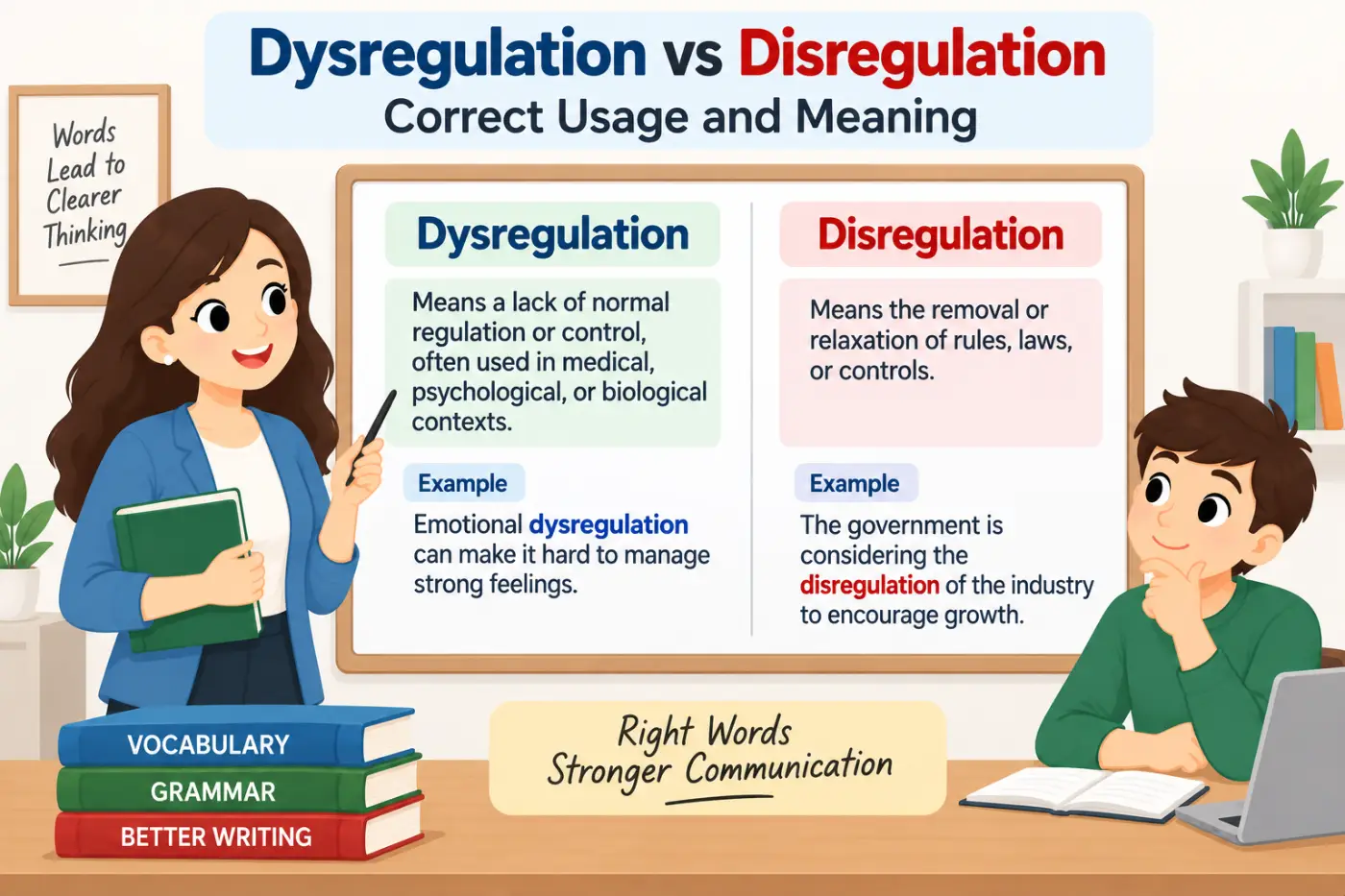
Dysregulation vs disregulation can be confusing because the two forms look almost identical and sound very similar when spoken. The standard term is dysregulation. Disregulation is generally treated as a misspelling or nonstandard form rather than an accepted alternative in modern English.
The confusion usually comes from the prefixes dys and dis. Both appear in many English words and both can suggest something is wrong or different. But they don’t carry exactly the same meaning. In medical and psychological language the prefix dys often points to abnormal or impaired functioning. That fits the meaning of dysregulation because the word describes a regulatory process that isn’t working properly.
You’ll most often see the standard term in psychology medicine neuroscience biology and other scientific fields. This guide explains its meaning spelling pronunciation grammar history and everyday use. You’ll also see why the competing form appears so often and how to choose the right word in academic professional and general writing.
Quick Definition
Dysregulation is the standard term for impaired abnormal or poorly controlled regulation of a process. It can describe emotional physiological behavioral neurological immune or other systems. Disregulation is generally treated as a misspelling or nonstandard form. Established dictionary sources define the standard term in connection with regulation that does not work normally.
Quick Answer
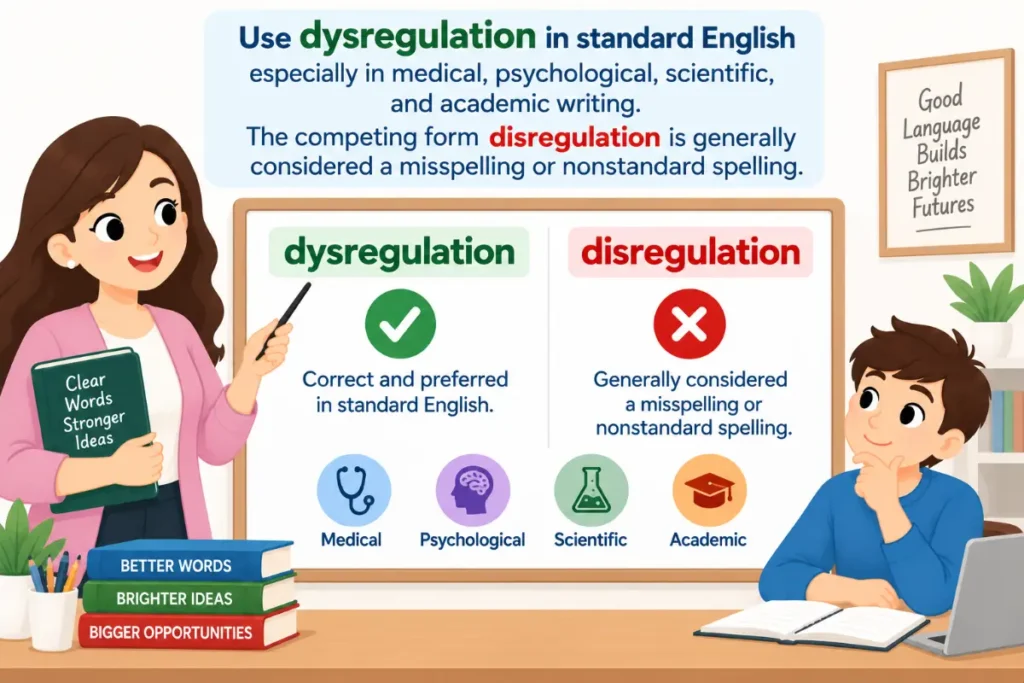
Use dysregulation in standard English especially in medical psychological scientific and academic writing. The competing form disregulation is generally considered a misspelling or nonstandard spelling.
The distinction comes from the prefix. Dys commonly indicates abnormal or impaired functioning while dis has several other meanings including separation negation or reversal. The established medical term therefore uses dys rather than dis.
Comparison Table
| Correct Form | Meaning | Part of Speech | Origin | Usage Frequency | Formality | Common Contexts | Example |
|---|---|---|---|---|---|---|---|
| Dysregulation | Impaired or abnormal regulation | Noun | Dys plus regulation | Common in specialized writing | Formal and technical | Psychology medicine biology neuroscience | Emotional dysregulation can affect daily functioning. |
| Disregulation | Generally a misspelling or nonstandard form | Noun form used in error | Usually formed by replacing dys with dis | Much less established | Generally avoided in formal writing | Informal writing and occasional technical usage | The report should use dysregulation instead. |
The table shows why the issue is more than a simple spelling preference. The established term has a clear place in professional vocabulary. The other form sometimes appears in published or technical material but is not the preferred standard form. Collins currently has an entry for disregulation that shows real usage examples while also presenting it in a word submission context rather than as a straightforward standard dictionary definition.
Meaning and Definition
Meaning of Dysregulation
Dysregulation is a noun that describes a failure impairment or abnormality in a system’s normal regulation.
The idea becomes easier to understand if you start with the word regulation. Regulation means controlling adjusting or maintaining something within an appropriate range. Your body regulates temperature. Your nervous system regulates many functions. People also regulate emotional and behavioral responses.
Dysregulation means that this control process is not working properly.
Cambridge defines the term in medical use as a condition in which a bodily process is not controlled in the way it normally should be. It also uses the term in psychology for difficulty controlling emotional responses.
The American Psychological Association uses the term in psychology for an excessive or poorly managed mechanism or response. Its example of emotional dysregulation refers to an extreme or inappropriate emotional response to a situation.
That gives you a useful general definition.
Dysregulation means regulation that is impaired abnormal excessive or poorly controlled.
The word does not have to refer only to emotions. You can encounter it in discussions of immune function metabolism nervous system activity hormones body temperature blood pressure and many other biological processes.
Meaning of Disregulation
Disregulation is a much less secure choice in standard English.
Some dictionaries and language resources treat it as a misspelling of dysregulation. Wiktionary explicitly labels it as a misspelling while YourDictionary gives the same basic treatment.
However there is a useful nuance here. The form does appear in real scientific and medical texts. Collins currently displays examples involving phrases such as cognitive emotional disregulation and cell cycle disregulation.
That means it would be too simplistic to claim that nobody ever uses the word. People clearly do use it. The better editorial conclusion is that disregulation is not the preferred standard form for most modern professional writing when the intended meaning is abnormal or impaired regulation.
If you’re writing an academic paper medical report educational article workplace document or formal explanation use dysregulation.
Why Both Forms Look Plausible
The confusion is understandable because English has both dis and dys as productive or historically established prefixes.
Consider words such as disorder disability disconnect and disagreement. The prefix dis appears in many familiar words.
Then consider dyslexia dysfunction dysphagia and dysregulation. The prefix dys also appears in established technical vocabulary.
Because the two prefixes can sound similar in rapid speech a writer may choose the familiar dis spelling automatically. That is especially easy when the writer already knows the word regulation and mentally builds the new term as dis plus regulation.
But specialized vocabulary often depends on the precise prefix. A single letter can change the history and conventional meaning of a term.
Key Differences Explained
Spelling
The standard spelling uses dys before regulation.
Dysregulation.
The competing form replaces y with i.
Disregulation.
That small difference is the main reason people search for the distinction.
Meaning
The standard term refers to impaired abnormal or poorly controlled regulation.
The competing form is generally intended to express the same idea but is not the preferred standard form.
Some discussions have tried to give the two forms different theoretical meanings. For example one could imagine disregulation describing absence or removal of regulation while dysregulation describes regulation that is working badly. A published interdisciplinary discussion has explored this conceptual distinction between dys and dis.
That distinction can be interesting in linguistic analysis but it doesn’t change ordinary editorial practice. If you mean abnormal regulation in modern medical or psychological writing use dysregulation.
Grammar
The standard word is a noun.
You can use it as the subject or object of a sentence.
The study examined emotional dysregulation.
Researchers observed dysregulation of the immune response.
You can also use the related adjective dysregulated.
The patient showed a dysregulated stress response.
The related verb is dysregulate.
The process may dysregulate normal cellular activity.
Pronunciation
The two forms are close enough in pronunciation to cause confusion. The standard form is commonly pronounced with the stress toward the final part of the word.
That means hearing the word alone may not tell you which spelling someone intends.
Formality
Dysregulation is strongly associated with technical and professional language. It is completely natural in medicine psychology biology neuroscience and academic research.
The other spelling is best avoided in polished professional writing.
Context
You’ll often encounter the standard term in phrases such as emotional dysregulation immune dysregulation metabolic dysregulation and autonomic dysregulation.
The exact meaning depends on the system being discussed.
Regional Usage
There is no major American British Canadian or Australian spelling difference that makes the alternative form standard. The preferred form remains the same across major varieties of English.
Which Form Is Correct?
The standard form is dysregulation.
The strongest evidence comes from established dictionary usage. Cambridge lists dysregulation as a specialized noun in medical and psychological contexts. The American Psychological Association also has a dictionary entry for the term. Wiktionary records its formation from dys plus regulation.
The spelling also makes linguistic sense.
The prefix dys has Greek roots and is commonly associated with something bad difficult abnormal or impaired. Regulation comes from the idea of controlling or adjusting a process. Put the two pieces together and dysregulation naturally describes impaired regulation.
This is different from simply saying that regulation is absent.
That distinction matters. A regulatory system can still be active while functioning poorly. For example a person can experience an emotional response but have difficulty bringing that response back to an appropriate level. Likewise a biological system can continue regulating a process while regulating it in an abnormal way.
That is one reason the standard term is so useful in scientific language.
Sentence Examples
Here are ten natural examples using the preferred form.
- Emotional dysregulation can make ordinary stressful situations feel much harder to manage.
- The researchers examined immune dysregulation in patients with chronic inflammation.
- Sleep problems can sometimes occur alongside difficulties with emotional regulation and dysregulation.
- The study explored how stress may affect nervous system dysregulation.
- The doctor explained that hormonal dysregulation can affect several body functions.
- The researchers found evidence of metabolic dysregulation in the experimental group.
- Her therapist discussed strategies for managing emotional dysregulation.
- The paper examines the relationship between trauma and stress response dysregulation.
- The researchers investigated how immune dysregulation may influence disease progression.
- Better regulation of the stress response may help reduce some effects associated with dysregulation.
Here are five examples showing the nonpreferred form as an error.
- The report described emotional disregulation.
- Researchers found signs of immune disregulation.
- The article discussed behavioral disregulation in children.
- The student wrote about nervous system disregulation.
- The editor changed disregulation to dysregulation throughout the paper.
These examples demonstrate the spelling issue rather than recommending the alternative form.
Common Mistakes and Misspellings
Replacing Dys With Dis
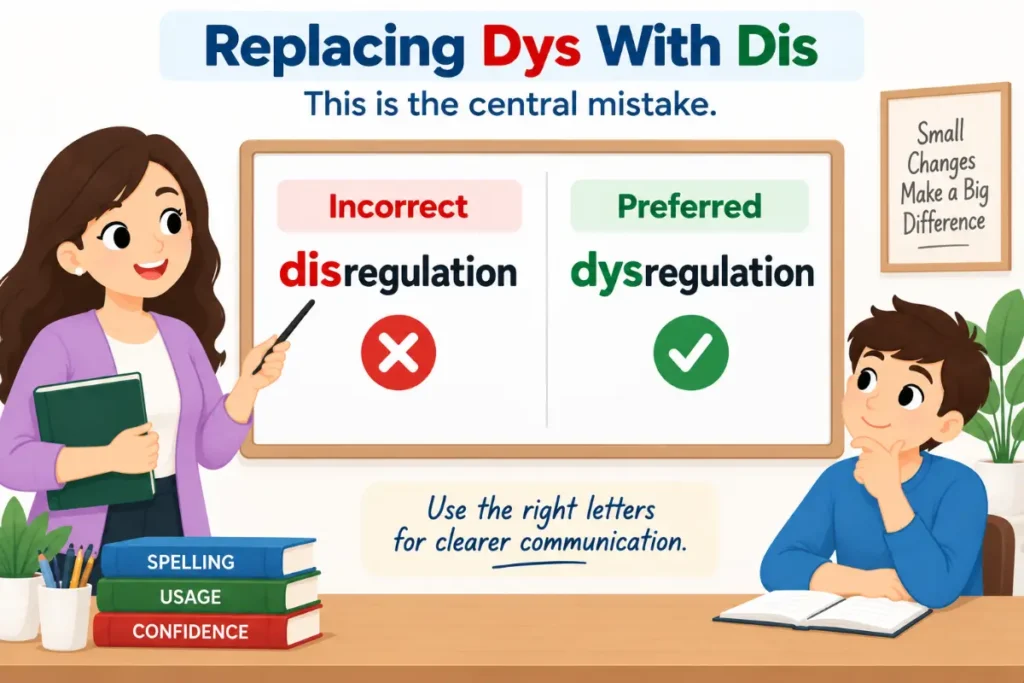
This is the central mistake.
Incorrect: disregulation.
Preferred: dysregulation.
The error probably feels natural because dis is a very familiar English prefix. Writers may also think of the word as dis plus regulation.
A useful correction is to remember that this specialized term belongs with other dys words such as dysfunction.
Using The Wrong Adjective
Another common mistake is confusion between the noun and adjective.
Noun: dysregulation.
Adjective: dysregulated.
You might write:
The study examined emotional dysregulation.
Or:
The study examined a dysregulated stress response.
The two forms are related but they perform different grammatical jobs.
Treating Dysregulation As A Diagnosis
Dysregulation describes a process or pattern. It does not automatically name a specific diagnosis.
For example emotional dysregulation can occur in connection with many different situations and conditions. The word itself does not tell you that someone has one particular disorder.
This distinction matters in careful medical and psychological writing.
Using The Term Too Broadly
Dysregulation should describe a regulatory process that is impaired or abnormal. It shouldn’t become a vague substitute for difficult behavior or any situation that feels out of control.
Good writing identifies what is being regulated.
Emotional dysregulation.
Immune dysregulation.
Metabolic dysregulation.
This makes the statement more precise.
Assuming Every Published Use Is Standard
A word can appear in published material and still be less preferred than another form.
The competing spelling does appear in scientific examples collected by Collins. That demonstrates usage but does not necessarily establish it as the preferred standard form.
Professional editing requires more than counting appearances. Editors consider dictionaries established terminology context and the conventions of the field.
Pronunciation Guide
The standard pronunciation is commonly represented in IPA as:
/ˌdɪsˌrɛɡjəˈleɪʃən/
A simple American English approximation is:
dis reg yuh LAY shun
The strongest stress usually falls on the lay part near the end.
You can divide the word into four broad sound groups.
dis | reg | yuh | lay shun
The pronunciation is one reason the spelling can be confusing. The spoken difference between dys and dis may be very small or disappear for some speakers in connected speech.
That means pronunciation alone isn’t a reliable way to decide the spelling.
A better strategy is to connect the word with its meaning and word family. Think of dys as the same prefix you see in words describing abnormal or impaired function.
For example:
Dysfunction.
Dyslexia.
Dysphagia.
Dysregulation.
This doesn’t mean all dys words have identical meanings. It simply gives you a useful spelling pattern.
Etymology and Word Origin
The word is formed from dys plus regulation. Wiktionary records this formation directly.
The prefix dys has Greek roots and has long been used in medical and scientific vocabulary to express ideas involving difficulty abnormality or impaired function.
Regulation has a different history. It is connected to the Latin family surrounding regula meaning a rule or standard. English developed regulation as a word for controlling managing or adjusting something according to a rule or desired condition.
Put the parts together and the basic idea becomes clear.
Dysregulation means regulation that is not working properly.
The word fits a larger pattern in medical vocabulary where dys is used to describe abnormal function rather than simple absence.
That distinction helps explain why the spelling uses y rather than i.
The competing spelling is easy to create by analogy with dis words but it doesn’t follow the established terminology of the standard medical term.
Regional Usage
American English
American English uses dysregulation in psychology medicine neuroscience biology and related fields. The term appears naturally in discussions of emotional regulation immune function nervous system activity and other physiological processes.
There is no American spelling rule that changes dys to dis.
For US academic or professional writing use dysregulation.
British English
British English also uses dysregulation as the established technical form. The meaning and spelling are essentially the same.
British medical and psychological writing may use the word in many of the same combinations found in American English.
There is no meaningful British spelling variation that makes disregulation the preferred form.
Australian English
Australian English follows the same broad terminology. The standard technical form is dysregulation.
The alternative spelling may appear occasionally but it shouldn’t be treated as a normal regional variant.
Canadian English
Canadian English also uses dysregulation. There is no significant Canadian spelling distinction for this term.
Across these varieties the difference is mainly one of standard terminology versus a less established form rather than regional preference.
Grammar Rules and Part of Speech
Dysregulation is a noun.
It can appear as the subject of a sentence.
Dysregulation can affect normal physiological processes.
It can also appear as the object of a verb.
Researchers examined dysregulation of the immune response.
The word is often followed by of when the writer identifies the affected process.
Examples include:
Dysregulation of blood pressure.
Dysregulation of emotional responses.
It can also appear before another noun as part of a technical phrase.
Emotional dysregulation.
Metabolic dysregulation.
Immune dysregulation.
Behavioral dysregulation.
The related adjective is dysregulated.
The patient showed a dysregulated stress response.
The related verb is dysregulate.
Chronic stress may dysregulate normal biological processes.
These related forms should not be treated as interchangeable.
If you are naming the process use the noun.
The study examined dysregulation.
If you are describing something use the adjective.
The system was dysregulated.
If you are describing an action use the verb.
The process may dysregulate normal function.
Punctuation
The word itself requires no special punctuation.
It can appear naturally in the middle of a sentence or at the beginning.
Dysregulation may affect emotional responses.
At the beginning of a sentence it follows ordinary capitalization rules.
Dysregulation may occur when regulatory systems fail to maintain normal control.
Because the word is technical it’s often helpful to define it briefly when writing for a general audience.
Instead of assuming every reader knows the term you might write:
Emotional dysregulation means difficulty managing emotional responses.
That makes the writing clearer without oversimplifying the subject.
Real Life Usage Examples
Daily Conversation
Technical words don’t appear in every casual conversation but the term can arise when people discuss psychology or health.
My therapist explained that emotional dysregulation can make strong feelings harder to manage.
I’m learning more about nervous system dysregulation and stress.
In everyday conversation people may choose simpler phrases such as difficulty managing emotions. The technical term becomes more useful when precision matters.
Email And Workplace Communication
The term can appear in professional communication when the subject involves health science research or education.
The report discusses possible signs of immune dysregulation.
Please review the section describing stress response dysregulation before the meeting.
In workplace writing clarity matters. If your audience isn’t familiar with the term give a short explanation rather than assuming specialized knowledge.
Academic Writing
Academic writing frequently requires precise terminology.
The study examined the relationship between chronic stress and emotional dysregulation.
Researchers evaluated markers associated with immune dysregulation.
In this setting the standard spelling is especially important. A spelling error in specialized terminology can distract the reader and may make the writer appear less familiar with the field.
News And Journalism
News writing may use the term when reporting on research or health topics.
Researchers are investigating how immune dysregulation may contribute to inflammatory disease.
The report discusses emotional dysregulation and its effects on behavior.
A journalist writing for a general audience may explain the term rather than leaving it undefined.
Literature And Storytelling
The word is less common in ordinary fiction because it has a technical tone. Still it can appear in medical fiction psychological narratives or nonfiction storytelling.
The doctor suspected that stress related dysregulation was affecting his recovery.
The therapist described her reactions as emotional dysregulation rather than simple moodiness.
In storytelling the writer should choose the term based on audience and purpose. Technical precision is useful but plain language can sometimes create a more natural voice.
Related And Confused Terms
Regulation
Regulation means controlling or adjusting a process. It is the basic concept behind the technical term.
Emotional Regulation
Emotional regulation refers to the processes involved in managing emotional responses. It doesn’t mean suppressing every emotion. Healthy regulation can involve recognizing emotions responding appropriately and recovering after stress.
Emotional Dysregulation
This refers to difficulty managing emotional responses. The American Psychological Association uses the term for excessive or poorly managed emotional responses.
Dysfunction
Dysfunction means impaired or abnormal functioning. It shares the dys prefix and can help you recognize the spelling pattern.
Disregulation
This is the form most likely to create confusion. It appears in real usage but is generally treated as a nonstandard spelling when the intended term is dysregulation.
Dysregulated
This is the adjective related to the noun.
The nervous system appears dysregulated.
Dysregulate
This is the verb.
Certain factors may dysregulate the immune response.
Homeostasis
Homeostasis refers to the maintenance of relatively stable internal conditions. Dysregulation can describe a failure or impairment in processes that normally help maintain appropriate physiological control.
These terms are related but they aren’t interchangeable. Choosing the precise word helps readers understand exactly what you mean.
Why The Prefix Matters
The prefix is the heart of the spelling problem.
English uses dis in words that can involve separation negation reversal or other meanings. Examples include disconnect disagree and disapprove.
The prefix dys has a different history and is especially common in medical terminology. It often signals abnormal difficult impaired or defective function.
This difference becomes clearer when you compare familiar words.
Dysfunction means impaired function.
Dyslexia refers to a specific difficulty involving reading and language processing.
Dysphagia refers to difficulty swallowing.
Dysregulation follows the same broad pattern. It describes regulation that is impaired or abnormal.
That doesn’t mean you can replace dis with dys in every English word. Prefixes belong to established words and cannot be swapped freely.
The lesson is more specific.
When you know the established medical term you should preserve its established prefix.
Is The Alternative Ever Used?
Yes. This is where careful language advice is better than an absolute claim.
Disregulation appears in real texts including scientific material. Collins currently displays several examples involving biological and psychological contexts.
However real world usage alone does not make a form the best choice for standard professional English. Some resources explicitly identify the form as a misspelling of dysregulation.
There has also been academic discussion about the possibility of giving dys and dis different conceptual roles. One published discussion contrasts dysregulation as bad or inappropriate regulation with a possible sense of disregulation involving absence or removal of regulation.
That is a specialized theoretical distinction rather than the normal rule writers should follow.
For most readers and writers the practical rule is simple.
If you mean abnormal or impaired regulation use dysregulation.
If you encounter disregulation in a source don’t automatically assume the author is making a conceptual distinction. Check the surrounding context and the terminology used by that field.
Expert Editor Insight
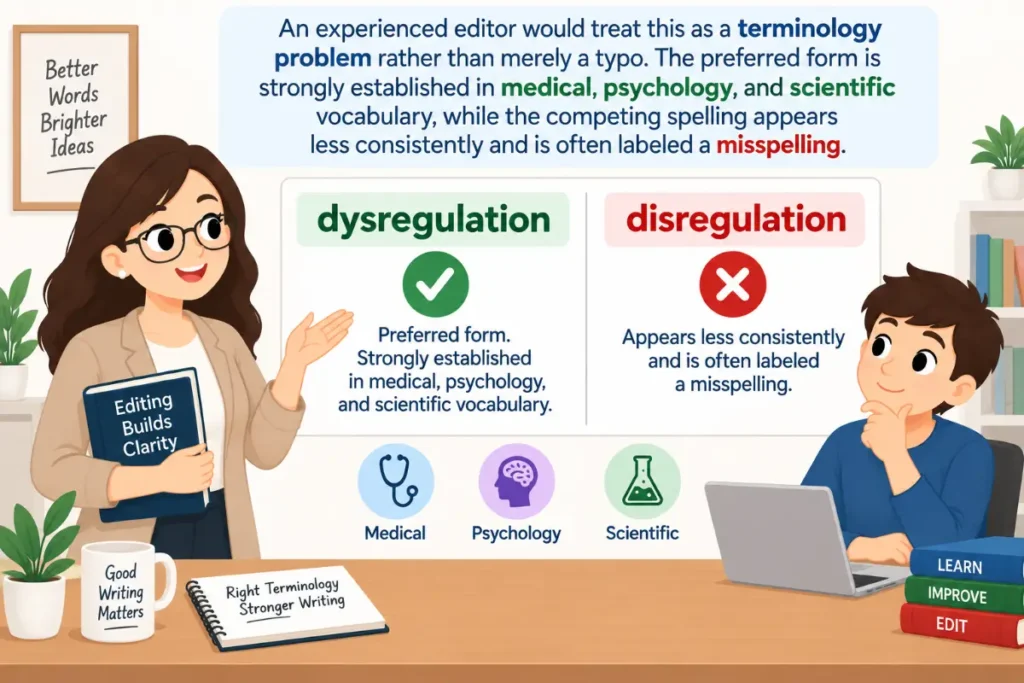
An experienced editor would treat this as a terminology problem rather than merely a typo. The preferred form is strongly established in medical psychology and scientific vocabulary while the competing spelling appears less consistently and is often labeled a misspelling. A spellchecker may catch the alternative immediately but professional editing goes one step further by checking the meaning of the prefix and the conventions of the field. My best editing tip is to connect dysregulation with dysfunction. Both use the familiar dys prefix associated with impaired function. That mental link is simple and surprisingly effective.
Conclusion
Dysregulation vs disregulation has a clear practical answer. Dysregulation is the established standard term for abnormal impaired or poorly controlled regulation, while disregulation is generally treated as a nonstandard form or misspelling. The difference comes down to more than one letter because the prefixes dys and dis have different histories and meanings.
The standard noun appears in psychology medicine biology neuroscience and other technical fields. It can describe emotional immune metabolic neurological or physiological processes that aren’t being regulated normally. The related forms dysregulated and dysregulate also follow the same word family.
A useful memory trick is to connect dysregulation with dysfunction. Both use the dys prefix associated with impaired function. If you’re writing professionally or academically, that simple association can help you choose the established spelling with confidence.
FAQs
Is disregulation a real word?
Disregulation does appear in real English texts, including some scientific and medical writing. However several language resources treat it as a misspelling or nonstandard form of dysregulation. Collins also records usage examples while presenting the term differently from its standard established vocabulary. For professional academic and medical writing, dysregulation is the safer and more widely accepted choice.
What does dysregulation mean?
Dysregulation means impaired abnormal or poorly controlled regulation of a process. It can refer to emotional responses, immune activity, nervous system function, metabolism and many other systems. In psychology it can describe difficulty controlling emotional responses. In medicine it can describe a physiological process that is not being controlled in its normal way.
Which spelling should I use in academic writing?
Use dysregulation. It is the established spelling used in medical psychological biological and scientific contexts. The competing form appears in some published material but is commonly treated as nonstandard or as a misspelling. Academic writing benefits from using the terminology recognized by dictionaries and the relevant professional field. If you are following a specific style guide or terminology list use its preferred form consistently.
How do you pronounce dysregulation?
The word is commonly represented in IPA as /ˌdɪsˌrɛɡjəˈleɪʃən/. An easy approximation is dis reg yuh LAY shun. The strongest stress falls near the end of the word. Because the opening sounds of dys and dis can be very similar in natural speech, pronunciation alone may not help you identify the correct spelling. Learning the word as a complete unit is useful.
Is dysregulation only about emotions?
No. Emotional dysregulation is one common use but the term has a much wider meaning. Medical and scientific writing can discuss immune dysregulation metabolic dysregulation nervous system dysregulation and other forms. The general idea stays the same: a regulatory process is not functioning normally. The exact meaning depends on the system being described and the context in which the word appears.
What is a simple synonym for dysregulation?
There is no single perfect synonym for every context. Depending on the subject you might use impaired regulation abnormal regulation poor control disrupted regulation or loss of normal control. In technical writing it’s usually better to keep the specialized term because it can carry a more precise meaning. Replacing it with a broad word such as imbalance may remove useful information about the regulatory process involved.
Why do people spell dysregulation with dis?
The confusion comes mainly from the similarity between the prefixes dys and dis. Dis is extremely common in English and appears in words such as disagreement and disorder. Dys is also common in medical terminology and often signals abnormal or impaired function. Because the two prefixes can sound similar people may choose the more familiar spelling automatically. That creates the common nonstandard form.
Is dysregulation appropriate in formal writing?
Yes. Dysregulation is especially appropriate in formal writing when the subject involves psychology medicine biology neuroscience or another technical field. It is an established noun and appears naturally in academic and professional contexts. The key is to use it precisely. Define the term briefly if your audience may not know it and identify the specific regulatory system involved whenever that information is relevant.
