
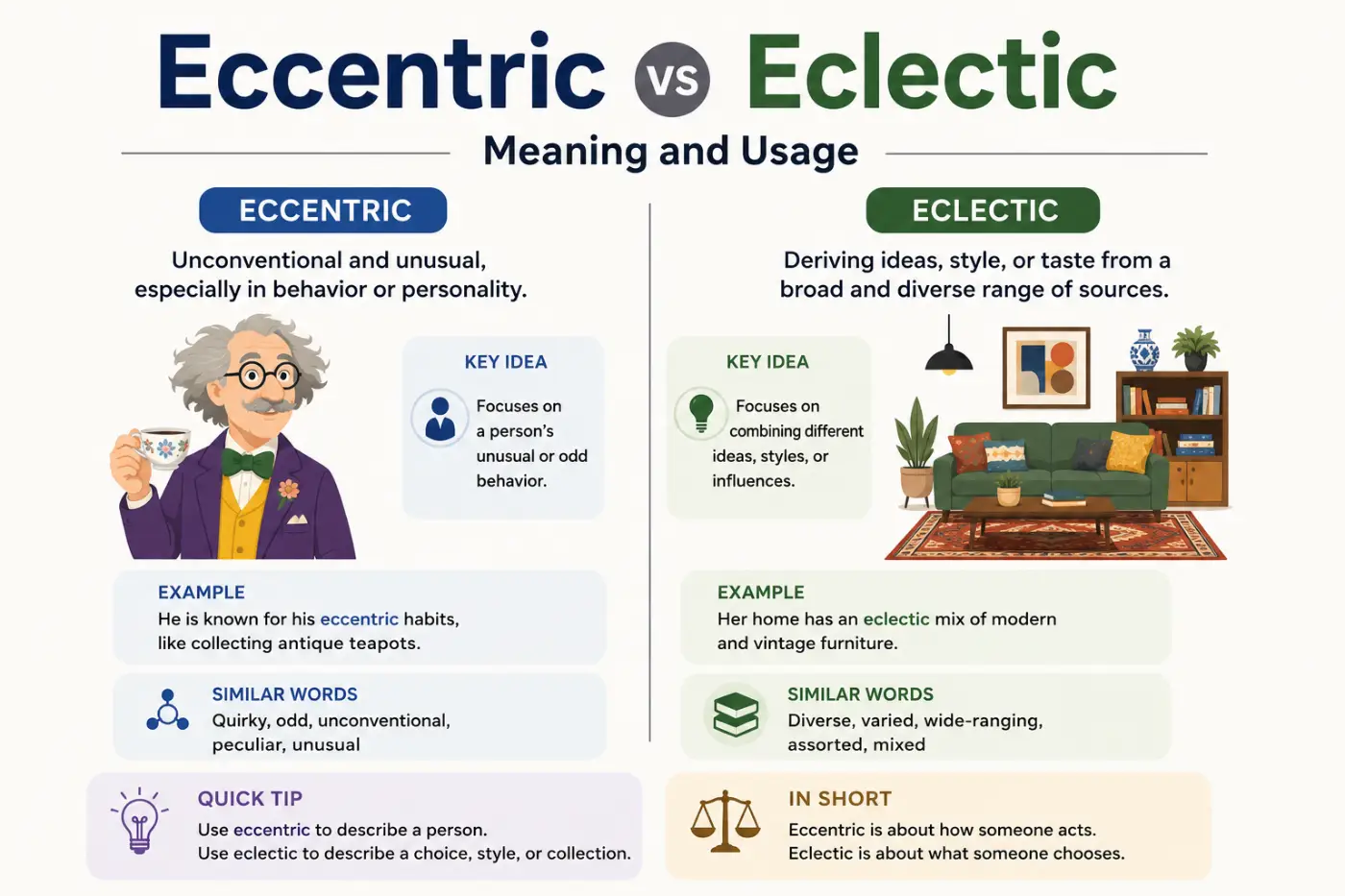
Eccentric vs eclectic can be confusing because both words describe people styles tastes and ideas that stand out from the ordinary. The good news is that they don’t mean the same thing. Eccentric usually describes someone or something that is unusual or unconventional. Eclectic describes something that draws from a wide range of different sources styles or influences.
The difference becomes much clearer when you focus on the reason something seems unusual. An eccentric person may have strange habits unusual behavior or an unconventional personality. An eclectic person or collection brings together different influences and choices. Someone can even be both. A person might have an eccentric personality and an eclectic taste in music.
This distinction matters because using one word in place of the other can change the meaning of a sentence. In this guide you’ll learn the definitions pronunciation grammar history and regional usage of both terms. You’ll also see practical examples common mistakes related words and a simple editing test that can help you choose the right word without second guessing yourself.
Quick Definition
Eccentric means unusual or unconventional in behavior appearance or ideas. Eclectic means selecting or combining ideas styles objects or influences from many different sources. An eccentric person stands out because of unusual traits while an eclectic taste stands out because it combines varied influences.
Quick Answer
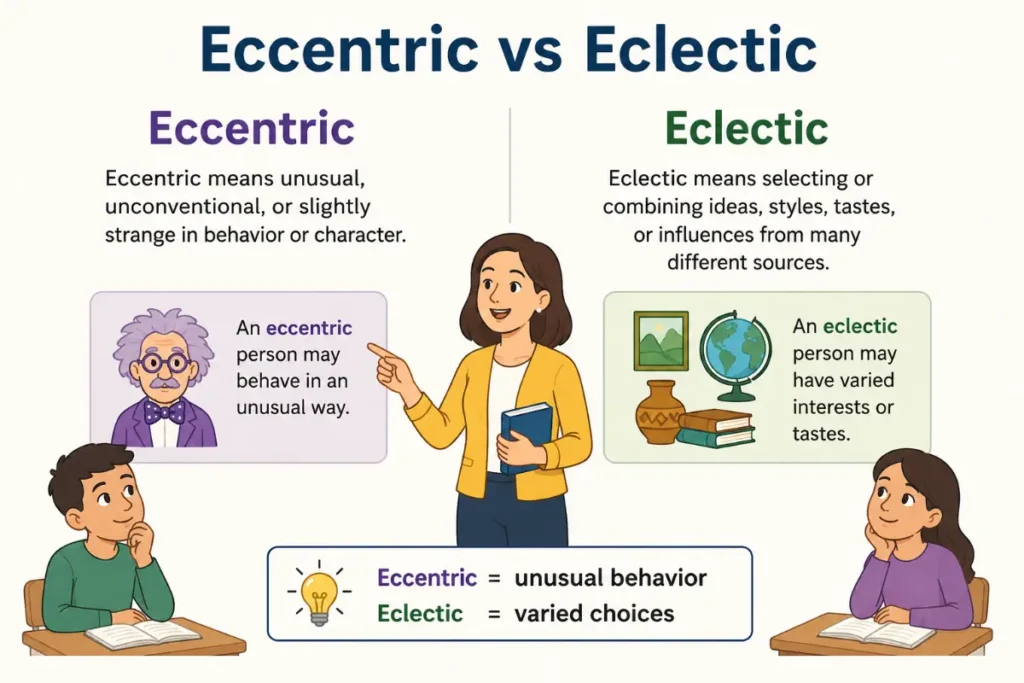
Eccentric describes something or someone that is noticeably unconventional or unusual. Eclectic describes a mixture that draws from many different sources or styles.
Think of the difference this way. Eccentric is about being unusual. Eclectic is about choosing from variety.
Comparison Table
| Form | Meaning | Part of Speech | Origin | Usage Frequency | Formality | Common Contexts | Example |
|---|---|---|---|---|---|---|---|
| Eccentric | Unconventional or noticeably unusual | Adjective and noun | Greek through Latin and French | Common | Neutral and formal | Personality behavior style habits design | His eccentric behavior made him memorable. |
| Eclectic | Drawn from many different sources or styles | Adjective and noun in limited usage | Greek through French and English | Common | Neutral and formal | Art music design taste ideas collections | She has an eclectic taste in music. |
Meaning and Definition
Meaning of Eccentric
Eccentric describes someone or something that doesn’t behave or appear in the usual way. The word often refers to a person whose habits opinions clothing or behavior seem unconventional.
For example:
My uncle is eccentric.
This tells us that his behavior or personality is unusual. It doesn’t necessarily mean that he is unpleasant or foolish. In fact eccentric can sometimes carry a positive or affectionate tone. An unusual person may be creative independent memorable or entertaining.
The word can also describe objects styles or ideas.
The artist created an eccentric sculpture.
Here the sculpture is unusual in appearance or concept.
As a noun eccentric refers to an unusual person.
The village regarded him as an eccentric.
The noun focuses on the person rather than simply describing a particular behavior.
Eccentric therefore has a strong connection with individuality and unconventional behavior.
Meaning of Eclectic
Eclectic describes something created by selecting elements from many different sources.
For example:
She has eclectic taste in music.
This suggests that she enjoys many different genres rather than staying within one musical tradition. She might listen to jazz rock classical music country and electronic music.
Eclectic can describe design too.
Their living room has an eclectic style.
The room may contain modern furniture vintage artwork handmade objects and pieces inspired by different cultures or periods.
The word can also describe ideas.
His approach to teaching is eclectic.
That means he draws techniques or ideas from different teaching methods rather than following one system exclusively.
Eclectic is therefore strongly connected with variety combination selection and diversity of influences.
The Main Difference Between the Two Words
The easiest way to separate these terms is to ask a simple question.
Is the focus on unusual behavior or on a mixture of different influences?
If the focus is unusual behavior or unconventional qualities use eccentric.
If the focus is a combination of different sources styles ideas or traditions use eclectic.
Consider these examples.
He has an eccentric personality.
The sentence describes the person as unusual.
He has eclectic musical taste.
The sentence describes the range of music he enjoys.
The same person could fit both descriptions.
Imagine a designer who dresses in unusual clothes and collects furniture from many different design traditions. You could describe the designer as eccentric because of the unusual personal style. You could describe the collection as eclectic because it combines many influences.
That distinction is the heart of the comparison.
Key Differences Explained
- Meaning. Eccentric means unusual unconventional or outside ordinary expectations. Eclectic means selected from many different sources or influences.
- Focus. Eccentric focuses on unusual qualities. Eclectic focuses on variety and combination.
- People. You can call a person eccentric when their personality behavior or appearance is unconventional. You can describe someone as eclectic when their tastes or choices come from many sources.
- Style. An eccentric style may look strange or unconventional. An eclectic style combines elements from different periods genres or traditions.
- Ideas. An eccentric idea is unusual or unconventional. An eclectic approach combines ideas from different systems.
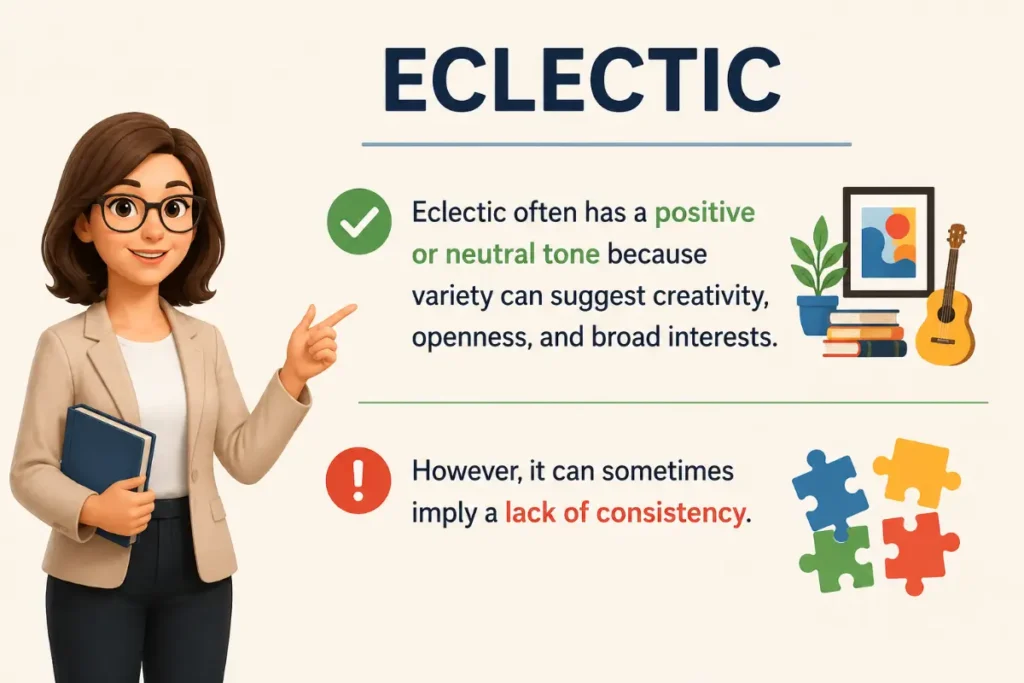
- Tone. Eccentric can sound positive neutral or slightly critical depending on context. Eclectic is often neutral or positive because it suggests variety and broad interests.
- Grammar. Both words commonly function as adjectives. Eccentric can also function as a noun.
- Pronunciation. The words begin differently. Eccentric starts with a sound like ek while eclectic starts with a sound like ih or ee depending on the speaker and variety of English.
- Context. Eccentric frequently appears with people personalities behavior habits and unusual objects. Eclectic commonly appears with taste collections styles approaches and selections.
- Relationship. The two concepts can overlap. Something can be eccentric and eclectic at the same time but the words emphasize different characteristics.
Which Word Should You Use?
Use eccentric when you want to emphasize unusual behavior character appearance or ideas.
Use eclectic when you want to emphasize a broad mixture of sources styles or influences.
Here is a useful test.
If you can replace the word with unconventional then eccentric may be the better choice.
If you can replace it with varied or drawn from many sources then eclectic may fit better.
Compare these sentences.
The professor has an eccentric teaching style.
This suggests the professor teaches in an unusual or unconventional way.
The professor has an eclectic teaching style.
This suggests the professor combines techniques from different educational traditions.
Both sentences are grammatical. They simply give the reader different information.
That is why treating one word as the correct version and the other as incorrect would be a mistake. Both are legitimate English words.
Sentence Examples
Here are ten examples that show the difference naturally.
- Her eccentric personality made every dinner party more interesting.
- The artist was known for his eccentric clothing and unusual sense of humor.
- My neighbor has an eccentric habit of painting his mailbox every month.
- The professor offered several eccentric theories about the mysterious artifact.
- The old bookstore owner was an eccentric man with a remarkable memory.
- She has an eclectic taste in music and listens to everything from opera to hip hop.
- The restaurant has an eclectic menu influenced by several culinary traditions.
- His eclectic reading list includes novels poetry history and science.
- They decorated their apartment in an eclectic style using modern and vintage pieces.
- The museum has an eclectic collection that spans several centuries.
Notice how the first group centers on unusual qualities while the second group centers on variety and combination.
Common Mistakes and Confusions
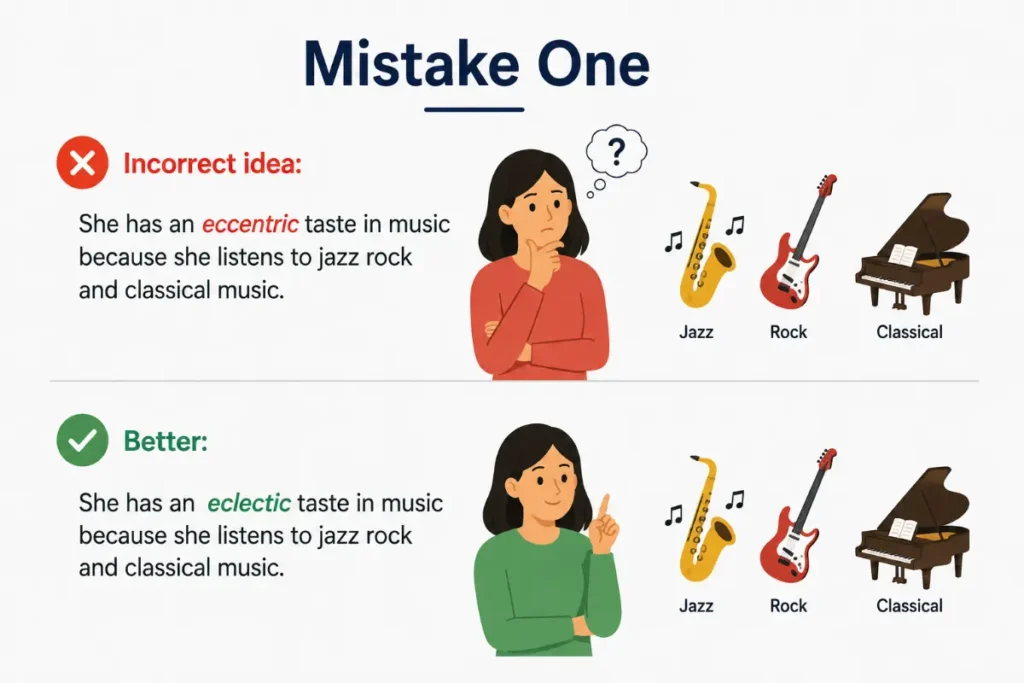
Using Eccentric for Variety
A common mistake is using eccentric when you simply mean varied.
Less precise: She has an eccentric taste in music.
This could suggest that her musical choices are strange or unconventional.
Better: She has eclectic taste in music.
Now the sentence clearly means that she enjoys music from many different sources or genres.
Using Eclectic for Strange Behavior
The opposite mistake also happens.
Less precise: His eclectic behavior surprised everyone.
This sounds as if his behavior comes from a mixture of different sources rather than being unusual.
Better: His eccentric behavior surprised everyone.
The second sentence clearly communicates unusual conduct.
Assuming Eclectic Means Random
Eclectic doesn’t necessarily mean random.
An eclectic collection can be carefully selected. The items simply come from different sources or traditions.
A designer might deliberately combine a modern sofa with an antique table and artwork from several periods. That can be eclectic without being careless.
Assuming Eccentric Means Negative
Eccentric doesn’t automatically mean bad.
Calling someone eccentric can suggest creativity independence originality or harmless oddness. Context determines the tone.
Her eccentric ideas helped the team find a fresh solution.
Here eccentric has a positive flavor.
Confusing Similar Sound Patterns
The words share several letters and both can appear in discussions about personality style art and ideas. That overlap can make them easy to mix up.
The best solution is to remember the meaning rather than relying on spelling alone.
Pronunciation Guide
Eccentric
Eccentric is commonly pronounced /ɪkˈsɛntrɪk/.
A simple pronunciation guide is:
ik SEN trik
The strongest stress falls on the second syllable.
The first sound is similar to the beginning of the word explain. The middle syllable carries the main emphasis.
Avoid stressing the first syllable too strongly. In natural American English the word generally has a clear emphasis on SEN.
Eclectic
Eclectic is commonly pronounced /ɪˈklɛktɪk/.
A simple pronunciation guide is:
ih KLEK tik
The strongest stress falls on the second syllable.
The opening sound is light and the main stress lands on the second syllable.
The words can sound somewhat similar to learners because both contain several consonants and end with the familiar tic sound. Listening to the stress pattern can help keep them separate.
A useful practice method is to learn each word with a short phrase.
eccentric personality
eclectic taste
These common combinations connect pronunciation directly with meaning.
Etymology and Word Origin
The histories of these two words explain why they look related even though their meanings differ.
Eccentric
Eccentric ultimately comes from Greek roots meaning outside the center. The word passed through Latin and French before becoming part of English vocabulary.
The original idea involved something that was not centered in the usual way. That concept developed into broader meanings involving something outside the normal pattern.
Over time eccentric became strongly associated with unusual people and unconventional behavior.
That history gives you a useful memory clue. Think outside the center and then connect that idea to someone who behaves outside ordinary expectations.
Eclectic
Eclectic also comes from Greek. It is related to a Greek verb meaning to choose or select.
That origin fits the modern meaning well. An eclectic person or approach selects elements from different sources rather than committing to one tradition.
The historical idea of choosing helps explain why the modern word is associated with variety.
You can therefore remember the two words through their basic concepts.
Eccentric means outside the usual center.
Eclectic means choosing from different sources.
These are not exact dictionary definitions of the historical roots but they are useful memory associations.
Regional Usage
American English
Both words are standard in American English. Eccentric commonly describes unusual people behavior habits ideas or styles. Eclectic frequently appears in discussions of taste design music art collections and intellectual approaches.
American speakers may use eccentric in an affectionate way when describing someone who is harmlessly unusual.
Eclectic often has a positive tone because it can suggest broad interests and creative choices.
British English
British English uses both words with essentially the same meanings. There is no major spelling difference between British and American English for these terms.
A British writer can describe an unconventional character as eccentric and a varied collection as eclectic.
The distinction between unusual and varied remains important in both varieties.
Australian English
Australian English also uses both terms as standard vocabulary. Their meanings remain close to those found in American and British English.
An eccentric person is unconventional while an eclectic collection contains elements from different sources.
No major Australian spelling variant changes this distinction.
Canadian English
Canadian English follows the same basic usage. Both terms appear in everyday writing professional communication education journalism and cultural discussions.
There is no meaningful Canadian spelling difference that changes the comparison.
Grammar Rules and Part of Speech
Both words commonly function as adjectives.
Eccentric as an Adjective
As an adjective eccentric describes a noun.
He has an eccentric personality.
She wore an eccentric outfit.
The artist created an eccentric design.
The adjective can describe people objects behavior ideas styles and other things that appear unusual.
Eccentric can also function as a noun.
The town was famous for its colorful eccentrics.
Here the word refers directly to unusual people.
Eclectic as an Adjective
Eclectic is most often used as an adjective.
She has eclectic musical tastes.
The gallery displays an eclectic collection.
His writing reflects an eclectic range of influences.
The adjective normally modifies a noun that involves selection variety or multiple influences.
Common Sentence Patterns
Several combinations sound especially natural.
eccentric personality
eccentric behavior
These common pairings can help you choose the right word quickly.
Punctuation
Neither word requires special punctuation. Punctuation depends on the structure of the sentence rather than the adjective itself.
She has an eclectic taste in art.
His eccentric behavior attracted attention.
No comma is needed simply because one of these words appears in a sentence.
Real Life Usage Examples
Daily Conversation
My cousin is a little eccentric but he’s fun to be around.
This describes an unusual personality.
She has eclectic taste in movies.
This describes variety in her choices.
Workplace Communication
The designer has an eccentric approach to visual branding.
The focus is on an unconventional method.
The team took an eclectic approach and borrowed ideas from several industries.
Here the focus is on combining ideas from different sources.
Academic Writing
The author presents an eccentric interpretation of the historical event.
This suggests that the interpretation differs noticeably from conventional views.
The study uses an eclectic framework that combines several established methods.
This indicates that multiple approaches have been brought together.
News and Journalism
The eccentric artist became a familiar figure at local cultural events.
The emphasis is on the person’s unusual character.
The new exhibition features an eclectic mix of contemporary and historical works.
The focus is on the range of influences represented.
Literature and Storytelling
The eccentric inventor lived alone in a house filled with strange machines.
The adjective helps create a distinctive character.
Her eclectic library contained everything from ancient poetry to modern science fiction.
The word highlights the wide range of material.
Related and Confused Terms
Unconventional
Unconventional means different from what is usual or expected. It is one of the closest general synonyms for eccentric.
However it doesn’t necessarily carry the same suggestion of unusual personality.
Quirky
Quirky describes someone or something with unusual but often appealing characteristics.
It can overlap with eccentric but often sounds lighter and more playful.
Unusual
Unusual simply means not common or ordinary. It is broader and less specific than eccentric.
Idiosyncratic
Idiosyncratic describes a characteristic or behavior that is distinctive to a particular person or group.
It can overlap strongly with eccentric when describing personal habits.
Diverse
Diverse means showing a lot of variety. It is related to eclectic but has a broader application.
A diverse group contains people with different backgrounds. An eclectic collection contains things selected from different sources.
Varied
Varied means consisting of different types or forms.
It often overlaps with eclectic but doesn’t necessarily suggest deliberate selection.
Conventional
Conventional means following accepted customs or usual patterns. It is useful as an opposite idea to eccentric in many contexts.
Traditional
Traditional refers to established customs methods or styles. Something eclectic may include traditional elements but combine them with influences from elsewhere.
These related words help reveal the central contrast. Eccentric belongs more closely to unusual individuality while eclectic belongs more closely to variety and selection.
How the Words Can Describe the Same Person
One person can be eccentric and eclectic at the same time.
Imagine a fashion designer who wears unusual clothing and mixes styles from many periods.
You might say:
The designer is eccentric and has an eclectic sense of style.
The first adjective describes the person. The second describes the range of influences in the person’s style.
This is a useful example because it shows why the words shouldn’t be treated as interchangeable.
The designer is eccentric because the personal presentation is unconventional.
The style is eclectic because it combines different influences.
The same distinction works with music art literature interior design food and academic ideas.
A musician can be eccentric because of unusual behavior and eclectic because the music draws from many genres.
An artist can be eccentric because of an unconventional personality and eclectic because the artwork combines different traditions.
A scholar can be eccentric because of unusual ideas and eclectic because the research draws from several fields.
Eccentric Style vs Eclectic Style
These phrases deserve special attention because both appear frequently in discussions about fashion interior design art and creativity.
An eccentric style is unusual or unconventional. It may involve unexpected colors shapes clothing choices patterns or behavior.
An eclectic style combines elements from different sources. A room might include a mid century chair a traditional rug modern artwork and handmade objects.
The two can overlap.
A room can have an eccentric appearance because the design choices are unusually bold. It can also be eclectic because those choices come from many different styles.
The distinction comes down to emphasis.
If you’re describing how unusual something is use eccentric.
If you’re describing how many different influences it combines use eclectic.
Eccentric Personality vs Eclectic Personality
The phrase eccentric personality is common because eccentric naturally describes unusual personal behavior.
He has an eccentric personality.
This tells the reader that his behavior or character differs from ordinary expectations.
Eclectic personality is less direct. You might use eclectic to describe someone’s interests tastes or influences rather than the basic nature of their personality.
For example:
She has eclectic interests.
This means she is interested in many different subjects.
You could say:
She has an eclectic approach to life.
This suggests that she draws ideas experiences or preferences from many different sources.
If your intended meaning is simply strange or unconventional personality eccentric is usually the clearer choice.
A Simple Memory Trick
Here is a quick way to keep the words apart.
Think of eccentric as outside the usual center.
Think of eclectic as selecting from many choices.
Then connect each word with a common phrase.
eccentric person
eclectic taste
If someone behaves unusually they may be eccentric.
If someone likes many different styles they may have eclectic taste.
That distinction is simple enough to remember during everyday writing.
An even faster test is to ask yourself what you are describing.
If you are describing unusualness choose eccentric.
If you are describing variety choose eclectic.
That one question will solve most cases.
Expert Editor Insight
From an editing perspective the biggest problem with these words isn’t spelling. It’s choosing the wrong meaning because both often appear near topics such as art design personality and creativity. I’d check the noun being modified and ask what the sentence is really emphasizing. If the writer means unconventional behavior I’d favor eccentric. If the writer means a blend of influences I’d favor eclectic. Spellcheck tools usually won’t catch this kind of mistake because both words are legitimate and correctly spelled. Context is what separates them.
Conclusion
Eccentric vs eclectic comes down to one central distinction. Eccentric describes unusual or unconventional qualities while eclectic describes a mixture of influences from different sources. Both words are correct and useful but they answer different questions about the thing you’re describing.
Use eccentric for unusual personalities behavior ideas or styles. Use eclectic for varied tastes collections approaches and combinations of styles. A person can be eccentric and still have eclectic interests so the terms can overlap without becoming interchangeable.
The easiest memory trick is to connect eccentric with unusualness and eclectic with variety. Before choosing a word ask yourself what you want the reader to notice. If it’s something outside the norm choose eccentric. If it’s a blend of different influences choose eclectic.
FAQs
What is the difference between eccentric and eclectic?
Eccentric means unusual unconventional or outside ordinary expectations. Eclectic means made from or influenced by many different sources. An eccentric person may have unusual habits or behavior while an eclectic person may have broad tastes or combine different influences. The two words can describe the same person but they highlight different qualities.
Is an eccentric person the same as an eclectic person?
Not necessarily. An eccentric person is unusual in personality behavior appearance or ideas. An eclectic person has tastes interests or methods drawn from many different sources. Someone can be both. For example a person may behave in an unconventional way and also enjoy music from many unrelated genres. The two adjectives describe different aspects of that person.
Is eclectic a positive word?
Eclectic is often neutral or positive. It can suggest broad interests creative choices and an openness to different influences. For example an eclectic taste in music usually means someone enjoys many genres. The word doesn’t normally suggest that the person’s choices are strange. Context can affect tone but eclectic generally emphasizes variety rather than oddness.
Is eccentric a negative word?
Eccentric is not automatically negative. It can describe someone who is unusual independent creative or memorable. In some contexts it can suggest strange behavior and may carry mild criticism. In other contexts it sounds affectionate or admiring. The surrounding words and situation determine the tone. Calling an artist eccentric may highlight originality rather than a flaw.
Can something be both eccentric and eclectic?
Yes. The words describe different qualities so they can comfortably apply to the same person object or style. An artist may have an eccentric personality because of unusual behavior and an eclectic artistic style because the work combines influences from several traditions. Using both words can actually make the description more precise because each adjective contributes a different idea.
What is an eclectic style?
An eclectic style combines elements from different sources styles periods or traditions. In interior design for example an eclectic room might combine vintage furniture modern artwork traditional textiles and contemporary lighting. The result doesn’t have to look random. The individual elements can be chosen carefully and arranged so the different influences work together.
What is an eccentric personality?
An eccentric personality is noticeably unusual or unconventional. An eccentric person may have distinctive habits unusual opinions unexpected clothing choices or behavior that differs from common social patterns. The word doesn’t automatically imply anything harmful or negative. It often simply means that the person has a strong individual character that stands apart from what most people expect.
How can I remember the difference?
Use one simple contrast. Eccentric means unusual while eclectic means varied or drawn from different sources. Think about an eccentric person and an eclectic collection. The person stands out because of unusual qualities. The collection stands out because it contains elements from different places or styles. That mental contrast is usually enough to prevent confusion.
