
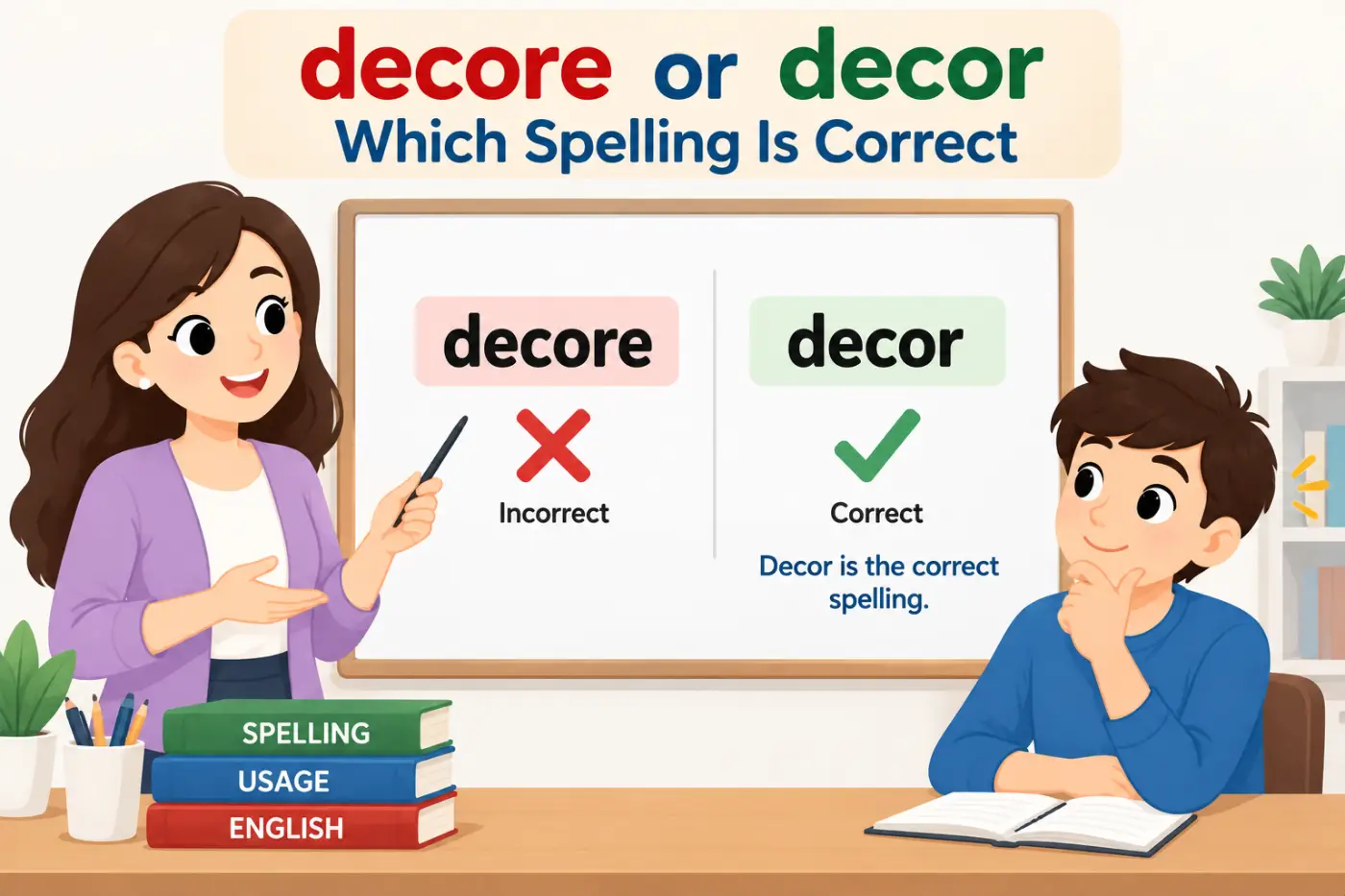
decore or decor can look like a small spelling question but the difference matters if you want your English to look polished. The correct standard English form is decor. Decore is generally a misspelling when you mean the style or decoration of an interior or space.
The confusion makes sense because decor is not pronounced exactly as many English spelling patterns might suggest. The word also comes from French and has a close connection with the longer word decoration. That connection can tempt people to add an extra e at the end. In everyday writing you may see decore in search queries social posts product descriptions or casual messages. Still standard English uses decor.
The good news is that the rule is simple once you connect the word with its meaning. This article explains the definition pronunciation origin grammar usage and regional patterns. You’ll also see practical examples common spelling mistakes related terms and an easy editing trick that can help you remember the correct form.
Quick Definition
Decor is the standard English noun for the style and arrangement of decorative elements in a room building or other space. It can describe furniture colors artwork lighting and other visual details. Decore is usually a misspelling of decor when used with this meaning and is not the standard form in modern English.
Quick Answer
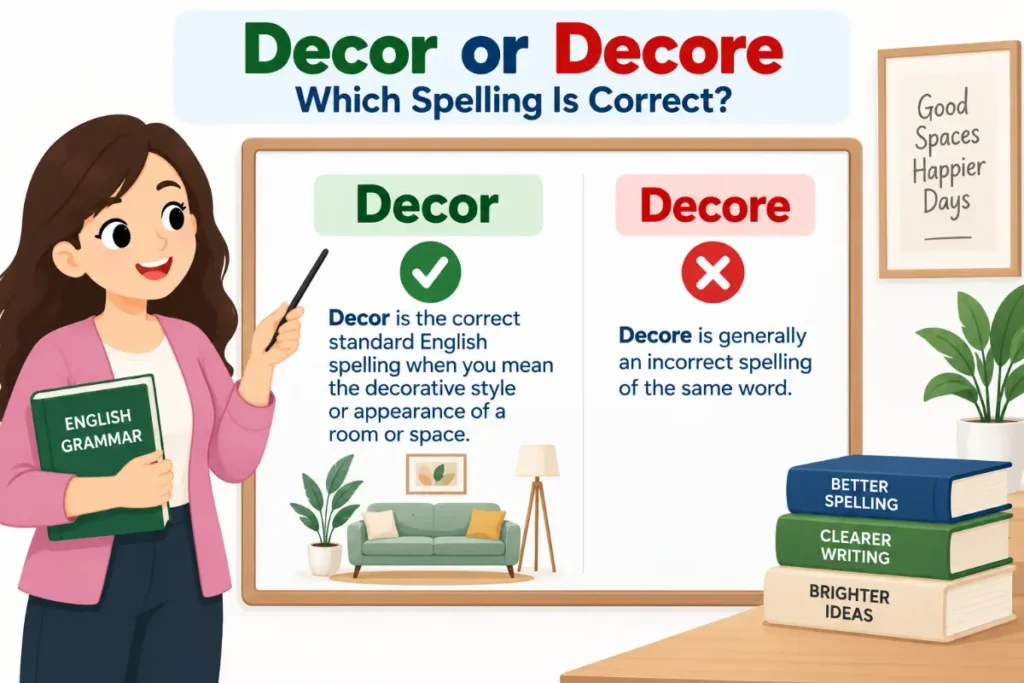
Decor is the correct standard English spelling when you mean the decorative style or appearance of a room or space. Decore is generally an incorrect spelling of the same word.
You can use decor in phrases such as home decor interior decor office decor and modern decor. The word is a noun and commonly refers to the overall visual character created by decorative choices.
Comparison Table
| Correct Form | Meaning | Part of Speech | Origin | Usage Frequency | Formality | Common Contexts | Example |
|---|---|---|---|---|---|---|---|
| Decor | The style or arrangement of decorative elements | Noun | French décor from Latin decōrus | Very common | Neutral | Interior design homes restaurants hotels offices fashion and media | The room has simple modern decor. |
| Decore | Usually intended as a spelling of decor | Nonstandard form | Not a standard spelling of the English noun | Uncommon | Not recommended | Typing errors informal searches and mistaken writing | Decore is usually corrected to decor. |
Meaning and Definition
Meaning of Decore
Decore is generally not the standard English spelling for the decorative style of a room or space. When someone writes decore in this context they usually mean decor.
For example a person might write that a hotel has beautiful decore. The intended word is decor.
The extra e can appear because English speakers often connect the word with decoration decorative and decorate. Those related words all contain an e sound or spelling pattern that can make decore seem reasonable. Yet English does not form this noun as decore.
This is a useful example of why English spelling cannot always be predicted from related words. Words that share a meaning may come from different historical paths. Their modern spellings can preserve those differences.
You may also encounter Decore as part of a proper name or business name. A name can follow its own spelling rules. That special use does not make decore the standard spelling of the general English noun.
If you are writing about the appearance of a room use decor.
Meaning of Decor
Decor is a noun that refers to the decorative style or appearance of an interior or other space.
Imagine walking into a room with cream walls wooden furniture soft lighting and framed artwork. You might describe the decor as warm and traditional. If the room has glass furniture simple lines and neutral colors you might call the decor modern or minimalist.
The word can describe both individual decorative choices and the overall style they create. Context determines the exact sense.
For example:
The restaurant has elegant decor.
The office has colorful decor.
We changed the decor in the living room.
In each sentence decor refers to the visual arrangement and style of the space.
The word appears frequently in interior design home improvement hospitality real estate retail and lifestyle writing. You’ll also hear it in everyday conversation when people talk about how a place looks.
Decor can describe more than homes. A restaurant can have rustic decor. A hotel can have luxurious decor. A theater can have dramatic decor. An office can have professional decor.
The central idea stays the same. Decor describes the visual and decorative character of a place.
Key Differences Explained
- Spelling. Decor is the standard spelling. Decore is generally a misspelling when it refers to interior decoration or style.
- Meaning. Decor refers to decorative style or arrangement. Decore usually carries no separate standard meaning in this context.
- Grammar. Decor functions as a noun. It can act as the subject or object of a sentence.
- Pronunciation. Decor is commonly pronounced with the final sound of the word sounding like core. The spelling does not include a final e.
- Formality. Decor works comfortably in casual speech professional writing marketing copy and interior design writing.
- Context. You can use decor for homes offices hotels restaurants stores and other spaces.
- Regional usage. The standard form remains decor across major varieties of English. Pronunciation can vary slightly but the spelling does not normally change.
- Standard usage. Professional editors and careful writers use decor for the general noun. A special brand or business name may use a different spelling as a proper name.
Which Form Is Correct?
Decor is the correct form for standard English when you mean the decorative style of a room or space.
The spelling comes from the French word décor. English borrowed the word and commonly uses decor without the French accent mark. The shorter form has become well established in American English and appears naturally in interior design writing home improvement discussions real estate descriptions and everyday speech.
The form decore often feels plausible because English contains words such as decorate decoration and decorative. Those related words make the final e look tempting. However decor is its own established borrowing and does not take that ending.
A good dictionary based approach is to check the headword rather than guess from related words. Standard English dictionaries list decor as the noun used for the style or decoration of a room. That established entry is the form you should choose in normal English writing.
There is also a practical test. If you can replace the word with decoration or interior style then decor is almost certainly the form you need.
Sentence Examples
The following examples show how native English speakers naturally use decor.
- The new restaurant has beautiful decor that feels warm and inviting.
- We chose simple decor for the guest bedroom.
- Her living room has modern decor with natural wood and soft lighting.
- The hotel is known for its elegant decor.
- I love the vintage decor in this little cafe.
- They changed the office decor to create a brighter atmosphere.
- The store uses colorful decor to attract attention.
- The apartment has minimalist decor and plenty of open space.
- The wedding venue had elegant decor from the entrance to the dining area.
- The designer helped us choose decor that matched the style of the house.
Here are examples that show the common mistake. These examples are included only to demonstrate the error.
- The room has beautiful decore.
- We spent the weekend choosing new decore.
- The hotel has traditional decore.
- I like the decore in this restaurant.
- She wants modern decore for her apartment.
In all five examples the standard form is decor.
Common Mistakes and Misspellings
The most common problem is adding an unnecessary e. Several spelling patterns can lead writers toward this error.
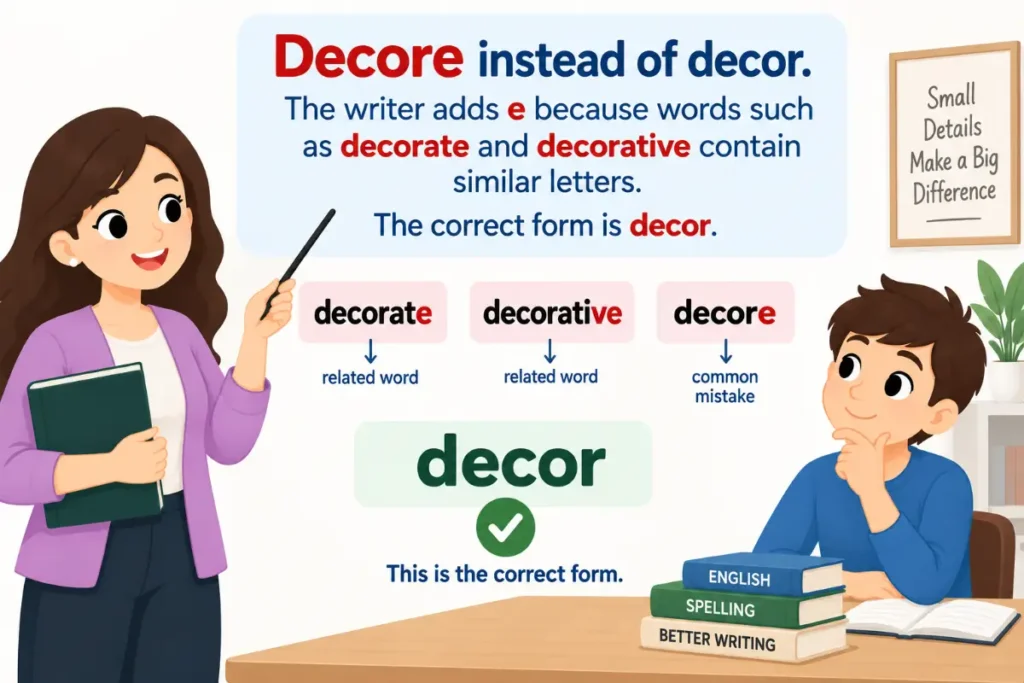
- Decore instead of decor. The writer adds e because words such as decorate and decorative contain similar letters. The correct form is decor.
- Decoré instead of decor. Some writers may add an accent because the word has French origins. English commonly uses decor without the accent mark.
- Decorr instead of decor. This error can happen during fast typing when a writer repeats the final consonant. The standard spelling has one r.
- Dekor instead of decor. A writer may spell the word according to its sound. English spelling does not use k in the standard form.
- Decour instead of decor. This can result from trying to represent the pronunciation with a familiar English spelling pattern. The accepted form remains decor.
These errors show a broader point about spelling. People often build unfamiliar words from familiar patterns. That strategy works sometimes but fails when a word comes from another language and keeps a distinctive spelling.
NLP based spelling systems can often recognize the intended word from surrounding context. A sentence such as The room has beautiful decore gives a strong clue that the writer probably meant decor. Still context recognition does not make the nonstandard spelling suitable for polished writing.
Pronunciation Guide
Decor is commonly pronounced like day core in American English.
A common pronunciation is represented as /deɪˈkɔːr/. Some speakers use a pronunciation closer to /deɪˈkɔː/ depending on accent and speech style.
The word has two main syllable beats:
day COR
The second syllable usually receives the stronger stress.
The first part sounds similar to day. The second part sounds similar to core.
A common mistake is to pronounce the final part as an extra syllable because of the mistaken spelling decore. Standard decor does not normally have a separate final vowel sound.
The pronunciation also explains why some people add e. English readers are used to silent e in many words. Yet the spelling of this borrowed noun does not need a final e.
A useful habit is to learn the sound and spelling together. Say day core and picture the word decor in your mind. That simple connection can prevent the extra letter from sneaking into your writing.
Etymology and Word Origin
Decor has an interesting history because English borrowed it from French.
The French form is décor. It comes from the French tradition of describing the decorative arrangement or appearance of a setting. The French word ultimately traces back to Latin roots associated with what is fitting beautiful or proper.
The English noun decor developed from this French form. Modern English commonly drops the accent mark and writes the word as decor.
The historical relationship explains why the spelling can feel different from related English words such as decoration and decorative. Those words developed through different paths even though they share a broad semantic connection.
This is one reason spelling by analogy can lead you astray. You may know decorate decoration and decorative very well and still need to remember that the shorter borrowed noun is decor.
The French connection also appears in the wider vocabulary of interior design. English has borrowed many terms from French over the centuries. Some retain recognizable French forms while others have become fully naturalized in English.
Today decor is an ordinary English noun. Most speakers do not need to think about its French origin when using it.
Regional Usage
American English
Decor is standard in American English. It appears often in conversations about homes interior design furniture restaurants hotels and offices. American speakers may use it in phrases such as home decor modern decor seasonal decor and office decor.
The spelling remains decor in standard American writing. Decore is generally treated as a spelling error unless it appears as a special name.
British English
British English also uses decor. The word is familiar in interior design and everyday descriptions of rooms and buildings. British writers may encounter the original French form décor as well especially in more formal or design focused contexts.
Still decor without the accent is an established English form. The spelling decore is not a standard British alternative.
Australian English
Australian English uses decor in much the same way as American and British English. The word appears in home design retail hospitality and lifestyle writing. There is no major Australian spelling variant that changes decor into decore.
Canadian English
Canadian English also uses decor as the standard form. Canadian writers can use it naturally in discussions of interior style furniture decoration and architecture. The spelling does not normally change based on Canadian usage.
Across these major varieties of English the main spelling point is consistent. Decor is the standard noun. Decore is generally an error when used for decorative style.
Grammar Rules and Part of Speech
Decor is a noun. It names the decorative style or arrangement of a space.
You can use it as the subject of a sentence.
The decor is beautiful.
You can also use it as the object of a verb.
We changed the decor.
You can place an adjective before it to describe the style.
The room has modern decor.
The restaurant uses rustic decor.
The hotel features elegant decor.
You can also use decor after a possessive noun or possessive pronoun.
I love the hotel’s decor.
Her decor is simple and clean.
Their office decor feels welcoming.
The noun is generally treated as an uncountable noun when you mean the overall decorative style of a space. For example you would normally say The decor is beautiful rather than The decors are beautiful.
However English can use plural forms in specialized contexts when discussing distinct decorative styles or settings. Such uses depend on context and are less common in ordinary conversation.
Another useful distinction is the difference between decor and decoration.
Decor often refers to the overall visual style.
Decoration can refer to an individual decorative object or the act of decorating.
For example:
The room has modern decor.
We bought several decorations for the party.
The first sentence describes the overall appearance. The second refers to individual items.
This distinction makes your writing more precise.
Real Life Usage Examples
Daily Conversation
People often use decor casually when talking about how a room looks.
- I really like the decor in your living room.
- The decor here feels a little too formal for me.
These sentences sound natural because decor has become a familiar everyday noun.
Email and Workplace Communication
Decor can also appear in workplace messages when discussing an office event renovation or customer space.
- We should keep the new office decor simple and professional.
- I attached a few ideas for the lobby decor.
In business writing the word is clear and neutral.
Academic Writing
Academic writing may use decor when discussing architecture design theater film culture or visual presentation.
- The study examines how interior decor influences perceptions of comfort.
- The researchers compared traditional decor with contemporary design elements.
The word works well when the subject involves visual environments.
News and Journalism
Journalists may use decor in stories about restaurants hotels homes fashion or cultural spaces.
- The restaurant combines local food with traditional decor.
- The hotel reopened after a renovation that updated its decor.
The word lets writers describe a visual setting without using a long phrase every time.
Literature and Storytelling
Writers can use decor to establish the feeling of a setting.
- The old library had dark wooden decor and tall shelves.
- The bright decor made the small apartment feel cheerful.
In storytelling the surrounding details matter. A short reference to decor can help readers picture a place without slowing the scene down.
Related and Confused Terms
Several words connect closely with decor but they do not all mean exactly the same thing.
- Decoration. Decoration can mean an object added to make something attractive or the act of decorating. Decor usually refers to the overall style.
- Interior design. Interior design is broader. It can involve layout materials function lighting furniture and visual style. Decor is one part of that larger field.
- Decorative. Decorative is an adjective. It describes something intended mainly to improve appearance.
- Furnishings. Furnishings usually refer to furniture and other useful items placed in a room. They can contribute to decor but they are not identical concepts.
- Style. Style is a broad word that can describe visual character in many areas. Decor specifically focuses on decorative appearance in a setting.
- Ambience. Ambience refers to the overall mood or atmosphere of a place. Decor can influence ambience but the two words are not interchangeable.
- Aesthetic. Aesthetic can describe a particular visual quality or style. It is broader than decor and can apply to art fashion design and other subjects.
- Ornamentation. Ornamentation refers to decorative additions or details. It sounds more formal than decor and is common in discussions of architecture art and historical design.
Knowing these distinctions helps you choose the most precise word. A room’s decor is part of its overall aesthetic and can influence its ambience.
Why The Spelling Causes Confusion
The spelling problem comes from a very natural mental shortcut.
English has a large group of related words built around the idea of decoration. You already know decorate decoration decorative and decorator. Because these words contain similar sounds and meanings it is tempting to assume that the shorter noun should follow the same spelling pattern.
That assumption feels logical but English does not always work that neatly.
Decor entered English through French. The modern form is shorter and keeps a spelling that does not match the full structure of words such as decoration.
There is another source of confusion. Some people may recognize the French spelling décor and assume that English needs an extra vowel after the r. It does not.
The best approach is not to invent a spelling from pronunciation or from related words. Instead learn decor as its own word.
Once you have seen the correct form enough times the spelling becomes automatic.
Decor Compared With Decoration
The difference between decor and decoration deserves special attention because the words are related.
Decor usually describes the overall decorative character of a place.
The hotel has elegant decor.
Decoration often describes something added for visual effect.
The hotel used flowers as decorations.
You can think of decor as the big picture and decoration as a particular element or act.
For example imagine a living room with neutral walls wooden furniture warm lighting and framed artwork. You could describe all those choices together as the room’s decor. If you then mention the vase placed on the table as a decorative object you are talking about a decoration.
This distinction helps avoid repetition too. If you are writing about interior design you can use decor for the overall style and decoration for individual details.
Decor In Formal Writing
Decor is perfectly acceptable in formal writing when the subject calls for it.
You might see it in an interior design article a real estate description a hotel report an architecture discussion or an academic paper about visual environments.
For example:
The building combines historic architecture with contemporary decor.
That sentence sounds natural and professional.
Still you should choose vocabulary based on context. In a highly technical paper you may need more precise terms such as interior treatment visual arrangement or ornamental elements. In most general writing decor is shorter clearer and more natural.
The word should not be avoided simply because it sounds conversational. Good formal writing does not require complicated vocabulary. It requires accurate vocabulary.
Decor In Digital Communication
Online writing has helped make the word even more visible.
People use decor when discussing home projects shopping interior design videos social media posts and room makeovers. Retail websites also commonly use the term when describing products and collections.
That broad exposure means readers are likely to recognize decor immediately.
The incorrect form can still appear because people type quickly or rely on sound. Search systems may understand the intended meaning from context but professional writers should not depend on automatic correction.
If you are publishing an article product description email or social post take a moment to check the spelling. A single extra letter can make otherwise polished writing look careless.
A Simple Memory Trick
The easiest way to remember decor is to connect it with the word core.
Think:
Decor sounds like day core.
The spelling ends with r rather than an extra e.
You can also connect the word with interior style.
If you mean the overall look of a room think decor.
If you mean a particular item added to make a space attractive think decoration.
That gives you both the spelling and the meaning.
A second useful trick is to picture the word in a phrase you already know.
Home decor.
Modern decor.
Holiday decor.
Office decor.
Once you become familiar with these combinations the standard spelling starts to feel natural.
Expert Editor Insight
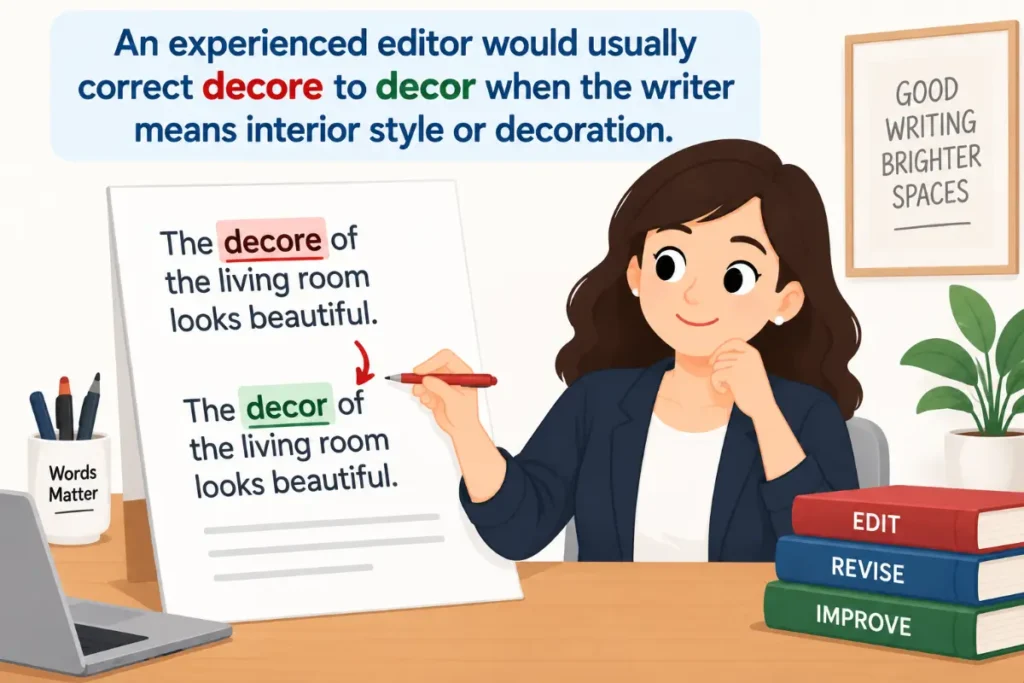
An experienced editor would usually correct decore to decor when the writer means interior style or decoration. The mistake is easy to understand because decorate decoration and decorative all look related and the French origin can make the spelling less predictable. Professional editing tools may flag the extra e as a spelling error while context based systems can often infer the intended word. The best practical habit is to remember that the standard noun ends with r and to treat decor and decoration as related but distinct words.
Conclusion
decore or decor has a clear answer. Decor is the standard English spelling for the decorative style or appearance of a room or space. Decore is generally a misspelling when used with that meaning. The correct form is short and ends with r.
The word works naturally in everyday speech as well as professional writing. You can use it to describe homes restaurants hotels offices stores and many other settings. It is closely related to words such as decoration decorative and interior design but it has its own specific spelling and use.
For an easy memory trick think of decor as day core. Keep the ending short and leave out the extra e. That small habit can save you from one of the most common spelling mistakes associated with this useful design word.
FAQs
Is Decore A Real English Word?
Decore is generally not the standard English word for the decorative style of a room. In that context it is usually a misspelling of decor. You may find Decore used as a proper name or part of a business name. Such special uses depend on the name itself and do not change the standard English spelling of the general noun.
What Does Decor Mean?
Decor means the decorative style or overall visual arrangement of a room or space. It can include colors furniture lighting artwork materials and other design choices. For example modern decor describes a modern visual style. The noun can apply to homes offices restaurants hotels stores and other places where appearance and atmosphere matter.
Which Is Correct Decore Or Decor?
Decor is the correct standard form when you mean the decorative style of a space. Decore is generally a spelling mistake in this context. The standard English noun comes through French and is commonly written decor without the original accent. If you are writing about interior style use decor in normal English communication.
How Do You Pronounce Decor?
Decor is commonly pronounced like day core in American English. A common IPA representation is /deɪˈkɔːr/. The second syllable normally receives the main stress. The word has two main syllables and does not need an extra final vowel sound. Thinking of the pronunciation as day core can help you avoid adding an unnecessary e.
Is Decor Formal Or Informal?
Decor works in both informal and formal English. People use it in everyday conversation when discussing their homes and also in professional writing about interior design real estate hospitality architecture and retail. It is a normal established English noun. You do not need to replace it with a more complicated word simply to make your writing sound formal.
What Is A Synonym For Decor?
Useful alternatives include decoration interior style interior design aesthetic furnishings ornamentation and visual style. These words do not always mean exactly the same thing. Decor usually describes the overall decorative appearance of a space. Decoration can refer to individual decorative elements. Interior design is broader because it can include layout function materials and lighting as well as appearance.
Why Do People Spell Decor As Decore?
People often add the final e because they connect the word with decorate decoration and decorative. Those familiar words create a strong spelling pattern in the mind. The French origin of decor can also make its spelling less predictable. Another factor is pronunciation. Some writers add letters that seem to match how they think the word should look.
Is Decor Appropriate In Professional Writing?
Yes. Decor is completely suitable for professional writing when the topic involves interior style decoration or visual presentation. You can use it in business emails reports articles real estate descriptions hospitality materials and design writing. The key is precision. Use decor for the overall decorative character of a space and choose terms such as decoration when you mean specific decorative objects.
