
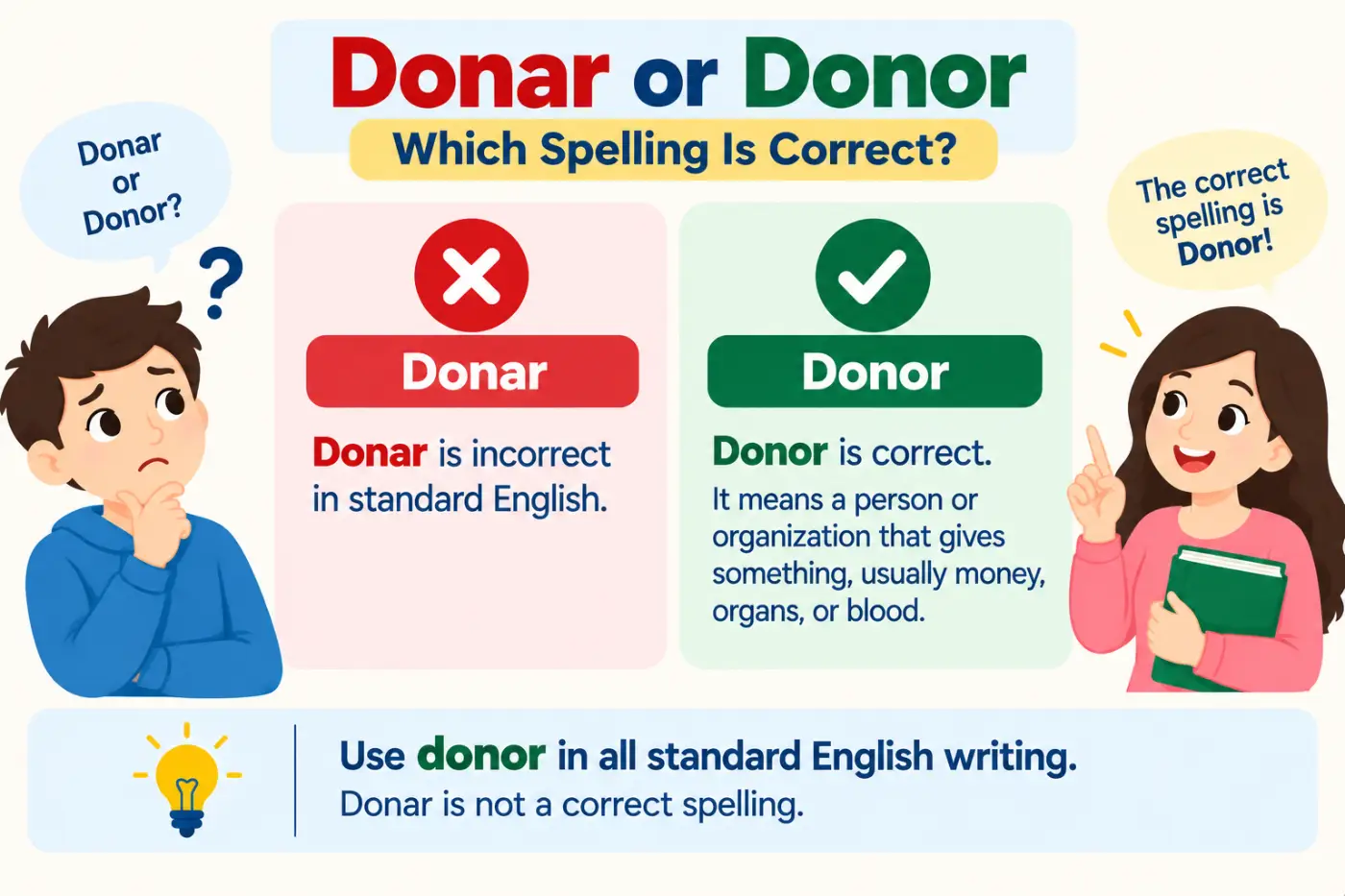
Donar or donor can look like a small spelling choice but only one form is the standard English word for a person or organization that gives something. Donor is the correct spelling in standard English. Donar is generally a misspelling when the intended meaning is someone who gives money blood organs property or another contribution. The difference is only one letter yet that single letter changes the standard form.
The confusion is easy to understand. The word donor is pronounced in a way that can make the final vowel sound less obvious to some writers. People may also connect the word with related forms such as donate and donation. That connection can lead someone to write donar because the spelling feels closer to the verb donate. English spelling often creates these little traps because related words don’t always keep the exact same letter pattern.
In this article you’ll learn what donor means how it works grammatically how to pronounce it and where it comes from. You’ll also see practical examples from everyday speech medical settings charities workplaces academic writing and journalism. Most importantly you’ll have a simple way to remember the correct spelling and avoid the common error.
Quick Definition
Donor is the standard English noun for a person or organization that gives something to another person or group. The gift may be money blood an organ property or another resource. Donar is normally a misspelling of donor when the intended meaning is a person who gives something.
Quick Answer
Donor is the correct standard English spelling. Donar is normally an incorrect spelling when you mean a person or organization that gives something. A donor can give money blood an organ property time or another valuable resource. For example you can say The blood donor helped save a patient’s life.
Comparison Table
| Correct Form | Meaning | Part of Speech | Origin | Usage Frequency | Formality | Common Contexts | Example |
|---|---|---|---|---|---|---|---|
| Donor | A person or organization that gives something | Noun | From Latin donor meaning giver through French and English | Very common | Neutral and formal | Charity medicine blood donation organ donation fundraising | The donor gave money to the hospital. |
| Donar | No standard English meaning in this context | Usually a misspelling | Not the standard English form of donor | Uncommon as a correct English word | Nonstandard | Typing errors spelling mistakes | Donar should be corrected to donor. |
Meaning and Definition
Meaning of Donar
In standard English donar isn’t the normal spelling for the noun meaning a person who gives something.
If someone writes The donar gave money to the charity the intended meaning is clear to most readers. However the spelling is still incorrect in standard English. A spellchecker may flag it and a professional editor would normally change it to donor.
There can be unusual cases where Donar appears as a name or part of a proper noun in another language. A foreign language can also have its own vocabulary and spelling rules. Those situations don’t change the standard English noun used for someone who gives money blood organs or other resources.
For ordinary English writing use donor.
Meaning of Donor
Donor is a noun that refers to someone who gives something. The word often appears when the thing being given has value or is intended to help another person organization or cause.
A donor may give money to a charity. A blood donor gives blood. An organ donor gives an organ for transplantation. A donor may also give property equipment or another asset.
The word can describe an individual or an organization.
For example:
The donor contributed $500 to the community center.
The first sentence describes an individual contribution. An organization can also act as a donor.
The company became a major donor to the scholarship program.
The word has a broad meaning because the thing being given changes with the context. You don’t need a special noun for every kind of giver. Instead English uses donor with a descriptive phrase when more detail is needed.
Common combinations include blood donor organ donor tissue donor sperm donor egg donor financial donor charitable donor political donor and anonymous donor.
The noun also appears in scientific and medical language. In those settings it can describe the source of biological material or an organ intended for another person.
Key Differences Explained
- Spelling. Donor is the standard English spelling. Donar is normally an error when the intended word is donor.
- Meaning. Donor means a person or organization that gives something. Donar doesn’t normally carry this meaning in standard English.
- Part of speech. Donor is a noun. It identifies the giver rather than the act of giving.
- Pronunciation. Donor is commonly pronounced with a first syllable that sounds like dawn or don depending on the speaker and accent followed by an unstressed sound.
- Formality. Donor works in casual conversation as well as formal writing. It is especially common in medical legal charitable academic and financial contexts.
- Context. The word can describe people who give money blood organs property or other resources.
- Regional usage. Major varieties of English use donor as the standard form. The spelling doesn’t normally change between American British Canadian and Australian English.
- Standard usage. Professional writing should use donor when referring to someone who gives something.
Why The Spelling Causes Confusion
The relationship between donor donate and donation is probably the biggest reason people hesitate over the spelling.
Consider these words:
Donate
Donation
Donor
They all belong to the same word family. Yet they don’t share the same ending.
Donate is a verb.
Donation is a noun describing the act or amount given.
Donor is a noun describing the person or organization that gives.
This distinction matters because English often builds related words through different historical patterns. You can’t always create a noun by simply changing the ending of a familiar word.
For example:
The charity received a donation.
The charity asked people to donate.
These three words are closely connected but they have different grammatical jobs.
That makes donor worth learning as its own word rather than trying to derive its spelling from donate.
Which Spelling Is Correct
Donor is the correct standard English form for someone who gives something.
The spelling comes from the historical word family associated with giving. The word entered English through French from Latin donor meaning giver. Its history is closely related to Latin donare meaning to give.
That history helps explain why donor doesn’t follow the spelling pattern someone might expect from donate.
Standard dictionaries treat donor as a noun. The word has established meanings across general English and specialized fields. Medical professionals use it when discussing blood and organs. Charities use it for people who provide financial support. Academic and news writing also use it naturally.
An editor should therefore treat donar as a spelling error when it appears in a normal English sentence with this intended meaning.
Sentence Examples
Here are natural examples showing how donor works in different settings.
- The donor gave enough money to fund the new library.
- Every blood donor must complete a health screening before giving blood.
- The charity thanked each donor for supporting the project.
- An anonymous donor paid for the family’s medical expenses.
- The hospital is looking for a suitable organ donor.
- She became a regular donor after learning how much her contribution could help.
- The scholarship was created by a generous donor.
- The organization received support from several private donors.
- The donor asked the charity to use the money where it was needed most.
- His contribution made him one of the foundation’s largest donors.
Here are examples showing the common misspelling for learning purposes.
- The donar gave money to the charity.
- The hospital thanked the donar for the blood donation.
- A generous donar funded the scholarship.
- The charity contacted every donar after the event.
- The donar requested that the gift remain anonymous.
Each sentence should use donor instead of donar.
Common Mistakes and Misspellings
Donar instead of donor
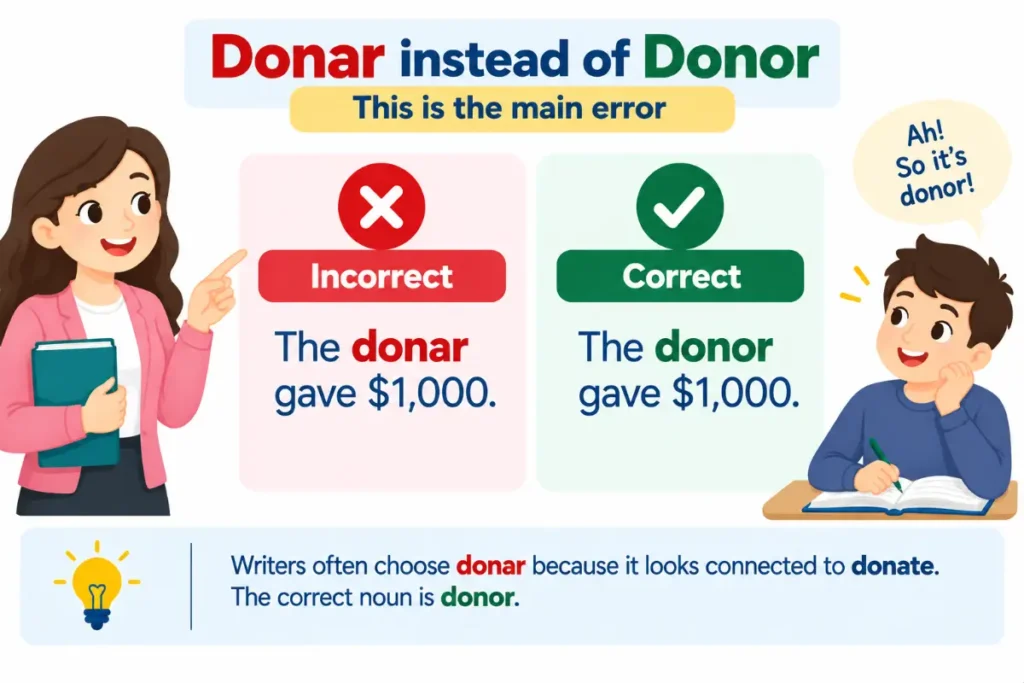
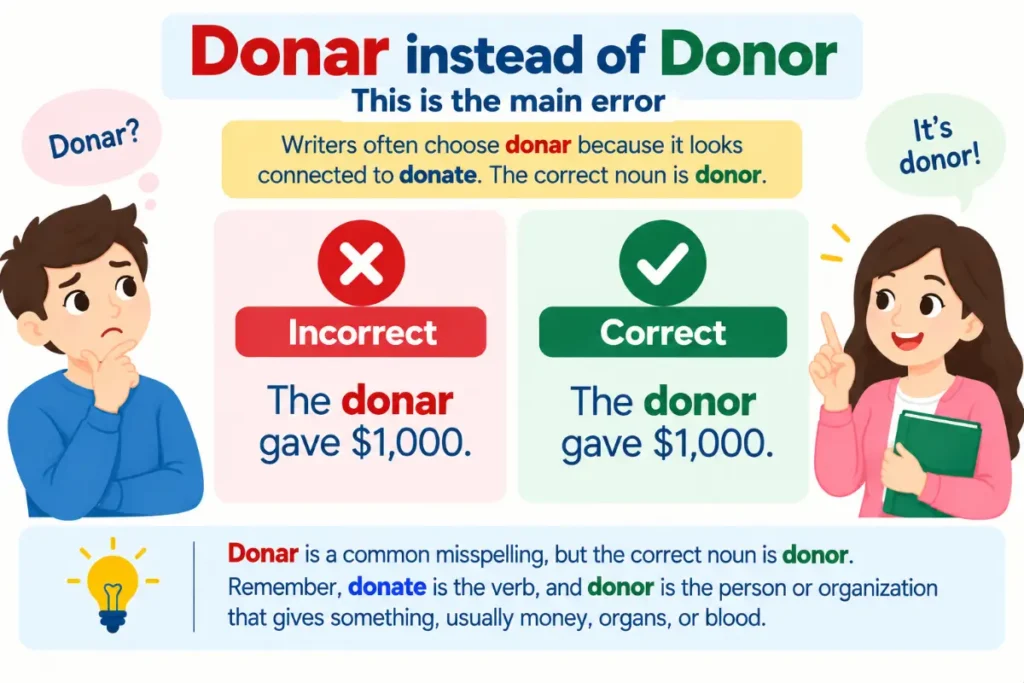
This is the main error. Writers often choose donar because it looks connected to donate. The correct noun is donor.
Incorrect: The donar gave $1,000.
Correct: The donor gave $1,000.
Doner instead of donor
Doner can create a different kind of confusion. In English food vocabulary a doner can refer to doner kebab. It is therefore not simply another spelling of donor.
Incorrect for the intended meaning: She became a blood doner.
Correct: She became a blood donor.
Donator instead of donor
Donator exists in English but it is far less common than donor and can sound awkward in many contexts. When you mean a person who gives money or another contribution donor is usually the natural choice.
Natural: The donor supported the charity.
Less natural: The donator supported the charity.
Donation instead of donor
These words describe different things. A donor is the giver. A donation is the thing given or the act of giving.
The donor gave a donation.
The sentence works because the person and the contribution have different roles.
Donate instead of donor
Donate is a verb. Donor is a noun.
You can say:
She decided to donate blood.
You can also say:
She became a blood donor.
You can’t normally replace one with the other because they perform different grammatical functions.
Pronunciation Guide
Donor is commonly pronounced /ˈdoʊnər/ in American English.
You can think of the pronunciation as:
DOH ner
The first syllable receives the main stress. The second syllable has a relaxed sound similar to the final sound in other common English words ending in er.
The American pronunciation usually begins with the long o sound found in words such as go and home.
A common mistake is to pronounce every written letter too strongly. Natural English pronunciation reduces unstressed sounds. The second syllable is usually much weaker than the first.
Donar doesn’t represent the standard spelling of this noun even if a writer thinks the a might better match the pronunciation of a related word.
The best approach is to learn the sound and spelling together.
Say:
Donor
Then connect it with:
A person who gives.
That mental pairing helps prevent the spelling mistake.
Etymology and Word Origin
Donor has an old linguistic history connected with the idea of giving.
The word traces back to Latin donor which meant giver. It is connected to the Latin verb donare meaning to give or present. From this Latin word family the term developed through French before becoming established in English.
The same broad Latin family appears in English words connected with giving such as donate and donation.
This is a useful example of how English word families work. Words can share a historical root while developing different forms and meanings.
Donor refers to the giver.
Donate describes the act of giving.
Donation refers to the gift or act of donating.
Understanding this relationship can make the vocabulary easier to remember. It also explains why spelling donor as donar doesn’t fit the standard English form.
Regional Usage
American English
American English uses donor as the standard spelling. The word appears frequently in healthcare charity fundraising education and everyday discussions about giving.
Common phrases include blood donor organ donor major donor and anonymous donor.
The word can describe a person or an organization. For example a foundation can become a major donor to a university.
British English
British English also uses donor as the standard spelling. There is no major spelling difference between American and British English for this word.
British speakers use it in medical charitable academic and general contexts.
Australian English
Australian English follows the same standard spelling. Donor is used in healthcare charity fundraising and community contexts.
The spelling doesn’t normally change to donar.
Canadian English
Canadian English also uses donor. The word appears in both formal and everyday writing and carries the same basic meaning found in American and British English.
Across these major English varieties donor remains the standard form.
Grammar Rules and Part of Speech
Donor is a noun. It names a person or organization that gives something.
You can use it as a singular countable noun.
The donor arrived at the hospital.
You can also use the plural form donors.
Several donors supported the project.
The noun often appears before another noun to provide more information.
For example:
Blood donor.
Organ donor.
Major donor.
Anonymous donor.
Corporate donor.
You can also use a prepositional phrase after the noun.
The donor to the charity requested privacy.
However a more natural construction in many situations would be:
The donor gave money to the charity.
The word donor can also function in compound terms related to medicine and science.
An organ donor is someone who provides an organ for transplantation.
A blood donor is someone who gives blood.
A stem cell donor provides cells for a medical procedure.
The grammatical distinction between donor and donation is especially useful.
A donor is the giver.
A donation is the gift.
Compare these sentences:
The donor gave $1,000.
The donation was $1,000.
Both sentences refer to the same event but identify different parts of it.
Donate is different again because it is a verb.
The donor decided to donate $1,000.
The donation helped the charity.
This three way distinction makes the word family much easier to use correctly.
Formal And Informal Usage
Donor is suitable for formal writing and ordinary conversation.
In everyday speech someone might say:
She’s a regular blood donor.
In a formal report you might see:
The organization received contributions from several major donors.
The word doesn’t sound overly technical by itself. Its tone depends largely on the context.
In medical writing donor can be highly specific.
The transplant team identified a compatible donor.
In charity writing it can sound appreciative.
The foundation recognized its longtime donors.
In journalism it can describe financial or political support.
The campaign received substantial support from private donors.
Because the word works across so many settings you don’t need to replace it with a simpler expression unless the context calls for one.
Real Life Usage Examples
Daily Conversation
- My sister has been a blood donor for years.
- The donor wanted to help without receiving any public recognition.
In conversation the word often appears around blood donation charity work or personal giving.
Email And Workplace Communication
- We would like to thank every donor who supported this year’s community program.
- The development team will send a receipt to each donor after the contribution is processed.
These examples show how the noun fits naturally into professional communication.
Academic Writing
- The study examined factors that influence long term donor participation.
- Researchers compared donation patterns among different groups of donors.
Academic writing often uses donor when discussing research funding medical studies or donation behavior.
News Writing
- An anonymous donor contributed several million dollars to the hospital.
- Officials said the new center was funded partly by private donors.
News reports use donor when identifying financial support or medical contributions.
Literature And Storytelling
- The old man became an unexpected donor to the struggling village.
- Nobody knew the identity of the donor who had quietly paid the family’s bills.
In storytelling the word can carry a sense of generosity mystery or sacrifice depending on the scene.
Related And Confused Terms
Donate
Donate is a verb meaning to give something voluntarily. It describes the action.
The couple decided to donate money to the shelter.
Donation
Donation is a noun referring to something given or the act of giving.
The charity received a large donation.
Giver
Giver is a broad everyday word for someone who gives something. It sounds less specific than donor.
Contributor
Contributor describes someone who provides money effort ideas material or another form of support. It can overlap with donor but has a broader range.
Benefactor
Benefactor refers to someone who provides help or financial support to another person or organization. The word often has a more formal tone.
Sponsor
Sponsor usually refers to a person or organization that provides financial or other support for a particular event project person or activity.
Recipient
Recipient is the opposite side of the transaction. It describes the person or organization receiving something.
The donor gives.
The recipient receives.
Donation
Donation describes the thing given or the act of giving rather than the person who gives it.
Keeping these distinctions clear prevents many grammar mistakes.
Donor And Donation In One Sentence
A useful way to remember the vocabulary is to put the related words together.
The donor made a donation after deciding to donate money.
Each word has a different job.
Donor is the person.
Donation is the gift.
Donate is the action.
This pattern is useful in both speaking and writing. If you can identify the person the action and the thing involved you can usually choose the right form without hesitation.
How To Remember The Correct Spelling
The simplest memory trick is to connect donor with the word giver.
A donor is a giver.
The spelling has one o after the d and another o before the r.
Think:
donor = giver
Then keep the spelling separate from donate.
Donate ends with ate.
Donation ends with ation.
Donor ends with or.
Trying to force all three words into the same spelling pattern is what creates much of the confusion.
Another useful trick is to remember common compound forms such as blood donor and organ donor. Once you’ve seen these expressions often enough the standard spelling becomes visually familiar.
When To Use Donor
Use donor when you need to identify the person or organization that gives something.
Use it for money:
The donor gave $2,000 to the school.
Use it for blood:
The blood donor completed the required screening.
Use it for organs:
The patient received an organ from a suitable donor.
Use it for organizations:
The foundation became a major donor to the university.
Use it for anonymous giving:
The donor asked to remain anonymous.
The word is flexible because the object of the giving can change while the noun remains the same.
When To Use Donate
Use donate when the sentence needs a verb.
The organization encourages people to donate.
She decided to donate blood.
They donated books to the school.
Notice that the person can be the subject while donate describes the action.
You wouldn’t say:
She donor blood.
You would say:
She donates blood.
The noun and verb have different grammatical functions even though they belong to the same word family.
When To Use Donation
Use donation when you need a noun for the thing given or the act of giving.
The charity received a donation.
His donation helped pay for the equipment.
The school announced a large donation.
This distinction is particularly useful in formal writing because unclear word choice can make an otherwise good sentence sound awkward.
Common Search Confusions
People searching for the correct spelling may also encounter related questions about doner donor donate and donation.
The spelling doner can refer to a food term in English usage. It isn’t the standard noun for someone who gives money or blood.
The spelling donar is usually an error for donor in this context.
The word donate is the verb.
The word donation is the noun for the gift or act of giving.
Once these four forms are separated by meaning and grammar the confusion becomes much easier to manage.

Expert Editor Insight
From an editing perspective the most useful correction is to look at the role the word plays in the sentence before checking its spelling. If the sentence describes a person or organization that gives something use donor. If it describes the gift use donation. Editors also watch for donar and doner because both can appear as visual substitutions during fast typing. Spellcheck tools usually catch the nonstandard form but context based proofreading remains valuable because software can miss unusual names and specialized terms.
Conclusion
Donar or donor has a straightforward answer. Donor is the correct standard English spelling when you mean a person or organization that gives something. Donar is normally a misspelling in this context. The correct noun appears in everyday speech as well as medical charity academic workplace and news writing.
The easiest way to keep the forms straight is to remember the three related words by their jobs. Donor is the giver. Donate is the action. Donation is the gift or contribution. Once you separate those roles the spelling becomes much easier to remember and use naturally.
As a practical editing tip remember donor equals giver. If you’re talking about the person or organization providing something use donor. If you’re describing the act use donate and If you’re talking about what was given use donation. That simple distinction will prevent most errors.
FAQs
Is donar a real English word?
Donar isn’t the standard English spelling for a person who gives something. In ordinary English writing it is generally a misspelling of donor. A proper name or word from another language could use the spelling for a separate reason but that doesn’t make it an alternative English spelling of donor. For standard English use donor when referring to a giver.
What does donor mean?
Donor means a person or organization that gives something to another person or group. The gift may be money blood an organ property or another resource. The word appears in many fields including medicine charity fundraising education and finance. For example a blood donor gives blood while a charitable donor provides financial or other support to a cause.
Which is correct donor or donar?
Donor is the correct standard English spelling for someone who gives something. Donar is normally a spelling error in this context. The confusion may come from related words such as donate and donation which have different endings. Remember that donor names the giver while donate describes the action and donation names the gift or contribution.
How do you pronounce donor?
Donor is commonly pronounced /ˈdoʊnər/ in American English. A simple approximation is DOH ner with the main stress on the first syllable. The second syllable is weaker and relaxed. Different English accents can produce small differences in vowel quality but the standard word remains donor. Learning the sound together with the spelling can make the word easier to remember.
Is donor a noun or a verb?
Donor is a noun. It identifies the person or organization that gives something. Donate is the related verb. For example you can say The donor gave money and The donor decided to donate money. Donation is another related noun that refers to the gift or act of giving. Knowing these grammatical roles helps you choose the right word.
What is the difference between donor and donation?
A donor is the person or organization that gives something. A donation is the thing given or the act of giving. For example the donor gave a donation to the hospital. The donor identifies the giver while donation identifies the contribution. These words are closely related but they can’t always replace one another because they have different grammatical roles.
Why do people spell donor as donar?
The error probably comes from the close relationship between donor and words such as donate and donation. Writers may expect the noun for a giver to follow the spelling of the verb. Fast typing and pronunciation can add to the confusion. The best solution is to memorize donor as its own noun and connect it with the simple meaning of giver.
Is donor appropriate in formal writing?
Yes. Donor is completely appropriate in formal writing and appears naturally in medical reports academic papers charity communications financial discussions and news writing. It isn’t limited to formal contexts either. You can use it in everyday conversation. If you need to describe someone who gives money blood organs or another resource donor is usually the clearest standard choice.
