
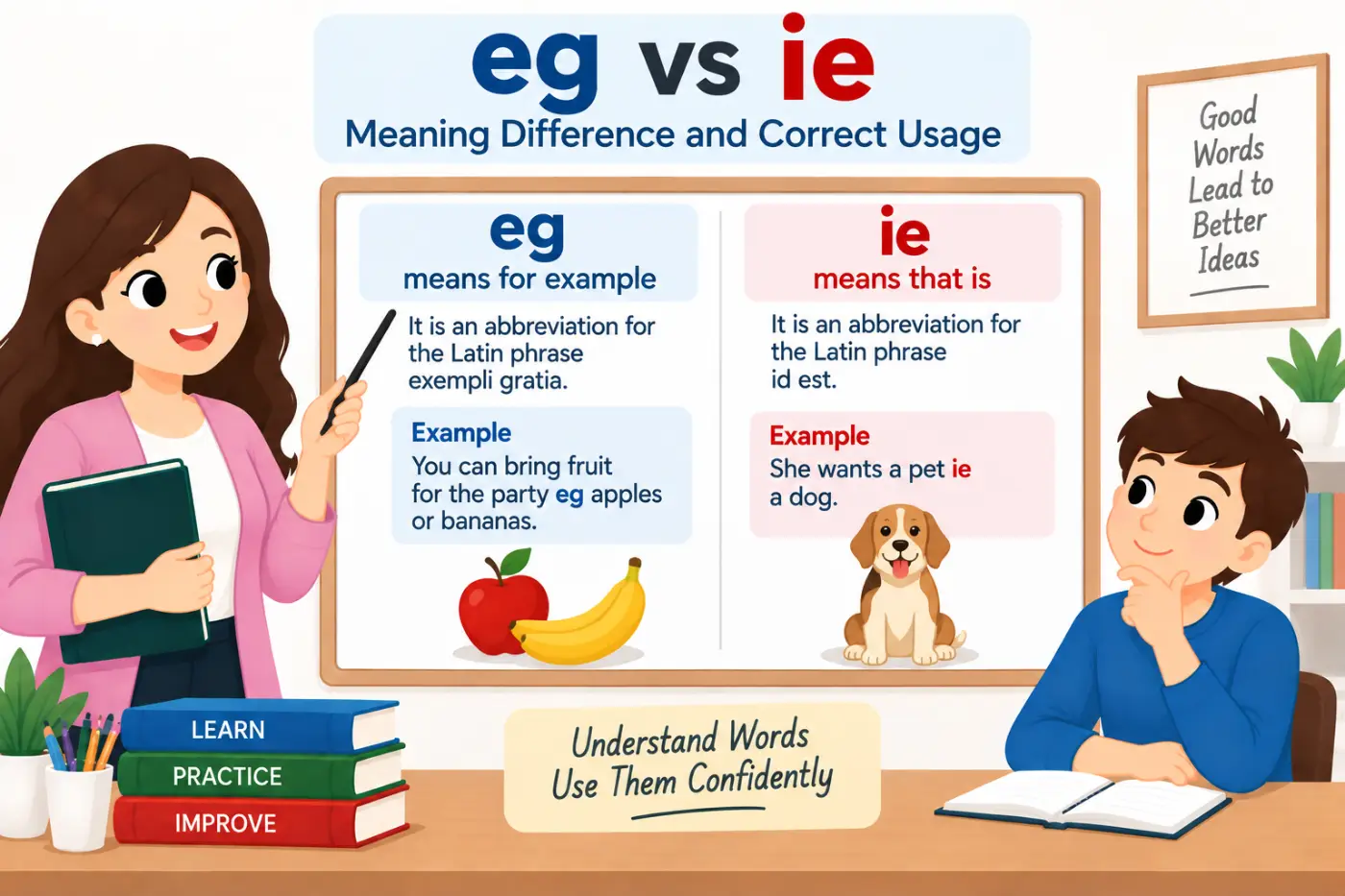
The difference between eg vs ie can seem tiny because both are short Latin abbreviations that appear inside ordinary English sentences. The key is simple: e.g. gives examples while i.e. clarifies or restates exactly what you mean. Once you understand that distinction the two forms become much easier to use.
The confusion often comes from their similar appearance and the fact that both can introduce extra information. Many writers also remember that one means something like for example and the other means something like that is but forget which abbreviation matches which meaning. Punctuation adds another small layer of confusion because style guides differ on details such as periods and comma placement.
The good news is that you don’t need to memorize Latin grammar to use these forms correctly. You only need to understand the job each abbreviation performs in a sentence. This guide explains their meanings origins punctuation grammar pronunciation common mistakes and everyday usage so you can choose the right form without second guessing yourself.
Quick Definition
E.g. means for example and introduces one or more examples that belong to a larger group. I.e. means that is or in other words and introduces a clarification or more exact restatement of the preceding idea. A useful memory trick is to connect e.g. with example and i.e. with in essence or in other words.
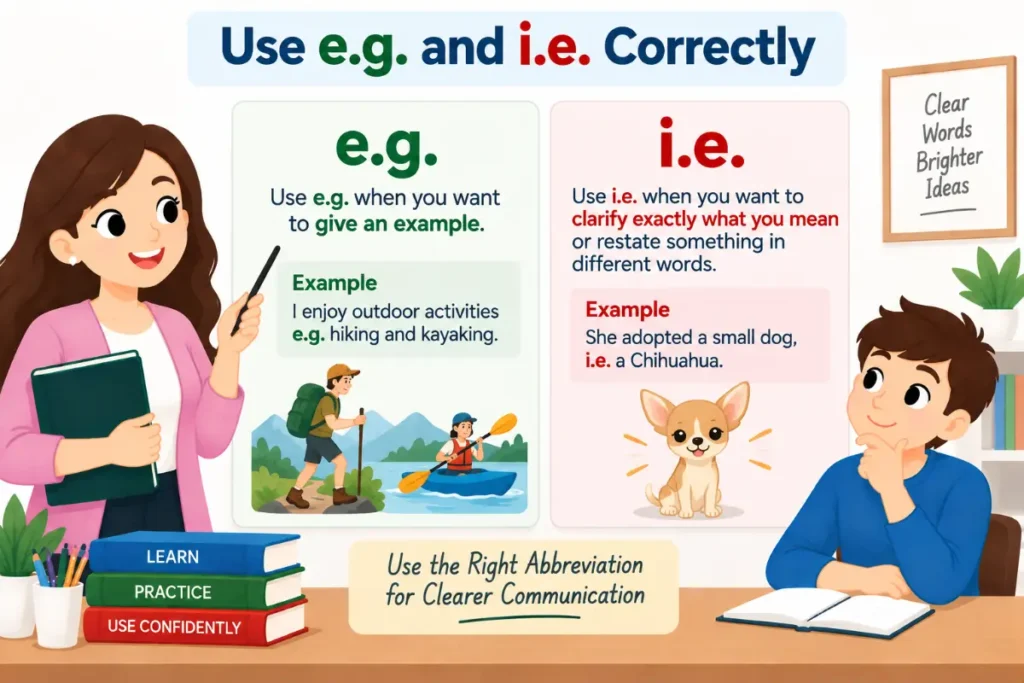
Quick Answer
Use e.g. when you want to give an example.
Use i.e. when you want to clarify exactly what you mean or restate something in different words.
For example:
I enjoy outdoor activities e.g. hiking and kayaking.
I enjoy one outdoor activity i.e. hiking.
The first sentence offers examples. The second identifies the specific activity being discussed.
Comparison Table
| Form | Meaning | Part of Speech | Origin | Usage Frequency | Formality | Common Contexts | Example |
|---|---|---|---|---|---|---|---|
| E.g. | For example | Latin abbreviation | Latin exempli gratia | Very common in writing | Neutral to formal | Essays emails reports instructions | Bring outdoor gear e.g. boots and a jacket. |
| I.e. | That is or in other words | Latin abbreviation | Latin id est | Very common in writing | Neutral to formal | Essays reports explanations instructions | Bring your best gear i.e. the equipment you trust most. |
Meaning and Definition
Meaning of E.g.
E.g. comes from the Latin phrase exempli gratia which means for the sake of an example.
In modern English it functions as an abbreviation that introduces examples. The examples usually represent only some members of a larger group.
Consider this sentence:
You can use several forms of transportation e.g. buses trains and bicycles.
The writer isn’t saying that buses trains and bicycles are the only possible forms of transportation. They are simply examples.
That distinction matters.
If someone tells you to bring writing supplies e.g. a notebook pens and a pencil the list gives you some possible items. You may also need other supplies depending on the situation.
E.g. therefore has an open quality. It points toward examples without necessarily creating a complete list.
You’ll often find it in academic writing technical documents instructions workplace communication and explanatory prose. In casual American English many writers simply use for example because it sounds more natural in ordinary conversation.
Meaning of I.e.
I.e. comes from the Latin phrase id est which means that is.
In modern English it introduces a clarification. You can often replace it with that is or in other words.
Consider this sentence:
The meeting is on the first business day of the month i.e. Monday.
The writer is identifying exactly what the phrase means in the specific context.
Here’s another example:
She wants to visit the largest city in the state i.e. the state capital.
The second part is intended as a clarification of the first statement.
Unlike e.g. which introduces possibilities i.e. narrows or restates the meaning.
That is the heart of the distinction.
If you can replace the abbreviation with for example then e.g. is probably right. If you can replace it with that is or in other words then i.e. is probably the better choice.
Key Differences Explained
- E.g. introduces examples. It points from a broad category toward selected members of that category.
- I.e. introduces clarification. It explains exactly what the writer means by the preceding statement.
- E.g. keeps the category open. The examples usually represent only some possibilities.
- I.e. narrows the meaning. The information after it is presented as an exact explanation or restatement.
- E.g. connects with example. The letters e and g come from the Latin words exempli gratia.
- I.e. comes from id est. The letters i and e represent the Latin phrase that is.
- E.g. often works like for example. You can mentally substitute those words when checking your sentence.
- I.e. often works like in other words. That substitution can help you test the intended meaning.
- Neither abbreviation is a verb or noun. Both are abbreviations borrowed from Latin and used within English sentences.
- Both can appear in formal writing. However many style guides recommend spelling out for example and that is in ordinary prose when readability matters.
Which Form Is Correct?
Both forms are correct. The choice depends on the meaning of the sentence.
Use e.g. when you’re giving examples from a broader category.
You might write:
Many fruits contain vitamin C e.g. oranges strawberries and kiwi.
You aren’t claiming that those are the only fruits containing vitamin C. You’re providing examples.
Use i.e. when you’re explaining or narrowing the previous statement.
You might write:
The store closes on the final weekday of the month i.e. Friday.
Here the second part identifies what the writer means by final weekday in the particular situation.
The distinction is semantic rather than grammatical. Both abbreviations can introduce additional information but they perform different jobs.
A reliable editing test is to replace the abbreviation with plain English.
If for example makes sense use e.g.
If that is or in other words makes sense use i.e.
This test works because it focuses on meaning instead of appearance. You don’t have to remember the Latin phrases every time you write.
How To Remember The Difference
The easiest memory trick uses the letters themselves.
E.g. equals example.
The e reminds you of example.
I.e. equals in other words.
The i can remind you of in other words. This isn’t the historical meaning of the Latin phrase but it’s a useful English memory aid.
Another way to picture the difference is to imagine a funnel.
E.g. opens the funnel. It moves from a general idea toward a few examples.
I.e. tightens the funnel. It moves from a general statement toward a specific explanation.
Imagine that your sentence says you enjoy winter sports. You could add e.g. skiing snowboarding and ice skating because those are examples.
If you say your favorite winter sport is the one that involves a board and snow i.e. snowboarding you’re clarifying exactly which activity you mean.
This simple mental picture can save you from one of the most common abbreviation mistakes in formal writing.
Sentence Examples
Here are examples where e.g. is the natural choice.
- You can bring a small snack e.g. fruit nuts or a granola bar.
- Several programming languages e.g. Python Java and C are widely used.
- Try low impact exercises e.g. walking swimming or cycling.
- Some household tasks e.g. cleaning and laundry can be done on weekends.
- We sell office supplies e.g. notebooks folders and pens.
Now look at examples where i.e. provides clarification.
- The store is closed on the first weekday after the holiday i.e. Tuesday.
- She wants to study one subject i.e. biology.
- The final payment is due next month i.e. June.
- Please meet me at the usual location i.e. the main entrance.
- He chose the simpler option i.e. the plan with fewer steps.
The difference becomes clearer when you ask one question: Is the information after the abbreviation an example or an exact explanation?
That single question often solves the problem immediately.
Common Mistakes and Misspellings
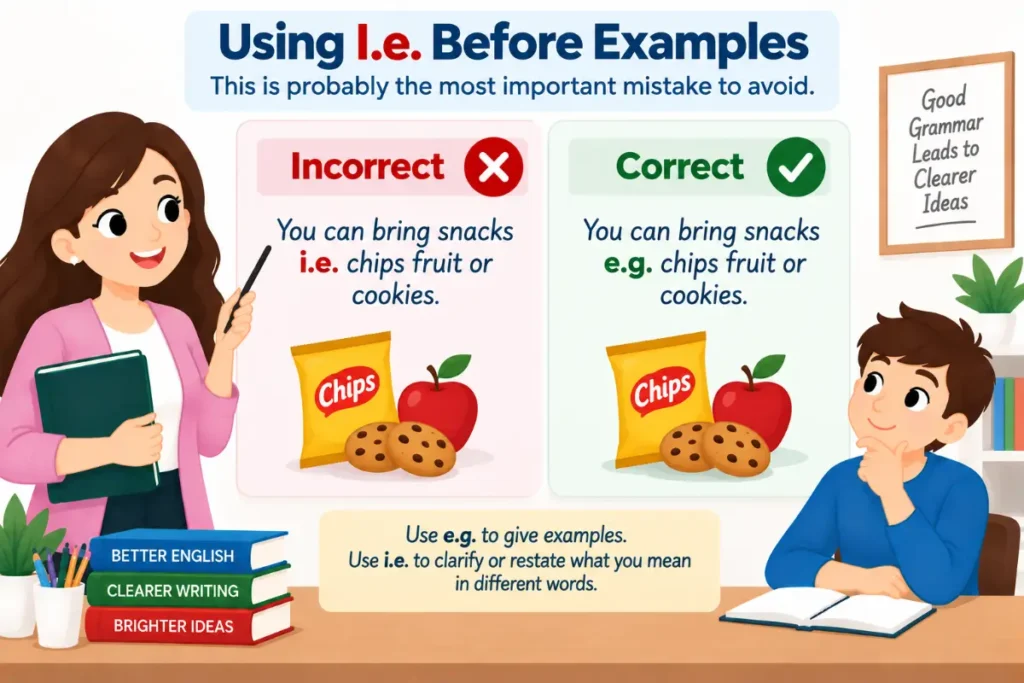
Using I.e. Before Examples
This is probably the most important mistake to avoid.
Incorrect:
You can bring snacks i.e. chips fruit or cookies.
If chips fruit and cookies are examples of snacks the correct choice is e.g.
Correct:
You can bring snacks e.g. chips fruit or cookies.
The writer is presenting several possible members of a larger category.
Using E.g. Before An Exact Restatement
Incorrect:
The appointment is tomorrow e.g. Wednesday.
If Wednesday identifies exactly what tomorrow means in the context the intended function is clarification.
Correct:
The appointment is tomorrow i.e. Wednesday.
The second part narrows the meaning rather than offering an unrelated example.
Thinking I.e. Means For Example
This confusion is common because both abbreviations often appear before lists or extra information.
Remember that i.e. does not mean for example. It means that is.
If you can put several possible items after the phrase then e.g. may be appropriate.
Treating An E.g. List As Complete
An e.g. list normally doesn’t claim to include every possible example.
If a teacher writes:
Bring classroom supplies e.g. pencils paper and a ruler.
The list gives examples. The instruction may still allow other useful supplies.
If the writer wants to identify every item required they should make that clear through direct wording.
Overusing Latin Abbreviations
Even when you use the forms correctly they can make simple writing harder to read if they appear too often.
In a casual email it may be cleaner to write for example rather than e.g.
In a report you might prefer that is rather than i.e.
Professional editing is not only about correctness. It’s also about making the sentence easy to understand.
Punctuation Rules
Punctuation around these abbreviations can vary slightly by style guide and publishing context. The safest approach is to follow the style guide used by your school workplace publication or organization.
In American English the traditional forms are written with periods:
e.g.
i.e.
Some modern style systems use forms without periods such as eg and ie. The choice is a matter of editorial style rather than a difference in meaning.
A comma often follows the abbreviation when it introduces an independent phrase within a sentence.
For example:
You can choose a nearby activity e.g. hiking or cycling.
Many editors prefer a comma after the abbreviation:
You can choose a nearby activity e.g. hiking or cycling.
However punctuation practices differ across style systems. The bigger issue is understanding the relationship between the main clause and the inserted information.
If the phrase is essential to the sentence structure you may not need punctuation that treats it like a parenthetical aside.
The safest rule is simple: use the punctuation system required by your chosen style guide and apply it consistently.
Grammar and Sentence Position
E.g. and i.e. are abbreviations rather than ordinary vocabulary words. They function as markers that introduce additional information.
They can appear after a general statement.
Several skills are useful for this job e.g. writing editing and research.
They can also appear inside parentheses.
Many cities offer public transportation options (e.g. buses trains and subways).
I.e. can work in a similar position.
The deadline falls on the next business day i.e. Monday.
The abbreviations don’t change form to match singular or plural nouns. They aren’t ordinary adjectives or adverbs that require grammatical agreement.
The material that follows them still needs to fit the sentence logically.
This is where many errors happen. Writers focus on the abbreviation itself and forget to check the relationship between the surrounding ideas.
Before using either form ask yourself what the second part is doing. Is it expanding the idea with examples or explaining the idea more precisely?
Formal And Informal Usage
Both forms are accepted in formal English but they aren’t always the clearest choice.
In academic writing technical writing and professional documents you may see both frequently. Writers often use them to save space or signal a compact relationship between ideas.
Still plain English can be better.
Compare these two sentences:
Several options are available e.g. online classes evening classes and weekend classes.
Several options are available for example online classes evening classes and weekend classes.
The second sentence is slightly longer but may feel more natural to a broad audience.
The same applies to i.e.
The project has one goal i.e. improving customer response times.
The project has one goal that is improving customer response times.
Neither choice is automatically better. The audience and context should guide the decision.
For highly formal or technical documents consistency matters more than personal preference. Pick a style and follow it throughout the document.
Pronunciation Guide
When these abbreviations are read aloud they are usually converted into their English meanings rather than pronounced as the individual Latin letters.
E.g. is commonly read aloud as for example.
I.e. is commonly read aloud as that is or in other words.
You generally wouldn’t read a sentence aloud by saying the letter names in a way that makes the abbreviation sound like ordinary vocabulary.
For example:
We offer several services e.g. editing and proofreading.
When speaking naturally you would usually say:
We offer several services for example editing and proofreading.
Likewise:
The meeting is on the next business day i.e. Monday.
You would normally say:
The meeting is on the next business day that is Monday.
The Latin origin matters for understanding the spelling but you don’t need to speak Latin to use these forms correctly in English.
Etymology and Word Origin
The two abbreviations come directly from Latin.
E.g. represents exempli gratia. The phrase literally carries the sense of for the sake of an example. English adopted the abbreviation as a compact way to introduce examples.
I.e. represents id est. This Latin phrase means that is. English uses the abbreviation to introduce a clarification or restatement.
Both forms survived because Latin has played a major role in English academic legal scientific and scholarly vocabulary. Writers historically used Latin expressions as compact tools for organizing information.
Today you don’t need knowledge of Latin to understand them. They function as established abbreviations within English writing.
Their meanings have remained stable enough that the practical distinction is still straightforward.
Think of their origins as useful background rather than a requirement for everyday use. The English meanings are what matter most when you’re writing.
Regional Usage
American English
American English commonly uses e.g. and i.e. in academic professional technical and formal writing. The forms with periods are widely recognized.
American style also often favors plain English alternatives such as for example and that is. Many organizations have their own preferences about punctuation and abbreviation style.
The key meaning distinction stays the same.
British English
British English also uses both abbreviations. Writers may follow different punctuation conventions depending on the publication or style guide.
The meanings remain unchanged. E.g. introduces examples while i.e. clarifies or restates.
British writing may use either the abbreviated forms or their English equivalents depending on the level of formality and the audience.
Australian English
Australian English uses both forms in much the same way. Academic and professional writing may include the abbreviations while general prose often favors full English expressions.
There is no major Australian meaning difference between them.
Canadian English
Canadian English also recognizes both abbreviations and uses them for the same basic purposes.
The main variation concerns editorial preferences such as punctuation style and how often abbreviations should appear. The semantic distinction remains consistent.
Across these major varieties the important rule doesn’t change. One form gives examples while the other explains exactly what came before.
Real Life Usage Examples
Daily Conversation
People rarely say the abbreviations themselves in everyday speech. They usually say the full expressions.
For example:
I like outdoor activities for example hiking and swimming.
You can meet me at the usual place that is the coffee shop near the station.
In conversation the full phrases sound more natural and remove any possible ambiguity.
Email And Workplace Communication
In workplace writing the abbreviations can be useful when information needs to stay compact.
Please send the required files e.g. the invoice and project summary.
We need the final version i.e. the document approved by the manager.
The first sentence gives examples of required files. The second clarifies exactly which document is meant.
Academic Writing
Academic writers may use e.g. to introduce examples that support a broader statement.
Several factors affect language learning e.g. exposure practice and motivation.
I.e. can clarify a technical term or narrow a statement.
The study focuses on one variable i.e. reading speed.
In academic work precision matters. Choosing the wrong abbreviation can subtly change the meaning of a sentence.
News And Journalism
News writing tends to favor clear wording over dense abbreviation use.
A journalist might write:
The region experienced several forms of severe weather for example flooding and strong winds.
In a technical or space limited context an abbreviation may appear instead.
The report covered one major issue i.e. the lack of emergency preparation.
For a broad audience spelling out the meaning can improve readability.
Literature And Storytelling
Creative writing usually avoids these abbreviations because narrative prose benefits from a natural rhythm.
A novelist is more likely to write:
He collected several things from the old house such as letters photographs and books.
Instead of inserting an abbreviation into the sentence.
That doesn’t mean the abbreviations are wrong in creative work. They simply tend to suit explanatory prose better than storytelling.
Related And Confused Terms
For Example
For example is the clearest English equivalent of e.g. It introduces one or more examples from a broader category.
That Is
That is is the closest everyday equivalent of i.e. It introduces a clarification or more exact explanation.
In Other Words
In other words signals a restatement. It is especially useful when you want to make a difficult idea easier to understand.
Such As
Such as introduces examples.
You can bring fruit such as apples oranges or bananas.
It often does the same practical job as e.g. without using an abbreviation.
Namely
Namely identifies specific items or people from a larger statement. It can sometimes overlap with the clarifying function of i.e.
Specifically
Specifically narrows attention to an exact detail. It often signals that the writer is moving from a broad statement to something more precise.
For Instance
For instance works like for example. It introduces an example rather than a complete definition.
In Particular
In particular highlights one specific member or detail. It can narrow a broad idea but doesn’t always function exactly like i.e.
These expressions give you alternatives that may be clearer than Latin abbreviations. In many cases plain English is the best choice.
Expert Editor Insight
A professional editor usually checks meaning before punctuation. The biggest problem isn’t deciding where to put a period after the abbreviation. It’s deciding if the writer is giving an example or defining the previous idea more precisely. Native readers can often infer the intended meaning from context but the wrong abbreviation can still create confusion. My practical editing tip is to replace the abbreviation temporarily with for example or that is. If the sentence becomes awkward or changes meaning you’ve found a sign that the original choice needs another look.
Conclusion
The difference between eg vs ie comes down to one simple question. Are you giving an example or explaining exactly what you mean? Use e.g. for examples and i.e. for clarification or restatement.
Both abbreviations come from Latin but they are now familiar tools in English writing. The first connects to exempli gratia while the second comes from id est. Their meanings don’t change across American British Canadian or Australian English although punctuation preferences can vary by style guide.
The best editing trick is to replace the abbreviation with plain English before you finalize the sentence. If for example fits use e.g. If that is or in other words fits use i.e. Once that habit becomes automatic you’ll rarely confuse the two again.
FAQs
What is the main difference between e.g. and i.e.?
E.g. introduces examples while i.e. introduces a clarification or restatement. If you mean for example choose e.g. If you mean that is or in other words choose i.e. The easiest test is to replace the abbreviation with one of those phrases. If the sentence still expresses your intended meaning you’ve likely chosen the right form.
Does e.g. mean for example?
Yes. E.g. comes from the Latin phrase exempli gratia and is used in English to mean for example. It introduces selected examples from a broader category. For instance you might write Bring outdoor gear e.g. boots and a raincoat. The items illustrate the category but don’t necessarily represent every possible item.
Does i.e. mean in other words?
I.e. comes from the Latin id est which means that is. In practical English it often works like in other words because it introduces a clarification or restatement. If you use the abbreviation to explain exactly what you mean rather than provide one possible example then i.e. is usually the appropriate choice.
How can I remember which one to use?
A simple memory trick is to connect e.g. with example. For i.e. think of in other words. These memory aids aren’t translations of the original Latin phrases but they make the distinction easier to recall. Another useful test is to ask if you’re giving an example or explaining exactly what the previous statement means.
Should I use periods in e.g. and i.e.?
The traditional American English forms use periods as e.g. and i.e. However punctuation and abbreviation preferences vary among style guides. Some modern editorial systems use eg and ie without periods. If you’re writing for school work a company or a publication check its preferred style and use that system consistently throughout the document.
Should there be a comma after e.g. or i.e.?
Comma practice varies by style and sentence structure. Some American writing styles commonly place a comma after an introductory abbreviation while other style systems handle the punctuation differently. The abbreviation itself doesn’t determine the comma automatically. Look at the grammatical structure of the sentence and follow the style guide required for your document.
Can I use these abbreviations in formal writing?
Yes. Both forms are established in formal English and appear in academic professional scientific and technical writing. Still they aren’t always the clearest choice. For a general audience for example and that is may read more naturally. Good formal writing focuses on clarity rather than using abbreviations simply because they sound more scholarly.
Which is better for general readers?
For general readers plain English is often the easiest choice. Use for example instead of e.g. and that is or in other words instead of i.e. when the audience may not know the abbreviations. If you do use the shorter forms make sure the surrounding sentence makes the intended relationship clear. Good writing should never make readers stop to decode a shortcut.
