
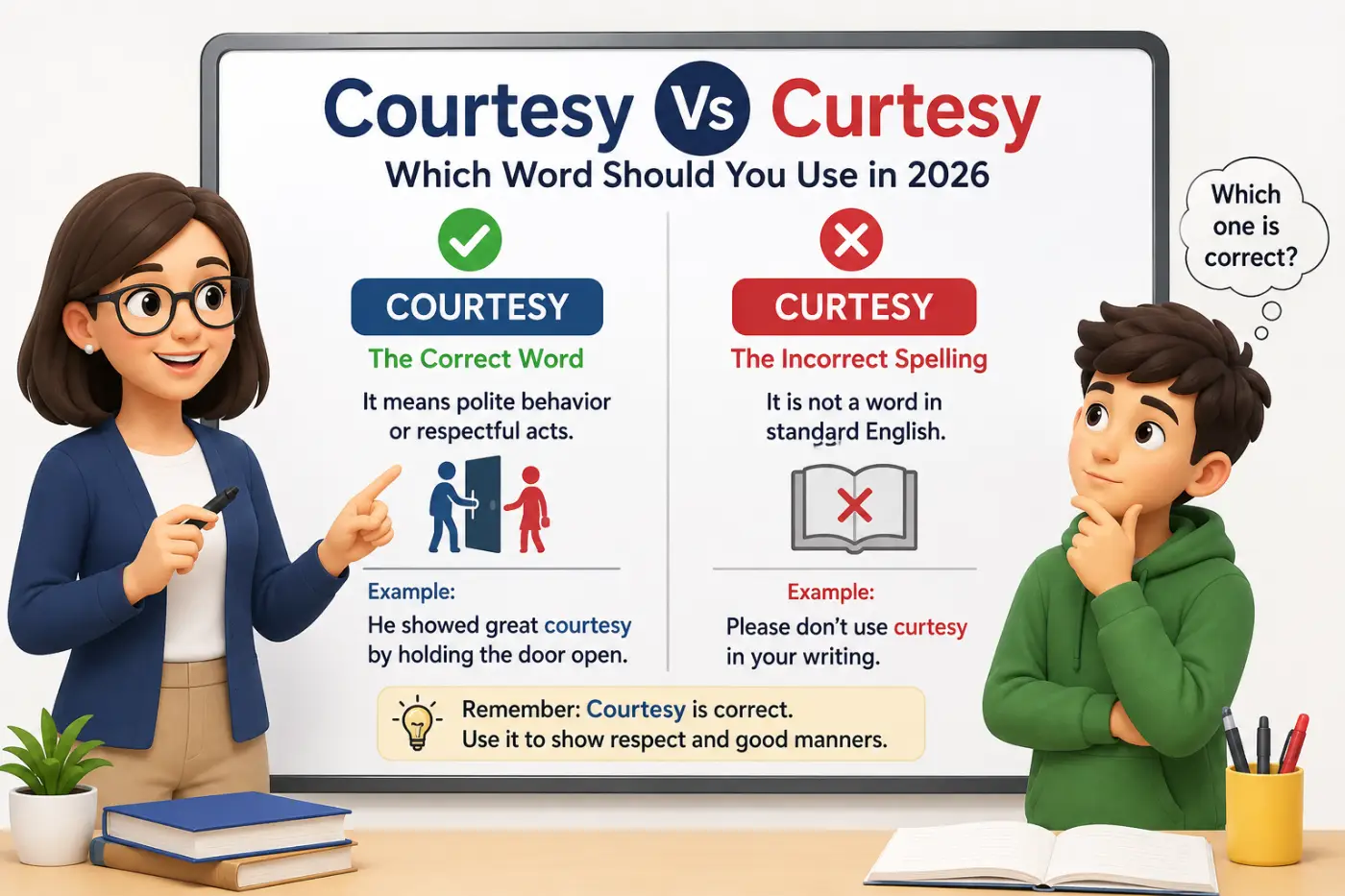
courtesy vs curtesy can be confusing because the two forms look almost identical and both have a history in English. For modern American English the standard spelling is courtesy. Curtesy is not the normal spelling used in current standard English and will usually be treated as an error when you mean polite behavior or a considerate act.
The confusion has a reasonable explanation. English spelling has changed over centuries and older forms of words can look surprisingly different from the forms we use now. The word also has a less obvious pronunciation than its spelling suggests. If you mostly hear the word in conversation you may not immediately know which letters belong in the written form. That can make a quick search or rushed email a little tricky.
This guide explains the meaning pronunciation grammar history and modern usage of both forms. You’ll also see natural examples common spelling mistakes related words regional usage and practical advice for choosing the right form in professional and everyday writing.
Quick Definition
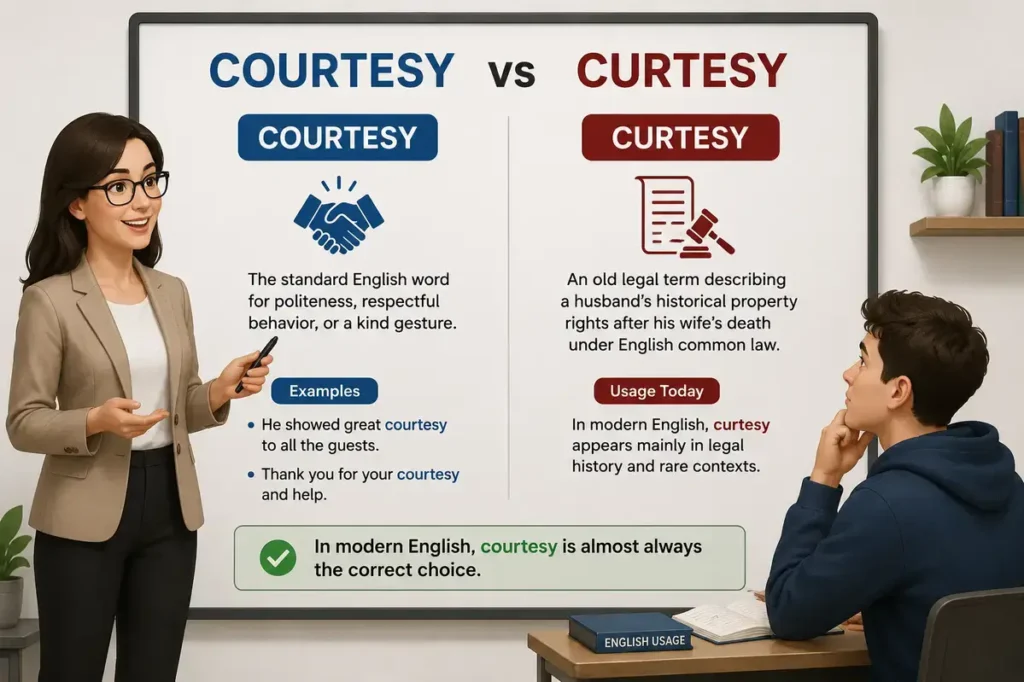
Courtesy is the standard modern English spelling for polite behavior consideration or a kind act toward another person. Curtesy may appear as an old or nonstandard spelling but it isn’t the usual form in modern American English. If you’re writing an email essay report or other standard English text use courtesy.
Quick Answer
The correct modern spelling is courtesy. Curtesy may be found in older texts or as a spelling variation but it isn’t the standard choice for modern English. If you mean politeness consideration or a thoughtful act use courtesy.
Comparison Table
| Standard Form | Meaning | Part of Speech | Origin | Usage Frequency | Formality | Common Contexts | Example |
|---|---|---|---|---|---|---|---|
| Courtesy | Polite behavior consideration or a kind act | Noun and occasionally adjective in established phrases | From Old French and Middle English forms connected with courtly behavior | Very common | Neutral to formal | Conversation business writing social situations customer service public notices | Thank you for the courtesy. |
| Curtesy | Historical or nonstandard spelling related to courtesy | Noun in historical usage | Older English spelling history | Very rare in modern use | Archaic or nonstandard | Historical texts older dictionaries and occasional spelling errors | The form appears in some older texts. |
Meaning and Definition
Meaning of Courtesy
Courtesy means polite and considerate behavior toward other people. It can describe a general attitude of respect or one specific action that shows thoughtfulness.
For example:
Thank you for your courtesy.
Here courtesy refers to the respectful or helpful behavior shown by another person.
The word can also describe a small act of kindness.
As a courtesy to our guests we provided free parking.
In this sentence the act is offered as a considerate gesture.
Courtesy can also appear in fixed expressions such as common courtesy, professional courtesy, courtesy call, and courtesy of. These expressions are common in American English and appear in both everyday and professional communication.
The word often carries a quiet sense of respect. It doesn’t necessarily describe a major favor. Sometimes courtesy is as simple as holding a door open listening without interrupting or letting someone know about a delay.
That makes the word useful across many situations. You can talk about courtesy at work at school in customer service or during an ordinary conversation.
Meaning of Curtesy
Curtesy is not the standard modern spelling you should normally choose for this meaning. It may appear in historical English sources or as an old spelling variation.
This distinction matters because seeing a word in an old text doesn’t automatically mean it is the preferred spelling today. English spelling has changed over time and older documents often preserve forms that modern editors would replace.
For present day writing the safe and natural choice is courtesy.
If you’re proofreading an email and see curtesy used to mean politeness there is usually no need to search for a complicated grammatical explanation. In most cases simply change it to courtesy.
There is another reason the older form can cause confusion. English has several words connected with older spellings and pronunciation patterns that no longer match current usage. Readers may encounter them in historical books or old documents and assume they remain equally acceptable today.
Modern standard usage says otherwise.
Key Differences Explained
- Spelling. The modern standard form is courtesy. The spelling contains the sequence cour near the beginning. The alternative form curtesy uses cur instead.
- Meaning. In ordinary modern English the intended meaning is usually politeness consideration or a considerate gesture.
- Grammar. Courtesy functions primarily as a noun. It names an idea quality action or gesture.
- Pronunciation. The modern word is generally pronounced with a sound close to KUR tuh see. The spelling can look more complicated than the spoken form.
- Formality. Courtesy works in casual conversation as well as formal writing. It doesn’t sound old fashioned.
- Modern usage. Courtesy is widespread in American English. Curtesy is extremely uncommon outside historical or nonstandard contexts.
- Regional usage. Modern American British Canadian and Australian English all use courtesy as the normal spelling.
- Standard English. Professional editors generally expect courtesy in modern writing when the meaning involves politeness or consideration.
The key point is simple. The two forms aren’t equal choices in modern everyday English.
Which Form Is Correct?
Courtesy is the correct standard form for modern English when you mean polite behavior consideration or a kind gesture.
The spelling developed through the history of English and French rather than from a simple sound based pattern. That helps explain why the written form doesn’t look exactly like the way many people pronounce it.
Standard English dictionaries recognize courtesy as the established modern word. Historical dictionaries and older texts can show spelling variations because English spelling was far less standardized in earlier periods.
That historical detail explains why you might occasionally encounter curtesy without assuming it is the preferred spelling today.
A useful editing rule is this. If you’re writing for a modern American reader and you mean polite behavior use courtesy.
For example:
Thank you for your courtesy.
As a courtesy we called ahead.
Common courtesy should guide how we treat other people.
These are all standard modern uses.

Sentence Examples
The best way to understand the word is to see how naturally it fits into real sentences.
- Please show common courtesy when speaking with other customers.
- She thanked the receptionist for the courtesy and patience she showed.
- As a courtesy to our neighbors we kept the music at a reasonable volume.
- The company offered a complimentary meal as a courtesy after the long delay.
- He called ahead as a courtesy to let the team know he would be late.
- A little courtesy can make a difficult conversation much easier.
- The manager treated every employee with the same level of courtesy.
- Out of courtesy I waited until everyone had finished speaking.
- The driver gave us the courtesy of letting us merge into traffic.
- Professional courtesy matters when people work together.
These examples show an important feature of the word. Courtesy usually involves another person. It describes behavior that recognizes someone else’s needs comfort time feelings or dignity.
Examples With the Less Common Form
You may encounter the less common spelling in historical material or in writing where someone has made a spelling error.
- The old document used curtesy as an apparent spelling variation.
- The editor changed curtesy to courtesy in the modernized edition.
- The student accidentally wrote curtesy instead of courtesy.
- The search result contained curtesy but the intended word was clearly courtesy.
- The proofreader marked curtesy as unsuitable for standard modern English.
These examples demonstrate the issue rather than recommend the spelling. In normal modern writing courtesy is the form to choose.
Common Mistakes and Misspellings
The confusion usually comes from pronunciation spelling patterns or simple typing habits. Here are some mistakes worth watching for.
Writing Curtesy Instead of Courtesy
This is the central error.
Incorrect: Thank you for your curtesy.
Correct: Thank you for your courtesy.
The mistake often happens because the first syllable sounds closer to kur than to the visual pattern suggested by cour.
Writing Courtsey
Some writers rearrange the letters and produce courtsey.
Incorrect: Thank you for your courtsey.
Correct: Thank you for your courtesy.
This is a classic letter order problem. The eye recognizes the general shape of the word but the letters get placed in the wrong order.
Writing Courtecy
Another error is replacing the s sound with a c spelling.
Incorrect: Thank you for your courtecy.
Correct: Thank you for your courtesy.
The ending follows the established spelling pattern sy.
Writing Courtesey
Some writers add an unnecessary e before the final y.
Incorrect: We appreciate your courtesey.
Correct: We appreciate your courtesy.
This mistake can happen because English contains many words where an e appears before a final y or another ending. That pattern doesn’t apply here.
Confusing Courtesy With Curtsy
Courtesy and curtsy look somewhat similar but they aren’t the same word.
A curtsy is a formal or traditional gesture of respect made by bending the knees slightly. Courtesy means polite or considerate behavior.
For example:
The performer gave a curtsy after the show.
The performer thanked the audience as a courtesy.
The words have different meanings even though their spellings share some letters.
Why Does Curtesy Look So Plausible?
Spelling mistakes often happen because the brain recognizes patterns instead of examining every letter individually. When you read a familiar word quickly you usually process its overall shape and meaning rather than consciously checking each character.
The spelling of this word creates a particularly tempting trap because its pronunciation doesn’t strongly reveal the our sequence.
When someone says the word naturally the first syllable sounds much closer to kur than to a careful reading of every written letter. A learner who spells mainly from sound may therefore choose curtesy.
Language transfer can add another layer of confusion. People who learn English as an additional language often expect spelling to follow pronunciation more closely. English doesn’t always cooperate with that expectation.
The historical development of English explains part of the problem too. Many common words preserve spelling patterns that developed through French influence and centuries of changing pronunciation.
So if you’ve ever wondered why the spelling looks less obvious than the pronunciation you’re not alone. The word has a history behind it.
Pronunciation Guide
The standard pronunciation of courtesy is commonly represented in American English as:
/ˈkɝːtəsi/
A simple pronunciation guide is:
KUR tuh see
The stress falls on the first syllable.
You can think of the word as three spoken parts:
KUR
tuh
see
The first syllable carries the strongest stress. The middle vowel is usually weak in normal American speech.
This pronunciation can make the spelling harder for learners because the spoken form doesn’t clearly reveal every written letter.
A common pronunciation mistake is trying to pronounce every letter exactly as it appears. English spelling often contains historical information that doesn’t translate directly into modern sounds.
The best approach is to learn the word as a whole. Connect the sound KUR tuh see with the written form courtesy.
Courtesy and Curtsy Pronunciation
The related word curtsy is commonly pronounced something like KURT see.
That difference is useful because it helps keep the two words separate.
Courtesy means politeness or consideration.
Curtsy means a traditional gesture.
The pronunciation is different enough to help once you become familiar with both words.
Etymology and Word Origin
The history of courtesy helps explain its unusual spelling.
The word comes through French and Middle English forms associated with courtly behavior. Its deeper history connects it with the idea of behavior expected at court and with qualities such as politeness refinement and respectful conduct.
English adopted many words from French after the Norman Conquest. Over time those words became part of everyday English vocabulary. Their spellings sometimes retained traces of their earlier forms even as pronunciation changed.
Courtesy developed from this historical word family. The connection with courtly behavior is also reflected in the modern sense of polite and considerate conduct.
The historical spelling record matters because earlier English was not standardized in the same way modern English is. Writers could use different spellings for the same word depending on region period education and writing tradition.
That is one reason a reader may encounter forms that look unfamiliar in older material.
The modern spelling has settled around courtesy. It is the form used in contemporary standard English.
Regional Usage
American English
American English uses courtesy as the normal spelling. You’ll find it in everyday conversation professional emails customer service language school writing and formal documents.
Common American expressions include common courtesy, professional courtesy, and as a courtesy.
The older form curtesy isn’t normally used in current American writing unless someone is discussing historical language or reproducing an older source.
British English
British English also uses courtesy as the standard modern spelling. There is no major spelling difference between American and British English for this word.
British speakers use it in much the same way Americans do. It can describe good manners a considerate action or respectful treatment.
Australian English
Australian English follows the same standard spelling. Courtesy is the expected modern form in general writing education journalism business communication and everyday speech.
There is no established Australian spelling that makes curtesy the normal alternative.
Canadian English
Canadian English also uses courtesy. The word functions in much the same way as it does in American and British English.
Canadian writers can use it in both formal and informal contexts without changing the spelling.
Across these major varieties of English the modern standard is consistent.
Grammar Rules and Part of Speech
Courtesy is primarily a noun.
A noun names a person place thing idea quality or concept. In this case the word names a quality or behavior involving politeness and consideration.
You can use it in several common grammatical patterns.
Courtesy As A General Quality
Courtesy makes workplace conversations easier.
Here the word describes a quality or principle.
Courtesy As A Specific Gesture
The hotel offered a courtesy breakfast.
Here the word refers to something provided as a considerate gesture.
Courtesy After A Preposition
The word frequently appears after prepositions.
He called as a courtesy.
She waited out of courtesy.
They acted with courtesy.
These patterns are natural and common.
Courtesy In Fixed Expressions
Some expressions occur so often that they are worth learning as complete phrases.
Common courtesy refers to basic polite behavior.
Professional courtesy refers to respectful treatment in a professional setting.
As a courtesy introduces something done as a favor or considerate gesture.
Courtesy call refers to a call made as a polite or helpful gesture.
By courtesy of can identify the person or organization responsible for providing something.
Singular And Plural Forms
The normal singular form is courtesy.
The plural is courtesies.
For example:
She appreciated his courtesy.
The staff showed several small courtesies during the visit.
The plural is useful when you’re describing multiple acts of consideration.
Adjective Use
Courtesy can also appear in established expressions that function adjectivally before another noun.
For example:
courtesy call
courtesy shuttle
courtesy vehicle
These phrases describe something provided as a service or considerate gesture.
Real Life Usage Examples
Daily Conversation
Courtesy appears naturally in ordinary speech when people discuss manners and consideration.
A little courtesy would make this conversation easier.
He showed courtesy by letting the older passenger sit first.
These sentences sound natural because the word connects directly with everyday behavior.
Email And Workplace Communication
The word is common in professional messages.
As a courtesy I wanted to let you know that the meeting time has changed.
Thank you for the courtesy of keeping us informed.
In workplace writing it can sound polite without becoming stiff or overly formal.
Academic Writing
Academic writing may use the word when discussing social behavior communication or professional conduct.
The study considers courtesy as part of effective interpersonal communication.
Professional courtesy can influence how teams handle disagreement.
The noun works well in formal analysis because it describes a recognizable social concept.
News And Journalism
Journalists may use the word when describing a service gesture or public interaction.
The passengers received transportation as a courtesy after the cancellation.
The official offered a courtesy call before the meeting.
News writing often uses established expressions because readers understand them quickly.
Literature And Storytelling
Writers can use courtesy to reveal character.
She accepted the invitation out of courtesy rather than genuine interest.
His courtesy remained calm even when the conversation became tense.
The word can subtly show that someone is behaving politely despite their private feelings.
Courtesy In Formal Writing
Courtesy is completely appropriate in formal writing. In fact it often works particularly well in professional communication because it expresses respect without sounding overly emotional.
Consider this sentence:
As a courtesy to our clients we will provide advance notice of any schedule changes.
That sounds professional and clear.
You can also use the word in formal requests.
I would appreciate the courtesy of a response by Friday.
This expression can sound somewhat formal but remains grammatical and understandable.
In modern business writing it’s usually better to keep the wording direct.
Instead of writing an elaborate sentence about courtesy you can simply state the action.
As a courtesy we’ll notify you before the change takes effect.
That style feels natural while still showing respect.
Courtesy In Informal Writing
The word also works perfectly well in casual settings.
Thanks for the courtesy.
That was a nice courtesy.
Common courtesy goes a long way.
The tone depends more on the surrounding sentence than on the word itself.
You can use courtesy in a text message or casual conversation without making the message sound formal.
Still some expressions such as I request the courtesy of your response sound more formal. In casual speech you’d probably say Please let me know when you can.
That distinction is about tone rather than correctness.
Courtesy And Politeness
Courtesy and politeness are close in meaning but they aren’t always interchangeable.
Politeness often describes the general quality of having good manners.
Courtesy can describe that quality too but often focuses on a specific act of consideration.
For example:
He spoke with politeness.
This describes his manner.
He held the door open as a courtesy.
This describes a particular considerate action.
The two words overlap but carry slightly different shades of meaning.
Courtesy often feels more concrete. It can be something you do for another person.
Courtesy And Respect
Respect is another closely related term.
Respect involves recognizing the value dignity rights or position of another person. Courtesy is one way of showing that respect.
You can respect someone without performing a specific courtesy. You can also perform a small courtesy even when you don’t feel deep personal respect.
For example:
She treated everyone with respect.
This expresses a broader attitude.
She showed courtesy by listening without interrupting.
This points to a specific behavior.
Understanding that distinction helps you choose the strongest word for your sentence.
Related And Confused Terms
Several words and expressions belong to the same semantic area.
- Politeness. This describes good manners and respectful social behavior. It is probably the closest general synonym.
- Consideration. This focuses on thinking about another person’s needs or feelings before acting.
- Respect. This describes regard for another person’s value dignity rights or position.
- Kindness. This refers to friendly helpful or caring behavior. It can overlap with courtesy but often carries more warmth.
- Good manners. This is a familiar phrase for socially accepted polite behavior.
- Common courtesy. This refers to basic consideration that people generally expect from one another.
- Professional courtesy. This describes respectful behavior between people in a workplace or professional setting.
- Curtsy. This is not another spelling of courtesy. It is a different word for a traditional gesture involving a slight bending of the knees.
These distinctions matter because similar words can point to slightly different ideas. Choosing the closest term makes writing sharper and easier to understand.
Why Spelling Tools May Flag Curtesy
Modern spelling tools are built around established word forms and language patterns. If you type curtesy in a normal sentence they may suggest courtesy because the intended meaning is usually clear from context.
That correction doesn’t mean every historical appearance of the older spelling was a mistake. Language changes over time.
A professional editor looks at context before changing unusual forms. If the text is a historical quotation an old document or a discussion of language history the unusual spelling may need to remain. If it’s a modern email or article and the writer means polite behavior the correction is straightforward.
This is an important editing principle. Don’t judge a spelling only by how strange it looks. Consider the date style audience and purpose of the text.
Expert Editor Insight
From an editing perspective the practical choice is simple. Use courtesy in modern standard English when you mean politeness consideration or a considerate gesture. The alternative can appear in historical material but it will look unusual to most modern readers. If a spelling tool flags it don’t automatically accept the suggestion in every context. First check the surrounding sentence and the age or style of the source. For everyday writing the modern form is the clear choice.
Final Takeaway
courtesy vs curtesy has a straightforward answer for modern English. Courtesy is the standard spelling for polite behavior consideration or a thoughtful gesture. Curtesy may appear in historical material but it isn’t the normal spelling you should use in current American English.
The word works as a noun and appears in familiar expressions such as common courtesy professional courtesy and as a courtesy. Its pronunciation can make the spelling tricky because the spoken form doesn’t clearly reveal every letter.
A useful editing trick is to remember the our in courtesy. If you mean politeness or consideration write courtesy. That small spelling check can keep your emails essays reports and everyday messages clean and professional.
FAQs
Is curtesy a real word?
Curtesy can appear as an older spelling related to courtesy but it isn’t the normal modern spelling used for polite behavior. In contemporary American English readers generally expect courtesy. If you’re writing an email essay report website page or professional document use courtesy unless you have a specific historical reason to preserve the older form.
What does courtesy mean?
Courtesy means polite and considerate behavior toward another person. It can describe a general quality such as good manners or a specific act such as making a helpful phone call. Expressions such as common courtesy and professional courtesy are also widely used. The word often suggests respect for another person’s time comfort feelings or needs.
Which is correct courtesy or curtesy?
Courtesy is the standard modern spelling. Curtesy may appear in historical sources as an older spelling variation but it isn’t the normal choice in present day English. If your sentence refers to politeness consideration or a considerate gesture use courtesy. That form is appropriate in both casual communication and formal writing.
How do you pronounce courtesy?
Courtesy is commonly pronounced /ˈkɝːtəsi/ in American English. A simple pronunciation guide is KUR tuh see. The first syllable receives the main stress while the middle vowel is relatively weak in normal speech. The pronunciation can contribute to spelling confusion because the spoken word doesn’t clearly reveal every letter found in its written form.
Is courtesy formal or informal?
Courtesy works in both formal and informal English. You can use it in casual expressions such as common courtesy and in professional sentences such as thank you for your courtesy. Some phrases sound more formal than others. For example I would appreciate the courtesy of a response has a more formal tone than simply please let me know.
What is a synonym for courtesy?
Common synonyms include politeness consideration respect kindness and good manners. The best choice depends on the context. Politeness focuses on proper social behavior while consideration highlights awareness of another person’s needs. Respect is broader and can involve attitude as well as behavior. Courtesy often works especially well when you’re describing a specific considerate action.
Why do people spell courtesy as curtesy?
The spelling is easy to confuse because the pronunciation begins with a sound similar to kur. Someone spelling the word from sound may naturally choose cur instead of cour. Historical spelling variation can also make the alternative look believable. Fast typing and visual pattern recognition can contribute too. Modern standard writing uses courtesy.
Is courtesy appropriate in formal writing?
Yes. Courtesy is fully appropriate in formal writing and appears naturally in professional emails reports notices and business communication. It can describe respectful behavior or a considerate service. The word is also common in established phrases such as professional courtesy and as a courtesy. Just keep the surrounding sentence direct so the writing doesn’t sound unnecessarily stiff.
