
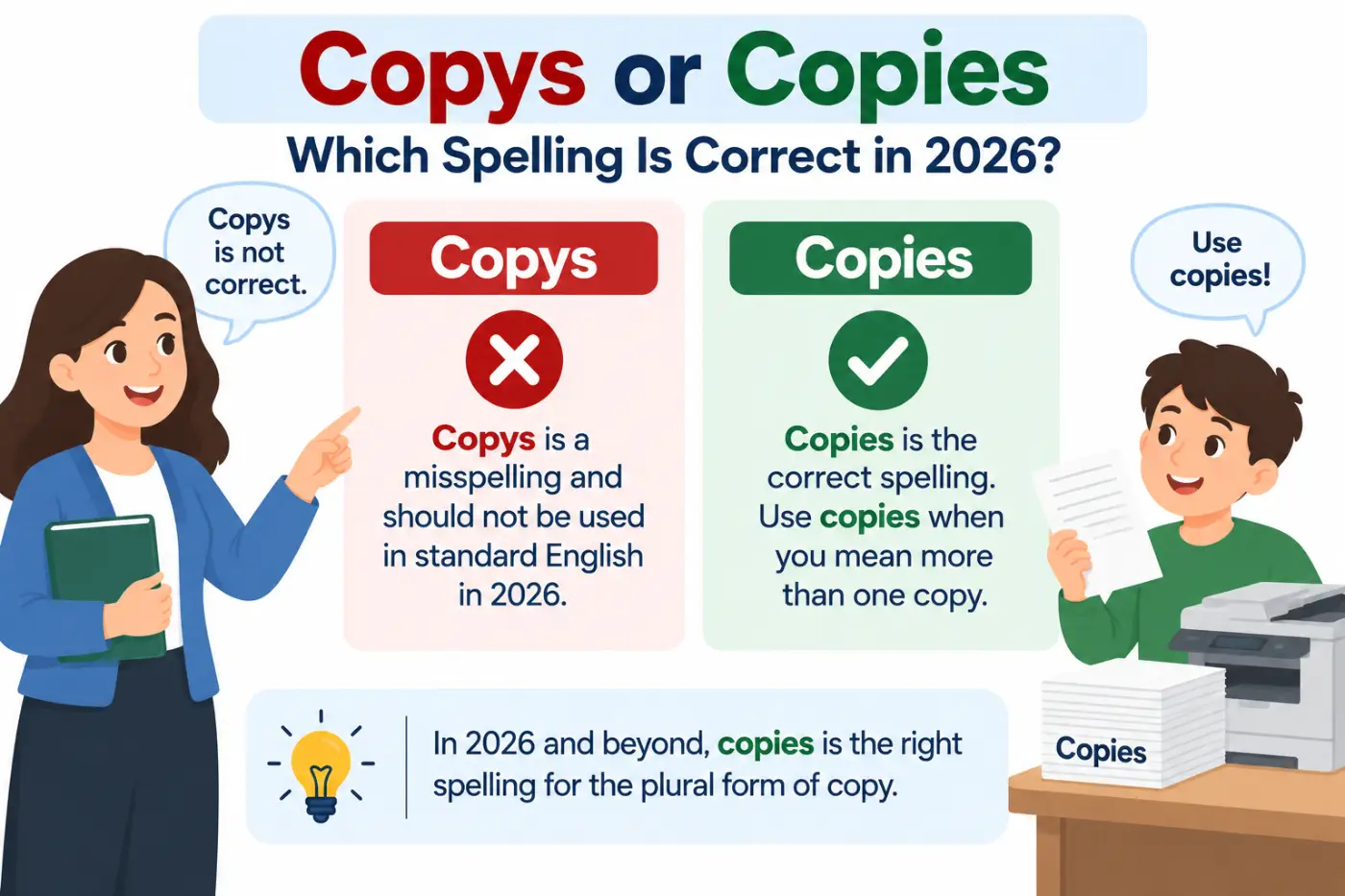
If you’re unsure about copies or copys you’re dealing with a common English spelling mistake. The correct form is copies. The spelling copys is not the standard plural or third person singular form of the verb copy.
The confusion comes from a real spelling pattern in English. Many words simply take s when they become plural or when a verb changes for he she or it. Words ending in consonant plus y follow a different pattern. The y usually changes to i before the ending is added. That gives us copy to copies and copy to copies in different grammatical roles.
This rule is easy to remember once you see how it works. In this guide you’ll learn the correct spelling the meaning grammar pronunciation word history common mistakes and natural examples. You’ll also see why the incorrect form looks tempting and how to avoid the mistake in everyday writing and formal work.
Quick Answer
Copies is the correct standard spelling. Use copies as the plural of copy and as the third person singular form of the verb copy. Copys is a common spelling error because English normally changes a final consonant plus y to i before adding s.
Meaning Of The Correct Form
The word copies has two main grammatical uses. It can be the plural form of the noun copy or the third person singular form of the verb copy.
As a noun a copy is one reproduction or version of something. The plural form means more than one reproduction or version.
For example:
- I printed one copy of the report.
- I printed five copies of the report.
In the first sentence copy refers to one item. In the second sentence copies refers to more than one item.
The word also works as a verb. Copy means to reproduce something or make another version of it. It can also mean to imitate something or reproduce information from one place to another.
When the subject is he she or it the verb becomes copies.
For example:
- She copies the information into her notebook.
- He copies the files to a new folder.
- The machine copies the document quickly.
Notice the spelling. The verb does not become copys. It becomes copies.
Meaning Of The Incorrect Form
Copys is not the standard English spelling for the plural noun or the third person singular verb form of copy.
You may see it in informal online writing text messages social media posts comments or documents written quickly. Its appearance does not make it a standard English word.
The error usually happens because writers apply a simple rule that works with many other words. They see copy and think that adding s should produce copys. That approach works with many nouns and verbs but not with words that end in consonant plus y.
For example:
- Book becomes books.
- Car becomes cars.
- Phone becomes phones.
- Copy becomes copies.
The final y changes because copy ends in a consonant followed by y.
Why The Spelling Changes
English spelling has several patterns for words that end in y. The key detail is the letter that comes before the y.
When a word ends in a consonant plus y and you need to add s for a plural noun or a third person singular verb form the y usually changes to i before the ending.
That gives us patterns such as:
- Copy becomes copies.
- City becomes cities.
- Story becomes stories.
- Baby becomes babies.
- Family becomes families.
The same basic spelling pattern explains all five examples.
There is another important pattern. When a word ends in a vowel plus y the y normally stays in place.
For example:
- Day becomes days.
- Boy becomes boys.
- Key becomes keys.
- Toy becomes toys.
- Journey becomes journeys.
This difference explains why writers sometimes make mistakes with words ending in y. The spelling rule depends on the letter immediately before the y.
Copy contains a consonant before y. The final y therefore changes to i before s is added.
Comparison Table
| Form | Meaning | Part of Speech | Standard Usage | Formality | Example |
|---|---|---|---|---|---|
| Copies | More than one copy | Noun | Standard | All levels | I need three copies. |
| Copies | Performs the action of copying | Verb | Standard | All levels | She copies the notes. |
| Copys | Intended as a plural or verb form of copy | Nonstandard spelling | Not standard | Informal error | Please avoid this spelling. |
The important point is that copies can serve two different grammatical purposes. Copys does not normally serve either of those standard functions.
Key Differences Explained
Spelling
The main difference is the ending.
Copies contains ies. Copys contains ys.
The correct spelling follows the consonant plus y rule. The final y changes to i before s is added.
Meaning
There is no separate standard meaning that distinguishes copys from copies. In normal English writing copys is usually intended to mean copies.
Grammar
Copies can function as a plural noun.
For example:
I need two copies.
Copies can also function as a third person singular verb.
For example:
She copies every detail.
The incorrect form does not follow standard English grammar or spelling in these uses.
Pronunciation
Copies is pronounced like KOP eez. The final syllable sounds like eez.
The spelling copys may tempt a reader to expect a different sound pattern. In standard writing the correct spelling makes the intended pronunciation easier to recognize.
Formality
Copies works in every level of English from casual conversation to formal academic and professional writing.
Copys should be avoided in edited writing.
Context
You can use copies when discussing printed documents digital files books photographs records or duplicated information.
You can also use it when describing an action performed by a person or thing.
For example:
The printer makes copies.
She copies the data.
Regional Usage
There is no meaningful American English versus British English spelling difference here. Standard English uses copies in both varieties.
Which Form Is Correct
Copies is the correct form.
The reason is grammatical as well as orthographic. Copy ends in a consonant followed by y. When English adds s to form the plural noun or the third person singular present verb form the y changes to i.
The pattern looks like this:
Copy + s becomes copies.
The same spelling pattern appears in many familiar English words. City becomes cities. Country becomes countries. Hobby becomes hobbies. Company becomes companies.
This is why writing copys is considered a spelling error rather than an alternative standard form.
A useful editing habit is to look at the letter before the final y. If the word ends in consonant plus y check the spelling before adding s. That quick pause can prevent many errors.
Sentence Examples
Here are natural examples that show how the correct form works in real writing.
- Please make three copies of the application before you leave.
- She keeps copies of all her important documents in a secure folder.
- The teacher copies the schedule onto the whiteboard every Monday.
- I sent copies of the report to everyone on the team.
- He copies the information into his notebook so he can review it later.
- The store keeps digital copies of every receipt.
- My sister copies the recipes she likes into a small notebook.
- The office printer makes clear copies even when the original page is old.
- The student copies the sentence carefully because the spelling matters.
- We need enough copies for everyone in the meeting.
These examples show why context matters. In some sentences copies refers to multiple things. In others it describes an action performed by one person or thing.
Common Mistakes And Misspellings
Using Copys Instead Of Copies
This is the most common mistake connected with this word.
Incorrect:
The teacher printed ten copys.
Correct:
The teacher printed ten copies.
The mistake happens because the writer adds s without changing the final y.
Keeping The Y In A Plural Form
Some writers know that y can stay in place before s and apply that pattern too broadly.
For example day becomes days. That does not mean copy becomes copys.
The letter before y matters.
Confusing Copy With A Regular S Ending
Many nouns simply take s in the plural.
For example:
Book becomes books.
Computer becomes computers.
Document becomes documents.
Copy follows a different spelling pattern because it ends in consonant plus y.
Applying The Wrong Rule To A Verb
The same issue can happen with verbs.
Incorrect:
She copys the notes every day.
Correct:
She copies the notes every day.
The spelling rule applies to the third person singular present form of the verb.
Forgetting The Singular Form
Another mistake involves using copies when the sentence requires copy.
For example:
I need one copy.
Not:
I need one copies.
Copies refers to more than one copy when it functions as a plural noun.
The verb form also depends on the subject.
I copy the file.
You copy the file.
We copy the file.
They copy the file.
He copies the file.
She copies the file.
The change from copy to copies happens because of the third person singular subject.
Pronunciation Guide
Copies is commonly pronounced as two syllables.
The pronunciation can be represented in IPA as /ˈkɑːpiz/ in many American English pronunciation systems. The exact vowel sound can vary slightly among speakers and dictionaries.
An easy pronunciation guide is:
KOP eez.
The first syllable receives the main stress.
The word sounds similar to the noun copy followed by a light eez ending.
The pronunciation does not create the spelling change. The spelling comes from the grammatical rule for words ending in consonant plus y.
It can help to learn the word as a complete pattern rather than trying to build it letter by letter.
Think:
Copy.
Copies.
The sound and spelling then become familiar together.
Etymology And Word Origin
The word copy has a long history in English and ultimately traces back through French to Latin.
The Latin word copia referred to abundance or plenty. It also developed a sense connected with a supply or amount of something. From there the word took on meanings related to written material and reproduction.
English later developed copy as a noun for a written text or something reproduced from an original. Over time the word expanded into many modern contexts.
Today copy can refer to printed material digital material text photographs files or another version of an original item. It can also function as a verb meaning to reproduce or imitate something.
The modern spelling pattern is not a new invention. It reflects established English spelling conventions that developed over centuries.
American English
Copies is the standard form in American English.
You’ll see it in everyday conversation workplace communication school assignments technical writing journalism and formal documents.
Examples include:
- Please send me two copies of the contract.
- She copies the information into the spreadsheet.
- The printer creates several copies at once.
American English does not use copys as a standard spelling for these meanings.
British English
British English also uses copies as the standard form.
There is no major spelling difference between American and British English for this particular word.
A British writer would normally write:
The office printed several copies.
A British writer would also write:
She copies the notes into her diary.
The same consonant plus y spelling rule applies.
Australian English
Australian English also uses copies in standard writing.
There is no established regional spelling that changes copies into copys.
The spelling remains the same in everyday and formal Australian English.
Canadian English
Canadian English also uses copies.
Canadian spelling can differ from American spelling in some areas of English. This word is not one of those cases.
For standard Canadian writing use copies for both the plural noun and the third person singular verb.
Grammar Rules And Part Of Speech
Copies has two main grammatical roles.
Copies As A Noun
As a noun copies is the plural of copy.
A noun names a person place thing or idea. In this case copy refers to one version or reproduction and copies refers to more than one.
Consider these examples:
I printed one copy.
I printed several copies.
The difference is straightforward. The singular form refers to one item. The plural form refers to two or more.
Copies can appear after numbers and quantity words.
For example:
- Two copies.
- Several copies.
- Many copies.
- Extra copies.
- Multiple copies.
It can also appear with phrases that describe the copies.
For example:
We need three clean copies of the form.
The library has several old copies of the book.
Copies As A Verb
Copies is also a verb.
The base form is copy.
The form copies is used with a third person singular subject in the simple present tense.
For example:
He copies the file.
She copies the answer.
The computer copies the data.
The machine copies the image.
The subject determines the form.
Compare these sentences:
I copy the file.
You copy the file.
We copy the file.
They copy the file.
He copies the file.
She copies the file.
The first four subjects use copy. The third person singular subjects use copies.
This is one of the most useful grammar points to remember.
The Spelling Pattern
The rule can be expressed simply.
When a word ends in consonant plus y and needs an s ending the y usually changes to i.
Examples include:
- Copy becomes copies.
- Fly becomes flies.
- Try becomes tries.
- Study becomes studies.
- Carry becomes carries.
This pattern applies to both plural nouns and many third person singular verb forms.
Words Ending In Vowel Plus Y
Words ending in vowel plus y normally keep the y when s is added.
For example:
- Boy becomes boys.
- Day becomes days.
- Key becomes keys.
- Play becomes plays.
- Enjoy becomes enjoys.
This contrast is worth remembering because it explains many spelling mistakes.
Copy has a consonant before y.
Boy has a vowel before y.
That small difference changes the spelling.
Real Life Usage Examples
Daily Conversation
Copies appears naturally in everyday speech when people talk about documents photographs books files or repeated information.
For example:
- Do you have copies of the tickets?
- I made extra copies just in case.
The word also appears as a verb in everyday situations.
For example:
- She copies everything I write.
- He copies the address into his phone.
Workplace Communication
Professional communication often uses copies when people discuss reports contracts forms invoices records and shared files.
For example:
- Please send copies of the signed form to the accounting team.
- The manager keeps copies of important records for future reference.
As a verb it can describe routine office actions.
For example:
- She copies the client information into the new system.
- The assistant copies the meeting notes into the shared document.
The correct spelling matters in professional communication because small errors can distract readers and reduce the polish of otherwise clear writing.
Academic Writing
Students and teachers often use copies when discussing assignments handouts books research materials and documents.
For example:
- The professor distributed copies of the reading before class.
- The library has several copies of the required textbook.
The verb form can also appear in academic contexts.
For example:
- The student copies the passage into her notes for later analysis.
- The researcher copies the data into a separate worksheet before checking it.
News And Journalism
The word can appear in journalism when writers discuss documents photographs records or reproduced material.
For example:
- Officials released copies of the documents after the meeting.
- The newspaper obtained copies of the public records.
The verb can appear when describing reproduction of information.
For example:
The system copies the files to a separate server.
Literature And Storytelling
Copies can also appear in stories and narrative writing.
For example:
- Maya found several copies of the old letter in a wooden box.
- Daniel copies the handwriting in his notebook because he wants to remember every detail.
These examples show that the word is not limited to technical or office language. It belongs to ordinary English.
Related And Confused Terms
Several words and forms connect closely with copy and copies.
Copy
Copy is the singular noun and the base verb.
As a noun:
I need one copy.
As a verb:
I copy the information.
Copies
Copies is the plural noun and the third person singular present form of the verb.
As a noun:
I need two copies.
As a verb:
She copies the information.
Copied
Copied is the past tense and past participle form of copy.
For example:
She copied the address yesterday.
The spelling changes from y to i before ed is added.
Copying
Copying is the present participle or gerund form.
For example:
He is copying the document.
Here the final y does not change to i. The ending ing is added to the base form.
Duplicate
Duplicate can describe something that is the same as another item.
For example:
Please remove the duplicate file.
Duplicate can be a useful alternative to copy in some contexts but the two words aren’t always interchangeable.
Reproduce
Reproduce means to make another version of something.
For example:
The printer can reproduce the image accurately.
This word is more formal than copy in many situations.
Imitate
Imitate means to behave like someone or something else or reproduce its style or actions.
For example:
The young player tries to imitate his favorite athlete.
Imitate focuses more on behavior or style than on making another physical or digital version.
Paste
Paste is often associated with copying information from one place to another.
For example:
Copy the text and paste it into the form.
Copy describes obtaining or duplicating the information. Paste describes placing it somewhere else.
Copy And Copies In Digital Language
The word has become especially common in digital communication.
You may copy text from a website and paste it into a document. You may make copies of files. You may save copies of photographs or create copies of important records.
For example:
- I made copies of the files before deleting the originals.
- She copies the text into her notes.
- The program creates backup copies automatically.
The digital meaning follows the same basic English rules as the older paper based meaning.
The technology has changed. The grammar hasn’t.
This is a useful reminder when writing online. A word doesn’t need a new spelling simply because its meaning has expanded into a digital context.
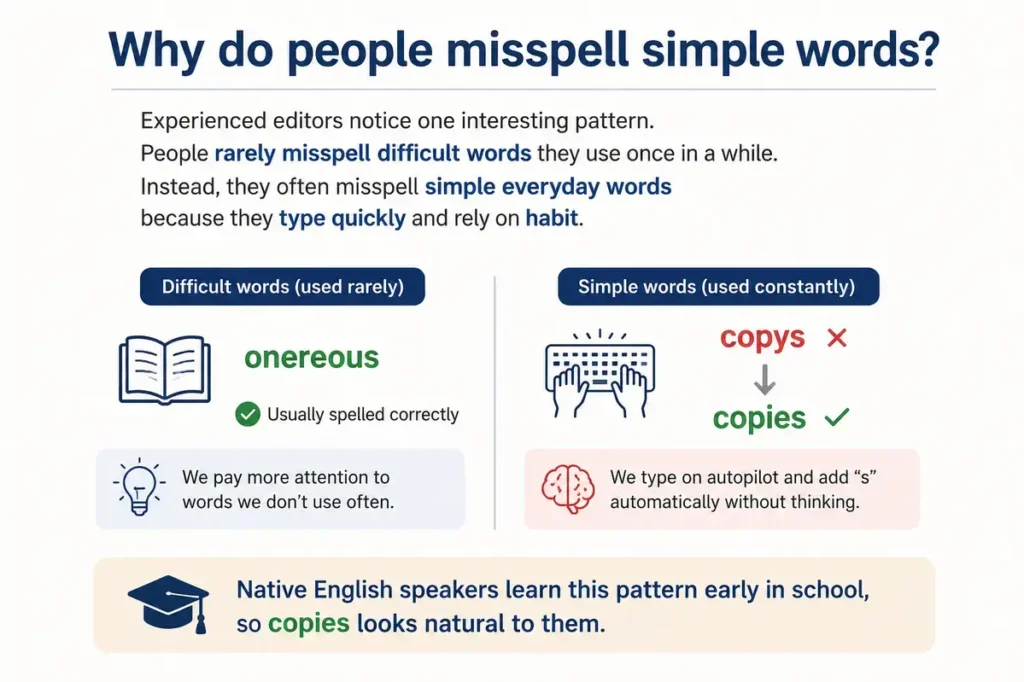
Why People Write Copys
The error usually comes from a predictable spelling shortcut.
English has many nouns that form plurals by adding s. Writers often learn this basic rule early and apply it automatically.
The problem is that English contains many spelling patterns that modify the ending.
A writer may know that:
Car becomes cars.
Book becomes books.
Desk becomes desks.
Then they see copy and instinctively write copys.
Another reason is that the pronunciation can make the spelling less obvious. The ending sounds like eez and doesn’t directly tell the writer that the written form needs ies.
Typing speed can make the problem worse. When people write quickly they often type the first spelling that feels familiar.
Autocorrect can also contribute to confusion. Some software catches spelling mistakes immediately while other tools depend on context and may not flag every error.
The best solution isn’t to memorize every possible mistake. Learn the underlying pattern.
Consonant plus y usually changes to i before s.
That single rule helps with many words.
A Simple Memory Trick
Use this short comparison:
Copy becomes copies.
Then compare it with:
Boy becomes boys.
Why does one change and the other stay the same?
Because copy has a consonant before y while boy has a vowel before y.
You can also remember the family of words that follow the same pattern:
- Baby becomes babies.
- City becomes cities.
- Story becomes stories.
- Family becomes families.
- Copy becomes copies.
If you remember one word family you can often predict the spelling of another.
Formal Writing And Editing
Copies is completely appropriate in formal writing.
You can use it in business letters academic papers reports applications instructions research writing and official documents.
For example:
The department distributed copies of the revised policy to all employees.
There is nothing informal about the word itself.
The main issue is spelling accuracy. A document that uses copys may look careless even when the surrounding writing is strong.
Professional editors pay attention to small patterns like this because repeated spelling errors can affect readability and credibility.
An editor also checks the grammatical role of the word. If the sentence needs a plural noun then copies may be correct. If it needs the base verb then copy may be correct. If it describes a completed action then copied may be required.
The correct spelling depends on the job the word performs in the sentence.
Expert Editor Insight
An experienced editor usually checks the entire sentence instead of correcting a word in isolation. With this particular form the first question is simple: does the sentence need the plural noun or the third person singular verb? If it does then copies is the standard spelling. If the sentence needs the base verb then copy is correct. Spelling tools can catch many errors but understanding the grammar behind the correction is more reliable than trusting a red underline alone.
Conclusion
If you’re choosing between copies or copys the correct standard form is copies. Use it when you mean more than one copy or when the verb copy has a third person singular subject such as he she or it.
The spelling follows a useful English pattern. When a word ends in consonant plus y the y usually changes to i before s is added. That gives us copy to copies just as city becomes cities and story becomes stories.
The easiest editing trick is to check the letter before the final y. If you see consonant plus y remember that the y will usually change before the s ending. Once that pattern becomes familiar you’ll spot the error quickly and write copies with confidence.
FAQs
Is Copys A Real Word?
Copys is not the standard English spelling for the plural of copy or the third person singular form of the verb copy. You may encounter it in informal writing or online posts but it is normally a spelling error. In edited American English use copies for the plural noun and the third person singular present verb.
What Does Copies Mean?
Copies can mean more than one version of something. It can refer to printed documents digital files books photographs or other reproduced items. Copies can also be the third person singular form of the verb copy. For example she copies the notes. The meaning depends on the grammatical role it plays in the sentence.
Which Is Correct Copies Or Copys?
Copies is correct. Copys is a misspelling in standard English. The spelling changes because copy ends in a consonant followed by y. When s is added the y changes to i. The same pattern appears in words such as city becoming cities and story becoming stories.
How Do You Pronounce Copies?
Copies is commonly pronounced with two syllables as KOP eez. The first syllable receives the main stress. In many American English pronunciation systems its IPA form is represented as /ˈkɑːpiz/. The exact vowel quality can vary slightly among speakers. The spelling copies represents the standard written form.
Can Copies Start A Sentence?
Yes. Copies can start a sentence when the sentence structure calls for it. For example copies of the report were sent to the office. Starting a sentence with copies isn’t grammatically unusual. The word can function as the plural noun at the beginning of a sentence just like many other plural nouns.
What Is A Synonym For Copies?
The best synonym depends on the context. Duplicates can work when you mean additional versions of the same item. Reproduces can work when copies functions as a verb. Replicates can also fit some technical contexts. Still each word has its own shade of meaning so copy and copies often remain the most natural choices.
Why Do People Misspell Copies?
People often misspell copies because they apply the simple rule of adding s to a word. That rule works with many English words but copy follows the consonant plus y pattern. The final y changes to i before s is added. Fast typing and weak familiarity with spelling patterns can make the mistake more likely.
Is Copies Appropriate In Formal Writing?
Yes. Copies is completely appropriate in formal writing. It can appear in academic papers business documents reports official communication and professional instructions. The word itself isn’t informal. The important point is using the correct form for the sentence. Use copies for the plural noun and the third person singular present form of copy.
