
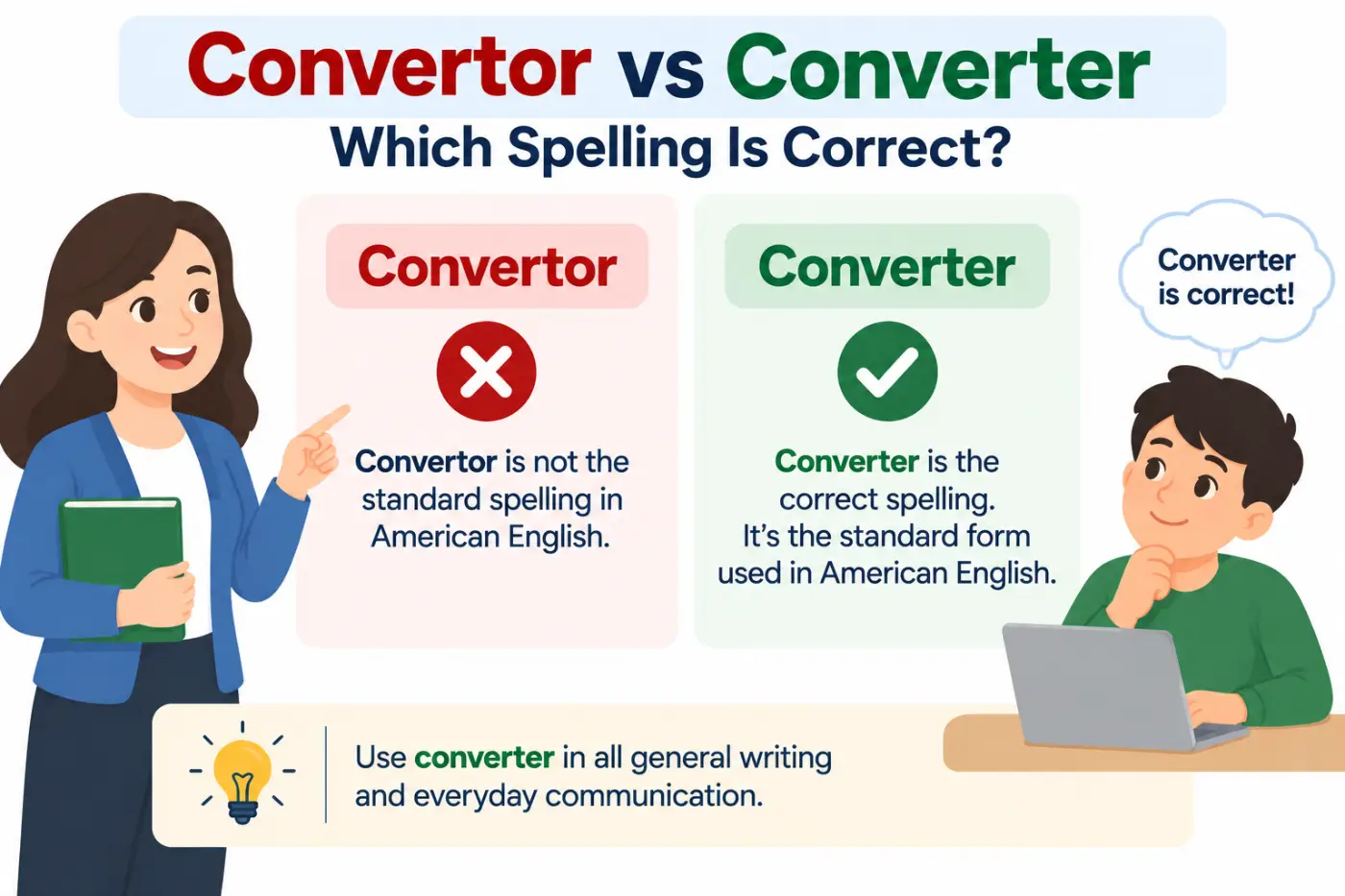
If you’ve ever paused while typing the name of a device that changes one form into another you’ve probably wondered about convertor vs converter. The good news is that both forms exist in English. However converter is the better default choice for American English and is the form you’ll most often want in everyday writing.
The confusion makes sense. English has many pairs that use different endings for words describing a person or thing that performs an action. Both convertor and converter follow a logical pattern based on the verb convert. Dictionaries recognize both forms as nouns. Cambridge lists convertor as an alternative form of converter while Oxford also gives convertor as an alternative.
So you don’t need to treat convertor as a simple spelling mistake. It is a legitimate variant. Still if you’re writing an email preparing a report completing an assignment or choosing wording for a website converter is the safest and most familiar choice. This article explains the difference and shows exactly how to use each form.
Quick Answer
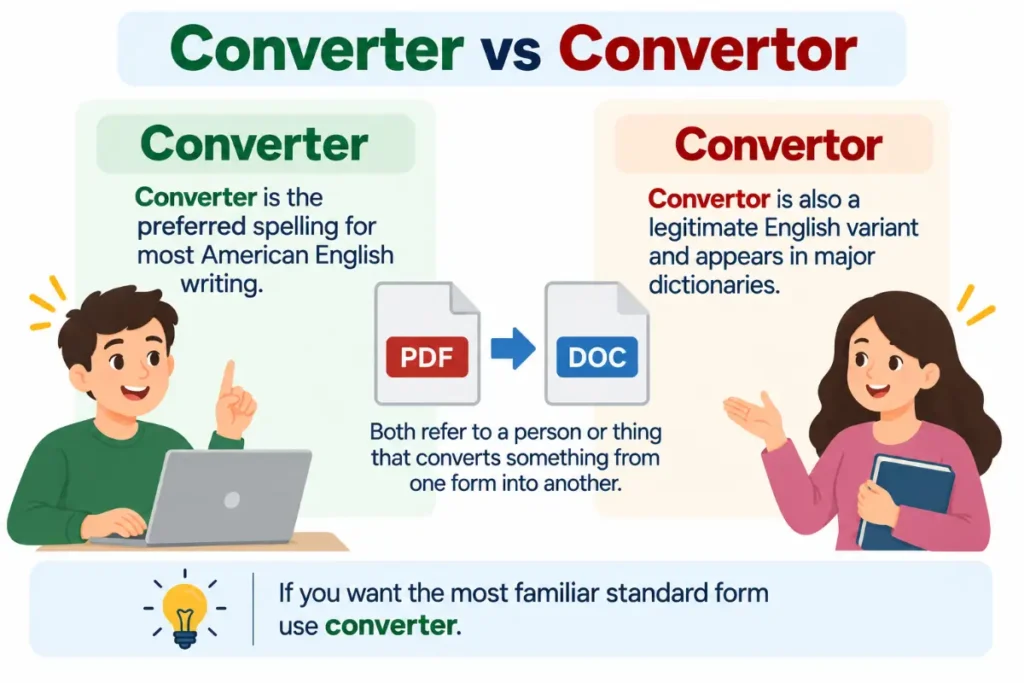
Converter is the preferred spelling for most American English writing. Convertor is also a legitimate English variant and appears in major dictionaries. Both refer to a person or thing that converts something from one form into another. If you want the most familiar standard form use converter.
Comparison Table
| Form | Meaning | Part of Speech | Origin | Usage Frequency | Formality | Common Contexts | Example |
|---|---|---|---|---|---|---|---|
| Converter | A person device or program that changes something into another form | Noun | From convert with the agent ending er | More common as the main dictionary form | Standard | Technology electronics cars computing measurements | The voltage converter stopped working. |
| Convertor | A person or thing that converts something | Noun | Variant formation related to convert | Less common than converter | Standard but less usual | Technical and general contexts | The system uses a digital convertor. |
The most useful point in the table is simple. Converter is the normal first choice. Convertor isn’t automatically wrong. It is an accepted variant that appears in established dictionaries. Cambridge explicitly lists convertor as another form of converter and Oxford does the same in its American English entry.
What Converter Means
A converter is a person device or program that changes something from one form into another. The change can involve physical material electrical energy data measurements signals or another type of system.
Oxford gives several uses for the word. A converter can be a person or thing that converts something. In physics it can describe a device that changes alternating current into direct current or the reverse. It can also describe a device that changes a radio signal from one frequency to another. In computing it can refer to software that changes data from one format into another.
The word appears in many familiar expressions.
- Currency converter changes one currency value into another.
- Catalytic converter is part of a vehicle exhaust system.
- Digital converter can change information from one digital format or system into another.
- Analog to digital converter changes an analog signal into digital information.
- Voltage converter changes electrical voltage from one level to another.
- File converter changes a file from one format into another.
The basic idea stays the same. Something starts in one form and ends in another.
That connection is easy to remember because the noun comes from the verb convert. A converter is simply something that converts.
What Convertor Means
Convertor has essentially the same basic meaning. It refers to a person or thing that converts something.
This matters because calling convertor an incorrect spelling would give you the wrong picture. Major dictionaries recognize it as a variant. Cambridge lists it alongside converter and Oxford’s American English dictionary does the same. Merriam Webster also includes convertor within its converter entry.
The practical difference is mainly one of preference and familiarity rather than meaning.
Imagine two doors leading into the same room. One door is wider and used by most people. The other door still works but sees less traffic. That’s a useful way to think about converter and convertor.
In most general American English writing converter is the wider door.
Convertor can still appear in technical material or in writing influenced by particular regional or professional conventions. Seeing it in a document doesn’t automatically mean the writer made a spelling error.
Key Differences Explained
Spelling
The only visible difference is the ending.
Converter uses er.
Convertor uses or.
Both forms are built around the same base word convert.
Meaning
There is no major meaning difference between the two forms. Both can describe a person device or program that converts something.
Grammar
Both forms function as nouns.
You can use them as the subject or object of a sentence.
The converter is broken.
The technician replaced the convertor.
The first example uses the more familiar form. The second uses a recognized variant.
Pronunciation
The two forms are normally pronounced essentially the same. The ending doesn’t create a meaningful difference in ordinary speech.
That similarity can actually make the spelling harder to remember. You hear one sound but have two possible written forms.
Formality
Neither spelling is inherently slang. Both have legitimate dictionary status.
Still converter is usually the safer choice in formal American English because it is the more familiar dictionary headword and the form used in many established technical expressions. Oxford’s American English entry gives converter as the main form and identifies convertor as an alternative.
Context
Converter appears across technology electronics computing automotive writing engineering and everyday language.
Convertor can appear in many of the same areas. It doesn’t carry a completely different technical meaning.
Regional usage
There is no simple American versus British rule that says one country uses converter and another uses convertor. Both forms are recognized in major English dictionaries.
That is worth remembering. Many spelling questions have a neat regional answer. This one doesn’t.
Which Form Is Correct?
If you need one clear answer converter is the best choice for most writing.
That doesn’t make convertor wrong.
The distinction is important because English contains many legitimate variant spellings. A dictionary may present one form as the main entry and another as an accepted alternative. Merriam Webster explains that an alternate spelling can be treated as a variant and that an entry marked with also is a less common form. Its converter entry includes convertor as an alternative.
Oxford follows a similar pattern. Its American English entry uses converter as the main headword and lists convertor as an alternative.
This gives you a useful editing rule.
If you’re writing from scratch choose converter.
If you’re editing general American English use converter unless there is a specific reason to preserve the variant.
The safest choice isn’t always the only correct choice. English has room for variation.
Sentence Examples
Here are natural examples using the preferred form.
- I need a voltage converter for this device.
- The technician installed a new catalytic converter in the car.
- You can use an online currency converter to check the exchange rate.
- This program includes a file converter for several common formats.
- The digital converter stopped working during the presentation.
- We bought a travel converter before leaving for Europe.
- The engineer tested the power converter under several conditions.
- This tool works as a unit converter for length weight and temperature.
- The television needs a signal converter to receive the new broadcast format.
- The software includes a built in converter for older files.
These examples show why the word is so useful. It isn’t limited to one field. You can encounter it in casual conversation technical instructions workplace documents school assignments and software documentation.
The noun also combines naturally with other words. Those combinations can make the correct spelling easier to remember. Think about familiar expressions such as catalytic converter or currency converter. Once you see the pattern often enough the spelling starts to feel automatic.
Common Mistakes and Misspellings
Using Convertor When You Want the Most Familiar Form
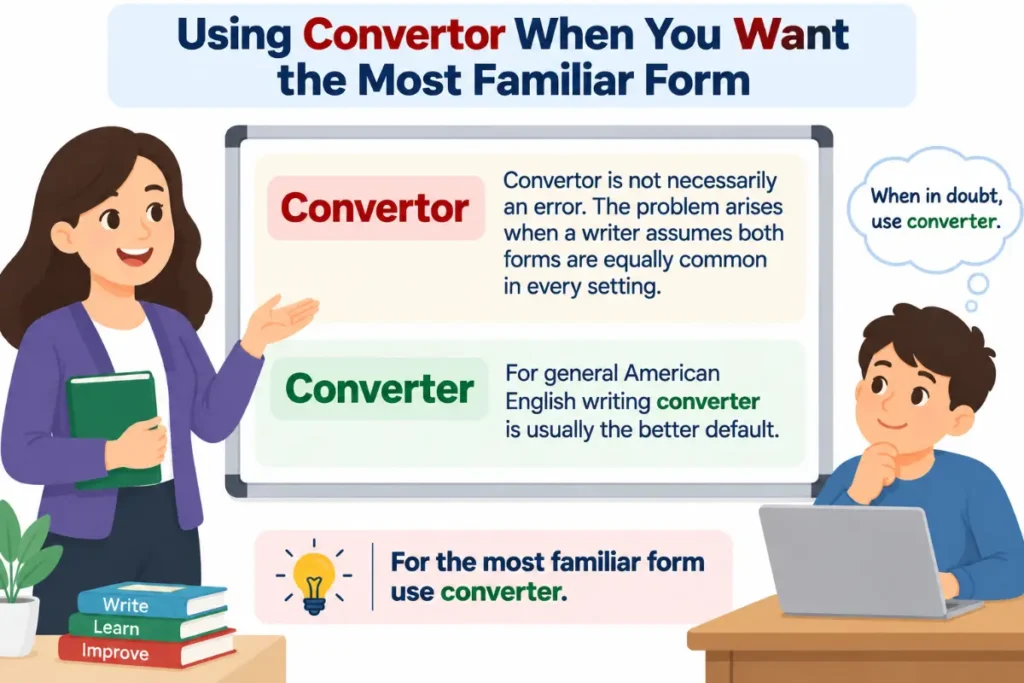
Convertor is not necessarily an error. The problem arises when a writer assumes both forms are equally common in every setting.
For general American English writing converter is usually the better default.
Example.
Incorrect for a general style preference: The currency convertor is easy to use.
Preferred: The currency converter is easy to use.
Confusing Converter With Convert
Converter is a noun while convert is commonly a verb.
Example.
Correct: This program can convert the file.
Correct: This program has a file converter.
The verb describes the action. The noun names the person device or program that performs the action.
Confusing Converter With Conversion
Conversion refers to the process or result of changing something. Converter refers to the person device or program that performs the change.
Example.
The conversion took several minutes.
The converter performed the conversion.
Cambridge defines conversion as the process of converting something from one thing into another.
Assuming Every Or Ending Is More Technical
English doesn’t follow a simple rule where words ending in or are always more technical.
That’s a tempting shortcut but it doesn’t work reliably. English word formation has developed over centuries and different nouns have settled into different patterns.
Treating Convertor as a Typo
This is the opposite mistake.
If you see convertor in an established text you shouldn’t automatically mark it as misspelled. Major dictionaries recognize it as a variant of converter.
A good editor checks the dictionary status of a disputed form before changing it.
Pronunciation Guide
Both forms are pronounced essentially the same in normal English.
For converter the American pronunciation is approximately:
kuhn VUR tur
The IPA pronunciation given by Cambridge is /kənˈvɝː.t̬ɚ/ for American English. Oxford gives a closely matching American pronunciation.
The stress falls on the middle syllable.
con VER ter
The first syllable is weak. The middle syllable receives the main stress. The final syllable is also reduced in ordinary American speech.
This creates an interesting spelling trap. When two words sound almost identical it becomes difficult to decide which written form you saw or heard. That is one reason people can hesitate between converter and convertor.
You don’t need to pronounce the two forms differently to show that you know the distinction. In ordinary speech the difference is not useful.
Etymology and Word Origin
The history of converter helps explain why the word has such a broad meaning.
The verb convert entered English through Anglo French from Latin convertere meaning to turn around or transform. Merriam Webster traces convert through Anglo French back to Latin convertere.
The Latin word combined elements associated with turning or changing. Over time the English verb developed beyond the original religious sense and gained the broader idea of changing something into another form.
The noun converter appeared in English in the sixteenth century. Etymological records identify an early sense involving a person who makes converts. The later technical sense of a device that changes materials or conditions developed centuries afterward.
That history fits the modern meaning remarkably well. At its heart the word has always involved the idea of change.
A converter changes one thing into another.
That could be a belief.
It could be an electrical current.
It could be a unit of measurement.
The specific object changes but the central idea remains.
Regional Usage
American English
In American English converter is the safest and most familiar choice.
Oxford’s American English dictionary lists converter as the main noun and gives convertor as an alternative.
You’ll see converter in common American expressions such as catalytic converter voltage converter currency converter and file converter.
For school work business writing websites instructions and most general communication choose converter.
British English
British English also recognizes both forms.
Cambridge lists converter as the main form and identifies convertor as another form. Its British pronunciation differs from the American pronunciation but the basic meaning remains the same.
So this isn’t a clean case of one spelling being American and the other being British.
Australian English
There is no strong spelling rule that makes convertor the required Australian form. The broader English usage pattern still recognizes converter as the familiar form and convertor as a variant.
Canadian English
Canadian English also follows the wider English pattern rather than creating a strict converter versus convertor distinction.
For readers in Canada the United States Britain or Australia the practical advice remains similar. If you want the most widely recognizable form choose converter.
Grammar Rules and Part of Speech
Converter is a noun.
It names a person thing or program that performs conversion.
The most common pattern is:
converter + noun
Examples include currency converter and signal converter.
Another common structure is:
a converter + verb
The converter changes the signal.
You can also use the word after a determiner.
The converter needs replacement.
A converter can solve the problem.
Several converters were tested.
The plural is converters.
This follows the normal English plural pattern for nouns ending in er.
Convertor follows the same basic grammatical pattern.
The convertor needs replacement.
Several convertors were tested.
The grammar itself isn’t what separates the two forms. Spelling preference is the main issue.
It’s also useful to keep the noun separate from the verb.
Convert describes an action.
Converter names the thing that performs the action.
Conversion names the process or result.
Consider this sentence.
The converter converts the file during the conversion process.
Each word has a different job.
The converter is the tool.
Converts is the action.
Conversion is the process.
This distinction becomes especially useful in technical writing where several related forms may appear in the same sentence.
Real Life Usage Examples
Daily Conversation
People often use converter when talking about travel cars electronics or measurements.
I need a power converter for my old device.
The mechanic said the catalytic converter needs attention.
These sentences sound natural because converter is the familiar everyday form.
Workplace Communication
Workplace writing often requires clear technical nouns.
The new converter supports the required file formats.
Please test the converter before the equipment reaches the client.
In professional writing the familiar form helps readers understand the sentence without stopping over an unusual spelling.
Academic Writing
Academic writing may use the word in science engineering computing or technology.
The researchers used a digital converter to process the incoming signal.
The experiment required a device capable of converting electrical energy into another form.
The second sentence uses converting instead of converter. This shows how the word family can change depending on the grammatical job.
News And Journalism
News writing may use converter when discussing vehicles technology energy or industry.
The manufacturer announced a new design for its catalytic converter.
Engineers developed a smaller converter for the next generation of equipment.
Technical journalism generally favors familiar established terms because readers need to understand the subject quickly.
Literature And Storytelling
The word is less common in general fiction but can appear naturally in stories involving machines or technology.
He reached beneath the dashboard and checked the converter.
The old machine needed a new converter before it could work again.
Good writing doesn’t force a specialized word into a scene. It uses the term when the subject naturally calls for it.
Related And Confused Terms
Several words belong to the same family or sit close to converter in meaning.
Convert
Convert is primarily a verb meaning to change something into another form. Cambridge gives examples involving changing a room into another use and changing measurements from one unit to another.
Example.
We need to convert the file.
Conversion
Conversion is the noun for the process or result of converting.
Example.
The conversion took five minutes.
Convertible
Convertible is an adjective meaning capable of being changed or converted. It can also function as a noun in other contexts.
Example.
The file is convertible to another format.
Transform
Transform is a verb meaning to change something significantly in form or character.
Example.
The renovation transformed the building.
Change
Change is the broadest everyday term for making something different.
Example.
We need to change the format.
Translator
A translator changes language from one language to another. It can overlap with the broader idea of conversion but has a more specific function.
Example.
The translator converted the document from Spanish into English.
Adapter
An adapter helps different systems or pieces of equipment work together. It isn’t automatically the same thing as a converter.
Example.
The adapter connects the two devices.
Transformer
A transformer is a specific electrical device used to change electrical voltage. It shouldn’t be treated as a general synonym for converter.
These distinctions matter because technical words often overlap in casual conversation while carrying different meanings in precise writing.
Why The Spelling Causes Confusion
The main reason for the confusion is the productive English ending er.
English often creates nouns for people or things that perform an action by adding er to a verb.
Teach becomes teacher.
Drive becomes driver.
Write becomes writer.
Convert becomes converter.
That pattern makes converter feel completely natural.
At the same time English has many nouns ending in or.
Actor.
Creator.
Translator.
Operator.
The ending or can therefore look equally plausible when you’re creating a noun from convert.
That’s where the uncertainty comes from.
English isn’t a perfectly predictable mathematical system. Word formation follows patterns but history usage and convention also matter. Sometimes two patterns survive side by side.
That is exactly what happened here.
Convertor isn’t a random typo invented by someone who doesn’t know how to spell converter. It is an established variant that dictionaries record.
A Simple Memory Trick
If you’re unsure which spelling to use remember the most common family pattern.
Convert → converter
The verb convert takes the familiar agent ending er.
You can connect it with several words you already know.
Drive → driver.
Teach → teacher.
Build → builder.
Convert → converter.
This isn’t a rule that proves convertor is wrong. It simply gives you a reliable writing choice.
Another useful trick is to remember familiar compound terms.
Catalytic converter.
Currency converter.
File converter.
Voltage converter.
Once you associate converter with these common expressions the spelling becomes easier to recall.
Expert Editor Insight
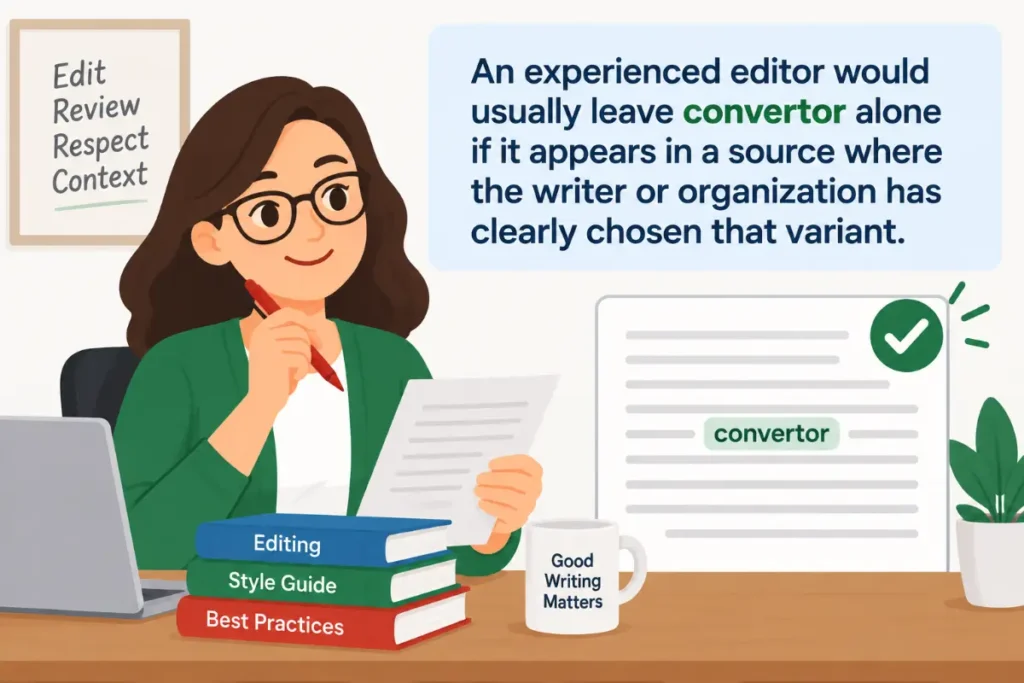
An experienced editor would usually leave convertor alone if it appears in a source where the writer or organization has clearly chosen that variant. But when editing general American English from scratch the editor would normally choose converter because it is the more familiar main dictionary form. The key is not to label every unfamiliar spelling as wrong. Check its status first then choose the form that best fits the audience and style.
Conclusion
The answer to convertor vs converter is straightforward once you separate correctness from preference. Both forms are legitimate English nouns that describe a person thing or program that converts something. However converter is the better default for most American English writing and is the form you’ll usually want in professional general and academic work.
Convertor isn’t simply a bad spelling. Major dictionaries recognize it as a variant of converter. That means you shouldn’t automatically correct it when you encounter it in an established document. Context style and audience still matter.
For everyday writing keep one simple memory trick in mind: convert becomes converter. If you’re unsure and need the safest familiar form choose converter. It’s clear natural widely recognized and works across technology business education and everyday communication.
FAQs
Is Convertor A Real Word?
Yes. Convertor is a real English word and a recognized variant of converter. Cambridge lists it as an alternative form and Oxford also includes it in its dictionary entries. Merriam Webster includes it under converter as an alternative spelling. So you shouldn’t automatically mark convertor as a spelling error.
What Does Converter Mean?
A converter is a person device or program that changes something from one form into another. The word appears in many fields including electronics computing automotive technology and measurement. Examples include catalytic converter currency converter voltage converter and file converter. The basic meaning stays the same even when the type of conversion changes.
Which Is Correct Converter Or Convertor?
Both are legitimate forms but converter is the safer default for most American English writing. Major dictionaries recognize convertor as a variant rather than treating it as an outright mistake. If you’re writing an essay report email website or general technical document choose converter unless a particular style guide calls for another form.
How Do You Pronounce Converter?
In American English converter is pronounced approximately kuhn VUR tur. Cambridge gives the IPA pronunciation /kənˈvɝː.t̬ɚ/. The main stress falls on the middle syllable. Convertor is normally pronounced in essentially the same way so pronunciation doesn’t provide a reliable clue about which spelling to write.
Can Converter Start A Sentence?
Yes. Converter can start a sentence because it is a noun. For example: Converter technology has improved over the years. Starting a sentence with a noun is completely normal. The word can also appear as the subject of a sentence or as the object after a verb. Its position depends on the meaning and structure of the sentence.
What Is A Synonym For Converter?
The best alternative depends on the context. Device can work in a broad technical context. Transformer may work for certain electrical applications but has a more specific meaning. Adapter can work for equipment that connects incompatible systems but isn’t always a converter. In many cases changing the sentence to use the verb convert is more natural than searching for a direct synonym.
Why Do People Confuse Converter And Convertor?
People confuse them because both spellings follow familiar English patterns. Converter follows the common er ending used in words such as driver and teacher. Convertor resembles words such as actor and operator. Since the two forms also sound essentially the same it can be difficult to know which spelling you heard or saw.
Is Converter Appropriate In Formal Writing?
Yes. Converter is fully appropriate in formal writing and is the preferred default for most American English contexts. You can use it in academic papers technical reports workplace documents instructions and professional websites. Convertor is also a recognized variant but converter is usually the more familiar choice for readers.
