
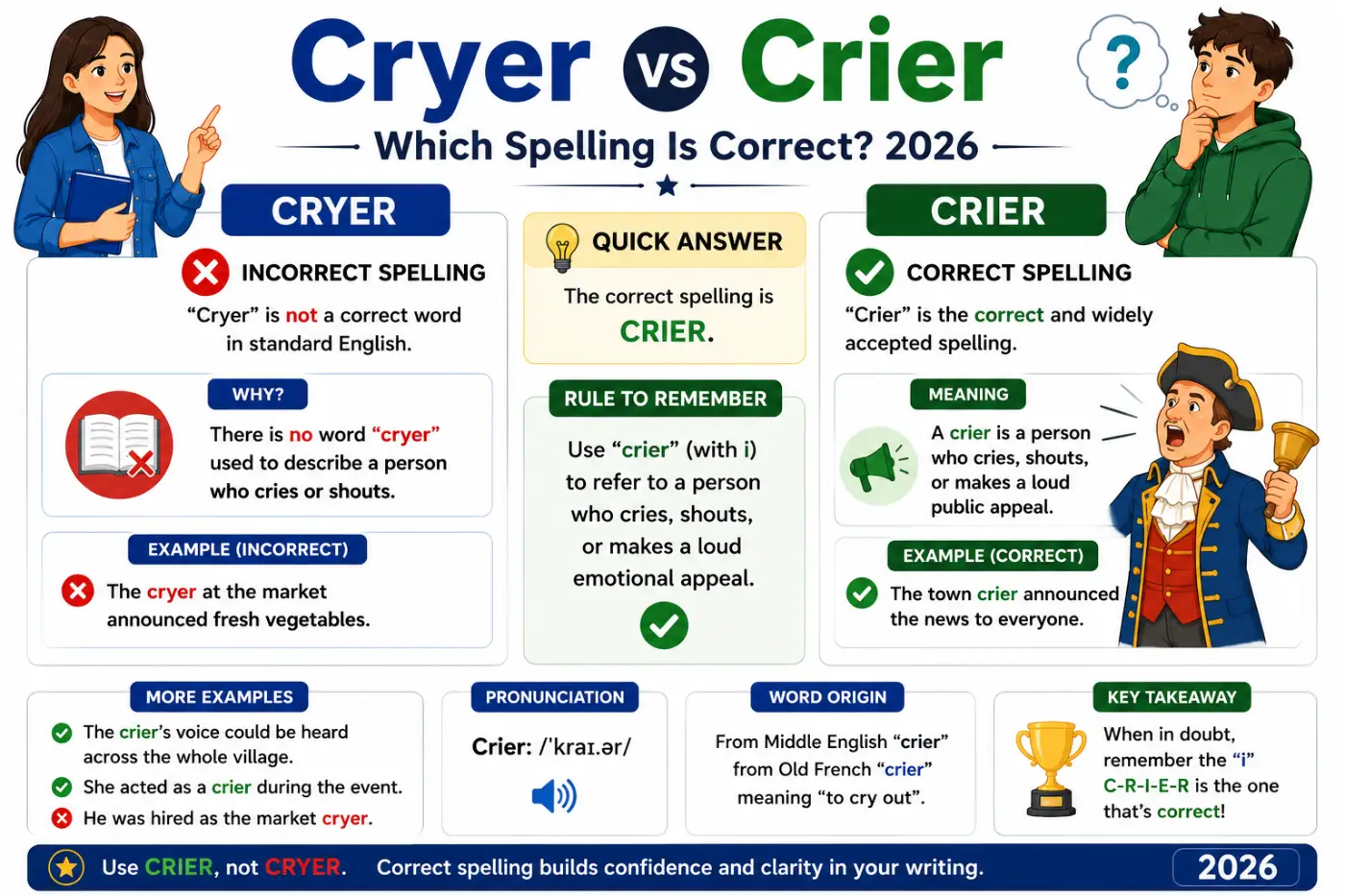
cryer vs crier can cause a surprisingly stubborn spelling problem because both forms come from the verb cry and both sound alike in ordinary speech. The standard modern spelling is crier. Cryer also exists as a historical variant of the noun and as a surname so calling it nothing more than a spelling mistake would be too simple.
The confusion makes sense. English often forms nouns for people by adding er to a verb. That pattern can make cryer look perfectly reasonable at first glance. Yet the established modern spelling changes the final y to i before the er ending. The result is crier. Modern dictionaries recognize crier for a person who cries and for the traditional public announcer known as a town crier.
This guide explains the difference in plain English. You’ll learn what each form means where each one belongs how to pronounce the word why the spelling developed this way and how native speakers use it. You’ll also see practical examples common mistakes regional usage related words and a simple editing tip that can help you choose the right form quickly.
Quick Definition
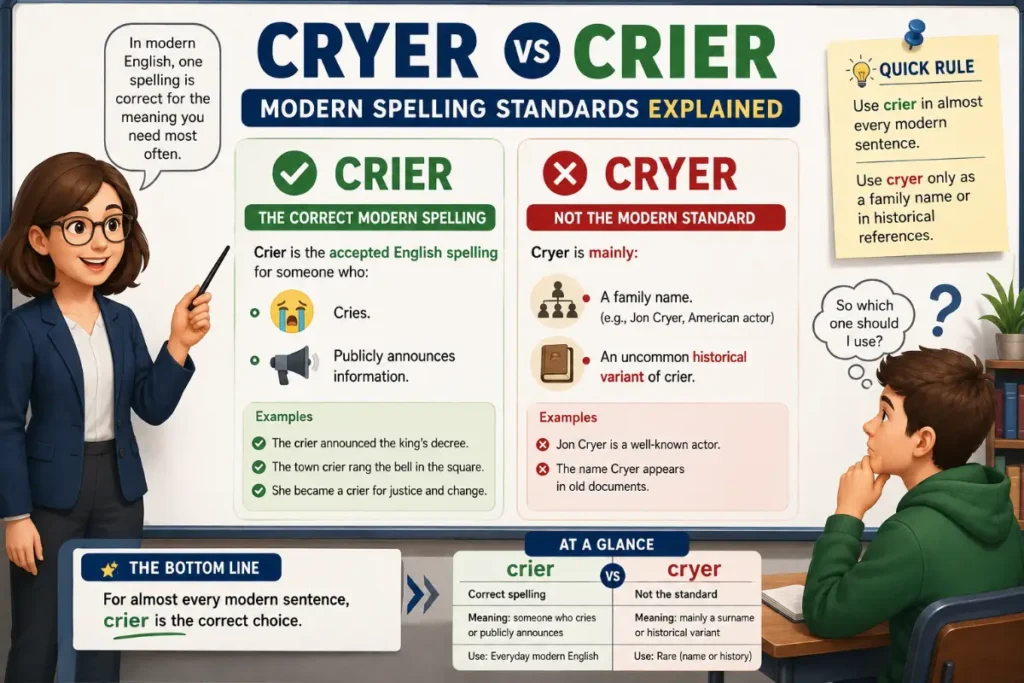
Crier is the standard modern English spelling for a person who cries or for someone who makes a public announcement. Cryer is an older variant spelling that still appears in historical material and can also occur as a surname. For normal modern writing choose crier unless you are preserving a historical form or referring to a person whose name is Cryer.
Quick Answer
Crier is the preferred spelling in modern standard English. It can mean a person who cries or a person who makes a public announcement such as a town crier.
Cryer is not simply meaningless. Merriam Webster records it as a variant spelling of crier and historical sources show the form in older English. It also survives as a surname. For everyday modern writing however crier is the form you should normally use.
Comparison Table for Cryer and Crier
| Form | Meaning | Part of Speech | Origin | Usage Frequency | Formality | Common Contexts | Example |
|---|---|---|---|---|---|---|---|
| Crier | A person who cries or a person who makes public announcements | Noun | From Middle English forms related to Old French crier | Common and established | Neutral | Everyday speech literature history journalism | The town crier announced the news. |
| Cryer | Historical variant of crier and also a surname | Noun or proper noun when used as a surname | Historical English variant related to crier | Uncommon as a common noun | Historical or name specific | Old texts surnames historical records | The family name was Cryer. |
The table shows the key point. The two forms have a shared history but they do not have equal status in modern everyday English. Crier is the normal choice for a common noun. Cryer deserves a different treatment because it can appear in genuine historical or name based contexts.
Meaning of the Two Forms
Meaning of Crier
Crier is a noun. Its most familiar modern meaning is a person who cries easily or often.
For example:
She’s a crier during emotional movies.
In this sentence the noun describes someone who tends to cry.
Crier also has a much older occupational meaning. A crier could be a person who announced information loudly in public. The best known expression is town crier. Historically a town crier made public announcements by calling them out so people in the community could hear them. Cambridge Dictionary still lists this meaning and gives the pronunciation used in American and British English.
The two meanings come from the same basic idea. A person who cries makes a vocal sound. A person who cries out a public announcement also uses the voice to communicate information.
The modern emotional meaning and the historical public announcement meaning can therefore sit comfortably under the same noun.
Meaning of Cryer
Cryer has a more complicated status.
Merriam Webster identifies cryer as a variant spelling of crier. Historical evidence also shows the form in older English. Wiktionary labels the English noun cryer as an archaic form of crier.
That means you shouldn’t treat every appearance of cryer as a simple typing error.
If you encounter cryer in an old book or historical document it may reflect spelling practices from an earlier period. The spelling can also appear in family names. Cryer is an established surname and should be preserved when it refers to a person whose actual name is Cryer.
For a new sentence in modern English however crier is the safer and more natural choice.
Write:
She is a crier.
Not:
She is a cryer.
The second sentence can only be defended in a special historical or name based context. It isn’t the normal spelling used by modern writers.
Key Differences Explained
- Modern spelling. Crier is the standard form used in contemporary English. Cryer is a historical variant and a surname in modern use.
- Meaning. Both forms are connected to a person who cries or cries out. The modern common noun is crier.
- Grammar. Crier is a countable noun. You can write one crier or several criers.
- Pronunciation. The two forms are generally pronounced alike when they represent the same noun. The spelling difference does not create a normal modern pronunciation difference.
- Formality. Crier works in casual conversation and formal writing. Cryer is more likely to appear in historical material or as a proper name.
- Historical usage. Older English used several spelling patterns for words related to cry. Cryer is one form that survived in historical records.
- Regional usage. Modern American and British English both favor crier for the common noun. There is no major US versus UK spelling split here.
- Names. Cryer can be correct when it is someone’s surname. A family name should not be changed simply because another spelling is more common as a noun.
The practical rule is straightforward. If you are describing someone who cries or referring to a public announcer use crier. If Cryer appears as a surname keep the capitalized name exactly as it belongs.
Which Form Should You Use?
Use crier in modern English.
That recommendation follows standard dictionary usage. Cambridge Dictionary lists crier as a noun meaning someone who cries and also connects it with town crier. Merriam Webster separately records cryer as a variant spelling of crier rather than presenting it as the normal modern choice.
There is also a useful historical reason for the spelling. The noun developed from the verb cry through older forms that were influenced by French. The modern form crier became established over time while cryer remained as an older variant.
This is a good example of why spelling should not always be built from sound alone. If you hear someone say crier you might naturally imagine cry plus er and write cryer. English has many words that look as though they should follow a simple pattern but actually preserve a spelling shaped by historical development.
For current writing the choice is easy.
Use crier for a person who cries.
Use town crier for the traditional public announcer.
Use Cryer when it is someone’s surname.
Treat cryer as an older spelling when you encounter it in historical material.
Sentence Examples
Here are natural examples showing the modern noun in different settings.
- My brother is a crier whenever he watches a sad movie.
- The baby became a frequent crier during the first few months.
- I’m not much of a crier but that ending got me.
- The town crier announced the festival from the center of the square.
- The museum hired a performer to portray a traditional town crier.
- The historian described how a crier once delivered public announcements.
- She laughed and said she was becoming a crier as she got older.
- The novel introduces a crier who struggles to hide his emotions.
- The article explains the historical role of the town crier.
- He’s a quiet person but he’s definitely a crier during family movies.
These examples show that the word works naturally in both ordinary conversation and formal contexts.
Now look at cases involving the older form.
- The historical document refers to a court cryer.
- The old record uses cryer as an alternative spelling for crier.
- The surname Cryer appeared in the family records.
- The author preserved the original spelling cryer in the historical quotation.
- The character named Cryer appears throughout the novel.
The first two examples require historical context. The last three show why context matters. Cryer can be a legitimate name and an older spelling. That doesn’t make it the preferred modern common noun.
Common Mistakes and Misspellings
Using Cryer for the Modern Common Noun
Incorrect:
He is a cryer.
Preferred:
He is a crier.
The mistake happens because cryer appears to follow the simple pattern of cry plus er. The established modern noun uses crier instead.
Treating Both Forms as Equal in Modern Writing
It’s tempting to think that two spellings must be equally acceptable because both have appeared in English. Language history doesn’t work that way. Older variants can survive in records long after one form becomes dominant in ordinary writing.
For current English choose crier.
Changing a Surname
Incorrect editing can happen in the opposite direction too.
If someone’s surname is Cryer you should not change it to Crier. Proper names have their own spelling and identity.
For example:
Dr. James Cryer spoke at the event.
Cryer is correct in that sentence because it is the person’s name.
Assuming Pronunciation Determines Spelling
Crier and cryer can sound the same. That doesn’t mean the spelling must be identical.
English spelling often preserves historical patterns that aren’t obvious from pronunciation. Listening carefully can’t always settle a spelling question.
Assuming an Older Form Is Always a Typo
If you find cryer in a historical document don’t automatically correct it. An editor working with historical material may need to preserve original spelling. The surrounding date and purpose of the text matter.
This is where good editing differs from automatic correction. The goal isn’t simply to change unfamiliar forms. The goal is to understand what the writer meant and what kind of text you’re editing.
Pronunciation Guide
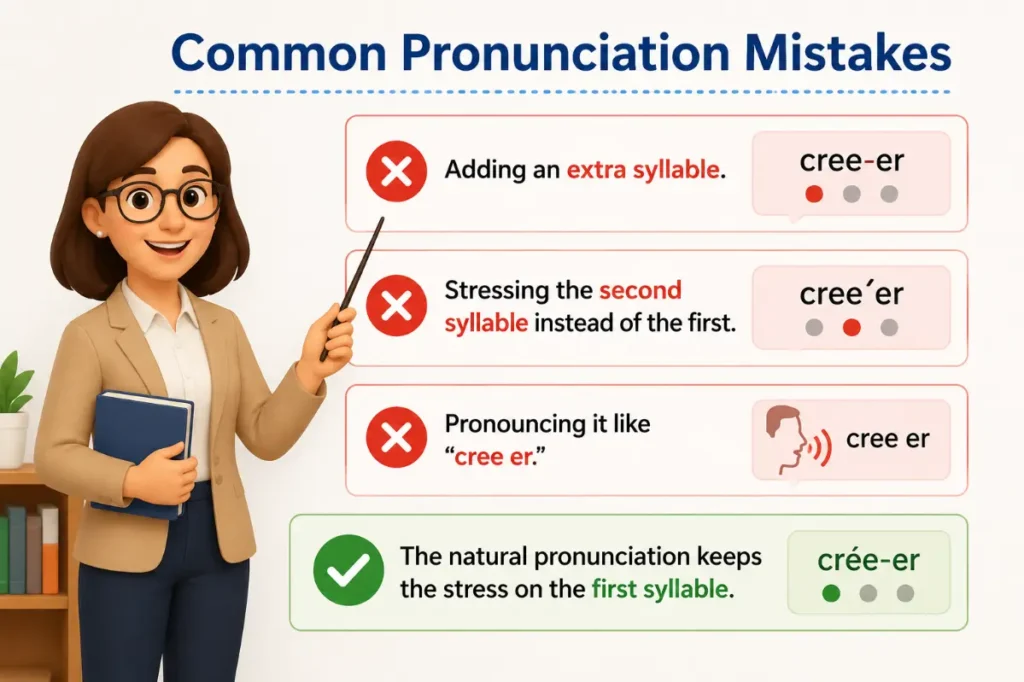
Crier is commonly pronounced /ˈkraɪər/ in American English. Cambridge gives the US pronunciation as /ˈkraɪ.ɚ/ and the UK pronunciation as /ˈkraɪ.ə r/.
A simple pronunciation guide is:
CRY er
The main stress falls on the first part.
The word has two main sound units in ordinary speech. The first rhymes with sky and the second has a light unstressed sound similar to er in many American pronunciations.
Crier and cryer generally sound the same when they represent the same noun. This is one reason the spelling confusion is so common.
A useful memory trick is to separate the written form from the sound. Say the word naturally as crier while looking at the spelling. After a few repetitions the visual pattern becomes easier to recognize.
Don’t try to force every letter into a separate sound. English spelling often contains letters that don’t stand out clearly in normal speech.
Etymology and Word Origin
The history of crier reaches back to the verb cry. Etymological sources trace English cry to Middle English forms and ultimately through Old French crier to Vulgar Latin and Latin roots associated with calling out or wailing. The meaning later developed in English to include the sense of shedding tears.
The noun crier developed from this verb as an agent noun. In simple terms an agent noun names someone who performs an action. A crier is someone who cries or cries out.
The historical public announcement sense is especially interesting. Etymological evidence places crier in English by the late thirteenth century with a sense connected to an officer who made public announcements in a court. The town crier meaning developed later.
This history explains why crier can describe both an emotional person and a public announcer. Both meanings connect to the older idea of crying out.
Cryer belongs to the same historical family. It survived as an alternative spelling and later became especially noticeable as a surname. Modern dictionaries can therefore recognize the form without making it the preferred spelling for ordinary writing.
Regional Usage
American English
American English uses crier as the standard common noun. You can use it for someone who cries easily and for a traditional public announcer. The phrase town crier is familiar even though the historical occupation itself is no longer part of everyday community life.
Cryer may appear as a surname or in historical material. It is not the form you should normally choose when writing a new sentence about someone who cries.
British English
British English also uses crier. The word has the same basic meanings and the same standard spelling.
The historical association with town criers is particularly strong in British cultural history because public criers played an important role in announcing official information before modern mass communication. Still the modern spelling remains crier.
Australian English
Australian English follows the same modern spelling. Crier is the standard common noun and town crier is the familiar historical expression.
There is no major Australian spelling rule that turns crier into cryer. If you are writing for an Australian audience use crier unless you are dealing with a historical form or a proper name.
Canadian English
Canadian English also uses crier as the normal spelling. The meaning remains the same as in American and British English.
Cryer can appear as a surname or historical variant but it does not represent a Canadian spelling alternative.
So the regional answer is refreshingly simple. Modern English varieties generally agree on crier for the common noun.
Grammar Rules and Part of Speech
Crier is a noun.
It names a person rather than an action. That means it can take normal noun forms.
You can write:
The crier entered the room.
You can also write:
The criers entered the room.
The plural is criers.
The noun can appear after articles such as a and the.
She is a crier.
The crier announced the message.
It can also appear with adjectives.
He is an emotional crier.
The town had a professional crier.
When crier means someone who cries often it usually refers to a person with a noticeable tendency to cry. It doesn’t mean that the person is crying at every moment.
For example:
My sister is a crier.
This means she tends to cry easily or often.
It doesn’t mean she is currently crying.
When the word appears in town crier the meaning changes slightly because the phrase refers to a public announcer. The context makes the intended meaning clear.
The word also works naturally in formal writing.
The study describes participants who identified themselves as frequent criers.
Here the noun is part of a factual statement and doesn’t carry the informal tone that some readers might associate with crying.
Punctuation is straightforward. Crier doesn’t require special punctuation simply because it is the noun in question.
If it appears in the middle of a sentence you treat it like any other common noun.
The crier announced the news.
If Cryer is a surname it receives a capital letter.
Mr. Cryer attended the meeting.
That capitalization signals that the word is functioning as a proper name rather than the common noun.
Real Life Usage Examples
Daily Conversation
Crier appears naturally in casual speech when people talk about emotional reactions.
I’m such a crier during sad movies.
My son is a happy crier when he gets excited.
These sentences sound normal because the noun describes a person’s tendency to cry.
Workplace Communication
The word is less common in ordinary business writing but it can appear in discussions about communication or behavior.
The report identifies several participants as frequent criers.
The historical exhibit includes a section about the role of the town crier.
In professional writing context matters. The word isn’t inappropriate simply because it describes emotion.
Academic Writing
Academic writing may use crier when researchers discuss crying behavior or when historians discuss public announcements.
The researchers recorded participants who described themselves as frequent criers.
The historian examines how town criers helped spread official information.
The plural form criers works naturally in both examples.
News Writing
News stories may use crier when discussing historical events or people known for emotional reactions.
The festival featured a performer dressed as a traditional town crier.
The actor joked about becoming a crier during emotional scenes.
The context makes the intended meaning clear.
Literature and Storytelling
Writers can use crier to characterize someone quickly.
Mara was a crier who tried to hide her emotions.
At the edge of the square the town crier called the villagers together.
The word can carry different emotional weight depending on context. In fiction a crier may be vulnerable emotional dramatic or simply expressive.
Related and Confused Terms
Several words sit close to crier in meaning but each one carries a different shade.
- Crybaby. This is an informal word for someone who cries easily or complains too much. It can sound insulting so use it carefully.
- Weeper. This noun can describe someone who cries or a sad emotional story. It is less neutral than crier in many contexts.
- Town crier. This refers to a person who traditionally announced public information aloud.
- Crying. This is the present participle of cry and can also function as a noun or adjective depending on the sentence.
- Tearful. This adjective describes someone who has tears or seems close to crying.
- Emotional. This broader adjective can describe strong feelings without specifically meaning tears.
- Announcer. This is a broader term for someone who communicates information publicly. A town crier is one historical type of announcer.
- Proclaimer. This formal noun describes someone who publicly announces something. It fits historical or official contexts better than everyday conversation.
These terms overlap but they aren’t interchangeable in every sentence. A crier is specifically connected to crying or crying out. An announcer has a broader communication role.
Why the Spelling Causes Confusion
The spelling problem comes from a perfectly understandable assumption.
English speakers often learn that adding er to a verb can create a noun for a person who performs that action.
Teach becomes teacher.
Drive becomes driver.
Play becomes player.
So when people see cry they may naturally think cryer.
That logic feels neat and tidy. Unfortunately English spelling has many forms that don’t follow the most obvious surface pattern.
The established noun is crier.
The change from y to i is not unique to this word. English spelling often changes a final y when an ending is added. The exact pattern depends on the ending and the word. Learners therefore need to learn crier as the standard form rather than relying only on the sound.
There is another reason the confusion lasts. Crier and cryer are homophones in ordinary English pronunciation. If two spellings sound the same then listening won’t tell you which one belongs on the page.
That makes this a classic spelling problem rather than a pronunciation problem.
The best solution is visual memory backed by word history. Connect crier with cry but remember the established spelling contains i before er.
Is Cryer Ever Correct?
Yes but context matters.
It would be inaccurate to say that cryer has never existed in English. Merriam Webster records it as a variant spelling of crier. Historical sources also describe it as an archaic form.
Cryer can also be correct as a surname. If someone is named Cryer you must preserve that spelling.
For example:
Jordan Cryer joined the panel.
Changing Cryer to Crier would change the person’s name.
Historical writing creates another exception. If you are quoting or reproducing an old document you may encounter cryer. An editor may preserve the original spelling to maintain historical accuracy.
The important distinction is between historical or name based usage and ordinary modern prose.
If you are writing a new article about a person who cries use crier.
If you are writing about a historical document that contains cryer you may need to retain the original form.
If you are writing about a person whose surname is Cryer keep the surname unchanged.
This approach gives you accuracy without pretending that language history is perfectly black and white.
Expert Editor Insight
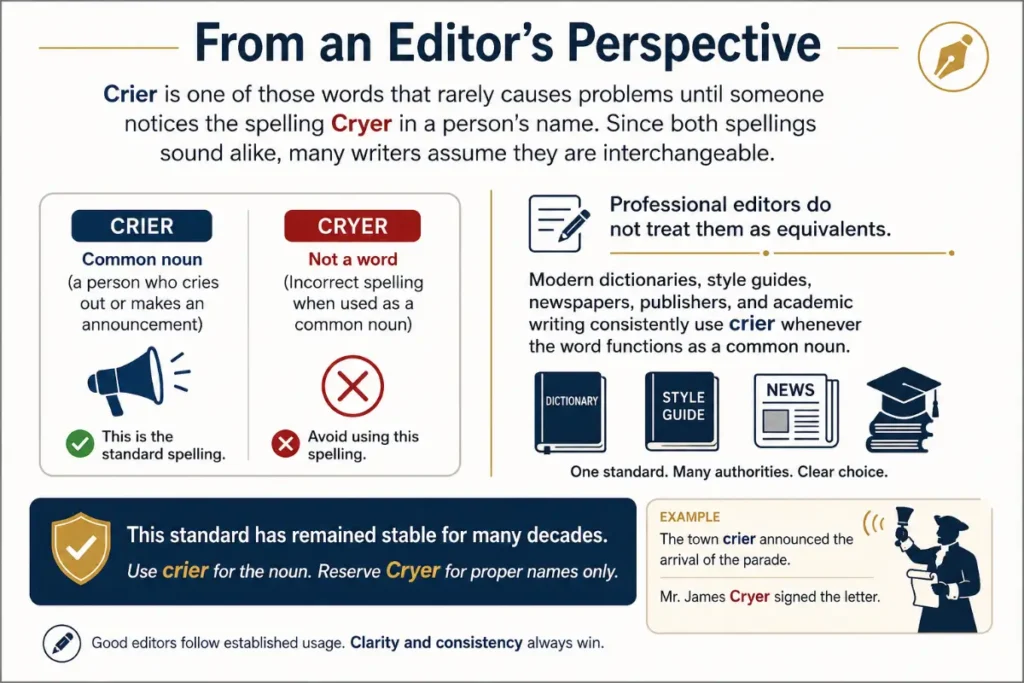
A professional editor would normally change cryer to crier in fresh modern prose unless context shows that the form is intentional. The key is to avoid treating spelling tools as the final authority because a spellchecker may flag a surname or historical form that is completely correct in context. Good editing combines dictionary knowledge with context. My practical tip is to ask what job the word is doing before changing it. If it describes someone who cries then crier is the normal modern noun. If it names a person or preserves an old text then the spelling may need to stay as written.
Conclusion
cry er vs crier has a clear modern answer. Crier is the standard spelling for a person who cries and for the traditional public announcer known as a town crier. Cryer has historical use and remains valid as a surname so it shouldn’t be treated as nothing more than a meaningless typo.
The spelling confusion comes from the way cryer looks like a simple combination of cry and er. That form seems logical but modern English has settled on crier. The two common noun forms can also sound the same which makes the mistake harder to catch by ear. Historical records can add to the uncertainty because older texts contain variant spellings.
For everyday writing use crier. Keep Cryer when it is a person’s surname and preserve cryer when a historical source requires the original form. That simple context check will help you edit the word accurately every time.
FAQs
Is cryer a real word?
Cryer has a real history in English. Merriam Webster records it as a variant spelling of crier and historical sources identify it as an older form. It can also appear as a surname. Still modern writers should normally use crier when referring to a person who cries or to a traditional public announcer.
What does crier mean?
Crier is a noun with two main meanings. It can describe someone who cries easily or often. It can also refer to a person who makes public announcements such as a town crier. The second meaning is especially associated with historical communities where important information was announced aloud in public places.
Which spelling should I use in modern English?
Use crier in modern standard English. It is the established spelling for someone who cries and for the traditional public announcer. Cryer has historical status and can also be a surname but it isn’t the normal choice for a new sentence. If you’re writing an essay email article or report crier is the safest form.
How do you pronounce crier?
Crier is commonly pronounced /ˈkraɪər/ in American English. It sounds roughly like cry er with the main stress on cry. Cambridge gives a US pronunciation with a final r sound and a British pronunciation that reflects a non rhotic accent. The spelling cryer usually has the same pronunciation when used as the noun.
Can crier describe someone who cries easily?
Yes. Crier can describe someone who tends to cry easily or often. For example you might say She’s a crier during emotional movies. The word doesn’t mean the person is constantly crying. It describes a general tendency or characteristic. The meaning is clear from context and works naturally in casual as well as more formal writing.
What is a town crier?
A town crier was a person whose job was to make official or important public announcements by calling them out aloud. The role existed before modern mass communication made it easy to spread news through newspapers radio television and digital media. The expression town crier remains familiar today and often appears in historical writing and cultural events.
Why do people write cryer instead of crier?
The main reason is that cryer looks like a logical noun formed by adding er directly to cry. English readers often expect verbs to form people words with er. The spelling is also hard to hear because crier and cryer are normally pronounced alike. Historical use of cryer adds another layer to the confusion.
Is crier appropriate in formal writing?
Yes. Crier is a standard noun and can appear in formal writing when the context calls for it. Academic writers can discuss criers when describing human behavior and historians can use town crier when discussing public communication. The word itself is not informal. The surrounding sentence and subject determine the overall tone.
