
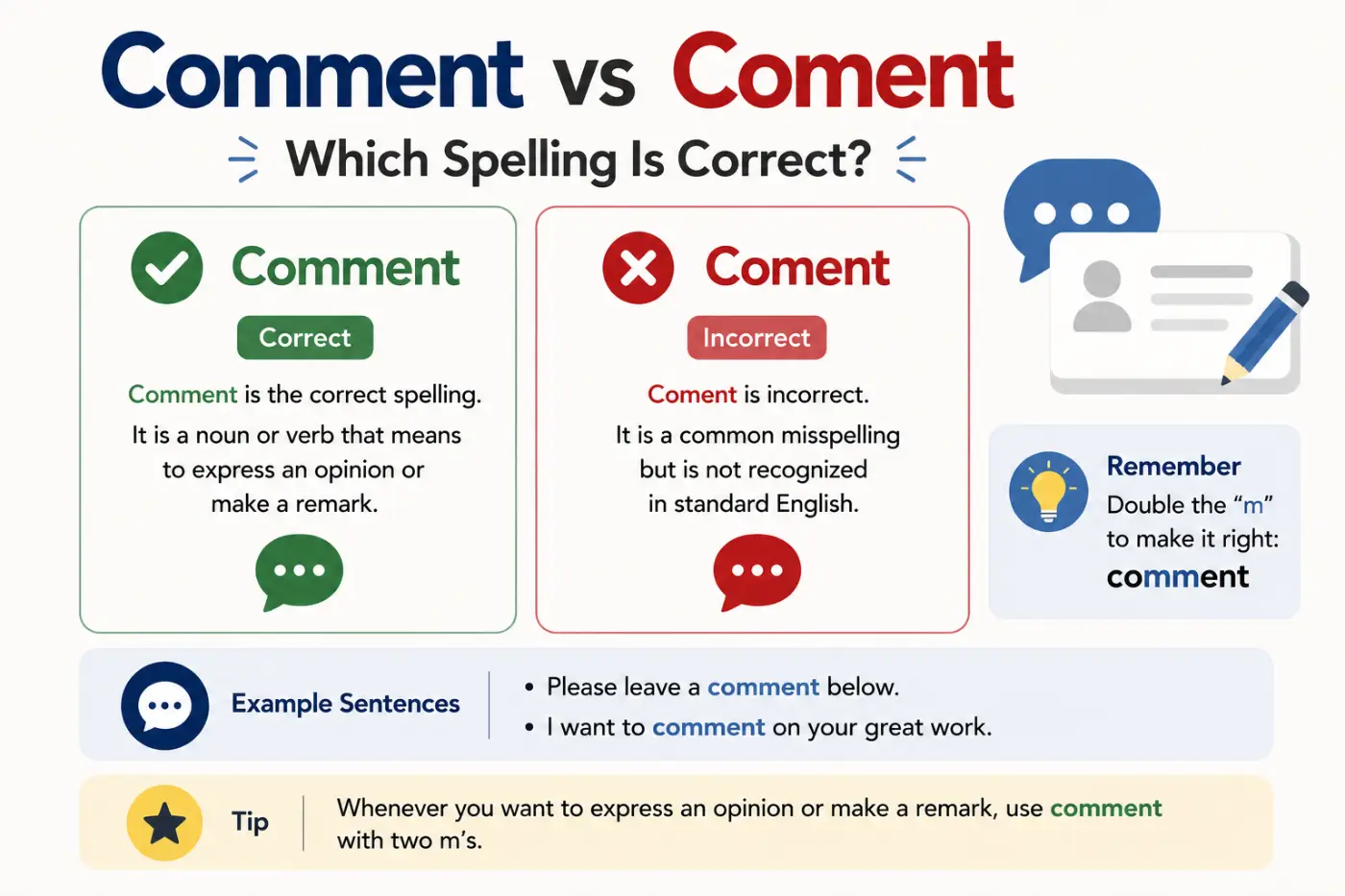
If you’ve ever paused before typing a sentence and wondered about comment vs coment you’re not alone. The correct spelling is comment with two m’s. Coment is not the standard English spelling.
The confusion usually comes from pronunciation. When people say the word quickly the two m sounds can blend together. That makes it easy to type only one m. English spelling also has many words where a repeated consonant can feel unnecessary. Still, this word keeps both m’s.
You’ll see comment in everyday conversation, school assignments, emails, websites, social media, news writing, and professional documents. It can work as both a noun and a verb. It can describe a spoken remark, a written response, an online contribution, or the act of expressing an opinion. This guide explains the spelling, meaning, pronunciation, grammar, history, examples, common mistakes, and practical usage so you can use the word without hesitation.
Quick Answer
Comment is the correct standard English spelling. Coment is a misspelling and should not be used in standard American English. The correct form has two m’s. As a noun it means a remark or observation. As a verb it means to express an opinion or make a remark about something.
Quick Answer
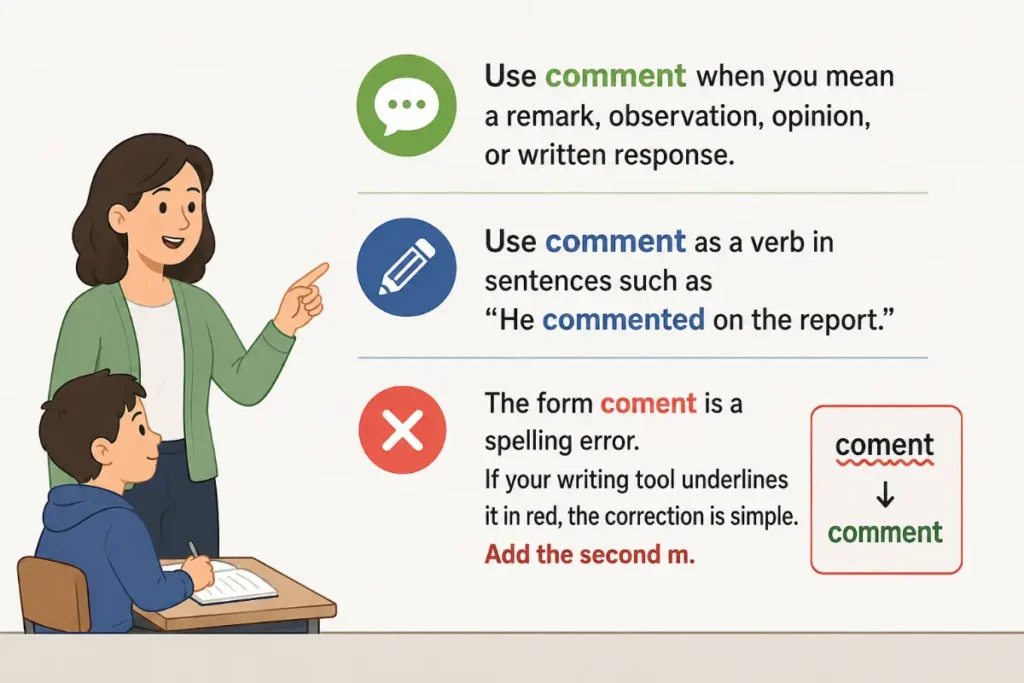
Use comment when you mean a remark, observation, opinion, or written response.
Use comment as a verb in sentences such as “He commented on the report.”
The form coment is a spelling error. If your writing tool underlines it in red, the correction is simple. Add the second m.
Comparison Table
| Correct Form | Meaning | Part of Speech | Origin | Usage Frequency | Formality | Common Contexts | Example |
|---|---|---|---|---|---|---|---|
| Comment | A remark or an expression of an opinion | Noun and verb | Latin through French and Middle English | Very common | Neutral | Conversation, school, work, media, websites, social media | She made a useful comment. |
| Coment | No standard English meaning | Misspelling | Spelling error | Uncommon | Not standard | Typing errors and informal mistakes | The writer should change “coment” to “comment.” |
The table shows the key point at a glance. One form belongs to standard English. The other results from leaving out a letter.
Meaning And Definition
The word comment has several closely connected meanings. The basic idea stays the same. It involves expressing something about a person, situation, idea, event, or piece of information.
As a noun, a comment is something someone says or writes. It can be a simple observation, an opinion, a criticism, an explanation, or a response.
For example:
“Your comment helped me understand the issue.”
Here, the word refers to something the person said.
A comment can also be a short response posted online. Social media platforms, blogs, video websites, and discussion forums commonly use the word in this sense.
For example:
“She left a comment under the video.”
The word can also refer to an official or public statement.
For example:
“The company declined to comment on the matter.”
In this sentence, comment has a more formal meaning. The company is being asked to give a statement or opinion.
As a verb, the word means to express an opinion or make a remark.
For example:
“The teacher commented on my essay.”
Here, the action is commenting. The teacher gave a remark or observation about the essay.
Meaning Of The Incorrect Form
Coment does not normally function as a separate English word. In standard American English it is simply a misspelling of comment.
This error usually happens because the writer remembers the sound of the word but does not remember the complete spelling. The missing m changes the written form even though the intended meaning remains obvious.
A reader may still understand the sentence. That doesn’t make the spelling correct.
For example:
“She left a coment on my post.”
Most readers will immediately understand the intended word. In polished writing the sentence should be written as:
“She left a comment on my post.”
Meaning Of The Correct Form
Comment is a standard English word that functions mainly as both a noun and a verb.
As a noun it can mean a spoken or written remark.
As a verb it can mean to express an opinion or make a remark about something.
The word also appears in several common expressions. You might comment on a situation, make a comment, leave a comment, add a comment, or invite comments.
That flexibility helps explain why the word appears so often in modern English.
Why The Spelling Causes Confusion
The main spelling problem is simple. The writer leaves out one of the two m’s.
The pronunciation does not always make the spelling obvious. In normal speech the two consonants sit together in the middle of the word. Speakers usually don’t stop and emphasize each letter. As a result, someone learning English or typing quickly may hear something closer to a single m.
Another reason is visual memory. Words with repeated consonants can look unusual to learners. A writer may think that one m should be enough because the pronunciation doesn’t strongly highlight the repeated letter.
There’s also a common spelling habit behind the mistake. English contains many words where doubled consonants appear for historical or grammatical reasons. Learners often have to remember the written form rather than rely entirely on sound.
The good news is that this particular mistake has an easy fix.
Remember the middle of the word.
co + mm + ent
The two m’s belong together.
Which Form Is Correct
The correct standard form is comment.
The reason is not a special grammar rule that allows two possible spellings. English dictionaries and standard written usage recognize comment as the established word.
Coment does not become acceptable simply because readers can understand it. Standard spelling depends on the conventional written form used by educated speakers and writers.
This distinction matters most in formal settings. A spelling mistake in a quick personal message may go unnoticed. In a school paper, job application, business email, article, report, or professional document, it can make the writing look careless.
When editing your work, look for the two m’s in the middle of the word.
If you see only one m, correct it.
Sentence Examples
The correct form appears naturally in many kinds of writing. Here are ten examples that show its different uses.
- “Her comment made the discussion more interesting.”
- “I left a comment under your post.”
- “The manager made a helpful comment during the meeting.”
- “Please comment on the first draft before Friday.”
- “The student added a thoughtful comment to the class discussion.”
- “He commented on the changes in the new policy.”
- “The editor removed a comment that was unrelated to the article.”
- “My teacher wrote a positive comment on my assignment.”
- “Several readers commented on the news story.”
- “She chose not to comment on the private matter.”
Notice how the word moves comfortably between casual and formal situations. The meaning changes slightly with context but the spelling remains the same.
Common Mistakes And Misspellings
Dropping One M
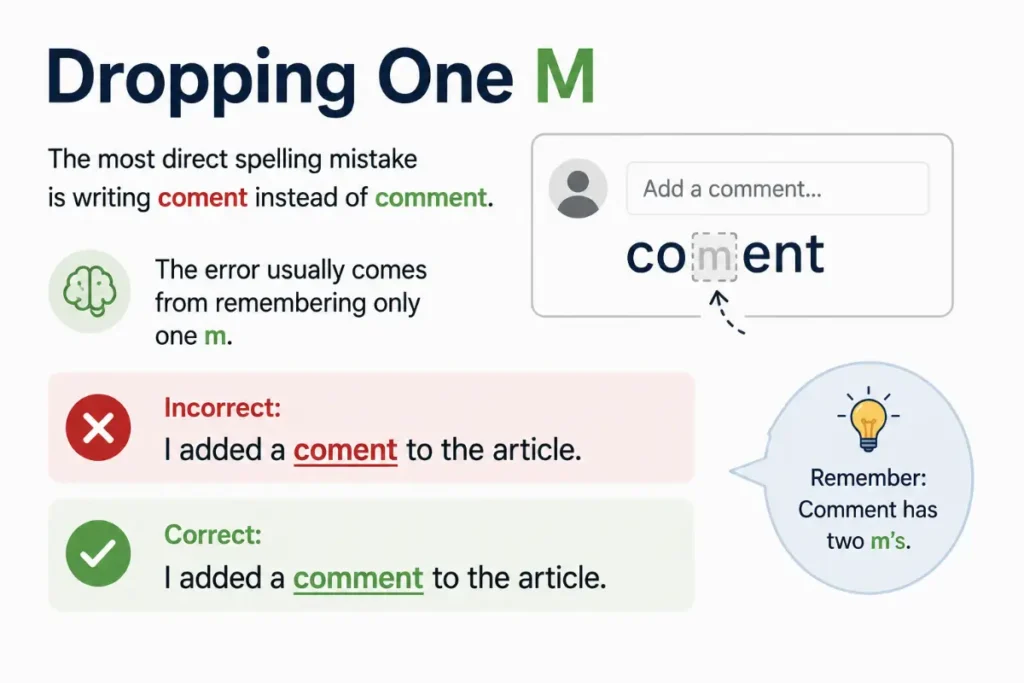
The most direct spelling mistake is writing coment instead of comment.
The error usually comes from remembering only one m.
Incorrect: “I added a coment to the article.”
Correct: “I added a comment to the article.”
Using The Wrong Verb Pattern
English speakers sometimes write “comment about” when “comment on” is the more natural choice.
For example:
“She commented on the report.”
The phrase comment on is especially common when someone gives an opinion or observation about a specific subject.
“Comment about” can appear in English but is less natural in many ordinary contexts.
Confusing A Comment With An Opinion
A comment can express an opinion but the two words are not always interchangeable.
An opinion is a belief or judgment about something.
A comment is a remark or statement made about something.
Someone can make a factual comment without expressing a strong personal opinion.
For example:
“The teacher commented that the essay needed more evidence.”
That sentence reports an observation rather than a personal belief.
Confusing Comment With Compliment
The words look and sound different but learners sometimes confuse their meanings.
A compliment is praise.
A comment is a remark or observation.
For example:
“Your presentation was excellent” can be a compliment.
“The presentation lasted twenty minutes” is a comment.
A comment can be positive, negative, neutral, or simply factual.
Treating The Misspelling As A Variant
Some writers assume that coment might be an accepted alternative spelling. It isn’t standard English.
Unlike some words that have recognized American and British spelling differences, this word does not have a standard one m version.
The difference is not regional. It is a spelling error.
Pronunciation Guide
The pronunciation is another reason some writers struggle with the spelling.
In American English, comment is commonly pronounced approximately like KAH ment.
The IPA pronunciation is commonly represented as /ˈkɑːmɛnt/ in American English.
The word has two syllables:
com ment
The first syllable receives the main stress.
The middle m sound may not feel especially strong in ordinary conversation. That explains why a listener can sometimes fail to notice that the written word contains two m’s.
British English commonly uses a pronunciation closer to /ˈkɒmɛnt/ because of the difference between the vowel sounds used in many British and American accents.
The spelling stays comment in both varieties.
A useful spelling habit is to separate pronunciation from spelling memory. Don’t try to spell the word entirely from what you hear. Picture the written form in your mind.
comment
Two m’s.
Etymology And Word Origin
The history of comment helps explain why the modern word looks the way it does. The English word traces back to Latin commentum, which referred to an invention, interpretation, or explanation. It developed through Old French and entered Middle English before becoming part of modern English vocabulary.
Over time, the meaning moved toward the idea of an explanation, observation, remark, or expression about something. The word has retained a close connection with interpretation and observation. That connection still appears in modern uses. A person can comment on a situation by offering an observation or explanation.
Its long history also shows why English spelling cannot always be predicted from pronunciation alone. Modern English contains thousands of words whose spellings reflect older forms and borrowing from other languages. That’s one reason memorizing the established written form can be more reliable than trying to construct the spelling from sound.
Regional Usage
American English
In American English, comment is the standard spelling.
It works naturally in casual speech and formal writing. Americans use it for spoken remarks, written observations, online responses, professional statements, and opinions.
For example:
“The professor made a useful comment.”
“He refused to comment.”
“Did you see my comment?”
All three are normal American English.
British English
British English also uses comment as the standard spelling.
There is no standard British spelling that changes the double m to a single m.
The main difference you may notice is pronunciation. British and American speakers can use different vowel sounds while keeping the same spelling and meaning.
Australian English
Australian English also uses comment as the standard form.
The word works in everyday conversation, professional communication, journalism, education, and online discussions.
Canadian English
Canadian English uses comment as well.
There is no meaningful Canadian spelling variation that changes the word to coment.
Across these major English varieties the spelling remains stable.
Grammar Rules And Part Of Speech
One useful feature of comment is that it can function as both a noun and a verb.
Comment As A Noun
As a noun, it identifies a remark or observation.
For example:
“His comment surprised everyone.”
Here, comment names the remark.
You can use it with common determiners and adjectives.
“a comment”
“the comment”
“an interesting comment”
“a helpful comment”
“a negative comment”
The plural form is comments.
For example:
“The article received hundreds of comments.”
Comment As A Verb
As a verb, comment means to make a remark or express an opinion.
For example:
“She commented on the proposal.”
The common grammatical pattern is comment on something.
You can also use the verb without directly naming the subject.
“He commented during the meeting.”
The past tense is commented.
The present participle is commenting.
For example:
“She commented on the issue yesterday.”
“He is commenting on the latest update.”
Comment On Something
The phrase comment on is especially useful.
For example:
“The editor commented on the structure of the article.”
“He refused to comment on the allegations.”
“The teacher commented on my writing style.”
The preposition on connects the act of commenting with the subject being discussed.
Comment About Something
You may sometimes encounter comment about. It can be grammatically possible in certain contexts but often sounds less natural than comment on.
For everyday writing the safest pattern is usually:
comment on something
That simple structure works in both casual and formal communication.
Punctuation With Comments
When comment appears as a noun in a sentence, normal punctuation rules apply.
For example:
“Her final comment was helpful.”
If the comment itself is quoted as direct speech, punctuation follows the rules of direct quotation. However, you don’t need quotation marks simply because the word comment appears in a sentence.
For example:
“His comment was unexpected.”
There is no need for quotation marks around the word.
Real Life Usage Examples
Daily Conversation
People use the word constantly in ordinary conversation.
“Did you hear his comment?”
“I don’t have a comment on that.”
“She made a funny comment about the weather.”
In these examples the word refers to something someone says.
Workplace Communication
Professional communication often uses the word when people review documents, projects, or decisions.
“Please send your comments by Monday.”
“The director commented on the revised proposal.”
“I added a comment to the document.”
The word can sound neutral and professional without becoming overly formal.
Academic Writing
Students and teachers use comments when discussing essays, research, presentations, and assignments.
“The professor added several comments to my paper.”
“The reviewer commented on the strength of the argument.”
“Her comments helped improve the final draft.”
In academic settings a comment can be praise, criticism, advice, or a factual observation.
News And Journalism
News writing often uses the word when reporting public statements.
“The mayor declined to comment.”
“The company issued a comment after the announcement.”
“Officials commented on the proposed changes.”
This usage can sound more formal because public figures and organizations often respond to questions through official comments.
Online Communication
The digital age has given the word another extremely common use.
A comment can be a response posted beneath a video, article, photograph, social media post, or discussion.
For example:
“Several people left comments under the photo.”
“Please add your comment below.”
“She replied to the comment.”
This meaning has become so familiar that many people immediately associate the word with online discussions.
Literature And Storytelling
Writers can use comments to show what a character thinks or says.
For example:
“His quiet comment changed the mood of the room.”
“She made a sharp comment about the situation.”
In storytelling, a comment can reveal personality. A short remark can show humor, anger, kindness, doubt, or confidence without requiring a long explanation.
Related And Confused Terms
Remark
A remark is something said or written about a subject. It is very close in meaning to comment.
For example:
“She made a brief remark about the decision.”
In many contexts you can replace remark with comment without changing the basic meaning.
Observation
An observation is something noticed and stated. It can be more factual than a personal comment.
For example:
“His observation about the pattern was accurate.”
Opinion
An opinion is a belief or judgment.
A comment can express an opinion but does not have to.
Statement
A statement is something expressed clearly in speech or writing. It often sounds more formal than comment.
Response
A response is an answer or reaction to something.
An online comment can be a response but not every response is a comment.
Feedback
Feedback gives information intended to help someone improve.
A comment may be feedback but can also be casual or unrelated to improvement.
Criticism
Criticism points out problems or faults. A comment can be critical but can also be positive or neutral.
Note
A note can be a short written message or observation.
In some contexts a note and a comment are similar but they have different common uses.
Why Double Letters Matter In English
The spelling issue provides a useful reminder about English itself.
English spelling does not always match pronunciation perfectly. Some letters are easy to miss when a word is spoken quickly. Repeated consonants are especially vulnerable because the sound may not feel repeated in ordinary speech.
That doesn’t mean the second letter is optional.
Think of spelling as a written map. Pronunciation tells you how the word sounds. Spelling tells you how the language conventionally represents that sound.
Sometimes those two systems line up neatly. Sometimes they don’t.
The safest approach is to learn commonly used words as complete written forms. Once you’ve seen comment often enough, the double m begins to look natural.
A Simple Memory Trick
If you often forget the second m, use a visual trick.
Break the word into small parts:
com + ment
Now notice that the ending begins with m.
The result gives you:
com + ment = comment
Another useful method is to connect the word with a familiar phrase.
comment on
Say the phrase while picturing the spelling.
You can also remember this short rule:
Comment has two m’s in the middle.
That is enough to prevent the most common spelling mistake.
How Spelling Tools Handle The Error
Modern spelling checkers usually recognize standard English vocabulary and flag obvious misspellings. If you type coment in many common writing applications, the software may suggest comment.
Still, spelling tools aren’t a replacement for proofreading.
A spell checker may miss an error if the incorrect form happens to match another recognized word. It may also fail to catch problems caused by context, grammar, or meaning.
That’s why human editing still matters.
A good editor looks at the whole sentence rather than trusting a red underline. The goal isn’t simply to remove marked errors. The goal is to make the writing clear, accurate, natural, and appropriate for the reader.
Expert Editor Insight
An experienced editor would treat this as a straightforward spelling correction rather than a meaningful difference between two English words. Native speakers normally use comment with two m’s. The single m form usually signals a typing or spelling mistake. When proofreading, editors pay special attention to repeated consonants in frequently used words because fast typing can make these small errors surprisingly easy to overlook.
How To Choose The Right Word In A Sentence
The spelling is only one part of good usage. You also need to make sure the word fits the meaning.
If someone says something about an issue, you can call it a comment.
If a person expresses an opinion about a topic, they can comment on it.
The word is broad enough to cover all these situations.
However, choose a more specific word when the context requires one. If you mean praise, compliment may be better. If you mean constructive advice for improvement, feedback may be more precise and If you mean a firm official declaration, statement may fit better.
Good writing isn’t about using the biggest word available. It’s about choosing the word that carries the intended meaning most clearly.
When To Use Comment In Formal Writing
The word is completely acceptable in formal writing.
You can use it in academic papers, business reports, professional emails, journalism, official documents, and research discussions.
For example:
“The reviewer commented on the limitations of the study.”
“The committee requested comments from all members.”
“The organization declined to comment on the issue.”
There’s no need to replace the word simply because the writing is formal.
The key is to use it accurately.
Formal writing often benefits from precise phrasing. If you mean an observation, say comment. If you mean evidence, say evidence. and If you mean criticism, say criticism.
Precision makes writing stronger.
When To Avoid Confusing It With Online Comments
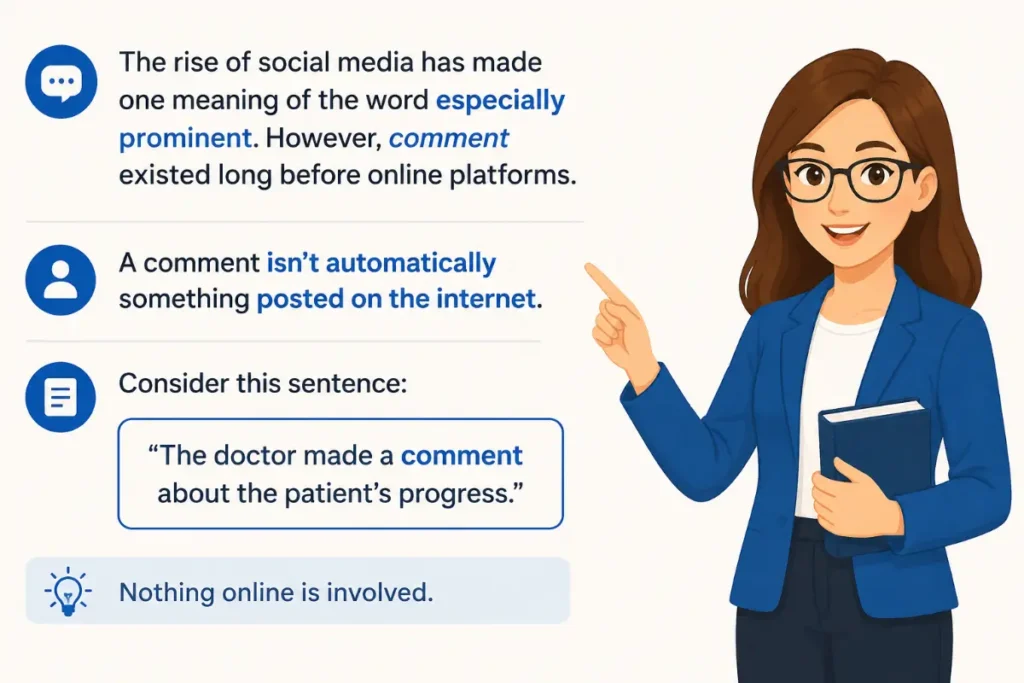
The rise of social media has made one meaning of the word especially prominent. However, comment existed long before online platforms. A comment isn’t automatically something posted on the internet.
Consider this sentence:
“The doctor made a comment about the patient’s progress.”
Nothing online is involved.
Likewise:
“My father made a funny comment during dinner.”
Again, this is simply spoken conversation. Understanding this broader meaning helps you recognize the word in books, articles, classrooms, offices, and everyday conversations.
Final Takeaway
The answer to comment vs coment is straightforward. Comment is the correct standard spelling, while coment is a misspelling. The correct word has two m’s and can function as both a noun and a verb. It can describe a remark, observation, opinion, online response, or the act of expressing an opinion.
The easiest way to remember the spelling is to picture com + ment and keep both m’s together. If you’re proofreading your work and see the single m form, correct it. That small edit keeps your writing polished, accurate, and professional.
Frequently Asked Questions
Is Coment A Real English Word?
No. Coment is not the standard spelling of the common English word meaning a remark or observation. In standard American English it should be corrected to comment. The spelling contains two m’s in the middle.
What Does Comment Mean?
Comment can mean a remark, observation, opinion, or written response. As a noun it identifies something someone says or writes. As a verb it means to make a remark or express an opinion about something.
Which Spelling Is Correct?
Comment is the correct standard spelling. The single m form is a misspelling. There is no standard American or British spelling rule that changes the word to the single m form.
How Do You Pronounce Comment?
In American English the word is commonly pronounced approximately like KAH ment and has two syllables. The main stress falls on the first syllable. British pronunciation can use a different vowel sound but keeps the same spelling.
Can Comment Be A Verb?
Yes. Comment can work as both a noun and a verb. As a verb it means to make a remark or express an opinion. The pattern comment on something is especially common.
Why Do People Misspell Comment?
People often misspell the word because the two m’s are not strongly noticeable in normal speech. Fast typing also makes it easy to leave out repeated letters. The best solution is to memorize the written form and remember that the word contains two m’s.
Is Comment Appropriate In Formal Writing?
Yes. Comment is completely appropriate in formal writing. It commonly appears in academic work, professional communication, journalism, reports, and official statements. Its suitability depends on the sentence and intended meaning rather than on the word itself.
What Is A Good Synonym For Comment?
Useful alternatives include remark, observation, statement, response, note, and opinion. The best choice depends on the context. A comment can be positive, negative, neutral, factual, or opinion based, so no single synonym works in every sentence.
