
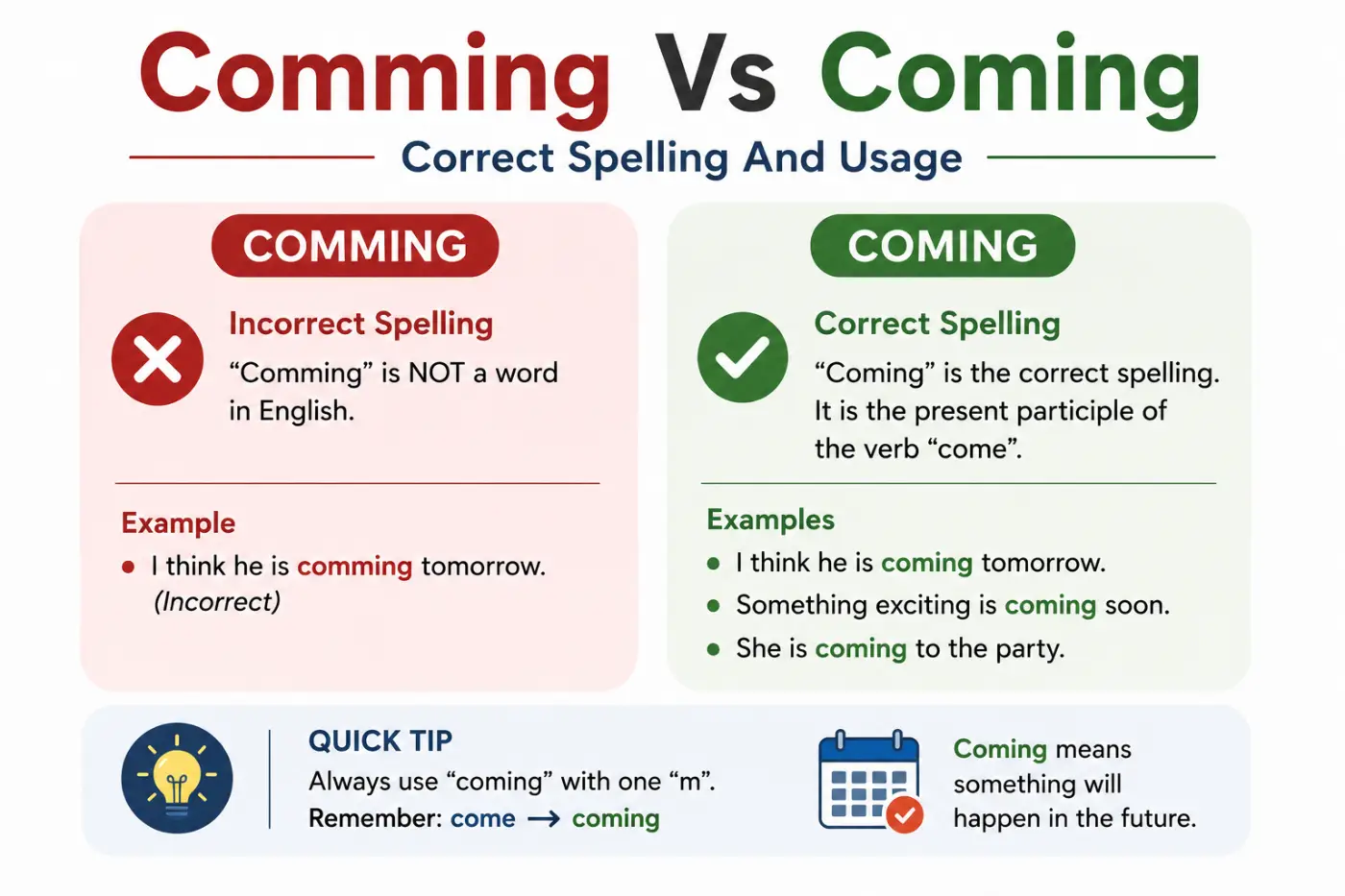
If you’ve ever paused while typing and wondered about comming vs coming, you’re dealing with a common English spelling mistake. The correct form is coming. Comming is incorrect in standard English. The confusion often happens because many English verbs double their final consonant before adding ing.
Words like running, swimming, sitting, and stopping follow that pattern. So it’s easy to assume that come should work the same way. But come follows a different spelling rule because it ends with a silent e. When you add ing to come, you remove the final e and then add ing. That gives you coming, not comming. The extra m doesn’t belong in the word.
Once you understand this pattern, the spelling becomes much easier to remember. You don’t have to memorize coming on its own. Start with the base verb come, remove the final e, and add ing. This guide explains the spelling rule along with the meaning, grammar, pronunciation, examples, common mistakes, and related expressions so you can use coming confidently.
Quick Answer
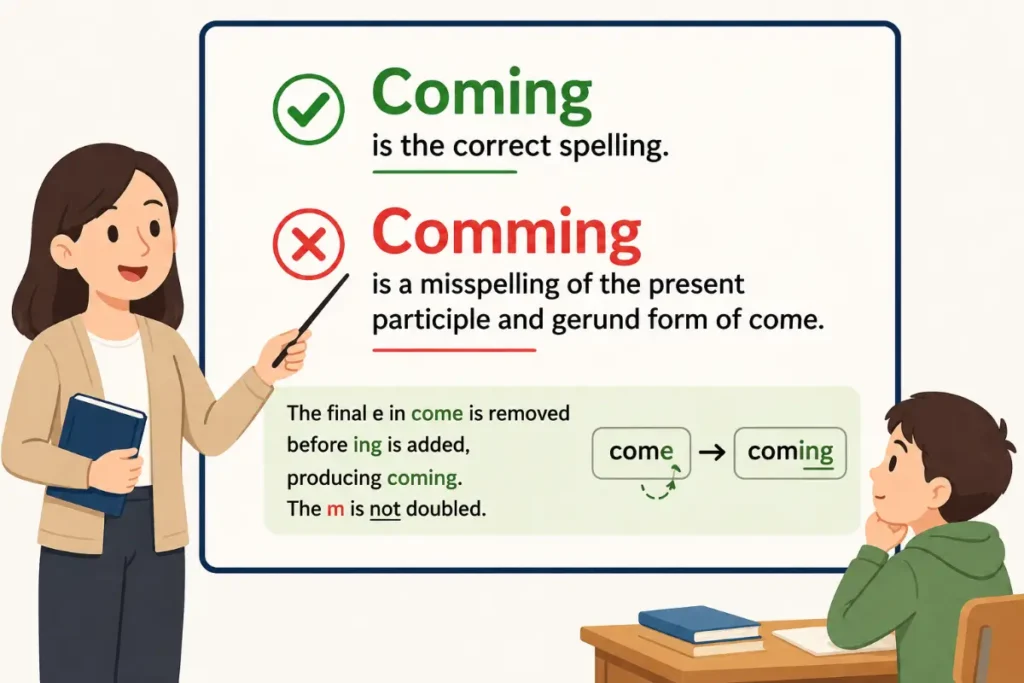
Coming is the correct spelling. Comming is a misspelling of the present participle and gerund form of come. The final e in come is removed before ing is added, producing coming. The m is not doubled.
Comparison Table
| Correct Form | Meaning | Part Of Speech | Origin | Usage Frequency | Formality | Common Contexts | Example |
|---|---|---|---|---|---|---|---|
| Coming | Moving toward someone or something or happening soon | Verb form adjective and noun | From come with Old English Germanic roots | Very common | Standard | Conversation work school writing and general English | She is coming home soon. |
| Comming | No standard meaning in this spelling | Misspelling | Not a standard form of come | Uncommon | Nonstandard | Typing and spelling errors | She is comming home. |
The difference becomes clear when you look at the base word. Come is the original verb. Its ing form is coming.
Meaning And Definition
Coming is one of the most common forms of the verb come. It can perform several grammatical jobs depending on the sentence.
Most often it acts as the present participle of come. It appears with forms of be to describe an action that is happening or expected.
For example:
She is coming home.
They are coming to the party.
I am coming right now.
In each sentence coming describes movement toward a person or place.
The word can also describe something that will happen soon.
For example:
The coming year will bring new challenges.
The coming weekend looks busy.
In these sentences coming works as an adjective. It describes something that is approaching in time.
Coming can also work as a gerund. A gerund has the form of a verb ending in ing but functions as a noun.
For example:
Coming early gave us more time.
I enjoy coming here.
The form can even appear as a noun in certain expressions.
For example:
The coming of spring changed the landscape.
The phrase comings and goings is another established expression. It refers to people arriving and leaving.
Meaning Of The Incorrect Form
Comming is not the standard ing form of come.
In ordinary English it should be treated as a spelling error. It may appear in text messages social media posts quick notes or other informal writing. Seeing it used by someone doesn’t make it an accepted spelling.
If you’re writing something for school work business or publication use coming.
Meaning Of The Correct Form
Coming has a broad range of uses because come itself is a highly flexible verb.
It can describe movement.
I’m coming to your house.
It can describe an expected arrival.
The train is coming.
It can describe something approaching in time.
The coming winter may be cold.
It can describe participation.
Thanks for coming to my party.
The meaning comes from the surrounding sentence. The spelling stays the same.
Key Differences Explained
The difference between the two forms is mainly spelling rather than meaning. Only one of them is standard English.
Spelling
Coming contains one m after the o.
Coming.
Comming contains two m letters.
Comming.
That second m is unnecessary.
Meaning
Coming has several established meanings connected with the verb come.
Comming has no standard English meaning as the spelling of this verb form.
Grammar
Coming can function as a present participle a gerund an adjective or in some contexts a noun.
Comming does not have these grammatical functions because it is not the accepted spelling.
Pronunciation
Coming is pronounced with two syllables.
The pronunciation is commonly represented as /ˈkʌmɪŋ/.
The incorrect spelling doesn’t create a different standard pronunciation. It simply represents the word incorrectly in writing.
Formality
Coming is standard in both casual and formal English.
Comming should be corrected in polished writing.
Regional Usage
The standard spelling remains coming in American British Canadian and Australian English.
There is no major regional spelling difference that makes comming correct.
Why The Extra M Seems Tempting
The human brain naturally notices patterns. English spelling has plenty of examples where a final consonant doubles before an ing ending.
Run becomes running.
Sit becomes sitting.
Stop becomes stopping.
Plan becomes planning.
Swim becomes swimming.
These examples make the double consonant pattern feel familiar. It’s easy to assume that come should follow the same path.
But come is different.
Come already ends with a final e. That e is removed before ing is added.
Come becomes com.
Com plus ing becomes coming.
So the correct process is:
Come → com → coming.
Not:
Come → comm → comming.
That distinction is the key to the entire spelling issue.
English spelling rules often work in groups but those groups have limits. You can’t take one pattern and apply it to every verb. The base word matters.
Which Form Is Correct?
Coming is correct.
Comming is incorrect.
The reason is simple. Come ends in a final e. When the ing ending is attached the final e is dropped.
This same spelling pattern appears in several other common verbs.
Make becomes making.
Take becomes taking.
Give becomes giving.
Write becomes writing.
Close becomes closing.
Drive becomes driving.
The final e disappears before ing is added.
By contrast words such as run and stop follow a different pattern because they don’t end in a final e.
Run becomes running.
Stop becomes stopping.
That’s why learning the base word is often more useful than trying to memorize every spelling separately.
Sentence Examples
Here are natural examples showing how coming works in everyday English.
- I’m coming home after work.
- Are you coming to the meeting tomorrow?
- She is coming over for dinner tonight.
- The bus is coming down the street.
- We have an important exam coming up.
- He is coming back next week.
- Thanks for coming to my graduation.
- The coming year could bring major changes.
- They are coming to visit us this weekend.
- I appreciate you coming early to help.
These examples also show why the spelling matters. Coming appears in conversations professional messages school writing and descriptions of future events.
Incorrect Examples For Comparison
The following sentences contain the common spelling mistake.
- She is comming home tonight.
- Are you comming with us?
- Thanks for comming to the meeting.
- The train is comming soon.
- We’re comming back tomorrow.
In every case replace comming with coming.
Common Mistakes And Misspellings
Several spelling mistakes can appear around this word.
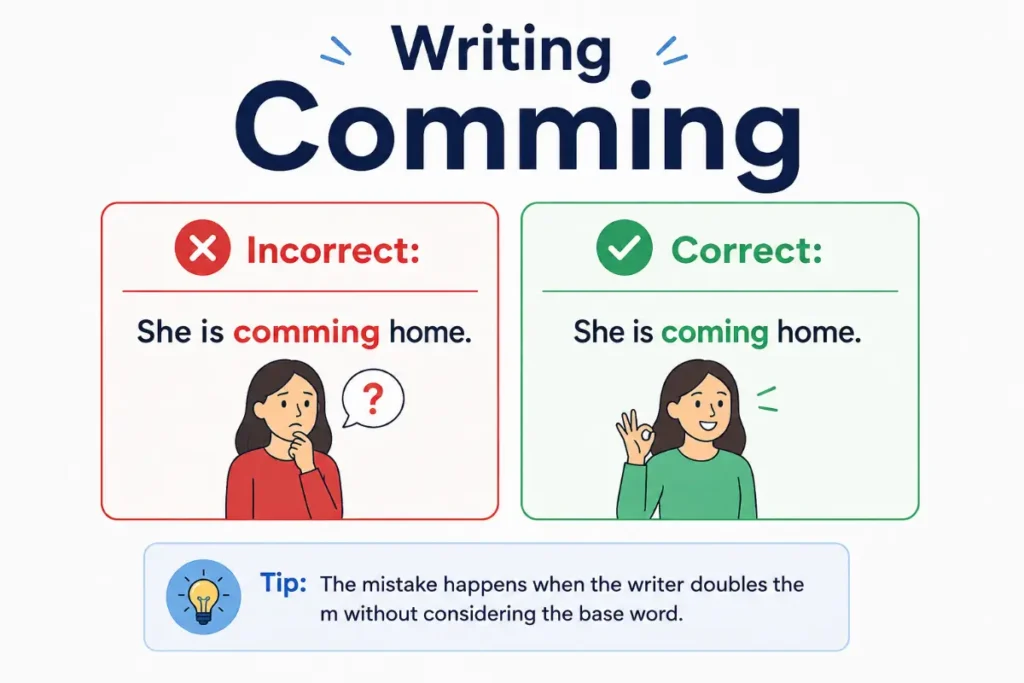
Writing Comming
Incorrect:
She is comming home.
Correct:
She is coming home.
The mistake happens when the writer doubles the m without considering the base word.
Writing Comeing
Incorrect:
They are comeing tomorrow.
Correct:
They are coming tomorrow.
This error happens when the writer keeps the final e from come and adds ing directly.
Doubling The Final Consonant Automatically
Some writers learn that short verbs can double their final consonants before ing. They then apply that rule too broadly.
That creates errors such as comming.
The better approach is to check the base word and its spelling pattern.
Confusing Coming And Going
Coming and going are related but they don’t always mean the same thing.
Coming generally describes movement toward the speaker or a relevant destination.
Going often describes movement away from the speaker or toward another destination.
For example:
Are you coming to my house?
Are you going to the store?
The choice depends on the direction and point of view.
Adding An Unnecessary E
Another common mistake is comeing.
The final e must disappear before ing is added.
Come becomes coming.
It doesn’t become comeing.
Pronunciation Guide
Coming normally has two syllables.
The IPA form is:
/ˈkʌmɪŋ/
An easy pronunciation guide is:
KUM ing
The first syllable receives the main stress.
The word sounds natural when spoken as two connected syllables. There is no need to create an extra m sound simply because some writers mistakenly spell the word with two m letters.
Pronunciation can also help reinforce the spelling. When you say coming naturally you don’t hear a separate doubled m. The sound flows directly into the second syllable.
Etymology And Word Origin
Coming comes from the verb come.
Come has very old roots in the English language. It developed from Old English forms related to movement toward a person or place. The word also has connections with related Germanic languages.
Over centuries the spelling changed as English developed. Modern English now uses come as the base form and coming as its present participle and gerund form.
The spelling change before ing follows a familiar English pattern. The final e is removed before the suffix is added.
The historical background is interesting but you don’t need to know the full history to use the word correctly. The practical rule is enough.
Come loses its final e before ing.
That gives us coming.
Regional Usage
American English
Coming is standard in American English.
It appears constantly in everyday speech and writing.
For example:
I’m coming over tonight.
The coming months will be busy.
The new store is coming soon.
Comming is not an accepted alternative spelling in American English.
British English
British English also uses coming.
There is no major spelling difference between American and British English in this case.
A British writer uses coming just as an American writer does.
Australian English
Australian English follows the same standard spelling.
Coming is correct.
Comming is a misspelling.
Canadian English
Canadian English also uses coming.
The same spelling rule applies.
So if you write for readers in the United States Canada Britain or Australia you should use coming.
Grammar Rules And Part Of Speech
Coming is grammatically versatile.
Coming As A Present Participle
The present participle form commonly appears with forms of be.
I am coming.
She is coming.
They were coming.
We will be coming.
These structures describe actions that are happening or expected around a particular time.
Coming As A Gerund
Coming can function as a noun.
For example:
Coming early helped us finish the work.
Here the entire coming early phrase acts as the subject.
Another example is:
I enjoy coming here.
In this sentence coming follows enjoy and functions as its object.
Coming As An Adjective
Coming can describe something that is approaching in time.
For example:
The coming year will be difficult.
The coming week is already packed.
This use is especially common with periods of time.
Coming In Expressions
Coming appears in many common phrases.
Examples
Coming soon.
Coming from.
Each expression adds a slightly different meaning.
For example:
The movie is coming soon.
My test is coming up.
She is coming back tomorrow.
Are you coming over tonight?
He is coming home after work.
Where are you coming from?
How is the project coming along?
These expressions are common enough that learning them can improve both writing and speaking.
Real Life Usage Examples
Daily Conversation
Coming is extremely common in normal conversation.
Are you coming with us?
I’m coming right now.
She’s coming over later.
These sentences sound natural because coming works directly with movement and arrival.
Workplace Communication
The word also fits naturally into workplace writing.
I’ll be coming to the office after lunch.
The coming week will be busy for the team.
We have an important deadline coming up.
There is nothing informal or incorrect about these expressions.
Academic Writing
Coming can appear in academic writing when the context calls for it.
The coming decades may bring significant changes.
Researchers are studying changes coming from population growth.
However academic writing should still favor precision over complicated wording.
News Writing
News articles often use coming to describe approaching events.
The coming election could influence public policy.
Officials are preparing for the coming storm.
The word is short clear and easy to understand.
Literature And Storytelling
Coming can also create movement in storytelling.
She heard footsteps coming from the hallway.
A dark cloud was coming across the valley.
These examples show how the word can describe physical movement while helping a reader picture a scene.
Related And Confused Terms
Come
Come is the base form.
Please come inside.
Came
Came is the simple past form.
She came home late.
Come
Come is also used as the past participle.
They have come a long way.
Coming Up
Coming up means something is approaching in time.
My birthday is coming up.
Coming Back
Coming back means returning.
He is coming back tomorrow.
Coming Over
Coming over often means visiting someone.
Are you coming over tonight?
Upcoming
Upcoming means something scheduled or expected to happen soon.
The upcoming meeting starts at nine.
Forthcoming
Forthcoming can describe something expected or about to happen. It often sounds more formal than coming.
The forthcoming report will explain the changes.
These words are related but they aren’t always interchangeable. Good writing depends on choosing the word that fits the exact meaning.
Coming In Common Expressions
Some expressions with coming are so common that you probably use them without thinking about their grammar.
Coming Soon
Coming soon means something will happen or become available in the near future.
A new restaurant is coming soon.
Coming Up
Coming up refers to something approaching.
My final exam is coming up next week.
Coming Back
Coming back refers to returning.
She is coming back tomorrow.
Coming Home
Coming home describes movement toward home.
I’m coming home after dinner.
Coming From
Coming from can describe the place someone has traveled from.
Where are you coming from?
It can also describe the source of an idea.
I understand where you are coming from.
Coming Along
Coming along can describe progress.
How is your project coming along?
It can also mean joining someone.
Are you coming along with us?
These expressions make the word an important part of everyday English.
Why Spelling Tools May Flag The Wrong Form
Modern spelling tools are useful but they aren’t a substitute for understanding English spelling.
If you type comming into a word processor it may suggest coming. That happens because the software recognizes comming as an unusual or incorrect form in normal English.
The same thing can happen with comeing.
A spelling checker can identify the error but it may not explain why the correction works.
That’s where knowing the spelling rule helps.
Start with come.
Remove e.
Add ing.
Coming.
Once you understand the process you can correct the word even without a spelling tool.
How To Remember The Correct Spelling
The simplest memory trick is this:
Come loses e before ing.
That gives you:
Come.
Remove e.
Add ing.
Coming.
There is no second m.
You can also compare coming with other verbs that end in final e.
Make becomes making.
Take becomes taking.
Give becomes giving.
Write becomes writing.
Come becomes coming.
Now compare those words with verbs that double a final consonant.
Run becomes running.
Stop becomes stopping.
Plan becomes planning.
The difference becomes much easier to see.
Instead of asking yourself how many m letters coming should have ask yourself what happens to the final e in come.
The answer is simple.
It disappears.
Is Coming Suitable For Formal Writing
Yes.
Coming is a standard English word and works perfectly well in formal writing.
For example:
The coming year will require careful planning.
The committee will meet during the coming months.
The report examines changes coming from recent policy decisions.
You don’t need to replace coming with a more complicated word just to make your writing sound professional.
Clear writing is often stronger than complicated writing.
If upcoming communicates the idea more precisely use upcoming. If forthcoming fits the context use forthcoming and If coming sounds natural use coming.
Good editing is about accuracy and meaning rather than using the biggest word available.
Expert Editor Insight
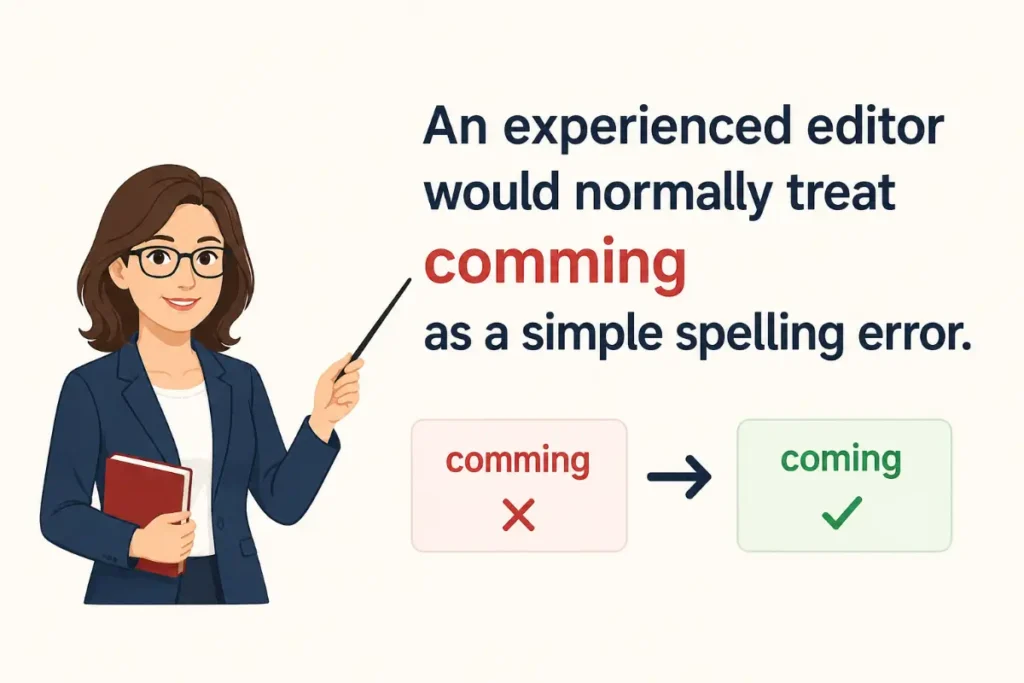
An experienced editor would normally treat comming as a simple spelling error. The most reliable correction is to return to the base verb instead of trying to remember the finished word by appearance. Start with come, remove the final e, and add ing. This method also helps prevent comeing because it forces you to follow the spelling process rather than guess. Spelling software can catch the mistake but knowing the rule makes your writing more dependable.
Conclusion
The correct form is coming. Comming is a spelling mistake and should not be used in standard English. The reason is easy to understand once you look at the base verb. Come loses its final e before the ing ending is added. That gives us coming.
The extra m comes from applying the wrong spelling pattern. English does double consonants in some words such as running and stopping but that rule doesn’t apply to come.
The best way to remember the spelling is simple. Start with come, remove e, and add ing. You’ll get coming every time. If you’re unsure while writing, return to the base verb instead of guessing from how similar words look.
FAQs
Is Comming A Real English Word?
Comming is not the standard spelling of the ing form of come. In normal English writing it should be treated as a spelling mistake. The correct form is coming. If you see comming in an informal message it is most likely the result of fast typing or confusion about consonant doubling.
What Does Coming Mean?
Coming usually means moving toward someone or a place. It can also describe something that will happen soon. In I am coming home it describes movement. In the coming year it describes a future period. The exact meaning depends on the grammatical role and context of the word.
Why Is Coming Spelled With One M?
Coming has one m because the base verb is come. The final e is removed before the ing ending is added. The spelling process is come followed by the removal of e and then ing. This creates coming. There is no rule that requires the m to be doubled.
How Do You Pronounce Coming?
Coming is pronounced /ˈkʌmɪŋ/. It has two syllables and sounds roughly like KUM ing. The first syllable receives the main stress. The spelling should not lead you to create an extra consonant sound.
Can Coming Start A Sentence?
Yes. Coming can start a sentence when it functions as a gerund or part of a participial phrase. For example: Coming early gave us more time. It can also appear in a phrase such as Coming down the stairs she heard the phone ring. The grammatical role depends on the sentence structure.
Is Coming Appropriate In Formal Writing?
Yes. Coming is completely acceptable in formal writing. It can describe movement or something approaching in time. For example: The coming year will require careful planning. The word is standard English and doesn’t need to be replaced simply because the writing is formal.
What Is A Synonym For Coming?
The best synonym depends on the meaning. Upcoming can describe something that will happen soon. Forthcoming can also describe something expected soon and may sound more formal. Approaching can describe something moving closer. These words have related meanings but they aren’t interchangeable in every sentence.
Why Do People Confuse Coming And Comming?
The confusion often comes from English words that double a final consonant before ing. Running and stopping are familiar examples. Writers may apply that pattern to come and create comming. The correct spelling follows a different rule because come ends in a final e that disappears before ing is added.
