
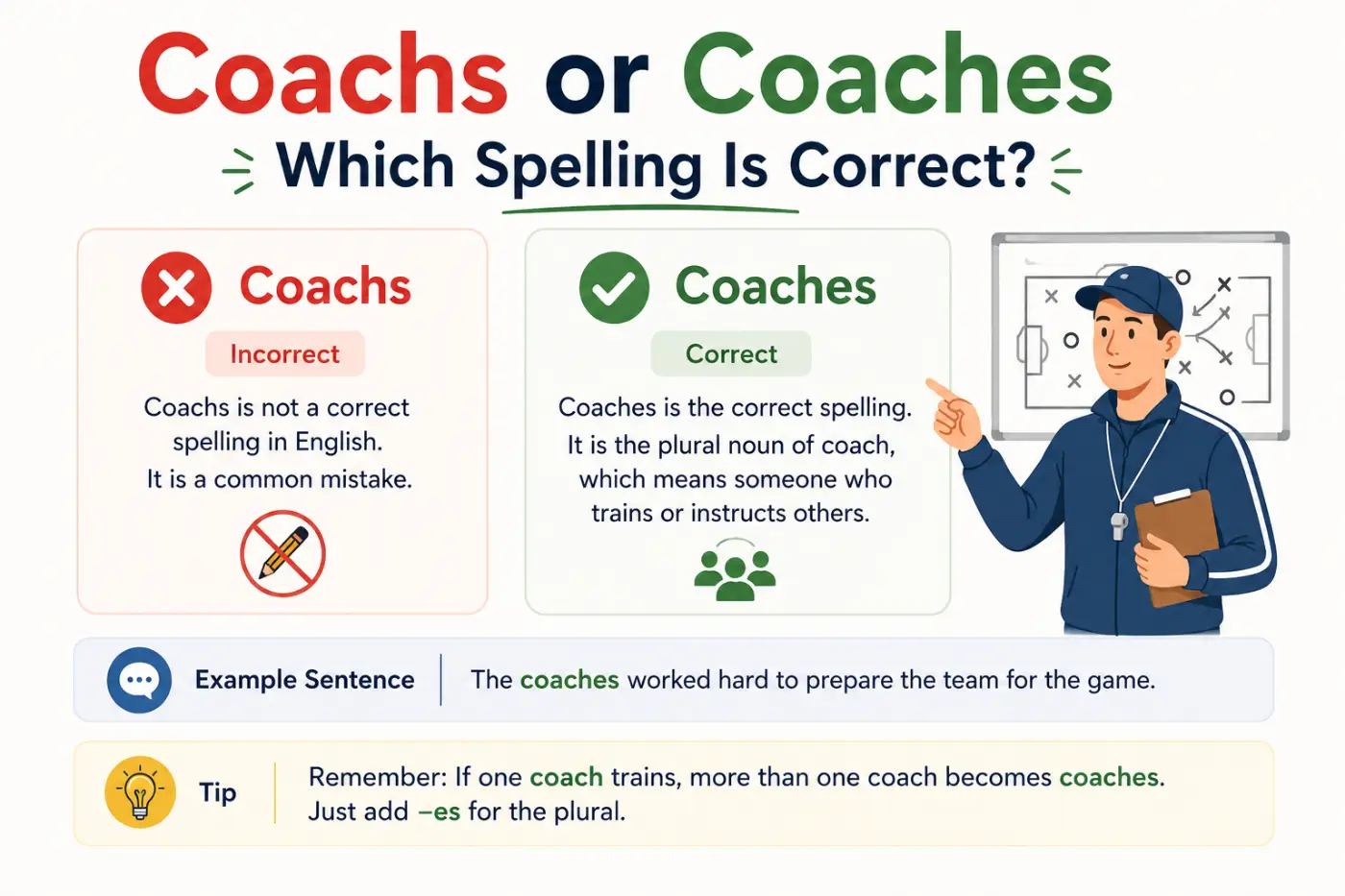
If you’re unsure about coachs or coaches, the correct plural form is coaches. The spelling coachs is incorrect in standard English. The confusion usually comes from a common plural spelling pattern. Many English nouns form their plural by adding s to the singular word. For example, coach might look like a word that simply needs an s at the end. However, English adds es to many nouns that end in certain sounds. That small spelling change gives us coaches.
This rule matters because the word appears often in sports, education, business, and personal development. You might talk about soccer coaches at school, basketball coaches at a local club, or professional coaches who help people improve their careers.
This guide explains the correct spelling, pronunciation, grammar, plural rule, common mistakes, and real world usage. By the end, you’ll have a simple way to remember the form every time you write it.
Quick Answer
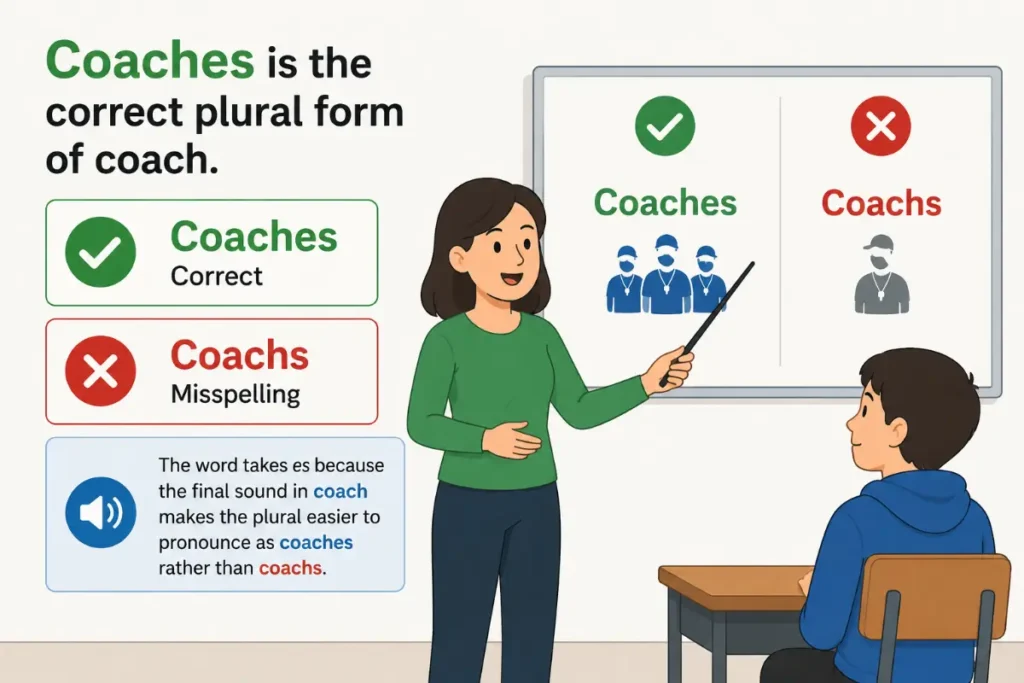
Coaches is the correct plural form of coach. Coachs is a misspelling in standard English. The word takes es because the final sound in coach makes the plural easier to pronounce as coaches rather than coachs.
Meaning Of The Word
A coach is a person who trains or guides someone toward better performance. The word commonly refers to someone who trains athletes or sports teams. It can also describe a person who helps others develop skills in areas such as business leadership communication or personal growth.
When you talk about more than one coach you use coaches.
For example:
The coach helped the team prepare for the game.
The coaches helped the teams prepare for the tournament.
The first sentence refers to one person. The second refers to more than one person.
The plural ending changes the spelling from coach to coaches. The meaning remains closely connected to the original noun.
The word can also function as a verb. To coach means to train guide or instruct someone.
For example:
She coaches the school volleyball team.
They coach young players every weekend.
In these sentences coaches is not a plural noun. It is a third person singular present tense verb in the first example and a plural subject form in the second example.
That distinction becomes useful because the same spelling can perform different grammatical jobs.
Comparison Table
| Form | Meaning | Part of Speech | Origin | Usage Frequency | Formality | Common Contexts | Example |
|---|---|---|---|---|---|---|---|
| Coach | One person who trains or guides someone | Noun | English through French | Very common | Standard | Sports education business development | The coach arrived early |
| Coaches | More than one coach | Noun | Plural form of coach | Very common | Standard | Sports education business development | The coaches met after practice |
| Coaches | Trains or guides | Verb | Verb form of coach | Very common | Standard | Sports education work training | She coaches the team |
| Coachs | Intended plural of coach | Nonstandard spelling | Not a standard plural form | Uncommon | Incorrect | Spelling mistakes | The coaches arrived early |
Why Coaches Is Correct
The answer becomes much easier once you understand the spelling pattern.
The singular noun ends in ch. English commonly forms the plural of nouns ending in sounds such as ch by adding es.
This gives us a familiar pattern.
One church becomes two churches.
One match becomes two matches.
One sandwich becomes two sandwiches.
One coach becomes two coaches.
The added es isn’t random. It helps create a natural spoken ending.
If you wrote coachs the ending would not follow the standard spelling pattern used for this word. Native English readers recognize coaches immediately as the normal plural form.
Think of the final part of the word as a little doorway. The extra e helps the plural ending pass through smoothly.
Why Coachs Is Incorrect
Coachs is usually created by applying the most basic plural rule too broadly. English learners often learn an easy rule first: add s to a singular noun to make it plural.
That rule works for many words.
One book becomes books.
One car becomes cars.
One teacher becomes teachers.
One player becomes players.
However, English has several plural spelling patterns. Words ending in sounds such as ch often take es.
That means you can’t always add a simple s to every noun.
The incorrect form may still be understandable. A reader will probably know that the writer means more than one coach. However, being understandable doesn’t make a spelling standard. In school assignments, professional emails, articles, reports, websites, and other polished writing, use coaches.
The Grammar Rule Behind The Spelling
The basic rule is straightforward.
Many singular nouns that end in ch form their plural by adding es.
Coach becomes coaches.
Church becomes churches.
Bench becomes benches.
Branch becomes branches.
Lunch becomes lunches.
This pattern gives readers a reliable visual clue. When they see coaches they immediately recognize the word as a plural noun. There are exceptions and variations across English plural patterns. For this particular word, though, the standard form is firmly established.
You don’t need to memorize a complicated grammar formula. Remember that coach belongs to a group of nouns that normally take es in the plural.
How To Pronounce Coaches
The pronunciation also helps explain why the spelling uses es.
The singular form coach is pronounced approximately like kohch.
The plural form coaches is pronounced approximately like KOH chiz.
The final sound is similar to the ending in watches and matches.
The IPA pronunciation for coach is commonly represented as /koʊtʃ/ in American English.
The plural coaches is commonly represented as /ˈkoʊtʃɪz/.
The word has two syllables.
coach es
The stress falls on the first syllable.
A common mistake is trying to pronounce the plural as if it were coach followed by a simple s. English speakers normally use the extra syllable in coaches.
Listening to the word can therefore help reinforce the spelling. You hear a distinct ending rather than simply adding an s sound to the singular form.
Ten Natural Examples
- The coaches arrived early to prepare the field.
- Our soccer coaches gave us helpful advice before the game.
- The coaches met after practice to discuss the players.
- Several basketball coaches attended the training session.
- The school hired two new coaches for the upcoming season.
- Good coaches know how to motivate people without putting unnecessary pressure on them.
- The coaches worked together to create a better training plan.
- Many professional coaches help clients develop stronger communication skills.
- The young players thanked their coaches after the final match.
- Experienced coaches often notice small problems that beginners miss.
These examples show how naturally the plural works in everyday American English. You can use coaches in casual conversation as well as formal writing.
Common Spelling Mistakes
Several mistakes can appear around this word. Most come from applying a familiar spelling rule to the wrong situation.
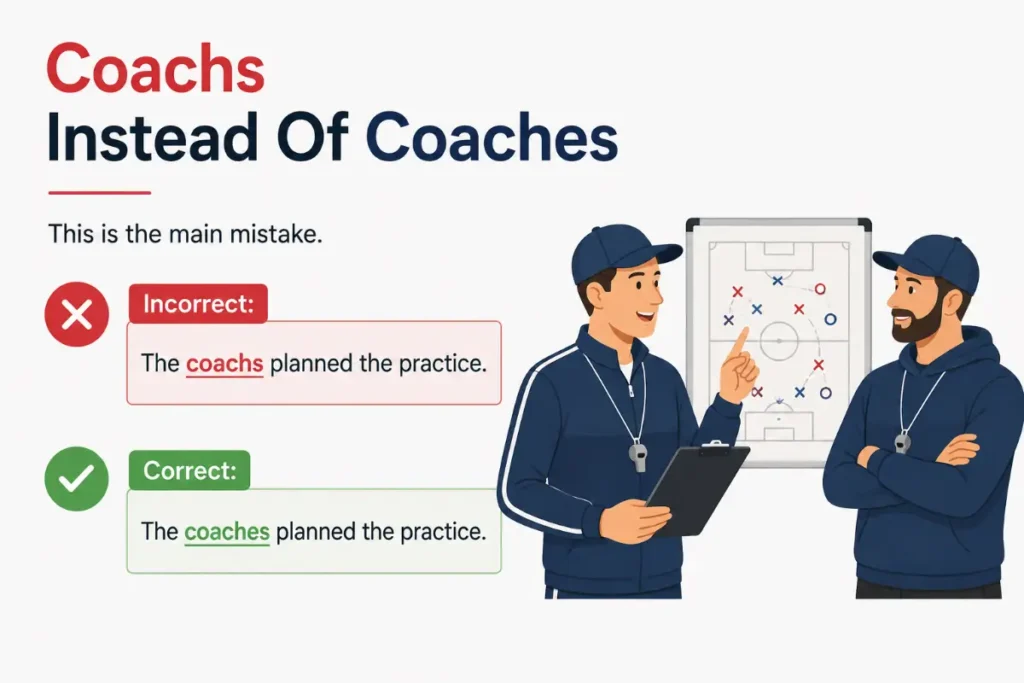
Coachs Instead Of Coaches
This is the main mistake.
Incorrect: The coachs planned the practice.
Correct: The coaches planned the practice.
The writer has simply added s to the singular form. The standard plural requires es.
Coachez Instead Of Coaches
Some writers may spell the final sound based on pronunciation.
Incorrect: The coachez arrived at the stadium.
Correct: The coaches arrived at the stadium.
English spelling doesn’t always follow pronunciation perfectly. The standard written form is coaches.
Coach’s Instead Of Coaches
This mistake changes the meaning completely.
Coach’s is a possessive form. It normally means something belongs to one coach.
For example:
The coach’s office is upstairs.
Here the office belongs to one coach.
Coaches refers to more than one coach.
For example:
The coaches’ offices are upstairs.
Notice the apostrophe position. This small detail can change the grammatical meaning.
Coaches’ Instead Of Coaches
Coaches’ is also possessive.
For example:
The coaches’ meeting lasted an hour.
The meeting belongs to or is associated with multiple coaches.
If you simply mean more than one coach you don’t need the apostrophe.
The coaches arrived.
That is the standard plural form.
Coachs In Formal Writing
Some people may type coachs quickly in a message or draft. Casual typing can produce many spelling errors. Still, polished writing should use coaches. A spelling checker will often identify coachs as an error because it isn’t the standard plural form.
American English Usage
In American English, coaches is the standard plural form of coach.
You will see it across many settings.
Sports teams have coaches.
Schools employ coaches.
Professional organizations may hire executive coaches.
Fitness programs may have personal coaches.
Career services may offer career coaches.
The word is common enough that most American readers recognize coaches instantly.
There isn’t a special American plural spelling that changes this rule. The standard form remains coaches.
British English Usage
British English also uses coaches as the standard plural form.
The spelling does not change simply because the variety of English changes.
American and British speakers may differ in vocabulary pronunciation punctuation or some spelling conventions. This particular plural form isn’t one of those major differences.
For example:
The coaches are meeting after the match.
That sentence is natural in both American and British English.
Canadian And Australian English
Canadian English and Australian English also use coaches as the normal plural form. Again, there is no meaningful regional spelling variation for this plural. You can therefore safely use coaches in standard English writing across major English speaking varieties. The context may change. The spelling does not.
Coaches As A Noun
As a noun coaches means more than one person who trains or guides others.
For example:
The coaches watched the final practice.
The sentence contains a plural subject.
You can also use the noun after determiners and quantities.
Several coaches attended the meeting.
Many coaches use video to review performance.
The two coaches discussed the strategy.
These structures all show the same basic function. The word refers to multiple people.
Coaches As A Verb
Coaches can also be a verb.
It is the third person singular present tense form of coach.
For example:
He coaches the high school team.
She coaches young athletes.
My brother coaches at a local club.
In these sentences coaches doesn’t mean multiple people. It means one person performs the action of coaching.
This is an important grammar point because context determines the function.
Compare these two sentences.
The coaches arrived early.
She coaches the team.
In the first sentence coaches is a plural noun.
In the second sentence coaches is a verb.
The spelling is identical but the grammatical role is different.
Singular And Plural Forms
The basic forms are easy to remember.
Singular: coach.
Plural: coaches.
Possessive singular: coach’s.
Possessive plural: coaches’.
These forms look similar but they serve different purposes.
Consider this short example.
The coach arrived.
The coaches arrived.
The coach’s whistle was loud.
The coaches’ whistles were loud.
Once you see the pattern in complete sentences the difference becomes much clearer.
When To Use Coaches
Use coaches when you mean two or more people who coach.
For example:
The coaches organized the tournament.
The coaches shared their training methods.
Three coaches attended the conference.
You can also use coaches when talking about several people in different fields.
For example:
The career coaches helped graduates prepare for interviews.
The leadership coaches worked with senior managers.
The fitness coaches created personalized programs.
The word isn’t limited to sports.
When To Use Coach
Use coach when you’re referring to one person.
For example:
Our coach is very supportive.
The coach changed the training schedule.
Her coach gave her useful feedback.
If you need to make the noun plural, change it to coaches.
This simple singular and plural contrast solves most spelling questions involving the word.
Real Life Usage
Daily Conversation
People commonly use coaches when talking about sports and training.
The coaches were really happy with the team’s progress.
Our coaches want us to practice tomorrow.
These sentences sound natural in everyday American conversation.
Workplace Communication
The word can appear in professional settings too.
The leadership coaches will meet with the management team.
Several coaches helped employees improve their presentation skills.
Career coaching has also made the word common outside traditional sports contexts.
Academic Writing
Academic and educational writing may use the word when discussing sports education training or professional development.
The coaches observed changes in student performance throughout the season.
The study group worked with experienced coaches during the program.
Academic writing usually favors precise standard spelling. Coaches is the appropriate form.
News Writing
Journalists often use coaches when reporting on sports teams.
The coaches announced the lineup before the game.
Several coaches spoke with reporters after the tournament.
The word is common and unremarkable in news writing because it follows standard English spelling.
Storytelling
Coaches can also appear naturally in fiction and personal stories.
The coaches gathered near the field as the rain began.
The players looked toward their coaches for guidance.
The word works just as naturally in narrative writing as it does in ordinary conversation.
Related Words And Confused Terms
Understanding nearby words can make the meaning of coaches even clearer.
Trainer
A trainer can be someone who teaches or prepares others. In sports and fitness contexts the meanings can overlap with coach.
Mentor
A mentor usually provides guidance based on experience. Mentoring often focuses on long term personal or professional development.
Instructor
An instructor teaches a skill or subject. The word is common in education and training settings.
Teacher
A teacher usually provides structured education. A coach often focuses more strongly on practice performance and improvement.
Manager
A manager oversees people tasks or operations. In sports a manager may have responsibilities that overlap with coaching but the roles aren’t always identical.
Adviser
An adviser gives recommendations or guidance. The role can be more focused on decisions than training.
Trainer
A trainer may teach practical skills or prepare someone for a specific task. The exact meaning depends on the setting.
Athlete
An athlete is a person who participates in sports. An athlete may work with one or more coaches.
These words aren’t interchangeable in every sentence. The best choice depends on the person’s role and the kind of guidance involved.
Etymology And Word Origin
The history of coach is interesting because the modern meaning developed over time. The word originally had a connection to transportation. English adopted coach from French coche which ultimately traces back to a Hungarian place name associated with a type of carriage. The transportation sense came first. A coach was a vehicle used to carry people from one place to another.
Later the word developed a figurative meaning connected to guiding someone toward a destination or goal. That idea helped lead to the modern sense of a person who trains or guides others.
Today coach can refer to someone who works with athletes teams professionals students or individuals. The modern word therefore carries an old idea beneath it. A coach helps someone move from one point to another. That image makes the meaning easier to remember.
Grammar And Sentence Position
As a plural noun coaches can appear in several places in a sentence.
It can serve as the subject.
The coaches planned the session.
It can serve as the object.
The players thanked their coaches.
It can appear after a preposition.
The players spoke with their coaches.
It can also appear in possessive constructions.
The coaches’ meeting starts at noon.
As a verb coaches normally follows a singular third person subject.
She coaches the team.
He coaches young athletes.
The manager coaches new employees.
With plural subjects the verb usually changes back to coach.
They coach the team.
The coaches coach the team.
That last sentence looks repetitive because coaches can be both a noun and part of the verb phrase. Context makes the meaning clear.
A Simple Memory Trick
Use a sound based memory trick.
Think of the ending as ch plus es.
Coach plus es becomes coaches.
You can also remember it through a small family of words.
Church becomes churches.
Bench becomes benches.
Match becomes matches.
Coach becomes coaches.
Once you recognize the pattern the spelling stops feeling like a random exception.
Another useful trick is to say the plural aloud. Coaches has an extra syllable. That sound can remind you that the written form also needs an extra e.
Expert Editor Insight
An experienced editor would treat coachs as a straightforward spelling error and change it to coaches in standard English. The mistake usually comes from adding the basic plural ending too mechanically. The best editing habit is to look at the final sound of the singular noun rather than assuming every plural simply takes s. For this word the standard form is familiar and consistent across major English varieties. A spell checker can catch the error but understanding the plural pattern helps you avoid making it in the first place.
Why The Mistake Feels Natural
The incorrect form isn’t difficult to understand because it follows a logical pattern. English learners often build spelling rules from examples. If they see words such as players teachers writers and students they may naturally assume that adding s creates every plural.
Then they meet words such as coaches churches and matches.
At first the extra letters may seem unnecessary.
English spelling has many patterns that reflect pronunciation and historical development. That means a rule that works well for one group of words may not work for another. The trick is not to think of English spelling as a single machine with one setting. It is more like a toolbox. Different word endings call for different tools.
Is Coaches Always A Plural Noun?
No.
This is one of the most useful details to remember.
Coaches can be a plural noun or a verb.
When it refers to multiple people it is a plural noun.
The coaches arrived before the game.
When it describes what one person does it is a verb.
She coaches the team.
You can identify the difference by looking at the surrounding words.
A determiner such as the or several can signal the noun use.
The coaches arrived.
Several coaches arrived.
A singular subject such as she or he can signal the verb use.
She coaches the team.
He coaches young players.
This distinction is useful in grammar exercises as well as everyday writing.
The Easiest Way To Remember The Difference
If you only remember one rule remember this.
Coach becomes coaches.
Don’t simply attach s to the end.
The extra e belongs to the standard plural spelling.
You can reinforce the pattern by remembering similar words.
Match becomes matches.
Church becomes churches.
Bench becomes benches.
Coach becomes coaches.
This approach is more reliable than trying to memorize an isolated spelling. You connect the word to a pattern that appears in other familiar English words.
Final Answer
The correct form is coaches. The spelling coachs is incorrect in standard English because the plural of coach takes es rather than a simple s.
Use coach for one person and coaches for more than one person. Also remember that coaches can function as a verb when it means that one person trains or guides others. A simple editing trick is to connect coach with words such as match and church. Their plurals use the same es pattern. Once you remember that pattern coaches becomes easy to spell correctly every time.

Formal And Informal Usage
Coaches is suitable in both formal and informal English. You can use it in a text message. The coaches are here. You can use it in a work email. The coaches will meet with the staff this afternoon. You can use it in academic writing. The coaches evaluated the participants throughout the program. You can use it in professional journalism. The coaches discussed the team’s performance after the game. There is no need to replace the word with a more formal alternative simply because you’re writing for a professional audience. The important point is spelling it correctly and using it in the right grammatical role.
Conclusion
If you’re choosing between coachs or coaches, always use coaches in standard English. Coach is the singular noun and coaches is its plural form. The word can also work as a verb when it describes what one person does.
The spelling becomes easier once you remember the plural pattern for words ending in ch. Instead of adding only s, English uses es here. Think of coach alongside match and church and the pattern becomes much easier to remember. When editing your writing, check the final letters instead of relying only on sound. That small habit can prevent this common spelling mistake.
FAQs
Is Coachs A Real Word?
No. Coachs isn’t the standard plural form of coach in English. It is generally a spelling mistake created by adding a simple s to the singular noun. The accepted plural is coaches. If you’re writing an email assignment article report or professional document use coaches.
What Does Coaches Mean?
Coaches can mean more than one person who trains or guides others. It can also be the verb form meaning that one person trains or guides someone. For example the coaches arrived uses the word as a plural noun while she coaches the team uses it as a verb.
Which Is Correct Coachs Or Coaches?
Coaches is correct. Coachs is a nonstandard spelling. The plural takes es because coach ends with the ch sound. This pattern appears in several other English nouns such as church which becomes churches and match which becomes matches.
How Do You Pronounce Coaches?
Coaches is commonly pronounced like KOH chiz in American English. The word has two syllables with the main stress on the first syllable. Its IPA form is commonly written as /ˈkoʊtʃɪz/. The final syllable helps distinguish the plural from the singular word coach.
Can Coaches Be A Verb?
Yes. Coaches can be the third person singular present tense form of the verb coach. For example she coaches the team means she trains the team. In the sentence the coaches arrived the same spelling functions as a plural noun.
What Is The Plural Of Coach?
The plural of coach is coaches. You don’t form the standard plural by simply adding s. The final ch sound belongs to a spelling pattern that normally takes es. Remembering coach and coaches as a pair makes the correct form easy to recall.
Why Do People Spell Coaches As Coachs?
People often write coachs because they apply the basic rule of adding s to a noun. That rule works for many English words but not all of them. Words ending in ch often take es in the plural. The extra e also reflects the natural pronunciation of the plural.
Is Coaches Appropriate In Formal Writing?
Yes. Coaches is the standard English form and works perfectly in formal writing. You can use it in academic papers professional emails reports journalism and business documents. There is no need to choose a different word simply because the context is formal.
