
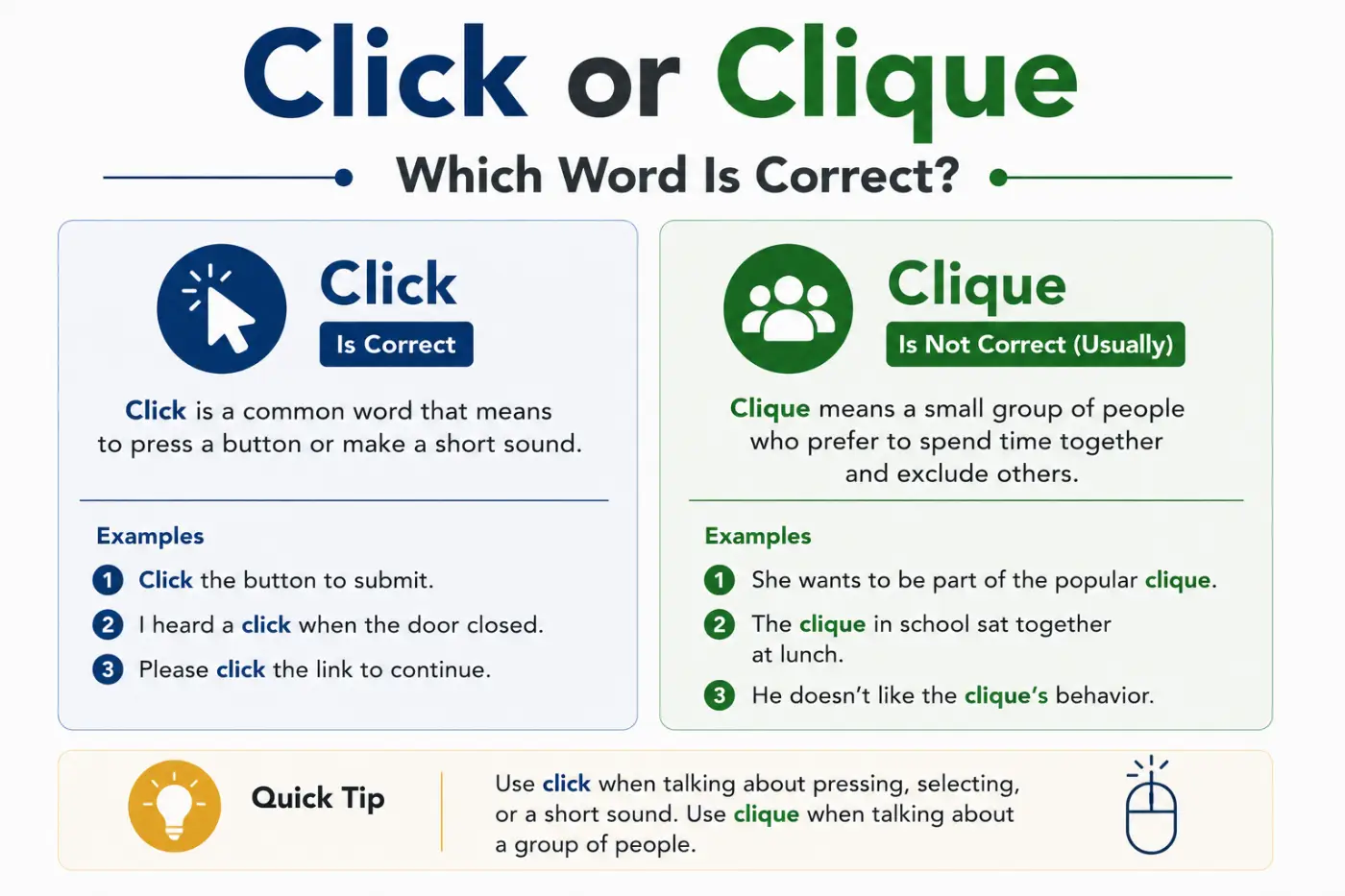
If you’re confused about click or clique you’re dealing with two real English words rather than one correct spelling and one simple typo. The key difference is meaning. Click commonly refers to pressing something or making a short sharp sound. It can also describe an instant connection between people. Clique refers to a small exclusive group of people.
The confusion makes sense because the words look similar and both can appear in conversations about people. However their pronunciations differ and their meanings are not interchangeable. A person can click with someone but a person can also belong to a clique.
Once you connect each spelling with its meaning the difference becomes much easier to remember. This guide explains the definitions grammar pronunciation origins common mistakes and real life usage so you can choose the right word with confidence.
Quick Answer
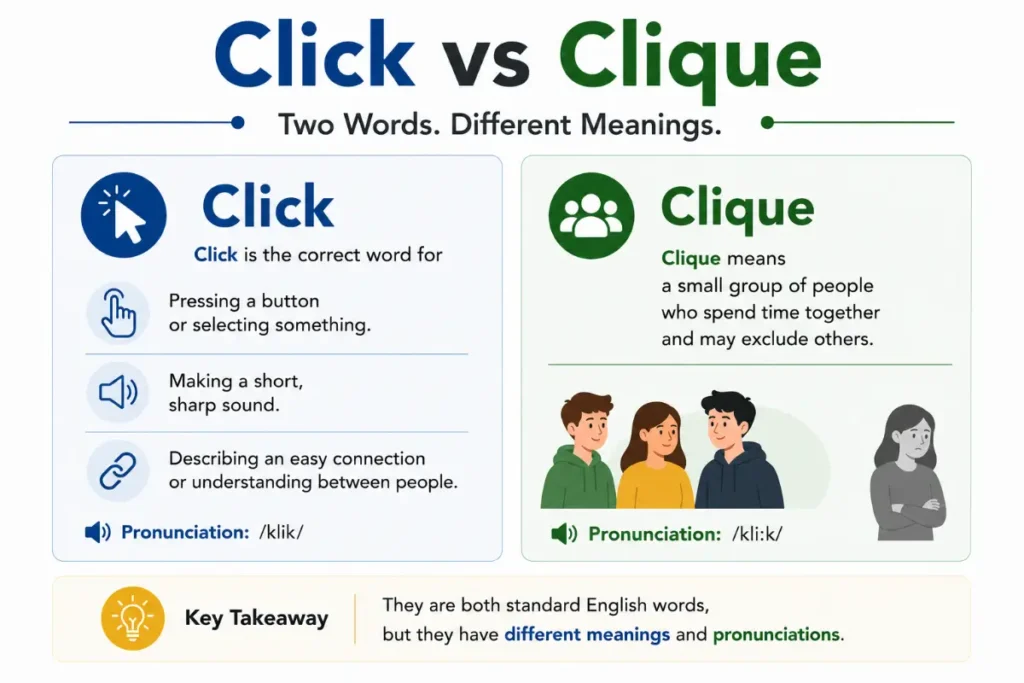
Click is the correct word for pressing a button making a short sharp sound or describing an easy connection between people. Clique means a small group of people who spend time together and may exclude others. They are both standard English words but they have different meanings and pronunciations.
Quick Answer For Everyday Writing
Use click when you mean pressing something or connecting naturally with another person.
Use clique when you mean a small and often exclusive social group.
For example you might say that you clicked with a new coworker. You might also say that the coworker belongs to a clique at work.
The spelling gives you an important clue. The shorter word has a short vowel sound while the longer word has a long e sound.
Meaning Of Click
Click has several common meanings in American English. Its most familiar meaning involves pressing a button on a computer mouse or another device. You can click a link. You can click an icon. You can click a button to open a page. In these examples the word works as a verb.
It can also work as a noun.
You might hear someone say that they heard a click from the door. In that context the word refers to a short sharp sound. There is another meaning that causes confusion with clique. Click can describe an immediate sense of connection between people.
If two people click they get along easily. Conversation feels natural. They understand each other and often enjoy spending time together. For example you could say that you clicked with your new neighbor. You could also say that two students clicked during their first meeting.
This meaning is informal but completely standard in everyday English.
Meaning Of Clique
Clique means a small group of people who spend time together and often share interests or social connections. The word can carry a negative suggestion because a clique may seem closed off to outsiders.
For example a school might have a popular clique that rarely welcomes new students. A workplace might have a small clique that always eats lunch together.
The important idea is social exclusivity.
A group does not have to be a clique simply because its members are friends. The word usually suggests that the group has a clear social boundary and that people outside the group may have difficulty joining it.
You might therefore describe a group of close friends as a clique if they regularly exclude other people.
The word can also appear in political professional artistic and academic settings.
A group of influential people within an organization might be described as a clique if they form a tight circle that keeps others at a distance.
The Main Difference
The easiest way to understand the distinction is to connect each word with its core idea.
- Click usually relates to pressing making a sound or connecting with someone.
- Clique refers to a small social group.
- Click is pronounced with a short i sound.
- Clique is pronounced with a long e sound.
- Click can function as both a noun and a verb.
- Clique is primarily a noun.
- Click has several meanings that depend on context.
- Clique has a much more specific meaning connected to groups of people.
A useful memory trick is simple. Think of the extra letters in clique as representing a group that has several people packed together. It is not a formal linguistic rule but it can help you remember the spelling.
Click And Clique Compared
A direct comparison makes the distinction easier to see.
Click means to press something with a mouse or similar device. It can also mean to make a short sharp sound or connect easily with another person.
Clique means a small group of people who spend time together and may exclude outsiders.
The words belong to different semantic fields. Click is strongly connected with actions sounds and interpersonal connection. Clique is strongly connected with social groups.
That difference matters more than the spelling.
If you’re writing about computers you almost certainly need click.
If you’re describing an exclusive social group you probably need clique.
If you’re describing two people who immediately get along you need click.
Which Form Is Correct
Both forms are correct because both are established English words.
The right choice depends entirely on the meaning you want.
Use click for actions sounds and personal connections.
Use clique for a small social group.
Calling one of them incorrect would therefore be misleading. The problem usually comes from confusing two different words that look and sound somewhat similar.
This type of confusion is common in English because spelling does not always give you a perfect guide to pronunciation. In this case the difference becomes clearer when you learn the sound and meaning together.
Consider these three sentences.
I clicked the button.
I heard a click from the lock.
I joined the school clique.
The first two sentences use the same word with different meanings. The third uses the word for a social group.
Pronunciation Guide
The pronunciation difference is one of the best ways to keep these words apart.
Click is pronounced /klɪk/.
An easy pronunciation guide is klik.
It has one syllable and uses the short i sound found in words such as sit and quick.
Clique is pronounced /kliːk/.
An easy pronunciation guide is kleek.
It also has one syllable but uses the long e sound found in words such as see and green.
The final sound is similar in both words. The vowel sound is the important difference.
Listen carefully to the middle of each word.
Click sounds like klik.
Clique sounds like kleek.
A common mistake happens when someone sees the spelling of clique but gives it the short i sound from click. That pronunciation is not standard American English.
Grammar And Part Of Speech
Click can work as a verb or a noun.
As a verb it describes an action.
You can click the button.
She clicked the link.
They clicked with each other.
As a noun it can describe an action or sound.
I heard a click.
Give the mouse a quick click.
Clique functions primarily as a noun.
You can say:
The students formed a clique.
She felt uncomfortable around the clique.
The office clique often ate lunch together.
You generally do not use clique as a verb in ordinary American English.
This grammatical difference gives you another useful clue. If you need an action word for pressing something or describing people connecting naturally you probably need click. If you need a noun for a tight social group you need clique.
Sentence Examples
Here are natural examples that show how click works in everyday American English.
- Click the button to submit the form.
- I clicked the link in the email.
- The door made a strange click when I closed it.
- She clicked with her new roommate right away.
- We clicked after talking for only a few minutes.
- Click the image to see the larger version.
- I heard a click coming from the kitchen.
- He and his coach clicked immediately.
- The students formed a clique during their first year.
- She never felt comfortable around the popular clique.
Notice how the meaning changes according to context. The first three examples involve an action or sound. The next four use the interpersonal meaning. The final examples involve a social group.
Examples With Clique
The word clique usually appears in situations involving social groups.
The popular clique sat together during lunch.
A small clique controlled most of the student activities.
He avoided the office clique because he disliked gossip.
The neighborhood had a clique of longtime residents who rarely welcomed newcomers.
She eventually realized that the group had become a clique.
These examples show why context matters. The word does not simply mean friends. It often suggests a group that feels closed or exclusive.
Common Mistakes And Misspellings
Several mistakes appear because the two words have similar letters and related sounds.
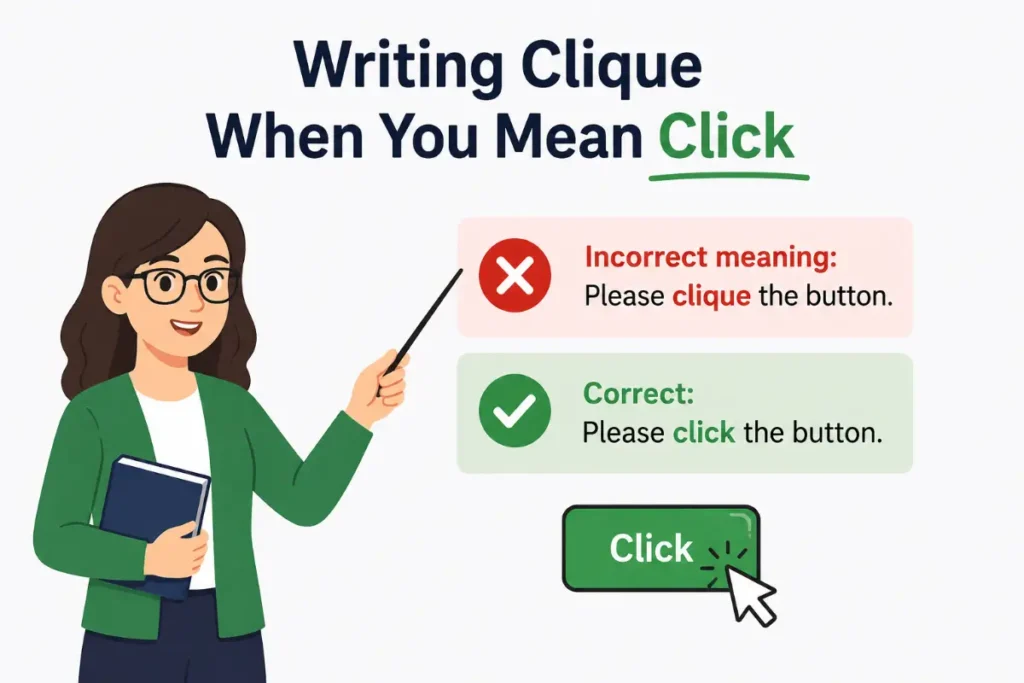
Writing Clique When You Mean Click
Incorrect meaning: Please clique the button.
Correct: Please click the button.
The mistake usually happens because the writer remembers the spelling of the social group but needs the verb for pressing something.
Writing Click When You Mean Clique
Incorrect meaning: The popular click excluded everyone else.
Correct: The popular clique excluded everyone else.
The spelling click refers to an action sound or interpersonal connection. It does not normally mean a social group.
Pronouncing Clique Like Click
Some learners see the spelling and pronounce clique with the short i sound.
The standard pronunciation is closer to kleek. The long e sound separates it from click.
Assuming Clique Means Any Group Of Friends
A group of friends is not automatically a clique.
The word usually carries an idea of exclusivity. If five friends happily spend time together but welcome everyone else the word clique may not be the best choice.
Treating Click As Only A Computer Term
Click has a much broader meaning.
It can describe a physical sound. It can describe pressing something digitally. It can also describe people forming an easy connection.
For example saying We clicked immediately has nothing to do with computers.
Etymology And Word Origin
The two words have different histories. That difference helps explain why their spellings and meanings developed separately.
Click is an old English word connected with the imitation of a short sharp sound. Its history is related to words that imitate noises. English has many sound based words of this kind.
The word later developed broader uses. The idea of making a small sharp sound led naturally to the modern noun. The verb also developed around producing such a sound and later became strongly associated with pressing a button or mouse.
The interpersonal sense of click developed later. It uses the idea of something suddenly fitting or working smoothly. When people click they seem to connect without much effort.
Clique has a different origin. English borrowed it from French. The French word referred to a group or faction. English adopted the term for a small exclusive social circle.
The different histories matter because the words did not develop as spelling variants of one another. They simply happen to look and sound similar in modern English.
American English Usage
Both words are standard in American English.
Click is extremely common in everyday speech and writing. You’ll see it in technology instructions workplace communication casual conversation and descriptions of social relationships.
For example:
Click the link below.
The lock made a click.
We clicked right away.
Clique is also standard but appears in more specific contexts. You’re more likely to see it in discussions about schools workplaces social groups politics or culture.
The word often carries a slightly negative tone. Calling a group a clique can suggest that the members act exclusive or unfriendly.
That tone depends on context. A writer might use the word neutrally to describe a recognizable social circle. However readers often sense criticism in it.
British English Usage
American and British English both use click and clique with essentially the same core meanings.
The pronunciation distinction remains important in both varieties.
Click has the short i sound.
Clique has the long e sound.
The social meaning of clique also remains recognizable across major English varieties. Regional vocabulary may differ in some situations but there is no major American versus British spelling change that affects these two words.
For a US audience the safest approach is simple. Treat them as two separate words with separate meanings.
Canadian And Australian English
Canadian English and Australian English also use both terms.
There is no major regional spelling rule that turns one form into the other.
You may encounter differences in pronunciation or conversational style across regions but the central distinction stays intact.
A person can click with another person in Canadian Australian British or American English. A small exclusive group can be called a clique in all of these varieties.
The practical lesson is that you don’t need to memorize a regional spelling rule here. You need to remember the meaning.
Click In Digital Communication
The technology meaning of click is now deeply established in everyday English.
You click a link.
You click a menu.
You click an icon.
You click a checkbox.
You click a button.
This usage has become so familiar that people often use click without thinking about its original connection to sound.
The word can also appear in phrases such as click through and click on. These expressions describe interacting with digital content.
However grammar still matters.
You can say Click the link.
You can also say Click on the link.
Both forms appear naturally in American English. The exact choice can depend on style and context.
In informal digital communication you may also see someone say Just click it. The meaning is immediately clear.
Click When People Connect
One of the most interesting meanings of click has nothing to do with technology.
When people click they connect easily.
Imagine meeting someone at a party and finding that conversation flows without effort. You laugh at similar things. You understand each other’s humor. You quickly find common interests.
You might say We clicked right away.
This expression is informal and natural. It often describes friendship dating teamwork or professional relationships.
For example:
I was nervous before the interview but the manager and I clicked immediately.
The new students clicked after working together on the project.
The phrase suggests natural compatibility rather than a formal agreement.
That distinction is useful because it gives click another meaning that can easily be confused with the social meaning of clique.
Clique In Social Situations
A clique is usually more than a group of people who happen to know each other.
The word often points to a social circle with boundaries.
Think of a school cafeteria. One group always sits together. New students try to join but feel unwelcome. The group has its own jokes routines and friendships.
That is the kind of situation where clique fits naturally.
The same idea can appear at work.
A few employees might spend every break together and make decisions among themselves. If they consistently shut out other coworkers someone might describe them as an office clique.
The word can also describe groups in politics entertainment universities and other communities.
The common thread is social closeness combined with some degree of exclusion.
Related And Confused Terms
Understanding nearby words can make the distinction even clearer.
Group
A group is a broad and neutral word for several people or things considered together. A group does not automatically suggest exclusivity.
Circle
A circle can refer to a group of friends or people with shared interests. It can sound warmer and less negative than clique.
Club
A club is usually an organized group with a shared purpose or interest. Members may formally join it.
Crowd
Crowd generally refers to a larger collection of people. It can describe people gathered in one place or a social category.
Team
A team is a group working toward a shared goal. The word usually emphasizes cooperation.
Gang
Gang can refer to a group of people who spend time together but may carry a negative meaning. In some contexts it can refer to criminal activity.
Connect
Connect means to establish a relationship or sense of understanding. It overlaps with the interpersonal meaning of click but does not share the same spelling issue.
Compatible
Compatible describes people or things that work well together. Someone who clicks with another person may also be described as compatible.
How To Remember The Difference
The simplest memory trick is to focus on the vowel sound.
Think click for a quick action.
You click a mouse.
You click a button.
You hear a click.
You click with someone.
Think clique for a close group.
A clique has people.
A clique may exclude outsiders.
The spelling also gives you a useful visual clue. Clique looks more unusual because of its French origin. The silent letters can remind you that its pronunciation is different from the simpler word click.
Another easy memory sentence is this:
Click means connect or press.
Clique means group.
If you remember those two ideas you’ll rarely confuse them again.
Real Life Usage In Conversation
In casual conversation click appears naturally when people talk about relationships.
I really clicked with her.
We didn’t click at first.
The two of them clicked immediately.
These sentences sound natural because click has become a familiar way to describe personal chemistry.
Clique appears when people discuss social dynamics.
That school has several cliques.
I never fit into that clique.
The office clique always eats together.
The emotional tone can differ. Click often sounds positive when it describes personal connection. Clique can sound negative because it may suggest exclusion.
That isn’t an absolute rule. Context decides the tone.
Real Life Usage At Work
Workplace communication gives you useful examples of both words.
You might say that you clicked with a new colleague after discovering shared interests.
You might also describe a small group as a clique if the members exclude the rest of the team.
For example:
I clicked with my new manager during our first meeting.
The department has a small clique that rarely includes new employees.
Professional writers should choose carefully here. Calling coworkers a clique can sound critical. If you simply mean a friendly group you may want to use terms such as team or group instead.
Real Life Usage In School
School settings are especially common for the word clique.
Students often form social circles based on interests personalities activities or shared experiences.
A writer might describe a group of students as a clique if they intentionally keep other students out.
Click appears in school writing too but usually with a different meaning.
Students can click a button in an online learning system. They can also click with a classmate while working on a project.
The context tells the reader which word you need.
Real Life Usage In Formal Writing
Both words can appear in formal writing but they serve different purposes.
Click is common in instructions and technical writing.
Click the menu icon to continue.
Click the link to open the application.
Clique is more likely to appear in journalism academic discussion or social analysis.
The article examined the influence of a political clique.
The novel portrays a wealthy social clique.
When you use clique in formal writing remember that it can carry a judgment about exclusivity. If you want a neutral term use group circle or association when those words fit better.
Expert Editor Insight
An experienced editor would never correct these words based on spelling alone. Context comes first. If the sentence describes pressing a button making a sound or connecting naturally with another person the editor expects click. If it describes a small exclusive social group the editor expects clique. A useful editing habit is to read the entire sentence for meaning before checking spelling because similar looking words can easily fool automated spellcheckers and rushed writers.
Why This Confusion Happens
English contains many word pairs that look similar but have unrelated meanings. Click and clique create an especially strong trap because both begin with the same three letters and end with a similar sound.
Pronunciation adds another layer of confusion. Someone who has mostly encountered the words in writing may not immediately know that the vowels differ.
Meaning also creates trouble because click can describe social connection while clique describes a social group. Both words can therefore appear in conversations about people.
That overlap makes the mistake feel logical even though the words are not interchangeable.
The best solution isn’t memorizing a spelling rule. It is learning each word as a separate vocabulary item.
A Simple Editing Test
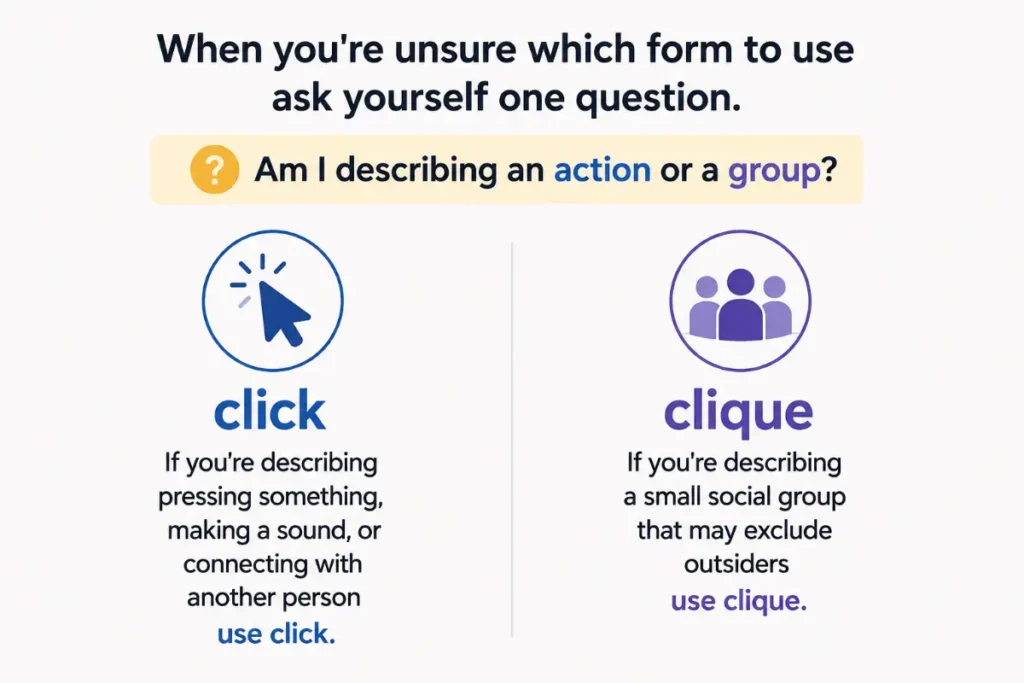
When you’re unsure which form to use ask yourself one question.
Am I describing an action or a group? If you’re describing pressing something making a sound or connecting with another person use click. If you’re describing a small social group that may exclude outsiders use clique. Then check the pronunciation in your mind. Click sounds like klik. Clique sounds like kleek. This two step check works quickly and doesn’t require you to remember complicated grammar terminology.
Final Takeaway
Click or clique isn’t a choice between a correct word and a misspelling. Both are legitimate English words with different meanings. Use click for pressing something making a short sound or describing people who connect easily. Use clique for a small social group that may exclude outsiders.
The fastest memory trick is to connect click with action or connection and clique with group. Also remember the pronunciation difference. Click has a short i sound while clique has a long e sound. Once you tie each spelling to its meaning the confusion largely disappears.
FAQs
Is Clique A Real Word?
Yes. Clique is a standard English noun. It refers to a small group of people who spend time together and often have an exclusive social relationship. The word can appear in school workplace political and cultural contexts. It often carries a slightly negative suggestion because it may imply that people outside the group are excluded.
What Does Click Mean?
Click has several meanings. It can mean pressing a button or link on a device. It can describe a short sharp sound. It can also describe two people who connect easily and naturally. The correct meaning depends on context. In everyday American English all three uses are common.
What Does Clique Mean?
Clique means a small and often exclusive social group. Members usually share friendships interests or social connections. The word often suggests that outsiders have difficulty becoming part of the group. For example a school clique may spend time together while deliberately keeping other students outside the group.
How Do You Pronounce Clique?
Clique is pronounced /kliːk/. It has one syllable and sounds like kleek. The vowel is the long e sound found in words such as see. It does not use the short i sound found in click. Remembering this pronunciation can make the spelling much easier to recognize.
How Do You Pronounce Click?
Click is pronounced /klɪk/. It has one syllable and uses the short i sound found in words such as sit and quick. The pronunciation is close to the simple spelling of the word. The main difference from clique is the vowel sound.
Can Click Describe People?
Yes. Click can describe people who connect easily. If you say We clicked right away you mean that you and another person quickly developed a natural sense of understanding or compatibility. This use is informal but common in American English and works well in conversations about friendships relationships and teamwork.
Is Clique Negative?
Clique can sound negative because it often suggests that a group excludes outsiders. However the word does not always express strong criticism. Context controls the tone. If you want a completely neutral description of people who spend time together words such as group circle or friends may be better choices.
Why Do People Confuse These Words?
People confuse them because the spellings look similar and both words can appear in conversations about people. The meanings also sit close enough to create mental confusion. Click can describe people connecting while clique describes a social group. Learning the pronunciation and core meaning of each word makes the distinction much easier.
