
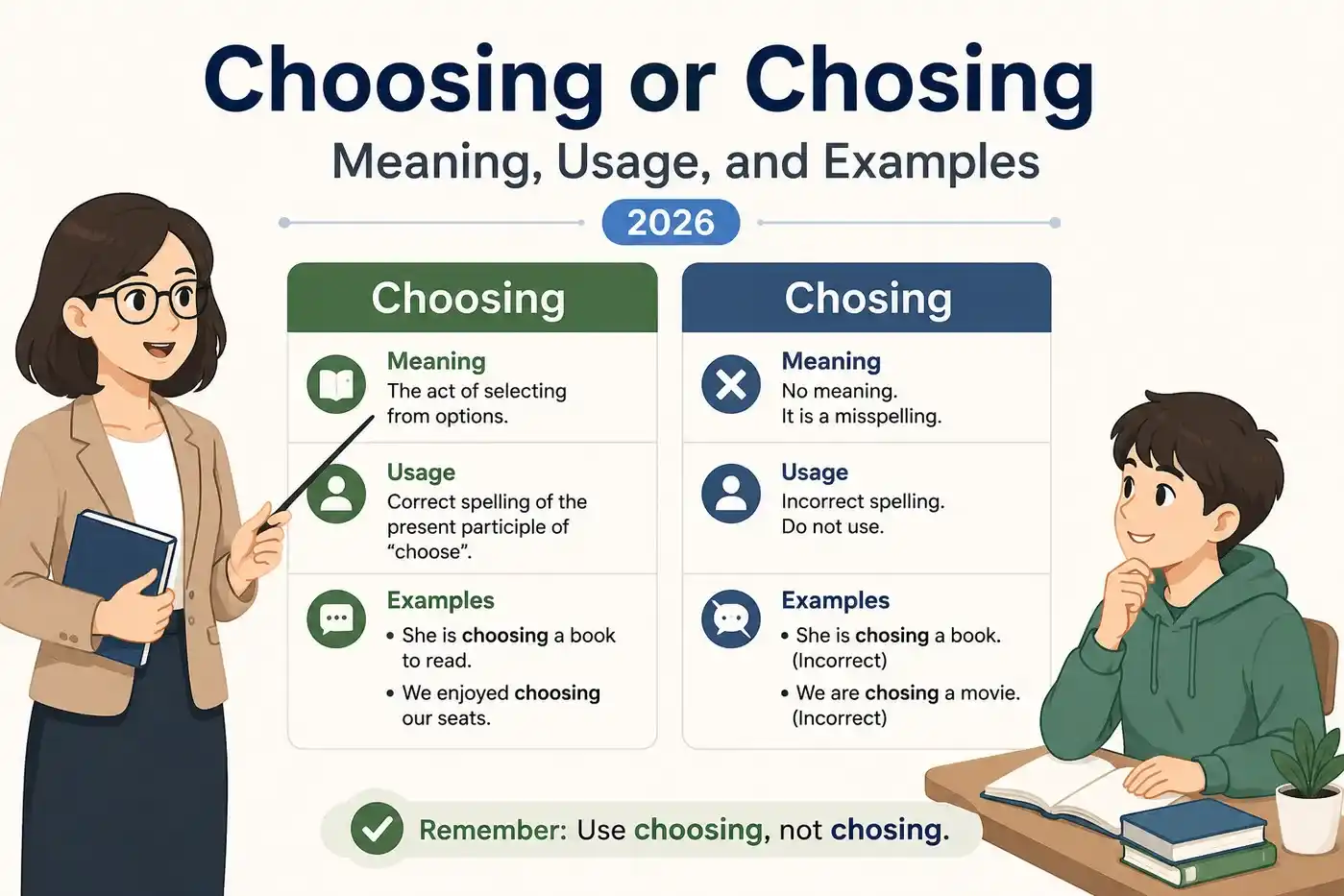
Choosing or chosing is a common spelling question because the verb looks simple until you add the ending. The correct spelling is choosing. Chosing is a misspelling and isn’t accepted in standard English.
The confusion comes from the spelling of the base verb choose. When you add the ending ing you might expect to keep the spelling pattern exactly as it appears. English doesn’t work that way here. The final silent e drops before ing, giving us choosing.
This guide explains the rule in plain English. You’ll learn what choosing means, why chosing is wrong, how to pronounce the word, how the spelling changes in different forms, and how native speakers use it in real sentences. You’ll also get memory tips, common mistakes, related words, and answers to the questions people ask most often.
Short Answer
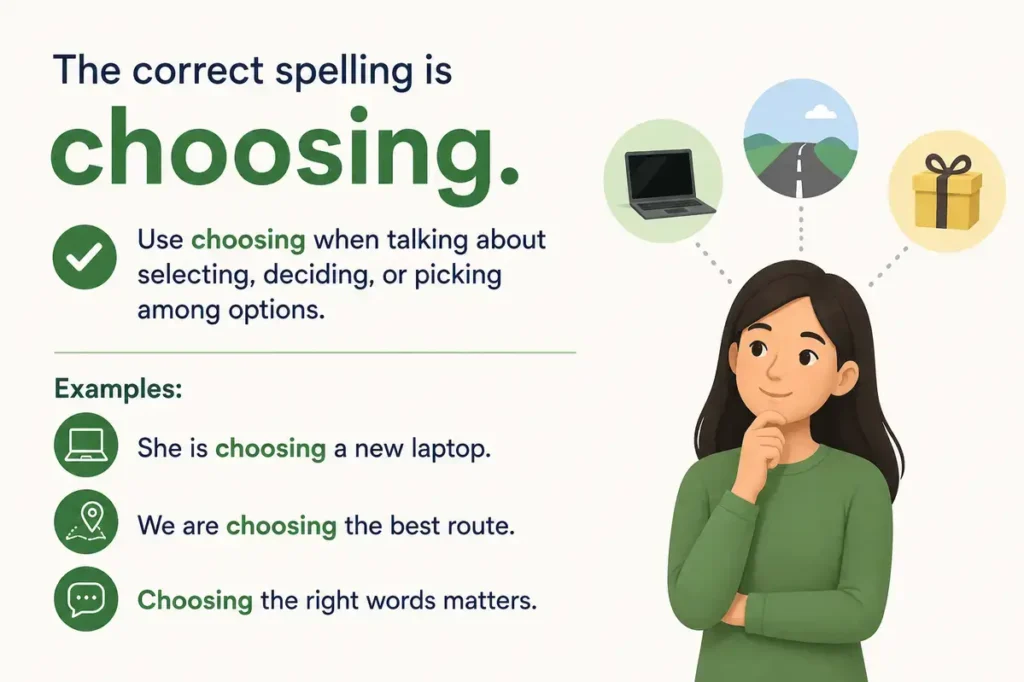
Choosing is the correct spelling. Chosing is incorrect because the verb choose loses its final silent e before the ending ing is added. The result is choosing with two o letters followed by s and ing. For example, I am choosing a new laptop.
Table Of Contents
- Choosing Or Chosing At A Glance
- What Choosing Means
- Why Chosing Is Incorrect
- The Spelling Rule Behind Choosing
- How Choose Changes Into Choosing
- Choosing As A Verb
- Choosing In Different Tenses
- Pronunciation And Syllables
- Choosing In American English
- Choosing In British English
- Common Spelling Mistakes
- Real Life Examples
- Choosing In Formal Writing
- Choosing And Similar Words
- Memory Tips
- Expert Editor Insight
- Key Takeaways
- FAQs
- Conclusion
Choosing Or Chosing At A Glance
If you’re asking choosing or chosing, choose choosing every time in standard English.
The word comes from the verb choose. When you add ing, the final silent e is removed.
Choose + ing = choosing.
That gives us choosing.
It does not give us chosing.
The spelling is easy to recognize once you remember that choose already contains two o letters. Those two letters stay when the final e disappears.
Consider these examples.
I am choosing a movie.
She is choosing her college courses.
We are choosing between two options.
They were choosing a restaurant.
In every case the correct form has two o letters.
What Choosing Means
Choosing is the present participle and gerund form of choose.
The verb choose means to select one person thing or option from two or more possibilities. Therefore choosing describes the action of making that selection.
For example:
I am choosing a shirt.
The speaker is currently deciding which shirt to select.
She is choosing a career.
The sentence describes an ongoing decision about a career.
We are choosing the best option.
The group is currently making a selection.
The word can describe a small everyday decision or a major life decision. You can choose a meal a movie a seat a school a career a gift or a person for a particular role.
The meaning stays connected to selection and decision making.
Why Chosing Is Incorrect
Chosing is a misspelling of choosing.
The mistake usually happens because writers know that some English verbs drop a final e before ing. They remember the spelling change but accidentally remove too much.
The base verb is choose.
It contains:
c
h
o
o
s
e
When the final e is removed the remaining form is:
c
h
o
o
s
Then ing is added:
c
h
o
o
s
i
n
g
The result is choosing.
The incorrect version removes the final e and also loses one of the two o letters.
That produces chosing.
The problem isn’t with pronunciation. It’s a spelling mistake caused by treating the word as if it were built from chos plus ing. It isn’t.
The correct base is choose.
The Spelling Rule Behind Choosing
English has a common spelling rule involving verbs that end in a silent e.
When many verbs ending in silent e take ing, the final e disappears.
For example:
make becomes making.
take becomes taking.
write becomes writing.
dance becomes dancing.
hope becomes hoping.
use becomes using.
The same pattern applies to choose.
Choose becomes choosing.
The final e disappears but the two o letters remain.
This distinction is the key to the whole spelling question.
The rule doesn’t say remove the final letter or shorten the word in any other way. It says that the silent e is dropped before ing.
So:
choose + ing = choosing.
Not:
chos + ing = chosing.
That small difference explains the entire mistake.
How Choose Changes Into Choosing
The best way to understand the spelling is to look at the word family.
Choose
Choose is the base form.
I choose tea every morning.
Chooses
Chooses is the third person singular present form.
She chooses tea every morning.
Chose
Chose is the simple past form.
She chose tea yesterday.
Chosen
Chosen is the past participle.
She has chosen tea.
Choosing
Choosing is the present participle and gerund form.
She is choosing tea now.
Notice something useful here. The vowel pattern changes across the word family.
Choose.
Chose.
Chosen.
Choosing.
These forms may look different but they all belong to the same verb.
This is one reason English spelling can feel tricky. A word’s pronunciation and spelling don’t always remain visually identical as grammatical forms change.
Choosing As A Verb
Choosing commonly appears with forms of the verb be to create the present continuous or past continuous tense.
Examples include:
I am choosing.
You are choosing.
She is choosing.
We are choosing.
They are choosing.
You can also use it with other verbs.
She kept choosing the same answer.
He started choosing healthier meals.
They continued choosing the cheaper option.
In these examples choosing describes an action in progress or an action connected to another verb.
The word can also act as a gerund. A gerund has the form of a present participle but functions like a noun.
For example:
Choosing a college can be difficult.
Choosing the right words matters.
In the first sentence the activity of selecting a college acts as the subject. In the second sentence the activity of selecting words acts as the subject.
This makes choosing especially useful because it can describe both an ongoing action and the general activity of making selections.
Choosing In Different Tenses
The form choosing itself doesn’t represent every tense. The surrounding verb tells us the time and grammatical structure.
Present Continuous
I am choosing a new phone.
This shows that the selection is happening now or around the present time.
Past Continuous
I was choosing a new phone when you called.
The action was in progress at a specific point in the past.
Future Continuous
I will be choosing a new phone tomorrow.
The action will be in progress at a future time.
Perfect Continuous
I have been choosing products for the store all morning.
The action began earlier and continues into the present.
The spelling remains choosing in all of these structures.
Pronunciation And Syllables
Choosing is usually pronounced with two syllables.
The common American English pronunciation is represented in IPA as:
/ˈtʃuːzɪŋ/
You can think of it as:
CHOO zing.
The first syllable sounds like choose without the final emphasis on the ending. The second syllable sounds like ing.
The word begins with the same sound as choose.
That can actually help with spelling. If you can mentally connect choosing with choose you are less likely to remove one of the two o letters.
A common mistake is to think the first part sounds like chose. Although choose and chose belong to the same verb family they have different vowel sounds.
Choose is pronounced like chooz.
Chose is pronounced like chohz.
Choosing follows choose in its first syllable.
The spelling therefore makes more sense when you connect the word to its base form.
Choosing In American English
American English uses choosing in exactly the same basic grammatical way as other major varieties of standard English.
Americans use it in casual conversation professional communication education journalism and everyday writing.
Examples include:
I’m choosing a new apartment.
We’re choosing a restaurant for dinner.
She is choosing her classes for next semester.
The spelling doesn’t change in American English.
The form chosing isn’t a recognized American English alternative. If you see it in an email text message social media post or online comment it is normally just a spelling mistake.
Choosing In British English
British English also uses choosing as the standard spelling.
The same spelling rule applies. The final silent e in choose drops before ing is added.
British writers use the word in ordinary conversation formal writing education journalism and literature.
For example:
I’m choosing a new course.
They are choosing between several candidates.
She spent the afternoon choosing furniture.
There is no British spelling variant that changes choosing to chosing.
Common Spelling Mistakes
The spelling of this word can lead to several predictable errors.
Chosing
This is the most common mistake. The writer removes the final e correctly but also removes one o.
Incorrect:
I am chosing a dress.
Correct:
I am choosing a dress.
Chooseing
Some writers make the opposite mistake and keep the final e.
Incorrect:
I am chooseing a dress.
Correct:
I am choosing a dress.
The final silent e needs to disappear before ing is added.
Choosying
This version adds an unnecessary y and doubles the consonant.
Incorrect:
She is choosying a new car.
Correct:
She is choosing a new car.
Choozing
This spelling reflects pronunciation rather than standard spelling.
Incorrect:
They are choozing the winner.
Correct:
They are choosing the winner.
English spelling doesn’t always follow sound exactly.
Chosingg
This version adds an extra g.
Incorrect:
We are chosingg the best answer.
Correct:
We are choosing the best answer.
The standard form ends with ing.
Why People Write Chosing
There are several reasons the misspelling appears.
First the word choose changes noticeably when ing is added. The final e disappears which can make writers feel that the word needs more shortening.
Second English has many spelling patterns that compete in memory. Writers may remember the correct rule but apply it too aggressively.
Third pronunciation can interfere with spelling. When people hear choosing they may focus on the sound rather than the written form.
Fourth typing quickly can produce omissions. The double o is easy to overlook when you’re writing at speed.
The mistake is especially understandable because choosing doesn’t visually resemble some other familiar ing forms as closely as people expect.
Still the solution is simple. Go back to the base verb.
Choose.
Drop the final e.
Add ing.
Choosing.
Real Life Examples
Natural examples are one of the fastest ways to make a spelling pattern stick.
Everyday Conversation
I’m choosing what to eat.
This means the speaker is deciding what food to select.
We’re choosing a movie tonight.
The speakers are deciding which movie they want to watch.
School And Education
Students are choosing their subjects for next year.
The students are deciding which subjects to take.
Choosing a major can feel like a big decision.
The sentence treats the act of selecting a major as a general activity.
Work
The manager is choosing someone to lead the project.
The manager is currently selecting a person for the role.
We’re choosing a new software system for the team.
The group is comparing options and making a selection.
Shopping
I’m choosing between these two jackets.
The speaker has two options and is deciding which one to buy.
She spent an hour choosing a birthday gift.
The sentence describes an extended selection process.
Relationships
He’s choosing to spend more time with his family.
Here the word means making a deliberate decision rather than simply selecting an object.
Choosing the right people to trust takes time.
The sentence uses the gerund form to discuss the general process of making decisions about relationships.
Professional Communication
We are choosing the final design this afternoon.
The team expects to make the decision during the afternoon.
The committee is choosing a new chairperson.
The committee is selecting someone for an official role.
Choosing In Formal Writing
Choosing is perfectly appropriate in formal English.
You can use it in academic papers business reports applications essays professional emails and official documents.
For example:
Consumers are increasingly choosing products based on durability.
The committee is choosing a candidate after reviewing the applications.
Students are responsible for choosing courses that meet the program requirements.
There is no need to replace the word with a more complicated expression simply because the writing is formal.
Good editing isn’t about making ordinary words sound sophisticated. It is about selecting the clearest accurate word for the situation.
In fact choosing is often preferable to alternatives such as selecting when the context is conversational. The two words overlap but choose tends to sound more natural in everyday English.
Choosing And Selecting
Choose and select are close synonyms.
Choose is more common in everyday English.
Select often sounds more deliberate or formal.
Compare these sentences:
I’m choosing a shirt.
I’m selecting a shirt.
Both are grammatical. The first sounds more natural in casual conversation. The second may sound more formal or procedural.
For example a website might say Select a payment method because the language gives an instruction. A friend is more likely to say Choose a movie.
The spelling issue doesn’t change when you use the synonym. Only the vocabulary changes.
Choosing And Deciding
Choosing and deciding are related but they aren’t identical.
To choose means to select from available possibilities.
To decide means to reach a conclusion about what you will do.
For example:
I’m choosing a restaurant.
This emphasizes the selection among restaurants.
I’m deciding where to eat.
This emphasizes the decision process.
The two ideas often overlap in real conversation.
Choosing And Opting
Opting means choosing one possibility or course of action from alternatives.
For example:
She is opting for the cheaper plan.
This means she is choosing the cheaper plan.
Opting can sound slightly more formal than choosing. It often appears with for.
She opted for tea.
She chose tea.
Both sentences communicate the basic idea of making a selection.
Word Origin
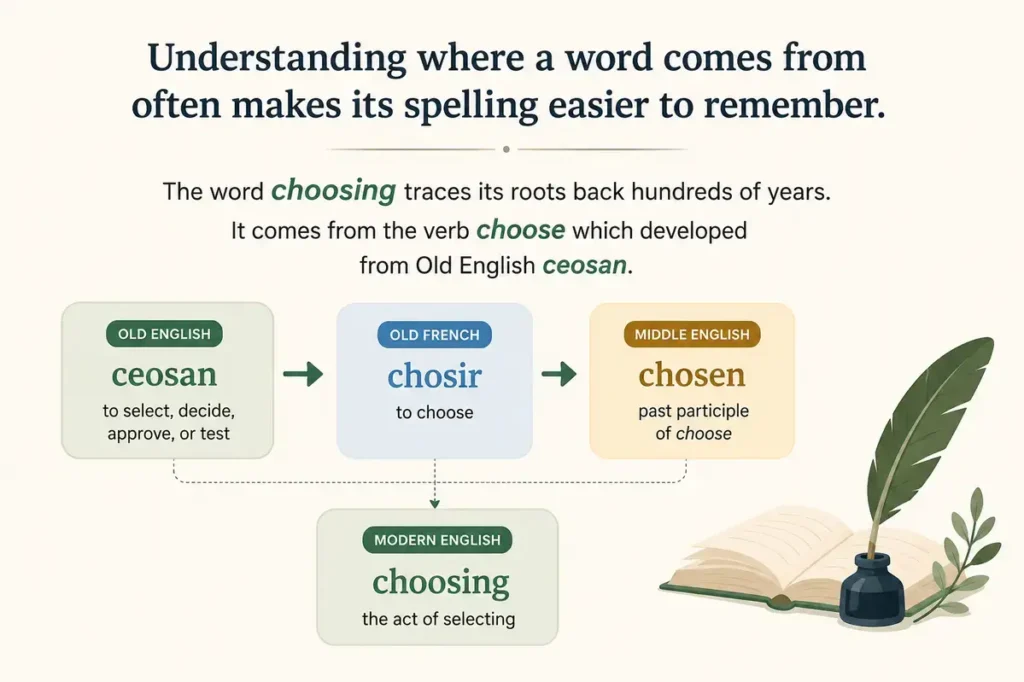
The verb choose has a long history in English. It comes from Old English cēosan which meant to choose or select. The word developed through the history of English and is related to forms found in other Germanic languages.
The modern forms choose, chose, chosen, and choosing developed through changes in English spelling and pronunciation.
The form choosing is built from the present form choose with the ing ending. The final silent e is removed according to a common English spelling pattern.
Understanding the history isn’t necessary to spell the word correctly but it explains why modern English contains several related forms that don’t look completely identical.
Related Words From The Same Family
Learning the word family can make the spelling much easier.
Choose
The base verb.
I choose coffee.
Chooses
The third person singular present form.
She chooses coffee.
Chose
The simple past form.
She chose coffee yesterday.
Chosen
The past participle.
She has chosen coffee.
Choosing
The present participle and gerund.
She is choosing coffee now.
These forms are connected even though their vowel patterns change.
Memory Tips
The simplest memory trick is to protect the two o letters.
Think:
Choose keeps both O letters.
When ing arrives the final e leaves.
So:
Choose.
Remove e.
Add ing.
Choosing.
Don’t think of the word as chos + ing. Think of it as choose + ing.
Another useful trick is to connect the spelling with the pronunciation.
Choosing starts with the sound of choose.
If you can spell choose correctly then you already have most of the difficult part.
A final trick is to compare it with chooses.
Choose.
Chooses.
Choosing.
The double o remains in all three forms.
Related Grammar And Usage Notes
The word can appear in several useful grammatical patterns.
Choosing Between
Use choosing between when someone must decide among alternatives.
I’m choosing between two universities.
She is choosing between the red dress and the blue dress.
Choosing From
Use choosing from when someone selects from a group or collection.
We’re choosing from several candidates.
He is choosing from the options on the menu.
Choosing To
Use choosing to before a verb when someone deliberately decides to take an action.
She is choosing to stay.
They are choosing to work remotely.
Choosing As A Gerund
A gerund can function as a noun.
Choosing carefully can save money.
Here the activity of making a careful selection acts as the subject.
Choosing As A Present Participle
It can also describe an ongoing action.
She is choosing carefully.
Here choosing forms part of the verb phrase.
This difference is useful for grammar students because the same ing form can perform different jobs depending on the sentence.
Expert Editor Insight
A professional editor would usually correct chosing without hesitation because the standard spelling comes directly from the base verb choose and the regular silent e rule. The best editing habit is to check the word family rather than rely on how the word sounds. If you can identify the base form first then the spelling becomes predictable. When proofreading quickly look for the two o letters. If one has disappeared from choosing the word deserves another look.
A Simple Rule To Remember
When a verb ends in a silent e, that final e often disappears before ing.
Choose becomes choosing.
Make becomes making.
Write becomes writing.
Take becomes taking.
The important part is that only the final silent e disappears.
The other letters stay unless another spelling rule applies.
That means the two o letters in choose remain.
This gives you a reliable pattern:
Choose.
Drop the final e.
Add ing.
Choosing.
Key Takeaways
- Choosing is the correct standard spelling.
- Chosing is a spelling error.
- The base verb is choose.
- The final silent e drops before ing.
- The two o letters remain.
- The pronunciation is commonly represented as /ˈtʃuːzɪŋ/ in American English.
- Choosing can function as a present participle or gerund.
- The spelling is the same in standard American and British English.
- The easiest memory trick is to remember choose + ing = choosing.
- When proofreading look for both o letters before the s.
Conclusion
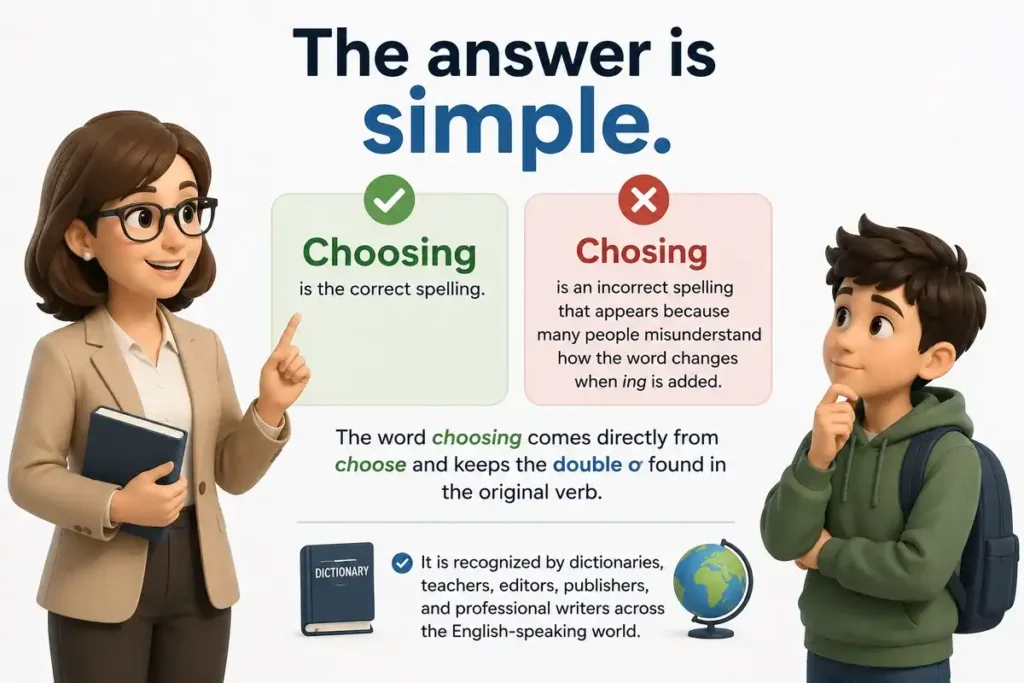
Choosing or chosing has a clear answer. Choosing is the correct spelling and chosing is a common misspelling. The reason is simple. The base verb is choose, and its final silent e disappears before the ing ending is added. The two o letters stay in place.
Once you see the word as choose + ing the spelling becomes much easier to remember. The form can describe an action in progress or work as a gerund depending on the sentence. It appears naturally in casual speech professional communication academic writing and many other contexts.
For a quick proofreading trick remember this sentence: Choose keeps both o letters before the final e drops. If you can remember that pattern you’ll have a reliable way to avoid chosing and write choosing correctly every time.
FAQs
Is chosing a correct spelling?
No. Chosing is not the standard spelling. The correct form is choosing. The word comes from choose, and the final silent e drops before ing is added. The two o letters remain. For example, She is choosing a new apartment is correct. She is chosing a new apartment is not standard English.
Choosing or chosing which is correct?
Choosing is correct. Chosing is a common misspelling. The easiest way to remember the difference is to start with choose. Remove only the final silent e and add ing. That produces choosing. The two o letters don’t disappear. This spelling works in American English and British English.
Why does choosing have two o letters?
The two o letters come from the base verb choose. When the word takes the ing ending the final silent e is removed. The remaining spelling is choos, and adding ing gives choosing. The spelling therefore keeps both o letters. Removing one of them produces the incorrect form chosing.
Is choosing a verb?
Yes. Choosing is a form of the verb choose. It can function as a present participle in constructions such as She is choosing a dress. It can also function as a gerund when the activity acts like a noun. For example, Choosing carefully takes time. The grammatical role depends on how the word functions in the sentence.
How do you pronounce choosing?
In American English choosing is commonly represented in IPA as /ˈtʃuːzɪŋ/. It has two syllables and sounds roughly like CHOO zing. The first syllable has the same basic vowel sound as choose. Connecting the word to its base form can help you remember the spelling and avoid dropping one of the two o letters.
What is the past tense of choose?
The simple past form of choose is chose. For example, I chose the blue shirt yesterday. The past participle is chosen, as in I have chosen the blue shirt. The present participle is choosing, as in I am choosing the blue shirt. These forms belong to the same irregular verb family but they don’t share one identical spelling pattern.
Can choosing be used as a noun?
Yes. Choosing can function as a gerund and therefore act like a noun in a sentence. For example, Choosing the right college can take time. Here the entire activity of selecting a college functions as the subject. The same form can also act as a present participle in I am choosing a college. Grammar determines its role.
Is choosing formal or informal?
Choosing works in both formal and informal English. You can use it in everyday conversation as well as academic writing business communication and professional documents. For example, consumers are choosing more durable products is appropriate in formal writing. I’m choosing a movie is perfectly natural in casual conversation. The word itself doesn’t carry an informal limitation.
What is the easiest way to remember choosing?
Start with the base verb choose. Remember that it contains two o letters. When you add ing, remove only the final silent e. You get choosing. A useful mental formula is choose plus ing equals choosing. If you write chosing, check the word again because one of the two o letters has disappeared.
What is the difference between choosing and selecting?
Both words describe making a choice but choosing is more common in ordinary conversation. Selecting can sound more formal or deliberate. You might say I’m choosing a movie when talking with a friend. A form or website might say Select an option. The meaning overlaps but the tone and context can differ. Both words are grammatically correct.
