
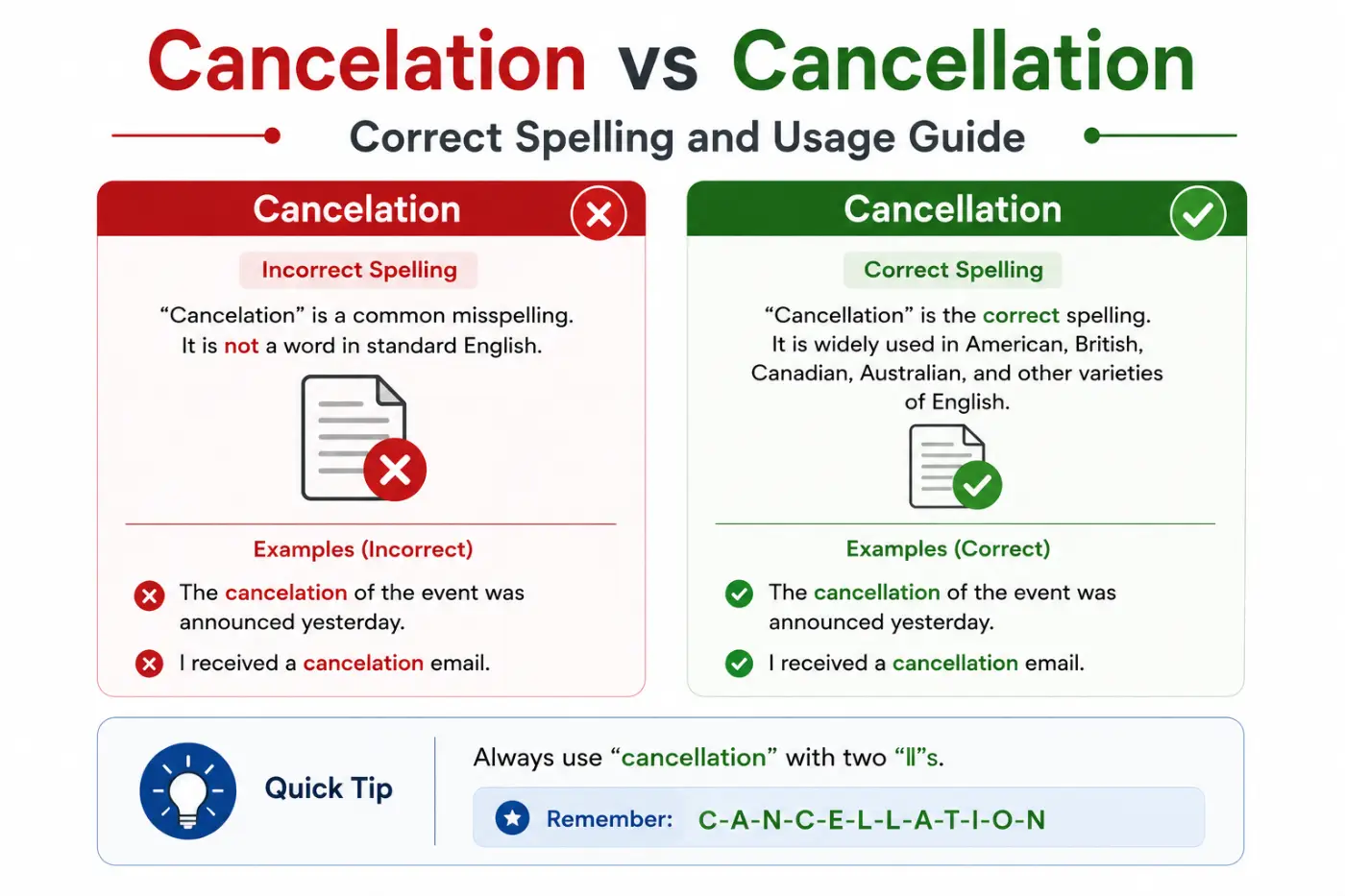
English spelling has a way of making simple words surprisingly tricky. The word related to cancel is a good example because writers often hesitate when they need to turn the verb into a noun. The two forms look almost identical, yet one is strongly preferred in standard modern English. If you are deciding between cancelation vs cancellation, the safest answer is cancellation.
The confusion comes from the spelling of the base verb cancel and the way English forms nouns ending in ation. American English also has a special pattern that makes the shorter spelling appear plausible. Since cancel ends in a single l in American spelling, many writers expect the noun to follow the same pattern. However, standard dictionaries recognize cancellation as the normal spelling, while cancelation is much less common and can appear as a variant in some sources.
This guide explains the difference in plain English. You will learn which spelling professional editors normally choose, how the word is pronounced, why the extra l appears, how American and British usage compare, and how to use the noun naturally in sentences. You will also see common mistakes and practical examples that make the spelling easier to remember.
Featured Snippet Section
Cancellation is the standard spelling for the act of canceling something. It means stopping an event, order, agreement, reservation, service, or planned activity. Cancelation exists as a less common spelling, but cancellation is the preferred form in standard American and British English and is the better choice for formal writing.
Quick Answer
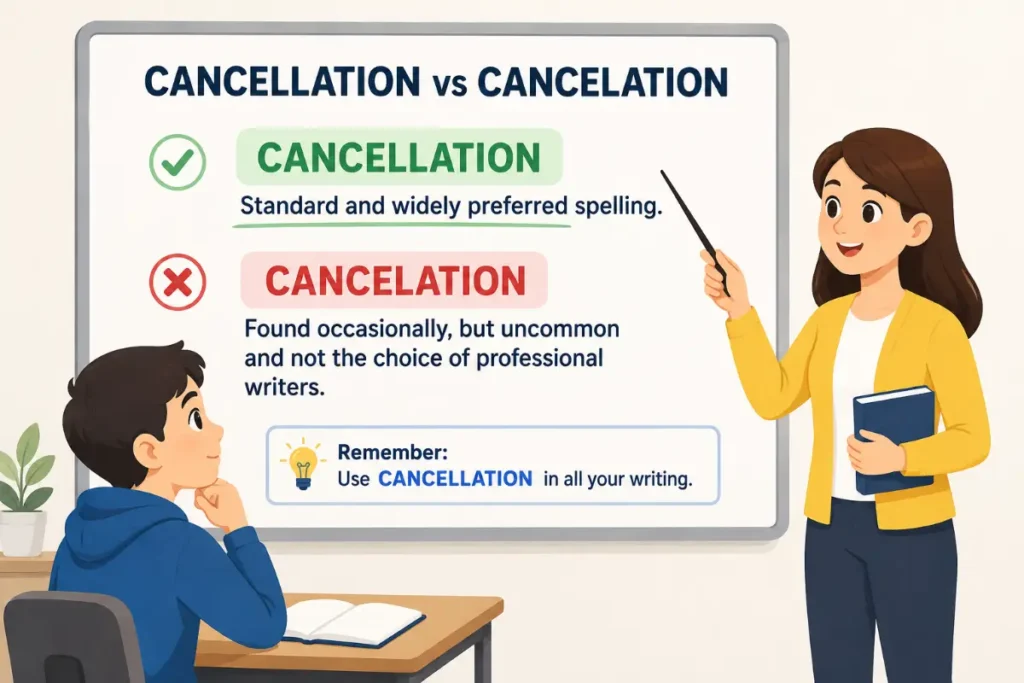
Cancellation is the standard and widely preferred spelling. Cancelation is found occasionally, but it is uncommon and is generally not the form professional writers choose.
If you are writing an email, article, report, academic paper, business document, or website copy, use cancellation. It is the spelling most readers expect.
Comparison Table: cancelation vs cancellation
| Correct Form | Meaning | Part of Speech | Origin | Usage Frequency | Formality | Common Contexts | Example |
|---|---|---|---|---|---|---|---|
| Cancellation | The act of canceling something | Noun | From cancel and the suffix ation | Very common | Standard and formal | Events, orders, contracts, reservations, services | The airline announced the cancellation of the flight. |
| Cancelation | The act of canceling something | Noun | Variant formation from cancel and the suffix ation | Much less common | Nonstandard or uncommon | Occasional variant spelling | The cancelation was announced late. |
Meaning and Definition
Meaning of cancelation
Cancelation is a real spelling found in English, but it is not the form most readers expect. It can be described as a variant spelling of cancellation rather than a completely different word with a different meaning.
Its meaning is the same basic concept: the act of canceling something.
You might encounter it in older material, informal writing, specialized publications, or texts influenced by simplified spelling patterns. However, its limited use creates a practical problem. A reader may interpret it as a spelling mistake even when the writer intended it as a variant.
For that reason, most writers should avoid it unless they are deliberately following a source, style guide, historical spelling, or specialized editorial convention.
Meaning of cancellation
Cancellation means the act of stopping something that had been planned, arranged, ordered, scheduled, or agreed upon. The word can describe many situations. A flight can have a cancellation. A customer can request the cancellation of a subscription. A company can announce the cancellation of an event. A person can ask for the cancellation of an order or appointment.
The noun comes from the verb cancel, which ultimately traces back through French to Latin roots associated with making something invalid or crossing something out. The word has a broad modern meaning. It can refer to physically stopping a plan, formally ending an arrangement, or removing the effect of a previous decision.
For example, these sentences all use the noun naturally.
The cancellation of the concert disappointed thousands of fans.
I received confirmation of my subscription cancellation.
The weather caused the cancellation of several flights.
The contract allows cancellation within thirty days.
Key Differences Explained
- Spelling
The main difference is the extra l in cancellation. The standard form contains two l letters before ation.
- Grammar role
Both forms function as nouns when they are used to describe the act or result of canceling something. The difference is primarily spelling and usage rather than grammar.
- Meaning
There is no meaningful difference in the basic definition. Both forms refer to stopping or ending something that was previously planned or arranged.
- Tone
Cancellation sounds completely natural in professional, academic, commercial, and everyday English. The shorter variant can look unusual and may distract readers.
- Context
Use cancellation for business communication, formal documents, journalism, academic writing, customer service, and general English. It is the safest choice across contexts.
Which Spelling Is Correct?
Cancellation is the spelling you should normally use.
Major English dictionaries recognize cancellation as the standard noun formed from cancel. Dictionaries such as Merriam Webster and the Oxford English Dictionary provide evidence for the established form and its historical development.
The spelling also follows the established pattern seen in related words such as cancellation, cancelled, and cancelling in varieties of English that retain the doubled consonant.
There is an interesting regional point here. American English commonly writes the verb as cancel rather than cancelled in the past tense, while British English normally writes cancelled with two l letters. That difference can make the noun seem confusing to American writers.
Still, the noun cancellation remains the standard choice in both major varieties. From an editing perspective, the practical rule is easy: if you are not following a special house style, write cancellation.
Sentence Examples
Here are natural examples showing how native speakers commonly use the standard form.
- The cancellation of the flight left hundreds of passengers searching for alternatives.
- We received an email confirming the cancellation of our reservation.
- The company apologized for the sudden cancellation of the service.
- I requested the cancellation of my membership before the renewal date.
- The storm led to the cancellation of several outdoor events.
- The hotel waived the fee because the cancellation was caused by a medical emergency.
- Customers can request cancellation through their online accounts.
- The announcement of the concert cancellation appeared on the venue website.
- Our team was disappointed by the cancellation of the final match.
- The agreement explains the conditions for cancellation.
These examples show that the noun works comfortably with many common expressions, including cancellation of an event, cancellation of an order, cancellation fee, cancellation policy, and cancellation notice.
Examples Showing the Common Misspelling
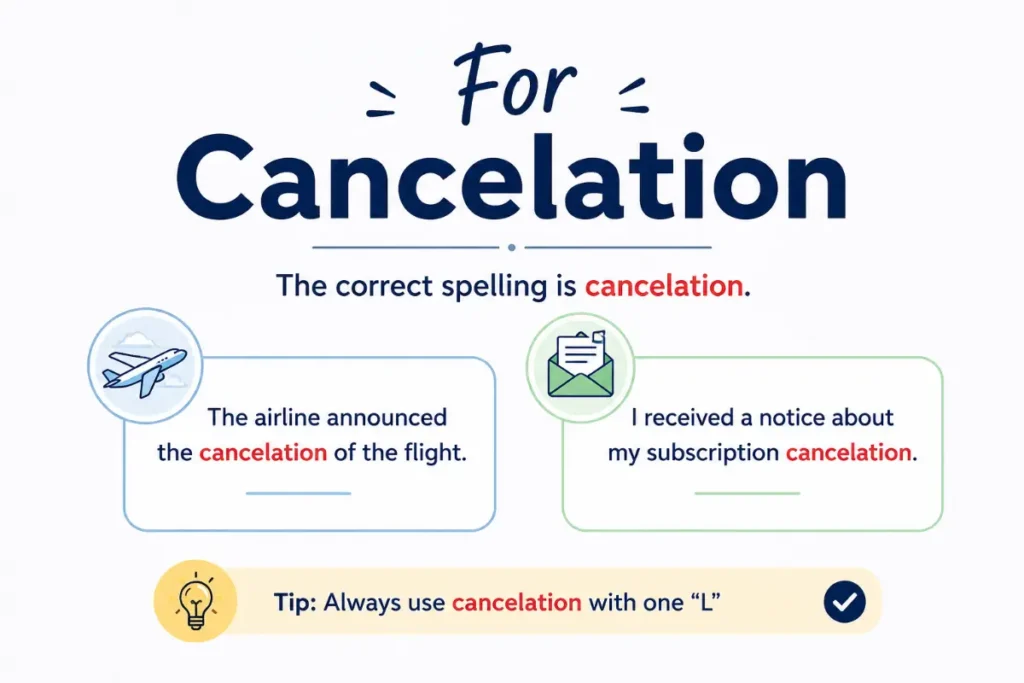
The following sentences demonstrate the spelling problem. In each case, cancelation should normally be changed to cancellation in standard edited English.
- The airline announced the cancelation of the flight.
- I received a notice about my subscription cancelation.
- The event cancelation surprised everyone.
- Please confirm the cancelation of my order.
- The company explained the reason for the cancelation.
The meaning is understandable in all five sentences. The problem is the spelling, not the intended meaning.
Common Mistakes and Misspellings
English learners and native speakers can make this mistake for several understandable reasons.
- Following the base verb too closely
A writer sees cancel and then adds ation mentally. That produces cancelation. The word looks logical even though the established noun normally contains the extra l.
- Confusion with American spelling
American English often uses canceling and canceled, which can encourage writers to assume that every related form should contain only one l.
- Visual compression
The two spellings look nearly identical. When people type quickly, the second l can disappear without being noticed.
- Phonological influence
The pronunciation does not clearly signal the spelling. You hear a single consonant sound, so nothing in ordinary speech tells you to write two l letters.
- NLP style pattern confusion
From an NLP perspective, this is a familiar orthographic confusion. The brain recognizes the lexical base cancel and predicts a familiar suffix. That prediction can produce a plausible but less conventional spelling.
Search engines and spell checkers may also recognize the shorter form as an error or suggest the standard form, depending on the software and dictionary database being used.
Pronunciation Guide
The standard word cancellation is commonly pronounced:
IPA: /ˌkæn.səˈleɪ.ʃən/
A simple syllable breakdown is:
can cel la tion
The strongest stress falls on the lay sound:
can suh LAY shun
An audio style spelling for an American speaker is approximately:
kan suh LAY shun
The word contains four syllables in ordinary pronunciation.
One common mistake is to pronounce every written letter too strongly. The double l does not mean you should produce two separate l sounds. English spelling and pronunciation do not always match letter for letter.
The verb cancel is pronounced approximately:
KAN sul
The noun expands that word into:
KAN suh LAY shun
Learning the sound pattern can help you recognize the word when listening, but pronunciation alone will not tell you to include the second l. That is a spelling feature you need to remember.
Etymology and Word Origin
The history of cancellation helps explain why the word does not always behave as modern writers expect.
The English verb cancel ultimately comes from Latin cancellare, meaning to make something ineffective or to cross out. The Latin word was connected with cancelli, a word referring to a lattice or set of crossbars. The connection makes sense because writing could be crossed out with lines that resembled a lattice.
The word passed through Old French before becoming established in English. Over time, cancel developed its modern meanings associated with crossing something out, making something void, withdrawing an arrangement, or stopping an event.
The noun cancellation developed from this verb with the noun forming suffix ation.
English spelling did not develop through one perfectly consistent mathematical rule. Historical spelling, pronunciation, language contact, regional conventions, and established usage all influence modern forms.
That history explains why a spelling can look logical without being the form that became standard.
Regional Usage: US
In American English, cancellation is the standard spelling used in professional and general writing.
American English often creates confusion because the past tense and present participle forms are normally written canceled and canceling with one l. That spelling pattern can make cancelation appear more logical.
However, the noun remains cancellation in standard American usage. A U.S. writer should therefore use phrases such as cancellation policy, cancellation fee, cancellation notice, and cancellation request.
Regional Usage: UK
British English also uses cancellation as the standard noun. British spelling normally doubles the l in forms such as cancelled and cancelling. As a result, the noun may feel more visually consistent to British readers.
British writers commonly use expressions such as cancellation of a booking, cancellation charge, and cancellation notice. The standard noun does not change to cancelation simply because the writer is using American English or British English.
Regional Usage: AU
Australian English generally follows British spelling conventions in many areas, and cancellation is the normal spelling. Australian writers can therefore use cancellation in formal, commercial, academic, and everyday contexts. Terms such as cancellation fee and cancellation policy are natural in Australian English.
Regional Usage: CA
Canadian English can draw from both British and American spelling traditions, depending on the word and context. Despite that mixture, cancellation is the normal and widely accepted noun.
Canadian writers should use the established spelling in formal documents and edited content. The important point is that the standard noun is remarkably stable across these four varieties of English.
Grammar Rules and Part of Speech
Cancellation is a noun.
It commonly refers to an action, process, event, or result. It can appear as the subject or object of a sentence and can follow a preposition.
Consider these examples.
The cancellation was unexpected.
Here, the noun functions as the subject.
We received confirmation of the cancellation.
Here, it follows the preposition of as part of a noun phrase.
The airline announced the cancellation yesterday.
Here, it functions as the direct object of announced.
The word is also common in compound expressions.
cancellation fee
cancellation policy
cancellation notice
cancellation request
cancellation process
cancellation date
Punctuation depends on the sentence rather than on the word itself. You do not need a special comma simply because you use cancellation.
If the word appears at the beginning of a sentence, capitalize it normally.
Cancellation of the service requires written notice.
If it appears in the middle of a sentence, use lowercase unless another capitalization rule applies.
The cancellation caused considerable confusion.
Real Life Usage Examples
Daily Talk
People use the noun naturally when discussing plans, reservations, appointments, and events.
The cancellation ruined our weekend plans.
I called the hotel about the cancellation.
These examples sound ordinary and conversational. The word is not restricted to formal writing.
Business and personal emails often use the noun when discussing services or arrangements.
I am writing to request the cancellation of my appointment.
Thank you for confirming the cancellation of my order.
In professional communication, using the standard spelling helps the message look polished and trustworthy.
Academic Writing
Academic writers may use the word when discussing studies, events, policies, experiments, or scheduled activities.
The cancellation of the research session affected the study timeline.
The authors discussed the cancellation of the planned experiment.
The noun works naturally in analytical and formal prose.
News
Journalistic writing frequently uses the word because events, flights, sports matches, and public programs can be canceled.
The cancellation of the festival was announced Tuesday.
Officials cited severe weather as the reason for the cancellation.
The form is concise and widely understood.
Literature
Literary writing can use the noun when a character’s plans change or an expected event disappears.
The cancellation of the journey left the family disappointed.
She regarded the cancellation as a sign that something had gone wrong.
The word does not belong exclusively to business or technical language.
Expert Editor Insight
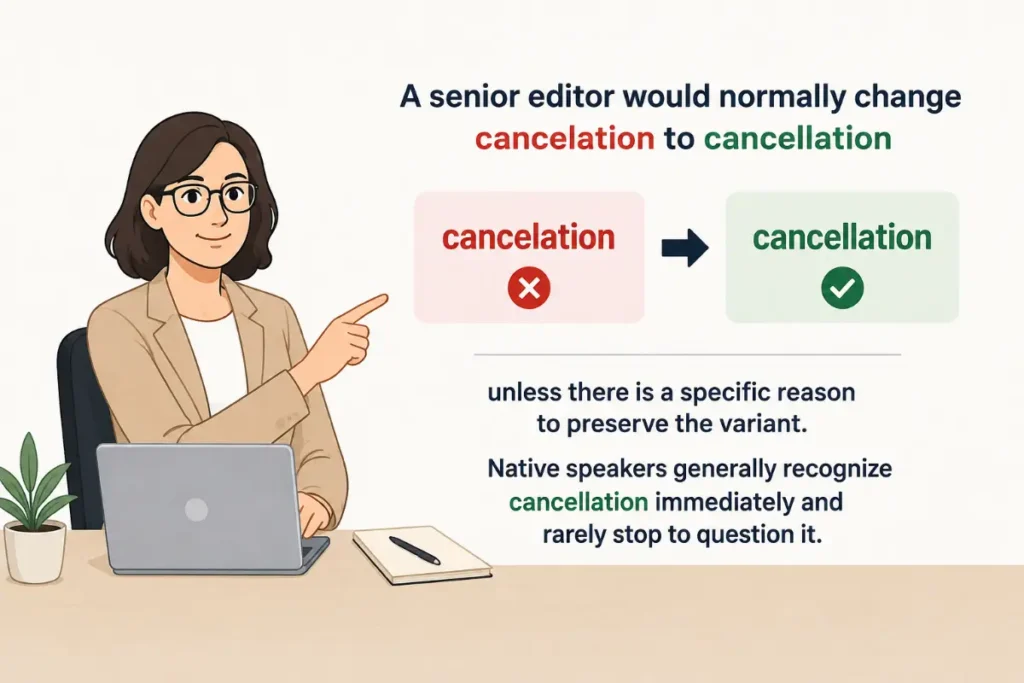
A senior editor would normally change cancelation to cancellation unless there is a specific reason to preserve the variant. Native speakers generally recognize cancellation immediately and rarely stop to question it. Spell checking software may flag the shorter version, although software dictionaries vary. The most reliable editorial approach is not to depend entirely on an automated checker. Use established dictionary forms, consistent style guidance, and the spelling your intended audience expects. The extra l is easy to forget, so a useful proofreading trick is to connect the noun visually with cancelled and cancelling.
Expert Tip
When you are unsure, remember the noun as a complete word rather than building it letter by letter from cancel. Think cancellation as one established spelling. This prevents you from accidentally dropping the second l during fast writing.
Conclusion
When choosing cancelation vs cancellation, use cancellation in standard English. It is the established spelling for the act of canceling an event, order, agreement, reservation, service, or other planned arrangement. The shorter cancelation can be found as a variant, but it is uncommon enough that many readers may assume it is simply a spelling mistake.
The confusion is understandable because American English uses canceled and canceling with one l, while British English commonly uses cancelled and cancelling with two. That difference can make the noun seem inconsistent at first glance. Still, cancellation remains the standard noun across American, British, Australian, and Canadian English.
For practical writing, remember one simple rule: write cancellation. If you are proofreading quickly, check the middle of the word and make sure the second l has not disappeared. That small habit can prevent an otherwise polished sentence from looking careless.
FAQs
Is cancelation a real word?
Cancelation is a real variant spelling found in English, but it is uncommon compared with cancellation. It does not normally have a different meaning. In standard edited English, cancellation is the safer and more widely accepted choice. If you are writing for a professional, academic, or general audience, using cancellation will prevent readers from mistaking the shorter form for a spelling error.
What does cancellation mean?
Cancellation means the act of stopping something that was planned, arranged, ordered, scheduled, or previously agreed upon. It can describe an event, flight, reservation, subscription, appointment, contract, service, or order. For example, the cancellation of a flight means that the scheduled flight will no longer take place. The word can also describe the formal process of ending an arrangement.
cancelation vs cancellation which is correct?
Cancellation is the standard spelling and the form most writers should use. Cancelation is an uncommon variant and may appear in some dictionaries or sources, but it is far less familiar to most readers. For business writing, academic work, websites, journalism, and everyday communication, cancellation is the clearest choice because it matches established modern usage.
How do you pronounce cancellation?
Cancellation is commonly pronounced /ˌkæn.səˈleɪ.ʃən/. You can think of it as kan suh LAY shun. The main stress falls on the syllable containing the long a sound in lay. The double l in the spelling does not mean you pronounce two separate l sounds. English spelling often contains letters that do not correspond directly to separate sounds.
Can cancellation start a sentence?
Yes. Cancellation can appear naturally at the beginning of a sentence because it is a noun. For example, Cancellation of the event was announced early this morning is grammatically correct. When the noun begins a sentence, capitalize its first letter as you normally would. The word does not require a special punctuation mark simply because it appears first.
What is a synonym of cancellation?
The best synonym depends on the context. Possible alternatives include termination, withdrawal, abandonment, revocation, annulment, and calling off. These words are not always exact substitutes. For example, termination often suggests formally ending an agreement, while calling off is more conversational. Cancellation is the broadest everyday term for stopping something that had been planned or arranged.
Why do people misspell cancellation?
People often misspell cancellation because the base verb cancel has one l in common American spellings such as canceled and canceling. That makes the shorter noun look logical. The pronunciation also gives no clear clue that an extra l belongs in the written form. Fast typing, visual similarity, and pattern based spelling can reinforce the mistake.
Is cancellation suitable for formal writing?
Yes. Cancellation is fully appropriate in formal writing and is the standard choice in professional, academic, legal, commercial, and editorial contexts. It appears naturally in phrases such as cancellation policy, cancellation notice, cancellation request, and cancellation fee. If your goal is polished standard English, cancellation is preferable to the less common variant because readers recognize it immediately.
