
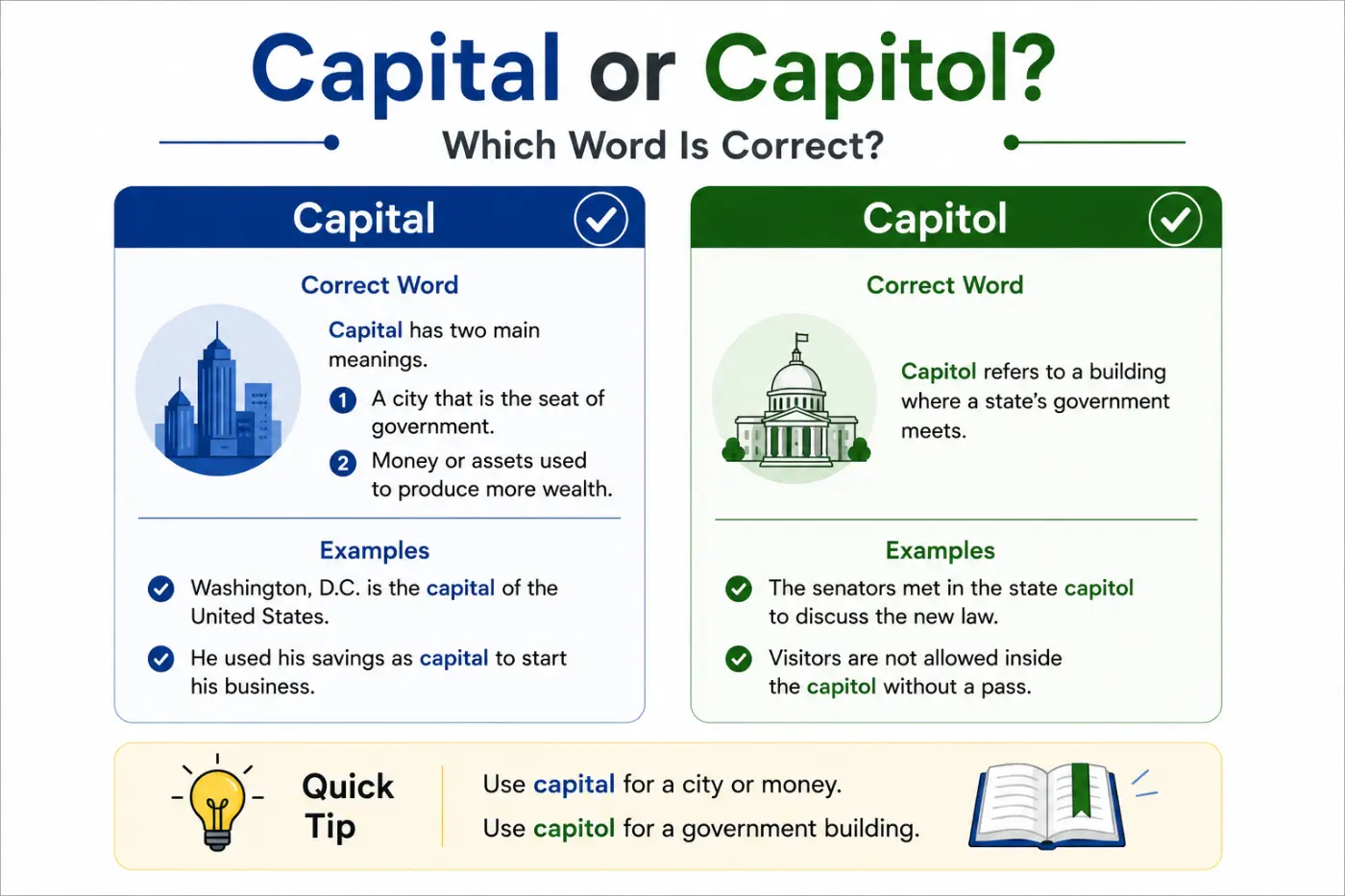
Capital or capitol can look like a simple spelling question, but the two words have completely different jobs. Capital is the much more common word and can refer to a city that serves as a seat of government, money invested in a business, an uppercase letter, or something of major importance. Capitol has a much narrower meaning. In American English, it usually refers to a building where a legislature meets, especially a state capitol or the United States Capitol. If you’re unsure which word belongs in your sentence, the meaning of the sentence gives you the answer.
The confusion comes from more than similar spelling. Both words are connected to government and political language, and they sound nearly identical in ordinary American speech. That makes it easy to type one when you mean the other. The distinction becomes especially useful when writing about government buildings, state governments, cities, economics, education, or business. A single letter can change the meaning of an otherwise correct sentence.
This guide explains the difference in plain English. You’ll learn how each word works, where the words came from, how native speakers use them, how to pronounce them, and which mistakes editors commonly see. You’ll also get practical examples from everyday conversation, emails, academic writing, news, and literature so you can recognize the right form without having to memorize a complicated rule.
Featured Snippet Quick Definition
Capital has several meanings, including a government’s chief city, financial assets, and an uppercase letter. Capitol refers specifically to a building where a legislature meets, especially a state capitol or the United States Capitol. Remember the distinction as city or money for capital and legislative building for capitol.
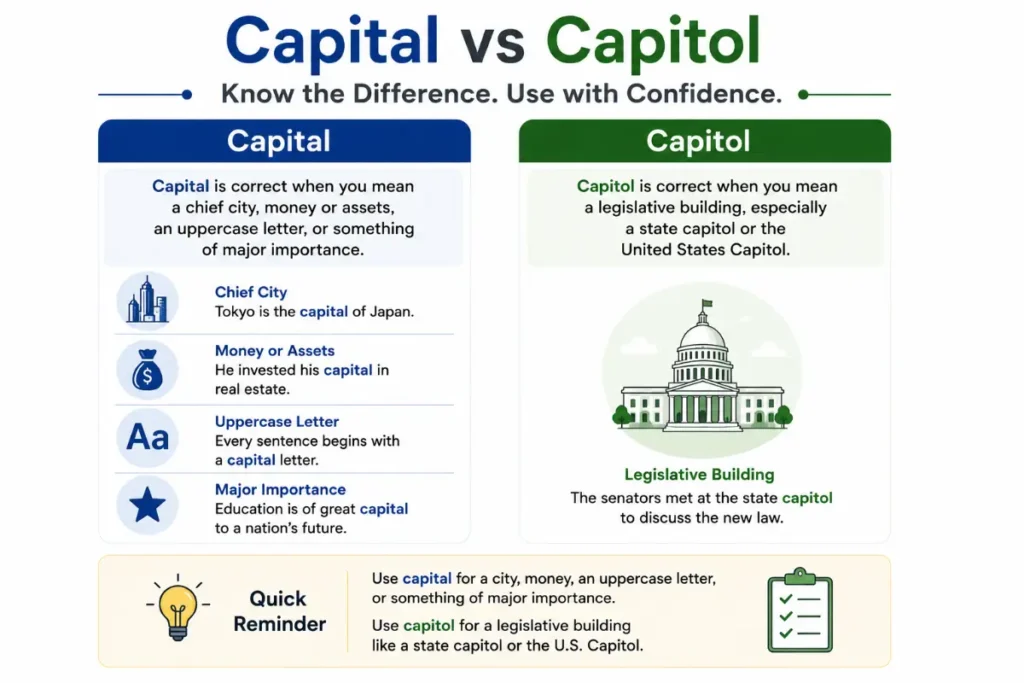
Quick Answer
Capital is correct when you mean a chief city, money or assets, an uppercase letter, or something of major importance. Capitol is correct when you mean a legislative building, especially a state capitol or the United States Capitol. A useful memory trick is simple: capital has many meanings, while capitol is mainly about a government building.
Comparison Table Capital or Capitol
| Correct Form | Meaning | Part of Speech | Origin | Usage Frequency | Formality | Common Contexts | Example |
|---|---|---|---|---|---|---|---|
| Capital | Chief city of a country or state | Noun | Latin capitalis through Old French | Very common | Neutral | Government geography | Sacramento is the capital of California. |
| Capitol | Legislative government building | Noun | Latin Capitolium | Less common | Neutral to formal | Government and politics | The lawmakers returned to the state capitol. |
| Capital | Financial wealth or invested assets | Noun | Latin capitalis | Very common | Neutral to formal | Business and economics | The company needs more capital. |
| Capital | Uppercase letter | Noun or adjective | Latin capitalis | Very common | Neutral | Writing and typography | Begin the sentence with a capital letter. |
| Capital | Major or excellent in importance | Adjective | Latin capitalis | Common | Neutral to formal | General description | That was a capital idea. |
| Capitol | A particular legislative building | Noun | Latin Capitolium | Uncommon | Formal | State and federal government | Visitors toured the Capitol. |
Meaning and Definition
Meaning of Capital
Capital is a highly versatile English word. Its meaning changes according to context, which is one reason learners sometimes hesitate when they encounter it.
In geography and government, it means the city where a national or regional government is based. Washington, D.C. is the capital of the United States. Austin is the capital of Texas. London is the capital of the United Kingdom.
In finance, the word refers to money, wealth, or other assets available for investment or productive use. A business may raise capital to open another location, purchase equipment, hire employees, or develop a new product.
In writing, capital means an uppercase letter. The first letter of a sentence is normally capitalized. Proper nouns also commonly begin with capital letters.
The word can also function as an adjective. In expressions such as “capital importance” or “a capital idea,” it can describe something major, excellent, or highly significant. This sense is less common in everyday American conversation but remains part of standard English.
Meaning of Capitol
Capitol is much more specific. It normally means a building where a legislature meets.
For example, a state legislature may meet in a state capitol. At the federal level in the United States, the United States Capitol is the building in Washington, D.C. where Congress meets.
The narrow meaning is the key to remembering the word. A capitol is a building. A capital is often a city.
The distinction matters because a city and the building containing its legislature are not the same thing. Washington, D.C. is the nation’s capital. The United States Capitol is a specific building located in that capital.
That difference becomes obvious in a sentence such as “The governor traveled to the capital.” The sentence focuses on the city. In “The governor spoke at the capitol,” the sentence focuses on the legislative building.
Key Differences Explained
Spelling
The words differ by one letter. Capital contains an “a” after the first consonant, while capitol contains an “o” in the corresponding position.
The spelling difference is small, but the meanings are not interchangeable.
Grammar Role
Both words function primarily as nouns in their most common uses. Capital has additional grammatical flexibility because it can also function as an adjective.
For example, you can write “capital city,” “capital investment,” and “capital letter.” By contrast, capitol normally identifies a legislative building.
Meaning
The broadest distinction is meaning. Capital can refer to a city, money, an uppercase letter, or something important. Capitol identifies a government building where lawmakers meet.
Tone
Neither word is inherently casual or formal. The context determines the tone. Both appear frequently in professional, governmental, academic, and journalistic writing.
Context
Government context causes the most confusion. If you’re discussing a city that serves as a seat of government, use capital. If you’re discussing the physical legislative building, use capitol.
Which Spelling Is Correct?
Both capital and capitol are correct English spellings. The correct choice depends entirely on meaning.
If you mean a chief city, use capital. If you mean a legislative building, use capitol. This distinction agrees with standard dictionary treatment from major English dictionaries such as Merriam Webster and the Oxford English Dictionary.
An experienced editor would never treat the two forms as interchangeable simply because they sound similar. Context determines the word.
Consider these two sentences.
“Denver is the capital of Colorado.”
“The legislature met inside the Colorado State Capitol.”
The first sentence identifies a city. The second identifies a building. Both spellings are correct because the meanings are different.
Sentence Examples
Examples Using Capital
- Washington, D.C. is the capital of the United States.
- Austin became the capital of Texas in the nineteenth century.
- The company needs additional capital before expanding overseas.
- Always use a capital letter at the beginning of a sentence.
- Paris is the capital of France.
- The investor provided enough capital to launch the business.
- Her name begins with a capital letter.
- The state capital attracts visitors throughout the year.
- The company has enough capital to purchase new equipment.
- The capital city has grown rapidly over the past decade.
Examples Showing the Misspelling Finaly
- Incorrect: “The legislature will meet finaly tomorrow.” Correct: “The legislature will meet finally tomorrow.”
- Incorrect: “She finaly understood the difference.” Correct: “She finally understood the difference.”
- Incorrect: “They finaly reached an agreement.” Correct: “They finally reached an agreement.”
- Incorrect: “He finaly finished the report.” Correct: “He finally finished the report.”
- Incorrect: “We finaly arrived at the station.” Correct: “We finally arrived at the station.”
The second set illustrates a different spelling issue from the main topic. Finaly is not the correct standard spelling of finally. It is a common typing and spelling error caused by dropping one of the repeated letters.
Common Mistakes and Misspellings
Confusing the City With the Building
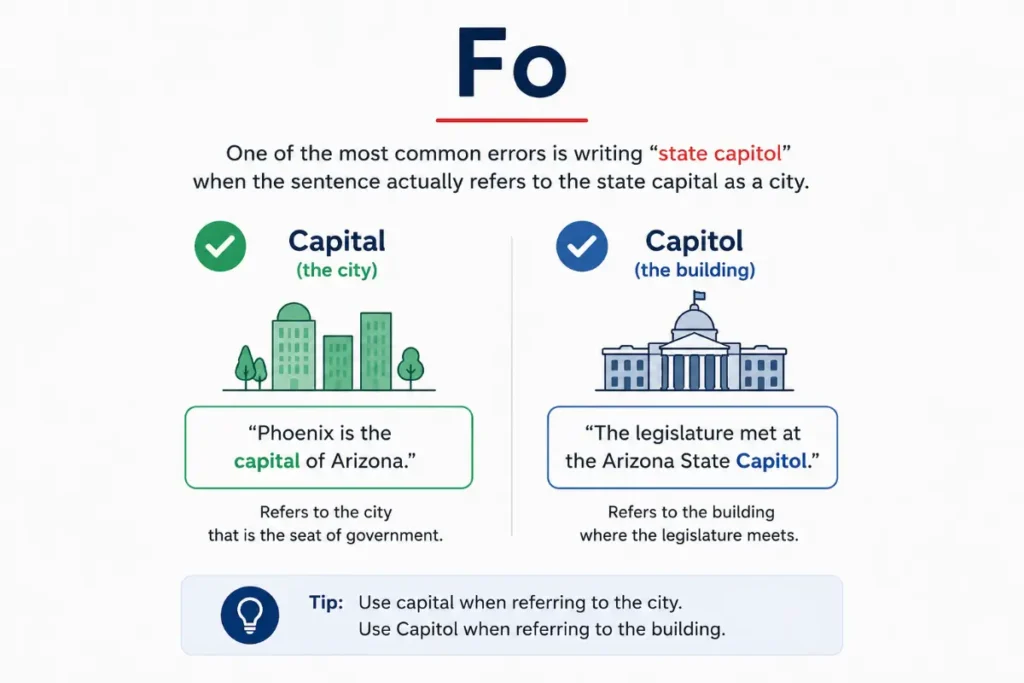
One of the most common error is writing “state capitol” when the sentence actually refers to the state capital as a city.
“Phoenix is the capital of Arizona” is correct.
“The legislature met at the Arizona State Capitol” is also correct.
The first sentence names a city. The second names a building.
Using Capitol for Financial Meaning
A sentence such as “The company needs more capitol” is incorrect when the writer means money or financial resources.
The correct sentence is “The company needs more capital.”
Using Capital for a Legislative Building
“The senator entered the state capital” can mean the senator entered the city. If you specifically mean the government building, “The senator entered the state capitol” is more precise.
Forgetting the Federal Distinction
The United States has a capital city and a Capitol building. Washington, D.C. is the capital. The United States Capitol is the building where Congress meets.
That distinction is worth remembering because it gives you a concrete example of both words working side by side.
Relying Only on Sound
In many American accents, the two words are pronounced very similarly. That makes sound alone a poor way to distinguish them.
When proofreading, ask what the word means rather than how it sounds.
Pronunciation Guide
In standard American English, capital is commonly pronounced /ˈkæpɪtəl/.
A simple syllable breakdown is CAP ih təl.
Capitol is also commonly pronounced /ˈkæpɪtəl/.
That near identical pronunciation explains much of the confusion. Native speakers normally understand the intended word from context.
A useful audio style spelling for both is CAP ih təl. The final syllable is unstressed.
The biggest pronunciation mistake isn’t usually saying one word incorrectly. It is assuming that identical or nearly identical pronunciation means the words have the same meaning.
English contains many homophones and near homophones that require context. These two words are a good example of why spelling still matters even when speech does not clearly reveal the difference.
Etymology and Word Origin
The histories of the two words help explain why they look so similar.
Capital ultimately traces back to the Latin word capitalis, meaning something related to the head. The Latin noun caput meant “head.” The connection makes sense because the head is metaphorically the top or chief part of something.
From this root developed meanings connected with prominence, importance, and the chief city of a government. The word passed through French before becoming established in English.
The financial sense developed through the idea of principal wealth or the main amount of money involved in an enterprise. The uppercase letter sense also connects to the idea of something being at the head or beginning. A capital letter historically had a prominent position in writing.
Capitol has a different historical path. It comes from Latin Capitolium, the name of the Capitoline Hill and the Temple of Jupiter Optimus Maximus in ancient Rome.
The English word later became associated specifically with legislative buildings. In American English, the spelling became strongly connected with government buildings, including state capitols and the United States Capitol.
So although the words look almost like twins, their histories aren’t identical. Their similar appearance developed through separate historical paths that eventually produced closely related modern spellings.
Regional Usage in the US
American English makes a particularly clear distinction between the two terms.
Capital is used for the chief city of a state or nation. For example, “Albany is the capital of New York.”
Capitol is used for a legislative building. American states commonly have a state capitol, and the federal legislature meets in the United States Capitol.
This distinction is standard in American government, journalism, education, and everyday writing.
Regional Usage in the UK
British English uses capital for the chief city of a country. London is the capital of the United Kingdom.
The word capitol is far less prominent in ordinary British usage because the American governmental sense is not as central to British political terminology. Britain has Parliament rather than a building commonly referred to as a capitol in the American sense.
The spelling capital remains fully standard in British English for meanings involving cities, money, uppercase letters, and importance.
Regional Usage in Australia
Australian English follows the broader English distinction. Capital refers to a capital city, such as Canberra, and also carries its financial and writing related meanings.
Capitol is uncommon in ordinary Australian usage. It may appear when discussing American politics, American history, or a specific building whose official name uses that spelling.
There isn’t a general Australian variant that replaces capital with capitol for capital cities.
Regional Usage in Canada
Canadian English also uses capital for a chief city. Ottawa is the capital of Canada.
The word capitol is not normally used as a general replacement for capital. It can appear in references to American institutions or particular names that officially use the word.
Canadian writers should therefore follow the same practical distinction: use capital for the city and capitol for the legislative building when that specific meaning applies.
Grammar Rules and Part of Speech
Capital is primarily a noun in the meanings discussed here.
As a noun, it can identify a chief city.
“Rome is the capital of Italy.”
It can also identify financial resources.
“The business raised enough capital.”
It can identify an uppercase letter.
“Use a capital at the beginning of the proper noun.”
As an adjective, capital can describe something involving capital, such as “capital investment,” or something important in older or more formal usage.
Capitol is normally a noun. It identifies a legislative building.
“The governor visited the capitol.”
The word does not normally function as an adjective in ordinary modern English.
Placement in Sentences
There is no unusual punctuation rule attached to either word. Use the spelling that matches the intended meaning and punctuate the sentence according to normal English grammar.
Capitalization itself can change according to proper name conventions.
For example, “state capitol” may be lowercase when used generically, while an official name such as “Texas State Capitol” uses capitalization because it identifies a particular building.
Likewise, “capital” is normally lowercase when referring generally to a capital city. Official names and titles can require capitalization based on the specific name.
Real Life Usage Examples
Daily Talk
“What’s the capital of California?”
“The capitol is open for visitors today.”
These sentences show the city versus building distinction in a natural conversation.
“Our team will travel to the state capital next month.”
“The meeting will take place near the state capitol.”
The first sentence describes a destination city. The second points toward a specific government building.
Academic Writing
“The capital became an important center of political activity.”
“The study examines the architectural history of the state capitol.”
Academic writers need the distinction because precise terminology strengthens credibility.
News Writing
“Officials gathered in the capital to discuss the proposed legislation.”
“Lawmakers later returned to the capitol for the afternoon session.”
News reporting often uses both words in the same story because journalists may discuss both the city and the legislative building.
Literature
“The travelers finally reached the capital after weeks on the road.”
“The crowd gathered outside the capitol.”
Literary writers can use the distinction to establish location, atmosphere, and political setting.

Expert Editor Insight
A senior editor usually solves this problem by looking at the noun that follows the word and the idea the sentence is expressing. If the writer means a city, money, an uppercase letter, or something important, capital is usually the answer. If the writer means a legislative building, capitol is the specialized term. Spellcheckers can catch some errors, but they may not catch a contextual mistake because both forms are legitimate English words. Grammar tools face the same limitation. Human meaning still matters.
Expert Tip
When you’re proofreading government related writing, replace the two words mentally with city and building. If “city” makes sense, choose capital. If “building” makes sense, choose capitol. This quick substitution test is often faster and more reliable than trying to remember a spelling rule.
Conclusion
Capital or capitol is not a choice between a correct word and an incorrect word. Both spellings are legitimate, but they identify different things. Capital is the broader word and can describe a chief city, financial resources, an uppercase letter, or something important. Capitol has a much narrower meaning and normally refers to a legislative building. That city versus building distinction is the most useful rule to remember.
The confusion is understandable because the two words are pronounced almost identically in common American English. Their similar appearance also makes proofreading by sight surprisingly easy to get wrong. Still, the context usually provides the answer. If you’re talking about where a government is based, think capital. If you’re talking about the physical building where legislators meet, think capitol.
The practical tip is simple: replace the word mentally with city or building. If you mean the city, use capital. If you mean the legislative building, use capitol. Once you connect each spelling with its core meaning, the distinction becomes easy to recognize and much harder to forget.
FAQs
What is the difference between capital and capitol?
Capital has several meanings. It can refer to a city that serves as the seat of government, money used for investment, or an uppercase letter. Capitol specifically refers to a building where a legislature meets. For example, Washington, D.C. is the national capital, while the United States Capitol is the legislative building.
Is capital or capitol correct for a city?
Use capital when referring to a city that serves as the official seat of government. For example, “Austin is the capital of Texas.” Capitol is not correct for the city itself. It refers to the legislative building located in the capital.
Is capital or capitol correct for a government building?
Use capitol when you mean a building where lawmakers meet. For example, “The governor spoke at the state capitol.” You can also use Capitol as part of an official name, such as the United States Capitol. The word capital refers to the city rather than the legislative building.
Why are capital and capitol confused?
The two words are easy to confuse because they look almost identical and are pronounced nearly the same in American English. Government discussions often use both words, which adds to the confusion. Remember the basic distinction: capital can mean a government city, while capitol means a legislative building.
Is the capital the same as the capitol?
No. A capital is generally a city, while a capitol is a specific government building. Washington, D.C. is the capital of the United States. The United States Capitol is a building within Washington, D.C. Keeping city and building separate makes the distinction easy.
Does capital have meanings besides a government city?
Yes. Capital has several common meanings. It can mean financial assets used by a person or organization, an uppercase letter, or something of major importance. For example, “The company needs more capital” refers to money, while “Start the name with a capital letter” refers to an uppercase letter.
Is capitol always related to government?
In its standard modern use, capitol is strongly associated with government and legislation. It usually identifies a building where lawmakers meet. The term is especially common in the United States, where states have capitol buildings and the federal legislature meets at the United States Capitol.
How can I easily remember capital and capitol?
Use the simple city versus building test. If you’re talking about a city that serves as a seat of government, choose capital. If you’re talking about the building where legislators meet, choose capitol. Think of Washington, D.C. as the capital and the United States Capitol as the building.
