
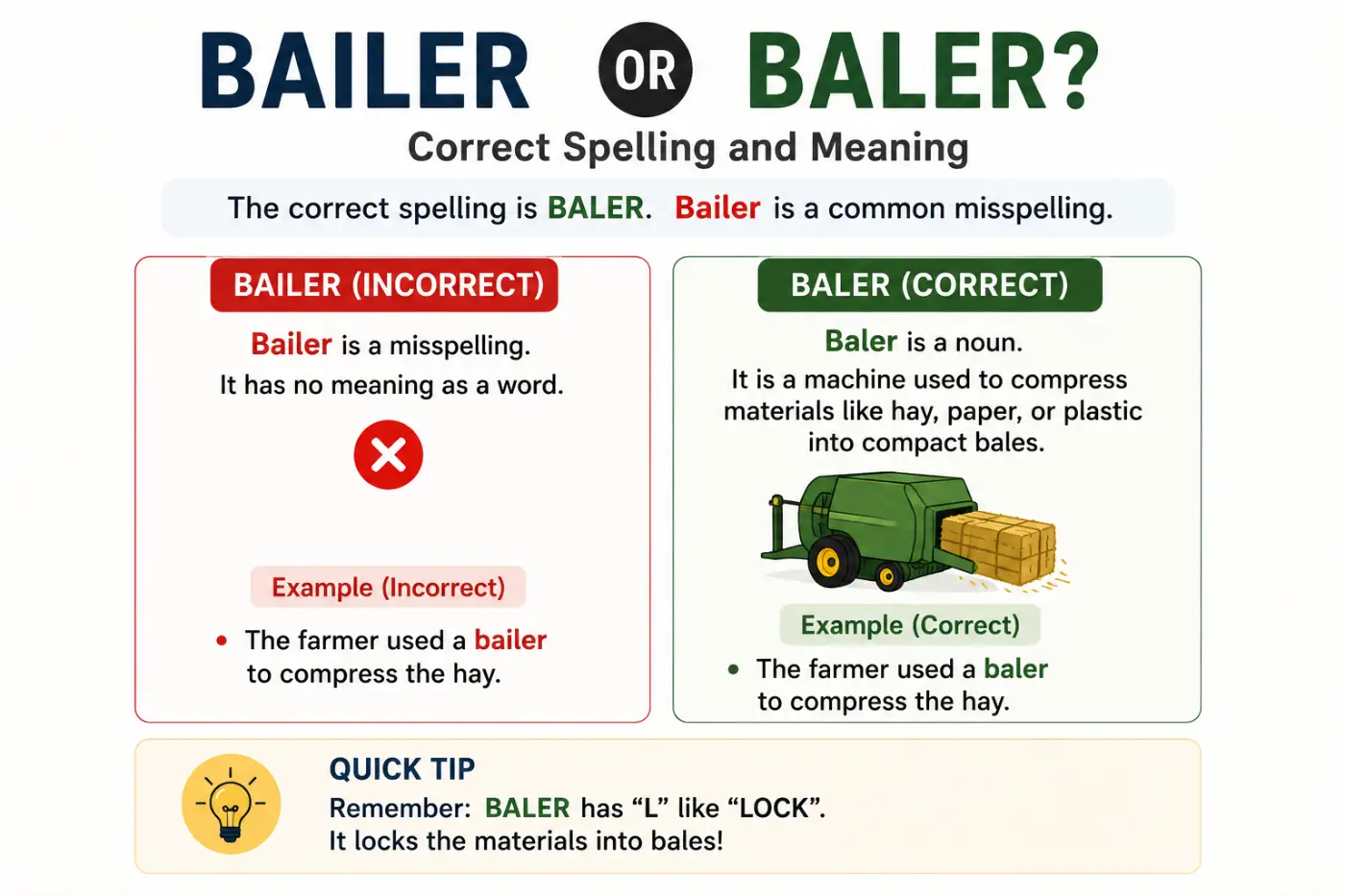
The phrase bailer or baler can stop you in your tracks because both words sound almost exactly the same. Yet they don’t mean the same thing and they aren’t interchangeable. Bailer is connected to removing water while baler usually refers to a person or machine that compresses material into bales.
The confusion comes from pronunciation. When you hear the word spoken aloud you can’t easily tell which spelling the speaker means. That makes it easy to type the wrong form. The spelling becomes much clearer when you connect each word to its base verb. Bailer comes from bail while baler comes from bale.
In this guide you’ll learn the exact difference between these two words including their meanings grammar pronunciation origins and everyday usage. You’ll also see natural examples that show when to use each form. By the end you’ll have a simple rule you can remember whenever these two homophones cause confusion.
Quick Definition
A bailer is a person or tool used for bailing water or removing liquid from a container or space. A baler is a person or machine that gathers and compresses material into bales. Both are correct English words but they describe different actions and objects.
Quick Answer
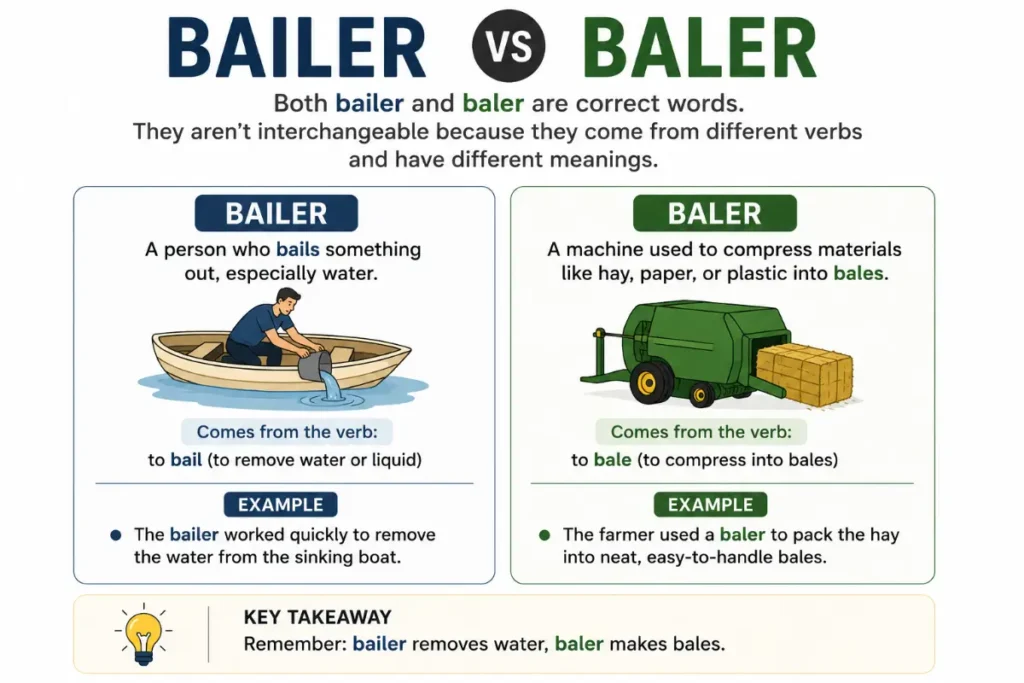
Both bailer and baler are correct words. They aren’t interchangeable because they come from different verbs and have different meanings.
Use bailer for someone or something that bails liquid. Use baler for someone or something that bales material into a compact bundle.
Comparison Table
| Correct Form | Meaning | Part of Speech | Origin | Usage Frequency | Formality | Common Contexts | Example |
|---|---|---|---|---|---|---|---|
| Bailer | A person or device that removes water or liquid | Noun | From bail meaning to remove water | Less common | Standard | Boats wells pumps containers | The sailor used a bailer to remove water. |
| Baler | A person or machine that compresses material into bales | Noun | From bale meaning to bundle or compress | Common in agricultural and industrial contexts | Standard | Farming recycling hay paper | The farmer repaired the hay baler. |
Meaning and Definition
Meaning of Bailer
Bailer is a standard English noun. It usually refers to a person or a tool that removes water or another liquid by bailing.
The word comes from the verb bail. In this sense bail means to scoop or remove water from a boat or another place. A simple bucket can serve as a bailer when it’s used for that purpose.
For example:
- The fisherman grabbed a bailer when water started filling the boat.
- We kept a small bailer beside the canoe.
- The crew used a manual bailer to clear the water.
The word can also describe equipment designed specifically for removing liquid. In boating and some technical settings you may see it used for a scoop or similar device.
There is another word that looks similar and can cause confusion. Bailor is a legal term for a person who temporarily gives possession of property to another person. That word has a different spelling and a different meaning.
So don’t automatically assume that every word connected with bail uses the same spelling pattern.
Meaning of Baler
Baler is also a standard English noun. It usually means a person or machine that makes bales.
The word comes from the verb bale. To bale means to gather material and compress it into a bundle or bale.
You’ll often see the word in agriculture.
A hay baler gathers cut grass or hay and compresses it into a manageable bundle. Farmers can then store transport or sell those bales.
The term also appears in recycling and manufacturing. A recycling facility might use a cardboard baler to compress large amounts of cardboard into dense blocks.
Examples include:
- The hay baler stopped working during harvest.
- The recycling center bought a new cardboard baler.
- The operator checked the baler before starting the machine.
The distinction is simple once you connect each noun to its verb.
Bailer comes from bail.
Baler comes from bale.
That single connection solves most spelling questions.
Key Differences Explained
- Spelling. Bailer contains the letter sequence found in bail. Baler contains the spelling found in bale. The extra letter in bailer isn’t random. It reflects the base word.
- Grammar role. Both words are nouns. Each can describe a person who performs an action or a device designed to perform that action.
- Meaning. A bailer removes liquid. A baler gathers and compresses material.
- Tone. Both forms are standard English. Neither is slang or an informal spelling.
- Context. Bailer commonly appears around boats water and liquid removal. Baler commonly appears around farming recycling paper cardboard and other materials.
- Pronunciation. In most standard varieties of English the two words are pronounced the same way. That makes them homophones.
- Word family. Bailer belongs with bail and bailing. Baler belongs with bale and baling.
The easiest memory trick is to picture the action first. If something is removing water think bail and then bailer. If something is making a bale think bale and then baler.
Which Spelling Is Correct
Both spellings are correct. The right choice depends entirely on the meaning you intend.
If you’re talking about removing water then bailer is the correct form. If you’re talking about compressing material into bales then baler is correct.
This follows a basic English word formation pattern. A noun ending in er often identifies a person or thing that performs the action expressed by the base verb.
Bail becomes bailer.
Bale becomes baler.
Major English dictionaries recognize both words as standard vocabulary. Dictionary definitions from sources such as Merriam Webster and Cambridge Dictionary distinguish the meanings through their connection to the verbs bail and bale.
That dictionary logic matters because spelling alone doesn’t tell the whole story. The pronunciation gives you almost no help here. The meaning and base word do the heavy lifting.
An editor would therefore never correct baler simply because the writer meant a machine used for hay. Likewise, an editor wouldn’t replace bailer with baler in a sentence about removing water from a boat.
Sentence Examples
Here are natural examples that show how the two forms work in real sentences.
- The sailor kept a bailer near the side of the boat.
- We used the bailer to remove water after the storm.
- The small canoe came with a plastic bailer.
- The crew passed the bailer from one person to another.
- He reached for the bailer when the boat began taking on water.
- The farmer purchased a new baler before the harvest season.
- The hay baler can produce hundreds of compact bales each day.
- The mechanic repaired the baler before the afternoon shift.
- The recycling center uses a large baler for cardboard.
- The operator cleaned the baler after finishing the job.
Common Misspelling Examples
The following examples show finaly style spelling errors applied to this word confusion. In standard English writing these forms should be corrected according to the intended meaning.
- The sailor grabbed a baler to remove water from the boat. The intended word is bailer.
- The farmer repaired the bailer before harvesting the hay. The intended word is baler.
- We keep a baler in the canoe for emergencies. The intended word is bailer.
- The recycling center installed a new bailer for cardboard. The intended word is baler.
- The crew used the baler to scoop water from the deck. The intended word is bailer.
These examples show why context matters more than sound.
Common Mistakes and Misspellings
English spelling can trip people up when two words share the same pronunciation. This pair is especially tricky because both spellings look perfectly believable.
- Using baler for water removal. A writer may hear the word and choose baler because the pronunciation doesn’t reveal the spelling. The correct word is bailer when the object removes water.
- Using bailer for agricultural equipment. If you’re talking about hay paper cardboard or another material being compressed into bales then baler is the correct noun.
- Confusing bailer with bailor. Bailor is a legal term connected with bailment. A bailer in ordinary usage is connected with removing liquid.
- Forgetting the base verb. People sometimes try to remember the noun independently. That’s harder than remembering the verb. Connect bailer with bail and baler with bale.
- Relying only on pronunciation. NLP based spelling systems and ordinary spell checkers can sometimes identify a likely error from context. They can’t always understand the writer’s intended meaning. Human context still matters.
From an NLP perspective this is a homophone problem. A speech recognition system may hear one sound while several written forms are possible. The surrounding words provide the semantic clues that separate them.
For example the words boat, water, leak, and scoop strongly suggest bailer. Words such as hay, farm, cardboard, recycling, and compress point toward baler.
That is why context is the best safety net.
Pronunciation Guide
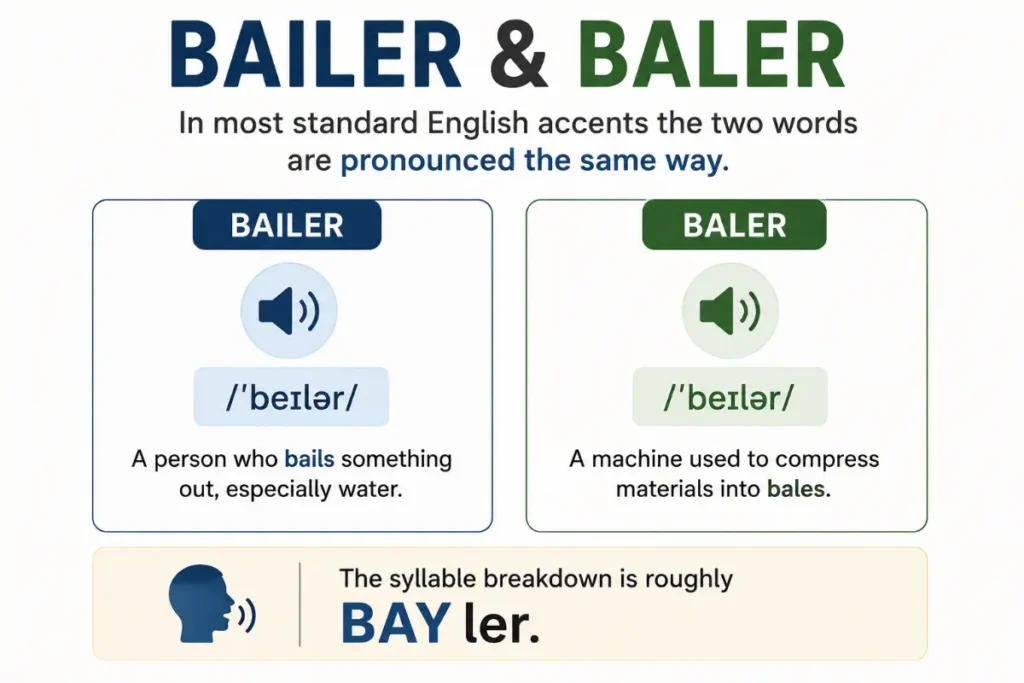
In most standard English accents the two words are pronounced the same way.
Bailer: /ˈbeɪlər/
Baler: /ˈbeɪlər/
The syllable breakdown is roughly BAY ler.
The first part sounds like bay. The second part sounds like ler.
You can think of the audio style as:
BAY ler.
Because the pronunciation is essentially identical in many varieties of English, you can’t reliably choose the spelling by listening to someone say the word.
That explains why this confusion appears so often in writing. Someone may know the word perfectly well when speaking but hesitate when typing it.
There can be minor differences in pronunciation across accents. Still, the two forms are generally homophones for most American English speakers.
If you’re writing for an American audience, focus on the meaning and the base verb rather than trying to hear a spelling difference.
Etymology and Word Origin
The history of these words becomes much easier to understand once you separate their roots.
Bailer comes from bail in the sense of removing water. English uses bail in several unrelated senses. One meaning involves removing water from a boat or container. That sense gave rise to related forms such as bailing and bailer.
The history of bail is connected to older French vocabulary associated with removing or managing water. English has used the verb in nautical contexts for centuries.
Baler comes from bale. A bale is a tightly packed bundle of material. The verb bale developed from the noun and came to mean gathering or compressing something into a bale.
The history of bale reaches back through French and Germanic language history. English inherited related forms referring to a bundle or package.
The two words therefore developed from different vocabulary families.
That distinction survives in modern English even though the words eventually became pronounced alike.
This is a good example of why English spelling often preserves history. Pronunciation changes over time while spelling may retain clues about a word’s origin and relationship to other words.
The extra i in bailer connects the noun to bail.
The spelling of baler connects the noun to bale.
Once you see those word families the difference becomes much easier to remember.
Regional Usage
United States
American English uses both forms. Bailer appears mainly in boating and situations involving removing water. Baler is common in farming manufacturing and recycling. American speakers generally pronounce the two words alike.
United Kingdom
British English also recognizes both forms. The meanings remain distinct even though pronunciation usually doesn’t provide a clear clue. Agricultural equipment is commonly described with baler while a tool used to remove water can be called a bailer.
Australia
Australian English follows the same basic distinction. Farming vocabulary makes baler especially familiar because hay and other agricultural materials are regularly compressed into bales. Bailer remains connected with removing water.
Canada
Canadian English also uses both spellings according to meaning. Baler is common in agricultural and industrial contexts while bailer is used for equipment or people involved in removing water.
No major English speaking region treats one spelling as a general replacement for the other. The difference is semantic rather than regional.
Grammar Rules and Part of Speech
Both words function primarily as nouns.
A bailer can refer to a person who bails or to a tool that performs the action.
For example:
The bailer removed water from the canoe.
A baler can refer to a person who makes bales or more commonly to a machine that compresses material.
For example:
The baler produced a large bundle of hay.
The words can appear as singular or plural nouns.
One bailer was stored on the boat.
Several bailers were available.
The farm owns one baler.
The farm owns two balers.
The grammar is straightforward. The main challenge is choosing the noun that matches the intended action.
Punctuation doesn’t change the spelling. You don’t add an apostrophe simply because the word ends in er. Possessive forms follow ordinary noun rules.
For example:
The baler’s engine needed repair.
The bailer’s handle broke.
The placement of either noun in a sentence depends on normal noun grammar. It can serve as a subject object or complement.
The bailer was missing.
We found the bailer.
That machine is a baler.
Real Life Usage Examples
Daily Talk
- The boat is taking on water. Grab the bailer. This is a natural situation where the water removal meaning is clear.
- The farmer says the baler is ready. Here the agricultural context immediately points to the machine that makes bales.
- Please leave the bailer in the boat before we head out tomorrow.
- The new baler should arrive before the next harvest.
Both examples show how context makes the intended word obvious.
Academic Writing
- The study examined the efficiency of a mechanical baler used in agricultural production.
- The researchers recorded the amount of water removed by the manual bailer.
Academic writing benefits from precise vocabulary. Choosing the wrong word can change the meaning of a technical statement.
News Writing
- The fishing crew used a bailer to remove water after the vessel began to leak.
- The farm invested in a high capacity baler ahead of the harvest.
News writers need words that communicate a specific action without forcing readers to guess.
Literature
- He reached for the bailer as the rainwater gathered beneath his feet.
- Beyond the barn stood the old baler that had served the farm for decades.
Literary writing can use either term naturally when the surrounding scene establishes the meaning.
Related and Confused Terms
Several words overlap with the ideas behind these terms. Knowing them can make the distinction even clearer.
- At last. This phrase means something happens after a long wait. It doesn’t describe either water removal or material compression.
- Eventually. This means something happens after some time or after a series of events. It isn’t a synonym for either noun.
- Ultimately. This refers to a final result or conclusion. It belongs to a different semantic field.
- At the end. This phrase points to the final part of a period place event or process.
- Conclusively. This means in a way that settles a matter or establishes something firmly.
- In the end. This commonly introduces the final outcome of a situation.
- Lastly. This usually introduces the final item in a sequence.
- Bailor. This is the closest visual confusion because it resembles bailer. In law a bailor is a person who transfers possession of personal property to another person under a bailment arrangement.
These terms demonstrate an important point. Similar looking words don’t necessarily belong to the same meaning group. English spelling often creates traps that only context can resolve.
Expert Editor Insight
As a senior editor would tell you, don’t try to solve this pair by sound. Solve it by identifying the base verb first. Ask yourself one simple question: Is the subject connected to bail or bale? If the action involves removing water then choose bailer. If it involves compressing material into a bale then choose baler. This method is more reliable than memorizing the spellings separately because it gives you a repeatable rule you can use in new sentences.
A useful editing habit is to read the entire sentence before correcting a suspected spelling mistake. Spell checkers can flag unusual words but context remains essential for homophones. A word can be perfectly spelled and still be wrong for the sentence.
Expert Tip
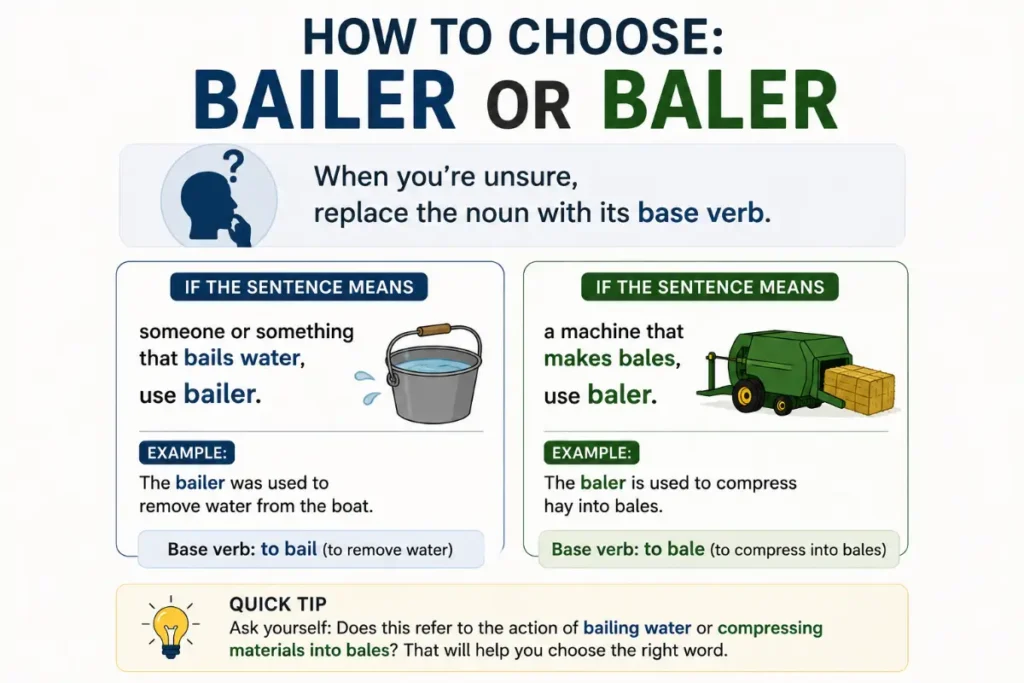
When you’re unsure, replace the noun with its base verb.
If the sentence means someone or something that bails water, use bailer.
If the sentence means someone or something that bales material, use baler.
This quick test takes only a second and works better than relying on pronunciation.
Conclusion
Bailer or baler isn’t a choice between a correct spelling and a misspelling. Both are legitimate English words. Bailer connects to bail and usually refers to a person or tool that removes water. Baler connects to bale and usually refers to a person or machine that compresses material into bales.
The confusion comes mainly from pronunciation. In most English accents the two words sound the same even though their meanings and spellings differ. That makes them homophones and explains why writers sometimes choose the wrong form.
The easiest way to remember the difference is to go back to the verb. Water gets bailed so the tool is a bailer. Hay cardboard or another material gets baled so the machine is a baler. Think about the action first and the spelling will usually fall into place.
FAQs
Is Bailer Or Baler Correct?
Both bailer and baler are correct words, but they have different meanings. Bailer refers to a person or tool that removes water or liquid, while baler usually refers to a machine that compresses materials such as hay, paper, or plastic into bales.
What Is The Difference Between Bailer And Baler?
The main difference is their meaning. Bailer comes from the verb bail, meaning to remove water or liquid. Baler comes from the verb bale, meaning to compress material into a bale.
What Does Bailer Mean?
Bailer is a noun for someone or something that bails. It commonly refers to a person or container used to remove water from a boat or another area.
What Does Baler Mean?
Baler is a noun that usually refers to a machine used to compress materials into compact bales. Farmers commonly use balers to package hay or straw.
Are Bailer And Baler Pronounced The Same?
Yes. In most standard English accents, bailer and baler are pronounced the same way: /ˈbeɪlər/. The pronunciation is roughly BAY ler.
How Can I Remember The Difference Between Bailer And Baler?
Think about the base verbs. Bailer comes from bail, so it is connected with removing water. Baler comes from bale, so it is connected with making or compressing bales.
Is A Bailer Used To Remove Water?
Yes. A bailer can be a person or a tool used to remove water or another liquid. For example, a small container can serve as a bailer for removing water from a boat.
Is A Baler Used To Make Hay Bales?
Yes. A baler is commonly used to compress hay, straw, or similar agricultural materials into compact bales that are easier to handle and store.
Can Bailer And Baler Be Used Interchangeably?
No. Although they sound the same, their meanings are different. Use bailer for something connected with bailing and baler for something connected with bal ing material into bales.
Which Spelling Should I Use For A Hay Machine?
Use baler. For example: The farmer used a baler to make hay bales. The spelling bailer would not be correct for this meaning.
Which Word Means Someone Who Removes Water?
Bailer is the appropriate word when referring to someone or something that removes water or liquid. It comes from the verb bail.
Are Bailer And Baler Homophones?
Yes. Bailer and baler are homophones in most standard English accents because they have the same pronunciation but different spellings and meanings.
