
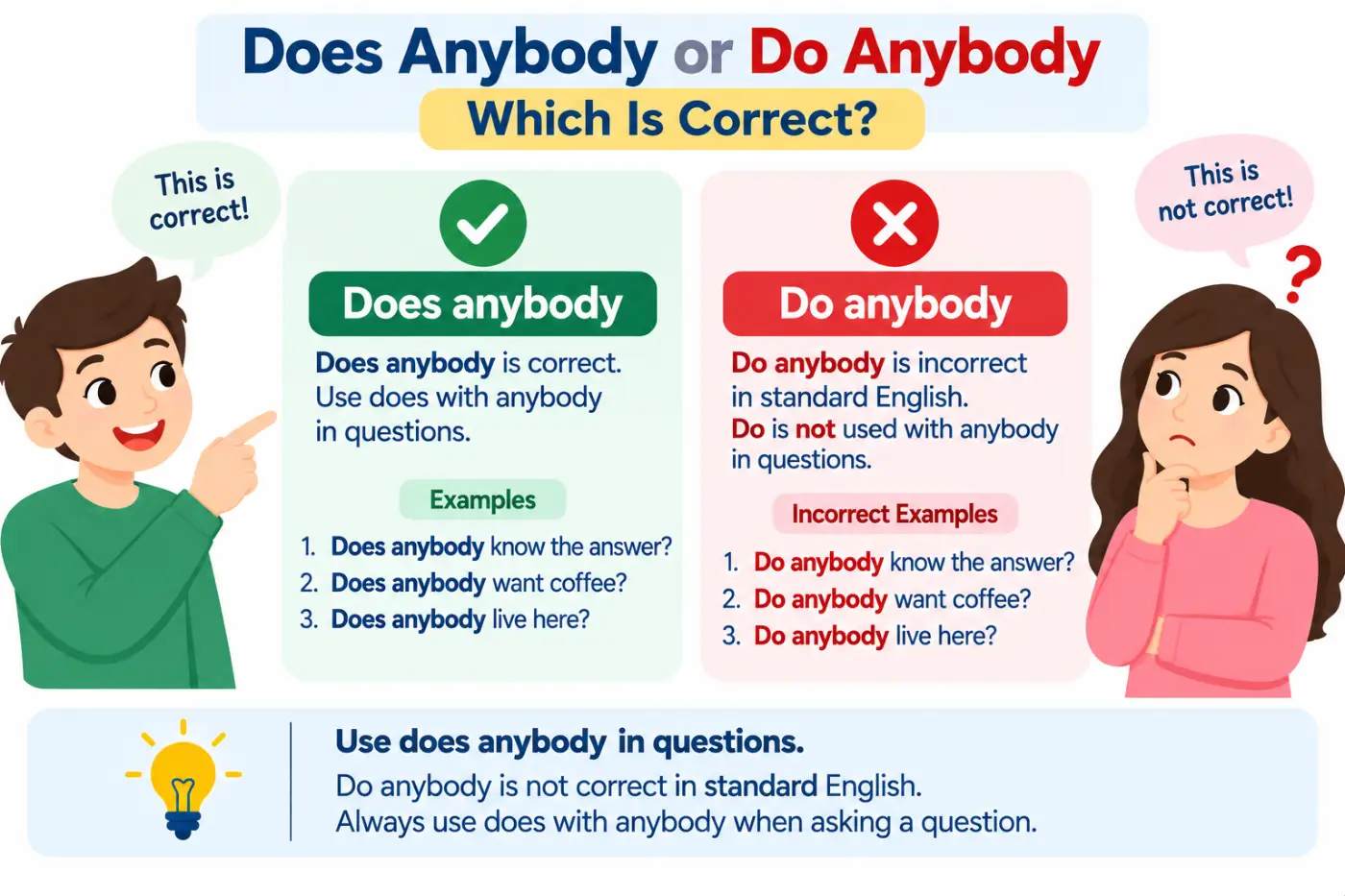
does anybody or do anybody can be confusing because anybody refers to people while the verb may seem like it should follow the idea of more than one person. In standard English the correct form is does anybody. The reason is simple: anybody is treated as a singular indefinite pronoun when it controls the verb in a sentence.
This can feel strange at first. The word anybody can refer to any number of people but grammar treats the pronoun itself as singular. That same rule applies to words such as somebody anyone everyone and no one. So we say Does anybody know the answer? rather than Do anybody know the answer?
The good news is that you don’t need to memorize a long grammar rule. Once you understand how indefinite pronouns work the pattern becomes predictable. This guide explains the grammar behind the choice and shows how native speakers use the expression in everyday questions workplace communication school writing and more formal English. You’ll also learn about pronunciation sentence structure related pronouns common mistakes and a quick editing trick that can help you catch the error before you send or publish your writing.
Quick Definition
Does anybody is the standard form in English because anybody is a singular indefinite pronoun. Use does with it in present simple questions and statements that require the auxiliary verb. For example: Does anybody know where my keys are? The form do anybody is nonstandard when anybody is the subject of the question.
Quick Answer
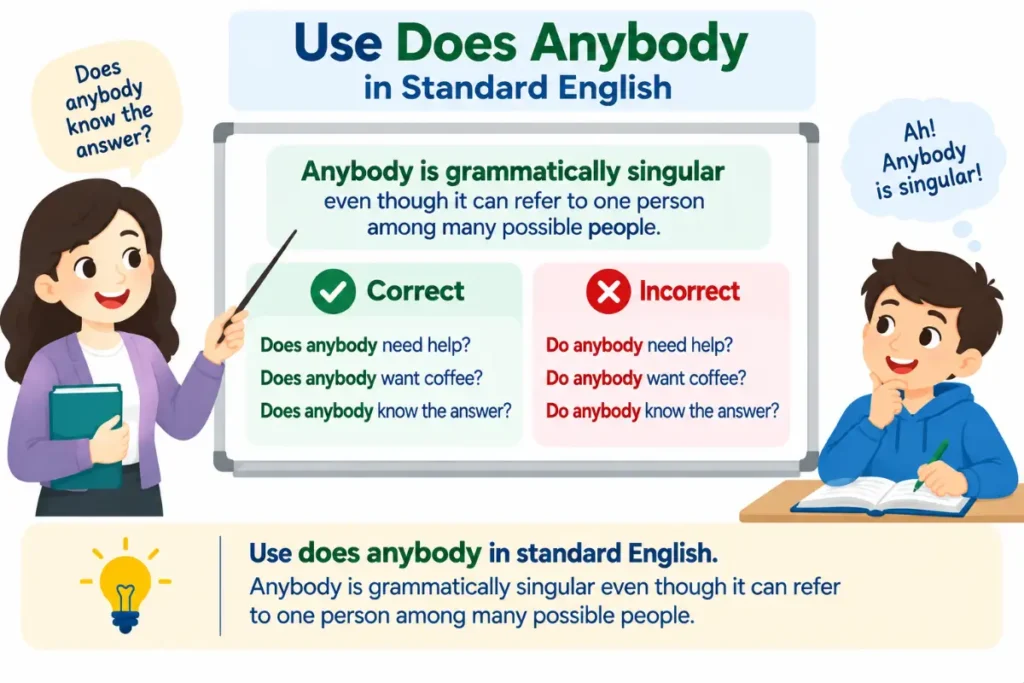
Use does anybody in standard English. Anybody is grammatically singular even though it can refer to one person among many possible people.
For example: Does anybody know the answer? The verb does agrees with anybody. You would use do with a plural subject such as Do the students know the answer?
Comparison Table
| Form | Meaning | Part of Speech | Grammar Role | Standard Usage | Formality | Common Contexts | Example |
|---|---|---|---|---|---|---|---|
| Does anybody | Asks if any person has done or knows something | Does is an auxiliary verb and anybody is a pronoun | Singular subject with present simple auxiliary | Standard | Neutral and formal | Conversation questions emails school work general writing | Does anybody know the answer? |
| Do anybody | Intended to ask if any person does something | Do is an auxiliary verb and anybody is a pronoun | Verb does not agree with the singular pronoun | Nonstandard in edited English | Informal or incorrect | Speech errors typing mistakes learner errors | Do anybody know the answer? |
Meaning and Definition
Meaning of Anybody
Anybody is an indefinite pronoun. It refers to any person without identifying a particular person.
Consider this question:
Does anybody need help?
The speaker isn’t asking about one named individual. The question is open to all people in the group. Any one person could answer.
Although anybody can point to many possible people, English grammar treats the pronoun as singular. That’s the key idea behind the verb choice.
You can see the same pattern in these sentences:
Anybody can learn this skill.
Anybody knows that isn’t true.
The first two sentences show the singular grammatical behavior clearly. We use can and is rather than forms that would normally go with a plural subject.
The word anybody is closely related to anyone. In most situations the two words have nearly the same meaning.
Does anyone know the answer?
Does anybody know the answer?
Both are standard English.
Meaning of Does
Does is the third person singular present form of the verb do when it works as an auxiliary verb or main verb.
As an auxiliary it helps form questions and negative statements.
Does she work here?
Does anybody remember the meeting?
He doesn’t understand the problem.
In these examples does doesn’t carry the main meaning by itself. Instead it helps build the present simple structure.
When does acts as the main verb it means performs carries out or has a particular effect depending on the context.
She does her homework every evening.
This does nothing to solve the problem.
For the question being discussed here the auxiliary use is the important one.
Why The Verb Is Singular
The central grammar rule is subject verb agreement.
In the present simple, third person singular subjects use does in questions and doesn’t in negative constructions.
Plural subjects use do.
Compare these pairs:
Does anybody want coffee?
Do the guests want coffee?
Does anyone live here?
Do the neighbors live here?
Does somebody know his name?
Do the students know his name?
The meaning may involve several people, but the grammatical subject controls the verb form.
This is one of those English rules that can seem counterintuitive until you separate meaning from grammar. Anybody has a broad reference. It doesn’t mean that the grammatical subject suddenly becomes plural.
Think of anybody as meaning any single person from a possible group.
That mental picture makes the agreement easier to understand.
Key Differences Explained
- Subject agreement
Anybody is grammatically singular. Therefore standard present simple questions use does.
- Meaning
Both forms are usually intended to ask if any person can perform an action or provide information. The difference lies in grammar rather than intended meaning.
- Verb form
Does is used with third person singular subjects. Do is used with I you we they and plural noun subjects.
- Sentence structure
After does the main verb stays in its base form.
Does anybody know?
Not:
Does anybody knows?
- Standard usage
Does anybody is the accepted form in standard edited English. Do anybody is generally treated as a subject verb agreement error.
- Pronunciation
The difference between does and do is easy to hear in careful speech. Does usually sounds like duhz while do sounds like doo.
- Formality
Does anybody works naturally in casual speech professional communication academic writing and formal prose.
- Regional usage
The standard rule remains the same across major varieties of English. Informal speech can contain nonstandard agreement but that doesn’t make the alternative standard.
Which Form Is Correct
Does anybody is the correct form when anybody is the subject of a present simple question.
The grammatical reason is that anybody belongs to a group of indefinite pronouns that take singular agreement. This includes anybody anyone somebody someone everybody everyone nobody and no one.
You can test the pattern by replacing anybody with any one person.
Does any one person know the answer?
That sounds more explicit but it reveals the underlying grammatical idea. The subject refers to a person considered individually.
English dictionaries generally classify anybody as a pronoun and describe it as referring to any person. Standard grammar treats this pronoun as singular for subject verb agreement.
A useful comparison is everyone.
Does everyone understand?
You wouldn’t normally write:
Do everyone understand?
The same logic applies to anybody.
There is one more detail worth remembering. The choice changes when anybody is not the subject.
For example:
Do you know anybody here?
Here the subject is you. Anybody is the object of the verb know. Because you takes do in the present simple question the sentence correctly uses do.
This distinction is extremely useful. Don’t simply look for the word anybody. First identify its grammatical role.
Sentence Examples
Here are natural examples using the standard construction.
- Does anybody know where the meeting is?
- Does anybody want the last piece of pizza?
- Does anybody have a question before we continue?
- Does anybody remember what time the store closes?
- Does anybody live in that house?
- Does anybody need a ride home?
- Does anybody know how to fix this printer?
- Does anybody have experience with this software?
- Does anybody understand what the teacher means?
- Does anybody know why the flight was delayed?
Now compare those sentences with situations where do is correct because another word is the subject.
Do you know anybody in this class?
Do the new employees know anybody on the team?
In these sentences anybody is not controlling the verb. The subjects are you they and the new employees.
That distinction prevents a surprisingly common mistake.
Common Mistakes
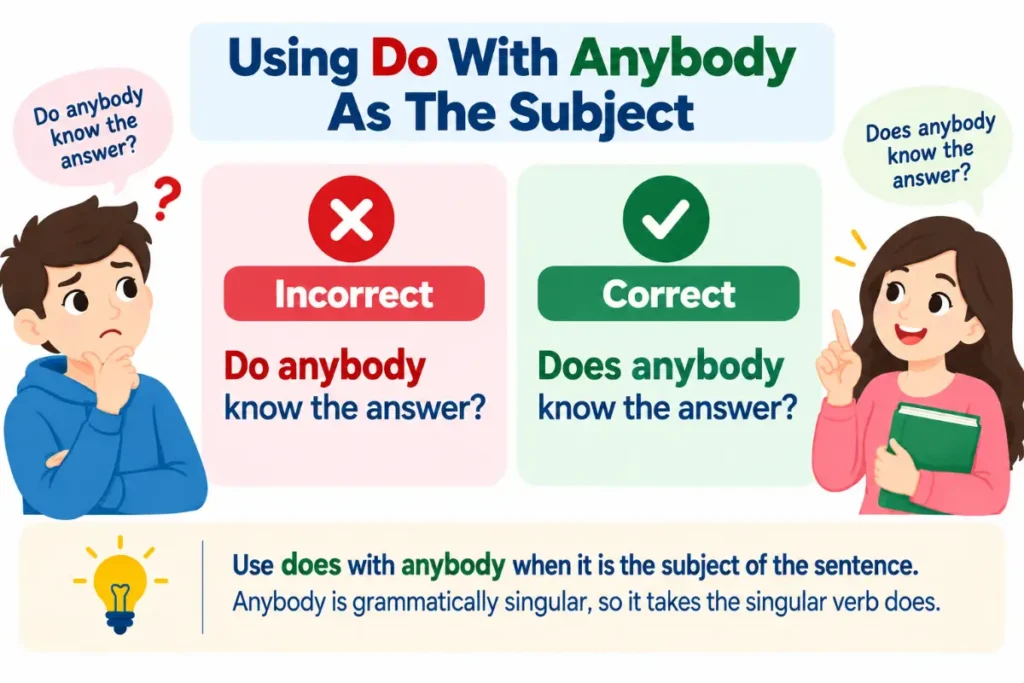
Using Do With Anybody As The Subject
Incorrect:
Do anybody know the answer?
Correct:
Does anybody know the answer?
The mistake happens because people may focus on the possibility that many people could answer. Grammar doesn’t work from that idea. Anybody remains singular.
Adding S To The Main Verb
Incorrect:
Does anybody knows the answer?
Correct:
Does anybody know the answer?
Once does carries the present tense marking the main verb returns to its base form.
The same pattern appears everywhere.
Does she work here?
Not:
Does she works here?
Confusing Anybody With They
Some speakers use singular they after anybody and similar pronouns.
Does anybody know what they should bring?
This is perfectly normal. The pronoun they refers back to an unspecified person while does agrees with anybody.
The two grammatical choices operate separately.
Assuming A Broad Meaning Requires A Plural Verb
This is the biggest conceptual trap.
Anybody can refer to any member of a group but the pronoun itself remains grammatically singular.
Compare:
Anybody can join.
with:
People can join.
Anybody takes singular agreement. People takes plural agreement.
Changing The Rule In Formal Writing
Some writers may see nonstandard forms in casual online communication and assume the grammar rule has changed.
Informal speech can be flexible and speakers sometimes use nonstandard agreement. Professional and academic writing should follow standard subject verb agreement.
Pronunciation Guide
The word does is commonly pronounced /dʌz/ in American English.
An easy approximation is duhz.
The word do is commonly pronounced /duː/ when it is stressed or pronounced clearly.
An easy approximation is doo.
So the difference sounds roughly like this:
Does anybody?
Duhz anybody?
The main phrase flows naturally in speech and the vowel in does is much shorter than the vowel in do.
A common pronunciation mistake is to pronounce does like doze. That isn’t the usual pronunciation when does functions as the present simple auxiliary.
Another mistake is stressing does too heavily. In ordinary conversation the auxiliary often receives little stress.
For example:
Does anybody know?
A natural speaker usually gives the main information word more emphasis than the auxiliary.
Pronunciation can help reinforce grammar because once you become familiar with the sound pattern you can recognize the standard form more quickly during conversation.
Grammar Rules You Need To Know
The easiest way to master this pattern is to understand the present simple question structure.
The basic pattern is:
Does + singular subject + base verb?
Examples include:
Does she work here?
Does anyone understand?
Anybody follows exactly the same structure.
Does anybody know?
The main verb stays in its base form after does.
That gives us:
Does anybody know?
Not:
Does anybody knows?
For plural subjects the pattern changes:
Do + plural subject + base verb?
For example:
Do the students know?
Do your friends work here?
There is also an important difference between using anybody as the subject and using it as the object.
Anybody As The Subject
Does anybody want coffee?
Anybody is doing the grammatical work of the subject. Therefore the auxiliary is does.
Anybody As The Object
Do you know anybody here?
You is the subject. Therefore do agrees with you.
This is one of the best ways to avoid mistakes. Instead of asking which verb looks right next to anybody ask yourself:
Who is the subject?
Once you identify the subject the verb choice usually becomes obvious.
Negative Sentences
The same singular agreement appears in negative sentences.
Use doesn’t with anybody when the meaning requires a negative statement.
Anybody doesn’t is generally not the natural standard construction for the intended meaning because anybody in a negative sentence usually appears with doesn’t after a different subject or with nobody depending on the meaning.
Natural examples include:
Doesn’t anybody know the answer?
Doesn’t anybody care about the problem?
These questions often express surprise frustration or disappointment.
Compare them with statements containing nobody:
Nobody knows the answer.
Nobody wants to help.
The meaning is similar but the structure changes.
Questions With Anyone And Somebody
The same grammar rule applies to several related indefinite pronouns.
Does anyone know the answer?
Does somebody have a pen?
The pronoun changes but the agreement stays singular.
This makes these words a useful grammar family. Once you learn one pattern you can transfer it to the others.
There is also a helpful contrast with plural expressions.
Do any students know the answer?
Do some people live here?
The words students and people are plural nouns. Therefore they take do.
Compare:
Does anybody know the answer?
Do any students know the answer?
The meanings overlap but the grammatical structures differ.
Real Life Usage Examples
Daily Conversation
Does anybody want to grab lunch after work?
This is a natural way to ask a group if any person is interested.
Does anybody know where I parked my car?
This question sounds completely normal in a group conversation.
Workplace Communication
Does anybody have the latest version of the report?
This works well in a meeting or workplace chat.
Does anybody know if the client has responded?
The construction remains natural in professional communication.
Academic Writing
Does anybody know is more common in classroom discussion than formal academic prose. Academic writers often choose more precise structures instead.
For example:
Does anybody know the source of this claim?
This could appear in classroom discussion or informal academic communication.
A formal paper might instead say:
Is the source of this claim known?
That doesn’t mean the original structure is grammatically wrong. It simply shows that grammar and style are separate issues.
News And Journalism
News writing may use the construction in quoted speech or informal reporting.
Does anybody know where the missing documents went?
A journalist could also describe the situation more directly:
Investigators are asking if anyone knows where the documents went.
The second structure is often more suitable for narrative reporting.
Literature And Storytelling
In dialogue a character might naturally say:
Does anybody hear that noise?
Another character might ask:
Does anybody know what happened here?
Dialogue often uses everyday grammar because the goal is to represent natural speech.
Related And Confused Terms
Anyone
Anyone has almost the same meaning as anybody. Both are singular indefinite pronouns and normally take does when they act as the subject of a present simple question.
Does anyone know?
Someone
Someone refers to an unspecified person.
Does someone need help?
The pronoun is singular.
Somebody
Somebody is another close synonym.
Does somebody have a phone charger?
It normally takes singular agreement.
Everyone
Everyone refers to all people in a group but remains grammatically singular.
Does everyone understand?
This is an especially useful comparison because it demonstrates how grammatical number can differ from the number of people involved.
Nobody
Nobody refers to no person and takes singular agreement.
Does nobody know the answer?
In a normal statement we say:
Nobody knows the answer.
People
People is a plural noun.
Do people understand the rule?
This contrasts directly with anybody.
Any person
Any person expresses the idea behind anybody in a more explicit noun phrase.
Does any person have the authority to approve this?
The phrase is grammatical but can sound more formal or less natural than anybody in ordinary conversation.
Do you know anybody
This phrase is correct because you is the subject and anybody is the object.
Do you know anybody in Chicago?
This example is useful because it proves that do can appear near anybody. The key isn’t the word’s presence. The key is its grammatical role.
Anybody In Formal Writing
The pronoun is completely acceptable in formal English. There is no need to avoid anybody simply because it sounds conversational.
However formal writing often favors precision.
Compare:
Does anybody know why this happened?
with:
Is there anyone who can explain why this happened?
Both can be grammatical and appropriate. The second may sound more deliberate in a formal report while the first sounds more direct.
The choice should depend on the tone and purpose of the sentence rather than a belief that anybody is automatically informal.
In business writing you can comfortably use sentences such as:
Does anybody on the team have access to the original file?
In academic communication you might write:
Does anybody have additional evidence that supports this conclusion?
The grammar remains standard.
American English
In American English anybody is treated as a singular indefinite pronoun when it serves as the subject.
Does anybody want coffee?
This pattern is standard in everyday American speech and writing.
American speakers also commonly use singular they with indefinite pronouns when referring back to an unspecified person.
Does anybody know what they should bring?
This combination is natural because does agrees with anybody while they refers to the unspecified person.
British English
British English follows the same basic subject verb agreement rule.
Does anybody know the answer?
There is no standard British grammar rule that changes anybody into a plural subject.
Informal regional speech can show variation in agreement patterns just as spoken English can vary in many other ways. Still edited British English uses singular agreement with anybody.
Australian English
Australian English also treats anybody as a singular indefinite pronoun in standard usage.
Does anybody want to come with us?
The same distinction between subject and object applies.
Do you know anybody here?
In the first sentence anybody is the subject. In the second sentence you is the subject.
Canadian English
Canadian English follows the same standard pattern.
Does anybody have a question?
The grammar doesn’t change simply because the variety of English changes. Canadian speakers may have different preferences in vocabulary pronunciation or style but the basic agreement rule remains consistent.
Why People Say The Wrong Form
Language errors often come from meaning rather than grammar.
A speaker hears anybody and thinks about a group of people. The brain then reaches for do because do is associated with plural subjects such as they and people.
But grammatical agreement doesn’t follow the possible size of the group. It follows the grammatical form of the subject.
Imagine a room containing fifty people. You can still ask:
Does anybody want coffee?
The room is plural. The pronoun is singular.
That small distinction explains the whole issue.
Another source of confusion is the word any. Writers may compare anybody with plural phrases beginning with any.
Do any students want coffee?
Does anybody want coffee?
The first uses the plural noun students. The second uses the singular pronoun anybody.
The words may look similar but their grammatical structures aren’t the same.
A Simple Memory Trick
Here’s an easy way to remember the rule.
Replace anybody with one person.
Ask:
Does one person know the answer?
That sounds clearly singular.
Now return to the original:
Does anybody know the answer?
The grammar becomes easier to see.
You can use the same trick with anyone somebody everyone and nobody.
Does anyone know?
Think:
Does one person know?
Does everyone agree?
Think of the group as made up of individual people but remember that everyone remains grammatically singular.
Another useful test is to identify the subject before choosing the auxiliary.
Ask yourself:
Who is doing the action or carrying the question?
If the answer is anybody then use does.
If the answer is you they we or a plural noun then use do.
Expert Editor Insight
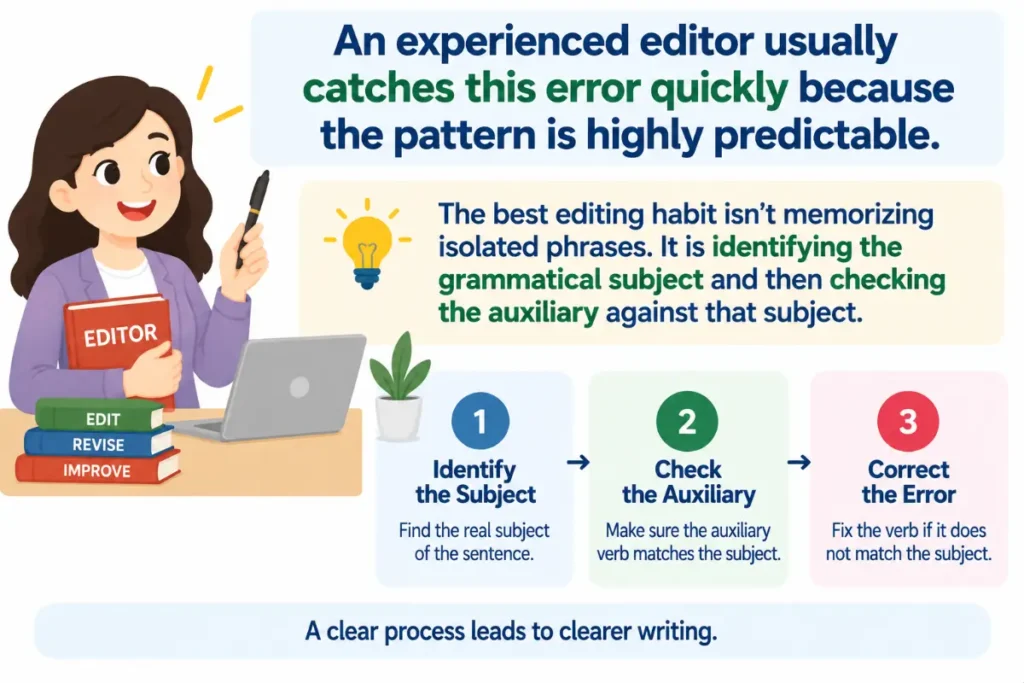
An experienced editor usually catches this error quickly because the pattern is highly predictable. The best editing habit isn’t memorizing isolated phrases. It is identifying the grammatical subject and then checking the auxiliary against that subject. Editors also watch for a second error that often appears nearby: writers sometimes use does with the main verb’s third person form and produce constructions such as Does anybody knows? Once does appears as the auxiliary the main verb must return to its base form. Grammar tools may flag either issue but understanding the rule is more useful than relying on software alone.
Conclusion
does anybody or do anybody has a clear answer in standard English. Use does anybody when anybody is the subject of a present simple question. Anybody is a singular indefinite pronoun even though it can refer to any person in a large group. That is why we say Does anybody know the answer?
The key is to focus on grammar rather than the size of the group. Compare Does anybody want to leave? with Do the students want to leave? The first subject is a singular indefinite pronoun while the second is a plural noun. Also remember that do can still appear near anybody when another word controls the verb as in Do you know anybody here?
For a quick editing trick replace anybody with one person. If does sounds right in that version use does in the original sentence too. Once you spot the subject this grammar choice becomes much easier.
FAQs
Is Anybody Singular Or Plural?
Anybody is grammatically singular when it functions as the subject of a sentence. It can refer to any person from a large group but that broad meaning doesn’t make the pronoun plural. For example we say Anybody is welcome and Does anybody know? The verb agrees with the pronoun’s grammatical number rather than the possible number of people it can refer to.
Why Do We Say Does With Anybody?
We use does because anybody is a singular indefinite pronoun. In the present simple English uses does with third person singular subjects. For example Does anybody understand? follows the same pattern as Does she understand? The fact that many people could potentially answer doesn’t change the grammatical number of the pronoun.
Can Do Be Used Near Anybody?
Yes. Do can appear in a sentence containing anybody when another word is the subject. For example Do you know anybody here? is completely correct because you is the subject and anybody is the object. The important point is to identify the subject before choosing do or does. The presence of anybody alone doesn’t determine the auxiliary.
Is Does Anybody Formal English?
Yes. The construction is standard English and works in casual conversation professional communication classroom discussion and many forms of formal writing. The phrase isn’t grammatically informal. A formal writer may sometimes choose a different structure for style or precision but there is nothing inherently incorrect or casual about using does with anybody.
What Is The Difference Between Anyone And Anybody?
Anyone and anybody are usually interchangeable indefinite pronouns. Both can refer to any person and both normally take singular agreement when they serve as subjects. You can say Does anyone know? or Does anybody know? The difference is mainly one of style and preference. Neither word requires a different subject verb agreement rule.
Why Does Do Anybody Sound Wrong?
Do anybody sounds wrong in standard English because the subject anybody is singular. English speakers learn patterns such as Does anyone know? and Does somebody have one? so the alternative conflicts with the expected agreement pattern. Nonstandard forms can appear in casual speech but that doesn’t make them appropriate for edited English.
Can I Say Does Anybody Knows?
No. In a standard present simple question you should say Does anybody know? The auxiliary does already carries the third person singular present marking. The main verb therefore stays in its base form. This is the same rule used in Does she work here? rather than Does she works here? It is a common second mistake after choosing does.
How Can I Remember The Rule?
Use the one person test. Replace anybody with one person and ask yourself which verb sounds correct. Does one person know? clearly uses does. Then apply the same pattern to Does anybody know? Also remember that the subject controls the verb. If anybody is the subject use does. If you or they is the subject use do.
