
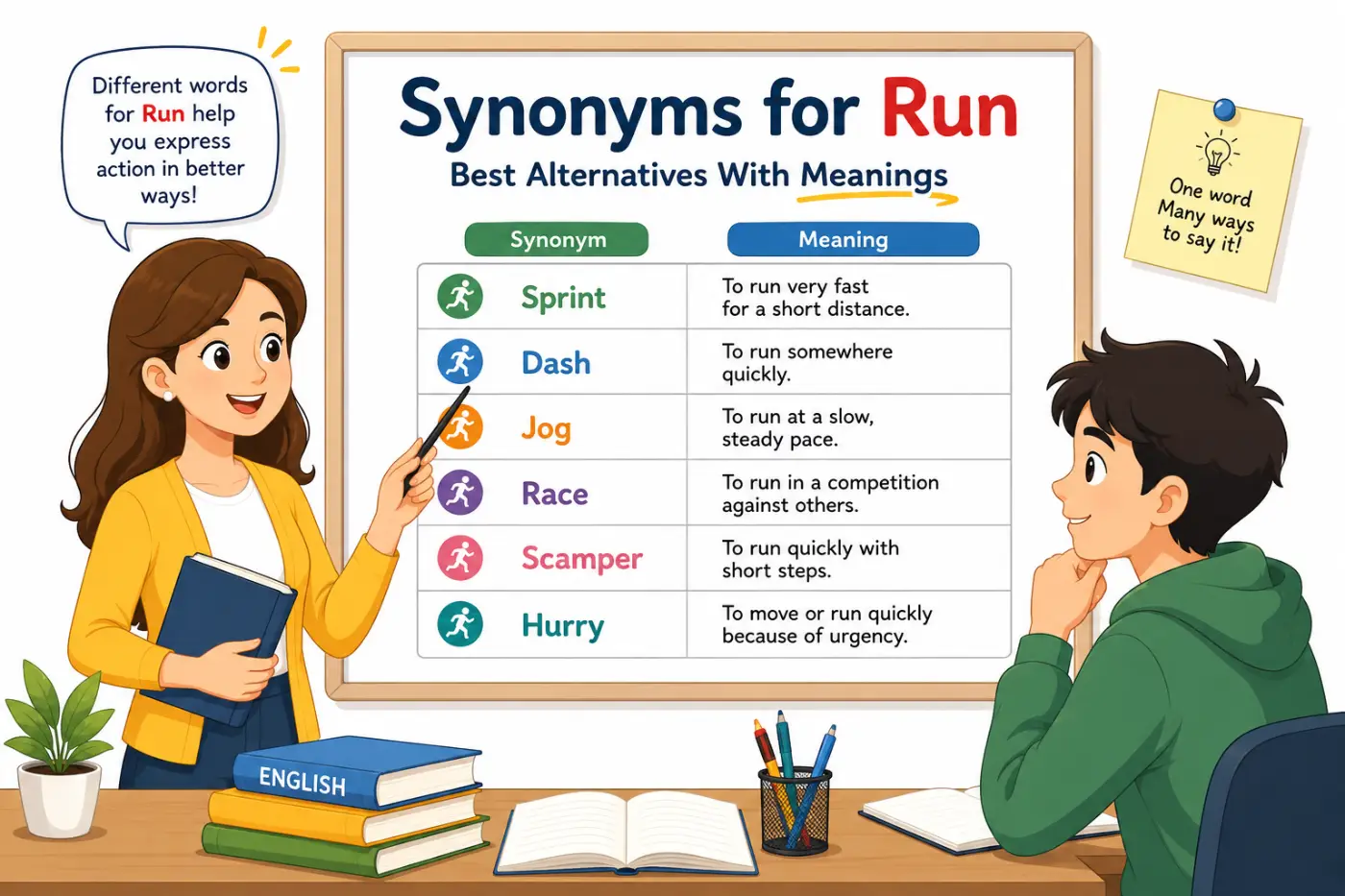
The English verb run is one of the most flexible words in the language. It can describe moving quickly on foot, operating a business, managing a project, flowing like water, functioning like a machine, competing in an election, or continuing over a period of time. Because it carries so many meanings, writers often search for synonyms for run that match a specific situation more precisely.
Choosing the right replacement can instantly improve your writing. Instead of repeating run several times in the same paragraph, you can select a word that communicates exactly what you mean. For example, sprint creates a different image than jog. Likewise, manage fits better than run when talking about leading a company, while operate sounds more natural for machines and equipment.
This guide explores the best synonyms for run, explains how each one differs in meaning, shows when to use them, and provides practical examples from everyday English. You will also learn grammar tips, pronunciation, common mistakes, regional preferences, and expert writing advice so you can choose the most accurate word with confidence.
Quick Definition
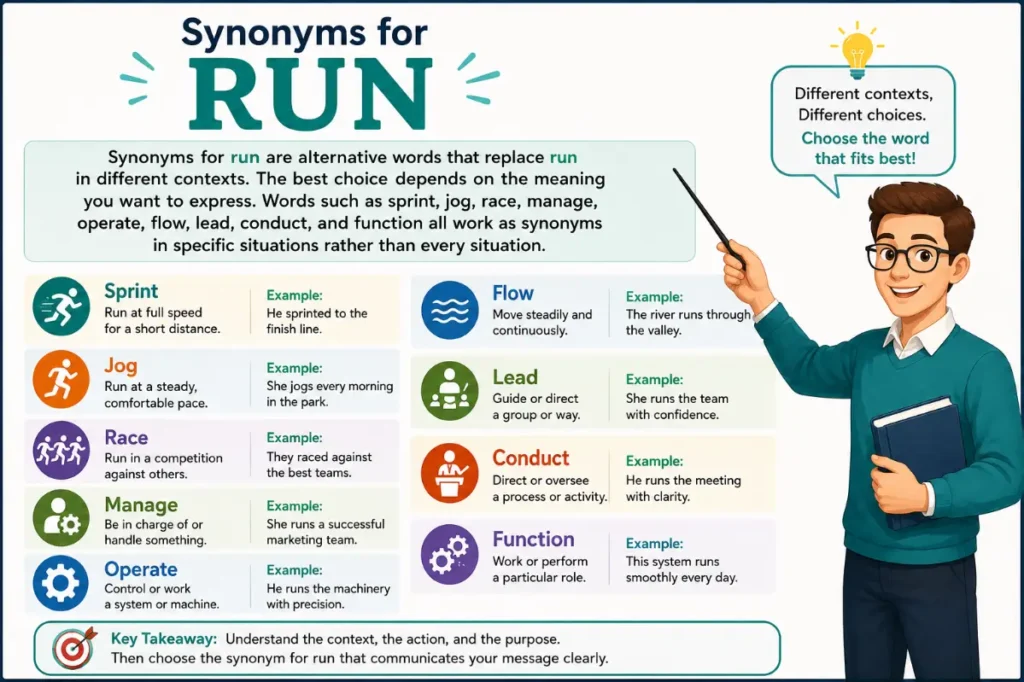
Synonyms for run are alternative words that replace run in different contexts. The best choice depends on the meaning you want to express. Words such as sprint, jog, race, manage, operate, flow, lead, conduct, and function all work as synonyms in specific situations rather than every situation.
Quick Answer
If you need another word for run, choose one that matches the context instead of replacing it automatically.
- For moving fast on foot use sprint, race, or dash.
- For gentle exercise use jog or trot.
- For managing something use operate, manage, direct, or lead.
- For machines use operate or function.
- For liquids use flow.
- For organizing an activity use conduct or administer.
The strongest synonym is always the one that matches the intended meaning.
Comparison Table
| Word | Primary Meaning | Part of Speech | Origin | Usage Frequency | Formality | Common Contexts | Example |
|---|---|---|---|---|---|---|---|
| Run | Move quickly on foot or perform many functions | Verb Noun | Old English | Very High | Neutral | Sports business machines water | She runs every morning. |
| Sprint | Run at top speed | Verb Noun | English | High | Neutral | Athletics racing | He sprinted to the finish line. |
| Jog | Run slowly | Verb Noun | English | High | Neutral | Exercise fitness | They jog around the park. |
| Dash | Run suddenly and quickly | Verb Noun | English | Medium | Neutral | Emergencies daily life | She dashed across the street. |
| Race | Move very fast to reach a destination | Verb Noun | Old Norse | High | Neutral | Competitions urgency | We raced home before the storm. |
| Hurry | Move quickly | Verb | Middle English | Very High | Neutral | Everyday conversation | Hurry to catch the bus. |
| Operate | Control or make something work | Verb | Latin | High | Formal | Machines systems | She operates the equipment. |
| Manage | Be responsible for | Verb | Italian through French | Very High | Neutral | Business projects | He manages a restaurant. |
| Lead | Guide or direct | Verb | Old English | High | Neutral | Teams organizations | She leads the department. |
| Conduct | Organize or carry out | Verb | Latin | Medium | Formal | Research meetings investigations | They conducted the survey. |
| Function | Work properly | Verb | Latin | Medium | Formal | Equipment systems | The printer functions well. |
| Flow | Move steadily | Verb | Old English | High | Neutral | Rivers traffic ideas | Water flows downhill. |
Meaning of Run
The word run has dozens of meanings, making it one of the most versatile verbs in English. Its exact meaning depends on the context.
As Physical Movement
The most familiar meaning is moving quickly using your legs.
Examples include:
- Children run across the playground every afternoon.
- She runs five miles before breakfast.
- The athlete ran toward the finish line.
As Managing Something
Run also means to control or oversee an organization, business, or event.
Examples include:
- They run a successful bakery.
- She runs the marketing department.
- He runs the entire project.
As Operating Equipment
Machines, software, and devices can also run.
Examples include:
- The engine runs smoothly.
- This program runs on Windows.
- The washing machine is running now.
As Continuous Movement
Run can describe something flowing or extending.
Examples include:
- Tears ran down her face.
- The river runs through the valley.
- A crack runs across the ceiling.
Etymology
The word run comes from Old English and has been part of the language for centuries. Over time, its meaning expanded far beyond physical movement. Today, it appears in sports, business, technology, transportation, politics, engineering, science, and everyday conversation.
Synonyms for Run in Physical Movement
Many people search for synonyms for run because they want stronger or more descriptive writing. Here are the most useful alternatives for movement.
Sprint
A sprint is a short burst of maximum speed.
Best for:
- Athletics.
- Competitive races.
- Urgent situations.
Example:
The firefighter sprinted toward the burning building.
Jog
A jog is slower than running and usually done for exercise.
Best for:
- Fitness.
- Morning routines.
- Casual exercise.
Example:
They jog around the lake every evening.
Dash
Dash suggests sudden quick movement.
Best for:
- Emergencies.
- Excitement.
- Fast reactions.
Example:
She dashed into the store before it closed.
Race
Race emphasizes speed and competition.
Best for:
- Sports.
- Challenges.
- Reaching a destination first.
Example:
The children raced to the playground.
Trot
Trot usually describes a steady light run.
Best for:
- Animals.
- Informal descriptions of people.
Example:
The horse trotted along the trail.
Rush
Rush focuses more on urgency than speed.
Example:
Everyone rushed toward the exit after the announcement.
Hurry
Hurry means moving quickly because of limited time.
Example:
We hurried to catch the last train.

Synonyms for Run in Business and Management
When run means leading or controlling something, better alternatives often exist.
Manage
Manage is one of the closest business synonyms.
Examples:
- She manages a software company.
- They manage multiple offices.
Lead
Lead highlights guidance and leadership.
Examples:
- He leads the design team.
- She leads international operations.
Direct
Direct emphasizes supervision.
Examples:
- She directs the advertising campaign.
- He directs daily operations.
Oversee
Oversee suggests monitoring work without handling every detail personally.
Example:
The supervisor oversees production.
Administer
Administer is common in government, education, healthcare, and business.
Example:
She administers the scholarship program.
Coordinate
Coordinate focuses on organizing people and activities.
Example:
He coordinates community events.
Synonyms for Run for Machines and Technology
When talking about computers, equipment, or software, these alternatives are often more precise.
Operate
Operate is one of the strongest replacements.
Examples:
- She operates heavy machinery.
- The factory operates around the clock.
Function
Function emphasizes working correctly.
Example:
The system functions perfectly after the update.
Execute
In computing, execute means to run a command or program.
Example:
The software executed successfully.
Process
Computers process information rather than simply run it.
Example:
The server processes thousands of requests each minute.
Perform
Machines perform tasks.
Example:
The robot performs repetitive work accurately.
Synonyms for Run for Liquids and Movement
Sometimes run describes continuous movement instead of speed. Suitable alternatives include:
- Flow.
- Stream.
- Pour.
- Drain.
- Spill.
- Trickle.
- Cascade.
Examples:
- Water flowed through the canal.
- Rain streamed down the windows.
- Oil spilled onto the floor.
- The mountain stream cascaded over the rocks.
Synonyms for Run in Sports
Sports writers often replace run with more vivid verbs.
Popular choices include:
- Sprint.
- Charge.
- Burst.
- Accelerate.
- Bolt.
- Dash.
- Race.
- Surge.
Instead of writing: The player ran toward the goal. You could write: The player surged toward the goal. The second sentence creates a stronger image and sounds more dynamic.
Expert Language Insight
One reason run appears so frequently in English is its extraordinary flexibility. Native speakers use it naturally in hundreds of expressions, from run a business and run late to run a marathon and run a computer program. Skilled editors rarely replace every occurrence of run. Instead, they look at the context and decide if a more specific verb would make the sentence clearer or more engaging. A useful editing strategy is to ask yourself one question: What exactly is running? If a person is moving, words like sprint, jog, or dash may fit better. If someone is in charge of an organization, manage, lead, or operate often communicates the idea more precisely. Choosing the synonym that matches the situation produces writing that feels more natural and professional.
Synonyms for Run in Different Contexts
One reason people search for synonyms for run is that no single alternative works in every sentence. The correct replacement depends entirely on the context. Below are some of the most common situations along with the most accurate choices.
Running in Daily Conversation
In casual English, people often replace run with words that sound more natural in conversation.
Examples include:
- Hurry.
- Rush.
- Dash.
- Jog.
- Sprint.
Examples
- I need to hurry to the grocery store before it closes.
- She rushed to answer the phone.
- He dashed upstairs to grab his keys.
- We jog every Saturday morning.
- The children sprinted across the field.
Running a Business
When talking about leadership or responsibility, words that focus on management usually sound more professional.
Good alternatives include:
- Manage.
- Operate.
- Lead.
- Direct.
- Oversee.
- Administer.
Examples
- She manages a successful clothing company.
- They operate several hotels across the country.
- He leads a team of engineers.
- Maria directs the marketing department.
- The principal oversees school operations.
- The agency administers public programs.
Running Software or Equipment
Technology uses run differently from physical movement.
Better choices include:
- Operate.
- Execute.
- Function.
- Process.
- Perform.
Examples
- This application operates on multiple platforms.
- The computer executed the command immediately.
- The printer functions without any problems.
- The server processes millions of requests every day.
- The machine performs repetitive tasks accurately.
Running Water or Other Liquids
When something moves continuously, choose a verb that describes the movement itself.
Useful alternatives include:
- Flow.
- Stream.
- Trickle.
- Pour.
- Cascade.
- Drain.
Examples
- Water flowed through the valley.
- Tears streamed down her face.
- Rain trickled from the roof.
- Coffee poured into the mug.
- The waterfall cascaded over the rocks.
- The sink drained slowly.
Key Differences Among Common Synonyms for Run
Although many words can replace run, each one has its own meaning and tone.
| Synonym | Main Difference | Best Context |
|---|---|---|
| Sprint | Maximum speed | Athletics |
| Jog | Slow relaxed running | Exercise |
| Dash | Sudden quick movement | Urgency |
| Race | Speed with competition | Sports |
| Hurry | Focus on limited time | Daily life |
| Rush | Strong urgency | Busy situations |
| Manage | Control people or work | Business |
| Operate | Make machines or businesses work | Technology and organizations |
| Lead | Guide people | Leadership |
| Conduct | Carry out formally | Research and official work |
| Function | Work correctly | Equipment and systems |
| Flow | Continuous movement | Liquids and ideas |
The table shows why replacing run without considering context can make a sentence sound awkward.
Which Synonym Should You Choose
There is no single best synonym for run. Instead, choose the word that expresses your exact meaning.
Use Sprint When
- Machines are involved.
- Businesses provide services.
- Equipment functions.
Use Flow When
- Talking about water.
- Describing liquids.
- Referring to ideas moving naturally.
Examples in Sentences
Ten Examples Using Run
- I run three miles every morning before work.
- The children run across the playground during recess.
- She runs a successful bakery downtown.
- This software runs on both Windows and Mac computers.
- Water runs beneath the old bridge.
- Our meeting ran longer than expected.
- He plans to run for city council next year.
- The refrigerator has been running all night.
- The road runs along the coastline.
- They run free workshops every summer.
Ten Examples Using Different Synonyms
- The athlete sprinted toward the finish line.
- We jogged around the neighborhood after dinner.
- She dashed into the office before the meeting started.
- They managed the project successfully.
- The engineer operated the new machine.
- The teacher led the discussion.
- Water flowed through the narrow stream.
- Scientists conducted several experiments.
- The software functioned exactly as expected.
- He hurried home before the storm arrived.
Common Mistakes
Many learners misuse run because they assume every synonym has the same meaning. In reality, each word has its own role.
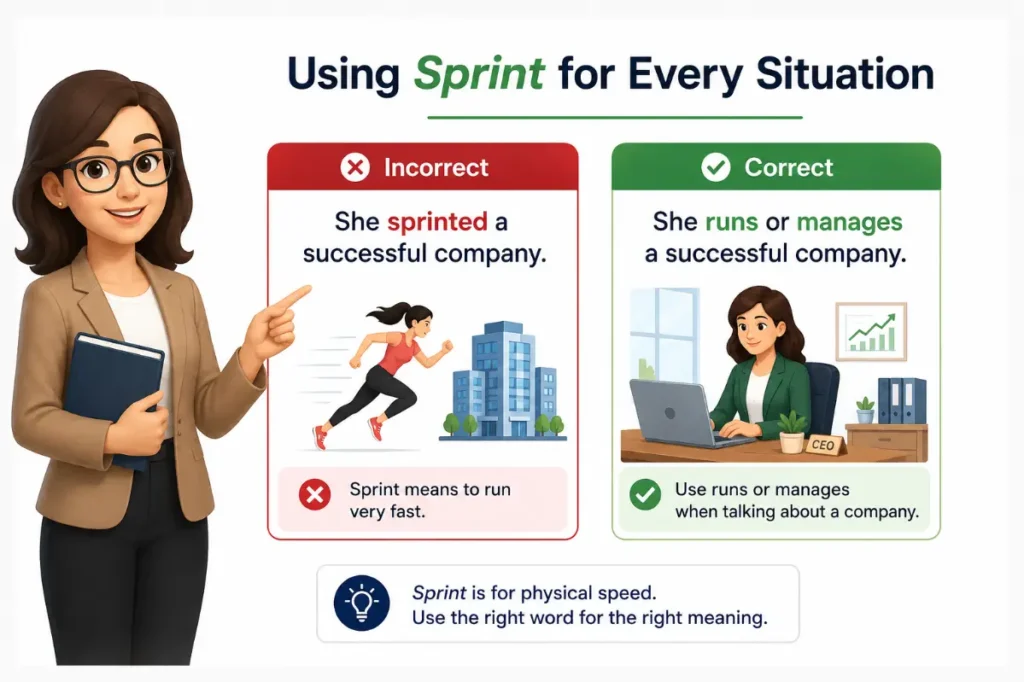
Using Sprint for Every Situation
Incorrect:
She sprinted a successful company.
Correct:
She runs or manages a successful company.
Using Manage for Physical Movement
Incorrect:
He managed around the park every morning.
Correct:
He jogged around the park every morning.
Using Flow for People
Incorrect:
The students flowed to school every morning.
Better:
The students walked, hurried, or ran to school.
Replacing Every Run
Some writers believe repeating run is always wrong. That is not true.
For example: The software runs efficiently. Replacing it with sprints or races would completely change the meaning. Editors replace run only when another verb improves precision.
Pronunciation Guide
Run
IPA
American English: /rʌn/
British English: /rʌn/
Syllables
Run has one syllable.
Common Pronunciation Mistakes
- Making the vowel sound too long.
- Confusing run with ran, which is the past tense.
- Adding an extra vowel after the final consonant.
- Stressing the word unnecessarily in normal conversation.
Pronouncing Common Synonyms
| Word | IPA |
|---|---|
| Sprint | /sprɪnt/ |
| Jog | /dʒɑːɡ/ |
| Dash | /dæʃ/ |
| Race | /reɪs/ |
| Hurry | /ˈhɜːri/ |
| Manage | /ˈmænɪdʒ/ |
| Operate | /ˈɑːpəreɪt/ |
| Lead | /liːd/ |
| Conduct as a verb | /kənˈdʌkt/ |
| Function | /ˈfʌŋkʃən/ |
| Flow | /floʊ/ |
Etymology and Word Origin
The verb run has a long history in English. It comes from Old English, where it referred primarily to moving quickly on foot. As English developed, the word gradually gained additional meanings. By the Middle English period, speakers were already using run to describe flowing water, moving objects, and the passing of time. Later, the Industrial Revolution introduced new meanings connected with machinery. People began saying that engines, factories, and machines run. During the twentieth century, computers expanded the word again. Today we commonly say that software runs, applications run, and computer programs run. Because of this long history, run now has hundreds of dictionary definitions and appears in thousands of expressions, making it one of the most versatile verbs in modern English.
Grammar Rules
Understanding the grammar of run helps you use it correctly.
Part of Speech
Run functions as both a verb and a noun.
Verb
They run every morning.
Noun
We went for a long run.
Verb Forms
| Base Form | Past Tense | Past Participle | Present Participle |
|---|---|---|---|
| Run | Ran | Run | Running |
Examples:
- I run every morning.
- Yesterday I ran five miles.
- She has run several marathons.
- They are running late.
Common Grammar Patterns
Run + adverb
She runs quickly.
Run + preposition
The trail runs through the forest.
Run + noun
They run a nonprofit organization.
Common Expressions
- Run out of time.
- Run into a friend.
- Run across an interesting article.
- Run away.
- Run after someone.
- Run over the details.
- Run short of money.
- Run smoothly.
- Run late.
- Run wild.
Each expression has its own meaning and should be learned as a complete phrase rather than translated word by word.
Regional Usage
The word run is common in every major variety of English. Its core meanings remain the same, but some expressions and preferred synonyms vary by region.
American English
American English frequently uses run in everyday speech for many situations.
Examples include:
- Run a business.
- Run for office.
- Run errands.
- Run a program.
- Run a meeting.
Americans also commonly use synonyms such as manage, operate, lead, and hustle, depending on the context.
British English
British English uses run in much the same way, although some surrounding vocabulary differs.
Examples include:
- Run a company.
- Run a campaign.
- Run a railway service.
- Run a shop.
- Run an event.
Words such as manage, administer, and organize are especially common in formal British writing.
Australian English
Australian English uses run naturally in both formal and informal settings.
Examples include:
- Run a farm.
- Run a café.
- Run a football club.
- Run a training session.
- Run a small business.
Informal conversation may also include expressions like rush off or head over instead of run, depending on the situation.
Canadian English
Canadian English closely follows American English while also sharing some vocabulary with British English.
Examples include:
- Run a department.
- Run a charity.
- Run a community program.
- Run a marathon.
- Run daily operations.
Overall, run remains the standard choice across all four regions. The differences usually involve the surrounding vocabulary rather than the verb itself.
Related Words and Commonly Confused Terms
People searching for synonyms for run are often interested in similar verbs that describe movement, management, operation, or continuous action. Understanding these related words helps you choose the most precise expression.
| Word | Meaning | Difference From Run |
|---|---|---|
| Sprint | Run at maximum speed | Faster and shorter distance |
| Jog | Run slowly for exercise | More relaxed than run |
| Race | Compete by running | Usually involves competition |
| Dash | Move suddenly and quickly | Suggests urgency |
| Hurry | Move quickly because of time | Focuses on urgency rather than speed |
| Rush | Act with great urgency | Often implies pressure |
| Walk | Move at a normal pace | Slower than run |
| Stroll | Walk in a relaxed way | Very different pace |
| Manage | Supervise people or work | Business meaning of run |
| Operate | Make something work | Machines and organizations |
| Lead | Guide people | Leadership rather than operation |
| Conduct | Carry out formally | Research, meetings, investigations |
| Function | Work correctly | Machines and systems |
| Flow | Move continuously | Liquids, ideas, traffic |
Words That Are Not True Synonyms
Some words seem similar but cannot replace run in most situations.
Examples include:
- Walk is slower and describes a different type of movement.
- Travel means moving from one place to another but does not describe running.
- Drive applies to vehicles, not people running.
- Fly refers to movement through the air.
- Navigate focuses on finding a route rather than moving quickly.
Choosing one of these words simply because it involves movement can change the meaning of a sentence.
Expert Language Insight
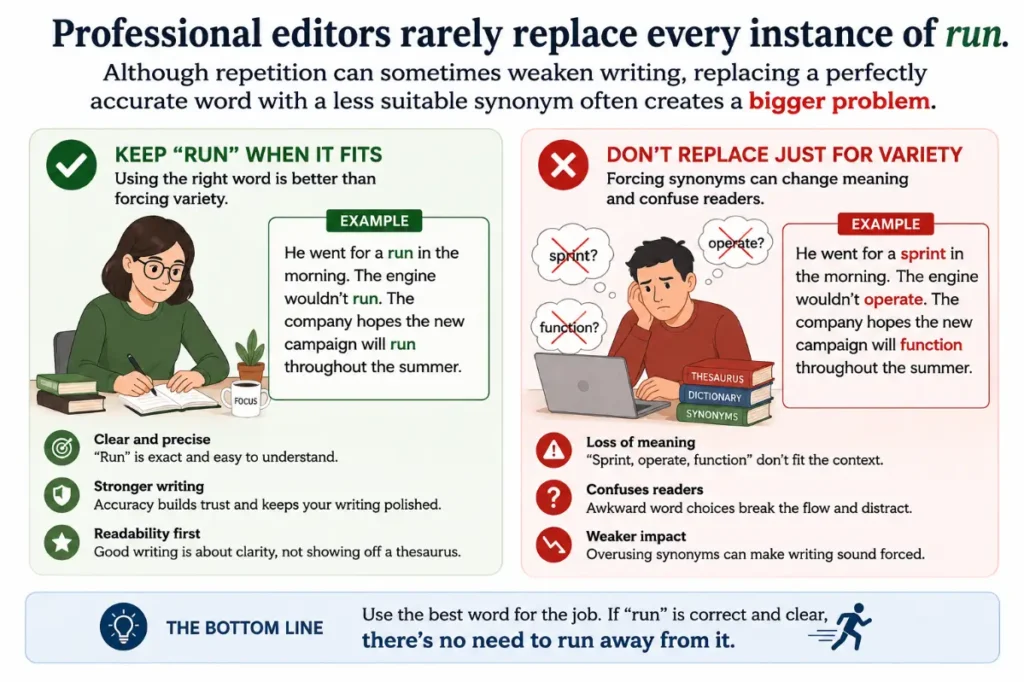
Professional editors rarely replace every instance of run. Although repetition can sometimes weaken writing, replacing a perfectly accurate word with a less suitable synonym often creates a bigger problem.
For example:
Natural She runs a successful business.
Less Natural She conducts a successful business. The second sentence sounds awkward because conduct usually refers to activities such as research, meetings, interviews, or investigations rather than owning or managing a business.
Likewise: Natural The software runs smoothly.
Conclusion
Finding the best synonyms for run is not about replacing the word every time it appears. It is about choosing the alternative that matches your exact meaning.
If you are writing about movement, words such as sprint, jog, dash, and race create more vivid descriptions. For business and leadership, manage, lead, operate, and direct often communicate responsibility more clearly. When discussing technology or machinery, operate, function, and execute are usually the most accurate choices. For liquids or continuous motion, flow, stream, and cascade are natural alternatives.
The most effective writers focus on precision rather than variety alone. A well-chosen synonym can make your writing clearer, more engaging, and more professional, but the original word run is still the best choice when it expresses the intended meaning naturally. Always consider the context first, then select the word that fits both the message and the audience.
Frequently Asked Questions
What is the best synonym for run?
There is no single best synonym because run has many meanings. If you mean physical movement, words such as sprint, jog, race, and dash work well. If you mean managing a business, manage, operate, or lead are usually better choices.
Can every synonym replace run?
No. Each synonym works only in certain contexts. For example, operate can replace run when discussing machines or businesses, but it cannot replace run when talking about physical exercise.
What is a formal alternative to run?
Formal alternatives include manage, operate, conduct, administer, direct, and supervise. The best option depends on the sentence and the meaning you want to express.
Is sprint the same as run?
No. Sprint means running at maximum speed for a short distance. Run is a broader term that can describe movement at many different speeds as well as dozens of nonphysical meanings.
What is the difference between run and jog?
Run is a general verb for moving quickly on foot. Jog specifically refers to slow, steady running, usually for exercise or fitness rather than speed.
Can run be used as both a noun and a verb?
Yes. As a verb, it describes actions such as moving quickly, managing a business, or operating equipment. As a noun, it refers to an act of running or a continuous sequence, such as a morning run or a run of good luck.
Why does the word run have so many meanings?
The word has been part of English for centuries. Over time, speakers extended its meaning from physical movement to machines, businesses, technology, politics, sports, transportation, and many other areas, making it one of the most versatile words in the language.
How can I choose the right synonym for run?
Start by identifying the exact meaning of run in your sentence. Then choose a synonym that matches that meaning, tone, and audience. A precise word almost always creates clearer and stronger writing than a general one.
