
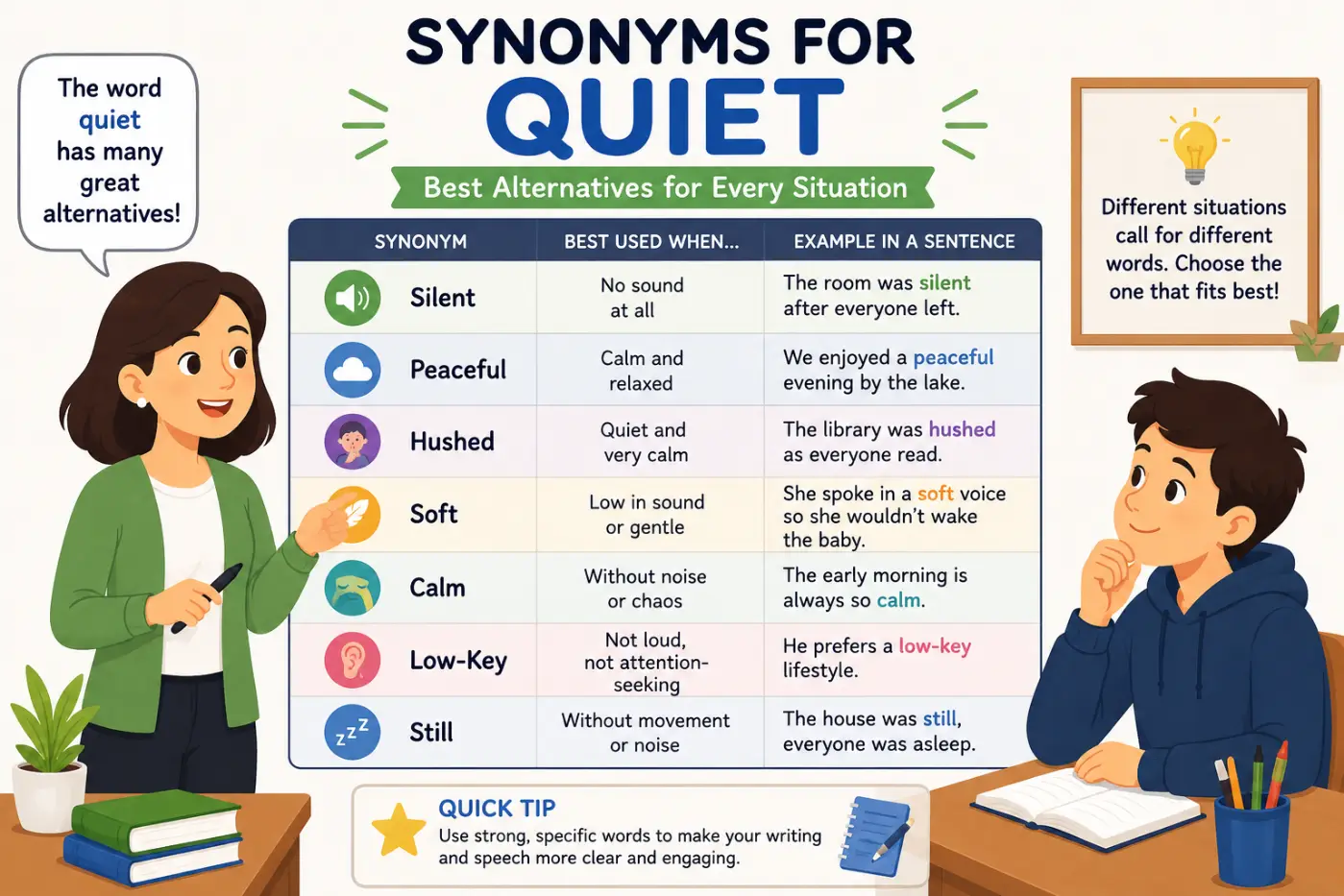
Finding the right synonyms for quiet can completely change the tone of your writing. Sometimes you want to describe a peaceful forest. Other times you need a word for a silent student, a calm workplace, a soft voice, or a private personality. While quiet works in many situations, it is not always the most precise choice.
English offers dozens of alternatives, each carrying its own meaning and emotional tone. Some suggest complete silence. Others describe calm behavior, gentle sounds, peaceful surroundings, or reserved personalities. Choosing the best word helps readers picture exactly what you mean.
In this guide, you’ll discover the best synonyms for quiet, learn how native speakers use them, understand the subtle differences between similar words, and see practical examples for everyday writing, academic work, business communication, and creative storytelling.
Quick Definition
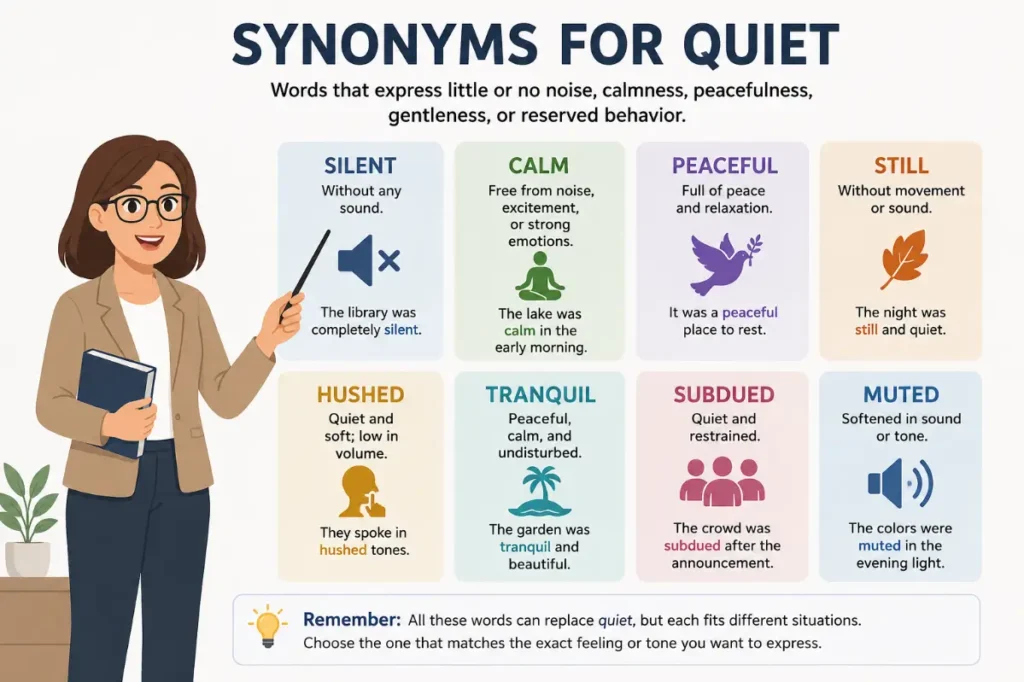
Synonyms for quiet are words that express little or no noise, calmness, peacefulness, gentleness, or reserved behavior. The best alternative depends on the context. Words like silent, calm, peaceful, still, hushed, tranquil, subdued, and muted all replace quiet in different situations, but they are not always interchangeable.
Quick Answer
If you simply need another word for quiet, these are among the strongest choices.
- Silent
- Peaceful
- Calm
- Still
- Tranquil
- Hushed
- Muted
- Soft
- Serene
- Reserved
Each word emphasizes a different type of quietness. Some describe sound, while others describe people, emotions, places, or atmosphere.
Comparison Table
| Word | Meaning | Part of Speech | Origin | Usage Frequency | Formality | Common Contexts | Example |
|---|---|---|---|---|---|---|---|
| Quiet | Little noise | Adjective | Latin | Very High | Neutral | Everyday English | The room became quiet. |
| Silent | No sound at all | Adjective | Latin | Very High | Neutral | Speech, rooms, people | Everyone stayed silent. |
| Calm | Free from disturbance | Adjective | Greek through French | Very High | Neutral | Emotions, weather | She remained calm. |
| Peaceful | Free from conflict or noise | Adjective | Old French | High | Neutral | Nature, neighborhoods | We enjoyed a peaceful evening. |
| Still | Without movement or sound | Adjective | Old English | High | Neutral | Water, air, rooms | The lake was still. |
| Tranquil | Peacefully quiet | Adjective | Latin | Medium | Formal | Landscapes, resorts | The garden felt tranquil. |
| Serene | Calm and untroubled | Adjective | Latin | Medium | Formal | Nature, emotions | Her face looked serene. |
| Hushed | Made intentionally quiet | Adjective | Middle English | Medium | Neutral | Crowds, voices | The audience became hushed. |
| Muted | Softened in sound | Adjective | Latin | Medium | Neutral | Music, colors, voices | The television was muted. |
| Reserved | Quiet in personality | Adjective | Latin | High | Formal | Character descriptions | He seemed reserved. |
What Does Quiet Mean
The word quiet usually means making little noise, creating a peaceful atmosphere, or showing calm behavior.
Depending on the sentence, it may describe:
- A place.
- A person.
- A voice.
- A period of time.
- An emotional state.
Examples include:
- The library was quiet all afternoon.
- She spoke in a quiet voice.
- He lives in a quiet neighborhood.
- We enjoyed a quiet weekend together.
- The child became quiet after dinner.
Understanding Synonyms for Quiet
Many people think every synonym means exactly the same thing. That is not true. Native English speakers choose different words depending on the situation. For example: Silent means no sound. Peaceful focuses on comfort. Still suggests little movement. Reserved describes personality instead of sound. Muted refers to reduced sound rather than complete silence. Understanding these differences makes your writing more accurate and natural.
Synonyms for Quiet Based on Meaning
Words That Mean No Sound
These words describe complete or almost complete silence.
- Silent
- Soundless
- Noiseless
- Hushed
- Speechless
Example:
The classroom became silent after the announcement.
Words That Describe Peaceful Places
These alternatives emphasize comfort and relaxation.
- Peaceful
- Tranquil
- Serene
- Restful
- Calm
Example:
They rented a peaceful cabin near the lake.
Words for Gentle Sounds
These words describe sounds that exist but remain soft.
- Soft
- Low
- Muted
- Gentle
- Faint
Example:
Only a soft breeze moved through the trees.
Synonyms for Quiet People
These words describe personality rather than noise.
- Reserved
- Shy
- Introverted
- Modest
- Unassuming
- Soft spoken
- Reticent
- Taciturn
Example:
She is quiet but always listens carefully before speaking.
Synonyms for Quiet by Tone
Choosing the correct synonym depends on the feeling you want readers to experience.
Neutral Alternatives
- Calm
- Peaceful
- Still
- Silent
- Soft
These work well in everyday conversation.
Formal Alternatives
- Tranquil
- Serene
- Reticent
- Taciturn
- Subdued
These often appear in professional or literary writing.
Creative Alternatives
- Whispering
- Dreamlike
- Gentle
- Restful
- Undisturbed
Creative writers often prefer these because they create vivid imagery.

Best Synonyms for Quiet in Different Situations
Quiet Place
Good replacements include:
- Peaceful
- Serene
- Tranquil
- Calm
- Restful
Example:
The hotel overlooked a tranquil beach.
Quiet Person
Better choices include:
- Reserved
- Introverted
- Soft spoken
- Reticent
- Taciturn
Notice that these words describe personality instead of volume.
Quiet Voice
Strong alternatives include:
- Soft
- Gentle
- Low
- Muted
- Faint
Example:
His gentle voice reassured the nervous patient.
Quiet Weather
Suitable choices include:
- Calm
- Still
- Peaceful
- Gentle
Example:
The sea remained calm throughout the afternoon.
Strongest Single Word Replacements
If you only need one replacement, these are usually the safest options.
- Silent when absolutely no sound exists.
- Peaceful for relaxing environments.
- Calm for emotions and situations.
- Still for motionless scenes.
- Tranquil for elegant descriptive writing.
- Soft for voices and sounds.
- Reserved for personality.
- Hushed for temporarily reduced noise.
- Muted for softened sounds.
- Serene for beautiful peaceful settings.
Editor’s Insight
Professional editors rarely replace every instance of quiet with the same synonym. Instead, they choose the word that best matches the scene. A forest is usually peaceful or tranquil. An audience becomes silent. A child may be quiet. A speaker may have a soft voice. A thoughtful employee may be reserved. That small distinction makes writing feel natural instead of repetitive and improves both readability and precision. Continuing the article, here is Part 2. It follows the same style and SEO structure while maintaining natural readability and consistent terminology.
Synonyms for Quiet Grouped by Context
One reason English is so expressive is that a single idea can have many shades of meaning. Instead of using quiet repeatedly, choose a synonym that matches your exact situation.
For Peaceful Places
These words create a sense of comfort, relaxation, and freedom from disturbance.
- Peaceful
- Tranquil
- Serene
- Restful
- Undisturbed
- Calm
- Secluded
- Idyllic
- Remote
- Sheltered
Examples:
- We spent the weekend in a peaceful mountain village.
- The garden remained tranquil even during the afternoon.
- They found a secluded beach far from the crowds.
For Silent Rooms
These words focus on little or no sound.
- Silent
- Soundless
- Noiseless
- Hushed
- Whisper quiet
- Still
- Mute
- Deathly quiet
Examples:
- The theater became silent as the performance began.
- The office was unusually hushed after lunch.
- The hallway remained soundless throughout the night.
For Quiet People
Some words describe personality instead of sound.
- Reserved
- Introverted
- Reticent
- Taciturn
- Soft spoken
- Modest
- Shy
- Unassuming
- Reflective
- Thoughtful
Examples:
- Although she was reserved, she shared excellent ideas.
- His soft spoken manner made people feel comfortable.
- The new student seemed shy at first.
For Quiet Voices
These alternatives describe the volume or style of speech.
- Soft
- Gentle
- Low
- Faint
- Muted
- Whispered
- Delicate
- Tender
Examples:
- She answered in a gentle voice.
- His low voice was easy to recognize.
- The guide spoke so softly that everyone leaned closer.
Synonyms for Quiet by Writing Style
Different audiences expect different vocabulary.
Everyday Conversation
Choose words that sound natural.
- Calm
- Peaceful
- Silent
- Soft
- Still
These fit casual conversations, emails, and everyday writing.
Academic Writing
More formal alternatives include:
- Tranquil
- Subdued
- Muted
- Reserved
- Reticent
These words often appear in essays, research papers, and reports.
Creative Writing
Writers often choose descriptive words that help readers picture the scene.
- Hushed
- Whispering
- Serene
- Dreamlike
- Undisturbed
- Motionless
- Restful
- Gentle
Instead of writing:
The forest was quiet.
You could write:
The forest was serene beneath the early morning light.
Key Differences Between Quiet and Its Synonyms
Although many words appear similar, native speakers rarely treat them as identical.
Quiet vs Silent
Quiet means little noise.
Silent means no noise at all.
Examples:
The café was quiet.
The courtroom was silent.
Quiet vs Calm
Quiet relates mainly to sound.
Calm often describes emotions, behavior, weather, or situations.
Examples:
The classroom was quiet.
She remained calm during the interview.
Quiet vs Peaceful
Peaceful suggests comfort and harmony.
A place may be peaceful even if birds are singing.
Examples:
The countryside felt peaceful.
The park was quiet.
Quiet vs Still
Still usually emphasizes the absence of movement.
Examples:
The lake was still.
The room was quiet.
Quiet vs Reserved
Reserved describes personality. Quiet may describe sound or behavior.
Examples:
He is reserved around strangers.
The office remained quiet all morning.
Which Synonym Should You Choose
The best synonym depends entirely on your purpose.
Use calm for emotions or situations.
Use reserved for personality.
Examples Using Quiet
- The baby finally became quiet.
- Our neighborhood stays quiet after sunset.
- She enjoys quiet mornings with coffee.
Examples Using Peaceful
- We enjoyed a peaceful walk along the river.
- The village has a peaceful atmosphere.
- She hopes for a peaceful future.
Common Mistakes
Many learners assume every synonym for quiet has the same meaning. That leads to awkward sentences.
Mistake One
Using silent when some sound still exists. Incorrect: The park was silent as birds sang. Better: The park was peaceful.
Mistake Two
Using reserved for locations.
Incorrect:
The neighborhood was reserved.
Better: The neighborhood was quiet.
Mistake Three
Using still to describe personality.
Incorrect: She is a still woman.
Better:
She is quiet.
Or:
She is reserved.
Mistake Four
Using muted to describe complete silence. Muted means reduced volume, not total silence.
Mistake Five
Ignoring tone.
Formal writing often benefits from words like tranquil or serene, while everyday conversation usually sounds more natural with quiet, calm, or peaceful.
Pronunciation Guide
| Word | IPA | Syllables |
|---|---|---|
| Quiet | /ˈkwaɪ.ət/ | qui et |
| Silent | /ˈsaɪ.lənt/ | si lent |
| Peaceful | /ˈpiːs.fəl/ | peace ful |
| Calm | /kɑːm/ | calm |
| Still | /stɪl/ | still |
| Tranquil | /ˈtræŋ.kwəl/ | tran quil |
| Serene | /səˈriːn/ | se rene |
| Reserved | /rɪˈzɝːvd/ | re served |
| Muted | /ˈmjuː.tɪd/ | mut ed |
| Hushed | /hʌʃt/ | hushed |
Common Pronunciation Mistakes
- Do not pronounce quiet as one syllable. It has two syllables.
- The l in calm is usually silent.
- Stress the second syllable in serene.
- Stress the first syllable in tranquil.
- Do not confuse reserved with reversed.
Etymology and Word Origin
The adjective quiet comes from the Latin word quietus, meaning resting, calm, or at peace. It entered English through Old French and Middle English, gradually expanding from the idea of rest to include silence, stillness, and gentle behavior. Tranquil comes from the Latin tranquillus, meaning calm, undisturbed, or free from agitation. Understanding these origins helps explain why some words sound more formal than others. Latin based words such as tranquil and serene often appear in literature and professional writing, while Germanic words like still are common in everyday English. Here is the final part of the article, completing all remaining sections and providing a strong conclusion optimized for readers, search engines, and AI search experiences.
Regional Usage
Most synonyms for quiet are understood throughout the English speaking world, but some appear more frequently in certain regions or contexts.
American English
American English commonly uses:
- Quiet
- Silent
- Calm
- Peaceful
- Soft spoken
- Reserved
These words appear in everyday conversation, journalism, education, and business writing.
Examples:
- We moved to a quiet neighborhood.
- She is quiet during meetings.
- The classroom stayed silent.
British English
British English also uses quiet frequently but often favors slightly more formal words in writing.
Common choices include:
- Tranquil
- Serene
- Hushed
- Reserved
- Reticent
Example:
The village remained tranquil throughout the winter.
Australian English
Australian English generally follows British conventions while using simple everyday vocabulary.
Popular choices include:
- Quiet
- Calm
- Peaceful
- Still
Example:
We found a quiet beach away from the tourists.
Canadian English
Canadian English blends American and British usage. Writers commonly use:
- Quiet
- Peaceful
- Silent
- Calm
- Serene
Because these words are widely understood, you can safely use them in international writing.
Grammar Rules
Understanding how quiet functions in a sentence helps you choose the correct synonym.
Parts of Speech
Quiet can serve as more than one part of speech.
Adjective
The office was quiet.
Noun
We enjoyed the quiet after dinner.
Verb
Please quiet the children.
Most synonyms discussed in this article function as adjectives, although a few have related noun or verb forms.
Common Sentence Structures
- Quiet + noun
A quiet street.
- Be + quiet
The room is quiet.
- Quiet + place
A quiet library.
- Quiet + person
A quiet student.
Comparative and Superlative Forms
Positive:
Quiet
Comparative:
Quieter
Superlative:
Quietest
Examples:
- This neighborhood is quieter than the last one.
- Sunday mornings are usually the quietest time of the week.
Common Collocations
Native speakers often pair quiet with specific nouns.
Examples include:
- Quiet room.
- Quiet voice.
- Quiet evening.
- Quiet neighborhood.
- Quiet moment.
- Quiet street.
- Quiet conversation.
- Quiet confidence.
- Quiet life.
- Quiet atmosphere.
Learning these combinations makes your English sound much more natural.
Real Life Usage Examples
Daily Conversation
Could we find a quieter table? The baby finally became quiet. I enjoy quiet mornings before work.
Academic Writing
The researchers completed the experiment in a quiet environment to reduce distractions. Students generally perform better in quiet study areas.
Professional Communication
Please keep the conference room quiet during the presentation. We selected a quiet office for client meetings.
Literature
Authors frequently choose more descriptive alternatives instead of repeating quiet.
Examples include:
The valley lay tranquil beneath the stars.
A serene smile crossed her face.
The forest stood still before sunrise.
These choices create stronger imagery than repeating the same adjective.
Media and Journalism
News organizations often use words like:
- Calm.
- Peaceful.
- Silent.
- Hushed.
- Subdued.
Each carries a slightly different meaning depending on the story.
Related Words and Confused Terms
Many words are closely related to quiet, but they are not perfect substitutes.
| Word | Difference |
|---|---|
| Silent | No sound at all. |
| Calm | Free from stress or disturbance. |
| Peaceful | Relaxing and harmonious. |
| Still | No movement. |
| Reserved | Quiet personality. |
| Introverted | Personality that enjoys solitude. |
| Shy | Lacking confidence in social situations. |
| Hushed | Temporarily made quiet. |
| Muted | Reduced volume. |
| Serene | Calm and beautiful. |
| Tranquil | Peacefully quiet. |
| Soft | Low in volume or intensity. |
| Gentle | Mild and kind in sound or behavior. |
| Restful | Promoting relaxation. |
| Secluded | Away from crowds. |
These semantic relatives help search engines understand the topic while giving readers a broader vocabulary.
Expert Language Insight
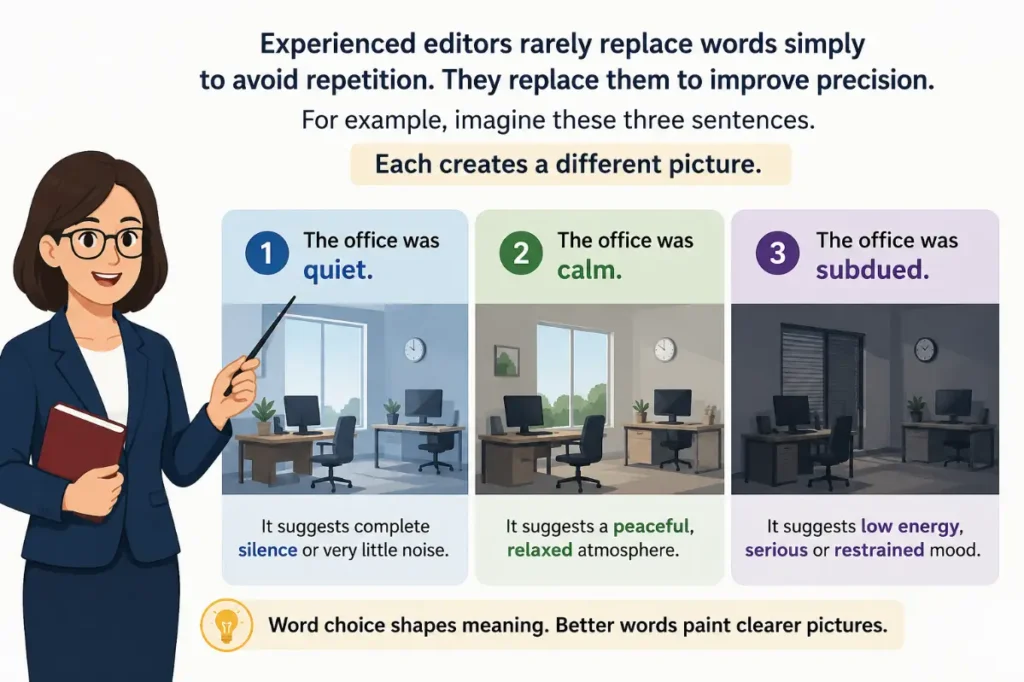
Experienced editors rarely replace words simply to avoid repetition. They replace them to improve precision. For example, imagine these three sentences. The office was quiet. The office was subdued. Each creates a different picture.
Quiet suggests little noise.
Silent suggests complete silence.
Subdued suggests low energy or restrained activity. Native speakers naturally choose the word that matches the exact situation instead of searching for the fanciest alternative. Another common mistake is using long, formal words when simple language works better.
Conclusion
Choosing the right synonyms for quiet is about more than finding a different word. It is about selecting the expression that communicates your exact meaning.
If you want to describe complete silence, choose silent. For relaxing places, peaceful, tranquil, or serene work beautifully. When writing about emotions, calm is often the strongest option. For personality, reserved, soft spoken, or reticent are more accurate than simply saying someone is quiet.
Professional writers and editors do not replace words randomly. They select vocabulary that matches the situation, tone, and audience. Following the same approach will make your writing more precise, more engaging, and easier to understand.
Frequently Asked Questions
What is the best synonym for quiet?
The best synonym depends on the context. Silent works for complete absence of sound, peaceful describes relaxing places, calm suits emotions and situations, while reserved is ideal for describing someone’s personality.
What is a stronger word than quiet?
Words such as silent, tranquil, serene, hushed, and soundless often create a stronger image than quiet. Each emphasizes a different kind of silence or calmness, so choose the one that best fits your sentence.
Is silent the same as quiet?
No. Quiet means there is little noise, while silent means there is no sound at all. A room can be quiet with soft background noise, but it cannot be silent if any sound is present.
Which synonym for quiet is best for describing a person?
Words like reserved, soft spoken, reticent, introverted, and taciturn describe personality more accurately than simply calling someone quiet. Each has its own nuance, so select the one that matches the person’s behavior.
What is the opposite of quiet?
Common opposites include loud, noisy, boisterous, rowdy, clamorous, and deafening. The best choice depends on the amount and type of noise you want to describe.
Which synonyms for quiet are best in professional writing?
Professional writing usually benefits from clear words such as calm, peaceful, subdued, reserved, and muted. They sound natural while communicating precise meaning.
Can quiet be used as a noun and a verb?
Yes. Although it is most often an adjective, quiet can also function as a noun meaning calmness and as a verb meaning to make something less noisy.
How can I avoid repeating quiet in my writing?
Instead of replacing every occurrence automatically, choose a synonym that matches your meaning. Consider the setting, level of sound, personality, mood, and writing style. This approach improves clarity and keeps your writing engaging.
