
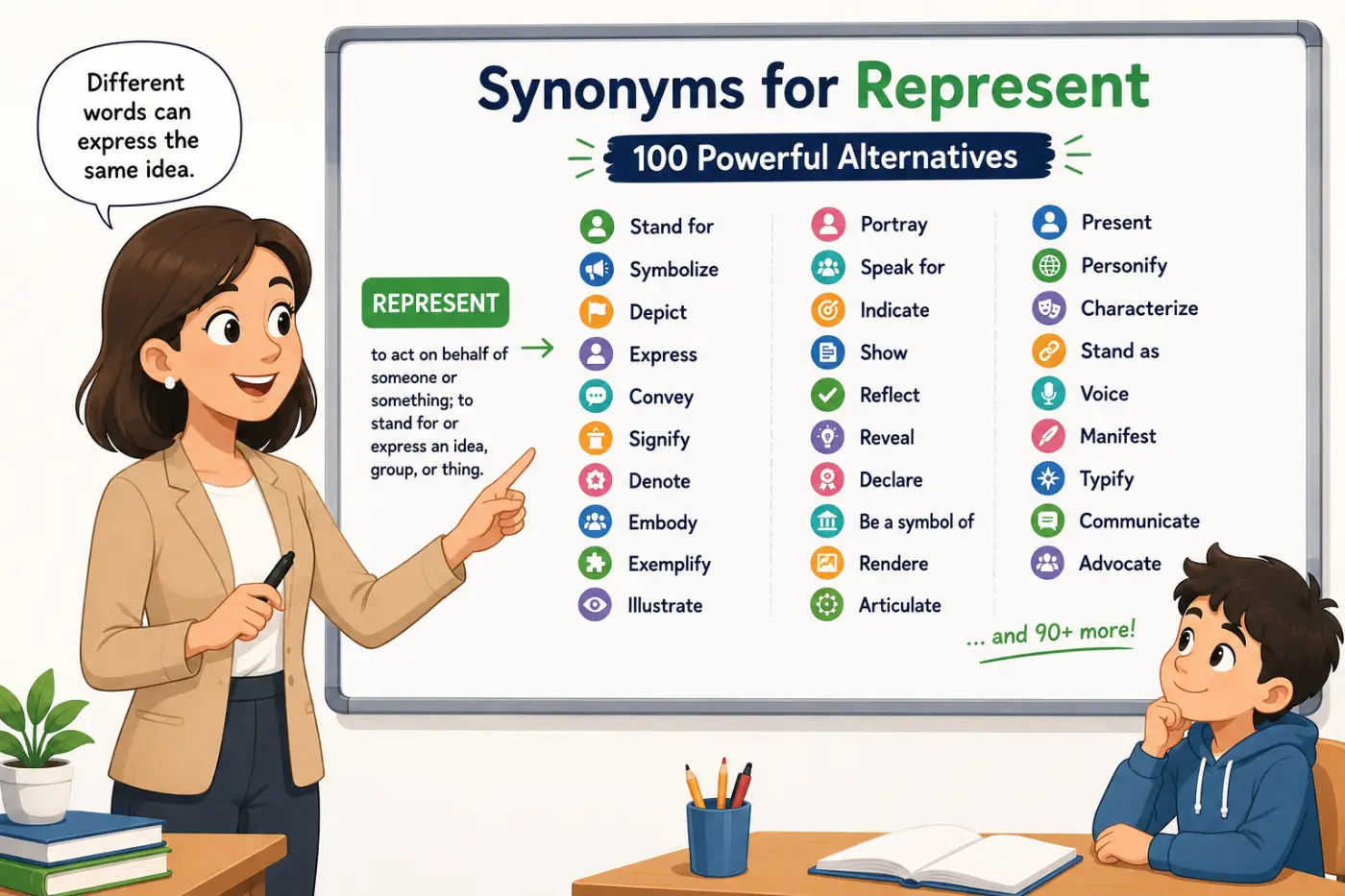
Finding the right synonyms for represent can make your writing clearer, more professional, and more engaging. The verb represent has several meanings, so there is no single replacement that works in every sentence. Sometimes it means to symbolize, while in other situations it means to act on behalf of someone, to depict, to indicate, or to stand for.
This variety often creates confusion. Writers, students, business professionals, and English learners frequently search for better alternatives because repeating represent throughout a document can make writing sound dull. The best synonym depends entirely on the context.
In this guide, you’ll learn the strongest synonyms for represent, how each one differs in meaning, when to use it, common mistakes to avoid, pronunciation tips, grammar guidance, real-world examples, and expert editing advice. By the end, you’ll know exactly which alternative fits every situation.
Quick Definition
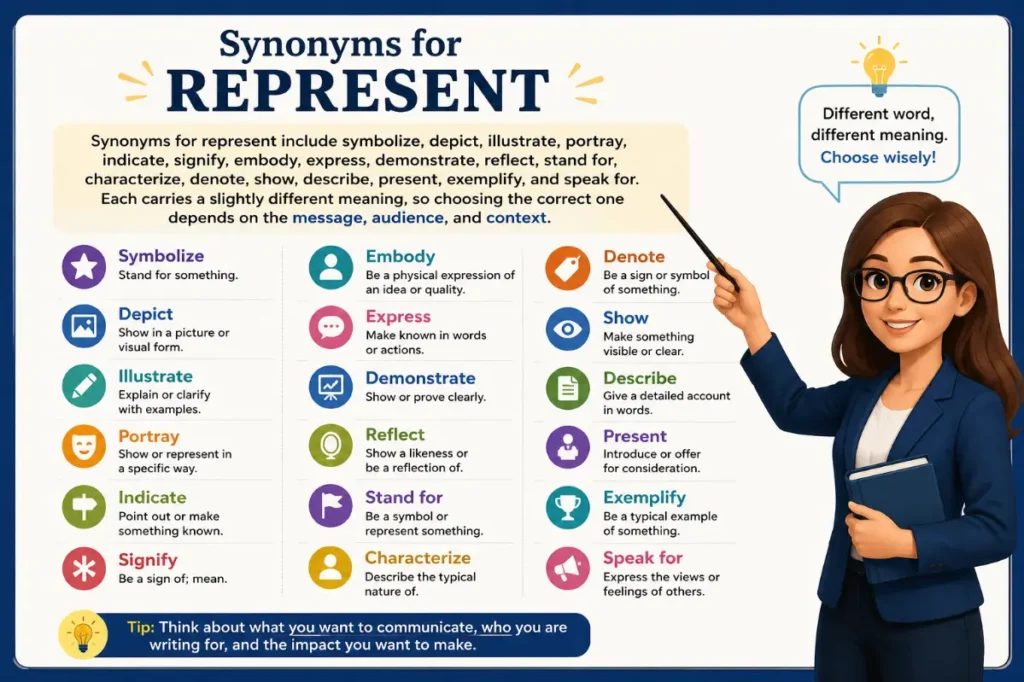
Synonyms for represent include symbolize, depict, illustrate, portray, indicate, signify, embody, express, demonstrate, reflect, stand for, characterize, denote, show, describe, present, exemplify, and speak for. Each carries a slightly different meaning, so choosing the correct one depends on the message, audience, and context.
Quick Answer
If you’re looking for the best synonyms for represent, your strongest options include:
- Symbolize.
- Stand for.
- Depict.
- Portray.
- Illustrate.
- Reflect.
- Indicate.
- Signify.
- Embody.
- Express.
- Demonstrate.
- Show.
- Describe.
- Characterize.
- Denote.
- Exemplify.
- Present.
- Speak for.
- Mirror.
- Convey.
Each synonym fits a different purpose. For example, symbolize works best for abstract ideas, depict suits visual descriptions, speak for refers to acting on someone’s behalf, and indicate is ideal when discussing facts or evidence.
Comparison Table for Synonyms for Represent
| Word | Primary Meaning | Part of Speech | Origin | Usage Frequency | Formality | Common Contexts | Example |
|---|---|---|---|---|---|---|---|
| Represent | Stand for or act for | Verb | Latin | Very High | Neutral | General writing | The flag represents freedom. |
| Symbolize | Express an idea symbolically | Verb | Greek through Latin | High | Formal | Literature, culture | The dove symbolizes peace. |
| Stand for | Mean or represent | Phrasal verb | Old English | Very High | Neutral | Everyday English | Red stands for danger. |
| Depict | Show visually | Verb | Latin | High | Formal | Art, media | The painting depicts a village. |
| Portray | Describe or present | Verb | Old French | High | Formal | Writing, acting | The actor portrayed Lincoln. |
| Illustrate | Explain with examples or images | Verb | Latin | High | Formal | Education | The chart illustrates growth. |
| Reflect | Show characteristics | Verb | Latin | High | Neutral | Reports, opinions | The survey reflects public opinion. |
| Indicate | Point out or suggest | Verb | Latin | Very High | Formal | Research | Results indicate improvement. |
| Signify | Mean or indicate | Verb | Latin | Medium | Formal | Academic writing | The gesture signifies respect. |
| Embody | Express in concrete form | Verb | French | Medium | Formal | Leadership | She embodies resilience. |
| Express | Communicate clearly | Verb | Latin | Very High | Neutral | Communication | His words express gratitude. |
| Demonstrate | Show with evidence | Verb | Latin | High | Formal | Science, business | The data demonstrate success. |
| Denote | Mean directly | Verb | Latin | Medium | Formal | Linguistics | Red denotes danger. |
| Exemplify | Serve as an example | Verb | Latin | Medium | Formal | Academic writing | The project exemplifies innovation. |
Meaning of Represent
The verb represent has several accepted meanings in modern English.
To Stand for Something
A word, sign, number, or object can represent an idea or concept.
Example:
The olive branch represents peace.
To Act on Someone’s Behalf
A lawyer, agent, ambassador, or spokesperson may represent another person or organization.
Example:
She represents several international companies.
To Show or Depict
Books, paintings, diagrams, films, and photographs often represent people, places, or events.
Example:
The sculpture represents a famous historical leader.
To Indicate
Statistics and percentages often represent quantities or trends.
Example:
This figure represents nearly half the population.
Meanings of the Best Synonyms
Symbolize
Symbolize means to serve as a symbol of something abstract.
Example:
The crown symbolizes authority.
Depict
Depict means to show something visually or describe it in detail.
Example:
The novel depicts rural life.
Portray
Portray focuses on presenting someone or something through words, art, or performance.
Example:
The documentary portrays life during the Great Depression.
Reflect
Reflect means to reveal, mirror, or show characteristics.
Example:
His actions reflect honesty.
Indicate
Indicate means to point toward evidence or suggest a conclusion.
Example:
The report indicates rising demand.
Embody
Embody means to be a perfect example of an idea or quality.
Example:
She embodies determination.
Demonstrate
Demonstrate emphasizes proof through evidence or action.
Example:
The experiment demonstrates the theory.
Signify
Signify means to communicate meaning, often formally.
Example:
A raised hand signifies agreement.
Synonyms for Represent by Meaning
Choosing the correct synonym becomes much easier when you group the words by their purpose.
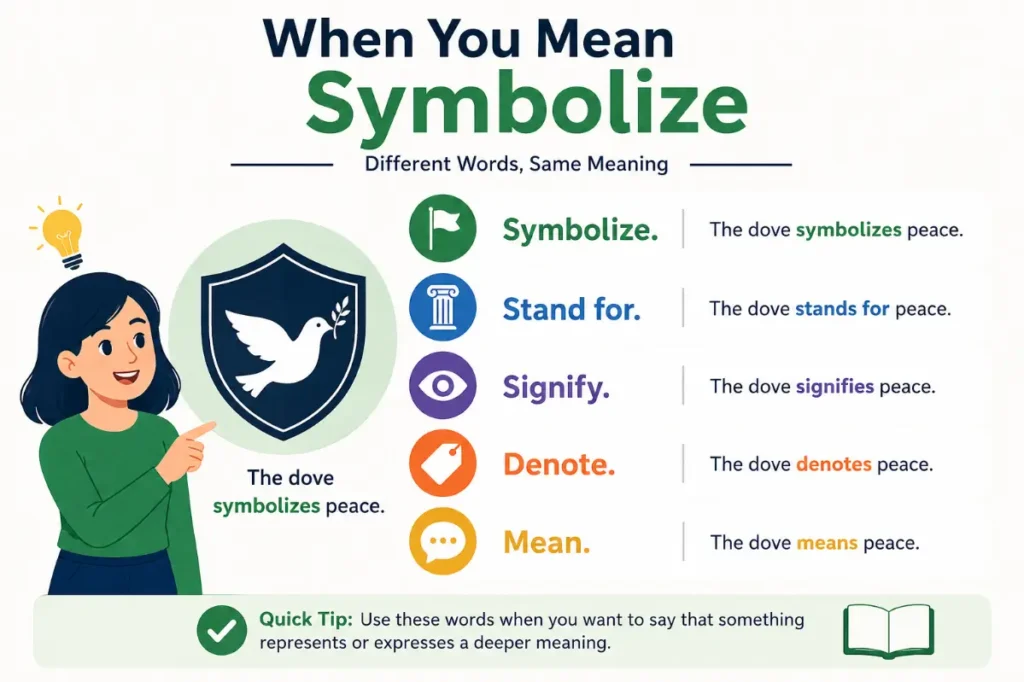
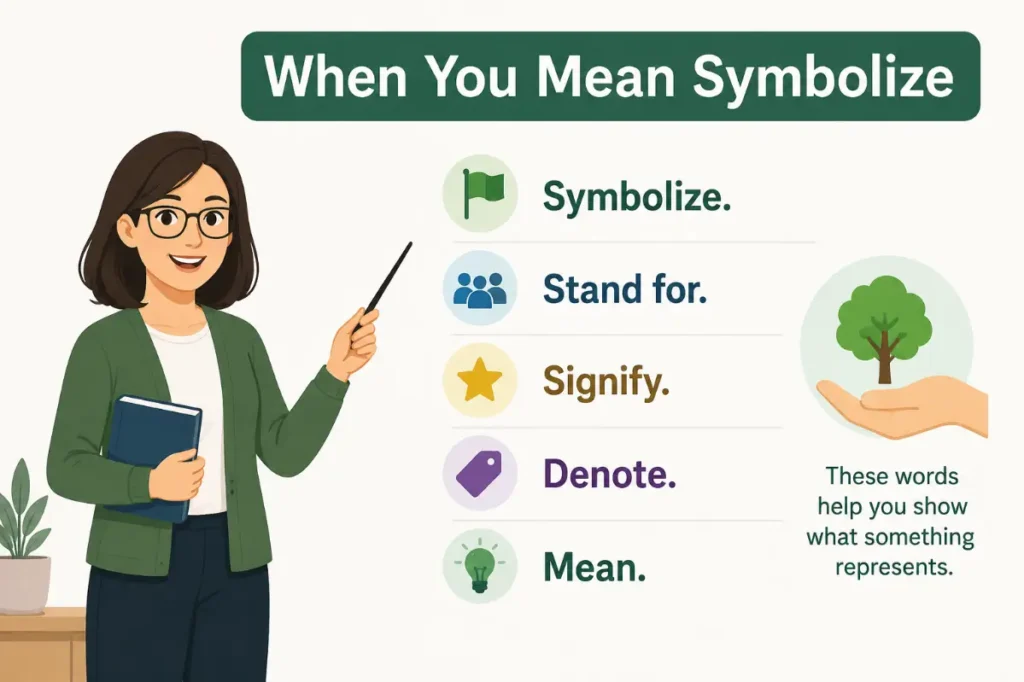
When You Mean Symbolize
- Symbolize.
- Stand for.
- Signify.
- Denote.
- Mean.
When You Mean Be an Example
- Embody.
- Exemplify.
- Personify.
- Characterize.
- Mirror.
Key Differences Between Represent and Its Synonyms
Although many dictionaries list these words as synonyms, they are not always interchangeable.
Represent vs Symbolize
Represent has many meanings. Symbolize focuses only on symbolic meaning.
Correct:
The white flag symbolizes surrender.
Represent vs Depict
Represent is broad. Depict emphasizes pictures, writing, films, or visual description.
Correct:
The mural depicts local history.
Represent vs Indicate
Represent often replaces something. Indicate points toward evidence or information.
Correct:
The numbers indicate higher sales.
Represent vs Embody
Represent may simply refer to something. Embody means fully expressing a quality.
Correct:
She embodies kindness.
Represent vs Speak for
Represent can refer to legal or official authority. Speak for is more conversational.
Correct:
The union president speaks for the employees.
Which Synonym Is Correct?
There is no universally correct synonym for represent because each alternative highlights a different shade of meaning.
Choose:
- Symbolize for abstract ideas.
- Depict for visual descriptions.
- Illustrate for explanations.
- Indicate for facts and evidence.
- Reflect for characteristics.
- Speak for when acting on behalf of others.
- Embody for personal qualities.
- Demonstrate when proving something with evidence.
Using the wrong synonym can subtly change the meaning of a sentence, so context matters more than finding a direct replacement.
Examples of Synonyms for Represent in Sentences
Learning synonyms becomes much easier when you see them in real sentences. The examples below show how each alternative works naturally in everyday English.
Symbolize Examples
- The eagle symbolizes strength and freedom.
- White flowers often symbolize purity.
- The broken chain symbolizes liberation.
- The ring symbolizes lifelong commitment.
- This monument symbolizes national unity.
- Blue often symbolizes trust in branding.
- The torch symbolizes hope for the future.
- Their handshake symbolizes mutual respect.
- The heart symbolizes love around the world.
- The rainbow symbolizes diversity and inclusion.
Depict Examples
- The painting depicts a quiet fishing village.
- The novel depicts life during the Civil War.
- The documentary depicts the challenges of climate change.
- The mural depicts local history beautifully.
- The illustration depicts the human heart.
- The sculpture depicts a famous explorer.
- The film depicts everyday family life.
- The artist depicts nature with remarkable detail.
- The map depicts trade routes across Europe.
- The comic depicts childhood adventures.
Portray Examples
- The actor portrays the president convincingly.
- The article portrays the company in a positive light.
- The biography portrays her as determined and compassionate.
- The series portrays the realities of modern medicine.
- The novel portrays friendship realistically.
- The documentary portrays survivors with dignity.
- The newspaper portrays the event fairly.
- The play portrays social inequality.
- The museum portrays ancient civilizations through interactive exhibits.
- The author portrays childhood memories vividly.
Indicate Examples
- The results indicate significant improvement.
- Dark clouds indicate approaching rain.
- The survey indicates changing consumer habits.
- These numbers indicate strong economic growth.
- The warning light indicates low fuel.
- Research indicates that exercise improves health.
- The graph indicates seasonal demand.
- Her smile indicates confidence.
- The data indicate a clear trend.
- Early signs indicate a successful launch.
Reflect Examples
- His actions reflect honesty.
- The design reflects modern architecture.
- The report reflects current market conditions.
- Her writing reflects years of experience.
- The budget reflects company priorities.
- These results reflect customer feedback.
- The policy reflects changing regulations.
- The photograph reflects everyday life.
- Their culture reflects centuries of tradition.
- The review reflects public opinion.
Embody Examples
- She embodies resilience.
- The coach embodies leadership.
- The company embodies innovation.
- This award embodies excellence.
- The character embodies courage.
- Their mission embodies integrity.
- The athlete embodies discipline.
- The organization embodies community service.
- The design embodies simplicity.
- The project embodies sustainable thinking.
Demonstrate Examples
- The experiment demonstrates the theory.
- The report demonstrates measurable progress.
- His work demonstrates exceptional skill.
- The results demonstrate customer satisfaction.
- This case demonstrates the importance of planning.
- The graph demonstrates annual growth.
- Their actions demonstrate commitment.
- The teacher demonstrated the correct technique.
- The figures demonstrate increasing demand.
- The project demonstrates practical innovation.
Stand for Examples
- The letters NASA stand for National Aeronautics and Space Administration.
- Green often stands for environmental awareness.
- The flag stands for national pride.
- The logo stands for quality.
- This symbol stands for recycling.
- The initials stand for the founder’s name.
- The dove stands for peace.
- The color black stands for elegance.
- The trophy stands for achievement.
- The badge stands for authority.
Common Mistakes When Using Synonycms for Represent
Even experienced writers sometimes choose a synonym that changes the intended meaning. Understanding these common mistakes helps your writing sound more precise and natural.
Using Symbolize Instead of Depict
These words are often confused because both involve expressing meaning.
Incorrect:
The painting symbolizes a mountain landscape.
Correct:
The painting depicts a mountain landscape.
Confusing Represent with Indicate
Incorrect:
The statistics represent inflation is increasing.
Correct:
The statistics indicate that inflation is increasing.
Using Embody Too Broadly
Incorrect:
The chart embodies last year’s sales.
Correct:
The chart represents last year’s sales.
Replacing Every Instance of Represent
Many writers replace every occurrence of represent with another synonym. That usually makes the writing less accurate.
For example:
The lawyer represents the client.
Choosing Formal Words in Casual Conversation
Some alternatives sound much more formal than others.
Formal:
The data signify a significant shift. Natural conversation: The data show a big change.
Pronunciation Guide
Although this article focuses on synonyms for represent, correct pronunciation also helps learners use these words confidently.
| Word | IPA | Syllables |
|---|---|---|
| Represent | /ˌrɛprɪˈzɛnt/ | rep re sent |
| Symbolize | /ˈsɪmbəˌlaɪz/ | sym bol ize |
| Depict | /dɪˈpɪkt/ | de pict |
| Portray | /pɔːrˈtreɪ/ | por tray |
| Illustrate | /ˈɪləˌstreɪt/ | il lus trate |
| Reflect | /rɪˈflɛkt/ | re flect |
| Indicate | /ˈɪndɪˌkeɪt/ | in di cate |
| Signify | /ˈsɪɡnəˌfaɪ/ | sig ni fy |
| Embody | /ɪmˈbɑːdi/ | em bod y |
| Demonstrate | /ˈdɛmənˌstreɪt/ | dem on strate |
Common Pronunciation Mistakes
- Stress the final syllable in represent.
- Do not pronounce the b separately in symbolize.
- Keep the second syllable clear in depict.
- Avoid adding extra syllables to reflect.
- Place the strongest stress on the final syllable of portray.
Etymology and Word Origin
Understanding where words come from often makes their meanings easier to remember.
Represent
Represent comes from the Latin repraesentare, meaning to bring before the eyes, to exhibit, or to show clearly. It entered Middle English through Old French and gradually developed several meanings, including acting on behalf of another person, depicting something visually, and symbolizing an idea.
Symbolize
Derived from the Greek word symbolon, meaning token or sign, symbolize entered English through Latin and French. It has long been associated with literature, religion, and art.
Depict
Depict originates from the Latin depingere, meaning to paint or portray. That artistic origin explains why it is still strongly connected with visual representation.
Portray
This word entered English from Old French and ultimately comes from Latin roots meaning to draw or to describe. Today it commonly refers to artistic, literary, and dramatic presentation.
Illustrate
Illustrate comes from the Latin illustrare, meaning to illuminate or make clear. That original idea of making something clearer still appears in modern usage.
Reflect
Reflect derives from the Latin reflectere, meaning to bend back. Over time it developed figurative meanings related to showing, revealing, or mirroring ideas and qualities.
Regional Usage
Most synonyms for represent are understood throughout the English-speaking world. The main differences involve style and frequency rather than meaning.
| Region | Common Preferences |
|---|---|
| American English | represent, show, indicate, reflect, symbolize |
| British English | represent, portray, signify, illustrate |
| Canadian English | Similar to American English with occasional British influence |
| Australian English | represent, depict, reflect, show |
American English
American writers frequently choose show, reflect, indicate, and represent because they sound direct and natural.
Example:
The survey indicates growing interest.
British English
British English often favors slightly more formal alternatives such as signify, portray, and illustrate, particularly in academic writing.
Example:
The findings signify an important change.
Canadian English
Canadian English blends American and British vocabulary, making both represent and portray common depending on the publication.
Australian English
Australian English generally follows the same usage patterns as British English while keeping everyday language straightforward.
Grammar Rules for Represent and Its Synonyms
Most synonyms for represent function as verbs, but they do not all follow identical grammar patterns.
Part of Speech
The primary word represent is a transitive verb. It requires a direct object.
Correct:
The statue represents justice.
Incorrect: The statue represents.
Verb Forms
| Base | Past | Past Participle | Present Participle |
|---|---|---|---|
| Represent | Represented | Represented | Representing |
| Depict | Depicted | Depicted | Depicting |
| Portray | Portrayed | Portrayed | Portraying |
| Reflect | Reflected | Reflected | Reflecting |
| Demonstrate | Demonstrated | Demonstrated | Demonstrating |
Common Sentence Patterns
Subject + represent + noun.
Example:
The logo represents trust.
Subject + indicate + clause.
Example:
The report indicates that profits increased.
Subject + embody + quality.
Example:
She embodies confidence.
Subject + depict + object.
Example:
The artist depicts nature beautifully.
Real Life Usage Examples of Synonyms for Represent
The best writers choose words that fit the situation instead of relying on one verb repeatedly. These examples show how native English speakers naturally use synonyms for represent in different settings.
Daily Conversation
- This gift symbolizes our friendship.
- His reaction shows how much he cares.
- That photo captures a special memory.
- Your answer reflects careful thinking.
- The badge stands for years of service.
Everyday speech usually favors simple verbs such as show, mean, stand for, and reflect because they sound natural and easy to understand.
Academic Writing
- The results indicate a significant improvement.
- The graph illustrates population growth.
- These findings demonstrate a strong relationship.
- The data suggest a clear trend.
- The research reflects current educational practices.
Academic writing values precision. Words such as indicate, demonstrate, and illustrate often sound more appropriate than simply repeating represent.
Professional Communication
- Our sales team speaks for the company during client meetings.
- The report summarizes last quarter’s performance.
- This chart shows annual revenue growth.
- The proposal reflects our long term strategy.
- The manager presented the company’s vision.
Business writing should remain clear and direct. Strong verbs help readers understand the message quickly.
Literature
Authors often choose vivid alternatives to create stronger imagery.
Example:
The old oak tree symbolized endurance through generations.
Example:
The novel portrays hope in the face of hardship.
Example:
The river mirrors the character’s emotional journey.
Journalism and Media
News organizations prefer verbs that sound objective.
Examples include:
- The report indicates rising inflation.
- Witnesses described the incident.
- The images depict widespread flooding.
- Experts suggest additional research.
- The survey reflects public opinion.
Related Words and Confused Terms
People searching for synonyms for represent often look for closely related words. Some are true synonyms, while others overlap only in specific situations.
| Word | Relationship |
|---|---|
| Symbolize | Close synonym for abstract meaning. |
| Depict | Close synonym for visual description. |
| Portray | Similar in artistic and literary contexts. |
| Illustrate | Similar when explaining ideas. |
| Show | General everyday synonym. |
| Demonstrate | Strong when proving something. |
| Reflect | Suggests mirroring qualities. |
| Indicate | Points toward facts or evidence. |
| Signify | Formal alternative meaning indicate. |
| Express | Focuses on communicating ideas or feelings. |
| Embody | Means to perfectly express a quality. |
| Describe | Focuses on giving details. |
| Present | Means introduce or display. |
| Characterize | Highlights defining qualities. |
| Exemplify | Means serve as an example. |
| Mirror | Suggests close resemblance. |
| Convey | Means communicate an idea. |
| Suggest | Implies rather than proves. |
| Mean | Everyday replacement in many situations. |
| Stand for | Common phrasal verb meaning represent. |
These related words strengthen your vocabulary and help you avoid repeating the same verb throughout an article, report, or presentation.
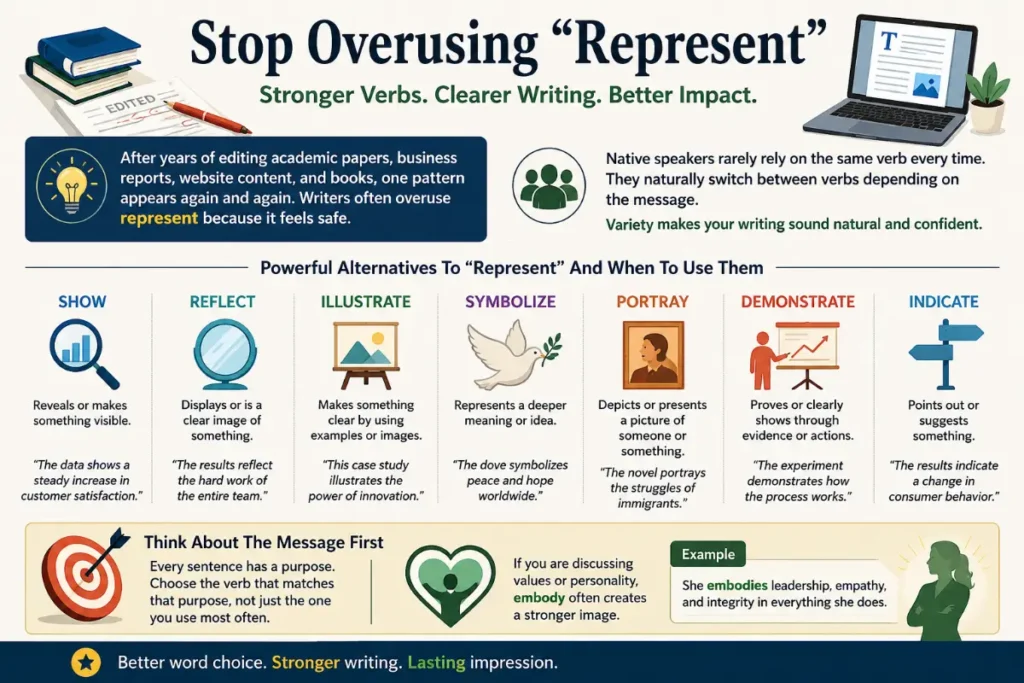
Expert Language Insight
After years of editing academic papers, business reports, website content, and books, one pattern appears again and again. Writers often overuse represent because it feels safe. Native speakers rarely rely on the same verb every time. They naturally switch between show, reflect, illustrate, symbolize, portray, demonstrate, and indicate depending on the sentence. Think about the message first. If you are discussing values or personality, embody often creates a stronger image.
Conclusion
Choosing the right synonyms for represent is not about finding one perfect replacement. It is about selecting the word that matches your meaning. If something stands for an idea, use symbolize or stand for. If you’re describing art, books, films, or images, depict and portray are usually stronger.
Expanding your vocabulary makes your writing clearer, more engaging, and more precise. Instead of repeating represent throughout a paragraph, choose the synonym that naturally fits the context. That simple habit helps your writing sound more polished while keeping your meaning accurate.
Frequently Asked Questions
What are the best synonyms for represent?
Some of the strongest synonyms include symbolize, depict, portray, illustrate, reflect, indicate, demonstrate, embody, show, express, stand for, and signify. The best choice depends on your context because each word emphasizes a different meaning.
Can I always replace represent with symbolize?
No. Symbolize works only when something stands for an abstract idea, concept, or value. It cannot replace represent in legal, business, mathematical, or statistical contexts.
Which synonym sounds most professional?
In professional writing, indicate, demonstrate, reflect, illustrate, and present are often the strongest choices. They sound precise without becoming overly formal.
What is the simplest alternative to represent?
For everyday English, show is usually the easiest replacement. It is widely understood, works in many situations, and sounds natural in conversation and informal writing.
Is represent a formal word?
No. Represent is considered neutral. It appears comfortably in casual conversation, journalism, academic writing, legal documents, and professional communication.
Which synonym works best in academic writing?
Academic writing often favors indicate, demonstrate, illustrate, reflect, and suggest because these verbs describe evidence, research findings, and analysis accurately.
How can I avoid repeating represent?
Instead of replacing every instance automatically, choose a synonym that matches the intended meaning. Rotating between show, depict, embody, illustrate, indicate, and reflect creates smoother writing without changing the meaning.
Do native English speakers use represent often?
Yes. Native speakers use represent regularly, especially in business, education, politics, law, mathematics, and everyday conversation. They also switch naturally to more specific verbs when those verbs communicate the idea more precisely.
