
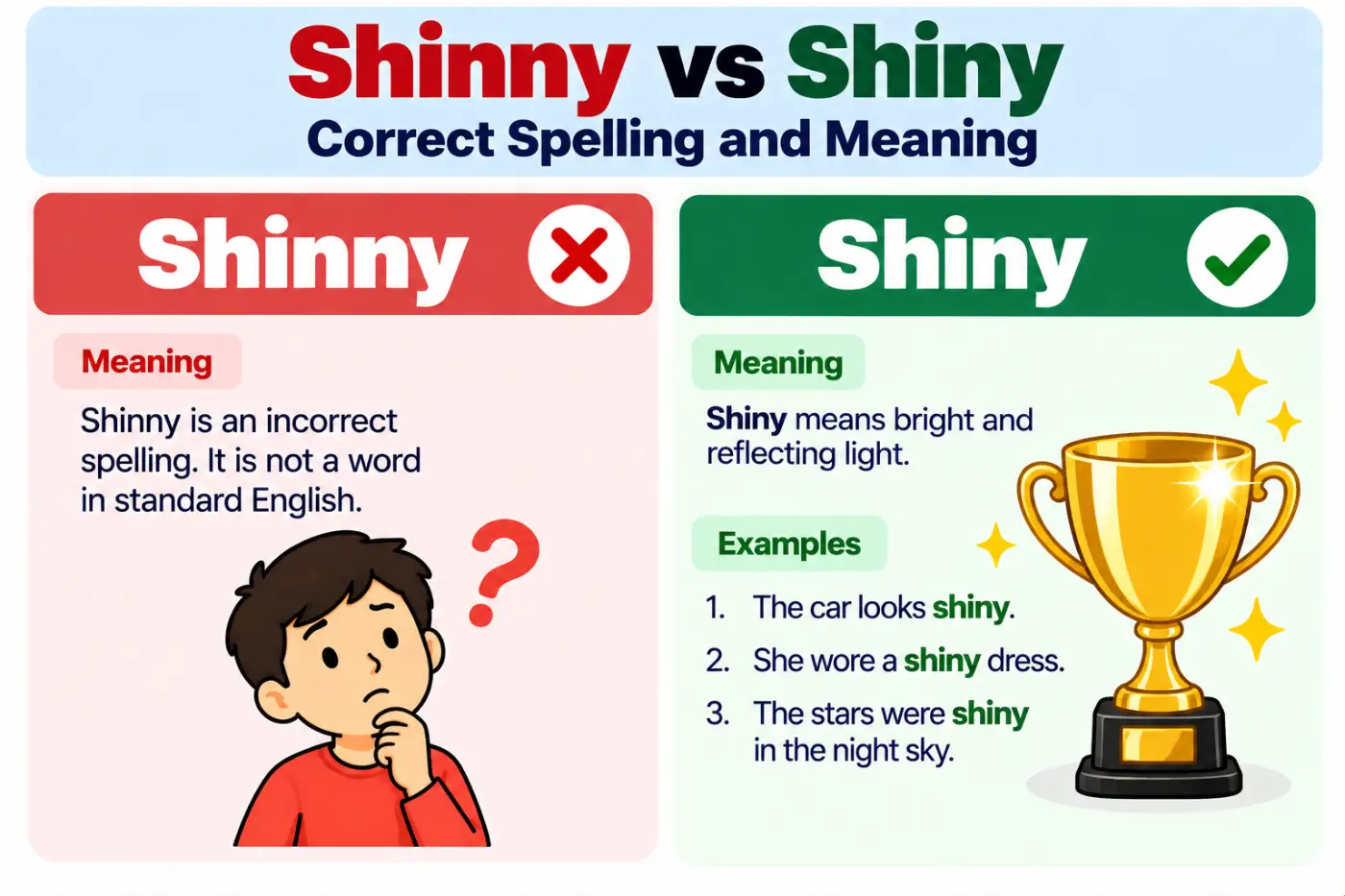
shinny vs shiny can be confusing because the words differ by only one letter, yet they do not mean the same thing. If you are describing something bright, glossy, polished, or reflective, the correct word is shiny. Shinny is also a real English word, but it has much narrower meanings connected with informal hockey or climbing.
The extra n is not simply an alternate spelling. It creates a different word with a different pronunciation, part of speech, and meaning. This is why writing “a shinny car” when you mean a car with a bright surface is a spelling error, not a stylistic variation.
Knowing the difference is useful in everyday writing, school assignments, workplace communication, product descriptions, and formal documents. Once you connect shiny with shine, the spelling becomes much easier to remember. This guide explains both words clearly, including their meanings, grammar, pronunciation, word origins, common mistakes, and natural examples.
Quick Answer
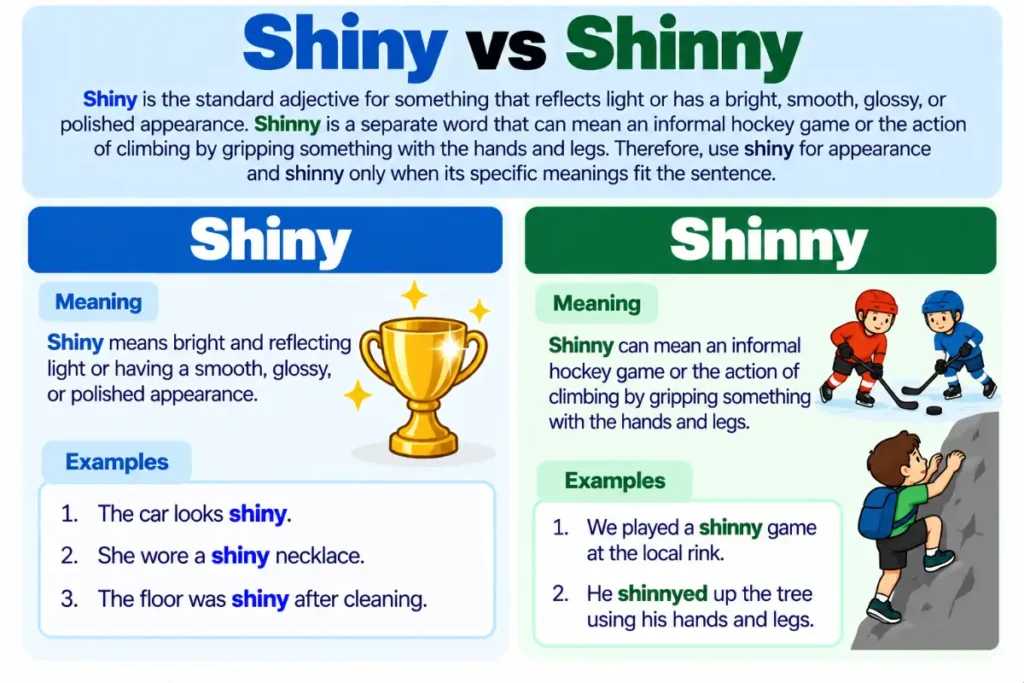
Shiny is the standard adjective for something that reflects light or has a bright, smooth, glossy, or polished appearance. Shinny is a separate word that can mean an informal hockey game or the action of climbing by gripping something with the hands and legs. Therefore, use shiny for appearance and shinny only when its specific meanings fit the sentence.
Quick Answer
If you mean that something looks bright, glossy, polished, or reflective, use shiny.
If you mean an informal hockey game or the act of climbing something by gripping it with your hands and legs, shinny is the appropriate word.
So these sentences are correct:
- The car has a shiny finish.
- The children played shinny after school.
- He shinnied up the pole.
The words are not interchangeable.
Comparison Table
| Form | Meaning | Part of Speech | Pronunciation | Usage | Common Contexts | Example |
|---|---|---|---|---|---|---|
| Shiny | Bright, glossy, smooth, or reflective | Adjective | /ˈʃaɪni/ | Very common | Objects, surfaces, clothing, hair, metal, glass | The table has a shiny surface. |
| Shinny | An informal hockey game | Noun | /ˈʃɪni/ | Less common | Canadian and North American hockey contexts | They played shinny on the outdoor rink. |
| Shinny | To climb by gripping with the hands and legs | Verb | /ˈʃɪni/ | Uncommon | Physical movement, especially North American English | He shinnied up the pole. |
The important point is that shinny is not a misspelling in every situation. Dictionaries recognize it as a legitimate noun and verb. The spelling becomes wrong only when you use it where shiny is required.
What Does Shiny Mean?
Shiny is an adjective that describes something with a bright, smooth, glossy, or light reflecting surface.
You can use it for physical objects and surfaces such as:
- Metal.
- Glass.
- Shoes.
- Cars.
- Jewelry.
- Floors.
- Furniture.
- Hair.
- Clothing.
- Paper or printed surfaces.
For example:
The silver spoon is shiny.
Here, shiny describes the appearance of the spoon.
The word can also describe something that appears new, attractive, or appealing in an informal or figurative sense. For example, someone might talk about a “shiny new phone” even when the main idea is that the phone is new and attractive rather than simply reflective.
The core meaning, however, remains connected to brightness, gloss, and reflected light.
Shiny as an Adjective
The word functions as an adjective because it describes a noun.
You can put it directly before a noun:
She bought a shiny necklace.
You can also use it after a linking verb:
The necklace looks shiny.
In the first sentence, shiny comes before the noun necklace. In the second, it follows looks and describes the necklace.
Comparative and Superlative Forms
The adjective also has comparative and superlative forms.
The comparative form is shinier.
This floor is shinier than the old one.
The superlative form is shiniest.
That was the shiniest car at the show.
Notice the spelling carefully. The forms are shinier and shiniest, not forms created by adding another n.
What Does Shinny Mean?
Shinny is a legitimate English word, but it is much less common than shiny.
It has two main uses.
First, shinny can be a noun referring to an informal form of hockey. It is especially associated with North American and Canadian usage. Oxford describes it as an informal form of ice hockey, particularly one played by children.
For example:
The kids played shinny at the outdoor rink.
Second, shinny can be a verb meaning to climb something by using the hands and legs for gripping. Oxford identifies this verb as North American English and gives shin as the British English equivalent.
For example:
The boy shinnied up the tree.
This meaning is quite different from describing something as bright or glossy.
Shinny as a Noun
As a noun, shinny can refer to an informal hockey game.
We played shinny on the frozen pond.
The plural form is shinnies when referring to multiple games or uses where a plural is appropriate.
Shinny as a Verb
As a verb, shinny describes a type of climbing movement.
He shinnied up the pole.
Its common forms include:
- Shinny.
- Shinnies.
- Shinnied.
- Shinnying.
Oxford lists shinnied as the past form and shinnying as the present participle.
Why the Extra N Changes the Meaning
The spelling difference looks tiny, but it creates two separate words.
Shiny is connected to shine.
shine → shiny
Shinny, in its climbing sense, is related to shin. Its hockey sense has a separate historical development. American Heritage identifies the hockey word as probably coming from the phrase “shin ye,” while the climbing verb developed as an alteration of shin.
That explains why adding another n does not make the adjective stronger or more descriptive.
You cannot use shinny to mean “very shiny.”
For example:
The new car has a shinny finish.
This is incorrect if you mean that the finish reflects light.
The correct sentence is:
The new car has a shiny finish.
Key Differences Explained
The difference becomes simple when you compare meaning, grammar, and pronunciation.
- Spelling: Shiny has one n. Shinny has two.
- Meaning: Shiny describes appearance. Shinny refers to informal hockey or a climbing action.
- Part of speech: Shiny is an adjective. Shinny can be a noun or verb.
- Pronunciation: Shiny begins with the vowel sound in “shy,” while shinny begins with the vowel sound in “shin.”
- Usage: Shiny is common in everyday English. Shinny is much less common and appears in specific contexts.
- Regional use: The climbing verb is especially associated with North American English, while British English commonly uses shin for this action.
- Context: Shiny often appears with words such as car, shoes, hair, metal, floor, and surface. Shinny appears in contexts involving hockey or climbing.
- Grammar: Shiny modifies nouns. Shinny can name an activity or describe an action.
The biggest clue is meaning. If you are talking about how something looks, you almost certainly need shiny.
Which Form Is Correct?
The answer depends on the meaning.
If you are describing something that reflects light, shiny is correct.
So it would be inaccurate to say that shinny is simply wrong. It is a real word with established dictionary entries. The mistake happens when writers use it in place of shiny.
Sentence Examples
Here are natural examples showing how shiny works in everyday English.
- The new car has a shiny black finish.
- Her shoes looked shiny after she polished them.
- The children were attracted to the shiny object.
- I bought a shiny silver watch for my brother.
- The kitchen floor looked shiny after it was cleaned.
- His hair looked shiny under the bright lights.
- The company chose a shiny finish for the product packaging.
- The polished table was smooth and shiny.
- The student used a shiny cover for the school project.
- The new phone has a shiny glass back.
These examples show that the adjective can describe many different surfaces and objects.
Now compare those sentences with the legitimate uses of shinny:
The children played shinny after school.
The player joined a casual game of shinny.
He shinnied up the tree to reach the branch.
The worker shinnied up the pole carefully.
These examples show why context matters. The extra n changes the word rather than simply changing its spelling style.
Common Mistakes and Misspellings
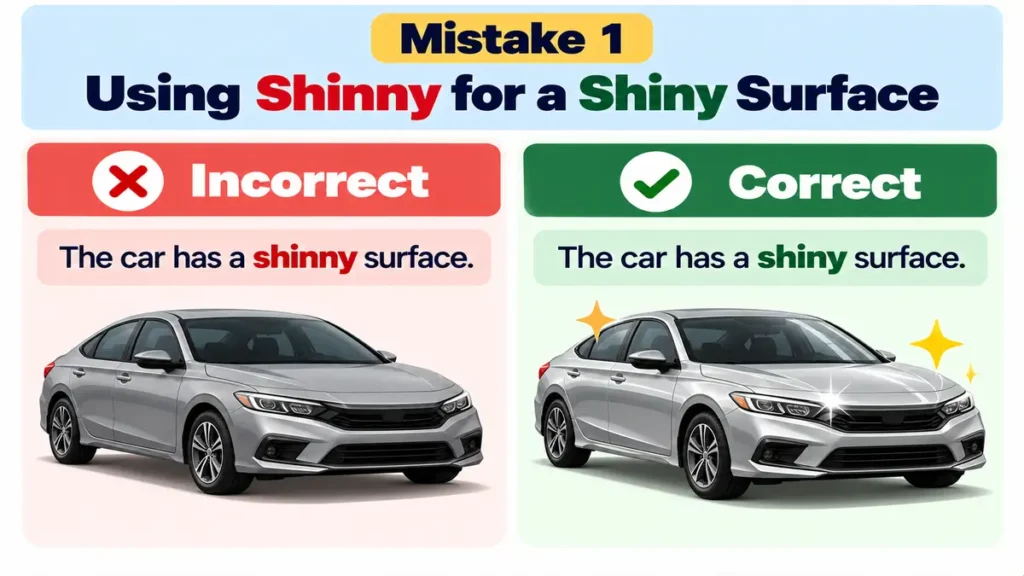
Mistake 1: Using Shinny for a Shiny Surface
Incorrect:
The car has a shinny surface.
Correct:
The car has a shiny surface.
The writer is describing appearance, so the adjective shiny is required.
Mistake 2: Treating Shinny as a Misspelling Every Time
Incorrect assumption:
Shinny is always wrong.
That is not accurate. Shinny is a legitimate word with established noun and verb uses.
Mistake 3: Confusing the Vowel Sounds
The words are not pronounced the same way.
Shiny begins with /aɪ/, as in my or sky.
Shinny begins with /ɪ/, as in sit or ship.
This pronunciation difference can help you choose the correct word when speaking.
Mistake 4: Adding an Extra N Because of Shin
Some writers see shin inside shinny and assume the word describing brightness should also contain two n’s.
That connection is misleading.
For the adjective, think:
shine → shiny
Not:
shin → shinny
Mistake 5: Confusing the Related Forms
The correct adjective is shiny.
Its comparative form is shinier.
Its superlative form is shiniest.
The verb shinny, on the other hand, has forms such as shinnied and shinnying. These belong to a different word and should not be mixed together.
Pronunciation Guide
The pronunciation difference is useful because it reinforces the difference in meaning.
Shiny
IPA:
/ˈʃaɪni/
Easy pronunciation:
SHY-nee
It has two syllables:
SHY + nee
The first syllable receives the main stress.
The vowel in the first syllable is the same sound you hear in words such as my, sky, and bright.
Shinny
IPA:
/ˈʃɪni/
Easy pronunciation:
SHIN-ee
It also has two syllables:
SHIN + ee
The first syllable is stressed.
The vowel sound is the short i sound found in words such as sit, ship, and win.
The distinction is therefore:
shiny = SHY-nee
shinny = SHIN-ee
For English learners, listening for that first vowel can make the difference easier to recognize.
Etymology and Word Origin
The two words have different histories.
The adjective shiny is related to shine, the word associated with giving off or reflecting light. The formation follows a familiar English pattern in which -y creates an adjective describing a quality.
The history of shinny is more complex because the noun and verb have different origins.
The hockey noun is recorded as a historical variant associated with the name of the game. American Heritage traces it probably to the phrase “shin ye,” a cry used during the game. Dictionary.com places its earliest recorded use in the late seventeenth century.
The climbing verb developed from shin. Oxford dates this form to the late nineteenth century and identifies it as coming from the noun shin plus -y.
This history helps explain why the spelling difference is meaningful. The two words are not simply different spellings of one adjective.
American English
In American English, shiny is the normal adjective for something that reflects light or has a glossy appearance.
You will commonly see it with words such as:
- Shiny car.
- Shiny shoes.
- Shiny hair.
- Shiny metal.
- Shiny floor.
- Shiny surface.
- Shiny jewelry.
- Shiny paper.
Shinny is also a valid American English word, but it is much more specialized.
As a noun, it can refer to informal hockey. As a verb, it can describe climbing by gripping with the hands and legs. Collins and Oxford both record these uses.
British English
There is no different British spelling of shiny. British English also uses shiny for something bright, glossy, or reflective.
The main regional difference concerns the climbing verb.
Oxford lists shinny as North American English and gives shin as the British English equivalent.
For example, an American English sentence may be:
He shinnied up the tree.
A British English speaker may instead say:
He shinned up the tree.
The adjective shiny, however, stays the same.
Canadian English
Canadian English commonly uses shinny in the context of informal hockey. Oxford describes the word as an informal form of ice hockey, while other dictionary sources specifically connect the term with Canadian and North American usage.
For example:
The kids went outside to play shinny.
This does not mean the game was bright or glossy. The word names the activity.
For ordinary descriptions of appearance, Canadian English uses shiny just like American and British English.
Grammar Rules and Part of Speech
Understanding the grammar makes the distinction much easier.
Shiny Is an Adjective
An adjective describes a noun.
She has shiny hair.
Here, shiny describes hair.
You can also place it after a linking verb:
Her hair looks shiny.
Common verbs that can appear before the adjective include:
- Look.
- Seem.
- Appear.
- Become.
- Feel.
For example:
The floor looks shiny.
Shinny Can Be a Noun
As a noun, shinny can name an informal hockey game.
We played shinny after dinner.
The word functions as the name of the activity.
Shinny Can Be a Verb
As a verb, shinny describes a climbing action.
The child shinnied up the pole.
The verb changes according to tense and subject.
He shinnies up the rope.
He shinnied up the rope.
He is shinnying up the rope.
These forms should not be confused with shiny, which remains an adjective.
Real Life Usage Examples
Daily Conversation
In everyday conversation, shiny is common when people describe objects and surfaces.
Your new shoes are really shiny.
The kitchen counter looks shiny after you cleaned it.
The word fits naturally into casual speech because people often comment on how things look.
Workplace Communication
In workplace writing, the adjective may describe products, materials, packaging, or finishes.
The sample has a shiny surface.
Please compare the shiny finish with the matte version.
The spelling matters in professional writing because a simple mistake can make a product description or report look less polished.
Academic Writing
Academic writing may use the word when discussing materials, surfaces, visual properties, or physical characteristics.
The sample developed a shiny surface after treatment.
The word itself is simple, but the surrounding subject can be technical.
News and Journalism
News writing may use shiny in descriptions of vehicles, buildings, objects, clothing, or new products.
The new building features shiny glass panels.
The word can also appear in figurative descriptions of something new or attractive.
Literature and Storytelling
Writers can use shiny to create a visual image.
Moonlight fell across the shiny surface of the lake.
The adjective gives readers a quick picture of how the surface appears.
Shinny is far less common in general prose, but it can appear naturally in stories involving hockey or climbing.
The children spent the afternoon playing shinny.
He shinnied up the old tree before anyone could stop him.
Related and Confused Terms
Several words are closely connected to the meaning of shiny.
Glossy
Glossy describes a smooth surface that reflects light.
The magazine has a glossy cover.
It is especially common for paper, paint, photographs, and finishes.
Gleaming
Gleaming suggests a strong or attractive brightness.
The kitchen was filled with gleaming appliances.
It often creates a more vivid image than the basic adjective.
Glistening
Glistening describes something that shines with reflected light, often because it is wet.
Her face was glistening with sweat.
Polished
Polished can describe something made smooth and bright through polishing.
The polished floor looked beautiful.
Glossy
Although glossy and shiny often overlap, glossy can suggest a particular smooth surface finish.
The brochure has a glossy finish.
Reflective
Reflective focuses on the ability to reflect light.
The material has a highly reflective surface.
It is more technical than shiny in many contexts.
Bright
Bright is broader. It can describe light, colors, rooms, objects, or even a person’s intelligence.
The bright metal caught the sunlight.
Not everything described as bright is necessarily shiny.
Lustrous
Lustrous means having a soft or attractive shine.
It is more formal and less common in ordinary conversation than shiny.
Shiny vs Glossy
These words often overlap, but they are not always identical.
Shiny is a broad everyday adjective for something that reflects light or looks bright and polished.
Glossy often suggests a smooth, polished surface with a noticeable sheen.
For example:
She has shiny hair.
The magazine has a glossy cover.
Both words can describe attractive surfaces, but glossy is especially common when discussing finishes, paper, paint, and printed materials.
Shiny vs Gleaming
Gleaming often creates a stronger visual impression.
Compare:
The car is shiny.
The car is gleaming.
The first sentence simply describes the car’s surface. The second suggests that the car is especially bright, clean, or polished.
Shinny vs Shiny in Everyday Writing
Most people asking about these spellings are trying to describe an object.
They may want to write:
shiny shoes
shiny hair
shiny car
shiny metal
shiny floor
In all of these cases, the answer is shiny.
You are unlikely to need shinny unless your sentence involves one of its specific meanings.
A useful test is to ask:
Am I describing how something looks?
If the answer is yes, use shiny.
If you are talking about informal hockey or climbing, consider shinny.
A Simple Memory Trick
The easiest memory trick is to connect the adjective to its base word:
Shine → shiny
If something shines, it can be shiny.
You can also remember the two special meanings of shinny:
Shinny → shin → climbing
and
Shinny → hockey
So think:
Something shines → shiny.
Someone climbs or plays informal hockey → shinny.
This simple connection prevents most mistakes.
Expert Editor Insight
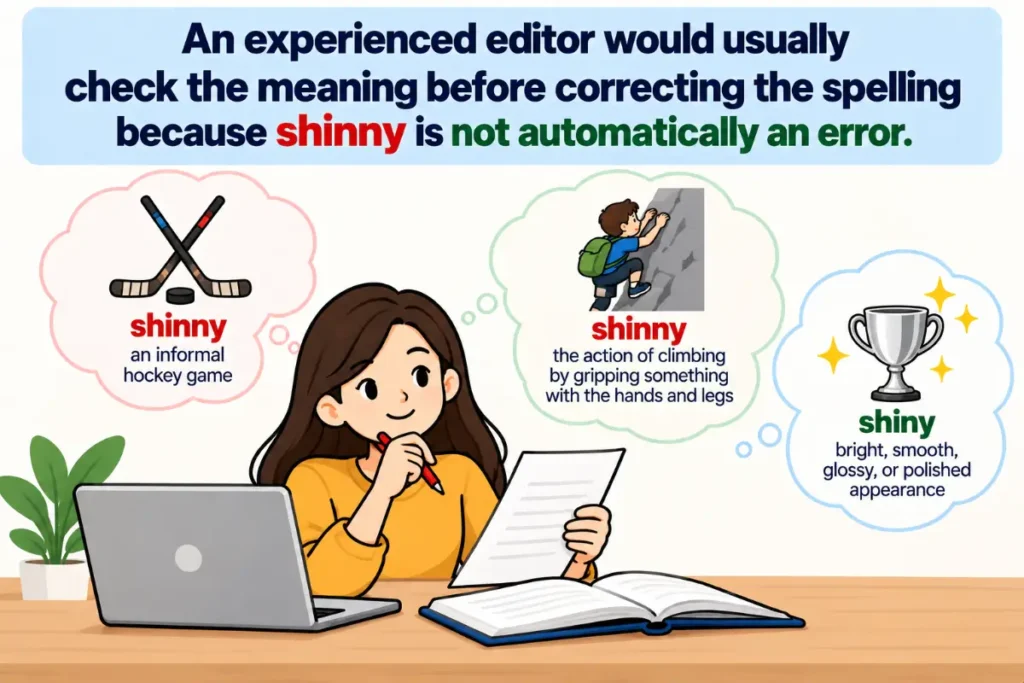
An experienced editor would usually check the meaning before correcting the spelling because shinny is not automatically an error. If a sentence says “the new car has a shinny finish,” the intended word is clearly shiny, but a sentence about children playing hockey may correctly use shinny. Editors also look at nearby words because context often reveals the intended form faster than spelling alone. Spell checkers can help catch accidental substitutions, but they cannot replace meaning based on context.
Conclusion
The difference between shinny vs shiny comes down to meaning, not just spelling. Shiny is the standard adjective for something bright, glossy, smooth, polished, or reflective. Shinny is a separate and legitimate word that can refer to informal hockey or climbing by gripping something with the hands and legs.
For most everyday descriptions of objects, surfaces, shoes, cars, hair, metal, and other things that reflect light, choose shiny. Use shinny only when the context calls for its specific noun or verb meanings.
A simple editing trick is to connect shiny with shine. If something shines, it can be shiny. That quick connection will help you avoid adding the extra n when you mean the common adjective.
FAQs
Is shinny a real word?
Yes. Shinny is a real English word. It can refer to an informal form of hockey, and it can also function as a verb meaning to climb by gripping something with the hands and legs. It is much less common than shiny, but it is not simply a spelling mistake.
Which is correct for a bright or glossy surface?
Use shiny. It is the adjective used to describe something that reflects light or has a bright, smooth, glossy, or polished appearance. For example, “The car has a shiny finish” is correct. Using shinny in this context changes the word and produces an incorrect meaning.
What does shinny mean?
Shinny has two main dictionary uses. As a noun, it can mean an informal form of hockey. As a verb, especially in North American English, it can mean climbing by using the hands and legs for gripping. The verb can appear in phrases such as “shinny up a tree.”
How do you pronounce shiny?
Shiny is pronounced /ˈʃaɪni/, approximately SHY-nee. It has two syllables, with the main stress on the first syllable. The first vowel has the same basic sound heard in words such as “sky” and “my.” This pronunciation helps distinguish it from shinny, which begins with a short i sound.
How do you pronounce shinny?
Shinny is pronounced /ˈʃɪni/, approximately SHIN-ee. The first syllable sounds like the word “shin.” The main stress falls on that first syllable. The vowel difference between shinny and shiny can help you recognize that they are separate words rather than two spellings of the same adjective.
Can shiny start a sentence?
Yes. Shiny can begin a sentence when it functions as an adjective describing a noun that follows it. For example, “Shiny coins covered the table” is grammatically correct. Starting a sentence with an adjective does not create a special grammar problem. The same word can also appear later in a sentence, such as “The coins looked shiny.”
What is a synonym for shiny?
Common synonyms include glossy, gleaming, glistening, lustrous, polished, and reflective. The best choice depends on the exact meaning. For example, “glossy” works well for paper and finishes, while “glistening” often suggests moisture. “Reflective” focuses more directly on the ability to reflect light.
Why do people confuse shinny and shiny?
The words look almost identical, so an extra n can easily be overlooked during typing or proofreading. Their related sound patterns also make them easy to mix up for some writers. The best way to avoid the mistake is to connect shiny with shine and remember that shinny has separate meanings related to hockey and climbing.
