
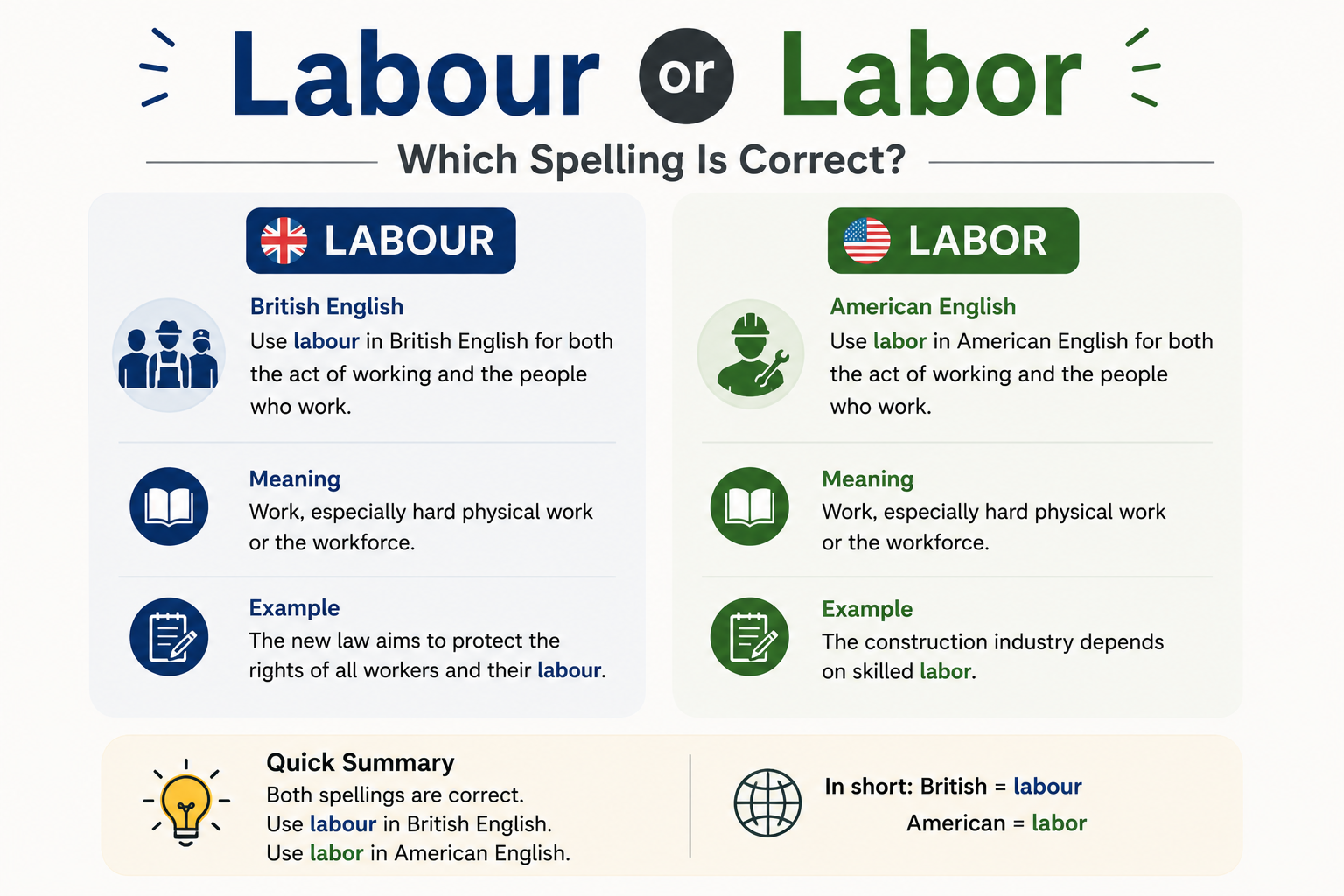
Labour or labor often confuses writers because the two forms have the same meaning and pronunciation but differ by one letter. The key answer is simple: labor is the standard spelling in American English, while labour is the standard spelling in British English and several other varieties of English. Neither form is simply a misspelling.
The difference comes from regional spelling conventions that developed over time. American English often favors shorter spellings in words that contain certain French influenced endings, while British English has preserved forms such as labour. This same pattern appears in other word pairs such as color and colour, favor and favour, and honor and honour.
Knowing the difference helps you choose the right form for your audience. In this guide, you’ll learn what the word means, how it functions in a sentence, how Americans and British speakers use it, how to pronounce it, where it came from, and which related words can cause confusion. You’ll also see practical examples that show how the spelling works in real writing.
Quick Definition
Labor is the standard American English spelling. Labour is the standard spelling in British English and is also used in several other English varieties. Both forms can mean physical or mental work, effort, childbirth, or the workforce as a group. The pronunciation and core meaning remain essentially the same.
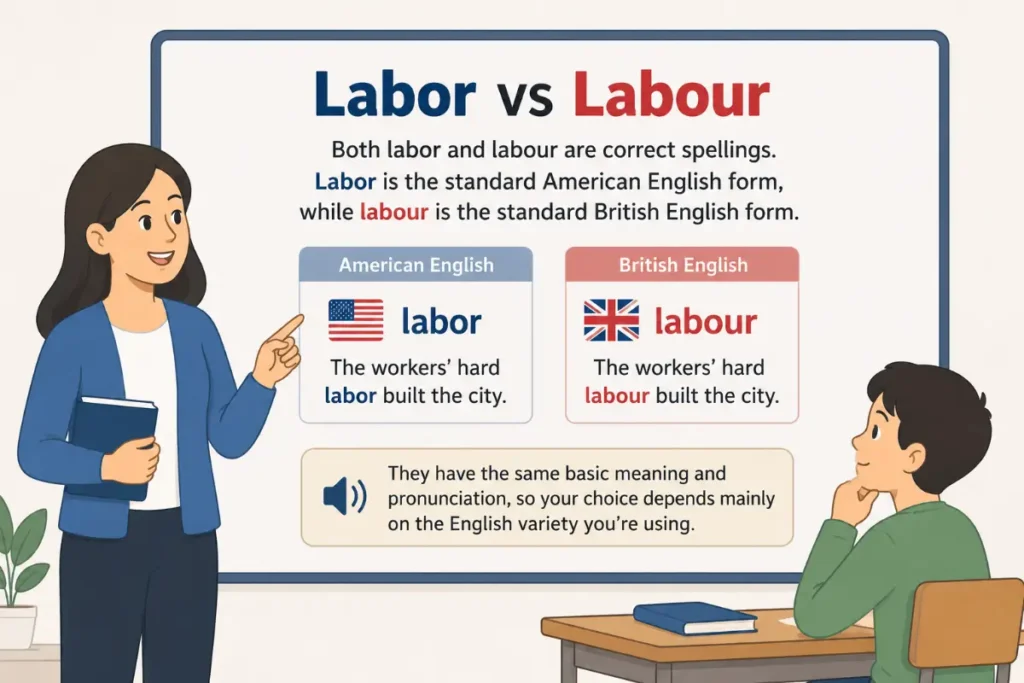
Quick Answer
Both forms are correct. Use labor for American English and labour for British English.
The difference is mainly regional spelling rather than meaning or pronunciation. If you’re writing for a US audience, labor is the natural choice. If you’re following British spelling conventions, labour is preferred.
Comparison Table
| Form | Meaning | Part of Speech | Origin | Usage Frequency | Formality | Common Contexts | Example |
|---|---|---|---|---|---|---|---|
| Labor | Work, effort, childbirth, or workers collectively | Noun and verb | From Latin labor through Old French and Middle English | Very common in American English | Neutral to formal | Work, economics, childbirth, politics, everyday speech | The workers were paid for their labor. |
| Labour | Work, effort, childbirth, or workers collectively | Noun and verb | From Latin labor through Old French and Middle English | Very common in British English | Neutral to formal | Work, economics, childbirth, politics, everyday speech | The workers were paid for their labour. |
Meaning and Definition
Meaning of Labor
Labor can describe work that requires physical or mental effort. It can refer to a person’s work in general or to the effort needed to complete a particular task.
For example:
The project required months of hard labor.
Here, the word refers to physical or sustained effort.
Labor can also describe the workforce of an organization, industry, or economy. In economics, the term can refer to people who provide work in exchange for wages or other compensation.
The company relies on skilled labor.
The word has another important meaning in medicine. Labor refers to the process of childbirth, especially the period during which contractions and other physical changes prepare the body for delivery.
She went into labor early in the morning.
Labor can also function as a verb. As a verb, it means to work hard or make a great effort.
They labored for years to complete the building.
In American English, labor is the expected spelling in all of these uses.
Meaning of Labour
Labour carries the same basic meanings as labor. The difference is spelling rather than definition.
A British writer might say:
The project required months of hard labour.
A British medical article might say:
She went into labour early in the morning.
The word can also refer to workers as a group or to the economic activity connected with employment.
The country has a shortage of skilled labour.
The spelling labour is standard in British English and appears widely in British publications, education, government writing, and everyday communication.
The same form also appears in other English varieties influenced by British spelling conventions.
Is Either Form Incorrect?
No. The two spellings belong to different regional standards.
Calling labour a spelling mistake in American English would miss the regional nature of English. Likewise, changing labour to labor in a British document can make the text look inconsistent with the chosen spelling system.
The best approach is to identify your audience and keep your spelling consistent.
If your article is aimed at readers in the United States, use labor. If you’re writing for a British audience, use labour.
Key Differences Explained
- Spelling. American English normally uses labor. British English normally uses labour.
- Meaning. The two forms have the same core meanings. Both can refer to work, effort, childbirth, or workers as a group.
- Grammar. Both forms can function as nouns and verbs.
- Pronunciation. The two forms are pronounced the same in standard varieties of English. The extra u in labour does not create an additional sound.
- Formality. Neither spelling is more formal than the other. Formality depends on the sentence and context.
- Regional usage. Labor is associated with American spelling. Labour is associated with British spelling and several related English varieties.
- Writing consistency. Your main goal should be consistency. Don’t switch between the two forms randomly within the same piece of writing.
- Related spellings. The same regional pattern appears in words such as color and colour, favor and favour, and behavior and behaviour.
The important point is that the extra u does not change the meaning. It signals a spelling convention.
Which Form Should You Use?
For American English, use labor.
For British English, use labour.
This distinction follows established spelling conventions rather than a difference in grammar. American English generally uses forms such as labor, color, favor, and honor. British English generally uses labour, colour, favour, and honour.
The difference became part of the broader development of American and British spelling traditions. English spelling was never controlled by one universal system. Different regions developed preferences that became established through dictionaries, publishing, education, government usage, and common practice.
If you’re writing for a US company, American school, American publication, or American website, labor will normally fit the expected style.
If you’re writing for a British publication, British institution, or audience that follows British English, labour is appropriate.
The same principle applies to other words with the same spelling pattern. Once you recognize the regional convention, these choices become much easier.
Sentence Examples
Here are examples using the American spelling.
- The construction project required a large amount of skilled labor.
- She went into labor shortly after midnight.
- The factory depends on local labor.
- Hard labor can be physically demanding.
- The company wants to reduce labor costs without lowering product quality.
- Many students take part time jobs to gain work experience and earn money for college.
- The workers received fair compensation for their labor.
- The machine reduced the amount of manual labor needed on the production line.
- He labored for years to build a successful business.
- The research team spent months laboring over the final report.
Now compare those sentences with British spelling.
The construction project required a large amount of skilled labour.
She went into labour shortly after midnight.
The factory depends on local labour.
Hard labour can be physically demanding.
The meaning stays the same. Only the regional spelling changes.
Common Mistakes and Spelling Confusion
Several mistakes appear because English spelling conventions can overlap.
- Using labour in American writing.
This isn’t always grammatically wrong, but it can look inconsistent in a document that otherwise follows American spelling. If your audience is primarily American, labor is usually the better choice.
- Using labor in British writing.
Again, the meaning remains clear, but British style normally uses labour. Mixing the forms can make a document look poorly edited.
- Changing the spelling halfway through a document.
A writer may use labor in one paragraph and labour later. This often happens after copying material from different sources. Professional editing should standardize the spelling according to the selected variety of English.
- Assuming the extra u changes pronunciation.
It doesn’t. The spelling difference is visible on the page but normally doesn’t create a different pronunciation.
- Treating one form as a typo.
This is the biggest mistake. Both spellings are established. The correct choice depends on the English variety being used.
From an NLP perspective, search systems can usually connect both spellings because they represent the same lexical item. Human readers also understand both forms easily. Still, consistent spelling matters for polished professional writing.
Pronunciation Guide
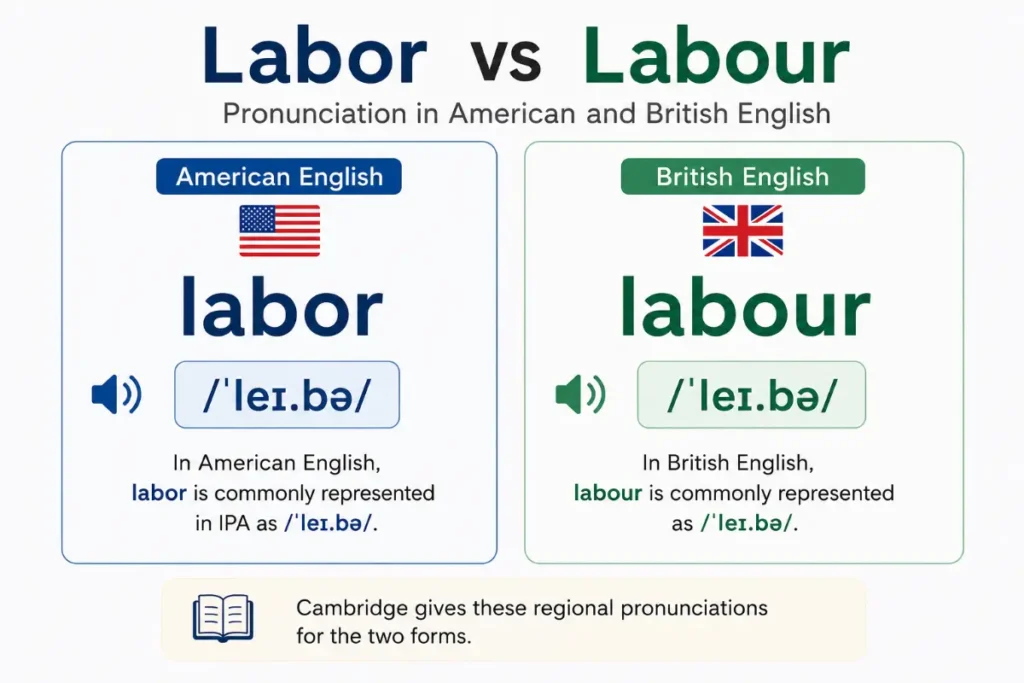
Both forms are generally pronounced the same way.
The common pronunciation is:
IPA: /ˈleɪbər/
A simple pronunciation guide is:
LAY ber
The first syllable receives the main stress.
The word has two basic syllables:
LA bor
or in British spelling:
LA bour
The spelling difference doesn’t mean you should pronounce an extra vowel at the end of labour. The u belongs to the written form and normally does not create a separate sound.
A common mistake is to pronounce every written letter as if each one must produce a distinct sound. English spelling doesn’t work that way. Silent or historically preserved letters appear in many English words.
You can think of labor and labour as two written versions of the same spoken word.
Etymology and Word Origin
The word has a long history in English.
It ultimately comes from Latin labor, meaning work, exertion, hardship, or toil. The word passed into Old French and then into Middle English before developing into the modern English forms.
The spelling history helps explain why the word looks familiar across several European languages. Latin provided an early form, while French influence played a major role in shaping English vocabulary during the Middle English period.
The modern American spelling labor and the British spelling labour reflect different developments in English spelling.
The extra u in the British form is associated with French influenced spelling traditions. American spelling later developed preferences for forms that removed some of these letters. This is part of the broader pattern seen in color and colour, favor and favour, and similar pairs.
The historical connection is useful because it shows that the difference isn’t random. The two spellings developed within different conventions for writing English.
Regional Usage
American English
American English normally uses labor. You’ll see it in workplace writing, economics, journalism, education, medicine, government documents, and everyday conversation.
American publications also use labor in compound terms such as labor market, labor force, labor costs, and labor union.
The same spelling applies to the verb.
They labored through the difficult conditions.
The American convention generally removes the u found in the British form.
British English
British English normally uses labour. It appears in everyday writing as well as professional and academic contexts.
Common British expressions include labour market, labour force, labour costs, and labour union.
The British spelling also appears in the names of organizations and political parties where the spelling forms part of an official name.
British English therefore treats labour as a standard spelling rather than a special or old fashioned version.
Australian English
Australian English generally follows British spelling conventions in words of this type, so labour is widely used.
You can find the spelling in Australian education, government writing, news reporting, employment discussions, and everyday communication.
Australian English has its own vocabulary and style preferences, but this particular spelling pattern remains closely connected to British conventions.
Canadian English
Canadian English uses a mixture of British and American spelling traditions. In many contexts, labour is the established Canadian form.
Canadian usage can therefore surprise writers who assume that every English variety follows either American or British rules exactly.
If you’re writing specifically for Canada, follow the style guide used by your publication, school, employer, or organization. Consistency matters more than forcing a single spelling system onto every context.
Grammar Rules and Part of Speech
Both forms can work as nouns and verbs.
As a Noun
The noun refers to work, effort, workers, or childbirth depending on context.
The factory needs skilled labor.
In this sentence, labor refers to workers or the work they provide.
The mother was in labor.
Here, the word refers to the process of childbirth.
Labor can also refer to effort.
The project required considerable labor.
Context tells the reader which meaning applies.
As a Verb
The verb means to work hard or make a sustained effort.
They labored through the night.
The workers labored under difficult conditions.
The verb can sound more literary or formal than ordinary alternatives such as work or struggle.
Compound Expressions
The word appears in many established phrases.
Common examples include:
- Labor market.
- Labor force.
- Labor costs.
- Labor union.
- Manual labor.
- Skilled labor.
- Forced labor.
- Child labor.
In British spelling these commonly appear as labour market, labour force, labour costs, labour union, manual labour, skilled labour, forced labour, and child labour.
The grammatical relationship stays the same.
Punctuation and Sentence Position
The word itself doesn’t create unusual punctuation rules.
You can place it naturally in a sentence based on its grammatical role.
For example:
The company hired more workers because it needed additional labor.
You don’t need a comma before or after the word simply because it means work.
Compound phrases also follow normal sentence punctuation.
The company reported higher labor costs this year.
If the word appears inside a longer noun phrase, punctuation depends on the structure of the entire sentence rather than the spelling of the word.
This is a useful distinction. Spelling and punctuation are separate issues. Changing labor to labour doesn’t change the grammatical structure of the sentence.
Real Life Usage Examples
Daily Conversation
In everyday speech, the word usually appears when people discuss work, effort, jobs, or childbirth.
- The farm needs more labor during harvest season.
- She was in labor for several hours.
In casual conversation, Americans often use simpler words such as work instead of labor unless the specific context makes labor more natural.
Workplace Communication
The word is common in business and employment discussions.
- Rising labor costs have affected the company’s budget.
- The manager is reviewing the labor needed for the new project.
In workplace writing, the American spelling is appropriate for US audiences
News Writing
Journalists often use the word when reporting on employment and economic conditions.
- The report showed changes in the national labor market.
- Officials discussed new policies affecting labor costs.
The word is especially common in economic reporting.
Literature and Storytelling
In storytelling, the word can describe physical effort or hardship.
- Years of hard labor had changed the old building.
- He labored through the storm until he reached the village.
The verb can create a stronger sense of struggle than the simpler word worked.
Related and Confused Terms
Several words connect closely with the meaning of labor but don’t always mean exactly the same thing.
- Work. This is the broadest and most common term. It can describe almost any task or job.
- Effort. This focuses on the energy or determination someone puts into an activity.
- Toil. This suggests difficult, tiring, or prolonged work and often has a stronger emotional tone.
- Employment. This refers mainly to having a job or the relationship between a worker and an employer.
- Workforce. This refers to a group of people available for or engaged in work.
- Occupation. This usually refers to a person’s job or profession.
- Industry. This can describe a particular area of economic activity and may include businesses, workers, and production.
- Productivity. This concerns how efficiently work produces goods, services, or results.
These terms belong to the same semantic field, but they aren’t interchangeable in every sentence.
For example, you can say the labor market but not normally the work market when discussing the broad economic system of employment. You can describe someone’s effort without referring to labor at all.
Choosing the right word depends on the exact idea you want to express.
Labor in Economics
In economics, the word has a more specific meaning than it does in ordinary conversation.
Labor can refer to human work used to produce goods and services. Economists may discuss labor markets, labor supply, labor demand, wages, employment, and productivity.
The phrase labor market describes the interaction between people who offer their work and organizations that seek workers.
The labor force generally refers to people who are working or actively participating in the job market according to the definition being used.
These technical meanings explain why the word appears frequently in business and economic writing.
It’s also useful to distinguish labor from capital. In basic economic discussions, labor refers to human work while capital can refer to resources such as machinery, buildings, equipment, or financial assets depending on the framework.
The exact meaning depends on the field and context.
Labor in Medicine
The medical meaning is especially common in American English.
Labor refers to the process that leads to childbirth. It includes physical changes and contractions that help the body prepare for delivery.
You may see expressions such as:
She went into labor.
The patient was in active labor.
Labor lasted several hours.
In British English, the same meaning is usually written as labour.
The pronunciation remains essentially the same. Again, the difference is spelling rather than meaning.
This is a good example of why context matters. A sentence about labor costs concerns employment or economics, while a sentence about going into labor concerns childbirth.
The same word can carry different meanings without changing its spelling.
Labor as a Verb
The verb form is less common in casual American conversation than work, but it remains standard.
To labor means to work hard or make a sustained effort.
For example:
The researchers labored over the data for months.
The team labored to finish the project before winter.
The verb can suggest difficulty or persistence. Saying someone labored over a task often gives the reader a stronger sense of effort than simply saying someone worked on it.
The British form follows the same pattern:
The researchers laboured over the data for months.
The spelling changes but the grammatical role and meaning remain the same.
Why American English Drops the U
One of the most interesting parts of this spelling difference is the missing u in American English.
American spelling developed a number of preferences that simplified certain traditional forms. Words ending in our in British English often appear with or in American English.
Examples include:
- Colour becomes color.
- Favour becomes favor.
- Honour becomes honor.
- Behaviour becomes behavior.
- Labour becomes labor.
This doesn’t mean American spelling is universally simpler or that British spelling is old fashioned. They are simply different standardized traditions.
You should also avoid assuming that every word ending in our changes in the same way. English contains exceptions and special cases. A reliable style guide remains useful when you’re editing formal material.
Consistency Matters More Than Mixing Styles
One of the most practical editing rules is to choose a spelling system and stay with it.
Suppose you’re writing an American English article. You might naturally use color, favorite, behavior, and labor.
If you suddenly write colour, favourite, behaviour, and labour, the reader may notice the shift. None of those British forms is inherently wrong, but the document now contains mixed conventions.
The same problem can happen in reverse.
Professional editors often check spelling patterns across an entire document rather than correcting individual words in isolation.
This matters especially in long articles, academic papers, websites, business reports, and books.
Consistency creates a smoother reading experience.
Common Phrases and Collocations
The word frequently appears alongside certain terms. These combinations are called collocations because they occur together naturally.
Common American expressions include:
- Labor market.
- Labor force.
- Labor costs.
- Labor shortage.
- Labor dispute.
- Labor union.
- Manual labor.
- Skilled labor.
- Forced labor.
- Child labor.
These phrases are useful because learning a word through natural combinations often makes it easier to use correctly.
For example, if you know the phrase labor shortage, you’re less likely to invent an unnatural expression such as work shortage when discussing an employment issue.
British English generally replaces the spelling with labour in these same expressions.
Expert Editor Insight
An experienced editor treats labor and labour as a style choice rather than a simple spelling correction. The first question is always which English variety the document follows. Spellcheckers may flag one form depending on the selected language setting, so a US English document should use an American dictionary setting while a British English document should use a British setting. A useful editing tip is to check three or four related words in the same document. If you see color, favor, and behavior, labor will usually belong to the same American spelling pattern.
A Simple Memory Trick
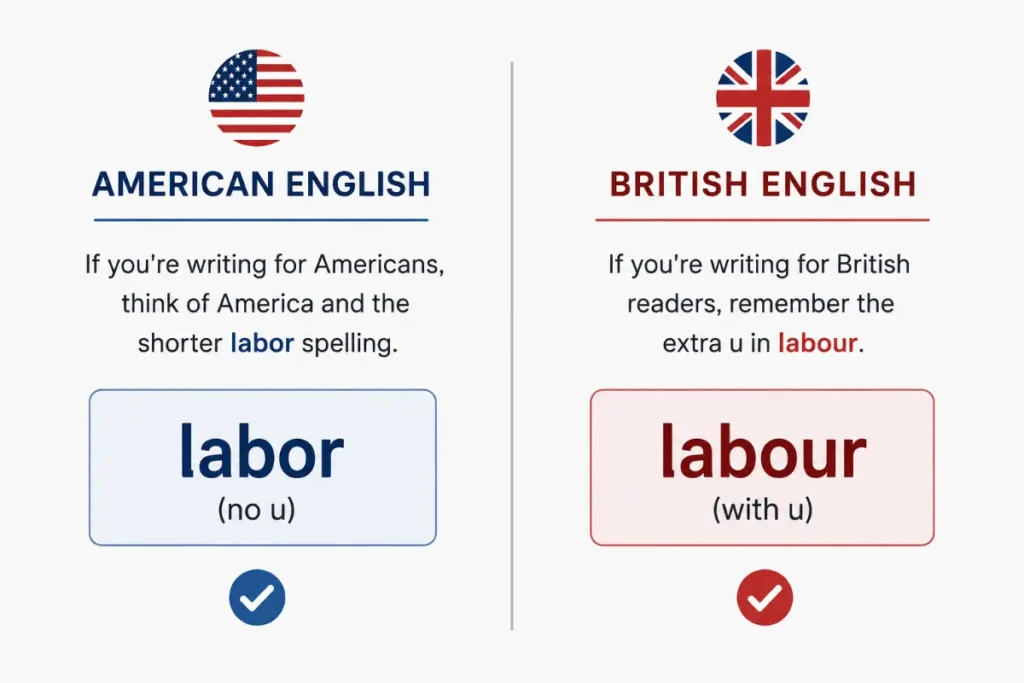
If you’re writing for Americans, think of America and the shorter labor spelling.
If you’re writing for British readers, remember the extra u in labour.
You can use the same memory trick with several related pairs:
- color and colour.
- favor and favour.
- honor and honour.
- behavior and behaviour.
- labor and labour.
Conclusion
Labour or labor presents a regional spelling difference rather than a right versus wrong choice. Labor is the standard American English form, while labour is standard in British English and several other varieties. Both forms have the same basic meanings and grammatical functions, and they’re generally pronounced the same way.
The word can refer to physical or mental work, human effort, workers as a group, or the process of childbirth. Its meaning depends on context. You’ll also find it in common expressions such as labor market, labor force, manual labor, and labor costs.
The easiest editing tip is to check the spelling style of your whole document. If you’re writing in American English, choose labor and keep related spellings consistent. If you’re following British English, use labour throughout.
FAQs
Is labor or labour the correct spelling?
Both spellings are correct in their respective English varieties. American English normally uses labor, while British English normally uses labour. The two forms have the same core meanings and pronunciation. The choice depends on the regional spelling system used by your audience, publication, school, employer, or style guide.
What is the difference between labor and labour?
The main difference is regional spelling. Labor is the standard American English form, while labour is the standard British English form and is also common in several other English varieties. Both can mean work, effort, childbirth, or workers as a group. They function as both nouns and verbs.
Should I use labor in American English?
Yes. Labor is the standard spelling for American English. You’ll see it in expressions such as labor market, labor force, labor costs, manual labor, and labor union. If you’re writing for a US audience, keeping this spelling throughout your document will make your writing consistent with standard American conventions.
Why does British English spell labor with a u?
The British form labour reflects historical spelling conventions influenced by French and earlier forms of English. American English later developed a preference for forms such as labor, color, favor, and honor. The extra u doesn’t change the pronunciation or basic meaning. It mainly signals the regional spelling tradition being used.
How do you pronounce labor and labour?
Both forms are generally pronounced /ˈleɪbər/. A simple guide is LAY ber. The first syllable carries the main stress. The written u in labour doesn’t normally add a separate sound. This is why the two forms sound alike even though their spellings look different.
Is labour wrong in American English?
Labour isn’t an invalid English word, but it isn’t the usual American spelling. In US English, labor is the standard form. A US reader will understand labour without difficulty, but using it in an otherwise American English document can create an inconsistent spelling style. Follow the spelling system used by your audience.
What are common phrases with labor?
Common phrases include labor market, labor force, labor costs, labor shortage, labor union, manual labor, skilled labor, forced labor, and child labor. These expressions appear frequently in economics, business, journalism, education, and everyday writing. British English generally uses the same phrases with labour instead of labor.
Is labor appropriate in formal writing?
Yes. Labor is fully appropriate in formal American English. It appears in academic papers, business reports, government writing, economic analysis, journalism, and professional communication. The key is to use the form that matches your chosen English variety. For a British audience, use labour instead. Consistency is the main editing principle.
