
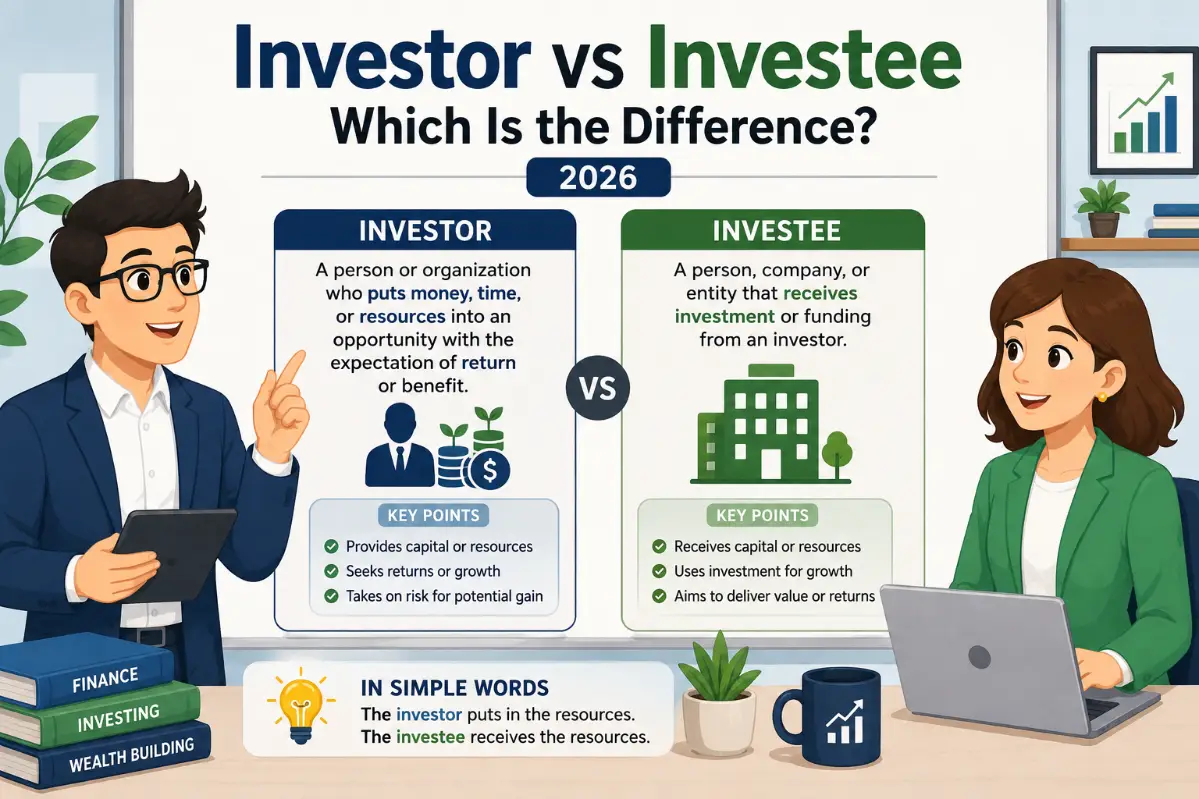
The difference between investor and investee is easier to understand once you focus on one simple question: who provides the money and who receives it. An investor provides capital with the goal of earning a financial return. An investee is the person, company, fund, or other entity that receives that capital and uses it for a stated purpose.
The confusion usually comes from the similar spelling of the two terms. Both words describe people or organizations involved in the same financial relationship, but they describe opposite sides of that relationship. An investor puts money into an opportunity. An investee receives that money and becomes the target of the investment.
This distinction matters in business, accounting, finance, venture capital, private equity, and everyday investment discussions. Once you understand the roles, related terms such as shareholder, borrower, founder, portfolio company, capital provider, and recipient become much easier to place. This guide explains the meanings, differences, grammar, pronunciation, examples, common mistakes and practical uses of both terms in clear American English.
Quick Definition
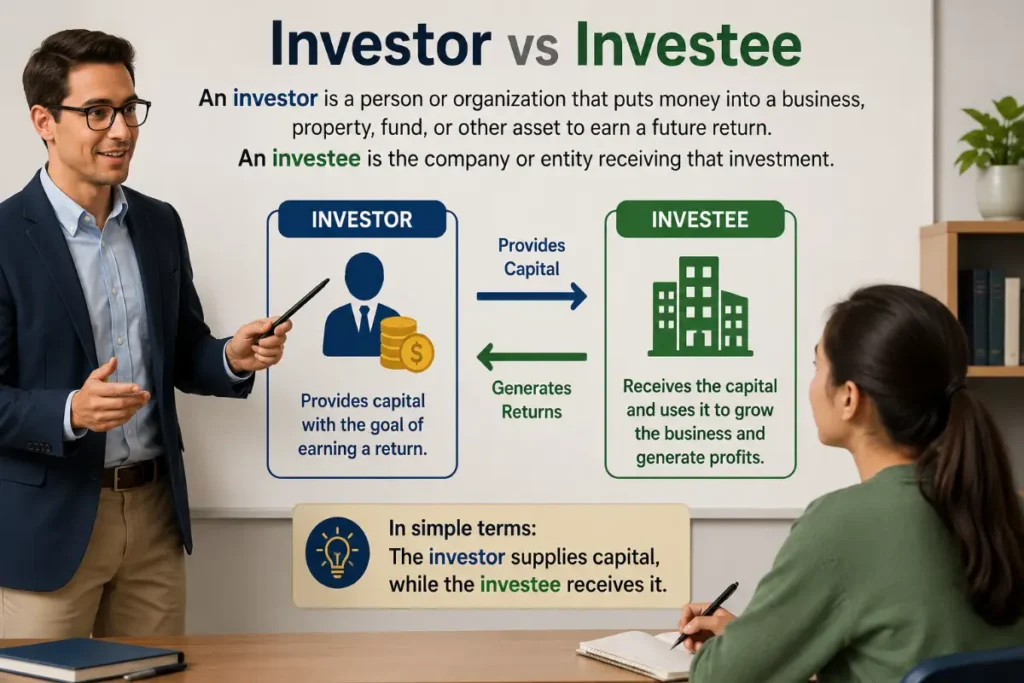
An investor is a person or organization that puts money or other capital into an asset, business, project, or financial opportunity with the expectation of a return. An investee is the person, company, fund, or entity that receives that investment. In simple terms, the investor provides capital while the investee receives and uses it.
Quick Answer
An investor supplies capital. An investee receives capital.
For example, if a venture capital firm gives $2 million to a startup in exchange for an ownership stake, the venture capital firm is the investor and the startup is the investee. The two terms describe opposite sides of the same investment relationship.
Comparison Table
| Term | Meaning | Part of Speech | Origin | Usage Frequency | Formality | Common Contexts | Example |
|---|---|---|---|---|---|---|---|
| Investor | A person or organization that provides capital for an investment | Noun | From invest plus the agent suffix or | Very common | Neutral and professional | Stocks, businesses, real estate, funds, startups | The investor purchased shares in the company. |
| Investee | A person, company, fund, or entity that receives an investment | Noun | From invest plus the recipient suffix ee | Common in finance and business | Professional and specialized | Venture capital, private equity, corporate finance, investment agreements | The startup became an investee after receiving funding. |
Meaning and Definition
What an Investor Means
An investor is someone who commits money, property, or another form of capital to an opportunity in the hope of receiving a benefit later.
The expected benefit may take several forms. An investor might earn interest from a loan, dividends from shares, rent from property, or a gain from selling an asset for more than the purchase price. In a private company, the expected return may come from the company becoming more valuable over time.
The word investor describes the person or organization taking the investment side of the transaction. It doesn’t necessarily tell you exactly what kind of investment they made.
For example, a person who buys shares of a public company is an investor. A private equity firm that purchases part of a private business is also an investor. A person who purchases an apartment as an income producing asset can also be described as an investor.
Investors can range from individuals to very large institutions. Common examples include individual investors, angel investors, venture capital firms, private equity firms, pension funds, mutual funds, banks, insurance companies, and other financial institutions.
The core idea remains the same: capital moves from the investor toward an opportunity.
What an Investee Means
An investee is the recipient of an investment. The term commonly refers to a business, organization, fund, or other entity that receives capital from an investor.
Suppose a technology startup raises money from an angel investor. The angel investor provides the capital. The startup receives the capital and therefore acts as the investee in that relationship.
An investee may use the money to hire employees, develop products, purchase equipment, expand into new markets, acquire another business, repay certain obligations, or support other approved business activities.
The term is especially common in professional finance. You may encounter it in investment reports, due diligence documents, fund reporting, shareholder agreements, corporate records, and discussions about portfolio companies.
An investee isn’t necessarily a company. The exact meaning depends on the transaction. A fund or other legal entity can also receive investment capital and therefore occupy the recipient side of the relationship.
Key Differences Explained
- Direction of capital. The investor provides capital. The investee receives capital.
- Role in the transaction. The investor makes the investment. The investee receives the investment.
- Financial objective. The investor generally expects some form of financial return. The investee generally uses the capital to support its stated activities or objectives.
- Ownership. An investor may receive an ownership interest if the investment involves equity. The investee may issue or transfer that ownership interest.
- Risk. The investor typically accepts investment risk in exchange for the possibility of a return. The investee may face obligations tied to the investment agreement and may also give up some ownership or control in an equity transaction.
- Relationship. The two roles describe opposite sides of a capital relationship. One side supplies resources and the other receives them.
- Context. Investor is a broad everyday business term. Investee is more specialized and appears often in finance and legal business writing.
- Grammar. Both terms are nouns. Investor identifies the party performing the investing action. Investee identifies the party receiving the investment.
The most useful memory trick is simple: the investor invests. The investee gets invested in.
Which Term Is Correct?
Both investor and investee are legitimate English words. They aren’t competing spellings of the same word, and neither one is an incorrect form of the other.
The difference comes from the roles they describe. Investor refers to the party that makes an investment. Investee refers to the party that receives an investment.
English often uses endings to show the relationship between an action and the person connected with that action. The ending or commonly helps form words for someone performing an action, as in employer or borrower. The ending ee often appears in words describing someone who receives an action, as in employee or lessee.
This pattern helps explain the structure of invest and investee. The investor performs the investment activity. The investee receives the investment.
That doesn’t mean every word ending in ee follows exactly the same grammatical history. It does provide a useful modern English pattern for understanding why the two terms point in different directions.
How the Investment Relationship Works
A simple example can make the distinction much clearer.
Imagine a startup needs $500,000 to expand its operations. An angel investor agrees to provide the money in exchange for an ownership stake.
The angel investor is the capital provider. The startup is the capital recipient.
Once the transaction closes, the investor may own part of the company. The startup now has access to additional capital and may use it according to the terms of the agreement.
The same basic relationship appears in larger transactions.
A private equity firm may invest in an established company. The firm becomes the investor while the company becomes the investee.
A corporation may invest in another company as part of a strategic partnership. The investing corporation takes the investor role while the recipient company takes the investee role.
An investment fund may place money into another fund. The exact legal structure can vary, but the basic distinction still depends on who supplies the investment and who receives it.
Investor Types
Investors can take many forms. Understanding the type of investor can help you understand the nature of the transaction.
Individual Investors
Individual investors use their own money to purchase assets or invest in businesses. They may buy stocks, bonds, real estate, mutual funds, exchange traded funds, or private investments.
A person who purchases 100 shares of a public company is an investor in that company.
Angel Investors
Angel investors typically provide their own money to early stage companies. They may receive shares or another financial interest in exchange for their capital.
Their involvement can extend beyond money. Some angel investors also provide industry knowledge, contacts, mentoring, or business advice.
Venture Capital Firms
Venture capital firms invest in companies that they believe have significant growth potential. They usually invest through funds raised from other investors.
A venture capital investment often involves an ownership stake and specific contractual rights.
Private Equity Firms
Private equity firms invest in established businesses through specialized investment funds. Their strategies vary widely, but transactions can involve significant ownership interests and active involvement in the portfolio company.
Institutional Investors
Institutional investors manage large pools of capital. Examples include pension funds, insurance companies, endowments, and investment funds.
Their investment decisions can involve complex research, risk analysis, governance requirements, and portfolio management.
What an Investee May Receive
An investee may receive several forms of capital depending on the transaction.
Equity investment gives the recipient capital in exchange for an ownership interest. In that case, the investor may become a shareholder.
Debt financing works differently. A lender provides money with an expectation of repayment, usually with interest. In casual discussion someone might describe the lender as an investor, but the more precise term can depend on the structure of the transaction.
Convertible instruments can combine characteristics of debt and equity. For example, a convertible note may begin as a debt instrument and later convert into equity under specified conditions.
The exact rights and obligations depend on the agreement. That’s why professional financial documents often define the parties carefully rather than relying only on general labels.
Investor and Shareholder Are Not Always the Same
An investor and a shareholder can overlap, but the terms aren’t identical.
An investor is broadly someone who puts capital into an investment. A shareholder specifically owns shares in a company.
For example, someone can invest in a bond without becoming a shareholder. A bondholder has a financial interest in the issuer but doesn’t own company shares simply because they purchased the bonds.
On the other hand, someone who purchases common stock becomes a shareholder and is also an investor.
This distinction matters because ownership rights depend on the type of investment. Equity ownership can provide voting rights, dividend rights, or other rights depending on the security and governing documents.
Investor and Lender Are Not Always the Same
The same caution applies to the terms investor and lender.
A lender provides money that normally must be repaid according to an agreement. An equity investor typically provides capital in exchange for an ownership interest or another investment right.
Both parties may expect financial returns, but the structure differs.
For example, a bank that provides a business loan is generally acting as a lender. A venture capital firm purchasing preferred shares in that same business is acting as an equity investor.
Using the most precise term helps readers understand the transaction instead of forcing different financial relationships into one category.
Grammar and Word Function
Investor and investee are both nouns.
Investor refers to the person or organization that invests.
Investee refers to the person or organization that receives an investment.
The words commonly appear after determiners such as a, an, the, this, that, each, and several.
For example:
- The investor reviewed the company’s financial statements.
- The investee used the funds to expand its operations.
- Several investors participated in the funding round.
- The company became an investee after the transaction closed.
Both terms can also appear in plural form.
Investor becomes investors.
Investee becomes investees.
The plural forms are straightforward because both words follow common English noun patterns.
Common Sentence Patterns
You will often see investor used with verbs such as invest, evaluate, purchase, fund, support, sell, hold, and review.
You may see sentences such as:
The investor purchased additional shares.
The investors reviewed the proposal.
The fund invests in early stage companies.
Investee often appears with verbs such as receive, use, report, disclose, become, and provide.
For example:
The investee received additional funding.
The investee must provide financial information.
The company became an investee after the investment closed.
Pronunciation Guide
Investor is commonly pronounced:
in VEST er
The IPA pronunciation is commonly represented as /ɪnˈvɛstər/ in American English.
The main stress falls on the second syllable.
Investee is commonly pronounced:
in ves TEE
The IPA pronunciation is commonly represented as /ɪnˌvɛˈstiː/.
The final syllable receives the strongest stress.
This difference is useful because the ending helps distinguish the two words in spoken communication.
Investor ends with an unstressed er sound. Investee ends with a clearly stressed ee sound.
A common mistake is to pronounce investee like investor. The two terms look similar, but their endings sound different.
Etymology and Word Origin
Both terms come from the English verb invest.
Invest ultimately traces to Latin roots associated with clothing or surrounding something. The historical development of the word led to meanings connected with putting resources into something and later with committing money or capital to an asset or enterprise.
Investor developed as a noun for a person or entity that invests.
Investee developed through the English pattern in which ee can identify the recipient or person affected by an action. Similar structures appear in words such as employee, trainee, and nominee, although each word has its own history.
The modern financial meanings developed as investment became an established part of commercial and economic activity.
Today investor is much more common in general English. Investee is more specialized and appears frequently in professional financial contexts.
Regional Usage
American English
Both terms are understood in American English. Investor is extremely common in everyday financial discussions and professional writing. Investee is more specialized and tends to appear in finance, investment management, corporate reporting, and legal business documents.
An American reader is unlikely to misunderstand either term when the surrounding context clearly describes an investment relationship.
British English
British English uses the same basic distinction. Investor refers to the party providing investment capital while investee refers to the recipient.
There is no major spelling difference between American and British English for these terms.
Australian English
Australian English also recognizes both terms. Investor is widely used in business and financial communication, while investee is more likely to appear in specialized investment contexts.
The role distinction remains the same.
Canadian English
Canadian English follows the same general usage. Investor is the common broad term, while investee appears more often in specialized financial and corporate contexts.
The distinction isn’t a regional spelling issue. It is mainly a difference in financial role.
Real Life Usage Examples
Daily Conversation
People usually use investor more often in everyday conversation because it is easier to understand without specialized financial knowledge.
- My brother became an investor after he started buying company shares.
- She wants to become a real estate investor.
The word investee is less common in casual speech. People often say company, startup, or business instead.
Workplace Communication
Professional communication may use both terms when the investment relationship needs to be precise.
- The investor requested an updated financial report before approving additional funding.
- The investee submitted its quarterly information to the investment fund.
This language is especially useful in financial teams where several companies may be involved in a single portfolio.
Academic Writing
Academic and business research may use both terms to describe the two sides of capital allocation.
- Investors evaluate expected returns before committing capital.
- The study examines how access to funding affects the performance of investee companies.
The terms can make a sentence more precise because they identify each side of the transaction without repeating longer descriptions.
News and Journalism
Financial journalism commonly uses investor when discussing markets.
- Investors reacted to the company’s earnings report.
- The company attracted new investors after announcing its expansion plans.
Investee is more likely to appear in specialized reporting about private equity, venture capital, or investment funds.
Literature and Storytelling
General storytelling rarely needs the word investee. Writers usually choose simpler language such as company, business, founder, or recipient.
Investor is more natural when the financial role itself matters.
- The investor believed the young company could become a major business.
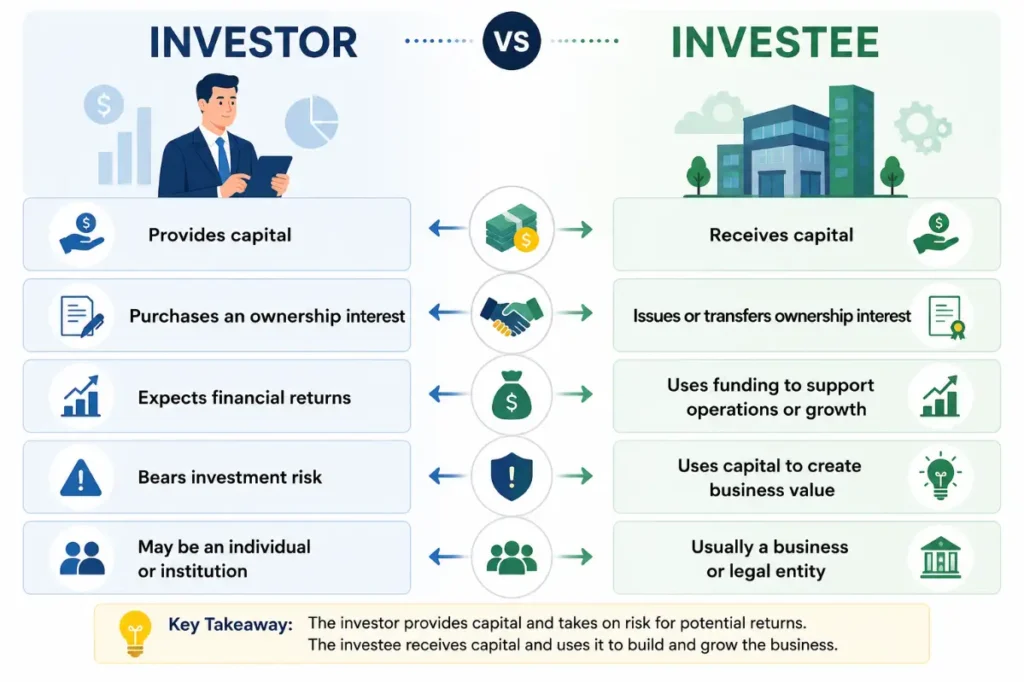
Investor vs Investee Key Differences
after months of negotiations the investor agreed to fund the expansion.Although these terms are closely connected, they describe opposite roles within the same investment relationship.
Investor
Investee
Provides capital
Receives capital
Purchases an ownership interest
Issues or transfers ownership interest
Expects financial returns
Uses funding to support operations or growth
Bears investment risk
Uses capital to create business value
May be an individual or institution
Usually a business or legal entity
Common Mistakes
Treating the Terms as Synonyms
Investor and investee don’t mean the same thing. One describes the provider of investment capital and the other describes the recipient.
Incorrect idea: The investor and investee both mean the person putting money into a company.
Correct idea: The investor provides the investment while the investee receives it.
Assuming Investee Means Employee
The ending ee can make the word look similar to employee. However, investee has nothing to do with employment.
An investee receives an investment. An employee works for an employer.
The relationship is completely different.
Calling Every Financial Recipient an Investee
Context matters. A business that receives a bank loan can be described using terms such as borrower or debtor. Investee is most appropriate when the transaction is actually an investment.
Precise financial language prevents confusion.
Assuming Every Investor Owns Shares
Not every investment creates direct equity ownership. A person can invest in bonds, funds, property, or other assets without becoming a shareholder of a company.
Investor is a broad term.
Confusing Investor With Founder
A founder creates or starts a business. An investor provides capital or other investment resources. One person can occupy both roles, but the words describe different activities.
A founder who puts personal money into their startup is acting as both founder and investor in that situation.
Related and Confused Terms
Several terms commonly appear alongside these two financial roles.
Shareholder
A shareholder owns shares in a corporation. A shareholder can also be an investor, but the terms aren’t identical.
Stakeholder
Stakeholder is broader. It can include shareholders, employees, customers, suppliers, communities, lenders, and others affected by an organization.
Founder
A founder starts a company or helps establish it. A founder may also become an investor by contributing personal capital.
Portfolio Company
A portfolio company is a business held or backed by an investment fund or investment firm. In many private investment settings, the portfolio company is the recipient of investment capital.
Capital Provider
Capital provider is a broad descriptive term for a person or organization that supplies money or financial resources.
Borrower
A borrower receives money under a debt arrangement and has an obligation to repay it. This differs from an equity recipient because the financial relationship has a different structure.
Lender
A lender provides money under a lending arrangement. A lender generally expects repayment according to agreed terms.
Beneficiary
A beneficiary receives a benefit under a legal or financial arrangement. The word has a broader meaning and shouldn’t automatically be treated as a synonym for investee.
Why the Distinction Matters in Finance
Financial language works best when each word identifies a specific role.
Imagine reading a report that says a company received $20 million from an investment fund. If you know the fund is the investor and the company is the investee, you immediately understand the direction of the transaction.
This matters even more when several parties are involved. A private equity fund may raise money from institutional investors and then invest that capital into several portfolio companies. In that structure, the parties can have different roles at different levels.
An institution may invest in the fund. The fund then invests in a company. The institution is an investor in relation to the fund. The fund is an investor in relation to the company. The company is the recipient in the second relationship.
The labels depend on the specific transaction being discussed.
That is why context matters more than memorizing a simple word pair.
How to Remember the Difference
A simple memory trick can make the distinction stick.
Think of the direction of the money.
Investor → provides capital → Investee
The investor is the party putting money into the opportunity.
The investee is the party receiving the money.
You can also connect the ending of each word with its role. Investor resembles other words for people who perform an action. Investee resembles words that describe a person or entity receiving an action.
Another useful question is: Who is investing?
The answer is the investor.
Who is receiving the investment?
The answer is the investee.
That two question test works especially well when you’re reading a contract, preparing a report, or checking a sentence.
Expert Language Insight
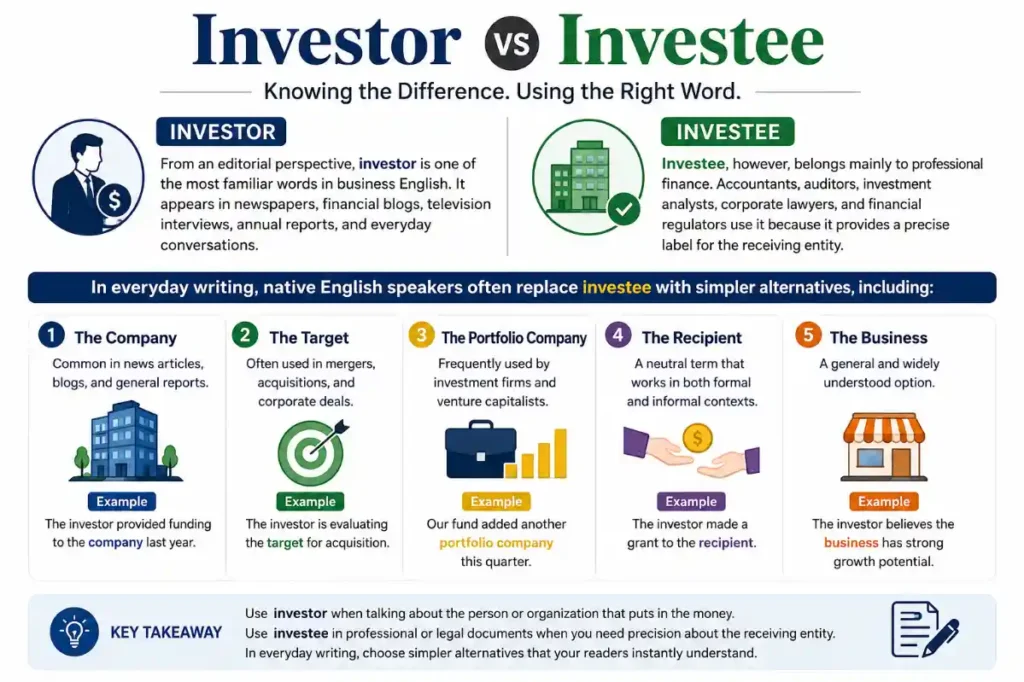
An experienced editor would usually leave investor alone in general financial writing because most readers understand it immediately. Investee deserves a little more care because it is more specialized and can sound technical outside finance. Professional editors look at the transaction itself before choosing the term. If the party provides investment capital, investor fits. If the party receives an actual investment, investee can provide useful precision. Financial writing becomes clearer when the terminology follows the transaction instead of simply repeating industry jargon.
Conclusion
Investor vs investee describes two sides of the same financial relationship. An investor provides capital with the expectation of a financial benefit while an investee receives that investment and uses it according to the transaction’s terms. Both are legitimate terms, but they aren’t interchangeable because they identify different roles.
The distinction becomes clear when you follow the direction of the money. Capital moves from the investor toward the investee. The terms can apply to startups, established companies, funds, and other entities depending on the investment structure.
For an easy memory trick, ask two questions: Who is investing and who is receiving the investment? The answer to the first is the investor. The answer to the second is the investee.
FAQs
What is the difference between an investor and an investee?
An investor provides capital to an investment opportunity. An investee receives that capital. For example, if a venture capital firm gives money to a startup in exchange for an ownership interest, the venture capital firm is the investor and the startup is the investee. The terms describe opposite sides of the same investment relationship.
Is investee a real English word?
Yes. Investee is a legitimate English noun used mainly in finance and business. It refers to a person, company, fund, or other entity that receives an investment. The word is less common than investor in everyday English, but it has a clear professional use in investment management, corporate finance, private equity, and related fields.
Can a company be an investor and an investee?
Yes. A company can hold both roles in different transactions. For example, Company A might invest in Company B, making A the investor and B the investee. Later, Company B could invest in another business. In that second transaction, Company B would become the investor. The role depends on the specific transaction.
Is an investee always a startup?
No. An investee can be a startup, established company, fund, organization, or another entity that receives an investment. Startups often appear in discussions about investees because venture capital and angel investment are common funding methods. However, the term isn’t limited to young businesses. The nature of the recipient depends on the investment structure.
Is an investor the same as a shareholder?
Not always. A shareholder owns shares in a company, while investor is a broader term for someone who commits capital to an investment. Someone can invest in bonds, real estate, funds, or other assets without becoming a shareholder. A person who buys company stock is both an investor and a shareholder.
Is an investee the same as a borrower?
No. An investee receives an investment, while a borrower receives money under a debt arrangement and normally has an obligation to repay it. An equity investment may give the investor ownership in the recipient company. A loan normally creates a creditor and debtor relationship instead. The exact terminology depends on the transaction.
Which term should I use in a financial report?
Use the term that accurately describes the transaction. Investor works for the party providing investment capital. Investee works for the party receiving that investment. If the recipient is actually borrowing money under a loan agreement, borrower may be more precise. Clear financial writing depends on identifying the legal and economic nature of the transaction.
Is investee common in everyday English?
Investee is less common in everyday conversation than investor. Most people naturally say company, startup, business, or recipient when discussing a business that received funding. In professional finance, however, investee is useful because it identifies the recipient side of an investment relationship in a concise way. The term is especially relevant in investment management and corporate reporting.
