
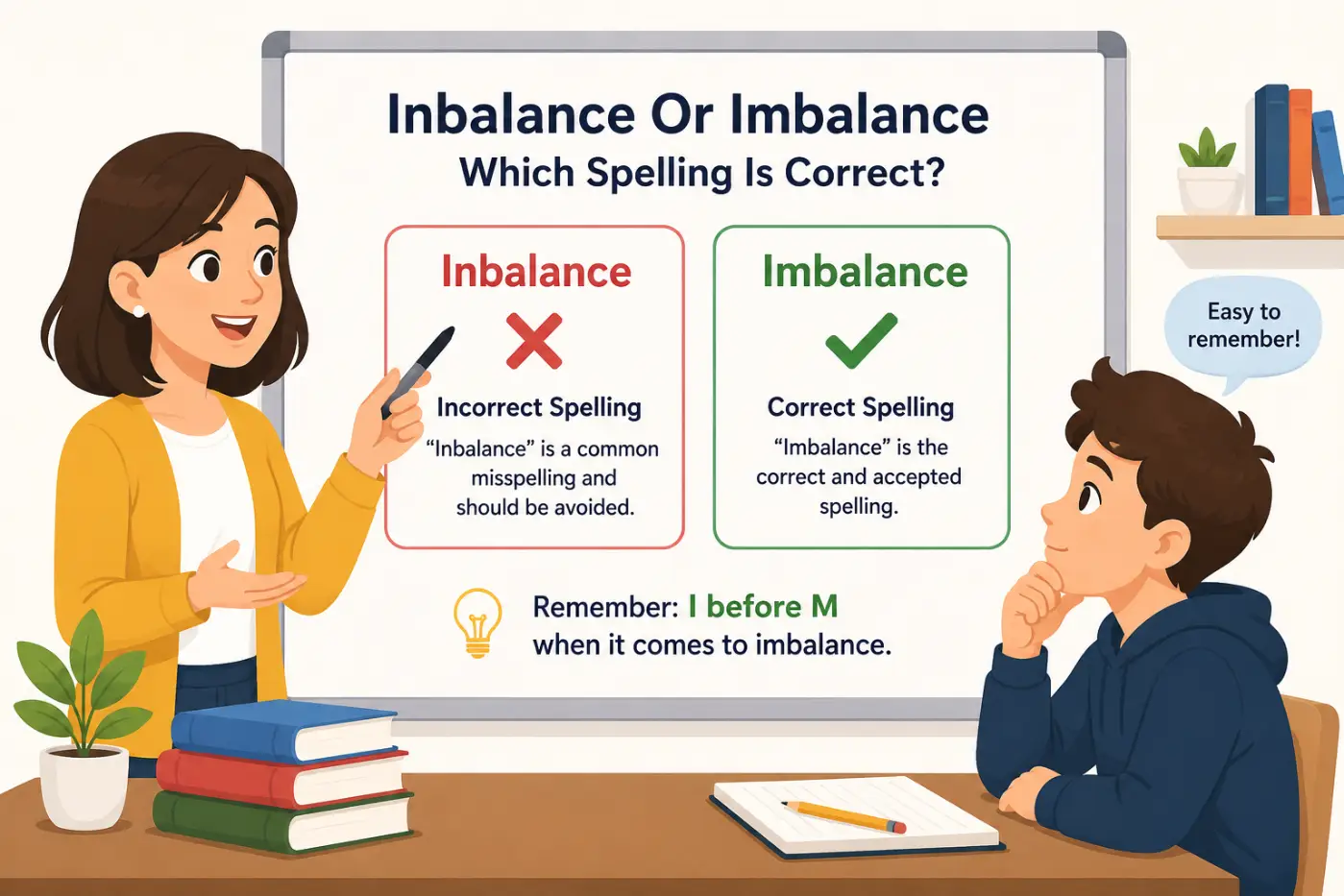
inbalance or imbalance is a common spelling confusion because the two forms look almost identical. The correct standard English form is imbalance. The form inbalance is generally treated as a misspelling when you mean a lack of balance or an unequal state.
The confusion makes sense at first glance. The prefix in can often mean not or opposite of something, so it may seem logical to attach in to balance and create inbalance. English does not always build words in such a simple way. In this case the established word uses the form im before the word balance.
If you are writing an email, school assignment, report, article, medical discussion, business document, or everyday message, you should use imbalance. This article explains its meaning, pronunciation, grammar, word origin, common mistakes, regional usage, related terms, and practical examples so you can recognize and use the standard form with confidence.
Quick Definition
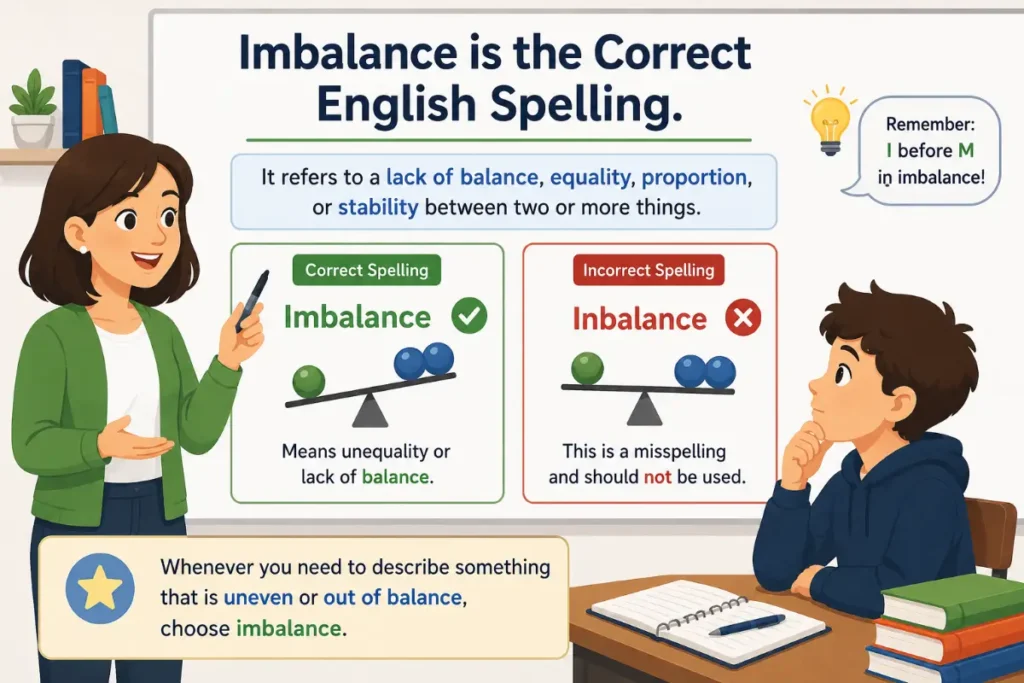
Imbalance is the standard English noun for a lack of balance, equality, proportion, or stability. It can describe physical conditions, unequal amounts, social differences, financial situations, chemical conditions, or other states where two or more elements are not properly balanced. In standard writing, inbalance is normally treated as a spelling error.
Quick Answer
The correct form is imbalance. Inbalance is not the standard spelling of the noun meaning a lack of balance.
The spelling may look unusual because the prefix changes from in to im before a word beginning with b. The form imbalance has become established in standard English and appears in formal and everyday contexts.
Comparison Table
| Correct Form | Meaning | Part of Speech | Origin | Usage Frequency | Formality | Common Contexts | Example |
|---|---|---|---|---|---|---|---|
| Imbalance | A lack of balance, equality, proportion, or stability | Noun | Formed from im plus balance | Common | Neutral to formal | Health, finance, society, science, physical balance, general writing | The imbalance between supply and demand affected prices. |
| Inbalance | Not the standard form for this meaning | Nonstandard spelling | A mistaken formation based on in plus balance | Uncommon | Not recommended in standard writing | Typing errors and spelling mistakes | The writer should replace inbalance with imbalance. |
Meaning and Definition
Meaning of the Incorrect Form
Inbalance is generally a misspelling of imbalance when the writer wants to describe a lack of balance. It can appear in typed messages, online posts, schoolwork, drafts, and other informal text, but frequent appearance does not make it a standard spelling.
The mistake usually comes from a reasonable looking spelling pattern. English has many words that use the prefix in to express negation or opposition. Examples include inactive, incomplete, and indirect. A writer may therefore assume that in plus balance should produce inbalance.
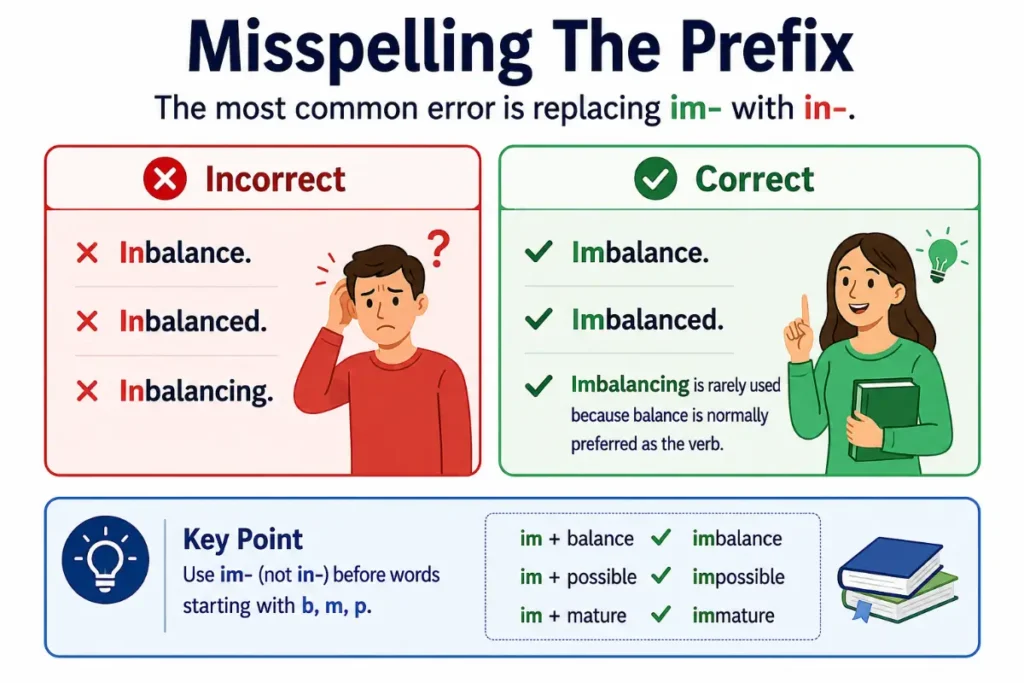
That assumption overlooks an important feature of English word formation. The negative prefix in often changes its form before certain consonants. Before words beginning with b, m, or p, the prefix commonly appears as im. This pattern can be seen in words such as imbalance, impossible, immature, and impatient.
There is another useful point. Inbalance does not normally function as a separate standard English word with a meaning different from imbalance. If your intended meaning is a lack of balance, imbalance is the form to choose.
Meaning of the Correct Form
Imbalance is a noun that describes a condition in which things are not balanced properly. The imbalance can involve physical weight, quantities, power, resources, emotions, systems, or other measurable or noticeable relationships.
For example, a person might experience an imbalance while standing on one foot. A company might face an imbalance between income and expenses. A market might show an imbalance between supply and demand.
The word can also describe a difference between groups or forces.
There is an imbalance between the two teams.
In this sentence, the word suggests that the teams are not equal in strength, resources, or some other relevant factor.
The meaning depends on context, but the central idea stays the same. Something that should be balanced, equal, proportionate, or stable has moved away from that state.
Key Differences Explained
- Spelling. Imbalance is the standard spelling. Inbalance is normally a spelling error.
- Word formation. Imbalance uses the form im before balance. This reflects a common pattern in English where the negative prefix in changes before certain sounds.
- Meaning. Imbalance means a lack of balance or equality. Inbalance does not normally carry a separate standard meaning.
- Part of speech. Imbalance is a noun. You can use it as the subject or object of a sentence.
- Pronunciation. Imbalance is commonly pronounced with stress on the second syllable of the first part and a clear balance ending. The spelling does not require a special pronunciation for the prefix.
- Formality. Imbalance works in casual conversation and formal writing. It is common in business, science, education, journalism, and general English.
- Context. You can use the word for physical balance, financial conditions, social differences, market conditions, scientific systems, and many other situations.
- Regional usage. Major varieties of English use imbalance as the standard form. There is no major American, British, Australian, or Canadian spelling difference that makes inbalance preferable.
The key point is simple. The difference is not a matter of American English versus British English. It is a matter of standard spelling.
Which Form Is Correct?
Imbalance is the correct standard form.
The spelling follows a familiar English word formation pattern. The prefix in can express a negative or opposite meaning, but its spelling often changes before certain consonants. Before b, m, and p, it commonly appears as im.
This process is sometimes described as assimilation. In simple terms, the sound and spelling of a prefix can adapt to the beginning of the word that follows it. This makes words easier to pronounce and reflects patterns that developed through the history of English and its source languages.
You can see the same pattern in several familiar words.
- In plus balance gives imbalance.
- In plus possible gives impossible.
- In plus mature gives immature.
- In plus patient gives impatient.
- In plus mobile gives immobile.
This does not mean you can automatically change every word beginning with b into an im form. English spelling has many historical exceptions and fixed forms. Still, the pattern provides a useful clue in this particular case.
If you are checking a professional document, school assignment, website, report, or publication, use imbalance.
Sentence Examples
The word fits naturally into many areas of communication. These examples show how its meaning changes slightly depending on the context.
- The doctor explained that the test showed an imbalance in the body’s normal levels.
- The company is trying to correct the imbalance between its expenses and revenue.
- An imbalance in the load caused the machine to shake.
- The report examines the imbalance between urban and rural development.
- The sudden imbalance made him lose his footing.
- The market experienced an imbalance between supply and demand.
- The teacher noticed an imbalance between the amount of time students spent reading and writing.
- The new policy was designed to reduce the imbalance between the two departments.
- The researchers studied how an imbalance in the system affected the final result.
- A small imbalance in weight can make a bicycle harder to control.
Here are five examples that demonstrate the common spelling mistake. These examples are shown only to make the error easier to recognize.
- Incorrect: The report found an inbalance between costs and revenue.
- Incorrect: The machine stopped because of an inbalance in the load.
- Incorrect: The study examined an inbalance between the two groups.
- Incorrect: The doctor discussed the possible inbalance with the patient.
- Incorrect: The team tried to correct the inbalance in the system.
In every example, replace inbalance with imbalance.
Common Mistakes and Misspellings
Writing Inbalance Instead of Imbalance
This is the main error. Writers often create inbalance because the prefix in appears in many other English words.
The correct sentence is:
The company faced an imbalance between spending and income.
The missing m is the central spelling problem.
Treating The Prefix As Completely Fixed
English prefixes do not always keep exactly the same spelling in every word. The negative prefix in has several related forms, including im, il, and ir.
For example, we have impossible, illegal, and irregular. The spelling changes help the words fit established pronunciation and historical patterns.
Assuming The Word Means Physical Balance Only
Imbalance has a much wider meaning. It can describe physical stability, financial relationships, social conditions, market forces, scientific systems, and many other situations.
For example:
There is an imbalance between demand and supply.
No physical object needs to be involved.
Using An Adjective Where A Noun Is Needed
Imbalance is a noun. The related adjective is imbalanced.
You can say:
The system has an imbalance.
You can also say:
The system is imbalanced.
These sentences are closely related, but the grammar differs.
Adding Extra Letters
Some writers may produce forms such as imballance or imbalence. These errors often happen because the writer knows the general sound of the word but has not stored its spelling as a complete word pattern.
The standard form is imbalance.
Pronunciation Guide
Imbalance is commonly pronounced /ˌɪmˈbæləns/ in American English.
You can divide it into three simple sound groups:
im BAL uhns
The main stress falls on bal.
The first part sounds like im. The middle part contains the stressed vowel found in balance. The final syllable is light and relaxed.
A common pronunciation mistake is to give equal stress to every syllable. Natural English usually places stronger stress on the main syllable while reducing weaker vowels.
The spelling also provides a useful pronunciation clue. The m sound is clearly part of the word. Saying the word aloud while looking at its spelling can help connect the sound pattern with the written form.
For learners, it can help to remember the pair together:
balance
imbalance
The second word keeps the complete base word and adds the prefix in its adapted form.
Etymology and Word Origin
The history of imbalance is closely connected with the history of balance.
Balance entered English through Anglo French and Old French forms related to the weighing scale. Its deeper history reaches back to Latin terms associated with a two pan balance. The word gradually developed from the physical idea of weighing two sides to broader meanings involving stability, proportion, and equality.
The negative prefix in has Latin roots and became part of English word formation through French and Latin influenced vocabulary. Before certain consonants, this prefix appears in an adapted form such as im.
The result is imbalance, a word that literally carries the idea of a condition that lacks balance.
This history explains why the spelling is not simply inbalance. English inherited the established form through centuries of language development. Modern speakers generally learn the complete word rather than construct it from scratch.
Understanding the history is useful, but you do not need to memorize Latin or French to spell the word correctly. The practical rule is enough for everyday writing.
Regional Usage
American English
Imbalance is the standard spelling in American English. It appears in everyday conversation as well as professional writing. American speakers use it for physical situations, financial differences, social conditions, market relationships, scientific systems, and many other contexts.
There is no standard American spelling rule that changes imbalance into inbalance.
British English
British English also uses imbalance as the standard form. The meaning and spelling remain essentially the same as in American English.
British writers may use the word in academic papers, news articles, professional reports, and ordinary conversation. The form inbalance is not a standard British alternative.
Australian English
Australian English follows the same standard spelling. Imbalance is used across general writing and professional contexts. There is no established Australian variant that replaces the m with n.
Canadian English
Canadian English also uses imbalance. The spelling does not change because of Canadian usage. Writers in Canada can use the same form in schoolwork, workplace communication, journalism, and formal documents.
The important regional point is simple. Major English varieties agree on the standard spelling.
Grammar Rules and Part of Speech
Imbalance is a noun. It names a condition or state in which balance is missing or uneven.
You can use it as the subject of a sentence.
The imbalance caused serious problems.
You can also use it as the object of a verb.
The company needs to correct the imbalance.
Another common structure uses between.
There is an imbalance between supply and demand.
This construction works well when two groups, amounts, forces, or conditions are being compared.
You can also use an imbalance in when talking about a condition inside a system.
The report identified an imbalance in spending.
The phrase an imbalance of can also occur when the context focuses on quantities or elements.
The experiment created an imbalance of pressure.
The choice between in, between, and of depends on the relationship you want to describe.
The related adjective is imbalanced.
An imbalanced system may be unstable.
Here imbalanced describes the system. Imbalance names the condition itself.
The related verb is less direct in ordinary usage. Writers often use phrases such as create an imbalance, cause an imbalance, produce an imbalance, correct an imbalance, or reduce an imbalance instead of trying to form a verb directly from the noun.
Articles With The Noun
Because imbalance is normally a countable noun when referring to a particular instance, you will often see it with an article.
There is an imbalance in the system.
The imbalance became obvious.
In broader statements, the word can also appear in plural form.
Several imbalances affected the results.
The plural form is imbalances.
Common Prepositions
Several prepositions work naturally with imbalance.
- An imbalance between two things.
- An imbalance in a system.
- An imbalance of certain elements or quantities.
Choosing the right preposition makes the relationship clearer.
Real Life Usage Examples
Daily Conversation
In everyday speech, people may use imbalance to describe physical stability or an uneven situation.
I felt an imbalance when I stood up too quickly.
There is an imbalance between how much work we do and how much time we have.
The word is useful in conversation, but people may choose simpler phrases such as uneven, off balance, or not equal when the context is informal.
Email And Workplace Communication
The term works naturally in professional communication.
The finance team identified an imbalance between projected income and expenses.
We need to address the imbalance before the next planning meeting.
In workplace writing, the noun can make a sentence more precise. It helps describe a measurable difference without using emotional or vague language.
Academic Writing
Academic writers often use imbalance when discussing systems, relationships, populations, resources, or data.
The study examines the imbalance between resource availability and population growth.
Researchers observed an imbalance in the distribution of the measured variables.
The word is especially useful when a paper compares two conditions and identifies an uneven relationship.
News And Journalism
News writing may use the term to describe economic, social, political, environmental, or institutional conditions.
The report highlighted an imbalance between housing demand and available homes.
Officials discussed the growing imbalance in regional investment.
Journalists often use the word when a difference has broader effects on a community or system.
Literature And Storytelling
In storytelling, imbalance can describe a character’s physical state, an unstable situation, or a larger conflict.
He sensed an imbalance in the room before anyone spoke.
The fragile balance of power shifted after the unexpected decision.
Literary writing can use the concept in both a literal and figurative sense.
Related And Confused Terms
Balance
Balance is the direct base word. It describes a state of stability, equality, or proper proportion.
Imbalanced
Imbalanced is an adjective. It describes something that lacks proper balance.
The system is imbalanced.
Uneven
Uneven describes something that is not equal, level, regular, or consistent. It can overlap with imbalance but has a wider range of uses.
Inequality
Inequality describes a lack of equality. It is especially common in mathematics, economics, and discussions about differences between groups.
Disparity
Disparity refers to a noticeable difference between people, groups, amounts, or conditions. It often carries a stronger focus on unequal outcomes.
Instability
Instability means a lack of steadiness or a tendency to change or collapse. It can result from an imbalance, but the words do not mean exactly the same thing.
Equilibrium
Equilibrium refers to a state of balance among opposing forces or influences. It is often used in science, economics, and technical writing.
Disequilibrium
Disequilibrium describes a state in which equilibrium has been disturbed or is absent. It is more technical than imbalance and appears often in specialized fields.
These words belong to the same broad semantic area, but they should not be treated as interchangeable in every sentence.
How To Remember The Spelling
A simple memory trick can save you from the most common mistake.
Think of the word as:
im plus balance
The prefix changes from in to im before b.
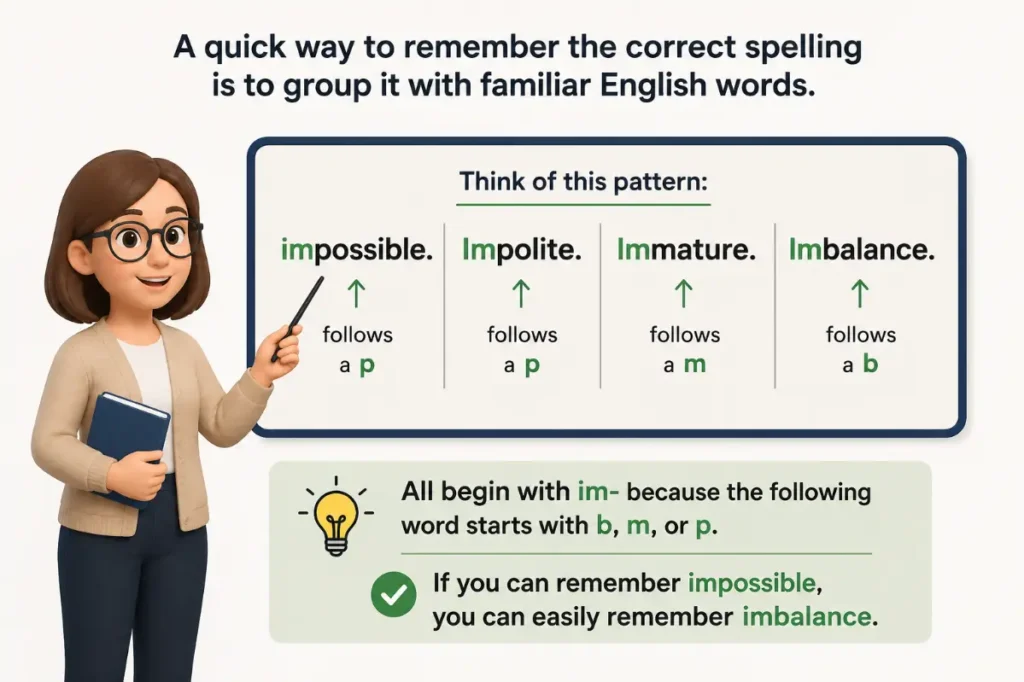
You can also connect it with other familiar words.
- Impossible.
- Immature.
- Impatient.
- Immobile.
- Imbalance.
These words all show the same broad prefix pattern.
Another useful trick is to focus on the base word. The word balance remains fully visible inside imbalance. You are adding a prefix rather than replacing the base.
Think:
balance → imbalance
That visual connection is often easier to remember than memorizing the whole word letter by letter.
Why The Spelling Causes Confusion
The spelling problem is partly a result of how English speakers process words.
When you hear imbalance, the first sound can blend quickly into the beginning of balance. In normal speech, people do not pause between im and balance. That makes it easy for a writer to remember the sound but reconstruct the wrong spelling.
There is also a pattern based on familiar words. Writers know many words that begin with in, so inbalance can look reasonable even though it is not the established standard form.
Typing speed adds another layer. A person who writes quickly may rely on a mental sound pattern instead of checking the complete written form.
From an NLP perspective, a spelling error such as inbalance can still be understood from surrounding words. A sentence such as the inbalance between supply and demand contains enough context for many language systems to infer the intended word. Human readers can do the same thing.
That does not make the spelling acceptable. Context can rescue meaning while still leaving an error on the page.
Formal And Informal Usage
Imbalance is suitable for both informal and formal writing.
In a casual conversation, you might say:
I noticed an imbalance in the load.
In a formal report, you might write:
The analysis identified an imbalance between available resources and projected demand.
The level of formality comes from the surrounding language rather than the word itself.
For very casual speech, simpler phrases may sound more natural.
The table is uneven.
The two sides aren’t equal.
The machine feels off balance.
In technical or professional writing, imbalance may be the more precise choice.
Expert Language Insight
An experienced editor would usually correct inbalance immediately because the intended word is clear and the standard form is well established. The mistake often survives because it looks logical and because spellings based on the prefix in can feel more intuitive than the established form. Professional editing tools may flag the nonstandard form, but a human editor still needs to understand the context. The best editing habit is to learn the word family rather than depend entirely on automatic correction.
Conclusion
inbalance or imbalance has a clear answer. Imbalance is the standard spelling for a lack of balance, equality, proportion, or stability. The form inbalance is normally a spelling mistake caused by treating the prefix in as if it always kept the same spelling.
The word works as a noun and appears naturally in everyday speech, workplace communication, academic writing, journalism, science, finance, and many other areas. Its related adjective is imbalanced, while words such as inequality, disparity, and disequilibrium describe related ideas with different shades of meaning.
For an easy memory trick, connect the word directly to balance. Think im plus balance. Once you remember that the prefix changes to im before b, the standard spelling becomes much easier to recall and use confidently.
FAQs
Is inbalance a real English word?
Inbalance is not normally accepted as the standard spelling of the noun meaning a lack of balance. In standard English writing, use imbalance. The nonstandard form can appear in typing errors or informal online text, but its presence does not make it an accepted alternative. If you are writing for school, work, publication, or a professional audience, choose the established spelling.
What does imbalance mean?
Imbalance means a lack of balance, equality, proportion, or stability. The word can describe physical conditions, financial relationships, social differences, market conditions, scientific systems, and many other situations. For example, an imbalance between supply and demand means the two sides are not properly matched. The exact meaning depends on the context.
Which is correct inbalance or imbalance?
Imbalance is the correct standard form. Inbalance is normally a misspelling. The reason for the unusual spelling is connected to the prefix in, which often changes to im before words beginning with certain consonants. Since balance begins with b, the established form is imbalance. This is the spelling you should use in standard English.
Why does the word use im instead of in?
The change reflects a common form of prefix assimilation. The negative prefix in can appear as im before certain consonants, especially b, m, and p. This pattern appears in words such as impossible, immature, and impatient. Imbalance follows the same established pattern. The form developed as part of English word formation rather than as a modern spelling preference.
How do you pronounce imbalance?
Imbalance is commonly pronounced /ˌɪmˈbæləns/ in American English. A simple guide is im BAL uhns, with the strongest stress on the middle syllable. The final part sounds like the ending of balance. Speaking the word slowly while looking at its spelling can help connect the pronunciation with the correct written form.
Is imbalance a noun or an adjective?
Imbalance is a noun because it names a condition or state. For example, The system has an imbalance uses the word as a noun. The related adjective is imbalanced, as in The system is imbalanced. Keeping these forms separate helps prevent grammar mistakes. The noun names the condition while the adjective describes something that has that condition.
What is another word for imbalance?
Useful related words include inequality, disparity, unevenness, instability, disequilibrium, and lack of balance. The best choice depends on context. Inequality often focuses on unequal amounts or treatment. Disparity emphasizes a significant difference. Instability focuses on a lack of steadiness. Disequilibrium is more technical. Imbalance is broad and works well in general and professional English.
Is imbalance suitable for formal writing?
Yes. Imbalance is fully suitable for formal writing and appears naturally in academic, professional, scientific, financial, and journalistic contexts. It can describe an uneven relationship between quantities, groups, forces, or conditions. The word itself is not overly casual. If your sentence needs a precise noun for a lack of balance, imbalance is a natural choice in both formal and everyday English.
