
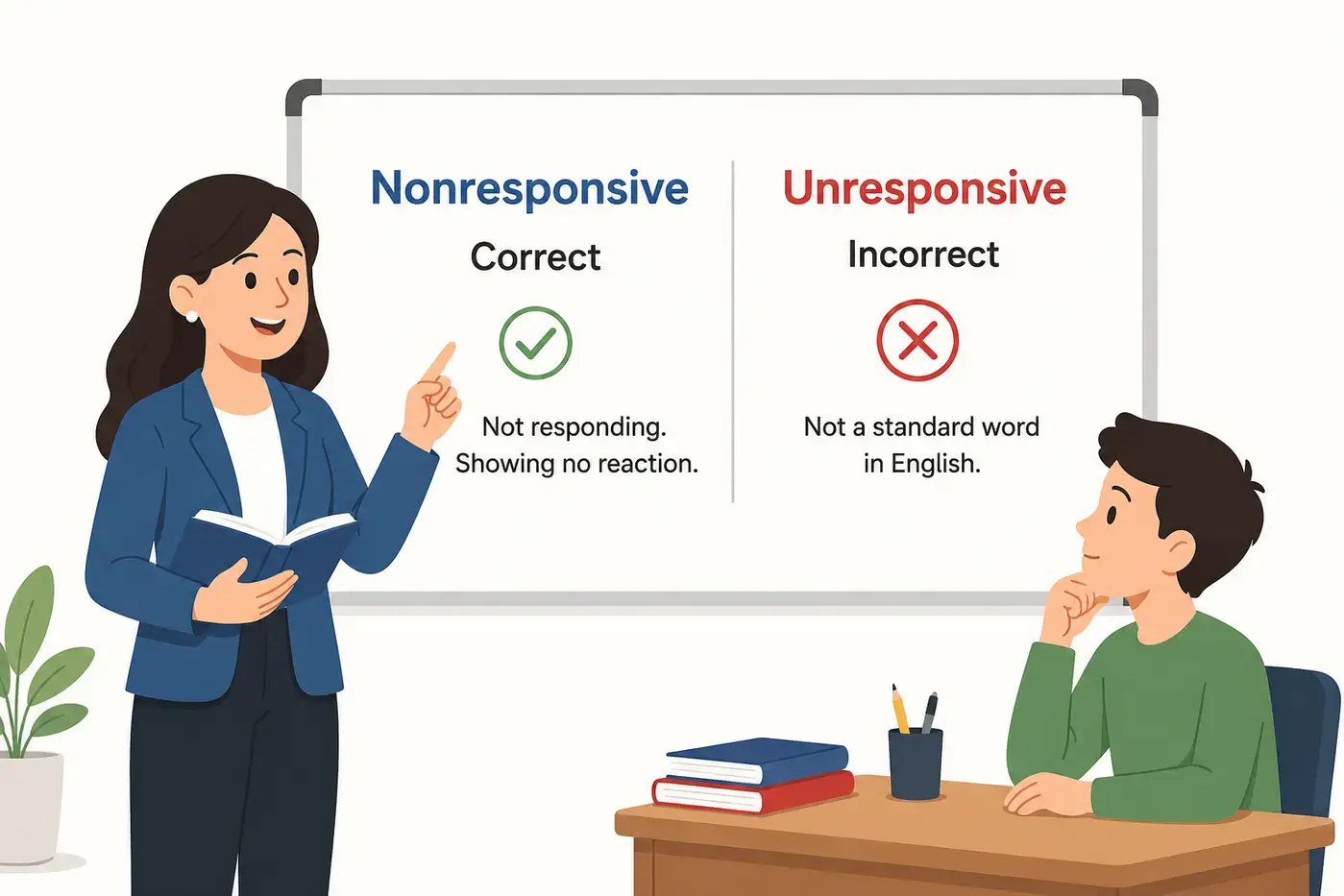
Have you ever paused while writing because you couldn’t decide between nonresponsive and unresponsive? Both words are correct English. They describe a lack of response, but the choice can depend on the situation and the meaning you want to express.
The difference is subtle. Nonresponsive often describes something that fails to respond to a request, signal, treatment, or expected input. Unresponsive can describe the same failure, but it also commonly refers to a person who isn’t reacting to speech, touch, or other attempts to get their attention. In medical settings, that distinction can matter.
Neither spelling is a mistake, and you don’t need to memorize a complicated grammar rule to use them well. Instead, focus on the subject, the type of response involved, and the tone of your sentence. A computer may be unresponsive, a customer may be nonresponsive, and a person who doesn’t react to their surroundings may be described as unresponsive.
This guide explains the meanings, pronunciation, grammar, regional usage, and common mistakes associated with both terms. You’ll also find practical examples and editing tips to help you choose the clearest word for your message.
Quick Answer
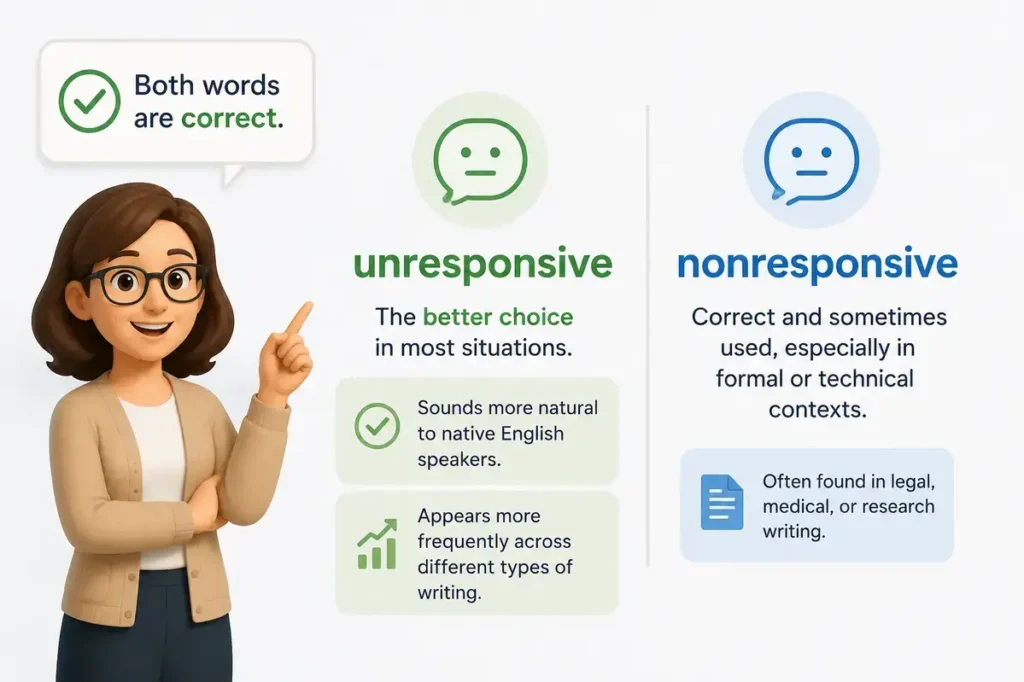
Both nonresponsive and unresponsive are correct English adjectives. They describe a failure or lack of response, and their meanings often overlap. Use nonresponsive when emphasizing a failure to respond to a request or expected input. Use unresponsive when describing a person, device, or system that isn’t reacting. Context matters more than spelling.
Comparison Table for Nonresponsive and Unresponsive
| Feature | Nonresponsive | Unresponsive |
|---|---|---|
| Correct spelling | Yes | Yes |
| Part of speech | Adjective | Adjective |
| Main meaning | Not responding or failing to provide an expected response | Not responding or failing to react |
| Typical emphasis | Lack of response to a request, treatment, signal, or input | Lack of reaction to a person, event, stimulus, or input |
| Pronunciation | non ri SPON siv | un ri SPON siv |
| Formality | Suitable for formal and informal writing | Suitable for formal and informal writing |
| Common contexts | Customer service, legal writing, research, technology, treatment outcomes | Medical descriptions, everyday speech, technology, relationships, customer service |
| Example | The company was nonresponsive to our complaint. | The patient was unresponsive to verbal commands. |
| Regional usage | Standard in American English and other major varieties | Standard in American English and other major varieties |
The table shows typical tendencies rather than strict rules. You can use either adjective in several of the same situations, provided the sentence communicates your intended meaning.
What Nonresponsive Means
Nonresponsive is an adjective that describes someone or something that doesn’t respond as expected. The missing response may involve a question, request, message, treatment, signal, or other form of input.
For example, a business that ignores repeated customer complaints can be described as nonresponsive. A computer program that fails to react to a command may also fit this description.
The word often appears in professional writing because it can describe an observable failure without suggesting why that failure occurred. A report might state that a department was nonresponsive to a request for information. The statement identifies the problem without claiming the department acted deliberately.
How the Word Works in a Sentence
The adjective commonly appears after linking verbs such as is, was, seems, and became. It can also appear before a noun.
- The support team was nonresponsive to our emails.
- We received a nonresponsive reply that didn’t address the question.
- The software became nonresponsive after the update.
In the second example, the adjective describes the reply rather than the person who sent it. The distinction helps you identify exactly what failed to provide a useful response.
Does Nonresponsive Mean Rude or Unwilling?
Not necessarily. A nonresponsive person or organization may be ignoring a request, but the word doesn’t prove that the silence is intentional. The recipient may be busy, unavailable, dealing with a technical problem, or unable to provide an answer.
If you need to describe intent, choose more precise language. Ignored the message suggests a different meaning from didn’t respond to the message. The first may imply a deliberate choice, while the second simply reports what happened.
What Unresponsive Means
Unresponsive is an adjective that describes someone or something that fails to react or respond. It can refer to a person who doesn’t answer when spoken to, a device that doesn’t react to input, or an organization that fails to address a request.
For example, you might describe a phone screen as unresponsive if tapping it produces no result. You might also describe a person as unresponsive if they don’t react to their name or other attempts to get their attention.
The word is especially familiar in medical language. An unresponsive person may not react to speech, touch, or other stimuli. However, the term alone doesn’t identify the cause or establish a diagnosis.
How the Word Works in a Sentence
Like its counterpart, this adjective can appear before a noun or after a linking verb.
- The patient was unresponsive to verbal commands.
- My phone screen became unresponsive during the call.
- Her manager seemed unresponsive to repeated requests for help.
Each example describes a lack of reaction. The surrounding words show what kind of response was expected and what failed to happen.
Does Unresponsive Mean Unconscious?
No. The words are related in some situations, but they aren’t interchangeable in every context.
Unresponsive describes a lack of response. Unconscious describes a state in which a person isn’t conscious or aware. An unconscious person is generally unresponsive, but someone who doesn’t answer a question may be fully awake and aware.
In an emergency, don’t assume that a person is unconscious simply because they don’t answer. Check for responsiveness and normal breathing, call emergency services, and follow the dispatcher’s instructions.
Key Differences Explained
The two adjectives share a central meaning, so you can often substitute one for the other without changing the basic message. Still, their usual contexts and shades of meaning can help you make a better choice.
Spelling
Both forms follow standard English spelling patterns. Nonresponsive combines the prefix non with responsive, while unresponsive combines un with the same base word.
The prefixes differ, but neither form is a misspelling. In standard American English, both are normally written as single words without a hyphen.
Meaning
Nonresponsive often emphasizes the absence of an expected answer or action. Unresponsive often emphasizes a failure to react to a person, signal, event, or stimulus.
Consider these sentences.
- The vendor was nonresponsive to our request for a refund.
- The vendor was unresponsive to our request for a refund.
Both sentences are correct. The first can sound slightly more focused on the vendor’s failure to answer a request. The second describes the same lack of response from a slightly different angle.
Now compare these examples.
- The patient was unresponsive to verbal commands.
- The patient was nonresponsive to verbal commands.
Both can make sense, but the first is the more familiar choice when describing a person’s lack of reaction in a medical setting.
Grammar
Both words function as adjectives. They can describe people, businesses, devices, services, systems, and other things that are expected to respond.
You can place either word before a noun, as in an unresponsive screen, or after a linking verb, as in the screen is unresponsive.
Neither adjective needs a special grammatical structure. Your sentence should simply make the expected response clear.
Pronunciation
Both words have four syllables in common American English pronunciation. The main stress falls on the third syllable, which contains the sound of spon.
The opening sounds differ. Nonresponsive begins with the sound of non, while unresponsive begins with the sound of un. The rest of the word follows the same basic pattern.
Formality
Both adjectives work in professional reports, business emails, academic writing, and ordinary conversation. Neither is automatically more formal than the other.
The best choice depends on your message. A workplace report might describe a nonresponsive department, while a medical report might describe an unresponsive patient. These are common tendencies, not rules that prohibit other combinations.
Context and Regional Usage
American, British, Canadian, and Australian English all recognize both words. There is no major regional spelling difference between the two forms.
A writer’s choice usually depends on context, personal style, and the type of response being described. You don’t need to switch spellings when writing for readers in another English speaking country.
Which Form Is Correct?
Both forms are correct. You don’t need to replace one with the other simply because you think it looks less familiar.
The choice becomes easier when you identify the kind of response involved.
- Use nonresponsive when describing a failure to answer a request, provide information, or respond to an expected input.
- Use unresponsive when describing a lack of reaction to a person, stimulus, command, or event.
- Use either form when both express your meaning clearly and naturally.
- Follow an organization’s established style guide if it prefers one term in a particular field.
For example, The agency was nonresponsive to our complaint is a natural sentence. So is The agency was unresponsive to our complaint. The wording changes slightly, but the central meaning stays the same.
The important point is that English doesn’t assign one adjective exclusively to requests and the other exclusively to reactions. Those patterns describe common usage rather than fixed grammar rules.
Ten Natural Example Sentences
The following examples show how both adjectives work in different situations. Each sentence uses standard English.
1. Everyday conversation. My old laptop became unresponsive when I opened too many apps.
2. Text messages. I’ve sent him two messages today, but he’s been nonresponsive.
3. Customer service. The company was nonresponsive to my request for a replacement.
4. Workplace communication. Our team needs a clear process for handling nonresponsive clients.
5. School. The student seemed unresponsive when the teacher asked him to join the discussion.
6. Academic writing. Several participants were unresponsive to follow up requests for additional information.
7. Technical support. Restarting the device may help if the touchscreen remains unresponsive.
8. Medical context. The emergency team assessed the unresponsive patient and checked for normal breathing.
9. Formal communication. The department remained nonresponsive despite several written requests for clarification.
10. Social situations. I thought my friend was upset because she seemed unresponsive during our conversation.
Notice that the examples describe different kinds of missing responses. A person may fail to answer a message, a device may fail to react to a command, and a department may fail to provide requested information. The surrounding context makes the intended meaning clear.
Common Mistakes and Misspellings
The main challenge isn’t choosing between two correct words. It’s using them accurately and avoiding spelling errors that look or sound similar.
Mistake One Writing Non Responsive as Two Words
Incorrect in standard usage. The support team was non responsive.
Correct. The support team was nonresponsive.
In ordinary modern English, the adjective is usually written as one word. A hyphen is generally unnecessary. Follow a specific style guide if it gives different instructions for a specialized use.
Mistake Two Writing Un Responsive With a Space
Incorrect in standard usage. The touchscreen is un responsive.
Correct. The touchscreen is unresponsive.
The prefix un combines with the base adjective to form a single word. Writing the two parts separately is a common typing error rather than a different accepted spelling.
Mistake Three Using Nonresponsive as a Noun
Awkward. The nonresponsive of the customer delayed the project.
Correct. The customer’s lack of response delayed the project.
The word is an adjective, so it normally describes a noun rather than replacing one. You can write the nonresponsive customer or the customer remained nonresponsive. If you need a noun, phrases such as lack of response or failure to respond are clearer.
Mistake Four Assuming Unresponsive Always Means Unconscious
Misleading. The customer didn’t reply to my email, so he must be unconscious.
Better. The customer hasn’t replied to my email.
A person can be unresponsive to a message for many reasons. The word doesn’t establish that someone is unconscious, unwilling, angry, or unable to communicate. Choose language that describes what you actually know.
Mistake Five Treating the Two Words as Opposites
Incorrect assumption. Nonresponsive means one thing, while unresponsive means the complete opposite.
Correct understanding. Both describe a lack of response.
The prefixes non and un can carry different shades of meaning across English words, but these two adjectives overlap heavily. You should choose the word that best fits the context instead of trying to force a sharp distinction that ordinary usage doesn’t support.
Pronunciation Guide
Both words are pronounced with four syllables in standard American English. Their stress patterns are the same, but their opening sounds differ.
Nonresponsive
IPA
/ˌnɑːn.rɪˈspɑːn.sɪv/
Easy guide: non ri SPON siv.
Stress falls on the third syllable.
Unresponsive
IPA
/ˌʌn.rɪˈspɑːn.sɪv/
Easy guide: un ri SPON siv.
Stress falls on the third syllable.
IPA transcriptions can vary slightly across dictionaries and accents. In particular, the vowel in the stressed syllable may sound different across English varieties. The transcriptions above give a common American English style of pronunciation.
How to Pronounce Each Word
Start with the first syllable, then move smoothly through the middle syllables. Give the strongest emphasis to spon. Finish with the short ending sound in sive.
A common mistake is to place too much stress on the opening prefix. Keep the beginning relatively light and let the main stress fall on the third syllable. This makes the word easier to say naturally.
You don’t need to pronounce each syllable as a separate unit during normal conversation. Native speakers usually connect the sounds smoothly, especially in longer sentences.
Etymology and Word Origin
Both adjectives developed from the English word responsive, which describes the ability or tendency to respond.
Responsive is related to the verb respond, which entered English through French from Latin respondere, meaning to answer or reply. The Latin word combines elements associated with answering and making a promise or commitment in return.
English uses prefixes to form words with negative meanings. The prefix non commonly means not or the absence of something, while un often gives an adjective the opposite or negative meaning. Adding these prefixes to responsive produces two adjectives with closely related meanings.
This word formation explains why both terms make sense in modern English. Their shared base gives them a common meaning, while the prefixes create negative forms. Their present day usage reflects ordinary English word building rather than a strict division between two unrelated concepts.
Regional Usage in English
The two words are standard across major English varieties. The main differences involve common phrasing and context rather than spelling.
American English
In the United States, both forms appear in everyday speech and professional writing. Nonresponsive is common in descriptions of organizations that fail to answer requests, while unresponsive is familiar in medical descriptions and discussions about devices that don’t react to input.
These preferences aren’t exclusive. An American writer can describe a customer as unresponsive or a patient as nonresponsive when the context supports that choice.
British English
British English also recognizes both adjectives. There is no general British spelling rule that changes nonresponsive to a different form or makes unresponsive incorrect.
Writers may encounter variations in punctuation and style across publications, but the core meanings remain the same.
Australian English
Australian English uses both forms in much the same way as American and British English. The choice depends on the subject and intended meaning rather than a national spelling rule.
For example, an Australian business might describe a supplier as nonresponsive, while a technical support team might report that a device has become unresponsive.
Canadian English
Canadian English also accepts both spellings. Writers can use either form in business communication, technical documents, and everyday conversation.
For all four varieties, consistency matters more than choosing one adjective for every situation. Use the wording that communicates the intended meaning clearly, and follow any relevant workplace or publication style guide.
Grammar Rules and Part of Speech
Both words are adjectives. They describe a quality or condition of a person, object, organization, or system. They don’t normally function as verbs or stand alone as nouns in standard sentences.
Using the Words Before a Noun
You can place either adjective directly before a noun to describe it.
- The nonresponsive vendor missed another deadline.
- We replaced the unresponsive keyboard.
- The report identified a nonresponsive department.
- The nurse assessed the unresponsive patient.
In each sentence, the adjective modifies the noun that follows it. The rest of the sentence explains the situation or consequence.
Using the Words After a Linking Verb
Both forms also work after linking verbs such as be, seem, remain, and become.
- The customer was nonresponsive.
- The screen became unresponsive.
- The department remained nonresponsive.
- The patient appeared unresponsive.
This structure places the adjective after the verb and uses it to describe the subject. The sentence doesn’t need an additional noun after the adjective to be grammatically complete.
Using Prepositions Correctly
Both adjectives commonly appear with the preposition to when you identify what failed to receive a response.
- The company was nonresponsive to our complaint.
- The device was unresponsive to touch.
- The patient was unresponsive to verbal commands.
- The department was unresponsive to public concerns.
You can also use them without to when the situation is already clear. For example, The computer is unresponsive is a complete sentence.
Punctuation and Hyphenation
In ordinary modern American English, both words are written as single words without a hyphen. You generally don’t need a comma between an adjective and the noun it describes.
For example, write an unresponsive customer, not an un responsive customer. Similarly, write the nonresponsive system, not the non responsive system.
When two or more adjectives describe the same noun, use punctuation according to the usual rules for coordinate adjectives. However, these two terms don’t normally require special punctuation simply because they begin with a negative prefix.
Real Life Usage Examples
The meaning of these adjectives becomes easier to understand when you see them in familiar situations. The following examples show how writers can use them without making the language sound stiff or overly technical.
Daily Conversation
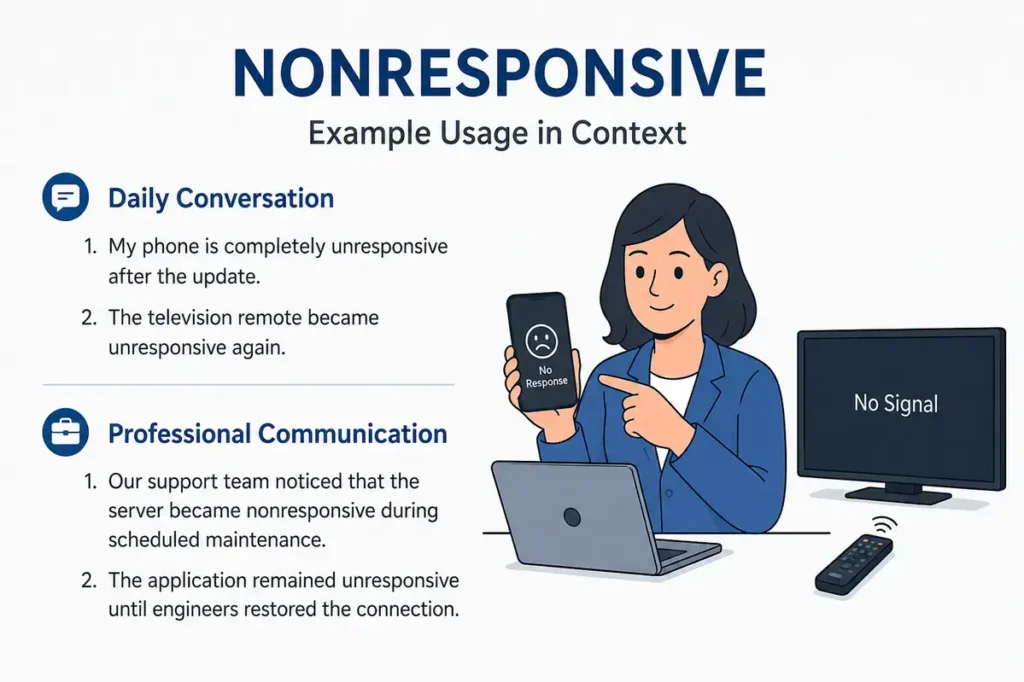
- My tablet became unresponsive while I was watching a movie.
- I’ve called the repair shop twice, but they’ve been nonresponsive.
The first example describes a device that isn’t reacting. The second describes a business that hasn’t answered attempts to make contact.
Email and Workplace Communication
- We have contacted the supplier three times, but the company remains nonresponsive to our requests.
- The new scheduling system became unresponsive after several employees logged in.
The first sentence communicates a failure to provide information or action. The second identifies a technical problem that may need investigation.
Academic Writing
- Several participants were nonresponsive to follow up questions during the interview process.
- The research team recorded an unresponsive system during the second phase of testing.
Academic writing benefits from precise descriptions. If the study defines nonresponsive or unresponsive in a special way, researchers should explain that definition before using the term throughout the report.
News and Journalism
- Residents criticized the agency for being nonresponsive to repeated complaints about road conditions.
- Emergency workers treated an unresponsive person at the scene of the accident.
Journalists should avoid adding assumptions that the available facts don’t support. Calling an agency nonresponsive describes its failure to address concerns, but it doesn’t automatically establish why the agency failed to act.
Likewise, describing someone as unresponsive reports an observed condition. It doesn’t establish a medical diagnosis or explain the cause.
Literature and Storytelling
- She called his name again, but he remained unresponsive, staring silently at the floor.
- The villagers grew frustrated with a nonresponsive council that refused to address their concerns.
In storytelling, either adjective can help establish tension or frustration. However, a writer may get a stronger result by describing the person’s actions directly. Instead of saying someone was unresponsive, you could write that they looked away, stayed silent, or failed to answer.
Related and Confused Terms
Several English words describe a lack of response, but each one carries a slightly different meaning. Choosing the right alternative can make your writing more precise.
| Related term | Meaning | Example |
|---|---|---|
| Unavailable | Not accessible or ready for use | The manager is unavailable this afternoon. |
| Silent | Making no sound or saying nothing | The room fell silent. |
| Inactive | Not operating or taking action | The account has been inactive for months. |
| Unconscious | Not conscious or aware | The injured person was unconscious. |
| Uncooperative | Unwilling to help or work with others | The witness was uncooperative during the interview. |
| Noncompliant | Failing to follow a rule or instruction | The device was noncompliant with the safety standard. |
| Inattentive | Not paying close attention | The student seemed inattentive during the lesson. |
| Unreachable | Impossible or difficult to contact | The technician was unreachable all morning. |
These words aren’t exact replacements for either adjective. An unavailable manager may respond later, while an unresponsive manager has failed to respond in the situation being described. A silent person may be listening carefully, and an inactive system may be working as designed.
The same principle applies to uncooperative and noncompliant. Those terms can suggest unwillingness or failure to follow expectations. The two main adjectives don’t automatically imply either one.
Expert Language Insight
An experienced editor looks at the facts before choosing between these words. If a report describes a company that hasn’t answered repeated requests, nonresponsive may fit naturally. If it describes a person who doesn’t react to speech or touch, unresponsive may be clearer. Both are standard spellings, so a grammar checker shouldn’t automatically treat one as an error. The editor’s job is to check meaning, context, and consistency rather than replace every occurrence with a single preferred term. When the distinction is minor, clarity matters more than forcing a rigid rule onto ordinary English.
Conclusion
Nonresponsive vs unresponsive comes down to context rather than correct and incorrect spelling. Both are standard English adjectives that describe a lack of response. Nonresponsive often fits situations involving unanswered requests or missing information, while unresponsive commonly describes a person, device, or system that fails to react. Their meanings overlap, so you don’t need to force a strict distinction into every sentence.
Remember this simple editing tip: identify what should have responded and describe the failure as clearly as possible. If both words express your meaning accurately, either can work. Clear writing depends on precise meaning, not on treating two valid words as spelling mistakes.
FAQs
Is nonresponsive a real word?
Yes. Nonresponsive is a standard English adjective used to describe someone or something that fails to respond as expected. It appears in business communication, technical writing, research, and everyday speech. The word isn’t a misspelling of unresponsive. Both forms are correct, and the best choice depends on the context and the meaning you want to communicate.
What does unresponsive mean?
Unresponsive means failing to respond or react to something. You can use it to describe a person who doesn’t answer when spoken to, a phone screen that doesn’t react to touch, or a business that doesn’t reply to requests. In medical settings, it can describe a person who doesn’t react to stimuli. The word alone doesn’t explain the cause.
Which is correct for a person who doesn’t answer a message?
Both words can describe someone who doesn’t answer a message. Nonresponsive often fits professional descriptions of people who fail to reply to requests, while unresponsive works naturally in everyday conversation. For a neutral message, you can simply say that the person hasn’t replied. This wording reports the facts without guessing why the person hasn’t responded.
How do you pronounce these two words?
Both words have four syllables, and the main stress falls on the third syllable. The opening sound distinguishes them: nonresponsive begins with non, while unresponsive begins with un. In American English, the rest of each word follows a similar sound pattern. Pronouncing the stressed syllable clearly helps both words sound natural in conversation.
Can nonresponsive or unresponsive start a sentence?
Yes. Both words can begin a sentence when they describe a subject or form part of a sentence opening. For example, Nonresponsive customers may need a follow up message is grammatically correct. So is Unresponsive devices can interrupt important tasks. The choice depends on what you’re describing, not on the position of the adjective in the sentence.
What is a good synonym for unresponsive?
Useful alternatives include silent, inactive, unavailable, and unreachable. However, these words have different meanings. A silent person may be listening, while an inactive device may not be expected to respond at all. If you mean that someone hasn’t answered a question or request, failed to respond is often a clear and neutral alternative.
Why do people confuse nonresponsive and unresponsive?
People confuse the words because they share the same base adjective and describe similar situations. Their prefixes both create negative meanings, so the resulting words overlap in everyday use. Many sentences can accept either form without changing the main message. Instead of memorizing a strict distinction, focus on the subject, the expected response, and the tone of your sentence.
Is nonresponsive or unresponsive better for formal writing?
Both are appropriate for formal writing. Use nonresponsive when describing a failure to answer requests, provide information, or address concerns. Use unresponsive when describing a lack of reaction to a person, stimulus, or input. These are useful tendencies rather than fixed rules. In professional documents, choose the term that communicates the facts clearly and follow your organization’s style guide.
