
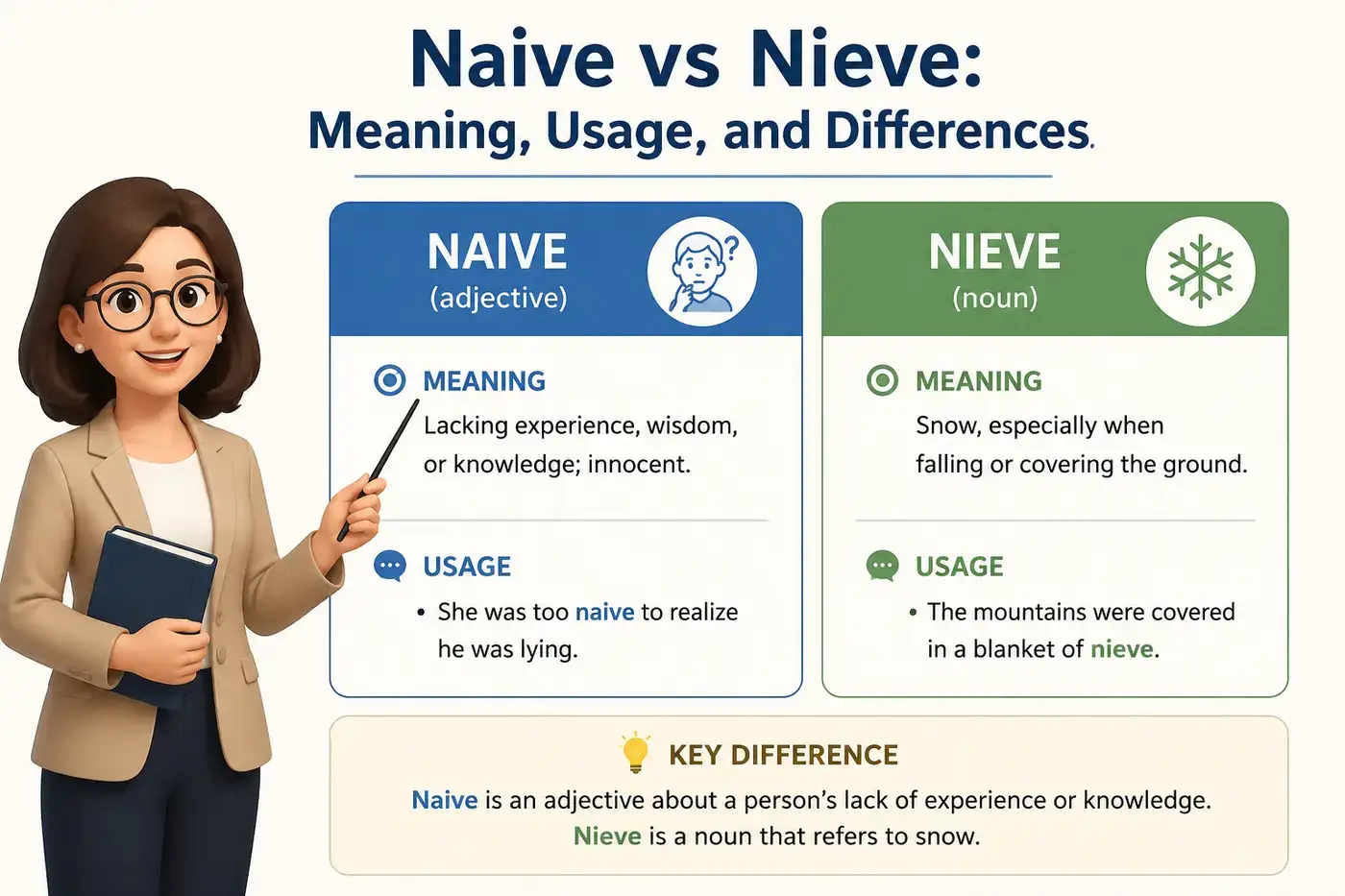
Have you ever written nieve when you meant naive? The two forms look similar, so it is easy to mix them up while typing or writing quickly. However, naive is the correct spelling in standard English when you mean someone who lacks experience or trusts people too easily. Nieve is not the standard spelling of this adjective.
The confusion often comes from the way English words sound, the influence of other languages, and the fact that some English words use unusual letter patterns. If you have seen both forms online, you may wonder if they have different meanings or if one is simply a typo.
The answer depends on the context, but for everyday American English, the choice is straightforward. Use naive to describe a person, belief, idea, or expectation that shows limited experience or an overly simple view of a situation. Learning its meaning, pronunciation, and grammatical use will help you choose it confidently in school assignments, emails, professional documents, and everyday conversations.
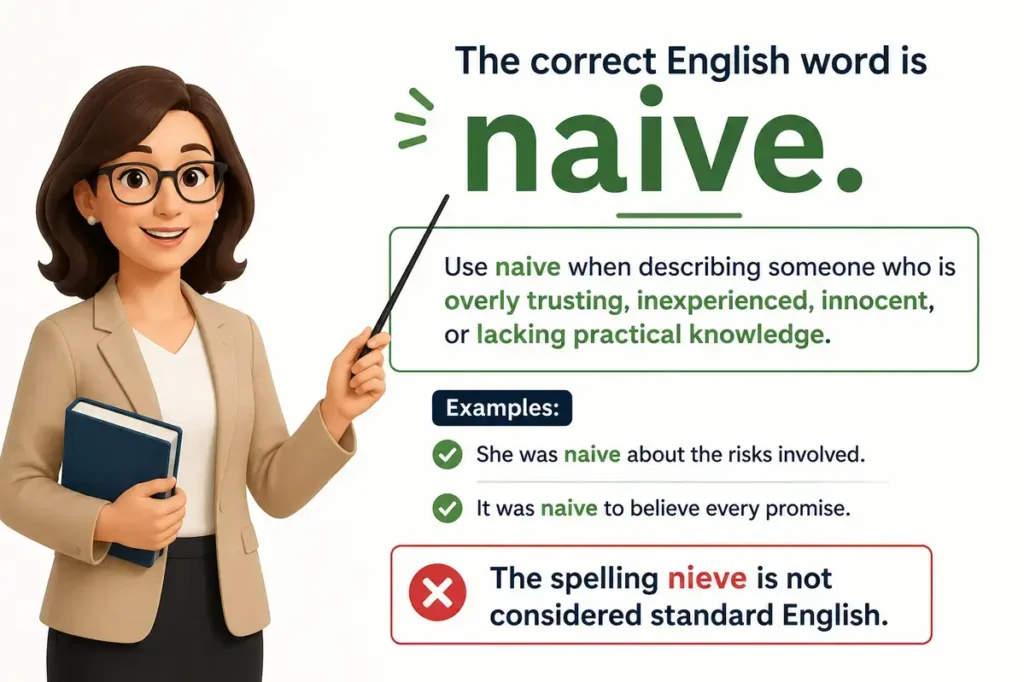
Quick Answer
Naive is the standard English spelling of the adjective meaning inexperienced, overly trusting, or lacking practical judgment. Nieve is not the standard spelling for this meaning and is usually a misspelling in ordinary English writing. Remember the spelling with the letter a after the initial n.
Comparison Table
| Feature | Naive | Nieve |
|---|---|---|
| Standard English spelling | Yes | No for the intended adjective |
| Meaning | Inexperienced or overly trusting | No standard English adjective meaning the same thing |
| Part of speech | Adjective | Not the standard form for this meaning |
| Pronunciation | Commonly nay EEV or nah EEV | No standard pronunciation for the intended adjective |
| American English | Standard | Usually a spelling error |
| Formal writing | Appropriate when used accurately | Incorrect when intended to mean naive |
| Common contexts | Personal judgment, beliefs, expectations, decisions | Often appears as a typo or spelling confusion |
| Example | It was naive to trust a stranger with the password. | The intended spelling is naive. |
What Does Naive Mean?
Naive describes someone who has little experience with a situation or who does not understand how complicated or risky it can be. A naive person may trust others too easily, accept claims without checking them, or expect people to behave honestly in every situation.
The word does not always mean someone is unintelligent. A smart person can be naive about money, relationships, politics, business, or a subject they have never studied. The missing ingredient is usually experience or a realistic understanding of the situation.
For example, a new employee might believe that every promise made during a business meeting will be kept. That expectation may be naive because experienced workers know that promises sometimes change when budgets, deadlines, or company priorities shift.
The Main Meanings of Naive
The adjective has several closely related uses.
- Inexperienced. Someone is naive when they have not yet learned how a particular situation works. A first time traveler may be naive about common tourist scams.
- Overly trusting. A naive person may believe what others say without asking for evidence. For example, giving a stranger your banking details because they promise a prize shows poor judgment and excessive trust.
- Unrealistically simple. An idea or plan can be naive if it ignores real problems. A plan to eliminate traffic by asking everyone to drive more carefully may overlook road design, public transportation, and traffic volume.
- Lacking practical judgment. A decision may be naive when it seems reasonable at first but fails to account for obvious risks. Investing all your savings in an unfamiliar business based on one conversation would be a good example.
The exact meaning depends on the sentence. When the word describes a person, it often refers to limited experience or trust. When it describes a plan or assumption, it often points to an incomplete understanding of reality.
Is Naive Always an Insult?
No. The word can be critical, neutral, or even affectionate, depending on the context.
Calling someone naive may suggest that they need more experience. For example, a manager might describe a new employee’s expectations as naive without questioning the employee’s intelligence or character.
In another situation, the word may sound harsh. Telling a friend that they are naive for trusting a dishonest person can make them feel foolish. The same idea can be expressed more gently by saying that they may be too trusting or that they have not seen this kind of behavior before.
The adjective can also describe an innocent or simple approach to the world. In art and literature, a naive style may refer to a direct or unschooled approach rather than a lack of intelligence. The surrounding context helps readers understand the intended meaning.
What Does Nieve Mean?
In ordinary English writing, nieve is not the standard spelling of the adjective discussed above. If you want to describe someone as inexperienced or overly trusting, writing nieve will generally be treated as a spelling error.
That does not mean the sequence of letters can never appear in any language, name, or specialized context. Words and names can have different meanings across languages, and a spelling that looks unusual in English may be legitimate elsewhere. However, those separate uses do not make nieve an accepted substitute for the English adjective naive.
For example, if you write, The new investor was nieve to believe every sales claim, readers will normally understand that you intended to write naive. In a school assignment, business report, or professional email, you should correct the spelling.
Why People Write Nieve
Several factors can lead to this error.
- Sound based spelling. Writers sometimes choose letters based on how a word sounds to them. Because English spelling does not always match pronunciation, this method can produce errors.
- Unfamiliar letter patterns. The spelling of naive may look unusual to someone who has not used the word often. That uncertainty can lead to a guessed spelling.
- Typing mistakes. A quick message or rushed document can contain a letter substitution that goes unnoticed.
- Language influence. People who know another language may bring familiar spelling patterns into English. This is a normal part of learning languages, although the correct English form still matters in formal writing.
- Limited exposure. Someone who has heard the word more often than they have read it may remember the sound but not the spelling.
The easiest solution is to learn the standard form as a complete word instead of trying to spell it from sound alone.
Key Differences Between the Two Spellings
The central difference is simple. Naive is the accepted English adjective for limited experience or excessive trust. Nieve is not the standard spelling for that meaning.
Spelling
The correct form contains the letters n, a, i, v, and e in that order. The incorrect form replaces the second letter with i, producing a different letter sequence.
A useful memory trick is to associate the opening letters of naive with the word natural. Both begin with n followed by a. This is only a spelling aid, not a shared word origin.
Meaning
The standard adjective describes a person or idea that does not account for enough real world experience. The misspelled form has no standard equivalent meaning in ordinary English.
Grammar
Naive functions as an adjective. It can describe a noun directly, as in a naive assumption, or follow a linking verb, as in the assumption was naive.
Writing nieve does not create a different grammatical form. It remains a spelling error when used in place of the adjective.
Pronunciation
The standard word has two common pronunciation patterns in American English. Some speakers say it with a first vowel similar to the word day, while others use a vowel closer to the one in father. The final part sounds like eve.
Because the misspelled form is not the standard adjective, it has no established pronunciation for this intended meaning.
Formality and Context
The correct form works in both casual and formal English. You can use it in a text message, a school essay, a workplace report, or an academic discussion.
The incorrect form should be fixed in all these contexts. Informal writing allows many shortcuts, but changing a word’s spelling by mistake does not create a standard alternative.
Which Spelling Is Correct?
Use naive when you want to describe someone or something as inexperienced, overly trusting, or unrealistic. Do not use nieve as a substitute.
This follows standard English spelling conventions. Major English dictionaries recognize naive as an adjective with meanings related to inexperience, innocence, and insufficient judgment. The alternate spelling naïve, which includes two dots over the i, is also established.
The two dots are called a diaeresis. They indicate that the adjacent vowels are pronounced separately rather than being read as one combined vowel sound. In modern American English, the unaccented form naive is widely used and is suitable for general writing.
For example, both of these sentences are acceptable.
- It was naive to assume that the offer had no hidden costs.
- It was naïve to assume that the offer had no hidden costs.
The difference is typographic, not a change in meaning. By contrast, replacing the a with an i to produce nieve is not a standard spelling choice for this adjective.
Ten Natural Example Sentences
These examples show how to use the correct form in everyday life, school, and professional communication.
- Everyday conversation. I was naive to think everyone would agree with my plan.
- Text message. I know it sounds naive, but I really thought the surprise would stay secret.
- Workplace communication. It would be naive to approve the proposal without reviewing the costs.
- School assignment. The character’s naive beliefs change after he experiences hardship.
- Academic writing. The argument rests on a naive assumption that all consumers behave in the same way.
- Personal relationships. She was not naive; she simply chose to give her friend another chance.
- Online safety. It is naive to share private information with an account you have not verified.
- Business planning. The founders had a naive view of how long it would take to attract customers.
- News commentary. Analysts warned that expecting an immediate recovery could be naive.
- Storytelling. His naive optimism faded after he discovered how difficult life in the city could be.
Each example uses the same adjective, but the tone changes with the situation. In a personal conversation, the word can describe an expectation. In professional writing, it can point to a weak assumption or an incomplete analysis.
Common Spelling Mistakes
The most useful way to avoid spelling errors is to recognize the pattern behind them. Here are five forms or habits that can cause confusion.
Mistake One: Writing Nieve
Incorrect: It was nieve to believe the stranger.
Correct: It was naive to believe the stranger.
The error comes from mixing up the vowel letters. Remember that the standard adjective begins with n and a.
Mistake Two: Adding an Unnecessary Accent
Incorrect: Treating naïve as the only acceptable form.
Correct: Both naive and naïve are established spellings.
The accented form is legitimate, but American writers commonly use the simpler form without the diaeresis. You do not need to add the marks to make the word correct.
Mistake Three: Confusing Naive With Native
Incorrect: She was naive to the United States.
Correct: She was new to the United States and naive about local customs.
Native generally refers to someone born in a place or something originating there. Naive describes limited experience or overly simple judgment. They are different words with different meanings.
Mistake Four: Using Naive as a Noun
Incorrect: He is a naive.
Correct: He is naive.
The word normally functions as an adjective rather than a noun. You can write a naive person or someone who is naive.
Mistake Five: Assuming Naive Means Unintelligent
Incorrect: Only unintelligent people make naive decisions.
Correct: Even intelligent people can make naive decisions when they lack experience.
The adjective describes a gap in experience or judgment in a particular context. It does not automatically describe a person’s overall intelligence.
Pronunciation Guide
The word is pronounced with two syllables in standard English. The second syllable receives the main stress.
Common American pronunciations: /nɑːˈiːv/ and /naɪˈiːv/.
The exact vowel quality varies among speakers and dictionaries. One common pronunciation begins with a vowel similar to the one in father. Another begins with a sound similar to the vowel in my. Both lead into a stressed syllable that sounds like eve.
How to Say It Clearly
- Start with the first syllable, using the vowel sound familiar from either father or my, depending on your accent.
- Move into the second syllable, which sounds like eve.
- Put the strongest stress on the second syllable.
The key is to pronounce the two vowel sounds clearly. Do not rush the word into a single syllable.
Common Pronunciation Errors
Some speakers place too much stress on the first syllable. Others try to pronounce the word exactly as they imagine it from its spelling. Listening to a trusted dictionary’s audio pronunciation can help you identify the pattern used in your variety of English.
Remember that pronunciation and spelling are related but separate skills. You can pronounce a word correctly and still spell it incorrectly, so use a spelling check when accuracy matters.
Etymology and Word Origin
The English word naive came through French from a Latin word related to being natural or native. The French form naïf is masculine, while naïve is feminine. English adopted the word and uses naive as an adjective without changing it to match the gender of the person being described.
Over time, the English meaning developed around ideas of natural simplicity, innocence, and limited worldly experience. Today, the word often suggests that someone has not yet learned to recognize the risks or complications of a situation.
The historical spelling helps explain why the word may look unusual. The diaeresis in naïve comes from the French spelling tradition, while the simpler naive is common in modern English. Neither form requires the writer to change the word’s meaning.
The spelling nieve does not follow the standard English form for this adjective. Its appearance in a sentence usually reflects a spelling error or a separate use outside the intended English meaning.
Regional Usage
The meaning of the adjective remains broadly consistent across major varieties of English. There is no established American, British, Canadian, or Australian rule that changes the standard spelling to nieve.
American English
In the United States, naive is a standard spelling. The form naïve is also correct, although the version without accent marks is common in everyday writing, news articles, workplace documents, and school assignments.
American speakers may pronounce the first vowel differently. That variation does not change the spelling.
British English
British English also uses naive and naïve. Writers may retain the diaeresis depending on the publication’s style guide, but the basic meaning remains the same.
The spelling nieve is not the standard British alternative for the adjective.
Australian English
Australian English follows the same general distinction. Both established spellings may appear, and editorial style often determines the use of accent marks.
There is no standard Australian spelling change that turns the adjective into nieve.
Canadian English
Canadian English also recognizes naive and naïve. The simpler spelling is suitable for general use, while individual publications may follow their own rules for accents.
Across these English varieties, the safest choice for ordinary writing is naive.
Grammar Rules and Part of Speech
Understanding the grammar makes it easier to use the word correctly. Naive is an adjective, which means it describes a person, object, idea, action, or situation.
Use It Before a Noun
An adjective can appear directly before the noun it describes.
Examples include:
- A naive investor trusted the sales pitch.
- They developed a naive plan for reducing expenses.
- His naive assumption caused confusion.
In each sentence, the adjective gives readers more information about a noun.
Use It After a Linking Verb
The adjective can also follow verbs such as be, seem, appear, and become.
Examples:
- The proposal seems naive.
- Her expectations were naive.
- I became less naive after working in sales.
The adjective describes the subject rather than naming an action.
Use It With Degree Words
You can modify the adjective with words such as very, somewhat, rather, and increasingly.
For example, a person may be very naive about online scams. A plan may seem somewhat naive because it ignores several costs. These combinations are grammatically natural, although the right choice depends on how strongly you want to express the criticism.
Use the Adverb Form Correctly
The related adverb is naively. It describes how someone performs an action or approaches a situation.
For example, He naively assumed that the contract had no hidden conditions.
The related noun is naivety or naiveté. Both refer to the quality of being naive. For example, Her naivety made her vulnerable to the dishonest offer.
Avoid Confusing Adjectives and Nouns
Do not write a naive when you mean one person. Instead, write a naive person, a naive student, or a naive approach, depending on the meaning.
You can use the adjective in formal writing, but consider the tone. If you want to criticize an idea rather than a person, describing the assumption as naive may sound more precise and less personal.
Real Life Usage Examples
The word appears in several kinds of writing. The meaning stays close to inexperience or oversimplified thinking, but the context determines how strong the criticism sounds.
Daily Conversation
- I was naive to think the repair would cost only twenty dollars.
- Don’t be naive about online giveaways that ask for your bank details.
In conversation, the word often expresses a lesson learned from experience. It can also serve as a warning when someone appears too trusting.
Email and Workplace Communication
- Our initial timeline was naive because it did not account for testing and revisions.
- It may be naive to expect the supplier to meet the deadline without written confirmation.
At work, the word often describes a plan, estimate, or expectation. Still, it can sound blunt when aimed directly at a colleague. If you want a more diplomatic tone, try overly optimistic or based on incomplete information.
Academic Writing
- The theory relies on a naive view of how people make decisions.
- A naive interpretation of the results overlooks several possible explanations.
In academic writing, the adjective can describe a basic model or an assumption that leaves out important factors. However, some fields use naive in specialized technical terms, where the meaning may be more specific and not necessarily insulting.
News and Journalism
- The campaign’s early strategy reflected a naive belief that public support would grow without further outreach.
- Experts cautioned that a naive reading of the figures could lead to an incorrect conclusion.
In journalism, the word can help describe unrealistic expectations or an overly simple explanation. Writers should support the judgment with facts rather than use the adjective as a substitute for evidence.
Literature and Storytelling
- The naive young traveler believed every stranger had good intentions.
- Her naive confidence gave way to caution after the first betrayal.
In a story, the adjective can help show a character’s starting point. The character may learn from mistakes and become more aware of other people’s motives as the plot develops.
Related and Confused Terms
Several words overlap with naive, but they do not all mean the same thing. Choosing the right alternative can make your writing more precise.
Innocent
Innocent may mean not guilty of wrongdoing or lacking harmful intent. It can overlap with naive when a person has a trusting or inexperienced outlook, but innocence does not always imply poor judgment.
Example: The child had an innocent belief that every adult kept every promise.
Inexperienced
Inexperienced directly describes a lack of practice or knowledge gained through experience. It is often more neutral than naive.
Example: The inexperienced driver needed more time on busy roads.
Use this word when you want to describe a person’s background without suggesting that their judgment is poor.
Gullible
Gullible describes someone who is easily fooled or persuaded to believe something untrue. It is usually more critical than naive because it focuses on being deceived.
Example: The gullible shopper believed the fake discount message.
Unsuspecting
Unsuspecting describes someone who does not expect danger, deception, or a particular event. It focuses on a lack of awareness at a given moment rather than a general lack of experience.
Example: The unsuspecting customer did not realize the email was fraudulent.
Idealistic
Idealistic describes someone who strongly believes in high principles or hopes for a better outcome. It can overlap with naive if those hopes ignore practical limits, but idealism itself is not a flaw.
Example: Her idealistic plan aimed to make education more accessible.
Credulous
Credulous means too ready to believe something, especially without enough evidence. It is more formal than gullible and often appears in analytical or literary writing.
Example: A credulous reader might accept the claim without checking its source.
Optimistic
Optimistic describes someone who expects a good outcome. Optimism can be realistic and useful. It becomes naive only when the expectation ignores clear risks or facts.
Example: The team remained optimistic but prepared for delays.
Sophisticated
In this context, sophisticated can describe someone who understands complex situations and recognizes subtle motives. It is not a perfect opposite in every use, but it can contrast with a naive outlook.
Example: The sophisticated negotiator recognized the hidden cost in the offer.
Expert Editor Insight
An experienced editor would keep the distinction simple: use naive for limited experience or overly trusting judgment, and correct nieve when it appears in that context. The confusion is understandable because English spelling can be hard to predict from sound alone. A spell checker will often catch the error, but context still matters because names and words from other languages may not follow the expected pattern. For professional writing, check both the spelling and the meaning. Replacing an error with a similar looking word is not enough if the sentence still fails to express the intended idea.
Conclusion
The correct choice in naive vs nieve is straightforward. Use naive to describe someone who lacks experience, trusts too easily, or holds an unrealistic view of a situation. The spelling nieve is not the standard English form for that meaning, although it may appear in separate names or language contexts. You can also write naïve, which is an established variant with the same meaning.
To remember the correct spelling, focus on the opening letters n and a. Before submitting an important document, check both the spelling and the sentence’s meaning. That small habit can keep an easy mistake from distracting readers.
FAQs
Is Nieve a Real English Word?
Nieve is not the standard English spelling of the adjective meaning inexperienced or overly trusting. You may encounter the letter sequence in a name or another language, but that does not make it an accepted substitute for naive in ordinary English. If you are describing a person’s judgment or experience, use naive.
What Does Naive Mean in Simple English?
Naive means that someone lacks experience or trusts people too easily. It can also describe a plan or belief that ignores real problems. For example, assuming that every online offer is genuine would be naive. The word does not mean that a person lacks intelligence. It usually points to a gap in experience or practical judgment.
Which Spelling Should I Use in American English?
Use naive in standard American English. The spelling naïve is also accepted, and the two forms share the same meaning. The version without accent marks is a practical choice for emails, schoolwork, business documents, and most everyday writing. Do not use nieve when you mean someone is inexperienced or overly trusting.
How Do You Pronounce Naive?
The word has two syllables, with the main stress on the second. Common American pronunciations include /nɑːˈiːv/ and /naɪˈiːv/. The first vowel varies by speaker, while the final syllable sounds like eve. If you are unsure, listen to a reliable dictionary recording and follow the pronunciation used in your variety of English.
Can Naive Start a Sentence?
Yes. An adjective can begin a sentence when it appears in a phrase describing a person or idea. For example, Naive about the risks, the new investor accepted the offer without checking the details. You can also start a sentence with a noun phrase containing the adjective, such as A naive assumption can lead to costly mistakes.
What Is a Good Synonym for Naive?
The best synonym depends on the intended meaning. Inexperienced is useful when you want a neutral description of limited practice. Gullible emphasizes being easily fooled, while innocent may suggest a lack of harmful intent. Idealistic can describe hopeful beliefs that overlook practical limits. Choose the word that matches the situation rather than treating all these terms as interchangeable.
Why Do People Confuse Naive and Nieve?
People may confuse the spellings because they remember the sound more clearly than the letter sequence. Typing quickly, learning English as an additional language, or encountering the word infrequently can also contribute. Since English spelling does not always follow predictable sound patterns, the safest approach is to learn the accepted spelling and check unfamiliar words before submitting important writing.
Is Naive Appropriate in Formal Writing?
Yes. Naive is appropriate in formal writing when it accurately describes an assumption, argument, expectation, or person’s level of experience. However, it can sound judgmental when used directly about a person. In sensitive workplace or academic contexts, phrases such as based on limited experience or overly optimistic may communicate the point more clearly and tactfully.
