
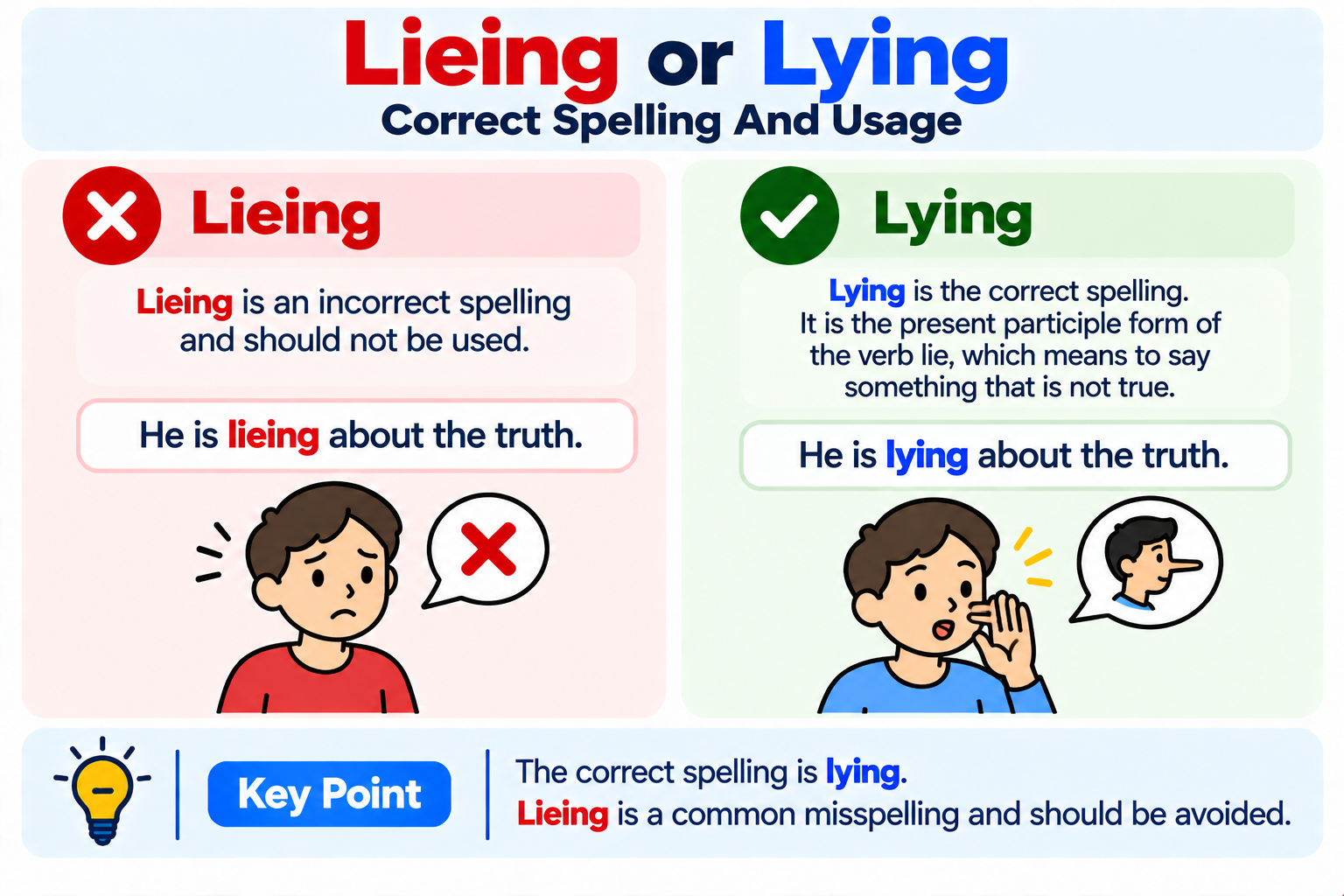
The correct spelling of lieing or lying is lying when you mean telling an untruth or resting in a horizontal position. Lieing is a common misspelling in standard English. The confusion happens because English verbs follow different spelling patterns when they take the ending ing. For example, die becomes dying and tie becomes tying. The verb lie follows the same pattern and becomes lying.
This small spelling difference matters in school assignments, work emails, text messages, and formal writing. Readers can often understand the intended meaning of the incorrect form, but standard spelling helps your writing look clear and polished. The word also has more than one meaning, so the sentence around it helps readers understand your message. Someone can be lying about a mistake, or a book can be lying on a table. Both uses are correct, but the meaning changes with the context.
The easiest way to remember the rule is to drop the final ie and replace it with y before adding ing. Once you learn this pattern, you will find it easier to spell several other English verbs correctly.
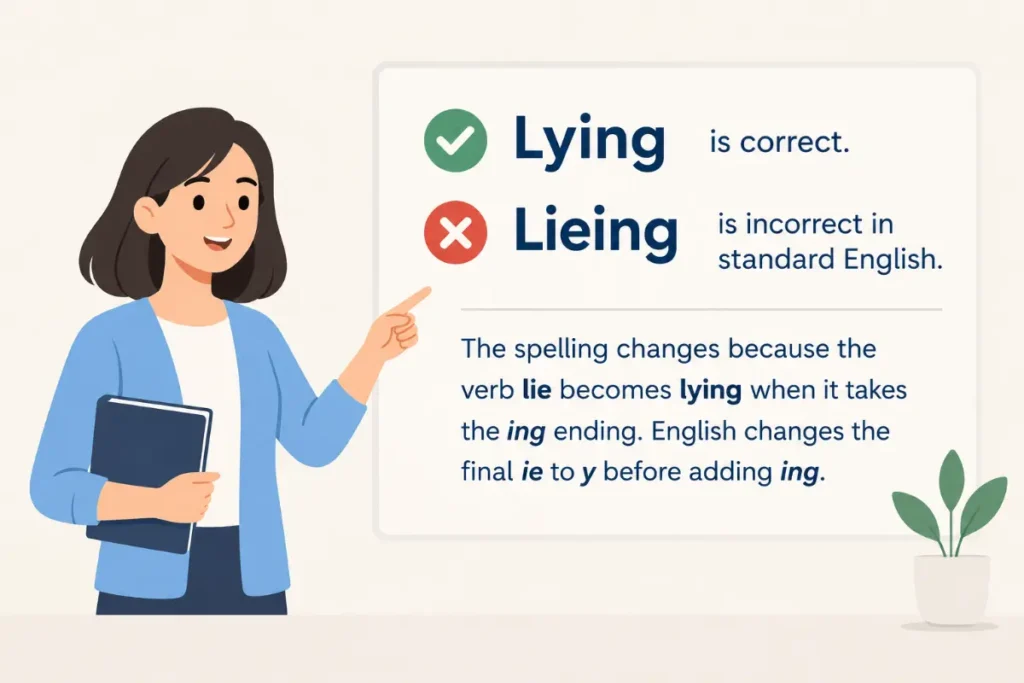
Quick Answer
Lying is the correct spelling. It is the present participle of lie and can mean telling an untruth or resting in a horizontal position. Lieing is a nonstandard misspelling and should be corrected in schoolwork, professional communication, and formal writing.
Comparison Table
| Form | Meaning | Grammar | Standard Usage | Example |
|---|---|---|---|---|
| Lying | Telling an untruth. | Present participle of lie. | Correct. | He is lying about the missing money. |
| Lying | Resting in a horizontal position. | Present participle of lie. | Correct. | The cat is lying on the sofa. |
| Lieing | An attempted spelling of the form above. | Nonstandard spelling. | Incorrect in standard English. | Write The cat is lying on the sofa. |
The two correct meanings share the same spelling. You do not need a different form for dishonesty and physical position. The surrounding sentence tells you which meaning the writer intends.
Meaning and Definition
What Does Lying Mean
Lying is the present participle of the verb lie. It has two common meanings that you can understand from context.
1. Telling something untrue. This meaning describes a person who deliberately says something they believe is false. For example, Mia is lying about where she went last night. The word suggests dishonesty rather than an ordinary mistake.
2. Resting in a horizontal position. This meaning describes a person or object that rests on a surface or stays in a particular place. For example, The keys are lying beside the phone. It does not suggest dishonesty.
The verb can also describe something that exists in a particular place or condition. For example, The answer lies in the final paragraph uses lies to mean that the answer can be found there. Its present participle can appear in a sentence such as The real problem is lying beneath the surface.
Is Lieing a Real Word
Lieing is not the standard spelling of the present participle of lie. In ordinary English writing, it is treated as a spelling mistake rather than an accepted alternative.
A reader might still understand the intended message because the context makes the meaning clear. However, understanding a word does not make its spelling correct. In a school essay, business email, report, or published article, use lying.
There is no separate meaning that makes lieing correct for dishonesty and lying correct for physical position. Both meanings use the same standard spelling.
Why Lying Is the Correct Spelling
English spelling can feel inconsistent because verbs do not all form their ing endings in the same way. Most verbs simply take ing, as in walk becoming walking and read becoming reading. Other verbs need a spelling change.
When a verb ends in ie, the usual pattern is to change ie to y before adding ing. That is why lie becomes lying instead of lieing.
The same pattern appears in these familiar words.
- Die becomes dying.
- Tie becomes tying.
- Vie becomes vying.
These examples make the rule easier to remember. The final two letters change before the ending is added. You keep the main sound of the verb while following the standard spelling pattern.
The past tense works differently. Lie becomes lied when it means telling an untruth, and it becomes lay when it means resting in a horizontal position. These forms have separate grammatical roles, so it helps to learn them together rather than guessing from the base word.
Key Differences Explained
The main difference between the two spellings is that one follows standard English spelling and the other does not.
Spelling
Lying is correct because the final ie changes to y before the ending ing is added. Lieing keeps the original letters and adds the ending directly. That spelling does not follow the standard pattern for this verb.
Meaning
Lying can refer to dishonesty or a horizontal position. Lieing has no separate standard meaning. It is usually an attempt to spell the correct word.
Grammar
Lying is a present participle and a gerund form of the verb lie. A present participle can appear in a continuous verb phrase, as in She is lying. A gerund acts like a noun, as in Lying can damage trust.
Pronunciation
Both spellings are often intended to represent the same sound. In standard American English, lying is pronounced with two syllables and the main stress on the first. It rhymes closely with flying. The incorrect spelling does not create a separate standard pronunciation.
Formality
Use lying in every type of standard writing. It works in casual messages and formal reports alike. The difference is not about formality or personal preference. It is a spelling rule.
Regional Usage
American, British, Canadian, and Australian English all use lying as the standard form. There is no established regional spelling difference that makes lieing acceptable in one of these varieties.
Ten Correct Sentence Examples
These examples show how the word works in different situations.
1. Everyday conversation. I think the dog is lying under the kitchen table.
2. Honest communication. She admitted that she had been lying about the broken vase.
3. Text messages. Are you lying on the couch or getting ready to leave?
4. Schoolwork. The student explained why lying can damage friendships.
5. Workplace communication. The report contained false information about the number of completed orders.
6. Formal writing. The witness denied lying during the interview.
7. Social situations. He felt uncomfortable lying to his friends about the surprise party.
8. Academic writing. The remains were lying beneath several layers of soil.
9. Online communication. People should check the facts before accusing someone of lying.
10. Storytelling. At sunrise, the traveler was still lying beside the road, exhausted from the long journey.
Notice how the same spelling fits several meanings and sentence structures. Context does the work of showing the intended meaning.
Five Common Spelling Mistakes
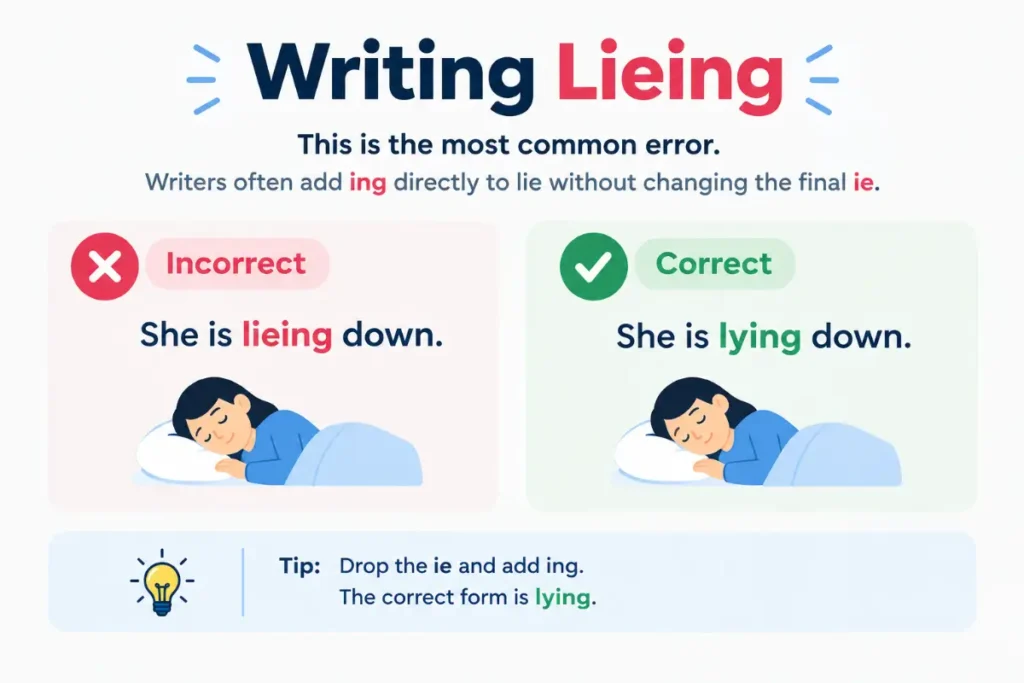
Writing Lieing Instead of Lying
Incorrect: She is lieing to her parents.
Correct: She is lying to her parents.
The mistake comes from adding ing without changing the final ie to y. Remember the pattern in dying and tying.
Confusing Lying With Laying
Incorrect: I am laying on the bed.
Correct when describing your own position: I am lying on the bed.
The confusion comes from two verbs with related meanings. Lie means to recline or rest in a horizontal position. Lay means to put something down and normally takes an object. You lay a blanket on a bed, but you lie on the bed.
Using Layed Instead of Laid
Incorrect: She layed the book on the desk.
Correct: She laid the book on the desk.
The past tense of lay is laid. The form layed is a common spelling error in standard English.
Confusing Lying With Lied
Incorrect: He was lied to his friend about the test.
Correct: He was lying to his friend about the test.
Use lying for an action in progress. Use lied as the past tense of lie when the verb means to tell an untruth. A correct past tense sentence is He lied to his friend about the test.
Using Lying When Lay Is Needed
Incorrect: Yesterday, I lying on the sofa for an hour.
Correct: Yesterday, I lay on the sofa for an hour.
The first sentence lacks the auxiliary verb needed for the continuous form. The second uses the simple past tense of lie. Choose the form that matches the sentence structure and time.
Pronunciation Guide
The correct form has a simple pronunciation in American English.
Standard American English
Lying
IPA: /ˈlaɪ.ɪŋ/
Easy guide: LYE ing.
Stress: The first syllable carries the stress.
The word has two syllables. The first sounds like lie, and the second has a short unstressed vowel followed by the nasal sound at the end. Say the word naturally rather than giving both syllables equal stress.
A common pronunciation mistake is to treat the spelling lieing as a reason to add an extra sound or syllable. Standard English does not require that change. The intended word is pronounced the same way as lying, regardless of the misspelling.
You can practice with this sentence: The child is lying on the floor. Say the word smoothly and keep the main stress on the first syllable.
Etymology and Word Origin
The verb lie has a long history in English. Its two common meanings developed from different historical roots, even though they share the same modern spelling.
The verb meaning to rest or recline comes from Old English licgan. Over time, its spelling and pronunciation changed into the modern form lie. Its past tense is lay, and its past participle is lain, as in She had lain there for hours.
The verb meaning to tell an untruth comes from Old English lēogan. It developed into the modern verb lie, with the past tense lied and the past participle lied.
These separate histories explain why the same modern spelling can have different grammatical forms. They also explain why the past tense of one meaning is lay while the past tense of the other is lied.
The spelling lying follows the modern English pattern of changing final ie to y before adding ing. You do not need to know the full history to apply the rule correctly, but it helps explain why the spelling differs from the base verb.
Regional Usage
American English
In the United States, lying is the standard spelling for both meanings. You can use it in a casual text, a college paper, a newspaper article, or a formal business email. The spelling does not change based on the meaning.
American English also follows the standard pattern in related forms such as dying and tying. Writing lieing is considered a spelling error.
British English
British English also uses lying. The spelling rule is the same as in American English, and the two meanings remain distinct through context.
There is no general British convention that accepts lieing as an alternative. A writer using British spelling should still write lying.
Australian English
Australian English follows the same standard spelling. Both the meaning related to dishonesty and the meaning related to resting use lying.
Canadian English
Canadian English also uses lying. There is no meaningful regional distinction between these varieties for this word. If you are writing for an international audience, lying is the safe and correct choice.
Grammar Rules and Part of Speech
Understanding the spelling is only part of using the word well. You also need to recognize how it functions in a sentence.
Lying as a Present Participle
A present participle often works with a form of be to describe an action in progress.
- She is lying about her age.
- The baby was lying in the crib.
- They have been lying to the team.
In each sentence, the word describes an ongoing or continuing action. The tense depends on the auxiliary verbs around it.
Lying as a Gerund
A gerund is a verb form ending in ing that functions as a noun. It can serve as a subject or appear after another verb.
- Lying makes it harder to build trust.
- He regretted lying to his parents.
- She dislikes lying about small things.
In these examples, the word names an action rather than simply describing what someone is doing at that moment.
Lying After a Preposition
The gerund form often follows a preposition.
- He was punished for lying.
- She left without lying to anyone.
- They talked about lying during the class discussion.
This structure is common in everyday English. The verb form remains lying even when the sentence moves from an action in progress to a broader idea.
Lying in Continuous Tenses
The present participle appears in several continuous forms.
- Present continuous: He is lying on the couch.
- Past continuous: He was lying on the couch.
- Present perfect continuous: He has been lying there for an hour.
The auxiliary verb changes to show time and aspect. The spelling of the participle stays the same.
Punctuation and Sentence Structure
The word itself does not require special punctuation. Use ordinary sentence punctuation based on how the sentence is built.
For example, She is lying, and everyone knows it uses a comma to join two independent clauses with a coordinating conjunction. In Lying, he hoped, would protect his friend, the commas set off an interrupting phrase. These punctuation choices come from sentence structure rather than from the word itself.
Real Life Usage Examples
Daily Conversation
In conversation, the word often describes honesty or physical position. The meaning is usually clear from the surrounding words.
- Stop lying to me and tell me what happened.
- I spent the afternoon lying in the shade.
The first sentence expresses frustration with dishonesty. The second describes a relaxed physical position.
Email and Workplace Communication
At work, the word may appear in discussions about honesty, reports, or a person’s location. Choose wording that states the facts clearly and avoids unsupported accusations.
- The review found no evidence that the employee was lying about the incident.
- The equipment had been lying unused in storage for several months.
The second example describes an object that remained in one place. It does not suggest that the equipment was dishonest.
Academic Writing
Academic writing may use the word to discuss ethics, behavior, or the position of an object.
- The study examined the effects of lying on trust between participants.
- The fossils were lying beneath a layer of compacted sediment.
Both sentences use the standard spelling. The first treats the action as a concept, while the second describes a physical location.
News and Journalism
News writing often uses direct and precise language. The word can appear in reports about statements, investigations, or objects found at a scene.
- The witness denied lying to investigators.
- Officials found several documents lying near the entrance.
The first describes a claim about honesty. The second describes where the documents were found.
Literature and Storytelling
In fiction, the word can build tension or create a picture of a scene.
- He knew he was lying, but fear kept him from telling the truth.
- A silver key was lying in the grass beside the old gate.
The first reveals a character’s inner conflict. The second gives readers a clear visual detail.
Related and Confused Terms
Several English words are closely connected to this spelling issue. Learning their differences can help you avoid errors in both grammar and meaning.
1. Lie. The base verb can mean to tell an untruth or to recline. For example, Do not lie to me expresses dishonesty, while I need to lie down describes a physical position.
2. Lay. This verb means to put something down. It normally takes an object, as in Please lay the folder on my desk. Its past tense is laid.
3. Lied. This is the past tense and past participle of lie when it means to tell an untruth. For example, He lied about the result describes a completed act of dishonesty.
4. Lain. This is the past participle of lie when it means to recline. For example, She had lain on the sofa all morning. It is often confused with laid.
5. Laid. This is the past tense and past participle of lay. For example, She laid the keys on the counter. The sentence identifies what she placed and where she put it.
6. Truthful. This adjective describes someone who tells the truth. It is a useful opposite of dishonest when discussing a person’s statements or behavior.
7. Deceiving. This word describes misleading someone or creating a false impression. It overlaps with dishonesty, but deception can happen through actions, appearances, or missing information rather than direct false statements.
8. Reclining. This word describes leaning back or resting in a relaxed position. It can sometimes replace the physical meaning of lying, as in He was reclining in his chair. The best choice depends on the posture being described.
These terms are related, but they are not interchangeable in every sentence. The most useful habit is to identify the intended meaning first and then select the grammatical form that matches it.
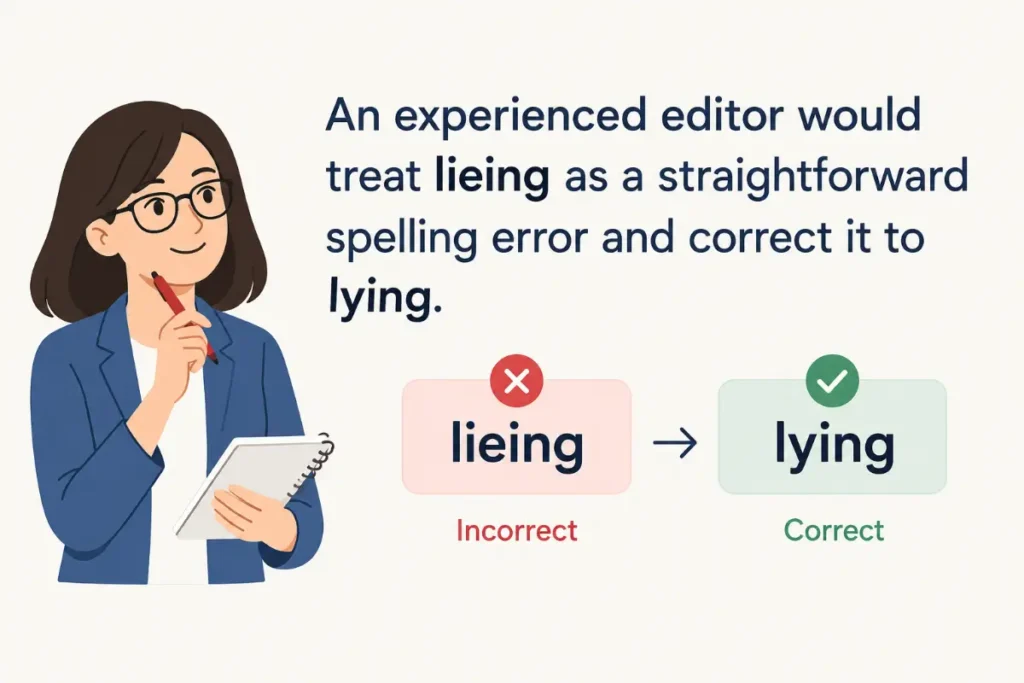
Expert Editor Insight
An experienced English editor would correct lieing to lying without hesitation in ordinary prose. The error is easy to understand because writers often add ing directly to a base verb. However, English spelling patterns sometimes require a change before the ending is added. Editing tools may flag the misspelling, but they cannot always determine the intended meaning of a sentence. A good editor checks both the spelling and the grammar. For example, changing lieing to lying fixes the spelling, but it does not fix a sentence that needs lay or laid instead. Context matters as much as the spelling rule.
Conclusion
The correct spelling in the question of lieing or lying is lying. Use it when describing dishonesty or a person or object resting in a horizontal position. The incorrect form lieing is a common spelling mistake and should not appear in standard English writing.
The rule is simple. When a verb ends in ie, change those letters to y before adding ing. This pattern also explains dying and tying. If you are unsure while writing, remember these three examples together. A quick spelling check can help, but understanding the rule will make the correct form easier to remember and use naturally.
FAQs
Is Lieing a Real Word?
Lieing is not the standard spelling of the verb form used in modern English. People sometimes type it because they assume they can add ing directly to lie. The correct form is lying. In formal writing, school assignments, and professional messages, correct the spelling rather than treating it as an accepted alternative.
What Does Lying Mean?
Lying has two common meanings. It can describe telling an untruth, as in He is lying about the accident. It can also describe resting in a horizontal position, as in She is lying on the bed. The sentence provides the context needed to understand which meaning the writer intends.
Which Is Correct Lying or Lieing?
Lying is correct in standard English. The spelling lieing does not follow the usual pattern for verbs that end in ie. Before adding ing, change the final ie to y. This gives you lying, just as tie becomes tying and die becomes dying.
How Do You Pronounce Lying
In standard American English, lying is pronounced /ˈlaɪ.ɪŋ/. It has two syllables, with the stress on the first. The opening sound rhymes with my and fly. The final syllable ends with the familiar nasal sound heard in words such as sing. The spelling mistake does not create a separate standard pronunciation.
Can Lying Start a Sentence?
Yes. The word can begin a sentence when it functions as a gerund or appears in a suitable descriptive phrase. For example, Lying to a friend can damage trust uses it as the subject. You can also write Lying on the beach, she watched the waves, where the opening phrase describes her position.
What Is a Synonym for Lying?
The best synonym depends on the intended meaning. If the word refers to dishonesty, you might use deceiving, fibbing, or being dishonest. If it describes a physical position, reclining may work. These alternatives are not perfect replacements in every sentence, so choose one that preserves the original meaning and tone.
Why Do People Misspell Lying?
Many people misspell the word because they apply a common spelling habit without noticing that the verb ends in ie. They may expect to add ing directly, as they do with many other verbs. Remembering the pattern in dying, tying, and vying helps make the correct spelling easier to recall.
Is Lying Appropriate in Formal Writing?
Yes. Lying is a standard English word and works in formal writing. Writers use it to describe dishonesty, a physical position, or an action treated as a concept. The important point is to use it accurately. In a formal report, for example, describe proven facts carefully instead of accusing someone of lying without evidence.
