
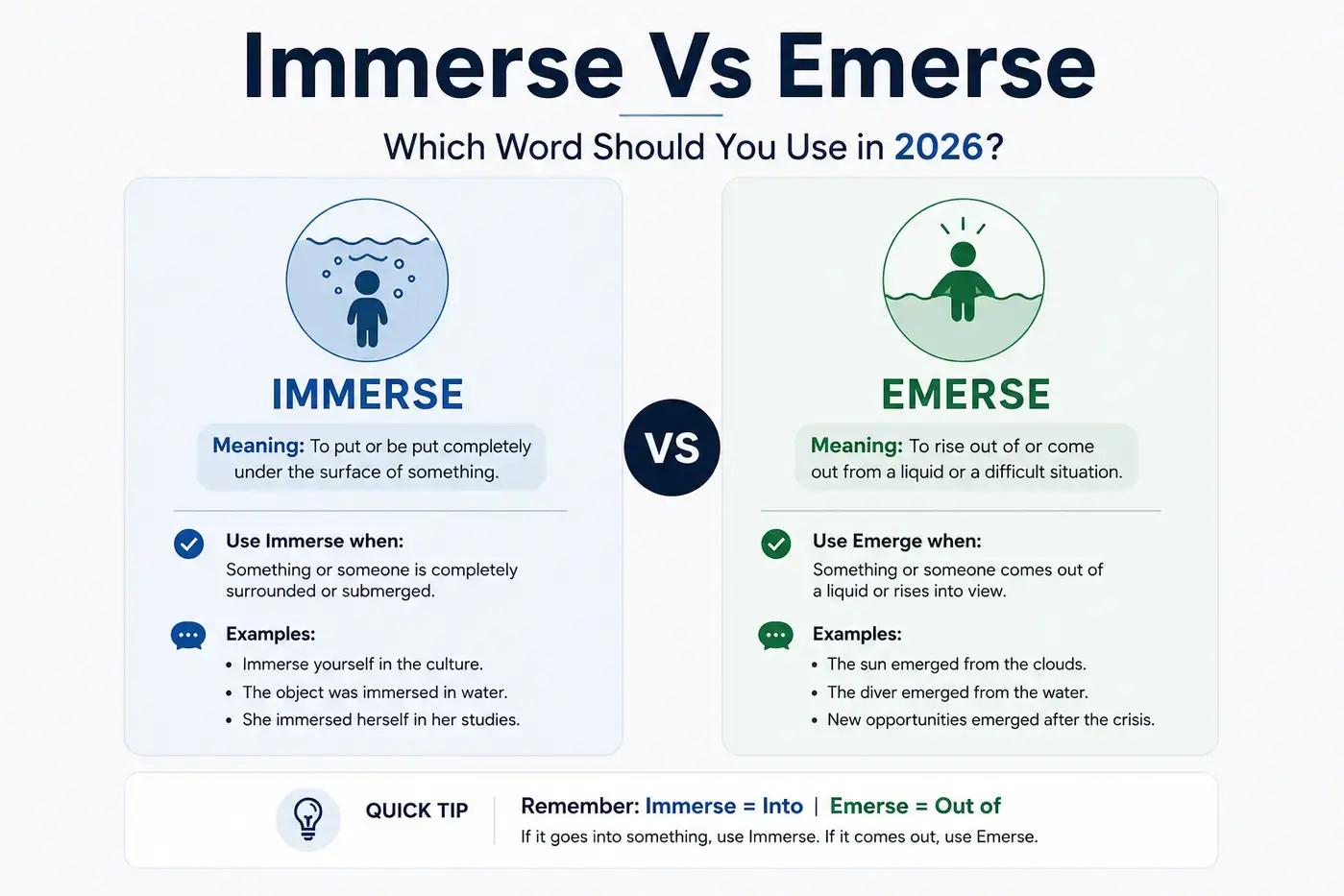
immerse vs emerse is a common spelling and vocabulary question because the two forms look almost identical and sound similar in quick speech. If you mean to put something deeply into a liquid or become deeply involved in an activity, the standard modern word is immerse. The spelling emerse should not normally be used for that meaning.
The confusion makes sense because English has several related looking words built around the idea of going into or coming out of something. Immerse means going into or becoming deeply involved. Emerge means coming out or becoming visible. The rare historical form emerse also exists in English records, but it is not the normal modern replacement for immerse.
Once you separate these meanings, the spelling becomes much easier to remember. This guide explains the difference between the two forms, the meaning and grammar of immerse, the unusual status of emerse, pronunciation, word history, regional usage, common mistakes, related words, and practical examples. You’ll also learn a simple memory trick that can help you choose the right word when you are writing quickly.
Quick Definition
Immerse is the standard modern English verb meaning to put something completely into a liquid or to involve yourself deeply in an activity, subject, or experience. Emerse has appeared as an obsolete historical form of immerse, but it is not the normal modern spelling. Use immerse in ordinary English writing.
Quick Answer
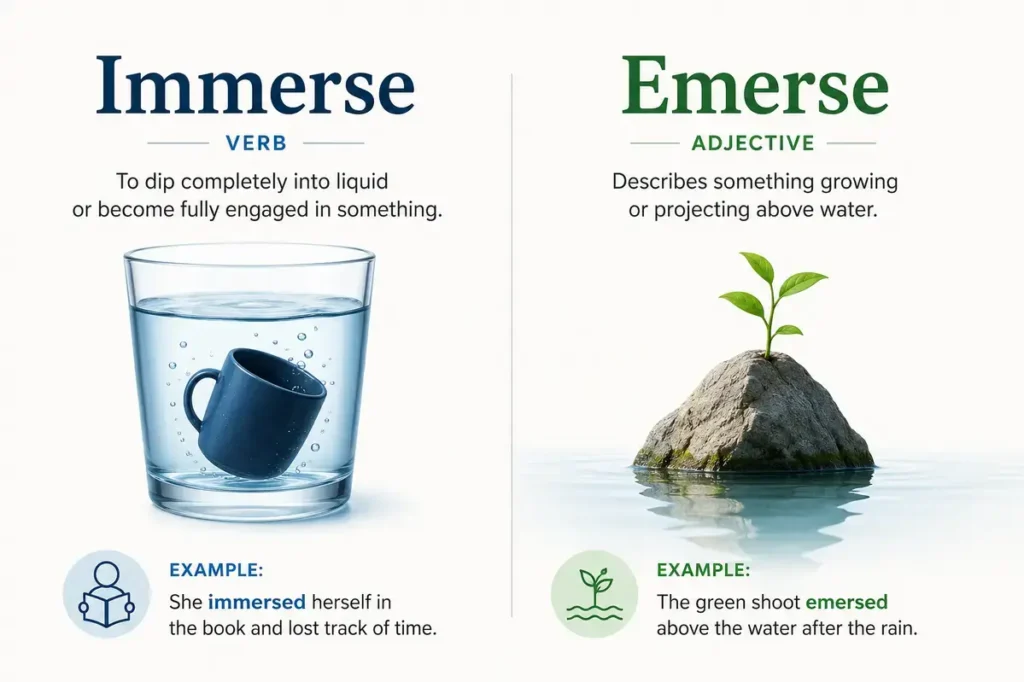
Immerse is the word you normally want.
Use immerse when you mean to place something into a liquid or to become deeply involved in something.
For example:
She immersed the cloth in water.
He immersed himself in his studies.
Emerse should not be used as a modern substitute for immerse. Although historical English contains the form emerse, modern readers will generally expect immerse for the meaning of submerging or becoming deeply involved.
There is also an important related word to remember. Emerge means to come out, appear, or become visible. That makes emerge much closer to the opposite direction of immerse.
Comparison Table For Immerse And Emerse
| Form | Meaning | Part of Speech | Origin | Usage Frequency | Formality | Common Contexts | Example |
|---|---|---|---|---|---|---|---|
| Immerse | To put into liquid or become deeply involved | Verb | Latin through French and English | Common | Neutral and formal | Water, study, culture, work, education, experiences | She immersed herself in the new language. |
| Emerse | Historical or obsolete form associated with immerse | Verb | Historical English usage related to Latin roots | Very rare | Archaic or historical | Older texts and historical word study | The old text uses emerse where modern English uses immerse. |
This table needs one important qualification. Emerse is not simply another current spelling of immerse. Historical sources record it as an obsolete form of immerse. Other rare uses and related forms can appear in specialized contexts, particularly around things that emerge from water, but that does not make emerse the normal modern verb for submerging something.
Meaning And Definition
Meaning Of Emerse
Emerse is unusual because calling it simply a meaningless spelling error leaves out an important piece of English word history.
Historical English records contain emerse as an obsolete form of immerse. Wiktionary records it specifically as an obsolete form of immerse and provides an example from a nineteenth century medical publication.
That historical existence does not mean you should use the word in modern everyday English.
If you write:
Please emerse the fabric in warm water.
A modern reader is likely to see a spelling error and expect:
Please immerse the fabric in warm water.
The distinction between historical existence and current standard usage matters. English contains many words that appear in old texts but have disappeared from normal modern use. A word can have a legitimate historical record and still be a poor choice for contemporary writing.
There is also a separate source of confusion involving emersed. In scientific and botanical contexts, emersed can describe something that rises above the surface of water while remaining associated with a submerged environment. That specialized adjective should not be confused with the ordinary verb immerse.
So if your sentence is about putting an object into water, becoming deeply involved in a subject, or giving something your full attention, choose immerse.
Meaning Of Immerse
Immerse is a standard English verb with both literal and figurative meanings.
The literal meaning involves placing something deeply into a liquid.
For example:
Immerse the cloth in warm water.
Here the cloth physically goes into the water.
The word can also describe putting a person or object completely under a liquid.
The swimmer immersed himself in the cold water.
The figurative meaning is just as common in modern English. It describes becoming deeply involved in an activity, subject, environment, culture, or experience.
She immersed herself in French literature.
He immersed himself in the new project.
They immersed themselves in the local culture.
In these examples, nobody is physically going underwater. The word creates the idea of being surrounded by something so completely that your attention becomes deeply focused on it.
That figurative sense developed centuries after the original physical sense. Historical word records show immerse in the physical sense from the early fifteenth century, with figurative uses connected with study, work, and passion appearing by the seventeenth century.
The Main Difference
The central distinction is straightforward.
- Immerse is the standard modern verb. Use it when something goes into a liquid or when someone becomes deeply involved in something.
- Emerse is not the normal modern spelling. It survives mainly in historical records as an obsolete form of immerse.
- Immerse has a strong figurative meaning. You can immerse yourself in a book, language, subject, culture, hobby, or project.
- Emerge is a different modern word. It means to come out, appear, or become visible.
- Emersed can have specialized scientific meaning. It may describe something that rises above the water surface. This specialized use should not be confused with the verb immerse.
- The spelling reflects different word histories. Immerse is connected with Latin roots meaning to plunge or dip into. Emerge comes from a different Latin construction connected with rising or coming out.
A useful way to picture the difference is movement.
Immerse means go in.
Emerge means come out.
That simple contrast solves much of the confusion.
Which Form Is Correct?
For modern standard English, use immerse.
If your sentence means to put something into water, place something under a liquid, or become deeply involved in an activity, immerse is the correct choice.
For example:
The teacher encouraged students to immerse themselves in the language.
The instructions say to immerse the material in water.
She immersed herself in the novel.
These sentences all use the standard modern form.
Emerse has a documented historical life, so it would be inaccurate to claim that the sequence of letters has never existed in English. However, historical existence is not the same as current standard usage. The modern writer should choose immerse for ordinary communication.
This distinction is useful beyond this particular word. Dictionaries and historical language records often preserve forms that modern speakers rarely use. When deciding what to write today, current standard usage matters more than simply finding an old example.
How To Use Immerse Correctly
Immerse is normally a transitive verb when you physically put something into a liquid.
For example:
She immersed the flowers in water.
The verb has a direct object. The flowers receive the action.
You can also use the reflexive pattern when someone becomes deeply involved in something.
He immersed himself in the research.
She immersed herself in the language.
The pronoun himself or herself shows that the subject is doing the action to himself or herself.
Another common construction uses immerse with a person and an area of activity.
The course immersed students in real world problem solving.
The documentary immerses viewers in the lives of rural communities.
These sentences use the figurative meaning.
The verb can also describe an experience that draws someone in.
The novel immersed me in another time period.
The game immerses players in a detailed fictional world.
In all these examples, the basic idea remains the same. The person becomes surrounded by or deeply engaged with something.
Physical Meaning
The physical meaning is the easiest place to start.
Imagine placing a piece of fabric into a bowl of water. You do not merely touch the water.
The same idea applies to objects placed under a liquid.
The technician immersed the sample in the solution.
The chef immersed the vegetables in boiling water.
The scientist immersed the material in a chemical bath.
This use is common in instructions, science, cooking, medicine, and everyday descriptions.
The word can also describe a person entering water.
The diver immersed himself in the pool.
The child immersed her feet in the cool water.
In these sentences, the physical idea is clear. Something moves into or becomes surrounded by liquid.
Figurative Meaning
The figurative meaning is now extremely common.
If you immerse yourself in a subject, you give it a large amount of your attention.
A student might immerse herself in history before an exam.
A traveler might immerse himself in the local culture.
A musician might immerse herself in a new style of music.
A researcher might immerse himself in old documents.
The physical image helps explain the figurative meaning. Imagine your attention as a person stepping into a pool. Instead of standing at the edge, you go all the way in.
That is why immerse often sounds stronger than simply study or focus on.
Compare these sentences:
I studied Spanish.
I immersed myself in Spanish.
The first tells us that the person studied the language. The second suggests a deeper level of involvement, perhaps through reading, conversation, listening, writing, culture, and daily exposure.
The word therefore carries a useful sense of depth.
Sentence Examples
Here are natural examples showing how the word works in different situations.
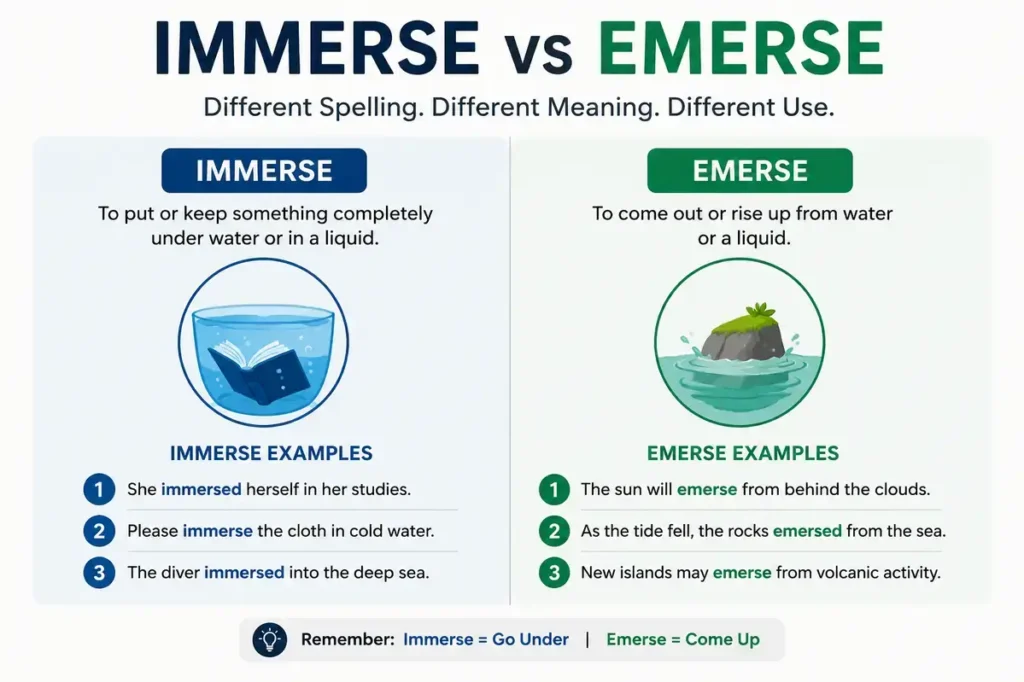
- I want to immerse myself in Spanish before my trip to Madrid.
- The instructions say to immerse the fabric in warm water for five minutes.
- She immersed herself in the book and forgot about the time.
- The students were encouraged to immerse themselves in the local culture.
- He immersed himself in the project during the final week.
- The documentary immerses viewers in the daily lives of coastal communities.
- The researcher immersed the sample in a controlled solution.
- After moving to Japan, she tried to immerse herself in the language.
- The museum uses sound and lighting to immerse visitors in the historical setting.
- I spent the weekend immersed in a new mystery novel.
These examples show why the word is so useful. It can describe a physical action, deep study, focused work, cultural involvement, or an engaging experience.
Examples Of The Incorrect Modern Usage
When writers accidentally use emerse for the meaning of immerse, the correction is straightforward.
- Incorrect: I want to emerse myself in the language.
Correct: I want to immerse myself in the language.
- Incorrect: Please emerse the cloth in water.
Correct: Please immerse the cloth in water.
Common Mistakes And Misspellings
Using Emerse Instead Of Immerse
This is the most direct error.
Incorrect:
She wants to emerse herself in art.
Correct:
She wants to immerse herself in art.
The confusion is understandable because the two forms look nearly identical. Still, modern standard English calls for immerse in this meaning.
Confusing Immerse With Emerge
These words are almost opposites in their basic physical imagery.
Immerse means to put into or go deeply into something.
Emerge means to come out or become visible.
For example:
The diver immersed himself in the water.
The diver emerged from the water.
The first sentence describes going in. The second describes coming out.
Writing Imerse
Some writers drop one of the two m letters.
Incorrect:
I want to imerse myself in the subject.
Correct:
I want to immerse myself in the subject.
The double m is part of the standard spelling.
Confusing Emersion With Immersion
Immersion is the common noun related to immerse.
For example:
Language immersion can provide constant exposure to a language.
Emersion is a different and much rarer term connected with emerging or reappearing. Historical etymological records trace emersion to Latin emergere and describe it as the act of emerging.
Assuming Every Similar Looking Word Has The Same Meaning
English contains several related forms built around Latin roots involving movement into or out of something.
Immerse.
Immersion.
Immersive.
Emerge.
Emergence.
Emersion.
They look similar because their histories are connected through Latin roots involving movement and sinking or rising. That does not make their meanings interchangeable.
Pronunciation Guide
Immerse is commonly pronounced /ɪˈmɝːs/ in American English.
A simple pronunciation guide is:
ih MERS.
The stress falls on the second syllable.
Break it into two parts:
ih + MERS
The final sound is like the ending of words such as verse or nurse in many American accents.
The spelling emerse may look as though it should have a different first sound, but historical and rare uses can vary by source. That is another reason not to rely on sound alone when deciding the spelling.
The bigger pronunciation issue usually involves the relationship between immerse and emerge. They begin differently, but fast speech can make learners focus on the shared sound pattern.
A useful habit is to pronounce the first syllable clearly when practicing the word:
ih MERS
Then connect it with the meaning of going into something.
Etymology And Word Origin
Immerse has a long history in English. It comes from Latin immergere, meaning to plunge into, dip into, sink, or submerge. The Latin form combines a prefix meaning into with mergere meaning to plunge or dip.
The word entered English in the early fifteenth century with its physical meaning. Its figurative meaning developed later. Historical records place the figurative use involving study, work, and passion in the seventeenth century.
The same Latin root helps explain other English words.
The Latin verb mergere is related to English merge. The original sense of merge also involved plunging or sinking into something before the modern idea of combining or becoming absorbed developed.
Emerge has a different prefix. Its Latin source is emergere, based on a form meaning out or up and mergere meaning to plunge or sink. The resulting idea is movement out and upward rather than movement in.
This word history gives you a useful mental picture.
Immerse means move into.
Emerge means move out.
That relationship is much more reliable than trying to memorize the spellings separately.
The History Of Emerse
Emerse is a fascinating case because it has not simply been invented by modern writers as a typo.
Historical records show emerse as an obsolete form of immerse. Wiktionary identifies it as an obsolete English verb and gives a nineteenth century example.
That means the word has a documented place in English history.
But historical usage does not make it a good choice for modern general writing.
English changes constantly. Some forms survive while others fade away. A word can remain visible in old books or specialized records even after modern speakers stop using it.
That appears to be the practical situation with emerse. If you are writing an email, essay, article, report, school assignment, or ordinary message and you mean to put something into liquid or become deeply involved, use immerse.
The rare historical form is mainly useful when studying older English or discussing word history.
Immerse And Emerge
One of the strongest sources of confusion is the word emerge.
The meanings move in opposite directions.
Immerse means to put into or become deeply involved in.
Emerge means to come out or become visible.
Compare these examples.
The swimmer immersed himself in the water.
The swimmer emerged from the water.
The first sentence describes entering the water. The second describes leaving it.
The same contrast works figuratively.
She immersed herself in the research.
A new pattern emerged from the research.
Here immerse describes deep involvement while emerge describes something becoming visible or apparent.
This distinction is especially useful in academic writing.
Researchers may immerse themselves in data.
A pattern may emerge from that data.
Those two verbs often appear naturally in the same discussion, but they perform very different jobs.
Immerse And Immersion
Immersion is the noun form most closely connected with immerse.
For example:
The immersion of the object in water changed its temperature.
More commonly in modern writing:
Language immersion can help learners gain constant exposure to a new language.
The noun carries the same central idea of being deeply surrounded or involved.
Other related forms include immersed and immersive.
For example:
She was fully immersed in the story.
The game offers an immersive experience.
These words are standard and common.
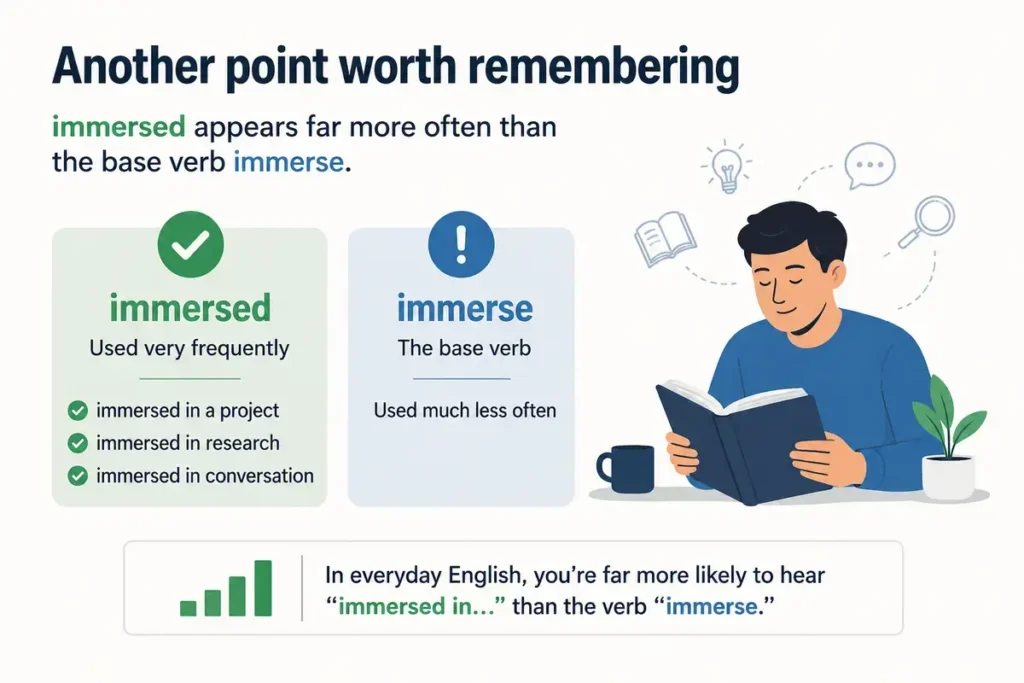
This word family is useful because learning several related forms can make the spelling easier to remember. If you know immerse, immersion, immersed, and immersive, the spelling pattern becomes familiar.
Immerse In Formal Writing
Immerse is perfectly suitable for formal writing.
It appears naturally in academic work, professional communication, educational material, research writing, journalism, and technical instructions.
For example:
The program aims to immerse students in practical research.
The procedure requires the sample to be immersed in a controlled solution.
The study examines how participants become immersed in online communities.
The word does not sound childish or overly casual. Its suitability comes from its precise meaning and its long established place in English.
In formal writing, the main concern is not formality but accuracy. Use immerse when you genuinely mean deep involvement or physical submersion.
Immerse In Everyday Writing
The word also works naturally in ordinary conversation.
You might say:
I spent all weekend immersed in that book.
She really immersed herself in the new job.
I want to immerse myself in the language before I travel.
These sentences sound normal because the figurative meaning has become a familiar part of modern English.
You do not need a formal setting to use the word.
It can describe anything from reading a novel to learning a language to working on a hobby.
Regional Usage
American English
Immerse is the standard modern spelling in American English. It works in casual speech, professional writing, education, journalism, and academic contexts.
The spelling does not change in American usage.
Emerse is not the normal American alternative for immerse. A US reader encountering it in an ordinary sentence will likely interpret it as a spelling mistake or an unusual historical form.
British English
British English also uses immerse as the standard modern form.
There is no ordinary British spelling variation that changes immerse to emerse.
The same distinction between immerse and emerge applies in British usage.
Australian English
Australian English uses immerse in the same standard way. Writers can use it for both physical and figurative meanings.
The rare historical form emerse does not function as a normal replacement in contemporary general writing.
Canadian English
Canadian English also follows the standard modern spelling immerse.
There is no major regional spelling difference here. Writers across North American English can safely use immerse for both literal and figurative meanings.
The practical rule is simple across these varieties. Use immerse for modern general English.
Grammar Rules And Part Of Speech
Immerse is a verb.
It can be transitive when you put an object into something.
The technician immersed the sample in water.
Here technician is the subject, immersed is the verb, and sample is the direct object.
The common grammatical pattern is:
immerse + object + in + substance or environment
Examples include:
She immersed the cloth in water.
They immersed the equipment in the cleaning solution.
The scientist immersed the sample in a chemical bath.
For the figurative meaning, the reflexive pattern is especially common.
immerse + reflexive pronoun + in + activity or environment
Examples:
He immersed himself in the subject.
She immersed herself in the culture.
They immersed themselves in the project.
You can also use the passive form.
The fabric was immersed in water.
The students were immersed in the language.
The audience was immersed in the story.
The word can therefore fit many sentence structures without changing its core meaning.
Real Life Usage Examples
Daily Conversation
I got completely immersed in that new series last night.
She immersed herself in cooking after taking the class.
These examples use the figurative sense to describe deep attention.
Email And Workplace Communication
I’m looking forward to immersing myself in the new project.
The training will immerse employees in real world customer scenarios.
The first sounds natural in a professional email. The second works well in workplace documentation.
Academic Writing
Students were immersed in the target language throughout the course.
The researcher immersed herself in historical records before forming a conclusion.
Academic writing often uses the word to describe sustained study or exposure.
News Writing
The documentary immerses viewers in the lives of people living along the coast.
Visitors were immersed in the atmosphere of the historic district.
Journalistic writing can use the word to describe an experience that surrounds the audience.
Literature And Storytelling
The novel immersed readers in a world of mystery and uncertainty.
He immersed himself in the old letters until he understood what had happened.
The word is particularly effective in storytelling because it suggests depth and involvement.
Related And Confused Terms
Submerge
Submerge usually means to put something under the surface of water or another liquid. It has a stronger physical focus than immerse.
Dip
Dip often describes putting something briefly into a liquid.
You dip a spoon into soup.
You immerse an object when you want to emphasize deeper or more complete placement.
Plunge
Plunge suggests entering or moving into something quickly or forcefully.
The diver plunged into the water.
Absorb
Absorb can mean to take in information, attention, or interest.
She absorbed every detail.
Immerse suggests active deep involvement rather than simply receiving information.
Engross
Engross means to occupy someone’s attention completely.
The book engrossed him.
This is close to the figurative sense of immerse but often focuses more directly on attention.
Emerge
Emerge means to come out, appear, or become visible.
The swimmer emerged from the water.
It is an important contrast with immerse.
Immersion
Immersion is the noun related to immerse.
Language immersion gives learners extensive exposure to a language.
Immersive
Immersive is an adjective describing something that creates a strong sense of involvement or surrounding experience.
The museum created an immersive experience.
These related words form a useful semantic family. Learning them together gives you a clearer sense of how the central idea changes across different grammatical forms.
A Simple Memory Trick
The easiest memory trick is to connect the spelling with the direction.
Immerse means in.
Look at the beginning:
IM
Think of it as a reminder that something is going in.
Then compare it with emerge.
Emerge means out.
A person can immerse himself in water and later emerge from it.
That gives you a simple story:
You immerse yourself by going in.
You emerge by coming out.
Do not rely too heavily on the spelling trick alone because English prefixes do not always work as perfect modern meaning clues. But for this particular pair, the association is useful and memorable.
Another trick is to remember the double m in immerse. Think:
I must immerse myself.
The repeated m can help you avoid writing imerse or emerse when you mean deep involvement.
Expert Editor Insight
An experienced editor would treat immerse as the clear modern choice whenever the intended meaning is submerging something or becoming deeply involved. Emerse has historical evidence, so simply calling it a meaningless invented spelling would be too broad. Still, that historical fact does not make it suitable for ordinary contemporary prose. Editors also watch for confusion with emerge, immersion, emersion, and emersed. Spelling tools may flag emerse in ordinary contexts, but context matters because language software cannot always distinguish a historical form from a genuine typo. The safest editorial test is to ask what direction or idea the sentence expresses. If something is going in or becoming deeply involved, immerse is the natural choice.
Conclusion
immerse vs emerse has a straightforward answer for modern writing. Use immerse when you mean to put something into liquid or become deeply involved in a subject, activity, culture, or experience. Emerse has a historical record as an obsolete form, but it is not the normal modern choice for these meanings.
The biggest source of confusion is the similarity between immerse, emerse, and emerge. Keep their direction in mind. Immerse suggests going in while emerge suggests coming out. That distinction also helps separate immersion from emersion.
For an easy editing trick, remember the double m in immerse and connect the word with the idea of going in. If you mean deep involvement or submersion, choose immerse. That simple habit will keep your writing clear and natural.
FAQs
Is emerse a real English word?
Emerse has existed in English, but its status needs context. Historical records identify it as an obsolete form of immerse. That means it has a genuine place in the history of English, but it is not the normal modern spelling. If you are writing contemporary English and mean to submerge something or become deeply involved, use immerse.
Which is correct for modern English?
Immerse is the standard modern choice. Use it for both the physical meaning of putting something into liquid and the figurative meaning of becoming deeply involved in an activity or subject. Emerse is not the form you should normally choose in contemporary general writing. Its historical existence does not make it an ordinary modern alternative.
What does immerse mean?
Immerse means to put something completely into a liquid or to become deeply involved in something. You can immerse a cloth in water, or you can immerse yourself in a new language. The physical meaning came first, while the figurative meaning developed later. The same central idea of being deeply surrounded connects both uses.
Is emerse a synonym for emerge?
No. Emerse and emerge should not normally be treated as interchangeable modern words. Emerge is the established modern verb meaning to come out, appear, or become visible. Emerse has a complicated historical and rare usage record. If you mean that something comes out of water or becomes visible, emerge is the ordinary modern choice.
How do you pronounce immerse?
Immerse is commonly pronounced /ɪˈmɝːs/ in American English. A simple guide is ih MERS, with the stress on the second syllable. The final part sounds similar to the ending in words such as verse in many American accents. Practicing the pronunciation together with the spelling can help prevent the common mistake of writing imerse or emerse.
Can I use immerse in formal writing?
Yes. Immerse is suitable for formal and informal English. It appears naturally in academic writing, workplace communication, research, education, journalism, and ordinary conversation. The figurative form is especially useful when describing deep study, cultural exposure, focused work, or strong involvement. There is no need to replace it with a more complicated word simply because the writing is formal.
Why do people confuse immerse and emerse?
The confusion mainly comes from their very similar appearance and sound. The problem becomes stronger because English also has words such as emerge, emersion, and emersed. Writers may mentally blend these forms or omit the first m. Fast typing can make the mistake more likely. Remembering immerse as the standard modern form helps prevent the error.
What is the difference between immerse and emerge?
Immerse describes going into something or becoming deeply involved in it. Emerge describes coming out, appearing, or becoming visible. Think of a swimmer who immerses himself in water and later emerges from it. The words share a historical connection through Latin roots related to sinking and rising, but their modern meanings point in opposite directions.
