
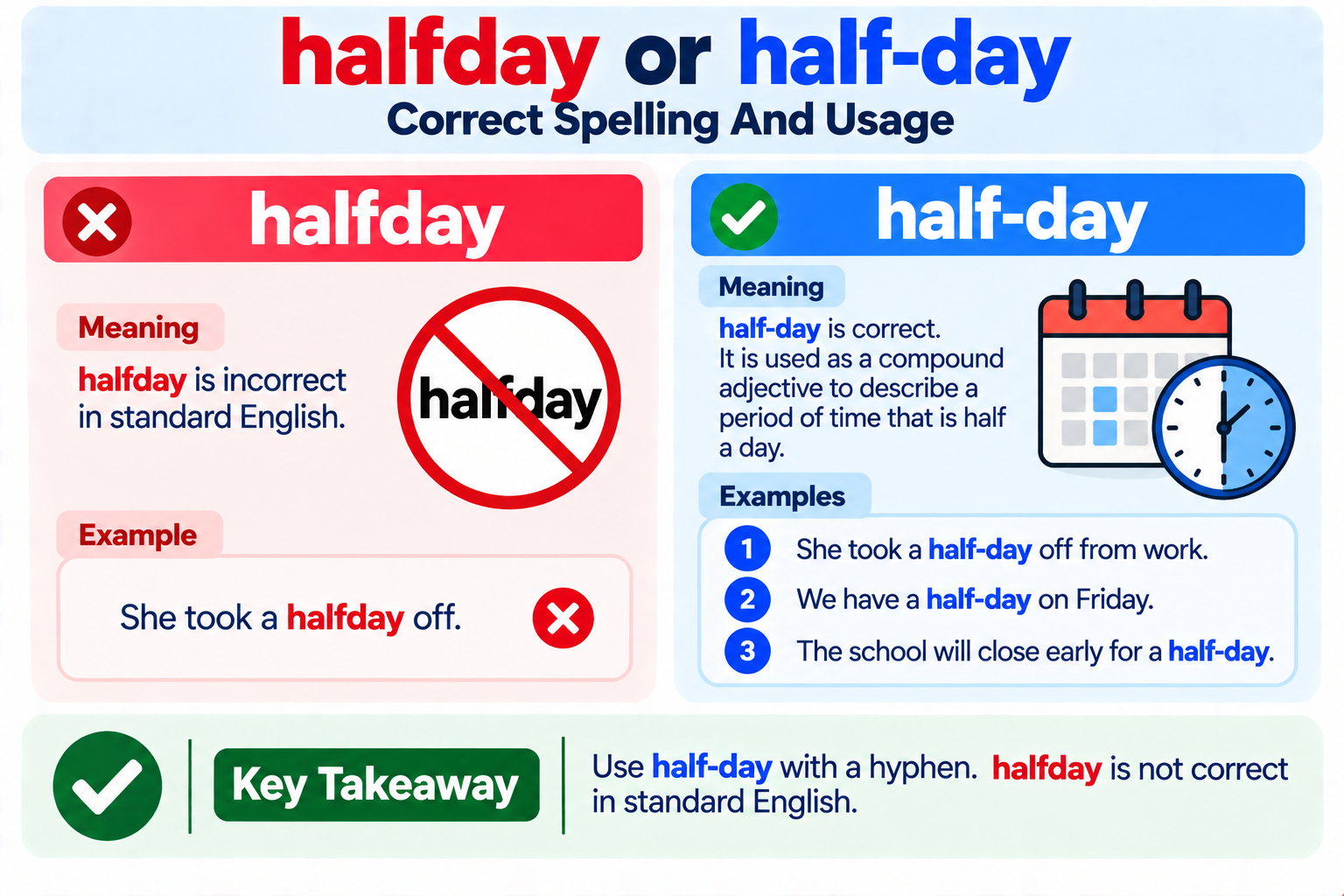
halfday or half-day can look like a tiny spelling question, but the answer depends on how the expression works in a sentence. Half-day is the standard hyphenated form when the expression works as a compound adjective before a noun. Half day is also correct when the phrase functions as a noun or follows the noun it describes. The closed form halfday is generally not the standard spelling in ordinary English.
The confusion happens because English often treats combinations of words differently based on their grammatical role. A phrase that describes a noun may need a hyphen to show that its parts belong together. The same words may appear without a hyphen when they function as a noun phrase. That small punctuation mark can therefore change how a reader understands the structure of the sentence.
This guide explains the difference between the closed form, the hyphenated form, and the open form. You’ll learn the meaning, grammar rules, pronunciation, word history, regional usage, common mistakes, sentence examples, and practical editing tips. Most importantly, you’ll learn a simple rule that makes this spelling choice much easier.
Quick Definition
The standard forms are half day and half-day, depending on grammar. Use half-day before a noun as a compound modifier, as in a half-day workshop. Use half day when the expression functions as a noun phrase, as in The class lasts half a day. The closed form halfday is generally not standard English.
Quick Answer
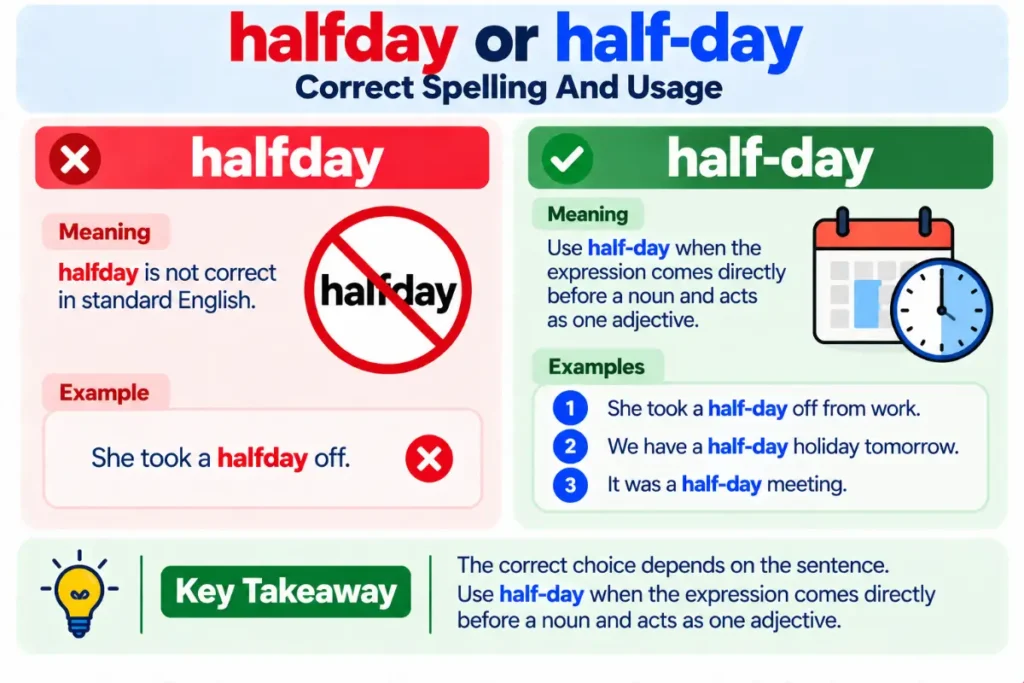
The correct choice depends on the sentence.
Use half-day when the expression comes directly before a noun and acts as one adjective.
Example: We attended a half-day workshop.
Use half day when the words function as a noun phrase.
Example: The workshop lasted half a day.
Avoid halfday in standard English. The closed form is generally treated as a nonstandard spelling rather than the normal form.
Comparison Table Halfday Or Half-day
| Form | Meaning | Part of Speech | Origin | Usage Frequency | Formality | Common Contexts | Example |
|---|---|---|---|---|---|---|---|
| Halfday | Not normally the standard form | Nonstandard closed form | Modern compound formation | Low in standard edited English | Nonstandard | Typing errors and informal usage | Avoid writing halfday workshop. |
| Half-day | Lasting or covering half of a day and modifying a noun | Compound adjective | Formed from half and day | Common | Neutral | Events, classes, workshops, schedules | We attended a half-day workshop. |
| Half day | A period equal to approximately half of a day | Noun phrase | Combination of half and day | Common | Neutral | Time descriptions, schedules, leave, work | I took a half day off. |
The key difference is grammatical function. The hyphen helps combine the two words when they work together as a modifier before another noun.
Meaning And Definition
Meaning Of Halfday
Halfday is generally not the standard closed spelling for this expression in edited English.
You may encounter it in online text, internal notes, filenames, search queries, or informal writing. Its appearance in those settings does not make it the preferred standard form.
English compounds sometimes become closed words over time. That process has happened with many familiar terms. However, not every combination automatically becomes one word. Halfday has not generally replaced the established forms half day and half-day in standard usage.
For that reason, writing halfday in a school assignment, professional email, report, website copy, or formal document can make the expression look like a spelling error.
Consider these examples:
Incorrect or nonstandard: We attended a halfday seminar.
Standard: We attended a half-day seminar.
Standard: The seminar lasted half a day.
The correction is simple, but understanding the reason behind it helps you apply the same principle to similar compound expressions.
Meaning Of Half-day
Half-day is normally used as a compound adjective when it comes before a noun.
For example:
We booked a half-day tour.
The company offers half-day training sessions.
The school organized a half-day event.
In each sentence, half-day describes the noun that follows it. The two words work together as one modifier.
The expression means lasting for or covering approximately half of a day.
The exact amount of time can depend on context. A half-day work schedule might mean four hours in an eight hour workday. A half-day tour might last several hours rather than exactly twelve hours. The phrase usually communicates duration in a practical rather than mathematical way.
Meaning Of Half Day
Half day is used as an open noun phrase.
For example:
I took a half day off work.
The class lasted half a day.
We spent half a day at the museum.
Here the expression is not functioning as a compound adjective directly before another noun.
This distinction explains why both half-day and half day can be correct.
The difference is not really about meaning. Both refer to a period covering about half of a day. The main difference is grammatical position and function.
The Key Difference
The simplest rule is based on position.
- Use half-day before a noun when the two words work together as a compound adjective.
Example: We planned a half-day trip.
- Use half day as an open phrase when it functions as a noun phrase.
This is a common pattern in English. Hyphens often help readers recognize compound modifiers quickly.
Compare:
a half day meeting
a half-day meeting
The second version makes the relationship between half and day clearer before the reader reaches meeting.
Why The Hyphen Matters
A hyphen can show that two words are working together.
Consider this sentence:
We attended a half-day conference.
The reader immediately understands that the conference lasted for half a day.
Without the hyphen:
We attended a half day conference.
The meaning may still be clear, but the grammatical relationship is less tidy in edited writing.
The hyphen is especially useful when several words combine to modify a noun.
For example:
a half-day training session
a half-day orientation program
In each case, half-day acts as a single modifier before the noun.
English does not use hyphens simply because two words appear next to each other. The punctuation depends on function. That is why you should not automatically hyphenate every occurrence of the phrase.
For example:
The training lasted half a day.
There is no compound modifier before another noun, so the hyphen is unnecessary.
This is one of the most useful ideas to remember. Hyphenation often depends on grammar rather than meaning alone.
When To Use Half-day
Use the hyphenated form when the phrase directly modifies a noun.
Here are some natural examples:
- We attended a half-day workshop.
- The company offers a half-day training course.
- She booked a half-day photography session.
- The students went on a half-day field trip.
- I signed up for a half-day cooking class.
- The manager scheduled a half-day orientation.
- They organized a half-day conference for new employees.
- The hotel offers a half-day city tour.
- We completed a half-day safety course.
- The clinic provides half-day appointments for some services.
The pattern is easy to see. In each sentence, the compound comes immediately before a noun.
Workshop.
Course.
Session.
Trip.
Class.
Orientation.
Conference.
Tour.
Course.
Appointments.
The hyphen helps the reader process half-day as one descriptive unit.
When To Use Half Day
Use the open form when the phrase functions as a noun phrase or appears after the main noun.
Examples include:
- I took a half day off work.
- We spent half a day at the beach.
- The project required half a day to complete.
- She worked for half a day.
- The meeting lasted half a day.
- He only needed half a day to finish the report.
- We have half a day before the flight.
- The students had half a day to complete the assignment.
Notice something important. Many natural sentences use half a day rather than simply half day.
That is because English normally uses the article a in this construction.
For example:
The trip lasted half a day.
Not:
The trip lasted half day.
However, certain contexts use half day naturally as a noun phrase.
For example:
I took a half day off.
This expression is common in workplace communication. The exact phrasing can vary by regional and institutional style.
Half A Day And Half-day
These three patterns are worth learning together.
Half-day before a noun
We attended a half-day seminar.
Here the expression modifies seminar.
Half a day after a verb
The seminar lasted half a day.
Here the expression describes duration.
Half day as a noun phrase
I requested a half day off.
Here half day refers to a period of leave.
These patterns cover most everyday situations.
If you are unsure, ask yourself one question.
Am I using the expression to describe the noun immediately after it?
If yes, the hyphenated form is usually the right choice.
If not, the open form is usually better.
Sentence Examples
Here are ten examples showing natural usage.
- We attended a half-day workshop on workplace safety.
- The school planned a half-day science program for the students.
- She booked a half-day tour of the city.
- I took a half day off to handle some personal errands.
- The training lasted half a day.
- They organized a half-day event for new employees.
- We spent half a day exploring the museum.
- The company offers a half-day orientation for new staff.
- He needed only half a day to finish the assignment.
- The clinic scheduled a half-day appointment block for Friday.
These examples show why a single spelling rule does not cover every sentence. The expression changes form according to its grammatical role.
Common Mistakes And Misspellings
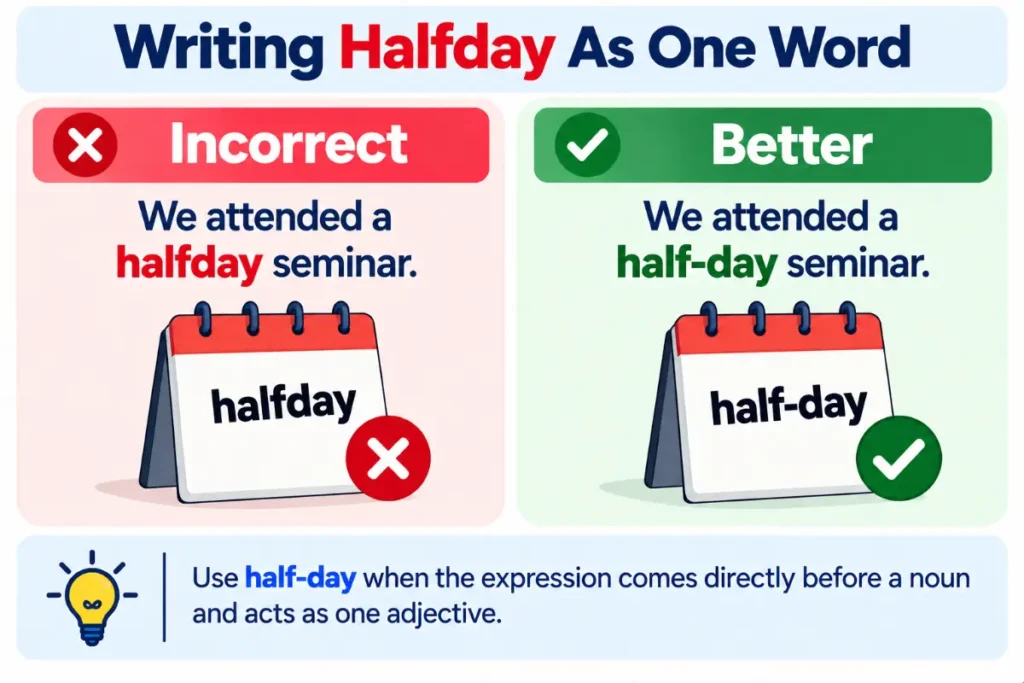
Writing Halfday As One Word
Incorrect: We attended a halfday seminar.
Better: We attended a half-day seminar.
The closed form is not normally the standard spelling. Writers may create it because many English compounds eventually become closed, but this expression generally retains a space or hyphen.
Removing The Hyphen Before A Noun
Less polished: We joined a half day workshop.
Standard edited form: We joined a half-day workshop.
The hyphen helps identify the compound modifier.
Adding A Hyphen Everywhere
Incorrect style: The class lasted half-a-day.
Better: The class lasted half a day.
The expression is not a compound adjective in this sentence, so the hyphens are unnecessary.
Forgetting The Article
Less natural: The course lasted half day.
Natural: The course lasted half a day.
The article a normally belongs in this construction.
Confusing Half-day With Half Day
Neither form is universally correct in every context. The grammar of the sentence determines the choice.
A half-day class uses the hyphen because the compound modifies class.
I attended for half a day uses the open phrase because it expresses duration.
Pronunciation Guide
The phrase is normally pronounced naturally as half day.
A simple pronunciation guide is:
haf day
The word half has a silent l in standard American pronunciation.
The phrase does not gain a different pronunciation simply because it is written with a hyphen.
For example:
half-day workshop
half day off
half a day
The main difference is grammatical rather than phonetic.
In connected speech, half a day may sound like several words flowing together. That can make the written distinction harder to notice. This is one reason learners sometimes write the whole expression as one word.
The hyphen is a visual grammar signal. You usually cannot hear it.
Etymology And Word Origin
Half is an old English word with Germanic roots. It has been part of English for centuries and is related to similar words in other Germanic languages.
Day is also an old Germanic word. The English form developed from Old English and belongs to a broad Germanic word family connected with daylight and a period of time.
The expression half-day is therefore a straightforward English compound built from two established words.
The spelling pattern reflects a common feature of English. Two familiar words can combine to form a compound adjective without immediately becoming a single closed word.
That is why half-day uses a hyphen in many attributive contexts while half a day remains an open phrase.
The history also explains why writing systems do not always provide a single permanent rule for compounds. English spelling develops over time, and compound forms can shift between open, hyphenated, and closed forms.
Regional Usage
American English
American English commonly uses half-day as a compound modifier before a noun.
Examples include:
half-day workshop
half-day tour
Half a day is also standard for duration.
The closed form halfday is not normally the preferred spelling in edited American English.
Workplace language may also use half day to describe a partial workday or period of leave.
British English
British English uses the same basic distinction. Half-day can work as a compound modifier, while half a day is used to describe duration.
British workplace and school contexts may use expressions such as half-day leave or half-day session.
There is no major regional rule that turns halfday into the standard closed form.
Australian English
Australian English generally follows the same compound spelling pattern.
Writers may use half-day before a noun and half a day when describing duration.
The closed form is not normally needed in standard edited writing.
Canadian English
Canadian English also follows the same broad pattern as American and British English.
Half-day works naturally as a compound modifier, while half a day is common for duration.
Workplace usage may also use half day as a noun phrase when discussing leave or scheduling.
Grammar Rules And Part Of Speech
The grammatical role determines the spelling.
Compound Adjective
When half-day comes before a noun and describes it, the expression works as a compound adjective.
Example:
We booked a half-day tour.
The entire expression half-day modifies tour.
The hyphen tells the reader that the two words form one modifier.
Noun Phrase
When the expression refers to a period of time, it can work as a noun phrase.
Example:
I took a half day off.
The phrase identifies the amount of time taken as leave.
Duration Expression
The most natural duration structure is often half a day.
Example:
The workshop lasted half a day.
Here the phrase tells us how long the workshop lasted.
Predicate Position
A compound modifier before a noun can behave differently from a phrase after a linking verb.
For example:
It was a half-day event.
The event was half a day long.
The first sentence uses a compound modifier. The second describes duration.
This distinction is common throughout English.
Punctuation And Hyphenation Rules
Hyphens are useful when they prevent confusion or show that several words act as one modifier.
Consider:
a half-day course
The hyphen connects half and day.
Now consider:
The course lasted half a day.
No hyphen is needed.
This is similar to other compound modifiers.
For example:
a five-day trip
The trip lasted five days.
A three-hour meeting
The meeting lasted three hours.
A two-week course
The course lasted two weeks.
The pattern is consistent. Before a noun, compound time expressions often use hyphens. After the noun, the duration phrase is generally written openly.
This does not mean every time expression follows the exact same pattern in every style guide. House style can vary. However, the compound modifier rule is a reliable practical guide for standard edited English.
Real Life Usage Examples
Daily Conversation
I have a half-day class tomorrow.
I only need half a day to finish it.
These sentences sound natural because the grammar matches the meaning.
Workplace Communication
The company scheduled a half-day orientation for new employees.
I requested a half day off next Friday.
Workplace communication often uses both forms because schedules and leave arrangements naturally involve partial days.
Academic Writing
The researchers conducted a half-day workshop for participants.
Participants completed the activity over half a day.
Academic writing benefits from making the grammatical distinction clear.
News Writing
The organization held a half-day training event for volunteers.
The program lasted half a day and included several presentations.
News writing usually follows standard edited punctuation and compound modifier conventions.
Literature And Storytelling
She joined a half-day walking tour through the old neighborhood.
They spent half a day wandering through the quiet streets.
Creative writing can use either structure depending on what the sentence needs to express.
Related And Confused Terms
Full-day
Full-day follows a similar compound pattern when it modifies a noun.
Example:
a full-day conference
The corresponding duration phrase is:
The conference lasted a full day.
Full day
Full day can function as an open noun phrase depending on sentence structure.
Example:
We spent the full day at the park.
Half-time
Half-time is a separate expression with several meanings, including a reduced work schedule and the break in some sports.
It should not be treated as a synonym for half-day.
Part-time
Part-time describes work or activity that involves fewer hours than a full schedule.
Example:
She has a part-time job.
One-half
One-half is another way to express the mathematical fraction 1/2.
Example:
One-half of the class attended.
Half an hour
This is a time expression meaning thirty minutes.
Example:
The meeting lasted half an hour.
It follows the same general open phrase pattern.
Half a week
This means approximately three or four days depending on context.
Example:
The project took half a week to complete.
Half a year
This means approximately six months.
Example:
She lived there for half a year.
These related expressions show that English usually keeps ordinary time phrases open unless they form a compound modifier before a noun.
Half-day In School And Work Contexts
The expression appears frequently in schedules.
A school might announce:
Students will attend a half-day session on Friday.
A company might write:
Employees can request a half day off with manager approval.
A training provider might advertise:
Join our half-day leadership workshop.
All three structures are useful because they serve different grammatical purposes.
School schedules often use the adjective form to describe classes and events.
Workplace communication may use half day as a noun phrase when discussing leave.
Marketing copy often uses half-day as a compound modifier because it describes an event or service.
Understanding these patterns helps you write schedules that look polished and professional.
Half-day In Formal Writing
Half-day is acceptable in formal writing when it functions as a compound modifier.
For example:
The committee conducted a half-day review of the proposal.
The sentence is clear and professional.
Halfday should generally be avoided because the closed spelling is not the established standard form.
In very formal writing, you may also choose a more explicit expression when precision matters.
For example:
The committee conducted a review lasting approximately four hours.
That sentence may be preferable if the exact duration matters.
Still, there is nothing inherently informal about half-day. It is a normal English compound adjective.
Half-day In Informal Writing
Informal writing often uses the phrase naturally.
You might text a friend:
I only have a half-day tomorrow.
Or:
I’ll be there for half a day.
People may also write half day in workplace messages or casual notes.
The closed form can appear in fast typing, but that does not make it the preferred standard spelling.
Good informal writing can still follow standard spelling. You do not need to sacrifice correctness simply because the message is casual.
Why People Write Halfday
The closed form is easy to understand because English contains many compound words written as one word.
Consider words such as bedroom, weekend, lunchtime, and daytime.
A writer may naturally assume that half and day should combine in the same way.
There is also a typing factor. People often remove spaces or punctuation in digital writing, especially in filenames, labels, usernames, and quick notes.
Search behavior can add another layer. People often type phrases without punctuation when searching online. A search query such as halfday schedule does not prove that halfday is the standard written form.
This distinction matters for editing. Search input reflects how people type. Standard writing reflects established spelling and grammatical conventions.
Expert Editor Insight
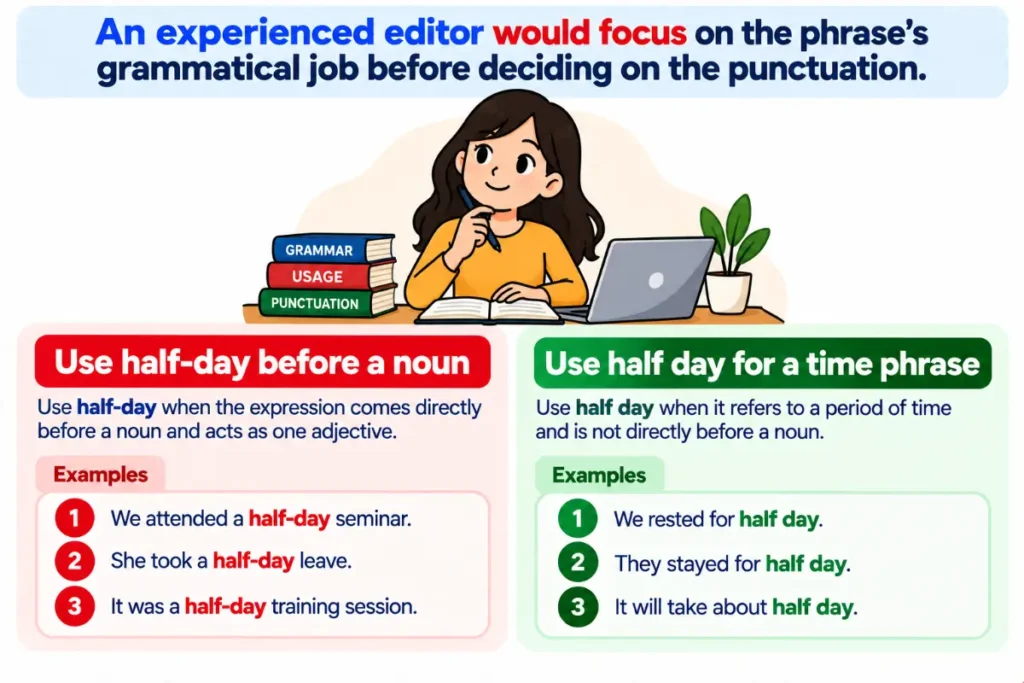
An experienced editor would focus on the phrase’s grammatical job before deciding on the punctuation. If the expression directly modifies a noun, the hyphenated form is usually the cleanest choice, as in a half-day workshop. If it describes duration, an open construction such as half a day is normally better. The closed form is generally not standard. Spellcheckers may catch it, but a good editor also checks the entire sentence because punctuation depends on structure, not just on the words themselves.
Conclusion
halfday or half-day is mainly a question of standard spelling and grammatical function. The closed form is generally not the preferred English spelling. Use half-day when the expression works as a compound adjective before a noun, such as a half-day workshop or a half-day class.
For duration, use an open construction such as half a day. You can also use half day as a noun phrase in contexts such as taking a half day off work. The easiest editing trick is to look at the word that follows the expression. If half and day are describing that noun together, use the hyphen. If you are simply describing time, keep the phrase open.
FAQs
Is halfday one word?
Halfday is generally not the standard spelling in edited English. The usual choices are half-day when the expression works as a compound modifier before a noun and half day or half a day when it functions as an open phrase. For example, write a half-day workshop but say the workshop lasted half a day.
Should I write half-day or half day?
Use half-day when the expression comes before a noun and describes that noun. For example, write a half-day course. Use an open form when you are describing a period of time, as in I took a half day off or The course lasted half a day. The grammatical role determines the punctuation.
Is half-day hyphenated?
Yes, half-day is normally hyphenated when it works as a compound adjective before a noun. For example, a half-day workshop and a half-day class use the hyphen to connect the words into one modifier. The hyphen is generally unnecessary in a phrase such as The workshop lasted half a day.
Is half a day correct?
Yes. Half a day is a standard and very common English expression for describing a period that lasts approximately half of one day. For example, you can write The training lasted half a day. Do not add hyphens to this normal duration phrase because it is not functioning as a compound adjective before another noun.
Can I say a half day?
Yes. A half day is commonly used when referring to a partial day as a period or schedule. For example, I took a half day off work is natural. In contrast, a half-day meeting uses the hyphen because half-day acts as a compound adjective directly before meeting.
Why does half-day need a hyphen?
The hyphen shows that half and day work together as a single modifier before the noun. In a phrase such as a half-day workshop, the reader can immediately understand that the workshop covers half a day. English commonly uses this type of hyphenation with compound time expressions placed before nouns.
Is half-day formal English?
Yes. Half-day is standard English and can appear in professional, academic, business, school, and general writing. The word is not limited to casual conversation. The main concern is using the correct structure. Write a half-day seminar when the phrase modifies seminar and half a day when you are describing duration.
What is the difference between half-day and half a day?
Half-day is a compound adjective used before a noun, as in a half-day conference. Half a day is an open duration phrase, as in The conference lasted half a day. They express a similar idea but perform different grammatical jobs. The hyphen depends on sentence structure rather than on a change in the basic meaning.
