
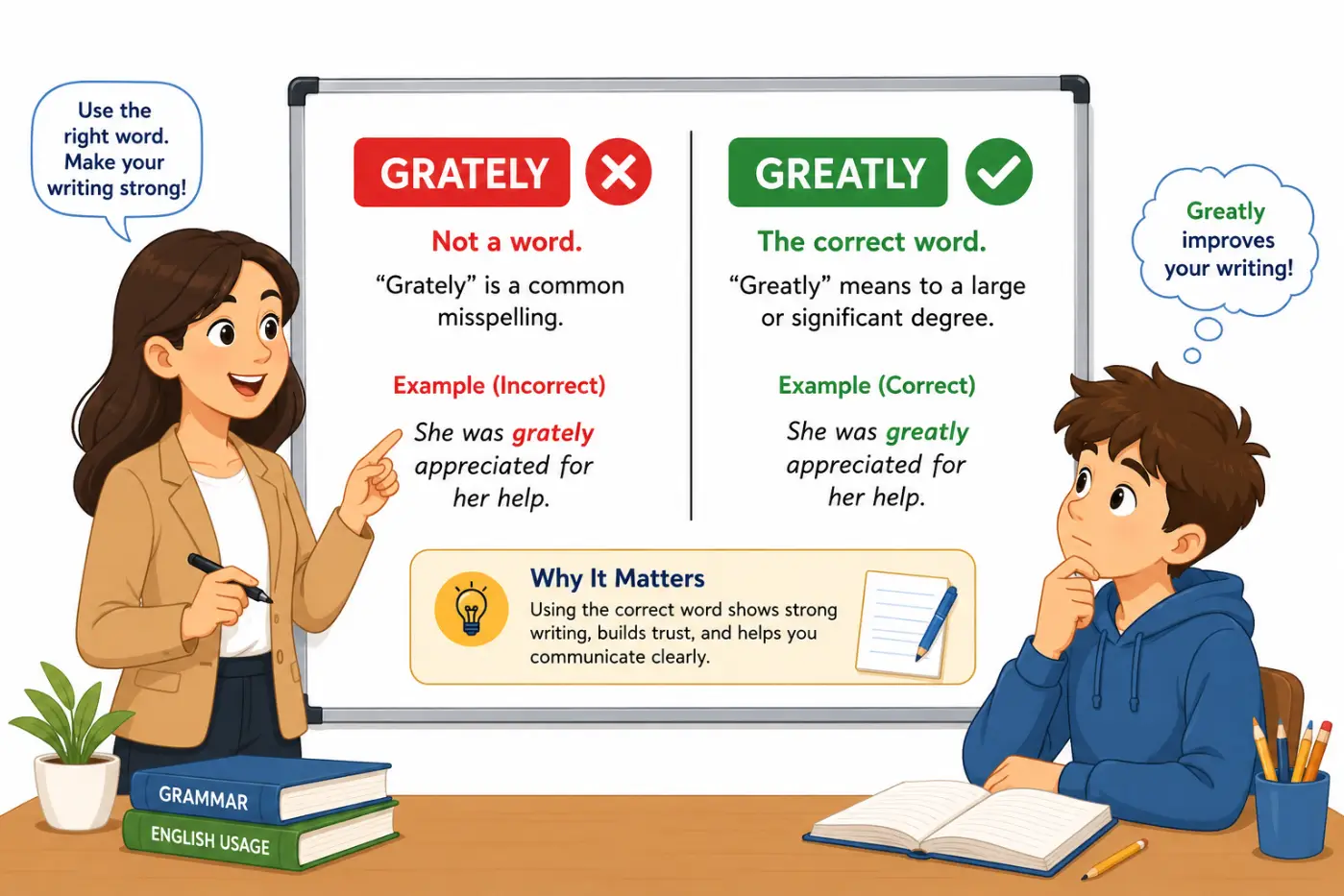
grately vs greatly is an easy spelling question to get stuck on because both forms look almost identical. The correct standard English word is greatly. Grately is generally a misspelling that occurs when writers try to form an adverb from great but leave out the second letter needed in the standard spelling.
The confusion makes sense at first glance. The adjective is great and the common adverb is greatly. When you add the suffix ly, the spelling may seem as simple as great plus ly. Yet English spelling sometimes preserves or changes letters in ways that are not obvious from pronunciation. The result is a word that sounds natural but can be easy to spell incorrectly.
If you are writing an email, school assignment, article, report, or professional message, use greatly. This guide explains its meaning, grammar, pronunciation, word history, regional usage, common mistakes, related expressions, and natural examples. You’ll also learn a simple way to remember the spelling so you can catch the error during proofreading.
Quick Definition
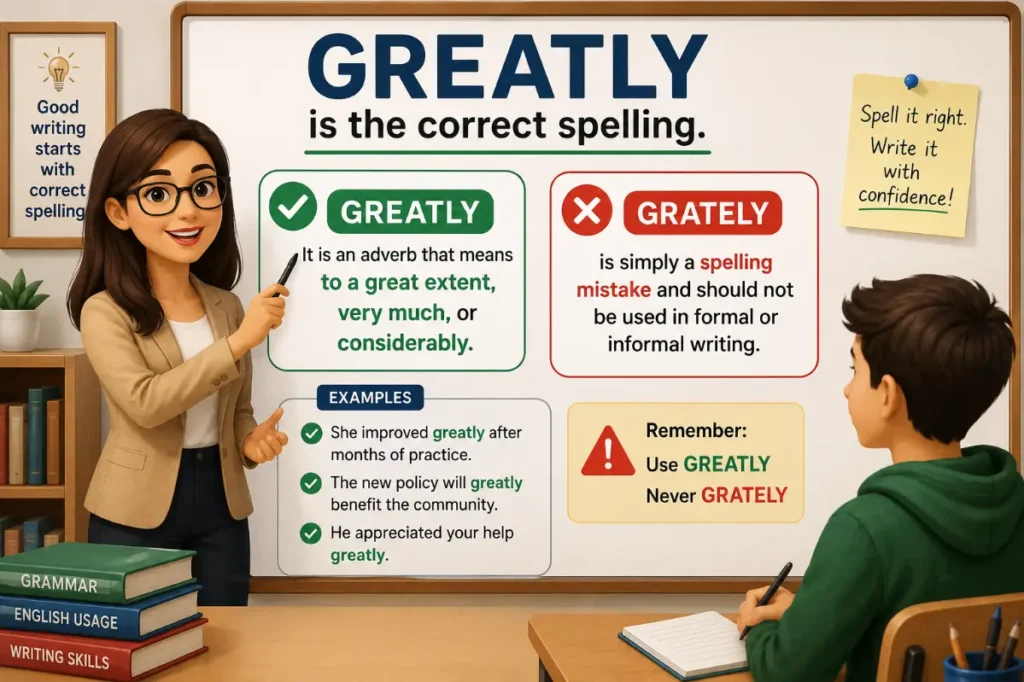
Greatly is the standard English adverb meaning to a large degree, very much, or significantly. Grately is generally a misspelling and is not the standard adverb formed from great. Use greatly in formal and informal writing when you need to describe a high degree or strong effect.
Quick Answer
The correct spelling is greatly.
Grately is generally incorrect when you mean the adverb related to great. The standard form is greatly because the word is spelled g r e a t l y.
For example:
Your support greatly helped me.
Not:
Your support grately helped me.
Greatly can mean very much, to a large degree, or significantly depending on the sentence.
Comparison Table For Grately And Greatly
| Form | Meaning | Part of Speech | Origin | Usage Frequency | Formality | Common Contexts | Example |
|---|---|---|---|---|---|---|---|
| Greatly | To a large degree or very much | Adverb | From great with the adverb ending ly | Common | Neutral to formal | Writing, speech, academic work, business, everyday English | I greatly appreciate your help. |
| Grately | No standard meaning as the intended adverb | Nonstandard spelling | Usually a spelling error based on great | Uncommon | Not standard | Typing mistakes and spelling errors | Grately is normally corrected to greatly. |
The distinction is simple. Greatly is the established standard form. Grately normally appears because someone has omitted the e that belongs in the word after great and before ly.
Meaning And Definition
Meaning Of Grately
Grately is generally not the standard English spelling of the adverb related to great.
If you see grately in a sentence such as:
I grately appreciate your help.
the intended word is almost certainly greatly.
This makes grately a spelling error rather than a separate word with a different meaning.
It can appear in online writing, informal messages, drafts, comments, or other places where people type quickly. Its appearance does not establish it as a standard alternative spelling.
There can always be unusual cases where a sequence of letters forms part of a name, username, brand, or other special label. Those special uses do not change the standard spelling rule for ordinary English.
For normal writing, choose greatly.
Meaning Of Greatly
Greatly is an adverb. It means to a large degree, very much, or significantly.
Consider this sentence:
I greatly appreciate your kindness.
Here greatly tells the reader how strongly the speaker appreciates the kindness.
Another example is:
The decision greatly affected the company.
In this sentence, greatly shows that the effect was significant.
Greatly often works with verbs that describe feelings, changes, effects, importance, or degree.
Common examples include:
greatly appreciate
greatly improve
The word can sound slightly more formal than very much, but it remains completely normal in everyday English.
For example:
I greatly appreciate it.
This is common and natural.
You could also say:
I really appreciate it.
The second version is more conversational. Both express appreciation.
Key Differences Explained
Spelling
Greatly is spelled g r e a t l y.
Grately is usually created by dropping the e from great before adding ly.
The standard spelling retains the e:
great + ly = greatly.
Meaning
Greatly means to a large degree or very much.
Grately does not normally have a separate standard meaning in English. It is usually an error intended to represent greatly.
Grammar
Greatly is an adverb.
It modifies verbs and sometimes entire ideas by expressing degree or intensity.
For example:
The new system greatly improved efficiency.
The word greatly modifies improved by showing the degree of improvement.
Pronunciation
Greatly and grately can easily seem confusing in writing because the intended word is pronounced as a smooth unit. The pronunciation does not clearly remind you of every letter.
Formality
Greatly works well in both everyday and formal writing. It is especially common in professional, academic, and polite expressions.
Grately should not be used in polished writing.
Context
Greatly commonly appears in sentences about appreciation, improvement, change, effect, influence, importance, and degree.
Standard Usage
Greatly is the standard form. Grately is normally treated as a misspelling.
Which Form Is Correct?
Greatly is the correct standard spelling when you want the adverb related to great.
The reason is straightforward. English forms many adverbs by adding ly to adjectives, and great becomes greatly in standard spelling.
You can see the pattern in several familiar words:
great → greatly
complete → completely
absolute → absolutely
immediate → immediately
The spelling does not always behave exactly the same way across all adjectives, so it is better to learn common words as established forms rather than assume every adjective follows one mechanical rule.
Dictionary conventions recognize greatly as the standard English adverb. A standard dictionary entry gives you the form used in established English rather than simply approving every spelling people may type online.
That distinction matters. Search engines and spellcheck systems can often understand a misspelled word from context, but recognition does not make the spelling correct.
If you are proofreading a document and see grately, replace it with greatly unless you are dealing with a specific name or special term.
How Greatly Works In A Sentence
Greatly is most often placed before the main verb or after an auxiliary verb.
For example:
The new policy greatly improved customer service.
Here greatly appears before improved.
With an auxiliary verb, it can appear after the auxiliary:
The project has greatly improved.
It can also appear after certain forms of be when the sentence structure allows it:
We are greatly concerned about the delay.
The word expresses degree. It tells the reader that the feeling, effect, change, or action is strong or significant.
Greatly can also appear in common fixed expressions.
I greatly appreciate your help.
This phrase is especially common in polite professional communication.
The placement is flexible enough to fit many sentence structures, but the word usually stays close to the verb or adjective it modifies.
Sentence Examples
Here are ten natural examples using the standard form.
- I greatly appreciate everything you’ve done for me.
- The new software greatly improved our workflow.
- Her advice greatly influenced my decision.
- The experience greatly changed the way he viewed the problem.
- We greatly value your feedback.
- The repairs greatly reduced the noise in the building.
- She was greatly relieved when she heard the news.
- This opportunity has greatly improved his confidence.
- The weather greatly affected travel plans.
- Your support would be greatly appreciated.
Each sentence uses the word as an adverb. Notice how it connects naturally with verbs and participles that describe degree, effect, feeling, or change.
For comparison, here are examples containing the common misspelling.
- I grately appreciate your help.
- The change grately improved the system.
- She grately admired her teacher.
- The decision grately affected the results.
- We grately value your support.
These sentences are useful only for spotting the error. In standard English writing, change grately to greatly.
Common Mistakes And Misspellings
Writing Grately Instead Of Greatly
This is the main error.
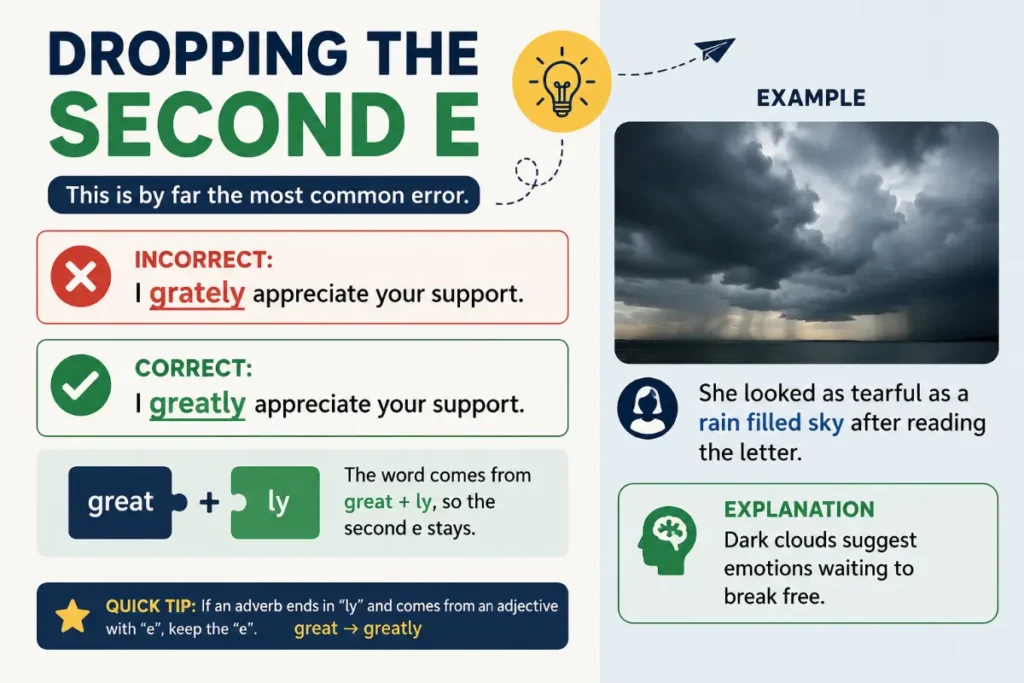
Incorrect:
I grately appreciate your support.
Correct:
I greatly appreciate your support.
The writer usually knows the intended word but drops the e during typing or spelling.
Writing Greatful Instead Of Grateful
Another common error involves the related adjective grateful.
Incorrect:
I am greatful for your help.
Correct:
I am grateful for your help.
Greatly and grateful belong to the same broad word family around great, but they follow different spelling patterns.
Writing Greatfully Instead Of Gratefully
The correct adverb from grateful is gratefully.
Incorrect:
She thanked them greatfully.
Correct:
She thanked them gratefully.
This creates an interesting spelling trap because grateful contains grate rather than great.
Confusing Greatly With Great
Great is an adjective while greatly is an adverb.
You can say:
This is a great opportunity.
You can also say:
This opportunity greatly helped me.
The forms do different grammatical jobs.
Overusing Greatly
Because greatly sounds polished, some writers use it too often.
For example:
The company greatly improved the system and greatly increased sales while greatly reducing costs.
The sentence is grammatically possible but repetitive.
A stronger version might be:
The company improved the system, increased sales, and reduced costs significantly.
Good editing is not only about correctness. It is also about rhythm and variety.
Why People Misspell Greatly
The main spelling problem comes from the relationship between the adjective great and the adverb greatly.
A writer may mentally process the word as:
great + ly
and then type the letters too quickly.
Ironically, that mental shortcut should produce the correct form. Yet during fast typing, the e can be skipped or the word can be mentally simplified.
Pronunciation also plays a role. When people say greatly, they do not pronounce each letter separately. English spelling rarely gives us a perfect one letter to one sound relationship.
Another factor is visual similarity. Greatly looks close to other adverbs ending in ly, and a writer who is moving quickly may not notice a missing letter.
Natural language processing systems can often infer the intended word from surrounding context. For example, in I grately appreciate your help, the phrase appreciate your help strongly suggests greatly. Contextual systems can recognize this pattern, but human writers still need to use the standard spelling.
Pronunciation Guide
Greatly is commonly pronounced /ˈɡreɪtli/ in American English.
You can divide it into two parts:
GREAT lee.
The first syllable receives the main stress.
The word sounds like great followed by lee.
The pronunciation is fairly straightforward, but the spelling can still cause trouble because the spoken word does not make the written letters obvious.
A common mistake is to pronounce the word as though it had a different vowel pattern. The safest approach is to connect the word directly with great.
Think:
great → greatly.
The pronunciation changes only slightly when the adverb ending is added.
Etymology And Word Origin
Greatly comes from the adjective great plus the adverb forming suffix ly.
The word great has a long history in English and can be traced through Middle English to Old English forms associated with size, importance, strength, or high degree.
The suffix ly has an equally old history. It developed from an Old English ending related to the idea of being in a particular manner or way.
Over time, the combination of adjective plus ly became a productive way to form adverbs in English.
Greatly therefore belongs to a familiar English word family.
great
greater
greatest
greatly
The exact meanings vary by grammatical role, but the connection remains clear.
Understanding the word family is useful for spelling. Once you associate greatly with great plus ly, the standard form becomes easier to remember.
Regional Usage
American English
Greatly is standard in American English and appears in everyday speech, professional writing, academic work, journalism, and formal communication.
The phrase I greatly appreciate your help is especially common in polite American English.
Grately is not a standard American spelling of the word.
British English
British English also uses greatly as the standard form. There is no major British spelling difference that changes this word.
A British writer would normally write:
I greatly appreciate your assistance.
The same spelling works in American English.
Australian English
Australian English also uses greatly as the standard adverb. The spelling does not normally change because of regional usage.
Canadian English
Canadian English follows the same standard spelling. Greatly is used in both formal and informal contexts, and grately remains a spelling error when it is intended as the adverb.
This is therefore not a regional spelling dispute. The standard form stays the same across major varieties of English.
Grammar Rules And Part Of Speech
Greatly is an adverb.
An adverb can modify a verb, adjective, another adverb, or sometimes an entire clause. In the case of greatly, its main job is to express a high degree.
Consider:
The medicine greatly reduced the pain.
Greatly modifies reduced.
Now consider:
She was greatly concerned.
Greatly modifies concerned.
The word commonly appears before a past participle or main verb.
The policy greatly affected workers.
The policy was greatly influenced by public feedback.
In each example, greatly adds the idea of strong degree or significant effect.
Punctuation normally does not require special treatment. You do not need commas simply because greatly appears in the sentence.
For example:
The new plan greatly improved efficiency.
There is no comma around greatly.
Formal And Informal Usage
Greatly is flexible enough for almost any normal English context.
It works in casual speech:
I greatly appreciate it.
It works in workplace communication:
We greatly value your contribution.
It works in academic writing:
The findings greatly expanded our understanding of the issue.
It works in formal writing:
The decision greatly influenced subsequent policy.
Although greatly is perfectly normal, it can sound slightly more formal than really or very much.
Compare:
I greatly appreciate your help.
I really appreciate your help.
The first has a more polished tone. The second feels more conversational.
Neither is inherently better. Choose based on the relationship with your reader and the tone of the message.
Real Life Usage Examples
Daily Conversation
I greatly appreciate you coming over to help.
The delay greatly upset everyone.
These sentences are natural, although casual speakers may often choose really, so much, or a lot instead.
Workplace Communication
We greatly appreciate your continued support.
The new process has greatly reduced the time required to complete the task.
Greatly fits naturally into professional emails and workplace documents.
Academic Writing
The discovery greatly expanded researchers’ understanding of the process.
The new evidence greatly strengthens the argument.
Academic writers often use greatly when describing significant effects or changes.
News Writing
The storm greatly affected transportation across the region.
The new policy greatly changed the way local agencies operate.
News writing uses the word when an event produces a substantial effect.
Literature And Storytelling
The loss greatly changed her view of home.
He was greatly relieved to see his family again.
In storytelling, greatly can emphasize an emotional or meaningful change without sounding exaggerated.
Related And Confused Terms
Great
Great is an adjective. It can mean excellent, important, large, or significant.
That was a great decision.
Greatly
Greatly is the adverb form. It means to a large degree or very much.
The decision greatly helped the team.
Grateful
Grateful is an adjective meaning thankful or appreciative.
I am grateful for your support.
Gratefully
Gratefully is the adverb related to grateful.
She gratefully accepted the offer.
Significantly
Significantly can mean to an important or noticeable degree. It is often a useful alternative in formal writing.
Considerably
Considerably means by a large amount or degree.
The price increased considerably.
Deeply
Deeply can express strong emotion or intensity.
I deeply appreciate your kindness.
Very Much
Very much is a common conversational alternative to greatly.
I appreciate your help very much.
These related words show why context matters. Greatly is useful, but it is not the only way to express a high degree.
Greatly And Gratefully
Both words are especially easy to confuse.
Greatly comes from great.
Gratefully comes from grateful.
Compare:
I greatly appreciate your help.
I gratefully accepted your help.
The first sentence means the appreciation is strong.
The second means the person accepted something with gratitude.
This distinction is worth remembering because the spelling difference is only one letter.
A useful memory trick is:
great → greatly
grateful → gratefully
Do not try to form gratefully from great. The two words have related histories but different modern spellings and meanings.
Greatly And Very Much
Greatly and very much can overlap.
I greatly appreciate your help.
I appreciate your help very much.
Both communicate strong appreciation.
The difference is mostly style and sentence structure. Very much often sounds more conversational. Greatly can sound more polished or formal.
This is why greatly appears frequently in professional thank you messages.
For example:
Your assistance is greatly appreciated.
This expression is common in formal communication.
A more conversational alternative would be:
We really appreciate your help.
Both work. The best choice depends on the tone you want.
Greatly And Significantly
Both words can sometimes express a similar idea, but they are not always interchangeable.
Greatly often means to a large degree.
Significantly often highlights importance or a meaningful change.
For example:
The new system greatly improved efficiency.
The new system significantly improved efficiency.
Both are possible, but significantly may sound more analytical.
In academic writing, the choice should match the evidence and intended meaning. Avoid using stronger language simply to make a sentence sound impressive.
Expert Editor Insight
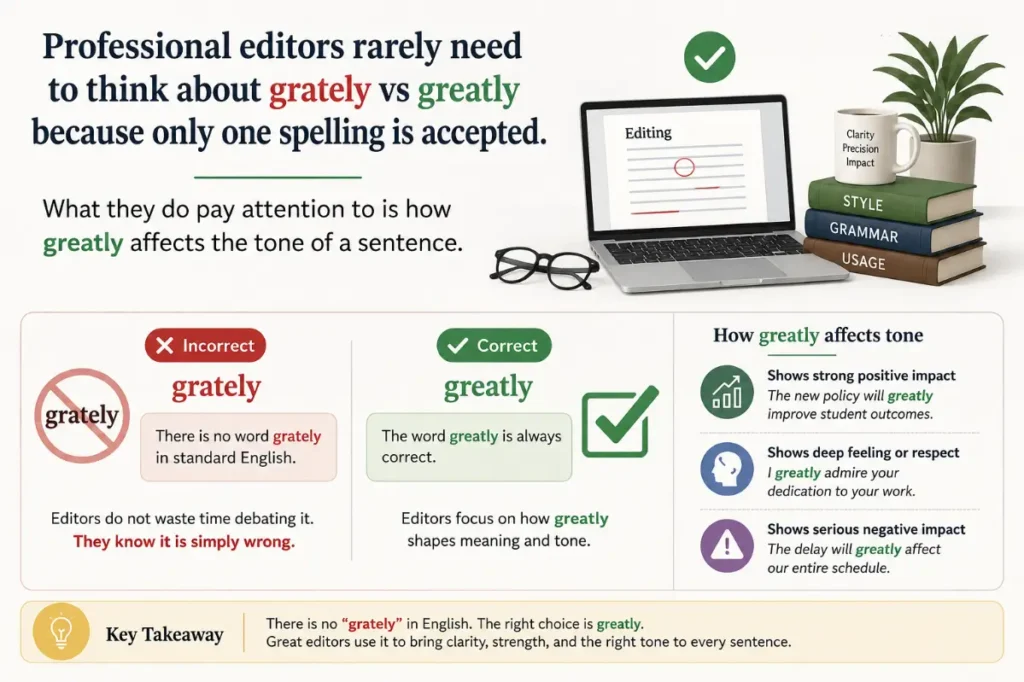
An experienced editor would correct grately to greatly in ordinary English because the standard adverb is established clearly. The confusion usually comes from fast typing, the close relationship between great and greatly, and the fact that pronunciation does not reveal every letter. Professional editors also watch for unnecessary repetition of greatly. If a paragraph uses the word several times, replacing one instance with significantly, considerably, or a more direct construction can make the writing smoother. Spellcheck tools normally recognize greatly and may flag grately, but careful proofreading still matters because context can hide simple spelling errors.
Conclusion
grately vs greatly has a clear answer. Greatly is the standard English spelling, while grately is generally a misspelling. The correct word is an adverb meaning to a large degree, very much, or significantly. You’ll often see it with verbs related to appreciation, improvement, influence, change, and effect.
The spelling becomes easier when you connect it directly with the adjective great. Think great followed by ly, which gives you greatly. Also remember that greatly and gratefully are different words with different meanings. One describes degree while the other describes gratitude.
For polished writing, use greatly whenever you mean the standard adverb related to great. During proofreading, pay special attention to the middle of the word. That quick check can catch one of the easiest spelling errors before your reader sees it.
FAQs
Is grately a real word?
Grately is not normally recognized as the standard English adverb related to great. In ordinary writing, it is treated as a misspelling of greatly. You may occasionally encounter the letter sequence in a name, username, or other special context, but that does not make it a standard English word. For normal communication, use greatly.
Which is correct grately or greatly?
Greatly is the correct standard spelling when you mean to a large degree or very much. Grately is generally a spelling error. The standard form is spelled great plus ly, producing greatly. For example, write I greatly appreciate your help rather than I grately appreciate your help.
What does greatly mean?
Greatly is an adverb meaning to a large degree, very much, or significantly. It commonly describes strong effects, feelings, changes, appreciation, or influence. In I greatly appreciate your help, the word greatly shows the strength of the speaker’s appreciation. It can appear in casual, professional, academic, and formal writing.
How do you pronounce greatly?
Greatly is commonly pronounced /ˈɡreɪtli/. A simple pronunciation guide is GREAT lee. The main stress falls on the first syllable. The word begins with the same sound as great and ends with a sound similar to lee. Connecting the pronunciation with the base word great can also help you remember the spelling.
Can greatly start a sentence?
Yes, but sentence initial use is less common than placing greatly near the verb it modifies. For example, you could write Greatly concerned by the results, the researchers repeated the test. In ordinary sentences, placement such as The change greatly improved the system is usually more direct and natural.
What is a synonym for greatly?
Depending on context, possible alternatives include significantly, considerably, substantially, deeply, strongly, very much, and to a large degree. These words are not perfect substitutes in every sentence. For example, deeply often works well with emotions, while significantly often fits measurable or important changes. Choose the alternative that matches the exact meaning you want.
Why do people misspell greatly as grately?
The error usually comes from fast typing or from mentally simplifying the spelling. Because the word is related to great, writers may know the correct base word but still omit a letter while adding the adverb ending. Pronunciation also does not clearly reveal every written letter, so the mistake can slip through during quick writing.
Is greatly appropriate in formal writing?
Yes. Greatly is completely acceptable in formal writing and commonly appears in professional emails, academic papers, reports, and official communication. Phrases such as greatly appreciated and greatly influenced are standard. The main concern is repetition. If the word appears too often in one passage, use a precise alternative or rewrite the sentence for better variety.
