
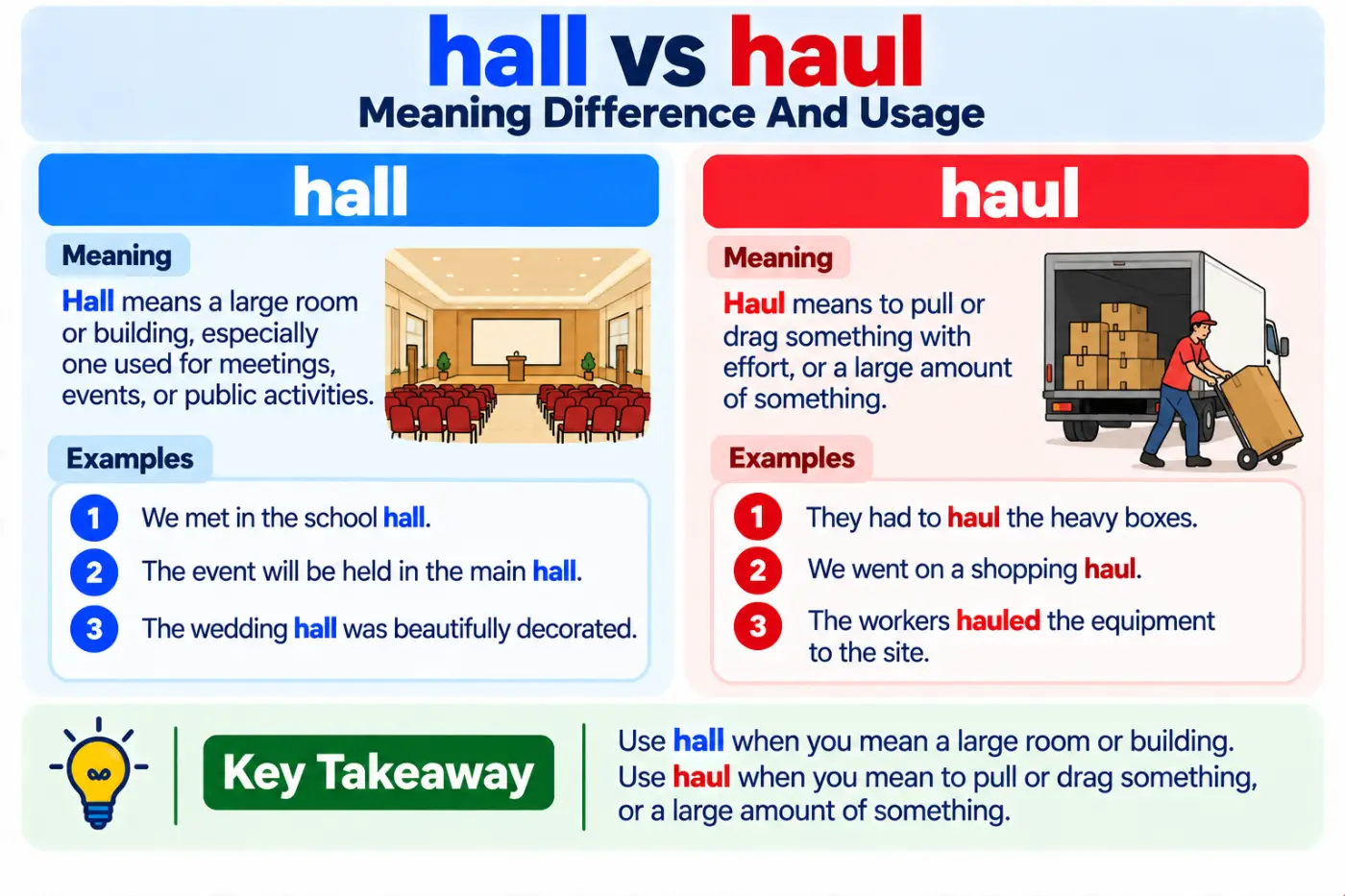
hall vs haul is a classic English word confusion because the two words sound exactly alike in standard American English but have different spellings and meanings. Hall usually refers to a passageway, large room, building, or entrance area, while haul usually refers to carrying or transporting something, or the amount of something collected or transported. Neither word is a misspelling of the other.
The confusion comes from pronunciation. If you hear someone say, I left my bag in the hall, you know the meaning from context rather than sound. The same pronunciation can represent a completely different word in a sentence such as We made a big haul at the store. This is a classic example of a homophone. The words sound alike but have different meanings and spellings.
Knowing the difference becomes easy once you connect each spelling with its meaning. This guide explains the definitions, grammar, pronunciation, word origins, regional usage, common mistakes, natural examples, and related terms. You’ll also learn a few simple memory tricks that can help you choose the right word quickly.
Quick Definition
Hall is a noun that commonly means an entrance area, corridor, large room, or building used for a particular purpose. Haul can be a verb meaning to pull, carry, or transport something, or a noun meaning something transported or collected. They sound alike but have different meanings and spellings.
Quick Answer
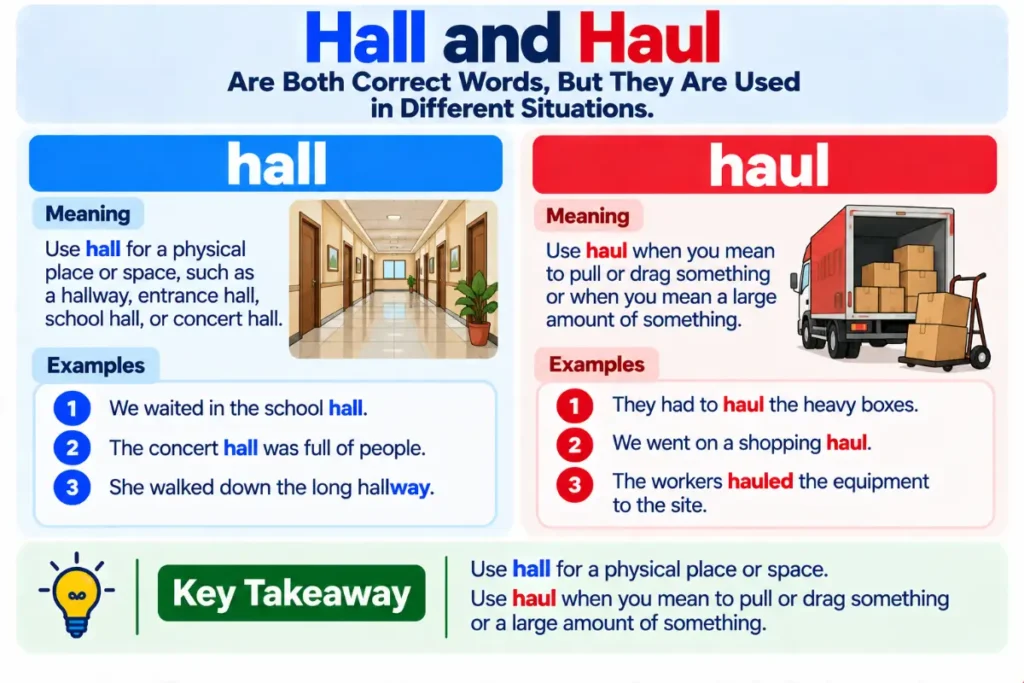
Hall and haul are both correct words, but they are used in different situations.
Use hall for a physical place or space, such as a hallway, entrance hall, school hall, or concert hall.
Use haul for carrying, pulling, transporting, or collecting something, such as hauling furniture or a big shopping haul.
The key is simple. Hall is a place or space. Haul involves moving or collecting something.
Comparison Table Hall And Haul
| Form | Meaning | Part of Speech | Origin | Usage Frequency | Formality | Common Contexts | Example |
|---|---|---|---|---|---|---|---|
| Hall | A passage, large room, building, or entrance area | Noun | Old English | Very common | Neutral | Homes, schools, buildings, public venues | The students waited in the hall. |
| Haul | To pull or transport something, or an amount transported or collected | Verb and noun | Old English | Common | Neutral and informal in some uses | Transport, work, shopping, fishing, travel | We hauled the boxes upstairs. |
The words belong to different word families even though they share the same pronunciation.
Meaning And Definition
Meaning Of Hall
Hall is mainly a noun. It has several related meanings that all involve a physical space or building.
One common meaning is a passage inside a building.
For example:
My bedroom is at the end of the hall.
Here hall refers to the passage that connects rooms.
Hall can also mean a large room used for meetings, events, performances, or gatherings.
The students gathered in the school hall.
The concert was held in a large hall.
The word can also refer to an entrance area.
Please leave your shoes in the hall.
In some contexts, hall refers to a building itself, especially a public or institutional building.
The town hall is across the street.
Hall also appears in names such as city hall, dining hall, lecture hall, and concert hall. In these expressions, it usually refers to a particular type of building or room.
Because hall has several related meanings, context tells you exactly which sense the writer intends.
Meaning Of Haul
Haul has two main grammatical roles. It can be a verb and a noun.
As a verb, haul means to pull, drag, carry, or transport something, often something heavy or difficult to move.
We hauled the furniture into the garage.
The workers hauled the equipment up the stairs.
It can also describe transporting goods over a distance.
The truck hauls supplies across the state.
As a noun, haul can refer to the amount of something collected, caught, purchased, or transported.
The fishermen had a large haul.
She showed us her shopping haul.
The thieves escaped with a valuable haul.
The meaning changes slightly with context, but the central idea involves obtaining, carrying, pulling, or transporting something.
The Main Difference
The most useful distinction is based on meaning rather than sound.
- Hall refers to a place or space. Think hallway, school hall, concert hall, or entrance hall.
- Haul refers to movement or collection. Think hauling boxes, hauling equipment, or making a shopping haul.
- Hall is mainly a noun. It normally names a physical space or building.
- Haul can be a verb or noun. As a verb, it describes an action. As a noun, it can describe something transported or collected.
- The pronunciation is the same. In standard American English, hall and haul are homophones.
- The spelling carries the meaning. Since pronunciation cannot distinguish them, you need to look at the sentence.
Consider these two examples.
The children ran down the hall.
The workers hauled the boxes downstairs.
The first sentence describes a place. The second describes an action.
That difference gives you a reliable way to choose the correct spelling.
Hall As A Noun
Hall is one of those everyday nouns that appears in many common expressions.
A hallway is a passage connecting different rooms.
An entrance hall is the area immediately inside an entrance.
A dining hall is a room or building where people eat.
A lecture hall is a large room used for teaching or presentations.
A concert hall is a venue designed for musical performances.
A town hall can refer to a municipal building or a public meeting.
A hall of fame is an institution that honors people for achievements in a particular field.
These expressions show how flexible the word can be.
Hall can also appear in compound nouns and proper names. In each case, the surrounding words make the intended meaning clear.
For example:
The students are waiting in the lecture hall.
The lecture tells us what kind of hall the writer means.
Haul As A Verb
As a verb, haul usually describes physical movement.
It often suggests effort. If someone hauls something, the object may be heavy, awkward, or difficult to move.
They hauled the broken sofa outside.
The workers hauled the machinery into the warehouse.
You can also use haul for transportation over a distance.
The company hauls freight across the country.
The truck hauls construction materials.
The verb does not always require great physical strength from a person. It can also describe vehicles or equipment transporting goods.
For example:
The truck hauls food to rural communities.
Here haul means transport.
The word can also describe pulling something.
The horse hauled the cart up the hill.
This sense emphasizes effort and movement.
Haul As A Noun
As a noun, haul often describes a collection of things obtained or transported.
A shopping haul is a group of items someone recently bought.
For example:
She posted a video showing her vacation shopping haul.
A fishing haul describes the fish caught during a trip.
The boat returned with a large haul.
A haul can also describe stolen goods.
The police recovered a large haul of stolen electronics.
The noun therefore has a broad meaning. The common idea is that something has been gathered, obtained, transported, or collected.
Modern informal English also uses haul in social media and video content. People may show a shopping haul, makeup haul, clothing haul, or holiday haul. In these contexts, the word has a casual and familiar tone.
Why Hall And Haul Sound The Same
Hall and haul are homophones. Homophones are words that share the same pronunciation but have different meanings, spellings, or both.
The exact vowel quality can vary across English accents. In standard American English, the two words are generally pronounced alike or extremely close.
This creates an important spelling challenge. When you hear the word, you cannot rely on sound alone to decide which spelling the speaker means.
Instead, use context.
If someone says:
Meet me in the hall.
The sentence clearly refers to a place.
If someone says:
We hauled the boxes upstairs.
The sentence clearly refers to moving something.
This is why English learners should study homophones as meaning pairs rather than pronunciation pairs. Once you know the meaning, the spelling becomes easier to select.
Sentence Examples
Here are ten natural examples showing how the words work.
- I left my jacket in the hall.
- The students gathered in the school hall before the ceremony.
- Please wait for me in the entrance hall.
- The concert hall was almost full.
- We hauled the furniture into the new apartment.
- The workers hauled the heavy equipment across the yard.
- She shared a video of her latest shopping haul.
- The fishermen returned with an impressive haul.
- The truck hauls supplies between the two cities.
- The police discovered a large haul of stolen goods.
The first four examples use hall as a place or building. The remaining examples use haul as a verb or noun connected with moving or collecting something.
Common Mistakes And Misspellings
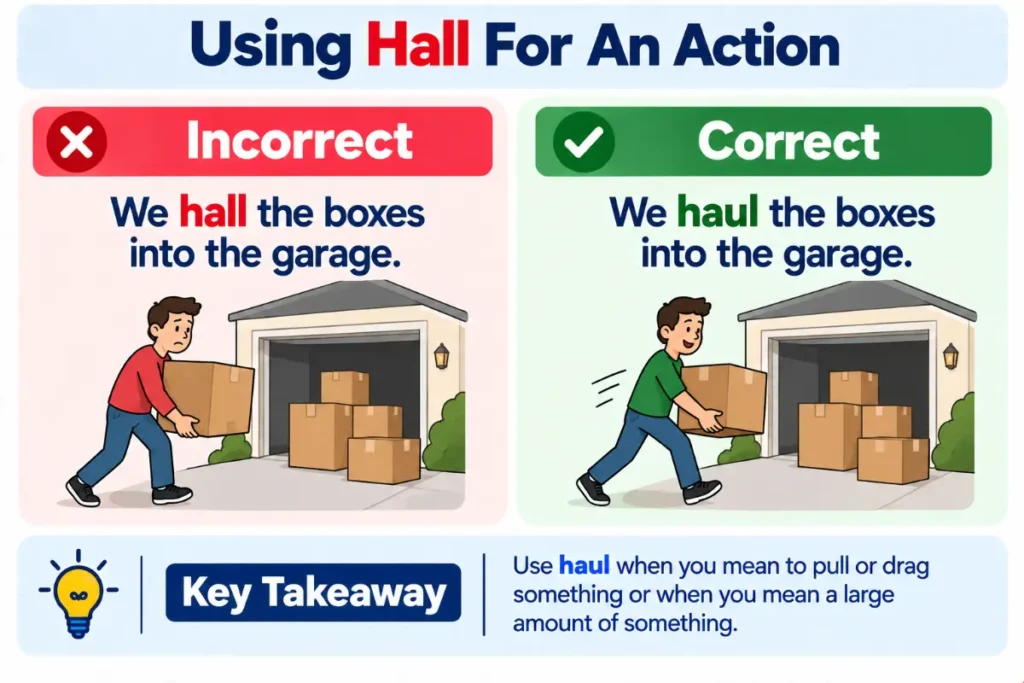
Using Hall For An Action
Incorrect:
We hall the boxes into the garage.
Correct:
We haul the boxes into the garage.
The sentence describes moving boxes, so haul is the correct word.
Using Haul For A Place
Incorrect:
Please wait in the haul.
Correct:
Please wait in the hall.
The sentence refers to an area inside a building.
Confusing Haul With Whole
In some accents, haul can sound similar to whole, especially when people speak quickly. However, the meanings are completely different.
Whole means complete or entire.
Haul means transport, pull, or a collection of something.
Confusing Hall With Hole
Hall and hole can sound similar in some speech patterns, especially for learners.
A hall is a space inside or a building.
A hole is an opening or hollow space.
The spelling and meaning are different.
Relying Only On Pronunciation
This is the most common source of confusion. Since hall and haul are homophones, pronunciation alone cannot tell you which word to write.
Look at the meaning first.
If the sentence needs a location, hall is likely the answer.
If it describes moving, carrying, pulling, or collecting, haul is likely correct.
Pronunciation Guide
Hall is commonly pronounced /hɔːl/ in American English.
Haul is also commonly pronounced /hɔːl/ in American English.
Both words have one syllable.
An easy pronunciation guide is:
Hall: hawl.
Haul: hawl.
The important point is that the spelling changes but the sound does not normally provide a useful distinction.
Regional accents can change vowel sounds, so pronunciation may vary somewhat across speakers. Still, the two words are widely treated as homophones in standard English.
Because the sound is the same, spelling must carry the distinction in writing.
This is similar to other English pairs such as:
to and too
right and write
there and their
flower and flour
Knowing the meaning of each word is the best defense against homophone mistakes.
Etymology And Word Origin
Hall and haul have different histories despite their similar pronunciation.
Hall comes from Old English heall, a word referring to a large room, building, or covered space. It is related to Germanic words connected with a large enclosed room or dwelling.
Over time, hall developed the range of meanings used in modern English. It can now refer to a passage, large room, public building, entrance area, or institution.
Haul has a different origin. It developed from Middle English forms associated with pulling or dragging and is connected with French forms related to pulling or drawing.
Its modern meanings grew from the basic idea of moving something with effort. From that physical sense came uses involving transportation and the amount of goods or items transported or collected.
The two words therefore arrived at the same modern pronunciation through different historical paths.
Their shared sound is a coincidence of language development rather than evidence that they are related words.
Regional Usage
American English
Both hall and haul are standard American English words. Their meanings remain distinct even though they are normally pronounced the same.
Hall appears constantly in everyday American speech through expressions such as hallway, school hall, concert hall, and city hall.
Haul is common in transportation, work, shopping, fishing, and informal online language.
American speakers may also use haul in expressions such as shopping haul or clothing haul.
British English
British English also uses both words with the same core meanings.
Hall commonly refers to rooms, passages, buildings, and venues.
Haul means to pull, carry, or transport something and can also refer to an amount collected or transported.
The pronunciation can vary by regional accent, but the spelling distinction remains important.
Australian English
Australian English uses hall and haul as separate words with the same basic meanings found in other major English varieties.
Hall is used for buildings, rooms, and passages.
Haul is used for transporting or collecting things.
Accent differences can affect pronunciation, but they do not remove the spelling distinction.
Canadian English
Canadian English also maintains the same distinction.
Hall refers to a space or building.
Haul refers to pulling, transporting, or collecting something.
Canadian pronunciation may vary by speaker and region, but the two words remain separate lexical items.
There is no major regional spelling variation that changes the basic rule.
Grammar Rules And Part Of Speech
Hall is primarily a noun.
It names a place, room, passage, or building.
Examples include:
The hall is crowded.
We waited in the hall.
The school hall needs new chairs.
Haul can be either a verb or a noun.
As a verb:
They haul equipment across the country.
As a noun:
The fishermen had a good haul.
When haul functions as a verb, it can take an object.
They hauled the boxes upstairs.
The word can also appear in passive constructions.
The equipment was hauled into the warehouse.
As a noun, haul can be modified by adjectives.
It was a large haul.
She had an impressive shopping haul.
The grammar therefore provides another useful clue. If the sentence needs a location or room, hall is likely to fit. If the sentence needs an action involving movement or a collection of items, haul is likely to fit.
Punctuation And Sentence Position
Neither word requires special punctuation.
Hall can appear after a preposition.
The children are in the hall.
It can also serve as the subject or object of a sentence.
The hall was crowded.
We cleaned the hall.
Haul as a verb can appear after a subject.
They haul furniture for a living.
As a noun, it can follow an article or determiner.
The haul was larger than expected.
She showed us her haul.
The surrounding grammar often provides enough information to distinguish the two words even when pronunciation does not.
Real Life Usage Examples
Daily Conversation
I’ll meet you in the hall after class.
We had to haul the boxes upstairs.
These sentences show the basic difference clearly. One describes a location. The other describes movement.
Workplace Communication
The staff meeting will take place in the main hall.
The company uses trucks to haul materials between warehouses.
In workplace writing, both words are common and neutral.
Academic Writing
The participants gathered in the university hall before the presentation.
The researchers examined the amount of material hauled from the site.
Academic writing may use hall in descriptions of locations and haul in technical discussions of transportation or physical movement.
News Writing
Residents gathered in the town hall to discuss the proposal.
Workers continued to haul debris away from the damaged building.
News writing often uses both words in straightforward descriptive sentences.
Literature And Storytelling
She walked quietly down the dark hall.
They struggled to haul the old chest through the narrow doorway.
In storytelling, hall can establish a setting while haul can describe physical effort and movement.
Related And Confused Terms
Hallway
Hallway means a passage inside a building. It is especially common in American English.
Corridor
Corridor also means a passage connecting rooms or areas. It is often more formal than hallway.
Entrance
An entrance is a place or opening through which people enter. An entrance hall is a specific type of hall.
Venue
A venue is a place where an event happens. A concert hall can be a venue.
Carry
Carry means to hold and move something from one place to another. It can overlap with haul but usually does not imply the same degree of effort.
Drag
Drag means to pull something along a surface. It emphasizes pulling rather than simply transporting.
Transport
Transport means moving people or goods from one location to another. It is broader and more neutral than haul.
Load
Load can mean to put goods or objects onto a vehicle or container. It often appears in the same transportation contexts as haul.
Understanding these related words helps you see why haul is connected to movement while hall is connected to physical space.
Hall In Common Expressions
Hall appears in many everyday expressions.
Town hall can refer to a municipal building or a public meeting.
City hall commonly refers to the main administrative building of a city.
Dining hall is a large room where people eat, especially at schools or institutions.
Lecture hall is a room designed for lectures.
Concert hall is a venue designed for musical performances.
Entrance hall is an area near the entrance of a building.
Hallway is a passage connecting rooms.
Hall of fame is an institution that recognizes people for achievements.
These expressions make hall an especially useful word to learn as part of a larger vocabulary group.
Haul In Modern Informal English
Haul has become especially common in informal discussions of shopping and purchases.
A shopping haul is a collection of items someone bought during a shopping trip.
For example:
I’m going to show you my back to school haul.
The phrase is common in casual online content and everyday speech.
You can also talk about a beauty haul, clothing haul, grocery haul, or vacation haul.
The word still retains its older transportation meaning.
The truck hauled the goods across the state.
The fishing boat returned with a large haul.
So the modern informal sense did not replace the older meaning. It expanded the word into a broader idea of collecting or obtaining a group of things.
A Simple Memory Trick
Use this mental picture.
Hall has walls.
A hall is a physical space inside a building, so think about walls.
Haul has movement.
To haul something is to move, pull, carry, or transport it.
This is not a formal grammar rule, but it is a useful memory aid.
If you can imagine a place, think hall.
If you can imagine moving something, think haul.
For example:
I’m waiting in the hall.
Picture a room or passage.
I’m going to haul these boxes.
Picture someone moving heavy boxes.
The mental image makes the spelling easier to recall.
Why Spellcheck May Not Catch The Mistake
Hall and haul are both standard English words. That means a spelling checker may accept either one even when you use the wrong word for the sentence.
For example:
Please wait in the haul.
There is nothing inherently misspelled about haul. The problem is that the meaning does not fit the sentence.
This is an important distinction between spelling and usage errors.
A spellchecker checks recognized word forms. It may not understand your intended meaning well enough to identify every homophone error.
That is why proofreading should involve meaning as well as spelling.
When reviewing a sentence containing hall or haul, ask yourself what the word is supposed to describe.
Is it a place?
Use hall.
Is it movement, transportation, pulling, or a collection?
Use haul.
Expert Editor Insight
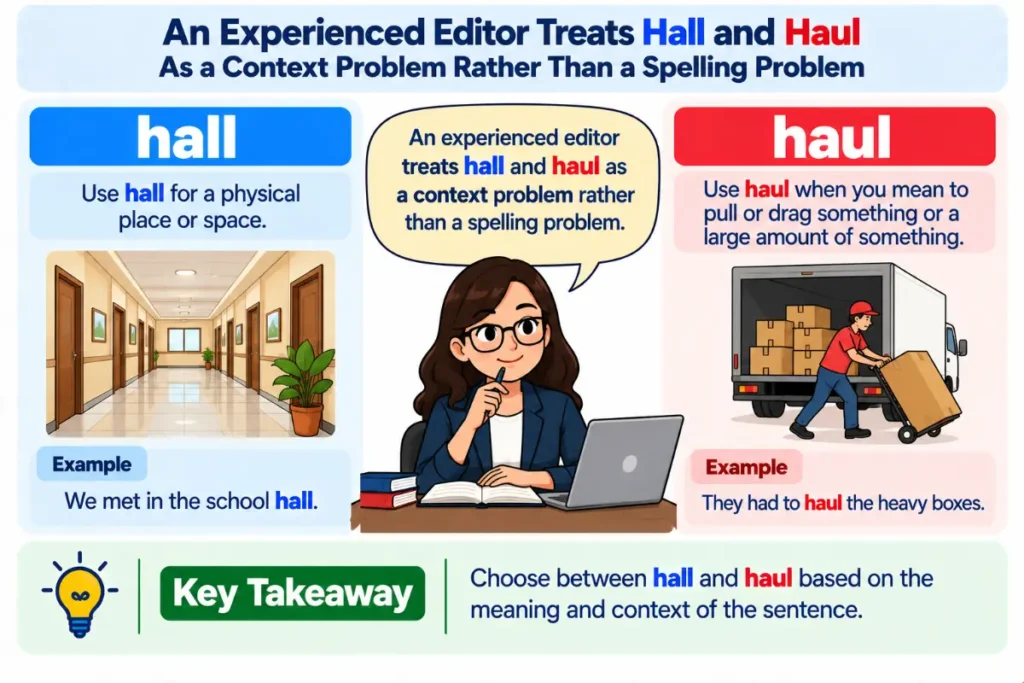
An experienced editor treats hall and haul as a context problem rather than a spelling problem. Both forms are standard, so a basic spellchecker may accept either one. The stronger editing habit is to read the entire sentence and identify the intended meaning. If the word describes a room, passage, or building, choose hall. If it describes pulling, transporting, or a collection of goods, choose haul. Reading aloud can help with rhythm, but it cannot solve the spelling choice because the two words are homophones.
Conclusion
hall vs haul is a meaning and spelling distinction rather than a case of one word being correct and the other being wrong. Hall refers mainly to a room, passage, entrance area, or building, while haul describes pulling, carrying, transporting, or a collection of items. Both words are standard English and commonly appear in everyday writing.
The biggest challenge is pronunciation because the words are homophones. Since they sound alike, context must guide your spelling choice. Think of hall as a place with walls and haul as an action involving movement. That small memory trick can help you choose the right word quickly. When proofreading, focus on meaning instead of relying only on spellcheck because both forms are valid English words.
FAQs
What is the difference between hall and haul?
Hall usually refers to a physical space, passage, large room, or building. Haul refers to pulling, carrying, or transporting something and can also mean an amount of something collected or transported. The two words are homophones in standard American English, so they sound alike but have different spellings and meanings.
Is haul a real word?
Yes. Haul is a standard English word with both verb and noun uses. As a verb, it can mean to pull, carry, or transport something. As a noun, it can describe an amount of something collected or transported, such as a fishing haul or shopping haul. It is common in everyday, professional, and informal contexts.
Is hall a real word?
Yes. Hall is a very common English noun. It can describe a passage inside a building, an entrance area, a large room, or a building used for a particular purpose. You can find it in expressions such as hallway, concert hall, dining hall, lecture hall, and town hall.
Are hall and haul pronounced the same?
In standard American English, hall and haul are generally pronounced the same way, commonly represented as /hɔːl/. They are therefore homophones. Some regional accents may produce slightly different vowel qualities, but the two words are close enough in pronunciation that context usually determines the intended meaning.
How do I remember the difference between hall and haul?
A simple memory trick is to connect hall with walls. A hall is a place inside a building and often has walls around it. Connect haul with movement. If someone hauls something, they pull, carry, transport, or collect it. Thinking about the meaning first makes the spelling much easier to choose.
Can haul be used as a noun?
Yes. Haul can function as a noun as well as a verb. It can refer to the amount of something collected, caught, purchased, or transported. Examples include a large fishing haul, a shopping haul, and a valuable haul of stolen goods. The noun is common in both ordinary and informal English.
Is hall the same as hallway?
Not always. Hall can refer to a passage inside a building, but it can also mean a large room, entrance area, or building. Hallway specifically means a passage that connects rooms or areas. In American English, hallway is often the clearest word for the passage inside a home or office.
Why do people confuse hall and haul?
People confuse them mainly because they sound alike. Since pronunciation does not clearly distinguish the words, a writer who is relying on sound may choose the wrong spelling. The best solution is to connect each word with its meaning. Hall relates to a place or space, while haul relates to moving or collecting something.
