
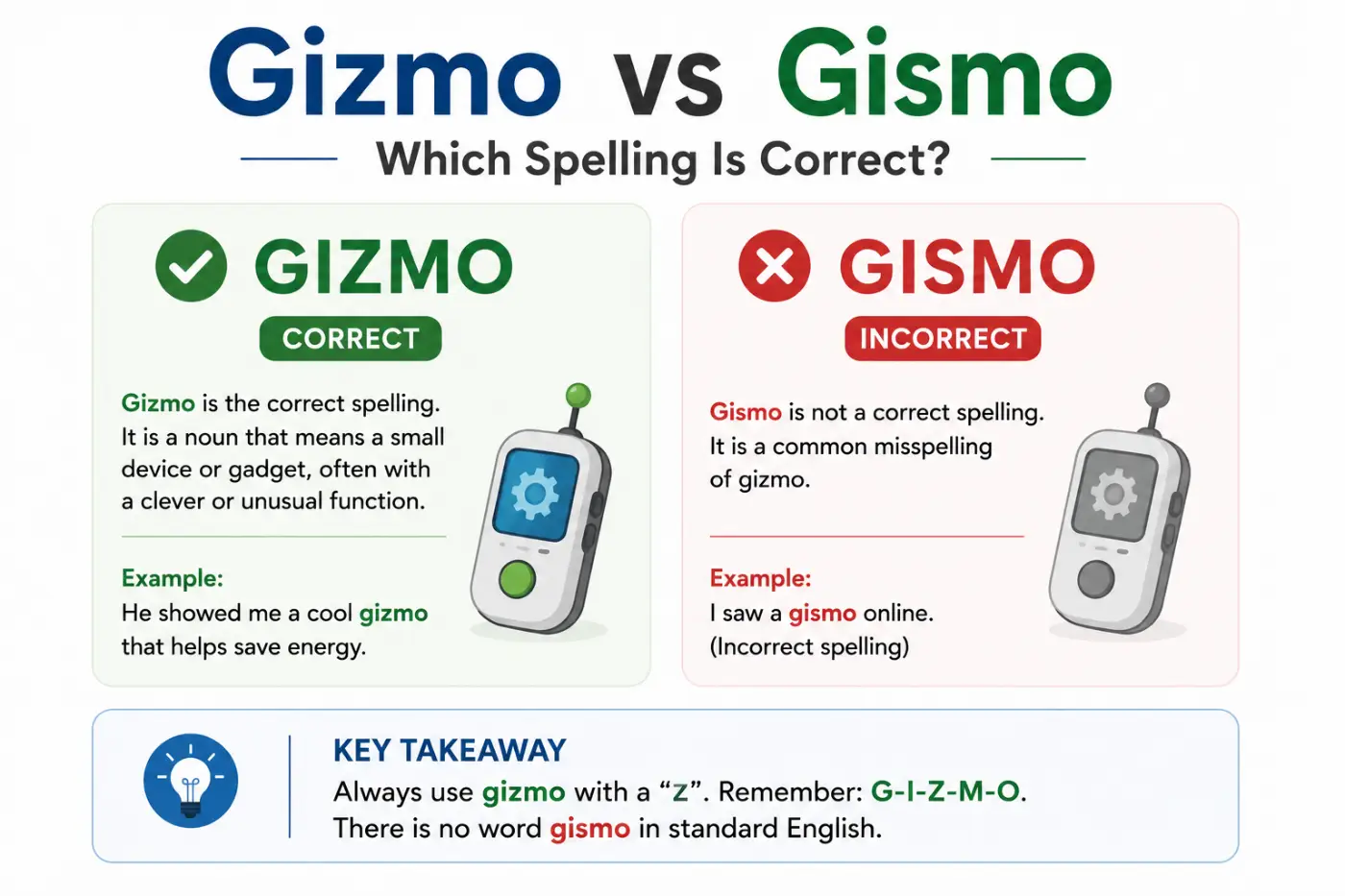
gizmo vs gismo is a common spelling question because the two forms look and sound almost identical. The short answer is that gizmo is the standard and much more widely recognized spelling in modern English. Gismo does appear in dictionaries and historical usage, but it is far less common and is generally not the form most writers should choose.
The word usually refers to a gadget, device, tool, or small mechanical object when the speaker does not know or does not want to give its exact name. It can also describe an object whose name is forgotten or unimportant. That makes it a handy informal word in everyday American English. You might say, Hand me that little gizmo on the desk, when the exact name of the object does not matter.
The spelling confusion makes sense because both forms have been used in English. Their pronunciation is essentially the same, and the word itself has an uncertain origin. This article explains the difference, meaning, pronunciation, history, grammar, regional usage, common mistakes, and practical examples so you can choose the spelling with confidence.
Quick Definition
Gizmo is the standard modern spelling for an informal word meaning a gadget, device, tool, or unnamed object. Gismo is a recognized variant in some dictionaries and historical sources, but it is much less common. For ordinary American English writing, gizmo is the safer and more familiar choice.
Quick Answer
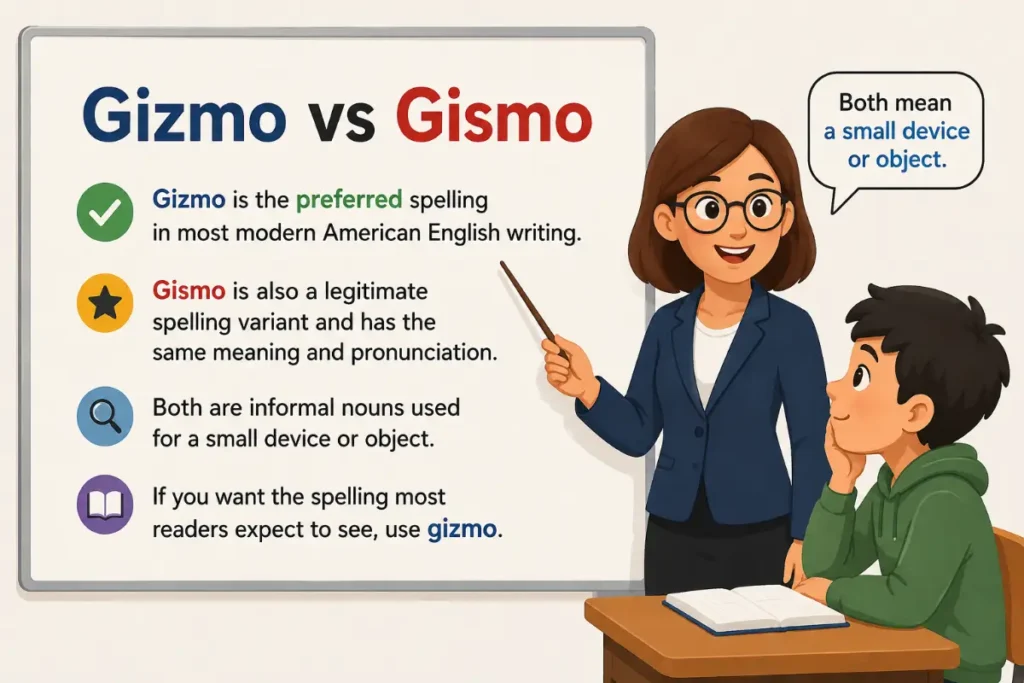
Use gizmo for normal English writing.
Gizmo is an informal noun for a gadget, device, tool, or object whose exact name is unknown, forgotten, or not worth mentioning. Gismo is an established variant spelling, but it has much lower usage and is usually not the first choice for modern general writing.
For example:
I bought a new kitchen gizmo.
You could encounter gismo in older or variant usage, but gizmo is the form most readers will expect.
Comparison Table For The Two Spellings
| Form | Meaning | Part of Speech | Origin | Usage Frequency | Formality | Common Contexts | Example |
|---|---|---|---|---|---|---|---|
| Gizmo | A gadget, device, tool, or unnamed object | Noun | Origin uncertain | Very common relative to the variant | Informal | Everyday speech, technology, tools, products | Hand me that gizmo. |
| Gismo | Variant spelling of gizmo | Noun | Origin uncertain | Much less common | Informal | Older usage, variant spelling, occasional writing | The old gismo stopped working. |
The key point is that this is not a simple case of one spelling being completely nonexistent. Gismo has a documented history as a variant. Still, modern readers are far more likely to recognize and expect gizmo.
Meaning And Definition
Meaning Of Gizmo
Gizmo is an informal noun used for a gadget, device, tool, or object that has a specific function but whose exact name is unknown, forgotten, irrelevant, or simply difficult to remember.
Imagine someone points at a strange kitchen tool and says:
What does this gizmo do?
They are not necessarily saying the object has no proper name. They simply do not know the name or do not care to use it.
The word is especially useful when an object has a complicated technical name.
For example:
I bought this little gizmo that removes the seeds from strawberries.
The speaker could probably give the device a more exact name. Gizmo keeps the conversation relaxed.
The word can also describe a gadget whose function matters more than its formal name.
He built a gizmo that turns sunlight into power.
Here the listener understands that some kind of device exists. The exact technical details are not part of the sentence.
Gizmo is strongly informal. It fits casual conversation, product descriptions with a friendly tone, technology discussions, and everyday writing. In highly technical or academic writing, a precise term is usually better.
Meaning Of Gismo
Gismo is a variant spelling of gizmo. It carries essentially the same meaning.
You may encounter it in dictionaries, older publications, historical documents, or occasional modern writing. It is not simply a random typo invented by people who do not know the standard spelling.
Still, the spelling is much less common than gizmo.
If you are writing for a general American audience, gizmo will usually look more familiar and natural.
That difference matters because a word can be technically documented without being the best everyday choice. English has many variant forms that survive in dictionaries even though one form dominates modern usage.
Gismo is a good example of that pattern.
The Main Difference
The central difference is usage frequency rather than meaning.
- Gizmo is the standard modern choice. It is the form most readers expect for an informal gadget or device.
- Gismo is a variant. It has documented usage but is far less common.
- Both refer to similar things. Neither spelling creates a major difference in meaning.
- Both function mainly as nouns. You can use either to refer to a gadget, device, or unnamed object.
- Both are informal. Neither is normally the best choice for technical precision.
- Pronunciation does not usually separate them. The two forms are generally pronounced alike.
The practical rule is simple. If you need the word in ordinary modern writing, choose gizmo.
Which Spelling Is Correct?
Gizmo is the preferred modern spelling.
That does not mean gismo is an invented word. The variant has appeared in English for a long time and is recorded in dictionaries. The issue is standard modern usage and familiarity.
For most readers, gizmo is immediately recognizable.
For example:
The new gizmo connects to your phone.
That sentence feels completely natural.
Using gismo would still be understandable:
The new gismo connects to your phone.
But the spelling may look unusual to many readers.
This is a useful distinction in language editing. A form can be legitimate without being the best default choice. When two spellings have the same meaning but one is overwhelmingly more familiar, professional writing usually favors the familiar form unless there is a reason to preserve the variant.
Why The Spelling Causes Confusion
The confusion comes from pronunciation.
Gizmo and gismo sound almost identical in normal speech. If you learn the word by hearing it first, you have no reliable pronunciation clue telling you to use z instead of s.
English also contains many words where the letters s and z represent related sounds. That makes the spelling distinction less obvious.
Another factor is the word’s unusual history. Gizmo does not have a simple transparent origin that tells learners how to spell it. Unlike a word such as toothbrush, you cannot break gizmo into familiar English parts and predict the spelling.
That makes visual memory important.
Once you have seen gizmo repeatedly in books, websites, product descriptions, and conversations, the standard spelling becomes much easier to recognize.
Grammar And Part Of Speech
Gizmo is primarily a noun.
It can be singular:
That gizmo is broken.
It can also be plural:
Those gizmos are useful.
The plural is formed normally by adding s.
Gizmo can work as the subject of a sentence:
The gizmo stopped working.
It can also be the object:
I bought a new gizmo.
It can appear after a determiner:
This gizmo is surprisingly useful.
The same basic grammatical behavior applies to gismo when that variant is used.
Because the word is informal, it is usually used when the exact identity of the object is not central to the sentence.
Compare:
I repaired the gizmo.
I repaired the hydraulic pressure regulator.
The first sentence is casual and vague. The second is specific and technical.
Neither is grammatically better. They serve different purposes.
When To Use Gizmo
Use gizmo when the object is small, mechanical, electronic, technical, or otherwise difficult to name.
The word works especially well in casual conversation.
For example:
- Can you hand me that little gizmo?
- This gizmo makes opening jars much easier.
- I bought a strange gizmo online.
- What does this gizmo do?
- My dad has a garage full of useful gizmos.
You can also use the word when you intentionally want to avoid technical language.
The engineer explained how the gizmo works.
That sentence suggests the speaker is simplifying a technical explanation.
In product writing, gizmo can create a friendly and approachable tone.
This handy gizmo helps keep your cables organized.
However, professional product documentation should usually name the actual device instead.
When Gismo Appears
Gismo can appear as a variant spelling of the same noun.
You might encounter it in older writing or in sources that preserve less common spellings.
It can also appear because someone remembers the pronunciation but not the dominant spelling.
For example:
I need to fix that old gismo.
The meaning is clear, but most modern editors would likely change the spelling to gizmo unless there is a specific reason to preserve the original form.
That is the important practical distinction. Gismo is understandable and documented, but gizmo is the stronger default for contemporary general English.
Sentence Examples
Here are ten natural examples using the preferred spelling.
- I bought a little gizmo that keeps my phone cables organized.
- Can you pass me that gizmo beside the toolbox?
- Nobody knows exactly what this gizmo does.
- My brother loves collecting strange electronic gizmos.
- This kitchen gizmo makes peeling vegetables much easier.
- The technician showed me how to use the new gizmo.
- I found an old gizmo in the garage and decided to see if it still worked.
- The company created a small gizmo for tracking package temperatures.
- What is that blue gizmo attached to your computer?
- We need a better name for this gizmo before we launch the product.
Here are examples showing the less common variant.
- The old gismo finally stopped working.
- He found a strange gismo in the workshop.
- Nobody could identify the little gismo.
- She kept the antique gismo as a souvenir.
- The manual used the spelling gismo throughout the document.
These examples demonstrate the variant without suggesting that it is the preferred modern spelling.
Common Mistakes
Writing Gismo As The Default Form
The most common issue is choosing gismo simply because the pronunciation sounds like it could contain an s.
For modern general writing, use gizmo.
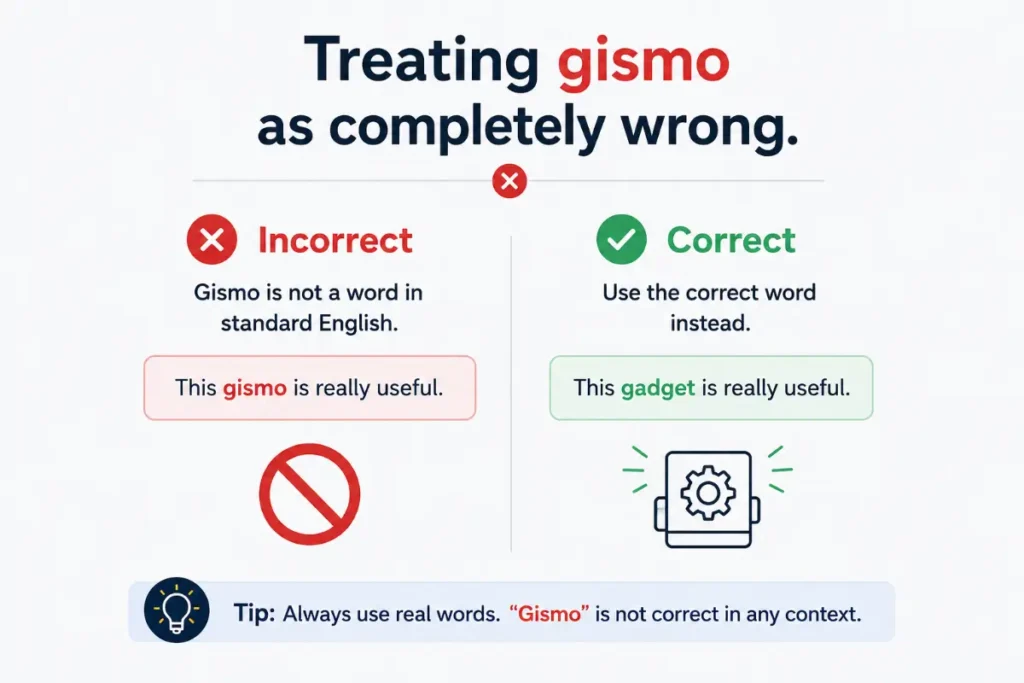
Treating Gismo As A Completely Wrong Word
Calling gismo a meaningless spelling mistake goes too far. It has documented variant usage.
The better description is that it is a less common variant of gizmo.
Assuming The Word Must Have A Technical Meaning
Gizmo can refer to almost any gadget or device when the exact name is unknown or unimportant.
It does not require a sophisticated machine.
A small kitchen tool can be a gizmo.
Using Gizmo In Highly Technical Writing
Gizmo is intentionally vague.
In technical documentation, vague terms can cause problems. If you know that the object is a voltage regulator, pressure sensor, adapter, or circuit component, use the precise name.
Confusing Gizmo With Gadget
Gizmo and gadget overlap strongly, but they are not always interchangeable in tone.
Gadget often sounds more neutral and may refer specifically to a useful device. Gizmo has a more playful or vague feel.
Pronunciation Guide
Gizmo is commonly pronounced /ˈɡɪzmoʊ/ in American English.
A simple pronunciation guide is:
GIZ moh.
The stress falls on the first syllable.
The first sound begins like the word give, followed by a z sound. The second syllable sounds roughly like moh.
Gismo is normally pronounced the same way.
That shared pronunciation explains much of the spelling confusion.
When people hear the word, they cannot tell from the sound alone which spelling appears on the page. They have to learn the written form through exposure.
A useful trick is to remember the z in gizmo as part of the word itself rather than trying to infer it from pronunciation.
Etymology And Word Origin
The exact origin of gizmo is uncertain.
The word appeared in American English during the early twentieth century. Its history is often discussed alongside other informal words for an unnamed object or device, including gadget and thingamajig.
Unlike many English words, gizmo does not have a widely accepted simple origin story that explains exactly why the spelling developed as it did.
That uncertainty is worth acknowledging rather than filling the gap with a neat but unsupported explanation.
The word became established as an informal noun for a gadget or device. Over time, the spelling with z became the dominant modern form.
Gismo developed and survived as a variant spelling. The two forms therefore share the same basic lexical identity even though one has become much more common.
This is a useful example of how English spelling can settle around one dominant form without completely eliminating older or less common variants.
Regional Usage
American English
Gizmo is especially familiar in American English. It appears naturally in everyday speech and informal writing.
American speakers often use it for electronic devices, tools, kitchen products, mechanical objects, and unnamed gadgets.
For example:
What is that gizmo on your desk?
That sounds completely ordinary in casual American English.
Gismo may be understood but is much less likely to be the preferred spelling.
British English
British English also recognizes gizmo. The word is used for gadgets and unnamed devices, although other informal terms may be preferred depending on the speaker.
Gismo can appear as a variant, but it is not the spelling most readers would normally choose in contemporary writing.
Australian English
Australian English can use gizmo with the same basic meaning. There is no major Australian rule that makes gismo the preferred spelling.
The dominant modern form remains gizmo.
Canadian English
Canadian English also uses gizmo in the usual sense of an informal gadget or device. The spelling is familiar in North American English generally.
Gismo may still be understood as a variant, but writers seeking the most widely recognized modern form should choose gizmo.
Formality And Tone
Gizmo is informal.
That does not mean it is sloppy. It simply means the word belongs naturally in relaxed and conversational contexts.
For example:
I bought a gizmo for my bike.
That sounds friendly and ordinary.
A technical report might instead say:
The device attaches to the bicycle frame.
The second version is more precise.
Gizmo can also be useful when the writer deliberately wants a light conversational tone.
For example:
This little gizmo could save you hours of work.
The word makes the sentence feel less technical.
The key is to match the word with the purpose of the writing.
Gizmo In Technology
The word appears frequently in technology because modern life contains countless small devices and accessories.
People might call a charger, adapter, sensor, cable tool, controller, or electronic accessory a gizmo when they do not remember its exact name.
For example:
I need the gizmo that connects the monitor to the laptop.
That sentence tells us the function without naming the exact device.
In technical writing, however, precision matters more.
Instead of:
Connect the gizmo to the computer.
A manual should say:
Connect the USB adapter to the computer.
The second version removes uncertainty.
This difference between conversational language and technical terminology is one of the most useful things to understand about the word.
Gizmo And Gadget
Gizmo and gadget are close in meaning, but they have slightly different feels.
Gadget is often used for a small device designed for a particular purpose. The word can sound neutral and is widely used in product and technology discussions.
Gizmo is more vague and playful. It often appears when the exact name is unknown or unnecessary.
Compare:
I bought a new kitchen gadget.
I bought a strange kitchen gizmo.
The first sentence sounds like the speaker knows what kind of product it is. The second suggests curiosity or uncertainty.
Neither word is automatically better. The intended tone decides the choice.
Related And Confused Terms
Gadget
A gadget is a small device or tool, often designed to perform a particular function. It is one of the closest alternatives.
Device
Device is broader and more neutral. It works well in formal and technical writing.
Contraption
Contraption often suggests a complicated or unusual machine. It can carry a humorous tone.
Thingamajig
Thingamajig is an informal word for an object whose name the speaker does not know or cannot remember.
Thingamabob
Thingamabob has a similar function to thingamajig. It is casual and playful.
Whatchamacallit
Whatchamacallit is used when the speaker cannot remember the name of something.
Tool
Tool is more specific when the object is designed to help perform a task.
Apparatus
Apparatus is more formal and usually refers to a piece of equipment or a group of equipment used for a particular purpose.
These terms overlap, but their tone and level of precision differ.
Gizmo And Thingamajig
Gizmo and thingamajig are both useful when the exact name of an object is unknown.
The difference is mainly in tone.
Gizmo often suggests a device, gadget, or mechanical object.
Thingamajig is broader and can refer to almost anything whose name the speaker cannot remember.
For example:
Pass me that gizmo.
This likely suggests a gadget.
Pass me that thingamajig.
This could refer to almost any object.
Both are informal. The choice depends on how specifically you want to describe the unnamed object.
Gizmo In Modern Informal English
Gizmo has remained useful because it solves a simple communication problem.
Sometimes you know what an object does but cannot remember its name.
Sometimes the name is complicated.
Sometimes the exact name simply does not matter.
Gizmo gives you a quick way to keep the conversation moving.
That makes the word especially useful in spoken English.
Imagine someone repairing a machine with several small parts. Instead of stopping to identify each component, they might say:
Hand me that little gizmo.
Everyone understands the basic request.
The word is therefore less about technical accuracy and more about convenient reference.
Can Gizmo Be Used In Professional Writing
Yes, but context matters.
A casual email might say:
Can you send me the gizmo we used in the last test?
That can work if everyone involved knows what the word refers to.
A formal engineering report should probably name the component.
The pressure sensor was replaced during testing.
That sentence gives the reader useful information.
Professional writing often needs exact terminology because readers may not share the writer’s immediate context. Informal words such as gizmo can create ambiguity.
An experienced writer asks a simple question.
Does the reader need the exact name?
If the answer is yes, use it.
If the exact name does not matter, gizmo may be perfectly suitable.
Expert Editor Insight
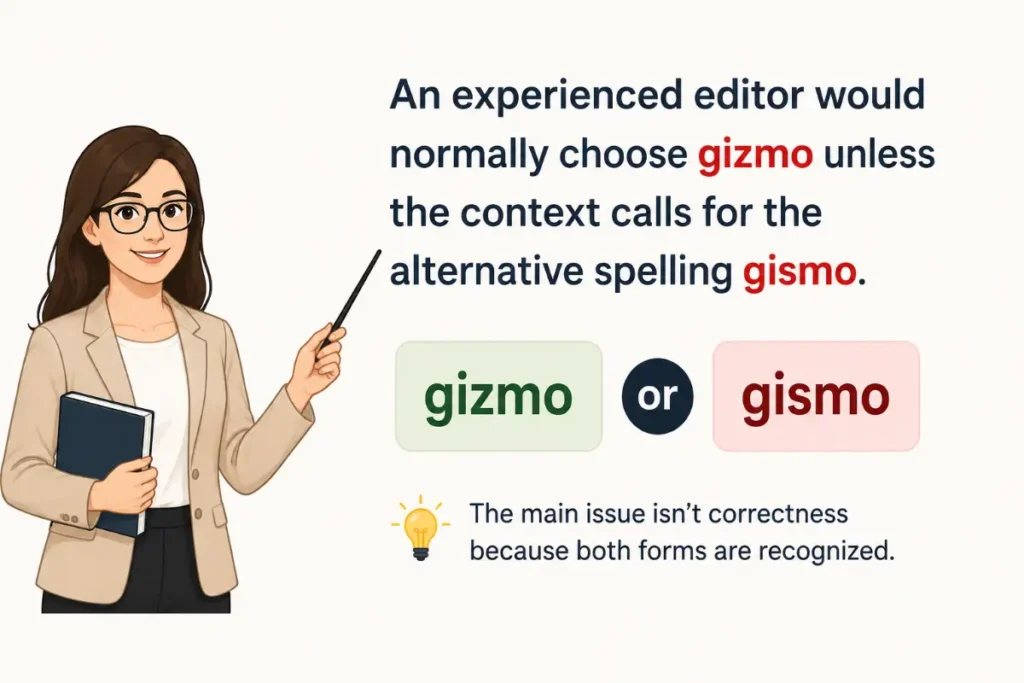
A professional editor would normally keep gizmo in casual or conversational writing and use a precise technical term when the object’s identity affects the meaning. Gismo would not automatically be treated as nonsense because it has established variant usage, but the editor would usually prefer gizmo for contemporary general English. Spellcheckers can help identify unusual spellings, yet they cannot always tell you that a less common variant may sound out of place for a modern audience. Context remains the final test.
Conclusion
gizmo vs gismo has a straightforward practical answer. Gizmo is the standard modern spelling and the form most writers should choose, while gismo survives as a much less common variant. Both forms refer to an informal gadget, device, tool, or unnamed object, and their pronunciation is essentially the same.
The word itself is useful when the exact name of an object is unknown or unimportant. It works naturally in casual conversation and informal writing, but precise terms are usually stronger in technical documents. If you are unsure which spelling to use, choose gizmo. A simple editing habit can help too: remember the z spelling as the familiar modern form and use a specific technical name whenever accuracy matters.
FAQs
Is gizmo the correct spelling?
Yes. Gizmo is the standard modern spelling most readers expect for the informal noun meaning a gadget, device, or unnamed object. Gismo also appears as a documented variant, but it is much less common. For general American English writing, gizmo is the clearest default. If you are writing a formal technical document, a precise term such as device or the actual component name may be better.
Is gismo a misspelling?
Gismo is not simply an invented misspelling. It has appeared as a variant spelling of gizmo and can be found in established English usage. However, it is much less common than gizmo in modern general English. If you want the spelling most readers will recognize immediately, choose gizmo. Calling gismo completely wrong ignores its documented variant status.
What does gizmo mean?
Gizmo is an informal noun for a gadget, device, tool, or object whose exact name is unknown, forgotten, complicated, or unimportant. Someone might call a small electronic device a gizmo without identifying its technical name. The word is useful in casual speech because it lets people refer to an object without stopping to find the precise terminology.
Are gizmo and gismo pronounced the same?
Yes. The two spellings are generally pronounced the same way in English. Gizmo is commonly pronounced /ˈɡɪzmoʊ/, which sounds roughly like GIZ moh. Because the pronunciation does not clearly reveal the spelling, people can easily become unsure about the middle consonant. Learning the written form through repeated exposure is the best way to remember it.
Is gizmo a formal word?
Gizmo is an informal word. It works well in everyday conversation, casual writing, friendly product descriptions, and discussions about gadgets. It is less suitable when exact technical information matters. In a formal report, use the specific name of the object when possible. Device or equipment can also work when the exact name is not necessary.
What is the plural of gizmo?
The plural is gizmos. The word follows the normal English plural pattern by adding s. For example, you can say, The workshop contains several useful gizmos. The same plural pattern would apply to the variant gismo, producing gismos, although the standard modern spelling remains much more familiar.
What is another word for gizmo?
Common alternatives include gadget, device, tool, contraption, thingamajig, thingamabob, and whatchamacallit. The best replacement depends on the context. Gadget is usually the closest neutral alternative. Device works well in formal writing. Thingamajig and whatchamacallit are more playful and can refer to almost any object whose name is unknown or forgotten.
Should I use gizmo in academic writing?
You can use gizmo in academic writing when the informal word itself is relevant, such as when discussing everyday language or quoting someone’s speech. In most academic contexts, however, a precise term is better. If you know the object’s exact name, use it. If you only need a broad reference, device or tool may sound more appropriate than gizmo.
