
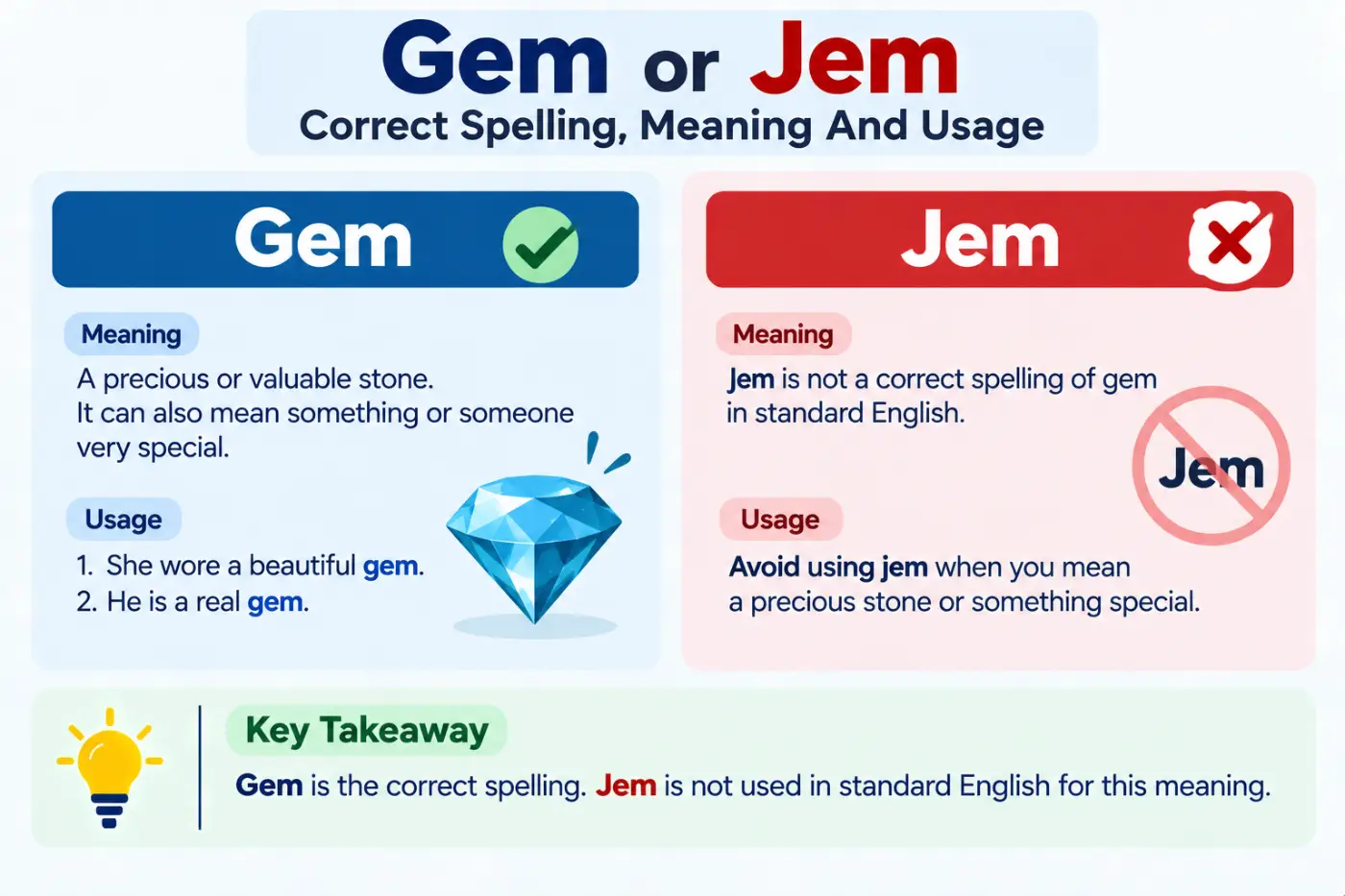
The spelling gem or jem can cause a quick moment of doubt because both forms look as if they could represent the same sound. The standard English spelling is gem. The spelling jem is not the normal spelling of the English noun for a precious stone or something considered especially valuable or excellent.
The confusion is easy to understand. The word is pronounced with the sound /dʒ/ at the beginning. That is the same sound heard in words such as jump and job. English uses both g and j to represent related sounds in different words. Because the pronunciation doesn’t reveal the spelling, someone writing the word from memory may choose the wrong letter.
The good news is that the rule is simple once you connect the word with its meaning and spelling pattern. This guide explains what gem means, how to pronounce it, where it came from, how it works in sentences, and why jem appears in informal writing. You’ll also see natural examples, common spelling mistakes, regional usage, related terms, and an easy memory trick that can help you choose the standard form with confidence.
Quick Definition
Gem is the standard English spelling for a precious or valuable stone and for something or someone considered especially excellent or valuable. Jem is not the standard spelling of this common noun. Cambridge lists gem as a noun pronounced /dʒem/ in both US and UK English.
Quick Answer
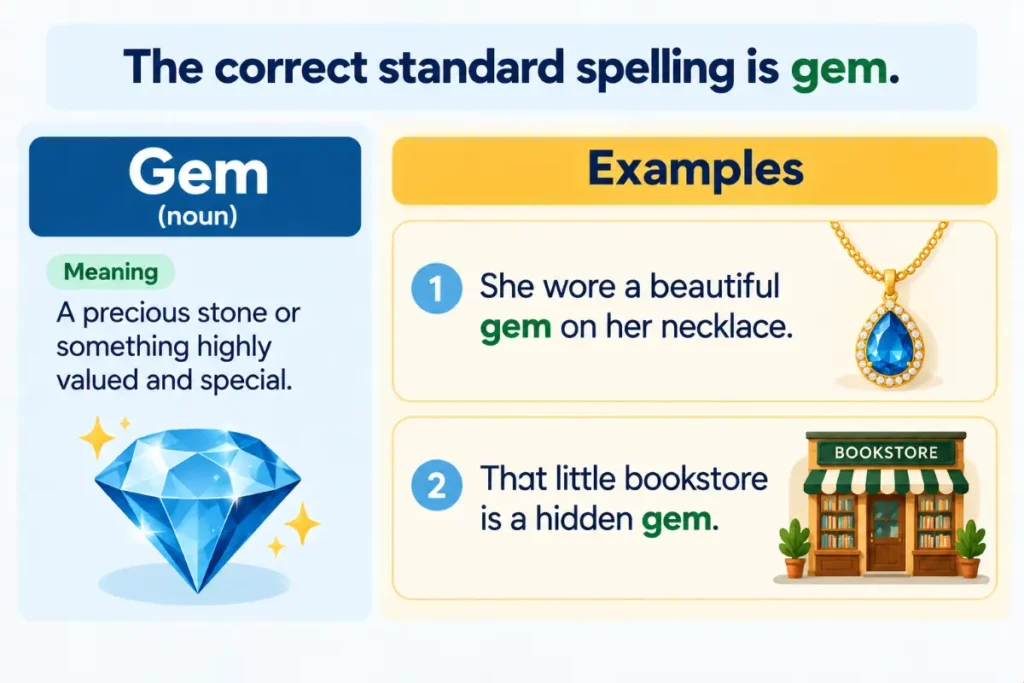
The correct standard spelling is gem. Gem is a noun that can mean a precious stone or something highly valued and special. For example, you can say, She wore a beautiful gem on her necklace, or, That little bookstore is a hidden gem.
Jem is not the standard spelling of this English word. You may see it as a name, username, brand element, or other proper label, but those special uses do not change the standard spelling of the common noun.
Comparison Table
| Form | Meaning | Part of Speech | Origin | Usage Frequency | Formality | Common Contexts | Example |
|---|---|---|---|---|---|---|---|
| Gem | A precious stone or a person or thing of exceptional value or quality | Noun | From Old French and Latin word history connected with precious stones | Very common | Neutral | Jewelry, writing, conversation, reviews, literature | The ring contains a rare gem. |
| Jem | No standard meaning as the common English noun for a precious stone | Usually a proper name or nonstandard spelling in this context | Used in names and other special contexts | Much less common as an ordinary English word | Depends on the special use | Names, usernames, brands, informal spelling errors | Jem may appear as a personal name. |
Meaning And Definition
Meaning Of Gem
Gem has a clear and established place in standard English. Its most direct meaning is a precious or valuable stone, especially one that has been cut and prepared for use in jewelry.
A diamond can be a gem. So can a ruby, sapphire, emerald, or another valuable stone.
For example:
The necklace has a blue gem in the center.
Here the word refers to a physical stone.
The word also has a broader figurative meaning. A person, place, object, idea, book, movie, or experience can be called a gem when it is unusually good, useful, beautiful, or valuable.
For example:
That small restaurant is a gem.
The speaker isn’t saying the restaurant contains a precious stone. The word is being used metaphorically to praise the restaurant.
Cambridge gives both the precious stone meaning and the figurative meaning for someone or something that is very good, pleasing, or useful.
This figurative use is extremely natural in American English.
You might call a helpful coworker a gem. You might describe a quiet beach as a hidden gem.
The central idea stays the same. Something described as a gem has special value.
Meaning Of Jem
Jem is not the standard spelling of the ordinary English noun meaning a precious stone.
If someone writes:
She bought a beautiful jem.
The standard correction is:
She bought a beautiful gem.
However, jem can appear in other situations. It may be part of a person’s name, a username, a business name, a fictional character’s name, or a specialized label. A proper name does not need to follow the spelling of an ordinary dictionary word.
This distinction matters. You shouldn’t automatically change every occurrence of Jem to gem if the word is being used as a name.
For example:
Jem is my cousin’s nickname.
In that sentence, Jem can function as a name. It isn’t being used to mean a precious stone.
The surrounding context therefore matters. In ordinary vocabulary, though, the standard spelling for the stone and figurative meaning is gem.
Key Differences Explained
- Spelling. The standard English word is gem. It uses g rather than j.
- Meaning. Gem can mean a precious stone or something highly valued. Jem does not normally carry those meanings as a standard English noun.
- Grammar. Gem is primarily a countable noun. You can say a gem or several gems.
- Pronunciation. Gem is pronounced /dʒem/. The opening sound is the same sound represented by j in many English words.
- Formality. Gem is suitable for casual conversation, professional writing, academic prose, journalism, and creative writing.
- Context. Gem can describe physical stones as well as people, places, objects, ideas, and experiences.
- Regional usage. The standard spelling remains gem across major English varieties.
- Standard usage. Jem should not replace gem in ordinary English writing simply because the two spellings can represent a similar sound.
The main trap is pronunciation. When you hear the word, you hear /dʒem/. You don’t hear the letter g. That means you need to remember the written form separately from the sound.
Which Spelling Is Correct?
Gem is the standard spelling.
This is supported by established English dictionary usage. Cambridge lists gem as a noun with the meanings of a precious stone and a person or thing that is especially good or valuable. It also gives the pronunciation /dʒem/ for both US and UK English.
The spelling can feel surprising because the letter g sometimes has a hard sound and sometimes has a soft sound. In gem, the g has the soft sound /dʒ/.
You can see a similar pattern in words such as general, giant, gentle, and giant.
That doesn’t mean every word with a similar sound uses g. English spelling developed over a long period and contains many different spelling patterns. So pronunciation alone isn’t enough to predict the written form.
The safest approach is to learn gem as a complete word.
Why The Spelling Causes Confusion
The main reason is the first sound.
Gem begins with /dʒ/. This is often called the voiced postalveolar affricate in phonetics. You don’t need the technical name to spell the word, but understanding the sound helps explain the problem.
The same sound can appear with different spellings.
For example:
- Job.
- Jump.
- Judge.
- Giant.
- Gem.
Some use j. Some use g. English spelling doesn’t give you one universal rule for every word with this sound.
Another source of confusion is typing. If you are writing quickly and thinking about the sound rather than the letters, you might naturally reach for j because j is strongly associated with the sound at the beginning.
This is a classic example of sound based spelling. The writer knows the word but chooses letters that seem to match the pronunciation.
That doesn’t mean the person doesn’t understand the word. It simply means the spelling pattern hasn’t been stored strongly enough in memory.
Sentence Examples
Here are natural examples showing the standard form in different situations.
- She wore a beautiful gem on her necklace.
- The museum displayed a rare blue gem from the region.
- That little bookstore is a hidden gem.
- Your grandmother sounds like a real gem.
- I found a gem of a restaurant near the park.
- The article contains a gem of useful advice.
- This old photograph is a real gem.
- The designer placed a small green gem in the center of the ring.
- We discovered a quiet beach that turned out to be a hidden gem.
- His kindness makes him a gem of a friend.
Here are examples showing the common nonstandard spelling as an error.
- She bought a beautiful jem.
- The ring contains a blue jem.
- We found a hidden jem downtown.
- That restaurant is a real jem.
- He gave her a small jem as a gift.
In standard English, each occurrence should be changed to gem when the intended meaning is a precious stone or something especially valuable.
Common Mistakes And Misspellings
Writing Jem Instead Of Gem
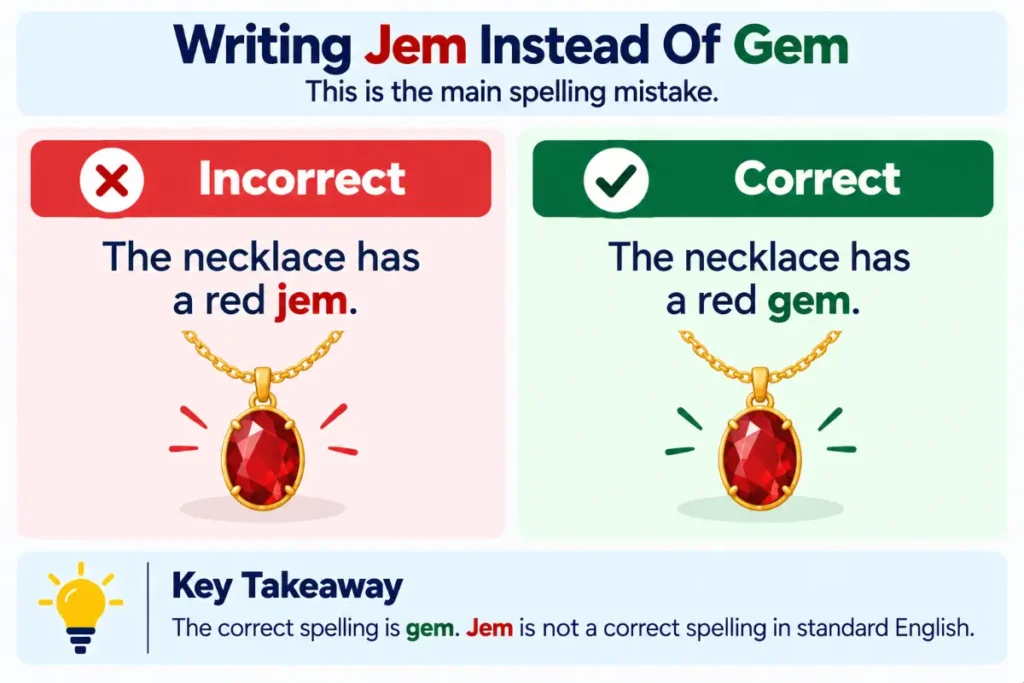
This is the main spelling mistake.
Incorrect:
The necklace has a red jem.
Correct:
The necklace has a red gem.
The mistake usually comes from matching the spelling to the initial sound.
Writing Gemm
Some writers may add an extra m because words from related language families sometimes contain doubled consonants. In ordinary American English, the standard noun is gem.
Writing Jemm
This combines two spelling patterns and produces a form that isn’t standard for the common noun.
Confusing Gem With Germ
The words look somewhat similar but have completely different meanings and pronunciations.
Gem refers to a precious stone or something excellent.
Germ can refer to a microorganism or the beginning of an idea or process.
Confusing Gem With Gym
Gym is pronounced /dʒɪm/ while gem is pronounced /dʒem/. The vowel sound changes the word and its meaning.
These mistakes show why spelling should be learned through both sound and visual form. Pronunciation helps you recognize a word while spelling helps you reproduce it accurately.
Pronunciation Guide
Gem is pronounced /dʒem/ in both American and British English according to Cambridge.
It has one syllable.
You can think of the pronunciation as:
JEM
The initial sound is /dʒ/. It is the sound at the beginning of jump, job, and judge.
The middle vowel is /e/, similar to the vowel sound in bed and head.
The final sound is /m/.
Put them together and you get:
j + em = gem
The word is short and usually pronounced clearly without any silent letters.
One useful point for learners is that the pronunciation doesn’t tell you to use g. The sound /dʒ/ can have several spellings in English. That is why you should remember the visual form as well.
Cambridge provides the same basic pronunciation for US and UK English.
Etymology And Word Origin
Gem has a long history. The English word came through French from Latin gemma, a word associated with a precious stone or jewel.
The historical path helps explain why the word has such a strong connection with value and beauty.
Over time, English speakers extended the physical meaning into figurative language. A person or thing that was considered unusually valuable could also be called a gem.
That figurative meaning is now completely natural in modern English.
When someone says:
She’s a gem.
They aren’t talking about jewelry. They are praising the person’s character or value.
Likewise:
That book is a gem.
The speaker means the book is especially good or valuable.
This kind of metaphor is common in English. Physical objects often provide the language we use to describe abstract qualities. A gem is rare, attractive, and valuable, so it makes sense that English speakers began using the word for people and things they value highly.
Regional Usage
American English
Gem is the standard spelling in American English. It is used for precious stones and for people or things considered especially good or valuable.
The figurative expression hidden gem is also very natural in American English. People use it for lesser known restaurants, books, travel destinations, stores, songs, websites, and other discoveries.
For example:
We found a hidden gem in the middle of the city.
British English
British English also uses gem as the standard spelling. The core meanings remain the same.
British writing may use the word for jewelry and in figurative expressions such as a little gem or a real gem.
There is no major British spelling change that turns gem into jem.
Australian English
Australian English follows the same standard spelling. Gem can describe a precious stone as well as something especially good or valuable.
The spelling difference sometimes seen in informal writing is not a recognized regional variant.
Canadian English
Canadian English also uses gem as the standard spelling. Writers use it in ordinary conversation, journalism, education, business communication, and creative writing.
The main distinction remains the same. Gem is the standard common noun while Jem may be used as a name or special label.
Grammar Rules And Part Of Speech
Gem is primarily a countable noun.
That means you can use it with singular and plural forms.
Singular:
She found a gem.
Plural:
She found several gems.
You can also use gem with articles.
I bought a gem.
The gem was beautiful.
You can use possessive forms too.
Her gem was stolen.
The museum’s gem attracted many visitors.
Gem can also appear in metaphorical expressions.
He is a gem.
That little shop is a gem.
The article contains a gem of an idea.
The expression gem of an idea is especially useful because it combines the literal idea of value with an abstract concept.
Gem can appear after adjectives.
A rare gem.
A precious gem.
A beautiful gem.
A hidden gem.
A valuable gem.
A small gem.
In figurative use, you might write:
A brilliant gem of a book.
A real gem of a person.
The grammar is straightforward. The main challenge is spelling rather than sentence structure.
Formal And Informal Usage
Gem works comfortably across different levels of English.
In formal writing, it can describe a valuable object or a noteworthy discovery.
For example:
The collection contains several rare gems.
In casual conversation, the figurative meaning is common.
Your sister is a gem.
The word can also appear in reviews and recommendations.
That small restaurant is a hidden gem.
The expression sounds friendly and natural because it communicates strong praise without sounding exaggerated.
In academic writing, gem is more likely to have its literal meaning unless the writer is using a metaphor intentionally.
For example:
The excavation revealed several gems among the artifacts.
A scholarly writer would usually choose more precise language when discussing technical subjects. Still, the word itself is not informal.
Real Life Usage Examples
Daily Conversation
That little café is a hidden gem.
Your neighbor is a real gem. She helped us when the car broke down.
The first sentence praises a place. The second praises a person.
Email And Workplace Communication
We found a gem of an idea during yesterday’s meeting.
The new employee has been a gem and has helped the team settle into the new system.
These uses are friendly and natural, especially in less formal workplace communication.
Academic Writing
The collection contains several valuable gems that illustrate the region’s artistic history.
The archive includes a number of rare gems that provide useful evidence for researchers.
In academic writing, the literal meaning is often more common, but the figurative meaning can work in carefully chosen contexts.
News And Journalism
Local residents say the small theater is a hidden gem.
The exhibition includes several gems from the artist’s private collection.
Journalists often use the word to make descriptions more vivid and accessible.
Literature And Storytelling
She wore a silver necklace with a deep blue gem at its center.
To him, the old house was a gem hidden behind the trees.
The word works well in descriptive writing because it naturally suggests beauty, rarity, and value.
Related And Confused Terms
Jewel
Jewel is a close synonym when referring to a precious stone or valuable ornament. It can also have a figurative meaning.
Gemstone
Gemstone specifically refers to a stone used or valued as a jewel. It is often more precise than gem when discussing minerals and jewelry.
Diamond
A diamond is a specific type of gemstone. Not every gem is a diamond.
Ruby
Ruby is another specific gemstone. It is known for its rich red color in many common examples.
Sapphire
Sapphire is a gemstone associated especially with blue varieties, although sapphires can occur in other colors.
Emerald
Emerald is a green variety of the mineral beryl and is widely recognized as a precious gemstone.
Treasure
Treasure is broader than gem. It can refer to valuable objects, money, resources, or something deeply valued.
Hidden Gem
Hidden gem is an idiomatic expression for something excellent that isn’t widely known.
The phrase is common in travel writing, restaurant reviews, entertainment, and everyday conversation. Cambridge also gives hidden gem as an example of the figurative meaning.
Gem As A Figurative Expression
One of the most useful things to understand about gem is that English speakers don’t use it only for jewelry.
Consider these examples.
That book is a gem.
This little park is a hidden gem.
She’s an absolute gem.
The phrase changes depending on context, but the underlying idea stays stable. Something has qualities that make it unusually valuable.
Calling a person a gem is usually a compliment. It can suggest kindness, reliability, talent, or another quality the speaker appreciates.
Calling a place a hidden gem suggests that it deserves more attention than it currently receives.
Calling an idea a gem suggests that the idea is especially useful or clever.
This makes gem a flexible word with strong positive meaning.
Gem In Common Expressions
Several expressions use gem naturally.
Hidden Gem
A hidden gem is something excellent that isn’t widely known.
That small bookstore is a hidden gem.
A Real Gem
A real gem is someone or something that is especially good or valuable.
Your assistant is a real gem.
A Gem Of An Idea
This expression praises an idea.
That’s a gem of an idea.
Gem Of A Person
This describes someone who is kind, helpful, or highly valued.
She is a gem of a person.
Gem In The Rough
This expression describes something or someone with strong potential that hasn’t yet been fully developed or recognized.
The young artist is a gem in the rough.
These expressions show how easily the literal meaning of a valuable stone extends into everyday metaphor.
Why Jem Appears In Writing
Jem appears for several reasons.
The first is simple spelling confusion. People sometimes hear the /dʒ/ sound and associate it with j.
The second is proper names. Jem can be used as a person’s name or nickname. When a reader sees the word with a capital letter, it may be functioning as a name rather than the common noun.
The third is creative naming. Businesses, products, usernames, fictional characters, and online identities sometimes use unusual spellings.
The fourth is typing behavior. Fast writing encourages people to spell words according to sound. This is especially common with short words because writers often move quickly through them.
None of these reasons changes the standard spelling of the common noun.
Expert Editor Insight
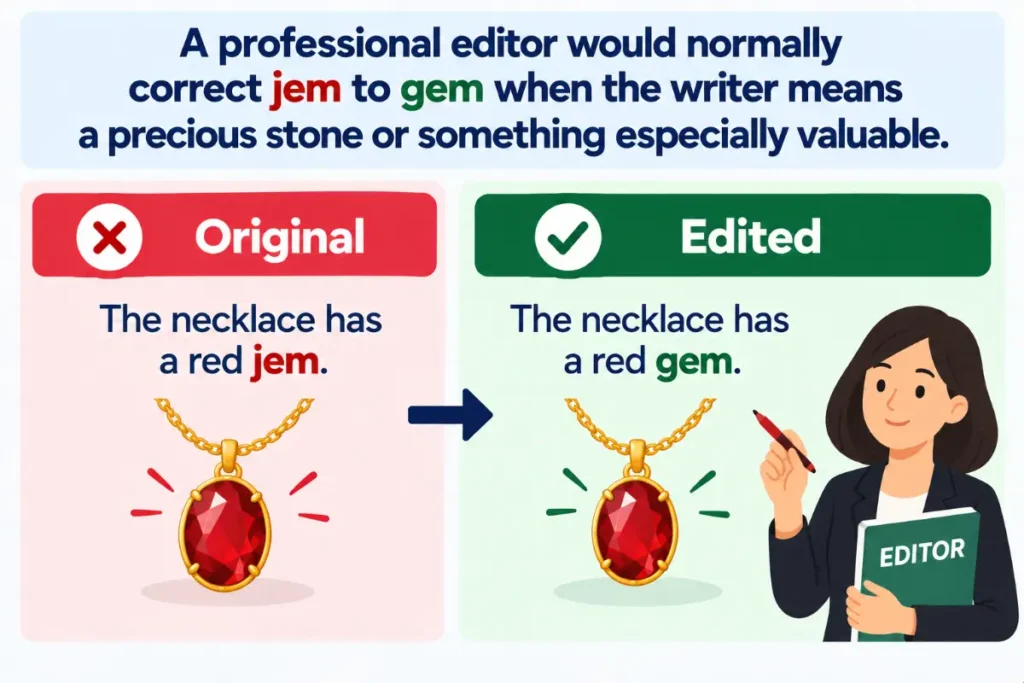
A professional editor would normally correct jem to gem when the writer means a precious stone or something especially valuable. The mistake is easy to understand because the opening sound is /dʒ/ and English represents that sound with both g and j in different words. Spelling tools usually recognize gem as the standard dictionary form, but context still matters because Jem may be a proper name. The best editing habit is to check the meaning first and the capitalization second. If the word describes a valuable stone or something excellent, gem is the standard choice.
Conclusion
The answer to gem or jem is straightforward. Gem is the standard English spelling for a precious stone and for something or someone considered especially valuable or excellent. Jem is not the standard spelling for these meanings, although it can appear as a personal name, nickname, username, or other special label.
The spelling can feel confusing because gem begins with the /dʒ/ sound that English often represents with the letter j. Still, pronunciation doesn’t determine the spelling in every English word. The safest approach is to remember the complete written form rather than spelling the word from sound.
A useful editing trick is to connect gem with gemstone and jewel. If you’re talking about a precious stone or something valuable, choose gem. That small connection makes the correct spelling much easier to remember.
FAQs
Is jem a correct spelling?
Jem is not the standard spelling of the common English noun for a precious stone. The standard form is gem. However, Jem can appear as a personal name, nickname, username, fictional name, or other special label. If you mean a gemstone or something especially valuable, use gem in standard English writing.
What does gem mean?
Gem has two main everyday meanings. It can refer to a precious or valuable stone used in jewelry. It can also describe a person or thing that is especially good, useful, beautiful, or valuable. For example, a diamond can be a gem, and a kind person can also be called a gem.
Why is gem spelled with g instead of j?
The spelling comes from the established history of the English word rather than from a simple sound based rule. Gem begins with the sound /dʒ/, which can be represented by different letters in English. Words such as job and jump use j, while gem uses g. Pronunciation alone therefore doesn’t determine the spelling.
How do you pronounce gem?
Gem is pronounced /dʒem/ in standard American and British English. It has one syllable and sounds like jem when spoken. The first sound is the same sound heard in jump and job. The important difference appears in writing. The standard spelling uses g even though the initial sound resembles the sound commonly associated with j.
Is gem a noun?
Yes. Gem is primarily a countable noun. You can say a gem for one item and gems for more than one. It can refer to a precious stone or something considered especially valuable. Examples include a rare gem, several gems, a hidden gem, and a real gem.
What is a synonym for gem?
Depending on the meaning, useful alternatives include jewel, gemstone, treasure, beauty, and prize. Jewel and gemstone work best for the literal meaning involving a valuable stone. Treasure can work for something highly valued. In figurative language, words such as beauty or prize may sometimes fit, but the exact choice depends on context.
Is hidden gem correct English?
Yes. Hidden gem is a natural English expression. It describes something excellent that isn’t widely known or noticed. People commonly use it for restaurants, stores, travel destinations, books, movies, parks, and other discoveries. For example, That small café is a hidden gem means the speaker thinks the café is unusually good despite being relatively unknown.
Can gem describe a person?
Yes. Gem can describe someone you value highly because of their kindness, usefulness, character, or another positive quality. Saying She is a gem is a warm compliment. It does not mean the person is literally a gemstone. The expression uses the value and beauty associated with a precious stone as a metaphor for a person’s qualities.
