
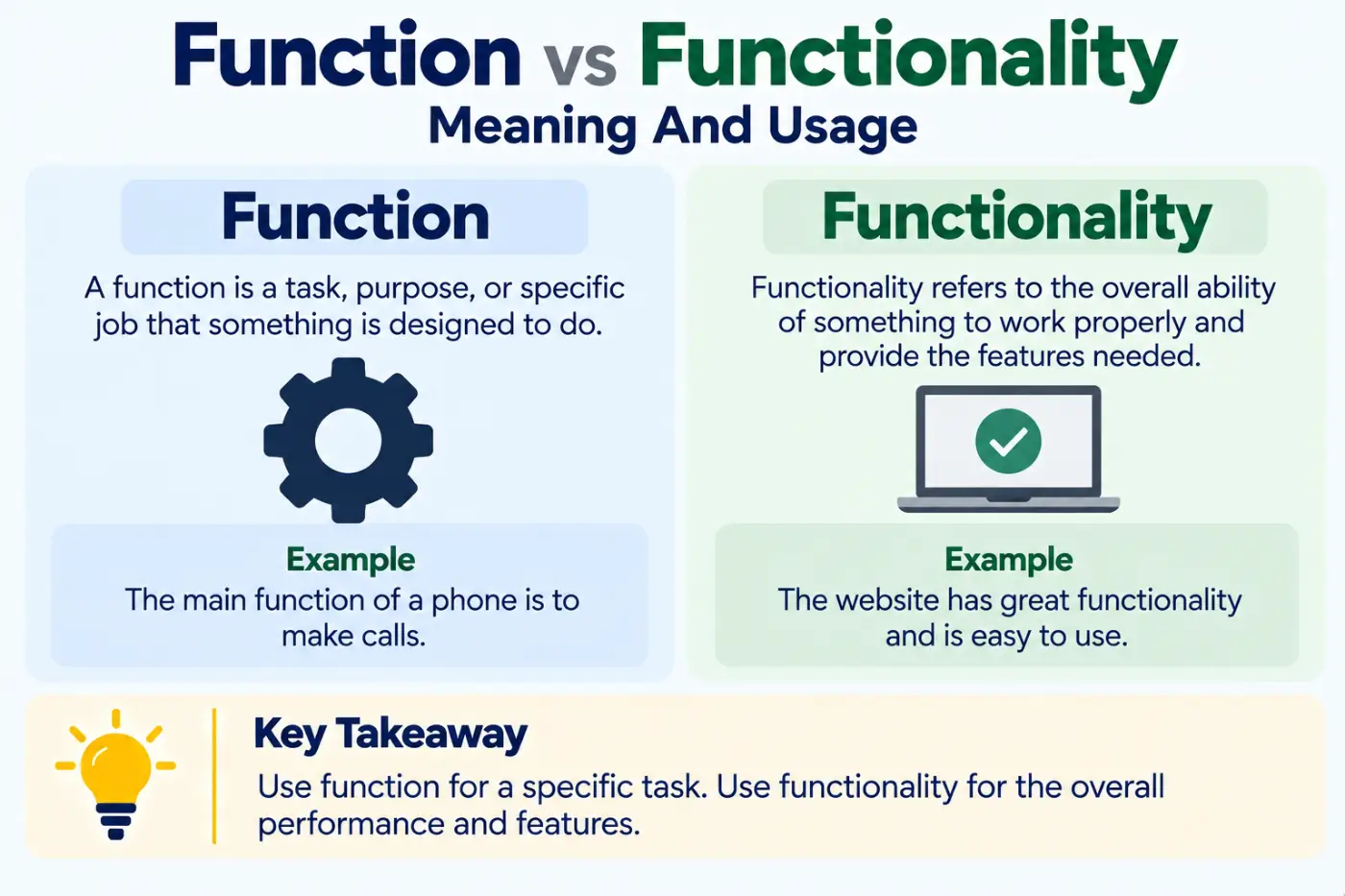
The difference between function vs functionality can seem small because the two words come from the same word family. They are both correct English words but they don’t mean exactly the same thing. Function usually describes what something does or the purpose it serves while functionality usually describes the range of things a system product or tool can do.
This distinction becomes especially useful in technology business writing product reviews engineering and everyday conversation. You might say that the function of a button is to save a file. You might then discuss the functionality of the entire application and describe everything users can do with it. The first word focuses on a specific purpose or action. The second focuses more broadly on available capabilities.
The difference can feel subtle because the words overlap in many contexts. Still, choosing the right one can make your writing more precise. This guide explains their meanings grammar pronunciation word history common mistakes regional usage and real examples. You’ll also learn when a simple word such as purpose or feature may sound more natural.
Quick Definition
Function usually means the purpose or job of something or an activity that something performs. Functionality usually means the set or range of capabilities that a system product or tool provides. In simple terms, a function is what something does while functionality describes what it is capable of doing overall.
Quick Answer
Function and functionality are both correct words. They are not interchangeable in every sentence.
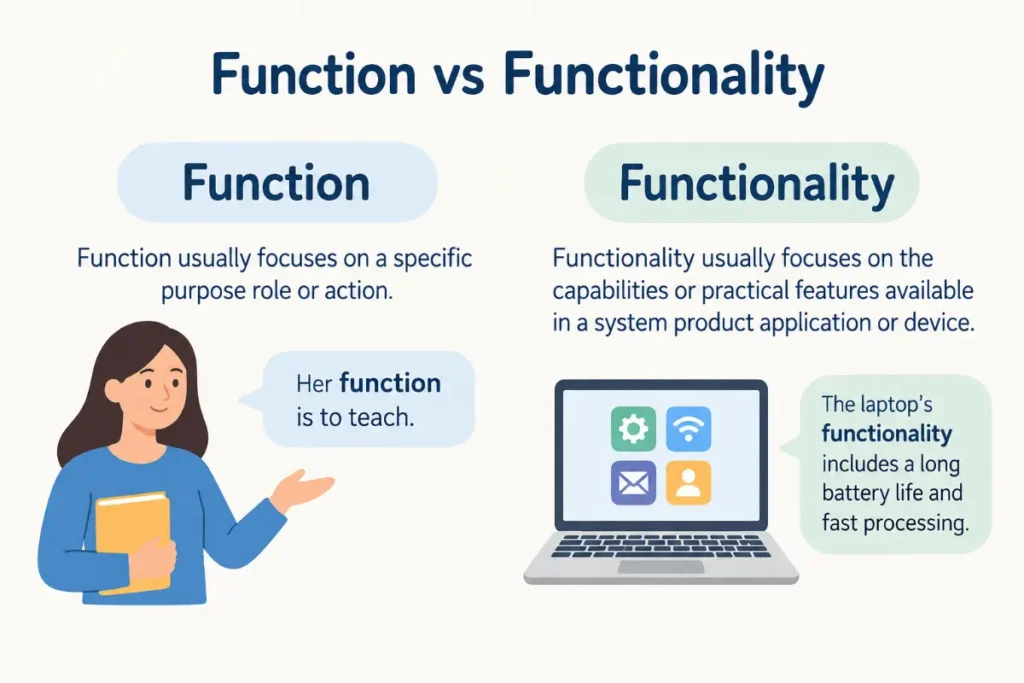
Function usually focuses on a specific purpose role or action.
Functionality usually focuses on the capabilities or practical features available in a system product application or device.
For example:
The function of this button is to save the document.
The software has enough functionality for small businesses.
The first sentence describes one specific job. The second describes the broader set of capabilities offered by the software.
Comparison Table Function Vs Functionality
| Form | Meaning | Part of Speech | Origin | Usage Frequency | Formality | Common Contexts | Example |
|---|---|---|---|---|---|---|---|
| Function | The purpose role or action performed by something | Noun and verb | Latin through Old French and Middle English | Very common | Neutral and formal | Everyday English science technology business grammar | The main function of the filter is to remove dust. |
| Functionality | The range or quality of functions available in a system or product | Noun | Derived from function with the suffix ity | Common especially in technical contexts | Neutral and professional | Software products engineering technology design | The new functionality lets users export reports. |
The biggest distinction is scope. Function can refer to one specific job or purpose. Functionality often refers to several capabilities considered together.
Meaning And Definition
Meaning Of Function
Function has a broad meaning in English. At its core it describes what something does or the role it serves.
Consider this example:
The function of a refrigerator is to keep food cold.
Here function means purpose or job. The refrigerator has a particular role and the sentence explains that role.
The word can also describe the way something operates.
The heart has an essential function in the human body.
In mathematics function has a more specialized meaning. A mathematical function describes a relationship between values where each input is associated with a particular output.
In programming function has another specialized meaning. A function is a reusable section of code designed to perform a particular task.
For example:
The function calculates the total price.
Here the word refers to a specific operation performed by code.
Function can also be a verb.
This machine no longer functions properly.
In this sentence it means works or operates.
The word therefore has a wide semantic range. Its exact meaning depends on context.
Meaning Of Functionality
Functionality refers to the capabilities or functions available in a system product application device or service.
Imagine a photo editing application. Its functionality might include cropping images adjusting brightness removing backgrounds adding text and exporting files.
The word describes the overall set of things the product allows users to do.
For example:
The new version adds functionality for automatic backups.
This means the software now has an added capability that lets users perform automatic backups.
Functionality is especially common in technology and product discussions. Developers may talk about adding functionality. Product teams may discuss improving functionality. Reviewers may describe the functionality of an application.
The word can also refer to how well a system’s features work together in practice.
For example:
The website has useful functionality but the interface is difficult to navigate.
Here functionality refers to the practical capabilities available on the website.
The Core Difference
The easiest way to separate the two words is to think about one capability versus a broader set of capabilities.
- Function describes a job or purpose. It answers the question What does this thing do?
- Functionality describes available capabilities. It answers the question What can this system or product do?
- Function can describe one action. The function of the button is to submit the form.
- Functionality often describes several related capabilities. The application has functionality for payments scheduling and reporting.
- Function has many general meanings. It appears in everyday English science mathematics biology technology and programming.
- Functionality has a narrower modern use. It appears especially often when people discuss software products websites devices and technical systems.
A useful comparison is a kitchen appliance.
The function of a blender is to mix or process ingredients.
The functionality of a modern blender may include several speed settings a pulse mode automatic programs and safety controls.
One word points toward a purpose. The other describes the available capabilities.
How The Words Work In Technology
Technology is one area where the distinction becomes especially clear.
A software application can have many individual functions.
A search function lets users find information.
A login function allows users to access an account.
An export function lets users save information in another format.
Taken together these capabilities contribute to the application’s overall functionality.
This is why technical writers often use functionality when discussing a product at a broader level.
For example:
The application provides functionality for team collaboration.
That statement doesn’t necessarily identify one specific action. It describes a broader capability area.
Compare it with:
The application has a function that sends notifications when a task changes.
Now the writer is talking about a particular operation.
This difference is useful when writing software documentation because readers need to know if you’re describing one specific behavior or a broader group of capabilities.
Function In Everyday English
Function is not limited to technical writing. Native speakers use it in many ordinary contexts.
You might say:
The main function of a thermostat is to control temperature.
The function of a lock is to keep a door secure.
The function of a handle is to make the object easier to carry.
In each example function means purpose or job.
It can also describe someone’s role in a group.
Her function on the team is to coordinate the schedule.
Here function means the role that person performs.
The word can also describe an event in formal English.
The school held a formal function for graduating students.
In this context function means an organized social event. This meaning is separate from the purpose meaning.
Functionality In Everyday Product Language
Functionality is more common when people evaluate products or systems.
A customer might say:
This phone has excellent camera functionality.
A software reviewer might write:
The app offers useful functionality for managing large files.
A website designer might say:
We need better search functionality.
In these examples functionality refers to practical capabilities.
The word can sound more technical than simpler alternatives such as features or capabilities. That isn’t necessarily a problem. In technical and professional writing it can be exactly the right term.
Still, good writers avoid using it simply because it sounds sophisticated.
Instead of:
The application provides functionality for changing your password.
You could write:
The application lets you change your password.
The second sentence is shorter and more direct. In user facing writing that version may be better.
Function And Functionality In Grammar
Function can be both a noun and a verb.
As a noun:
The main function of this switch is to control the lights.
As a verb:
The system functions normally after the update.
Functionality is a noun.
The new functionality improves the search experience.
You cannot normally use functionality as a direct replacement for the verb function.
For example:
The system functionalities correctly.
That is incorrect.
You would say:
The system functions correctly.
Functionality can appear with words such as new additional advanced basic limited useful and core.
Examples include:
The update adds new functionality.
The device offers limited functionality.
The software provides advanced functionality.
The platform includes useful functionality for teams.
Function commonly appears in patterns such as:
The function of something is to do something.
Something functions as something.
Something functions properly.
Functionality commonly appears in patterns such as:
The functionality of something.
Something provides functionality.
Something offers functionality.
Which Word Should You Choose?
Choose function when you’re talking about a specific purpose role or operation.
Choose functionality when you’re describing the broader capabilities offered by a system product or tool.
Ask yourself one simple question.
Am I describing one specific job or the broader set of capabilities?
If you’re describing one job use function.
If you’re describing a collection or range of capabilities use functionality.
For example:
The function of the button is to start the machine.
The machine offers several safety functionality options.
The second sentence sounds less natural because functionality is often used as an uncountable noun. A better version would be:
The machine offers several safety features.
Or:
The machine includes several safety functions.
This illustrates another important point. The difference is not only about meaning. Natural collocation matters too.
Natural Collocations
Collocations are words that commonly appear together. Learning them can help you choose the natural expression.
Common combinations with function include:
- Main function.
- Primary function.
- Basic function.
- Essential function.
- Biological function.
- Mathematical function.
- Programming function.
- Social function.
Common combinations with functionality include:
- New functionality.
- Additional functionality.
- Advanced functionality.
- Core functionality.
- Search functionality.
- Payment functionality.
- Accessibility functionality.
- Security functionality.
These patterns aren’t strict grammar rules. They reflect common ways English speakers describe purposes and capabilities.
Sentence Examples
Here are natural examples showing how the two terms work in different settings.
- The main function of the button is to save your work.
- This software provides functionality for creating detailed reports.
- The function of the filter is to remove unwanted particles.
- The latest update adds functionality for automatic backups.
- One important function of the operating system is managing computer resources.
- The website needs better search functionality.
- The function of this switch is to control the fan.
- The application has enough functionality for most small businesses.
- The kidneys perform an essential function in the human body.
- The new device offers improved functionality without adding much complexity.
These examples show why replacing one word with the other can change the meaning or make the sentence sound unnatural.
Common Mistakes
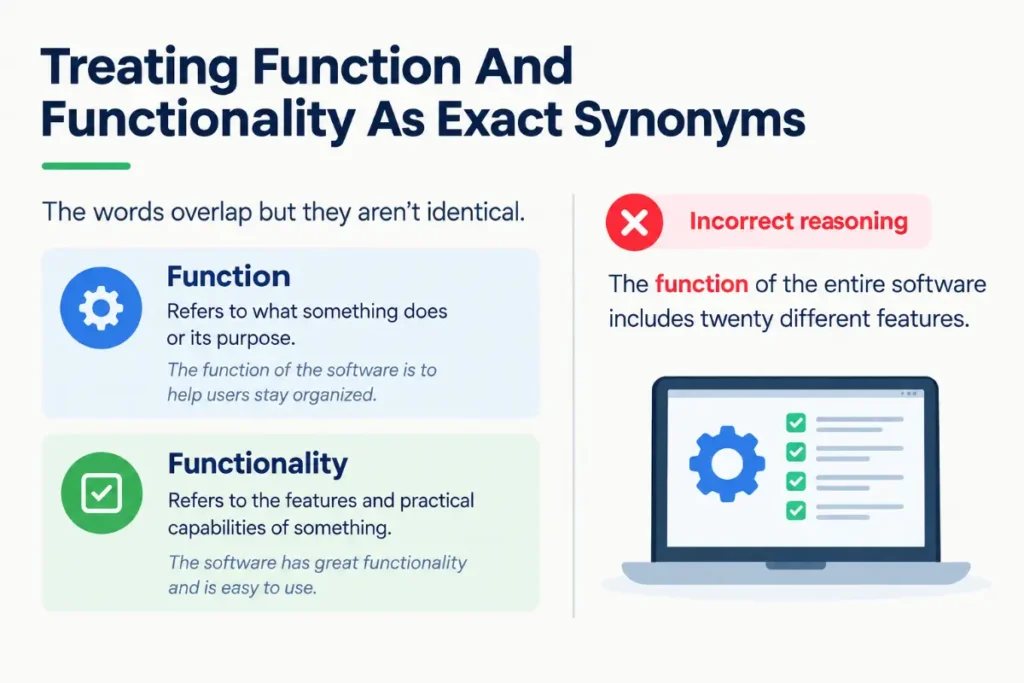
Treating Function And Functionality As Exact Synonyms
The words overlap but they aren’t identical.
Incorrect reasoning:
The function of the entire software includes twenty different features.
A clearer version might be:
The software has twenty functions.
Or:
The software provides a wide range of functionality.
Using Functionality As A Countable Noun
Functionality is generally treated as an uncountable noun when it means a collection of capabilities.
This can make phrases such as functionalities sound awkward in ordinary technical English.
Instead of:
The product has five functionalities.
Try:
The product has five functions.
Or:
The product offers five key features.
Using Function When You Mean Features
Consider:
The new version adds three functions.
This can be correct if the three items are actual operations. If you’re talking about broader product capabilities the word features may sound more natural.
Overusing Functionality In Plain Writing
Functionality can become unnecessary technical language.
Instead of:
The website has functionality that allows users to contact support.
Write:
The website lets users contact support.
The second sentence gives the same practical information with fewer words.
Confusing Function With Functional
Function is a noun or verb. Functional is an adjective.
The function of the tool is simple.
The tool is functional.
Functionality is the noun form describing available capabilities.
These related forms should not be treated as interchangeable.
Pronunciation Guide
Function is commonly pronounced /ˈfʌŋkʃən/ in American English.
A simple pronunciation guide is:
FUNK shun.
The first syllable receives the main stress.
Functionality is commonly pronounced /ˌfʌŋkʃəˈnæləti/.
A simple guide is:
funk shuh NAL uh tee.
The strongest stress falls on the syllable that sounds like nal.
One common mistake is to pronounce every letter as if it has a separate strong sound. Natural English reduces unstressed vowels, so the middle of functionality often sounds much softer than its spelling suggests.
If you’re learning the terms for professional communication, focus on rhythm rather than trying to pronounce every letter equally.
Etymology And Word Origin
Function comes from Latin functio, which is connected to the idea of performing or carrying out something. The word entered English through French and developed into the broad modern meanings associated with purpose role operation and performance.
Functionality is a later formation built from function with the suffix ity. The suffix turns an adjective or related concept into a noun describing a state quality or condition.
The relationship is therefore straightforward.
Function refers to what something does or the role it performs.
Functionality develops that idea into the broader concept of available functions or practical capabilities.
The historical connection explains why the two words look and sound so similar. They belong to the same word family but have developed different uses.
Regional Usage
American English
Both words are standard in American English. Function is extremely common across general English while functionality appears more often in technology product design software and professional discussions.
American writers often replace functionality with simpler terms such as features or capabilities when writing for a general audience.
British English
British English uses the same basic distinction. Function commonly refers to purpose role or operation while functionality can describe the capabilities of a product or system.
There is no major British spelling difference between these words.
Australian English
Australian English follows the same general pattern. Both terms are standard and their meanings remain closely aligned with broader international English usage.
Technology and business writing may use functionality frequently while ordinary conversation often favors simpler terms.
Canadian English
Canadian English also uses both words in their standard senses. Function remains the more general word while functionality is especially useful when describing software products technical systems and product capabilities.
There is no major Canadian variation that changes the core distinction.
Formal And Informal Usage
Function is comfortable in almost every level of English. You can use it in a casual conversation about a household object or in a technical paper about mathematics.
Functionality has a more specialized feel. It appears naturally in product documentation business writing software development and technical communication.
That does not mean functionality is always more formal. It simply belongs more strongly to certain contexts.
For example:
What does this button do?
This is natural everyday English.
What is the function of this button?
This sounds more formal but remains clear.
What functionality does this application provide?
This sounds technical and is likely to appear in product or software discussions.
All three sentences can be appropriate. The audience and context should guide the choice.
Function Versus Feature
Feature is one of the most useful related words because writers sometimes use it instead of functionality.
A feature is usually a particular element or capability offered by a product.
For example:
The phone has a night mode feature.
Functionality is broader.
The phone has useful photography functionality.
You can think of the relationship this way.
A feature can be one specific capability.
Functionality can describe the collection of capabilities available.
Function can describe the specific job performed by one element.
These meanings overlap enough that context matters.
Function Versus Capability
Capability means the ability to do something.
The machine has the capability to process large files.
Function can describe the actual role or operation.
The function of the machine is to process large files.
Functionality can describe the set of capabilities.
The machine provides file processing functionality.
These sentences are related but each word highlights something slightly different.
Capability focuses on ability.
Function focuses on purpose or operation.
Functionality focuses on available capabilities as part of a system or product.
Function Versus Purpose
Purpose is often the simplest word in general writing.
The purpose of the button is to submit the form.
The function of the button is to submit the form.
Both sentences work. Purpose focuses on intended use. Function can focus more directly on the role or operation.
For general audiences, purpose may sound more natural.
For technical audiences, function may provide more precise language.
Function Versus Operation
Operation describes the way something works or the process of working.
The machine operates automatically.
The function of the machine is to sort packages.
The two concepts are closely connected but not identical. Function answers what something is meant to do. Operation often describes how it works or the process through which it works.
In technical writing, both terms may appear in the same explanation.
Functionality In Product Design
Product designers often need to describe what a product allows users to accomplish.
Imagine a budgeting application.
Its functionality could include:
- Creating budgets.
- Tracking expenses.
- Categorizing purchases.
- Setting spending limits.
- Generating reports.
Each item represents a capability. Together they form part of the application’s overall functionality.
The function of one particular control might be much narrower.
For example:
The function of the export button is to download the report.
This distinction helps teams communicate clearly during product planning. One discussion may focus on individual operations while another considers the broader user experience and available capabilities.
Functionality In Software Development
Software developers commonly use functionality to describe what a program or system can do.
A developer might say:
The update adds authentication functionality.
That statement describes a broader capability area.
They might then describe individual functions within the software that handle login validation password resets and account verification.
In programming, function has an even more specific meaning. A function is often a defined block of code that performs a particular task.
For example:
The calculateTotal function adds the item prices and returns the final amount.
Here function refers to a specific programming construct.
This technical meaning makes the distinction especially important for software readers. The same word can operate at different levels of description.
When Functionality Sounds Unnatural
Although functionality is a valid word, native English speakers don’t use it everywhere.
Consider this sentence:
The functionality of this pen is to write.
It sounds unnecessarily technical.
A natural version is:
The function of this pen is to write.
An even more natural everyday version might be:
The pen is used for writing.
The problem isn’t grammar. The problem is fit.
Functionality works best when you’re describing a system with multiple capabilities. Using it for a simple object with one obvious purpose can make the sentence sound inflated.
This is a useful editing principle. Don’t choose a longer technical word simply because it sounds professional. Choose the word that expresses the idea most naturally.
Related And Confused Terms
Feature
A feature is a specific element or capability of a product or service.
Capability
Capability describes the ability to perform an action or task.
Purpose
Purpose describes the intended reason for something.
Role
Role describes the part something plays within a larger system or situation.
Operation
Operation focuses on how something works or performs.
Purposefulness
Purposefulness describes the quality of having a clear purpose. It is not a direct replacement for functionality.
Functional
Functional is an adjective meaning designed to work or serving a practical purpose.
Usability
Usability describes how easily people can use a product or system to accomplish their goals.
These words overlap in technical writing but they answer different questions. Good word choice depends on the exact idea you want the reader to understand.
Grammar And Punctuation
Neither function nor functionality requires unusual punctuation.
Use function as a noun when naming a purpose or role.
The main function of the device is to measure temperature.
Use function as a verb when describing operation.
The device functions normally.
Use functionality as a noun when discussing available capabilities.
The application offers useful functionality.
When function introduces an infinitive purpose structure, use to.
The function of the button is to open the menu.
When discussing multiple specific capabilities, you may prefer functions or features.
The application includes five useful functions.
The application includes five useful features.
Functionality is often used without an article when it refers broadly to a set of capabilities.
The software provides functionality for managing accounts.
You can use an article when referring to a particular type or defined area.
The new functionality was added after customer feedback.
Real Life Usage Examples
Daily Conversation
This button has one simple function. It turns the lights on.
The phone has enough functionality for everything I need.
The first sentence describes a specific purpose. The second describes the broader abilities of a device.
Email And Workplace Communication
The main function of this report is to summarize monthly sales.
The updated platform now includes functionality for automated notifications.
In professional communication, both words can make technical ideas precise without adding unnecessary detail.
Academic Writing
The primary function of the membrane is to regulate movement between the cell and its surroundings.
The software provides functionality that supports data collection and analysis.
Academic writing often uses function when discussing roles in systems and functionality when discussing technical capabilities.
News And Journalism
The new system will perform the same basic function while processing requests more quickly.
The updated application introduces functionality designed to improve online payments.
News writing usually favors clear language, so writers should use the simplest accurate term.
Literature And Storytelling
The old clock served a practical function in the house.
Its real functionality was never obvious to the family who owned it.
The second example sounds deliberately technical. That can work in a story if the context calls for that tone.
Expert Editor Insight
An experienced editor usually starts with the reader’s question rather than the vocabulary itself. If you’re explaining one job or purpose, function is often the cleanest choice. If you’re describing a group of capabilities within software a device or service, functionality can be useful. One practical editing tip is to replace functionality with features capabilities or lets users when the sentence starts sounding heavy. If the meaning stays intact, the simpler wording is often stronger.
Conclusion
function vs functionality becomes much easier once you focus on scope. Function usually describes a specific purpose role or operation while functionality describes the broader capabilities available in a product system or application. Both words are correct and belong to the same word family, but they serve different purposes in clear writing.
Use function when you’re explaining what something does or the role it performs. Use functionality when you’re describing a collection of capabilities, especially in technology and product discussions. If the sentence sounds overly technical, try replacing functionality with features, capabilities, or a simple verb phrase.
A useful editing trick is to ask one question: am I describing one job or a broader set of abilities? That answer will usually point you toward the more natural word.
FAQs
What is the difference between function and functionality?
Function usually describes a specific purpose role or operation. Functionality generally describes the range of capabilities available in a system product or application. For example, the function of a button might be to save a file. The functionality of the application could include saving editing sharing and exporting files. The words overlap but they emphasize different levels of detail.
Is functionality a proper English word?
Yes. Functionality is a standard English noun. It is widely used to describe the capabilities or practical features of products systems and software. It is especially common in technical and professional contexts. However, it can sound unnecessarily technical in simple sentences. In those cases, words such as features capabilities or functions may communicate the same idea more naturally.
Can function and functionality be used interchangeably?
Not always. Function can describe a specific purpose or operation while functionality usually describes a broader collection of capabilities. You can sometimes replace one with the other without changing the basic idea, but the sentence may sound less natural or become less precise. Always consider the scope of the idea before choosing the word.
Is functionality countable or uncountable?
Functionality is commonly treated as an uncountable noun when it refers to the general capabilities of a product or system. For example, you can say the software offers useful functionality. When you need to count individual capabilities, functions or features are usually better choices. Saying the software has five functionalities may sound awkward in many contexts.
What is a simple synonym for functionality?
Useful alternatives include features, capabilities, functions, abilities, and practical options. The best choice depends on context. Features often works well for products. Capabilities works well when discussing what a system can do. Functions works well for specific operations. In plain English, you can sometimes replace functionality with a simple phrase such as what the system lets users do.
Is function more common than functionality?
Function is the broader and more widely used word. It appears in everyday English as well as specialized fields such as mathematics, biology, engineering, grammar, and programming. Functionality has a narrower range and appears especially often in discussions about software, technology, products, and systems. The difference in frequency comes largely from their different meanings and contexts.
Is functionality appropriate in formal writing?
Yes. Functionality is appropriate in formal writing when you are discussing a system’s capabilities. It appears naturally in technical reports, product documentation, academic work, and professional communication. Still, formal writing should not use technical vocabulary simply to sound sophisticated. If features, capabilities, or functions express the idea more clearly, one of those simpler terms may be preferable.
How can I remember the difference?
Think of function as one specific job and functionality as the broader set of things a system can do. A button has a function. An application has functionality. This is not an absolute rule because function can also refer to several operations and functionality can describe a specific capability area. Still, the distinction is a useful starting point when choosing the natural word.
