
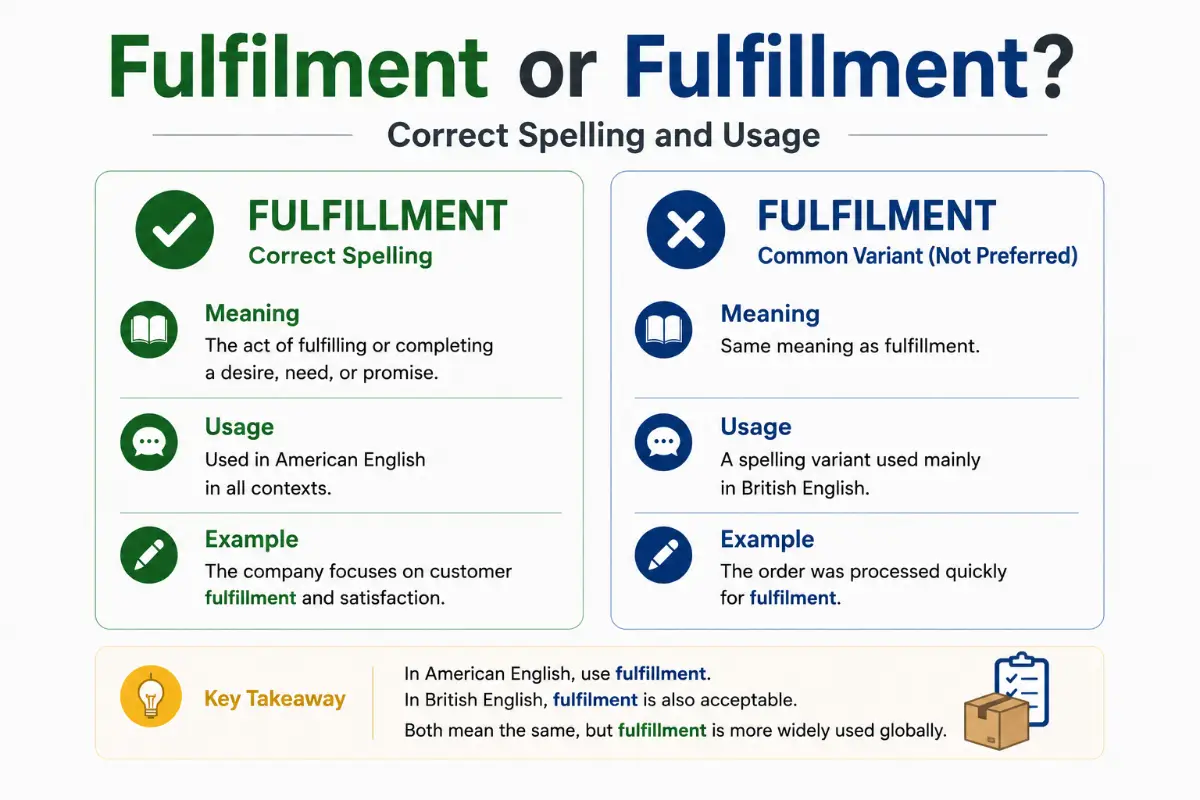
If you’ve ever typed fulfilment or fulfillment and stopped to wonder which spelling belongs in your writing, you’re dealing with a real difference between English varieties rather than a simple spelling mistake. Fulfilment or fulfillment can both be correct. The main difference is regional spelling. American English generally prefers fulfillment with two l letters and no second l after the fi, while British English commonly uses fulfilment with one l in the final part of the word.
The confusion comes from the verb fulfill and the different spelling conventions used across English speaking countries. Both forms refer to the act of fulfilling something or the state of being fulfilled. They can describe completing a duty, meeting a requirement, satisfying a need, or achieving a personal goal.
For most US readers, fulfillment is the safer choice. For British audiences, fulfilment is widely accepted and often preferred. This guide explains the spelling difference, meaning, grammar, pronunciation, word history, regional usage, common mistakes, and practical examples so you can choose the form that fits your audience.
Quick Definition
Fulfilment and fulfillment are both standard spellings of the same noun. Fulfillment is the usual American English spelling, while fulfilment is common in British English and other varieties that follow British spelling conventions. Both mean the act or result of fulfilling something, such as a duty, requirement, promise, need, or personal goal.
Quick Answer
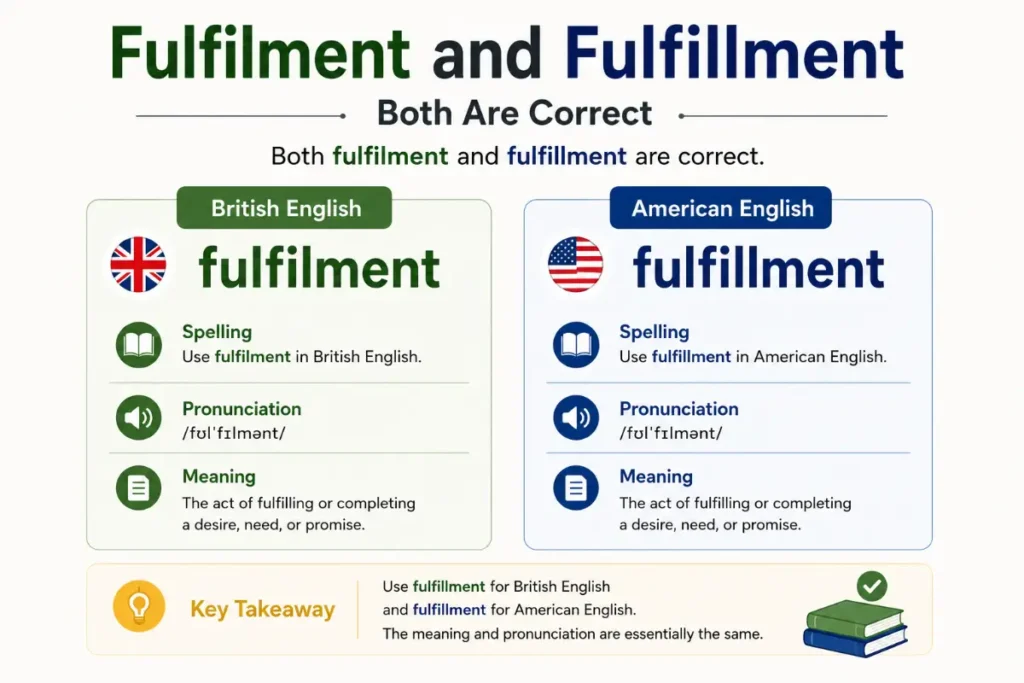
Both spellings are correct. The choice depends mainly on the variety of English you are using.
American English generally uses fulfillment. British English commonly uses fulfilment. Canadian, Australian, and other English varieties can show variation, although British style often favors fulfilment and American influenced contexts may use fulfillment.
The meaning does not change. Both forms can describe completing an obligation, satisfying a need, or achieving a sense of personal satisfaction.
If you’re writing for a US audience, choose fulfillment. If you’re following British English conventions, fulfilment is a natural choice.
Comparison Table
| Form | Meaning | Part of Speech | Origin | Usage Frequency | Formality | Common Contexts | Example |
|---|---|---|---|---|---|---|---|
| Fulfillment | The act or state of fulfilling something | Noun | Derived from fulfill and ultimately related to full and fulfill | Very common in American English | Neutral and formal | US business, personal goals, customer service, psychology, general writing | She found fulfillment in her work. |
| Fulfilment | The act or state of fulfilling something | Noun | Derived from fulfil and ultimately related to full and fulfill | Common in British English | Neutral and formal | UK business, personal goals, customer service, general writing | She found fulfilment in her work. |
The key point is that these forms do not carry different meanings. They represent regional spelling preferences.
Meaning And Definition
Meaning Of Fulfilment
Fulfilment is a noun meaning the act of fulfilling something or the state of being fulfilled.
It can describe completing a responsibility.
The fulfilment of the contract took several months.
It can describe meeting a requirement.
The fulfilment of all entry requirements is necessary before admission.
It can also describe personal satisfaction.
She found fulfilment through teaching.
In this sense, fulfilment is about a feeling that something important has been achieved or satisfied. The word can describe emotional satisfaction, professional satisfaction, personal purpose, or the successful completion of an obligation.
This spelling is especially familiar in British English.
Meaning Of Fulfillment
Fulfillment has the same basic meaning as fulfilment. The difference is spelling rather than definition.
You might write:
She found fulfillment in helping young students.
Here fulfillment refers to a deep sense of satisfaction gained from meaningful work.
You might also write:
The company handles order fulfillment for several retailers.
In this business context, fulfillment refers to the process of completing customer orders. That can include receiving an order, preparing the product, packing it, and arranging delivery.
The same word therefore appears in both personal and business contexts.
The Main Spelling Difference
The spelling difference becomes easier to understand when you look at the related verb.
British English commonly spells the verb as fulfil.
American English commonly spells the verb as fulfill.
That difference carries into the noun.
British English gives us fulfilment.
American English gives us fulfillment.
The meaning stays the same.
This pattern appears in several related forms of English spelling. American English often uses a doubled final consonant in certain forms where British English may use a single consonant.
The difference is not an error. It is a regional spelling convention.
If your document follows American English style, use fulfillment consistently. If your document follows British English style, use fulfilment consistently.
Mixing the two forms in the same document can make your spelling look inconsistent even though both forms are legitimate.
Which Form Should You Use
For a US audience, fulfillment is generally the best choice.
For a British audience, fulfilment is generally the natural choice.
If you are writing for an international audience, either spelling can work as long as you use one spelling system consistently.
For example, a US company might write:
Our fulfillment team processes thousands of orders each week.
A British company might write:
Our fulfilment team processes thousands of orders each week.
Neither sentence changes the meaning.
The same principle applies to academic writing, business writing, websites, reports, product descriptions, and general communication. Choose the regional style that matches your audience.
Key Differences Explained
- Spelling. The main difference is the number and placement of the letter l. American English commonly uses fulfillment, while British English commonly uses fulfilment.
- Meaning. Both forms have the same meaning. They can describe satisfaction, completion, achievement, or the successful carrying out of something.
- Grammar. Both forms are nouns. They can function as subjects, objects, or complements in a sentence.
- Pronunciation. The two spellings are normally pronounced the same way. The spelling difference does not create a major pronunciation difference.
- Formality. Both forms are suitable for formal and informal writing. Regional convention matters more than formality.
- Context. Both forms appear in personal development, business, customer service, logistics, education, religion, psychology, and general writing.
- Regional usage. American English strongly favors fulfillment. British English commonly favors fulfilment.
- Standard usage. Both forms are standard within their relevant spelling traditions. Neither should be treated as a simple typo.
Why The Two Spellings Exist
English has never had one single spelling system used by every English speaking country.
British English developed its own conventions over centuries. American English later developed several spelling preferences that became standard in the United States.
The difference in this word is connected to the spelling of fulfill and fulfil.
American English commonly writes:
Fulfill.
Fulfilling.
Fulfillment.
British English commonly writes:
Fulfil.
Fulfilling.
Fulfilment.
The difference becomes particularly noticeable in words related to business and online shopping because order fulfillment is a major American business term.
British businesses may instead describe the same process as order fulfilment.
The spelling changes, but the underlying concept remains the same.
Sentence Examples
The following examples show how both spellings work naturally.
- She found fulfillment through her career as a teacher.
- The fulfillment of the agreement required several additional steps.
- Many people search for fulfillment outside their professional lives.
- The company improved its order fulfillment process.
- He felt a strong sense of fulfillment after completing the project.
- Personal fulfillment can come from meaningful relationships and useful work.
- The fulfillment center processed the customer’s order quickly.
- The course gave students a greater sense of fulfillment.
- She believes that helping others brings lasting fulfillment.
- The fulfillment of the promise required patience and commitment.
Here are examples using the British spelling.
- She found fulfilment through her work with children.
- The fulfilment of the agreement took several months.
- Many people seek fulfilment through meaningful relationships.
- The company improved its order fulfilment system.
- He experienced a strong sense of fulfilment after completing the project.
These examples show that the spelling changes according to regional convention. The meaning stays the same.
Common Spelling Mistakes
Using The Wrong Regional Form For The Audience
A US publication that consistently follows American spelling would normally use fulfillment. A British publication would commonly use fulfilment.
Neither form is automatically wrong. The problem appears when a writer follows one regional style but randomly switches between systems.
Mixing Fulfill And Fulfil
Writers sometimes use fulfill in one paragraph and fulfil in another.
That creates an inconsistent spelling style.
Choose the form that matches your audience and keep it throughout the document.
Confusing The Noun With The Verb
Fulfillment and fulfilment are nouns.
Fulfill and fulfil are verbs.
For example:
The team will fulfill the order.
The team completed the fulfillment process.
The first sentence uses a verb. The second uses a noun.
Confusing Fulfillment With Satisfaction
Fulfillment can mean satisfaction, but the two words are not always interchangeable.
She found fulfillment in her work.
She felt satisfaction after completing the task.
Fulfillment often suggests a deeper or more lasting sense of meaning. Satisfaction can refer to a more immediate feeling that something met expectations.
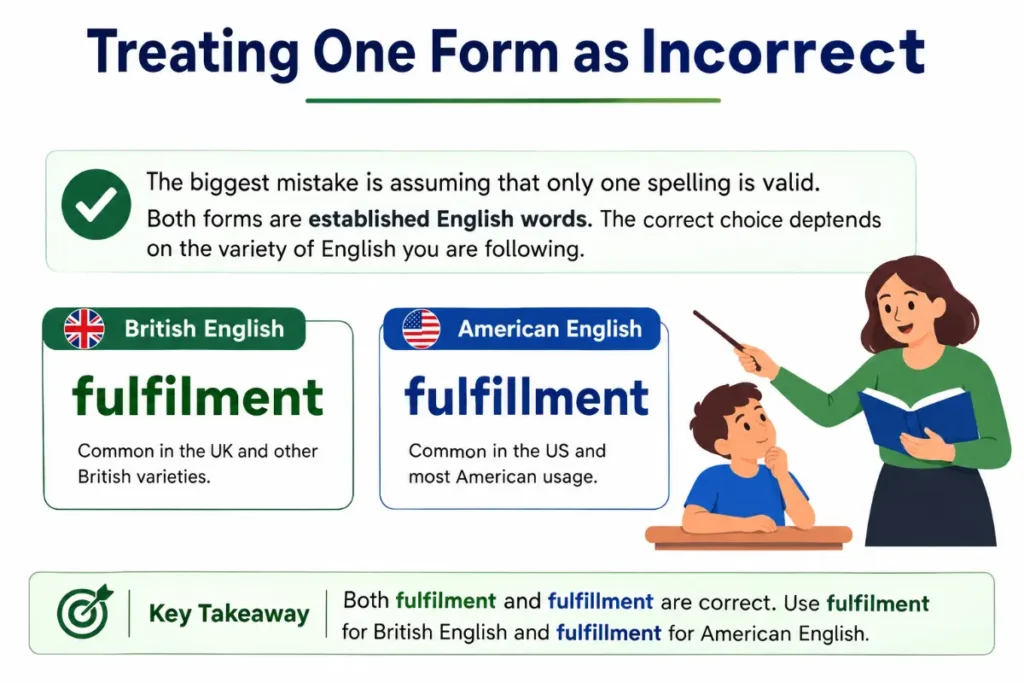
Treating One Form As A Typing Error
This is one of the most common mistakes in discussions about the word.
If you see fulfilment in a British document, that does not mean the writer made a spelling error. Likewise, fulfillment is not an American misspelling.
The regional context matters.
Pronunciation Guide
Both spellings are generally pronounced the same way.
A common American pronunciation is represented as /fʊlˈfɪlmənt/.
A simple pronunciation guide is:
ful FIL ment.
The main stress falls on the second syllable.
You can divide the word into three parts:
ful + fill + ment.
In natural speech, the final syllable is usually lighter than the middle syllable.
One common pronunciation mistake is giving every syllable equal stress. English normally uses stronger and weaker syllables, so the word sounds more natural when the middle part receives the main emphasis.
The spelling difference between fulfilment and fulfillment does not normally require a different pronunciation. If you hear the word without seeing it written, you generally cannot identify the spelling from sound alone.
That is one reason this word can create spelling confusion.
Grammar And Part Of Speech
Fulfilment and fulfillment are nouns.
They can refer to an action, process, condition, or state.
Consider these examples:
The fulfillment of the contract was delayed.
Here the noun refers to the completion of an obligation.
She experienced personal fulfillment.
Here the noun refers to a state of satisfaction.
The company manages order fulfillment.
Here the noun describes a business process.
The word often appears with the preposition of.
Examples include:
Fulfillment of a promise.
Fulfillment of a requirement.
It can also appear with adjectives that describe the type of fulfillment.
Examples include:
Personal fulfillment.
Emotional fulfillment.
Professional fulfillment.
Spiritual fulfillment.
Customer fulfillment.
Order fulfillment.
The word can therefore function naturally across many subjects.
Fulfillment In Business
One of the most common modern uses appears in business and retail.
Order fulfillment describes the process of completing a customer’s order.
A typical process may involve receiving the order, locating the product, preparing the package, and arranging shipment.
For example:
The company handles order fulfillment for small online stores.
A fulfillment center is a facility where products may be stored, processed, packed, and prepared for shipment.
In American business writing, fulfillment is the usual spelling.
British businesses commonly use fulfilment for the same concept.
This distinction matters for companies that serve multiple markets. A business may choose one spelling based on its primary audience and brand style.
Fulfillment In Personal Life
The word also has a broader human meaning.
Personal fulfillment describes a sense that your life, work, relationships, or activities provide meaning and satisfaction.
For example:
She found personal fulfillment in teaching.
This does not simply mean she enjoyed her job. The phrase can suggest that teaching gave her a meaningful sense of purpose.
Similarly:
He felt a deep sense of fulfillment after helping his community.
Here the word points to emotional satisfaction connected with meaningful action.
The exact feeling varies from person to person. One person may find fulfillment through family life. Another may find it through work, creativity, service, learning, or personal goals.
Fulfillment In Formal Writing
Both forms are appropriate in formal writing when they match the chosen regional style.
You may see the word in academic essays, business reports, professional correspondence, legal documents, policy writing, and research discussions.
For example:
The fulfillment of contractual obligations depends on compliance with the stated conditions.
This sentence uses the noun in a formal legal and business context.
In an academic context:
Personal fulfillment may influence how individuals evaluate career success.
The word works naturally here because the topic involves satisfaction and personal goals.
The spelling should follow the style of the publication or institution.
Regional Usage
American English
American English generally uses fulfillment.
This spelling appears in everyday writing, business communication, education, psychology, personal development, retail, logistics, and customer service.
You will commonly see phrases such as order fulfillment, personal fulfillment, fulfillment center, and fulfillment process.
The related verb is generally fulfill.
British English
British English commonly uses fulfilment.
The related verb is generally fulfil.
You may see phrases such as order fulfilment, personal fulfilment, and fulfilment process.
The underlying meaning remains the same as in American English.
Australian English
Australian English commonly follows British spelling traditions in many words of this type, so fulfilment is widely used.
However, English usage can vary across organizations, publications, and international business settings. A writer should follow the style guide used by the intended publication or company.
Canadian English
Canadian English can show variation because Canadian spelling contains influences from both British and American English.
Both fulfilment and fulfillment may appear depending on the publication, organization, or regional style being followed. For professional writing, consistency with the chosen style guide is the safest approach.
American And British Spelling Patterns
This word belongs to a larger group of spelling differences.
American English often prefers forms such as:
Color rather than colour.
Honor rather than honour.
Center rather than centre.
British English commonly uses:
Colour.
Honour.
Centre.
Fulfillment fits into this broader pattern, although its spelling history has its own details.
Seeing these patterns can help you understand why English sometimes gives you two accepted spellings for the same word.
The important point is that regional spelling is not the same thing as incorrect spelling.
If your goal is to write naturally for Americans, use American conventions consistently. If your audience is British, follow British conventions.
Etymology And Word Origin
Fulfilment and fulfillment are built from the verb fulfill or fulfil and the noun forming ending ment.
The deeper word family is connected with full. The basic idea involves making something full, complete, or satisfied.
The verb fulfill developed with meanings connected to carrying out something, completing a requirement, satisfying an expectation, or making something complete.
The noun then describes the act or state associated with that process.
The spelling split developed as English spelling conventions diverged across regions. American English established fulfillment as its common form, while British English retained fulfilment.
The historical development explains why the two forms look almost identical. They are not unrelated words. They are regional spellings of the same English noun.
Related And Confused Terms
Fulfill
Fulfill is the common American spelling of the verb. It means to carry out, complete, or satisfy something.
The company will fulfill the order tomorrow.
Fulfil
Fulfil is the common British spelling of the same verb.
The company will fulfil the order tomorrow.
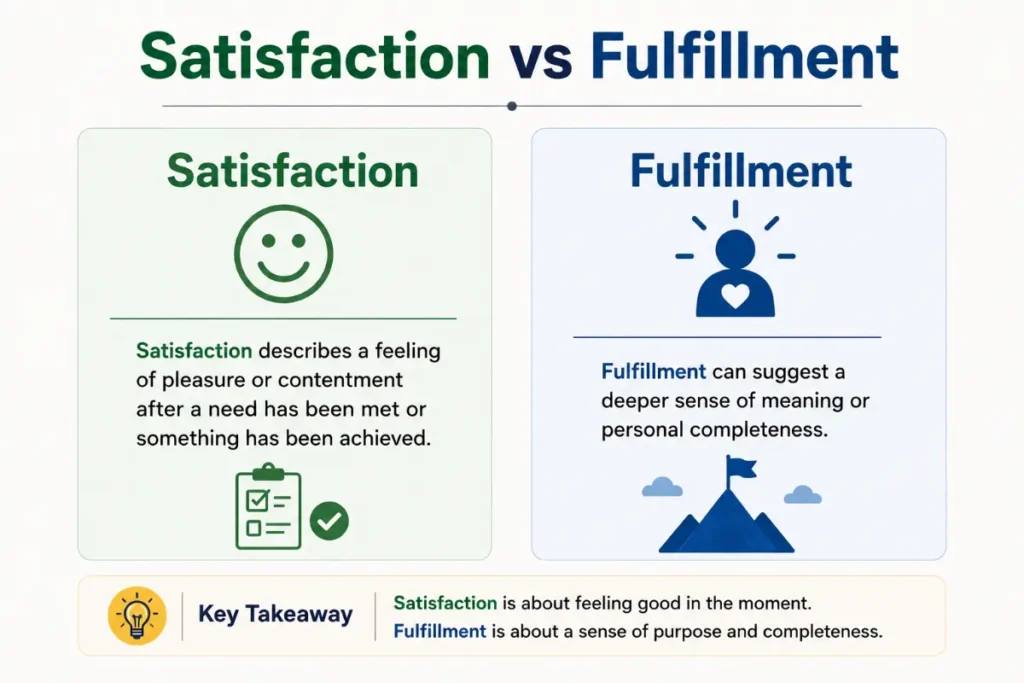
Satisfaction
Satisfaction describes the feeling that something has met your needs or expectations. It can overlap with fulfillment, but fulfillment often suggests a deeper sense of purpose or completion.
Achievement
Achievement refers to successfully reaching a goal or completing something worthwhile. It may lead to fulfillment, but the words do not mean exactly the same thing.
Completion
Completion means bringing something to an end or finishing it. Fulfillment can involve completion but may also describe emotional or personal satisfaction.
Purpose
Purpose refers to the reason something exists or the meaning behind an action. A strong sense of purpose can contribute to personal fulfillment.
Contentment
Contentment describes a state of calm satisfaction. It can overlap with fulfillment but often suggests peace rather than achievement or purpose.
Self Actualization
Self actualization refers to realizing or developing your potential. It is often discussed alongside personal fulfillment, especially in psychology and personal development.
These terms share part of the same semantic field, but they are not interchangeable in every sentence.
Fulfillment And Fulfilment In Different Contexts
The word has a surprisingly broad range of uses.
In customer service, it can describe completing an order.
In contracts, it can describe meeting obligations.
This broad usage explains why the word appears in many different types of writing.
Real Life Usage Examples
Daily Conversation
I’m looking for more fulfillment in my work.
She finally felt a sense of fulfillment after reaching her goal.
In casual American conversation, fulfillment is the usual spelling in writing, while the pronunciation remains natural and familiar.
Workplace Communication
The fulfillment team processed all customer orders before the deadline.
The company is reviewing its fulfillment process to reduce delays.
In British workplace writing, the same sentences may use fulfilment instead.
Academic Writing
Personal fulfillment can influence how people define career success.
The study examines the relationship between meaningful work and personal fulfillment.
Academic writers should follow the spelling conventions of their institution or publication.
News Writing
The retailer expanded its fulfillment network before the holiday season.
The company announced changes to its order fulfillment system.
The business meaning is especially common in commerce and logistics reporting.
Literature And Storytelling
She searched for fulfillment but discovered that success alone did not satisfy her.
His journey toward personal fulfillment changed the way he viewed his family.
In storytelling, the word often describes an emotional or personal resolution.
Common Questions About Regional Spelling
A useful rule is to decide on your audience before you begin a long document.
If you are writing for readers in the United States, choose the American form.
If you are writing for an international company, check its established editorial style.
The biggest mistake is not choosing one form over the other. The bigger problem is switching between them without a reason.
Consistency makes writing look deliberate and professional.
Expert Editor Insight
An experienced editor would not mark fulfilment as simply wrong or fulfillment as universally correct. The first question is always which English variety the document follows. For a US audience, fulfillment fits American spelling conventions. For a British audience, fulfilment is natural. Spelling tools can flag one form when their language setting is configured for another variety, so a red underline does not always mean the word itself is incorrect. A practical editing tip is to check the language setting before changing a regional spelling.
Conclusion
Fulfilment or fulfillment is not a case of one correct spelling and one incorrect spelling. Both are standard forms of the same noun, but fulfillment is the usual American English spelling while fulfilment is common in British English. The meaning stays the same in both varieties. The word can describe completing an obligation, satisfying a need, processing an order, or experiencing a deeper sense of personal satisfaction.
For US writing, choose fulfillment and use it consistently. For British writing, fulfilment is the natural choice. Australian English commonly follows the British pattern, while Canadian usage can vary by style and context.
The easiest editing tip is to check your audience first. Once you know which English variety you’re using, choose the matching spelling and keep that choice consistent throughout the document.
FAQs
Is fulfilment a correct spelling?
Yes. Fulfilment is a correct standard spelling used especially in British English and other varieties influenced by British spelling conventions. It has the same meaning as the American spelling fulfillment. The difference is regional rather than grammatical. If your document follows British English, fulfilment is an appropriate choice.
Is fulfillment correct in American English?
Yes. Fulfillment is the standard American English spelling. It is widely used in contexts such as personal fulfillment, customer fulfillment, order fulfillment, and fulfillment centers. The related American verb is fulfill. If your audience is primarily in the United States, fulfillment is generally the natural spelling to choose.
Which spelling should I use in the United States?
For US readers, use fulfillment. American English commonly uses the double l form in this noun. The spelling appears in business writing, education, personal development, retail, logistics, and everyday communication. If you are following an American style guide, keeping fulfillment throughout the document will help maintain consistency.
Which spelling is used in British English?
British English commonly uses fulfilment. The related verb is fulfil. This spelling is standard in British usage and appears in formal and informal contexts. It has the same meaning as fulfillment in American English. The difference is mainly a matter of regional spelling convention rather than meaning, grammar, or pronunciation.
Are fulfilment and fulfillment pronounced differently?
They are generally pronounced the same way. The spelling difference does not normally create a different pronunciation. A common pronunciation is represented as /fʊlˈfɪlmənt/, with the main stress on the middle syllable. Because the sounds are essentially the same, listeners usually cannot tell which spelling you would use simply by hearing the word.
What does fulfillment mean?
Fulfillment can mean the act of completing or satisfying something. It can refer to fulfilling a promise, requirement, contract, or order. It can also describe a feeling of personal satisfaction or purpose. For example, personal fulfillment refers to a sense that your activities or achievements provide meaning and satisfaction.
Is fulfillment formal or informal?
Fulfillment is suitable for both formal and informal writing. Its tone depends more on the surrounding sentence than on the word itself. You can use it in business reports, academic writing, professional emails, everyday conversation, and personal writing. The main consideration is regional spelling. US writing generally uses fulfillment, while British writing commonly uses fulfilment.
Why are there two spellings?
English developed different spelling conventions in different regions. American English commonly uses fulfillment, while British English commonly uses fulfilment. The difference is connected to the related spellings fulfill and fulfil. Both forms belong to the same word family and carry the same meaning. The variation reflects English spelling traditions rather than two separate words.
