
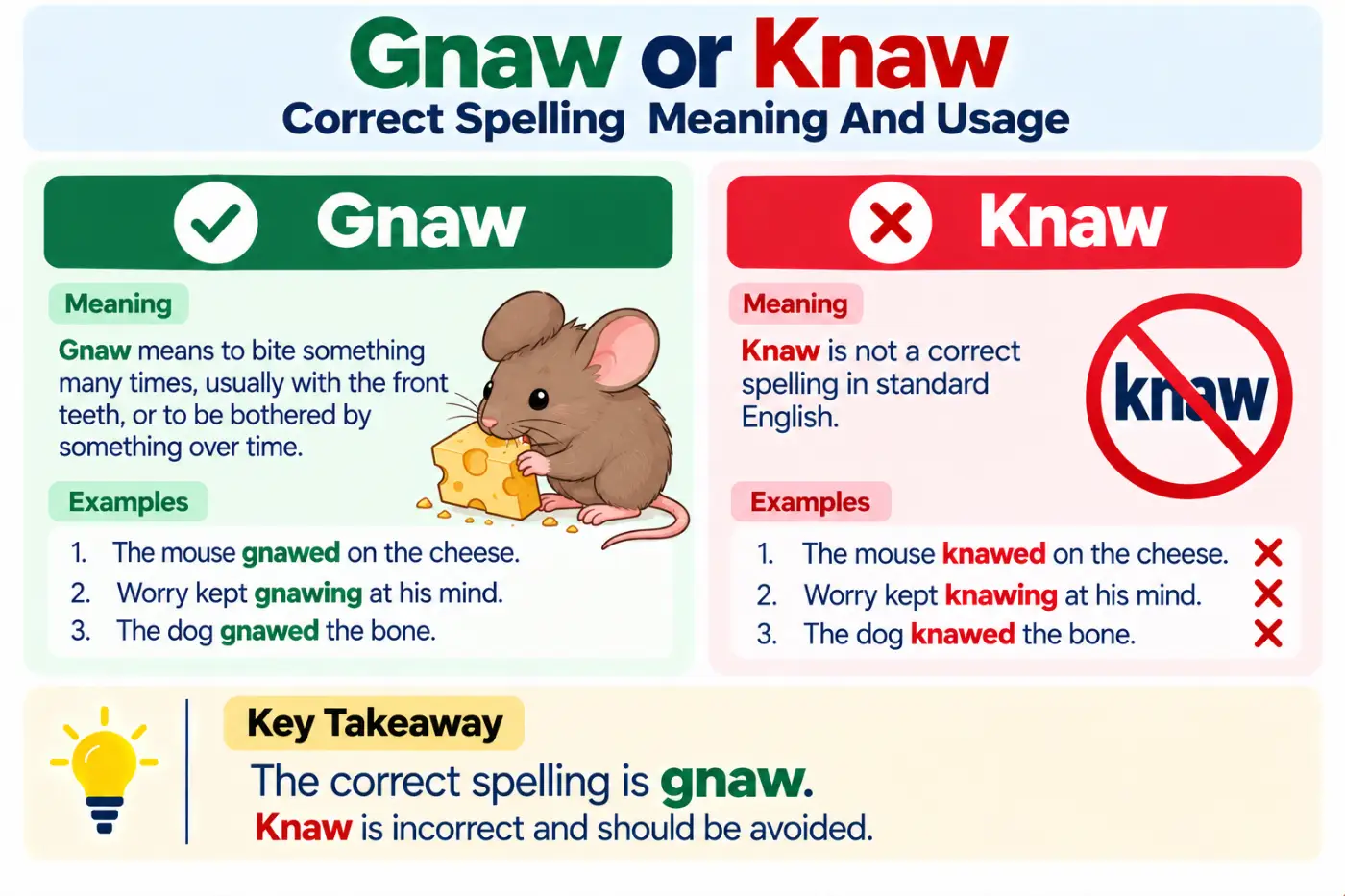
gnaw or knaw can be confusing because the word sounds almost nothing like the way it looks. The correct spelling for the standard English verb meaning to bite or chew something repeatedly is gnaw. The form knaw is not the standard modern English spelling of that verb.
The confusion makes sense once you hear the word aloud. In American English, gnaw is pronounced like naw, so the silent g can easily disappear when someone tries to spell the word from sound. English also contains many words with silent letters, and the spelling pattern can feel unusual if you have not seen the word often. There is another wrinkle too. Knaw does exist in historical and Scots usage with meanings connected to know, and older Scottish sources also record knaw as a variant spelling of gnaw. That does not make it the normal spelling in present day standard English.
This guide explains the standard spelling, meaning, pronunciation, grammar, word history, regional usage, common mistakes, related expressions, and natural examples. By the end, you’ll know exactly when to use gnaw and why knaw can appear in older or specialized language.
Quick Definition
Gnaw is the standard modern English verb meaning to bite or chew something repeatedly, often gradually wearing it away. It can also describe something that causes persistent worry or discomfort, as in guilt that gnaws at you. Knaw is not the standard spelling of this verb in modern general English.
Quick Answer
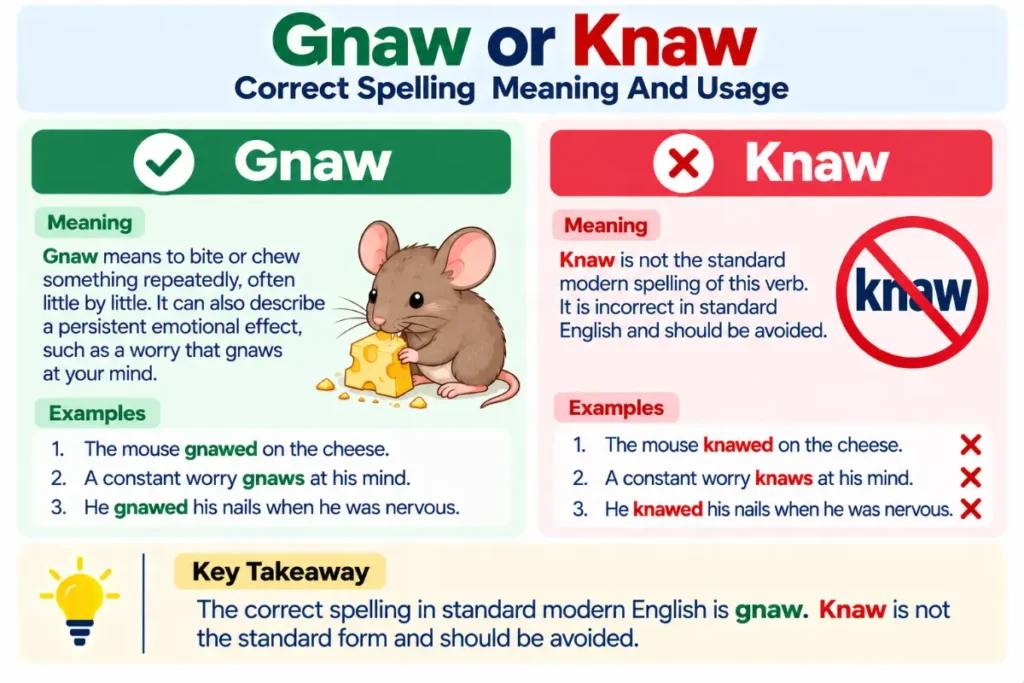
The correct spelling in standard modern English is gnaw. Gnaw means to bite or chew something repeatedly, often little by little. It can also describe a persistent emotional effect, such as a worry that gnaws at your mind. The spelling knaw is not the standard modern form of this verb.
However, knaw is not simply meaningless. Historical Scottish dictionaries record it as an older or Scots form connected with gnaw, and another Scots entry records knaw as a form of know. These specialized historical uses are different from ordinary modern English spelling.
Comparison Table For Gnaw And Knaw
| Form | Meaning | Part Of Speech | Origin | Usage Frequency | Formality | Common Contexts | Example |
|---|---|---|---|---|---|---|---|
| Gnaw | To bite or chew repeatedly or gradually wear away | Verb | Old English and Germanic | Common | Standard | Everyday English, literature, journalism, academic writing | The dog likes to gnaw on its bone. |
| Knaw | Historical or Scots form associated with gnaw or know depending on the source | Verb | Older English and Scots usage | Rare in modern general English | Historical or dialectal | Historical texts, Scots language, older dialect usage | The form may appear in an older Scottish text. |
The key distinction is simple. If you are writing ordinary modern English and mean bite or chew repeatedly, use gnaw.
Meaning And Definition
Meaning Of Knaw
Knaw requires a little more care than a simple incorrect spelling label suggests.
In ordinary modern American and British English, knaw is not the standard spelling for the verb meaning to chew or bite repeatedly. If you type knaw when you mean gnaw, most modern readers will treat it as a spelling mistake.
However, historical language tells a more interesting story.
The Dictionary of the Scots Language records knaw as an older Scottish form of English know. It also records another historical Scots entry for knaw as a variant of gnaw. The older entry gives examples dating back centuries.
That means knaw has a legitimate historical life. It simply does not function as the normal modern spelling of the verb in standard English.
This distinction matters for editors and researchers. A form can be historically real without being appropriate in present day general writing.
If you are writing a school essay, email, article, report, or ordinary message, use gnaw for the meaning related to biting or chewing.
Meaning Of Gnaw
Gnaw is a verb that means to bite or chew something repeatedly. The action often involves small repeated bites rather than one quick bite.
A dog might gnaw on a bone.
A rabbit might gnaw through a piece of wood.
A rodent might gnaw through a cable.
The word can also suggest gradual damage. Something that repeatedly bites into a surface can slowly wear it away.
For example:
The mice gnawed through the wooden box.
Here the animals did not simply bite the wood once. Their repeated chewing gradually created damage.
Gnaw also has an important figurative meaning. It can describe a feeling that keeps troubling someone.
Guilt began to gnaw at him.
In that sentence, guilt is not physically biting the person. The word creates an image of a persistent emotional pressure that keeps eating away at peace of mind. Cambridge and Oxford both recognize this figurative use.
This gives the word two closely related meanings. One is physical and one is emotional.
The Main Difference
The central difference between the two forms is standard modern usage.
- Gnaw is the standard spelling. Use it when you mean to bite or chew repeatedly.
- Knaw is not the standard modern spelling for that meaning. It can appear in historical or Scots material, but it should not replace gnaw in ordinary modern English.
- Gnaw has a silent g. The first letter is written but not pronounced in the modern standard pronunciation.
- Both forms have historical connections. The history of English and Scots includes forms that can make the spelling look less straightforward than it seems today.
- Context matters for historical forms. A writer studying Scots literature may encounter knaw as a genuine historical form. A student writing a modern English essay should use gnaw.
- The pronunciation explains much of the modern confusion. Gnaw sounds like naw in American English, so the written g is easy to overlook.
Which Form Is Correct?
For standard modern English, gnaw is correct when you mean to bite, chew, or wear away by repeated biting.
Oxford lists gnaw as a verb meaning to keep biting or chewing something so that it gradually disappears. It also gives related patterns such as gnaw at, gnaw on, and gnaw away at.
Cambridge similarly defines gnaw as repeatedly biting or chewing something, often causing gradual destruction. It also recognizes the figurative meaning of causing continuing worry or discomfort.
The spelling is not based on the modern sound alone. English spelling often preserves older forms even after pronunciation changes. Gnaw is a good example of that pattern.
So if your sentence says that a dog is chewing a bone repeatedly, write:
The dog began to gnaw on the bone.
Do not write:
The dog began to knaw on the bone.
The second version may look logical from the sound, but it is not the standard modern spelling.
Why The G Is Silent
The silent g is the biggest reason learners struggle with this word.
In modern English, the g in gnaw is not pronounced. The word begins with the n sound.
That means the spelling looks longer than the spoken word.
You see:
gnaw
You hear something close to:
naw
This is similar to other English words where an initial letter is silent.
Think about words such as know, knee, knife, and knock. English spelling preserves historical letters that no longer have their old pronunciation.
The same broad spelling pattern appears in gnaw.
The result is a classic sound to spelling trap. Someone hears the word and may naturally write naw or knaw because the initial g does not appear in the pronunciation.
The safest approach is to learn the whole spelling rather than trying to reconstruct it from sound.
Sentence Examples
Here are natural examples using the standard modern form.
- The puppy loves to gnaw on its rubber toy.
- The rabbit began to gnaw through the wooden fence.
- The dog spent an hour gnawing on a large bone.
- The rats had gnawed through the old electrical cable.
- She likes to gnaw on ice when she is nervous.
- The dentist warned him not to gnaw on hard objects.
- A strange feeling of guilt continued to gnaw at him.
- Doubt began to gnaw away at her confidence.
- The cold seemed to gnaw at his hands as he waited outside.
- The problem had been gnawing at me all week.
These examples show both major uses. The first group describes physical biting or chewing. The later examples use the verb figuratively to describe worry, doubt, guilt, or discomfort.
Common Misspellings And Confusion
Knaw
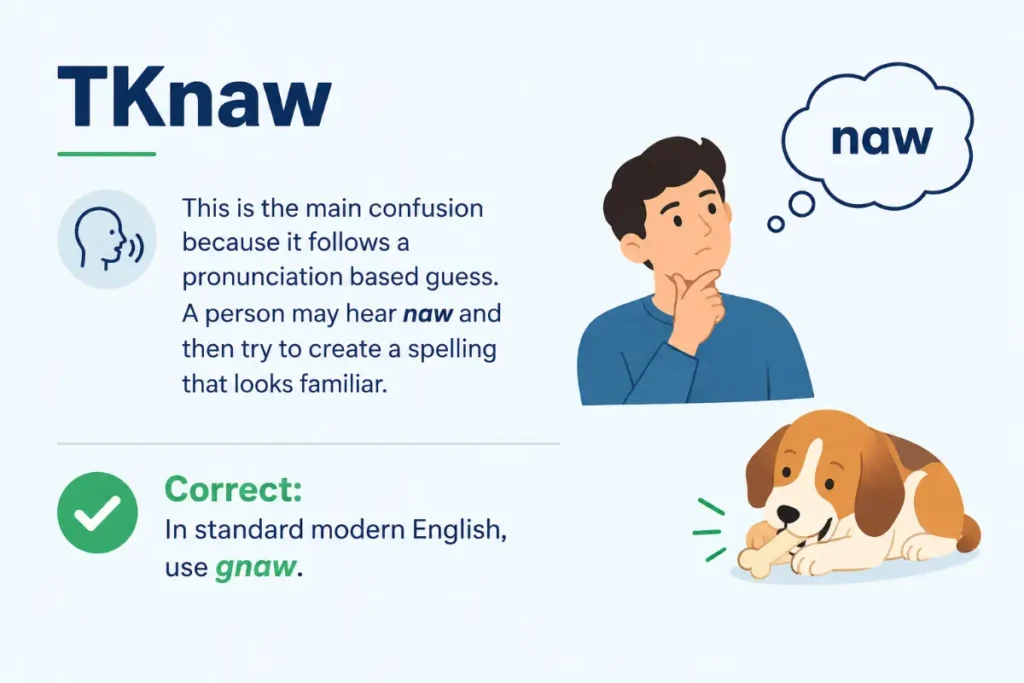
This is the main confusion because it follows a pronunciation based guess. A person may hear naw and then try to create a spelling that looks familiar. In standard modern English, use gnaw.
Naw
Naw can appear in informal speech as a representation of a pronunciation of no in some dialect writing. It is not the standard spelling of gnaw.
For the verb meaning chew repeatedly, write gnaw.
Gnawing
Some writers may forget the spelling when adding the ing ending.
The correct form is:
gnawing
Not:
gnawwing
The base spelling stays intact before the ending is added.
Gnawed
The past tense is gnawed.
For example:
The dog gnawed the bone.
The word is pronounced with a d sound at the end in normal speech.
Gnaws
The third person singular form is gnaws.
For example:
The dog gnaws on the bone every evening.
These forms are easier to remember if you learn gnaw as the base form first.
Pronunciation Guide
The standard pronunciation of gnaw differs slightly across major English varieties.
Cambridge gives the US pronunciation as /nɑː/ and the UK pronunciation as /nɔː/.
For many American speakers, a simple approximation is:
naw
The word has one syllable.
There is no pronounced g at the beginning.
The pronunciation pattern is therefore:
gnaw = naw
The initial consonant sound is n.
The silent g is part of the spelling rather than the spoken form.
A common mistake is to pronounce the g.
Do not say:
guh naw
Say:
naw
Another common mistake is to pronounce the word like no. The vowel is different for most speakers.
American English commonly uses a sound represented by /nɑː/. British English commonly uses /nɔː/. Regional accents can produce additional variation, so the exact vowel may sound different from one speaker to another.
Etymology And Word Origin
Gnaw has a very old Germanic history.
Modern English gnaw comes through Middle English from Old English forms such as gnagan. The word has related forms in other Germanic languages. Oxford identifies its origin as Old English and Germanic and notes that the word is ultimately connected with an imitative sound associated with gnawing.
Etymological sources also connect the English form with German nagen, Old Norse forms, and Dutch forms related to biting or gnawing.
The old history helps explain why the spelling looks unusual today.
Modern pronunciation has changed over time, but the written form has preserved the initial g.
That is not unusual in English. Spelling often acts like a historical photograph. It can preserve traces of an older pronunciation long after speakers stop saying the sound.
The history of knaw is more complicated because Scots records contain multiple historical uses. One Scots dictionary records knaw as a form of English know, while an older Scots dictionary records another knaw as a variant of gnaw.
So the spelling is not simply a modern typo invented by people who forgot the g. It has historical roots, but those roots do not make knaw the standard spelling today.
Regional Usage
American English
American English uses gnaw as the standard spelling.
You will see it in ordinary writing when people describe animals chewing objects or figurative feelings that continue to cause distress.
The American pronunciation is commonly represented as /nɑː/.
Knaw is not the standard American spelling of the verb.
British English
British English also uses gnaw as the standard modern spelling.
The common British pronunciation is represented as /nɔː/.
Historical Scottish writing can contain knaw, but that is a different matter from present day standard British English. The Scots form has a documented historical record.
Australian English
Australian English uses gnaw as the normal spelling of the verb. There is no standard Australian spelling rule that changes gnaw to knaw.
A writer in Australia using standard contemporary English should therefore write gnaw.
Canadian English
Canadian English also uses gnaw as the standard spelling.
The pronunciation can reflect regional Canadian speech patterns, but the spelling remains gnaw.
Knaw may appear in historical or dialect material, but it is not the normal contemporary spelling for the verb.
Grammar Rules And Part Of Speech
Gnaw is primarily a verb.
It can be transitive, meaning it takes a direct object.
The dog gnawed the bone.
Here bone is the object receiving the action.
Gnaw can also be used with prepositions such as at and on.
The dog gnawed at the bone.
The dog gnawed on the bone.
These structures are both common.
The verb can also appear with through when the action results in something being penetrated or destroyed.
The mice gnawed through the box.
Another useful pattern is gnaw away at.
The mice gnawed away at the wood.
This can describe physical chewing or gradual figurative damage.
The same pattern works with abstract ideas.
Doubt gnawed away at her confidence.
The word therefore moves naturally from physical action to figurative description.
Verb Forms
The basic forms are straightforward.
- Base form: gnaw.
- Third person singular: gnaws.
- Past tense: gnawed.
- Past participle: gnawed.
- Present participle: gnawing.
Examples include:
The dog gnaws on a bone.
The dog gnawed on the bone yesterday.
The spelling stays connected to the same base form.
Common Grammar Patterns
Gnaw Something
This pattern directly identifies the thing being chewed.
The puppy gnawed the toy.
Gnaw On Something
This pattern is extremely natural when describing repeated chewing.
The puppy gnawed on the toy.
Gnaw At Something
This can describe repeated biting or chewing.
The rabbit gnawed at the branch.
It can also have a figurative meaning.
The thought gnawed at her.
Gnaw Away At Something
This emphasizes gradual damage or gradual emotional pressure.
The water slowly gnawed away at the stone.
Doubt gnawed away at his confidence.
These patterns give the word more flexibility than the basic definition might suggest.
Formal And Informal Usage
Gnaw is a standard English verb. It does not belong only to casual speech.
You can use it in ordinary conversation.
The dog is gnawing on a bone.
You can also use it in formal writing.
Repeated abrasion can gradually gnaw away at the surface.
The figurative use is also common in serious writing.
Persistent uncertainty continued to gnaw at the researcher.
The word can therefore fit many registers.
Knaw is different. In modern general writing, it should not be substituted for gnaw. Its historical and Scots uses make it relevant to specialized language study, but those uses do not establish it as a standard contemporary spelling.
Real Life Usage Examples
Daily Conversation
My puppy keeps gnawing on my shoes.
The baby has been gnawing on a teething toy all morning.
These examples describe ordinary physical chewing.
Workplace Communication
The unresolved problem continued to gnaw at the team.
Repeated delays began to gnaw away at employee confidence.
Here the verb works figuratively to describe a continuing problem.
Academic Writing
Rodents can gnaw through materials such as wood and plastic.
Persistent uncertainty may gnaw at a person’s sense of confidence.
Academic writers can use the verb when the context calls for it. It does not need to be avoided simply because it is vivid.
News Writing
Rats had gnawed through cables inside the building.
The ongoing dispute continued to gnaw at public confidence.
The physical and figurative meanings both work naturally in journalism.
Literature And Storytelling
The old dog lay beneath the table and gnawed quietly on the bone.
A quiet fear began to gnaw at her as night approached.
Gnaw is particularly effective in storytelling because the physical action creates a strong image. The figurative use borrows that image and applies it to emotions or thoughts.
Related And Confused Terms
Chew
Chew is the broad everyday word for breaking food down with the teeth. Gnaw often suggests repeated or persistent biting and can involve hard objects that are gradually worn away.
Bite
Bite usually refers to one act or instance of using the teeth. Gnaw suggests repeated biting.
Nibble
Nibble means taking small bites. It often sounds gentler than gnaw.
Chomp
Chomp describes vigorous or noisy biting and chewing. It is more informal and expressive.
Munch
Munch usually describes eating something with steady chewing. It often has a casual tone.
Erode
Erode means to wear away gradually. It can describe physical processes and is often more technical than gnaw.
Wear Away
Wear away describes gradual loss or damage. Gnaw can produce the same general idea through the image of repeated biting.
Worry
Worry is closely related to the figurative use of gnaw. If something gnaws at you, it keeps troubling your thoughts or emotions.
These words overlap, but they are not interchangeable in every sentence. Gnaw is especially useful when you want the image of persistent biting or gradual emotional pressure.
Gnaw At And Gnaw Away At
These expressions deserve special attention because they are common in natural English.
Gnaw at can describe physical chewing.
The rabbit gnawed at the branch.
It can also describe a thought or feeling that keeps causing discomfort.
The memory gnawed at him.
Gnaw away at emphasizes gradual erosion.
The insects slowly gnawed away at the wood.
The uncertainty gnawed away at her confidence.
The figurative meaning is easy to understand if you picture something slowly eating away at a solid object. The word takes that physical image and applies it to emotions, confidence, patience, or peace of mind.
Why People Write Knaw
The main reason is pronunciation.
The word begins with a silent g, so someone who has only heard it may never realize that the spelling starts with gn.
This is a classic spelling pattern problem. The listener has access to sound but not to the historical spelling.
Another factor is the existence of familiar words beginning with kn.
Know, knee, knife, and knock all contain silent initial letters. That makes knaw look believable to someone who is trying to spell the sound rather than recalling the written word.
There is also historical evidence for knaw in Scots and older English usage. That means the form is not completely random. It has a documented history, although it is not the standard spelling of the modern English verb meaning to chew repeatedly.
A Simple Memory Trick
The easiest way to remember the spelling is to connect gnaw with other words that begin with silent g.
Think of:
gnaw
gnat
gnome
gnash
The g is written but not pronounced.
You can also remember the sound:
gnaw sounds like naw.
Then remember that the standard spelling preserves the g.
A useful sentence is:
The g is silent, but it still belongs in gnaw.
This is not a grammar rule. It is simply a practical spelling trick.
Expert Editor Insight
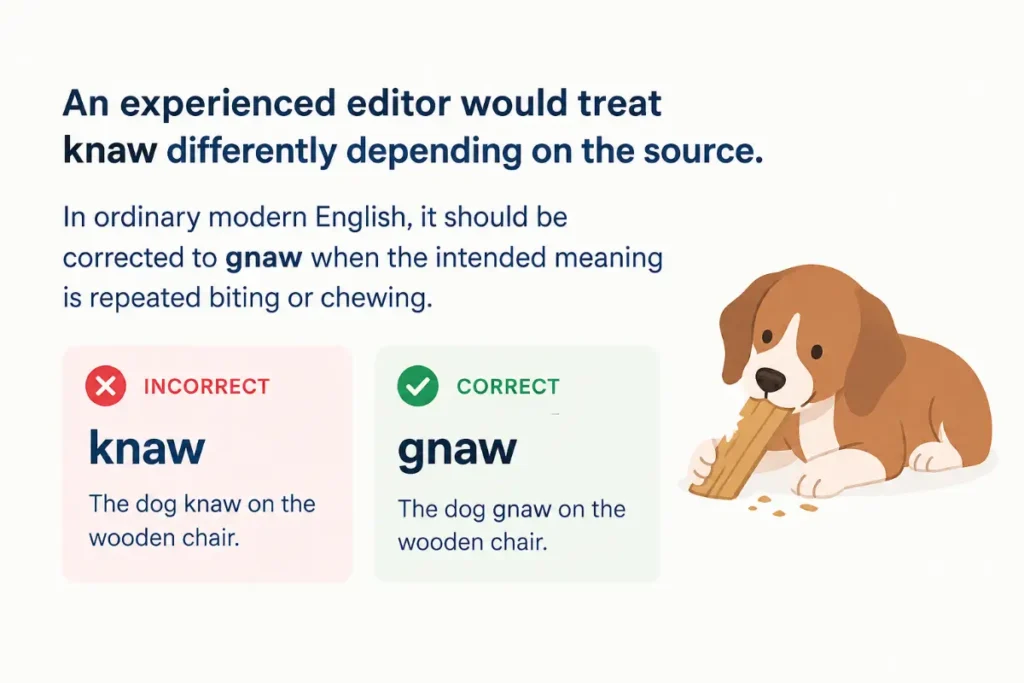
An experienced editor would treat knaw differently depending on the source. In ordinary modern English, it should be corrected to gnaw when the intended meaning is repeated biting or chewing. In a historical or Scots text, however, an editor should not automatically change the spelling because the form may be authentic to the source. Modern spellcheckers usually recognize gnaw and may flag knaw in ordinary English, but software cannot always understand historical dialect or literary context. The best editing decision starts with meaning and source context rather than spelling alone.
Conclusion
gnaw or knaw has a clear answer for standard modern English. Gnaw is the correct spelling when you mean to bite or chew something repeatedly, while knaw is not the normal contemporary form. It also has a useful figurative meaning for something that keeps causing worry or discomfort.
The silent g is the main reason the spelling causes trouble. You hear naw, but you write gnaw. Historical Scots records explain why knaw can appear in older or dialect writing, so it should not be dismissed as meaningless in every context. For everyday English, though, stick with gnaw.
A simple editing trick is to remember the silent g. If the meaning is repeated biting, chewing, or gradual emotional pressure, write gnaw and let the g stay silent.
FAQs
Is knaw a real word?
Knaw has a documented history, but it is not the standard modern English spelling of the verb meaning to bite or chew repeatedly. Historical Scots dictionaries record knaw as a form connected with know and also record an older Scots form of gnaw. So the word has historical legitimacy, but modern general English uses gnaw for the chewing sense.
Which spelling is correct for biting or chewing?
Gnaw is the correct standard modern spelling for the verb meaning to bite or chew repeatedly. You can write The dog gnawed the bone or The dog gnawed on the bone. Knaw should not be used as the ordinary spelling of this verb in contemporary American or British English.
Why is the g silent in gnaw?
The g is silent because English spelling preserves an older form of the word even though modern pronunciation has changed. Gnaw developed from Old English forms related to gnagan. Over time, the initial consonant cluster changed in pronunciation while the spelling retained the g. Today the word is pronounced without a spoken g.
How do you pronounce gnaw?
In American English, gnaw is commonly pronounced /nɑː/, which is close to naw. In British English, the common pronunciation is /nɔː/. The word has one syllable, and the g is completely silent. You should not pronounce it as guh naw. The safest simple pronunciation guide is naw.
What does gnaw mean figuratively?
Figuratively, gnaw can mean to cause continuing worry, discomfort, guilt, or emotional pressure. For example, The mistake gnawed at her means the mistake continued to trouble her. This meaning comes from the physical image of something repeatedly biting or eating away at an object. The emotional problem is imagined as slowly wearing someone down.
Is gnaw a noun or a verb?
Gnaw is primarily a verb in modern English. It describes the action of biting or chewing repeatedly. Related forms include gnawing and gnawed. A related noun is gnawer, meaning something that gnaws. Dictionaries also record gnaw as a noun in some usage, but the everyday word you are most likely to need is the verb.
Is knaw an old spelling of gnaw?
In some historical Scots material, yes. The Dictionary of the Older Scottish Tongue records knaw as a variant of gnaw, with examples from earlier centuries. Another Scottish dictionary records knaw as a Scottish form of know. This historical evidence explains why the spelling may appear in older texts. It does not make knaw the standard spelling for modern general English.
What is an easy way to remember gnaw?
Remember that the g is silent but still written. Think of other words with a silent initial g, such as gnat and gnome. Then connect the sound to naw while remembering the spelling gnaw. If you mean repeated biting or chewing, use gnaw. This simple association helps prevent the common mistake of replacing the initial gn with kn.
