
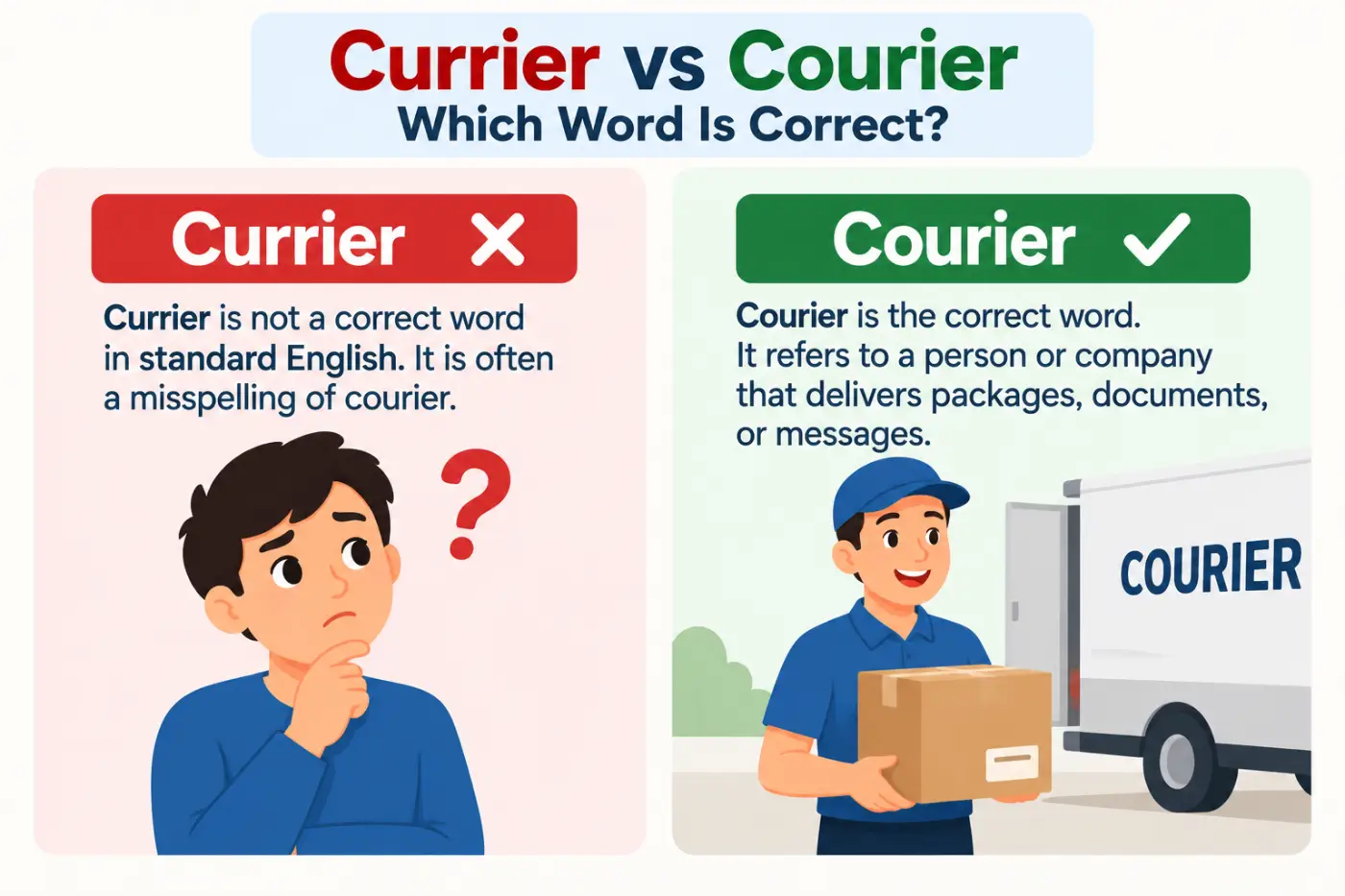
currier vs courier can be confusing because the two words look and sound remarkably similar. However they refer to very different things. Courier is the word you want for a person or company that carries packages messages or documents from one place to another. Currier is a real word too but it traditionally refers to a person who prepares and finishes leather.
The confusion makes sense. Both words contain almost the same letters and both end with the familiar er pattern. Their histories also come from different language roots which helps explain why their meanings have nothing to do with modern package delivery. One word is connected with running and carrying messages. The other belongs to the old craft of preparing leather.
This guide explains the difference in plain English. You’ll learn the meanings pronunciation grammar word origins regional usage common mistakes and natural examples. By the end you’ll know exactly which word to choose when talking about a package delivery service or a traditional leather worker.
Quick Definition
Courier means a person or company that delivers messages documents packages or other items from one place to another. Currier is a different noun that traditionally means a person who prepares and finishes tanned leather. Both are legitimate English words but they belong to different fields and should not be treated as alternative spellings.
Quick Answer
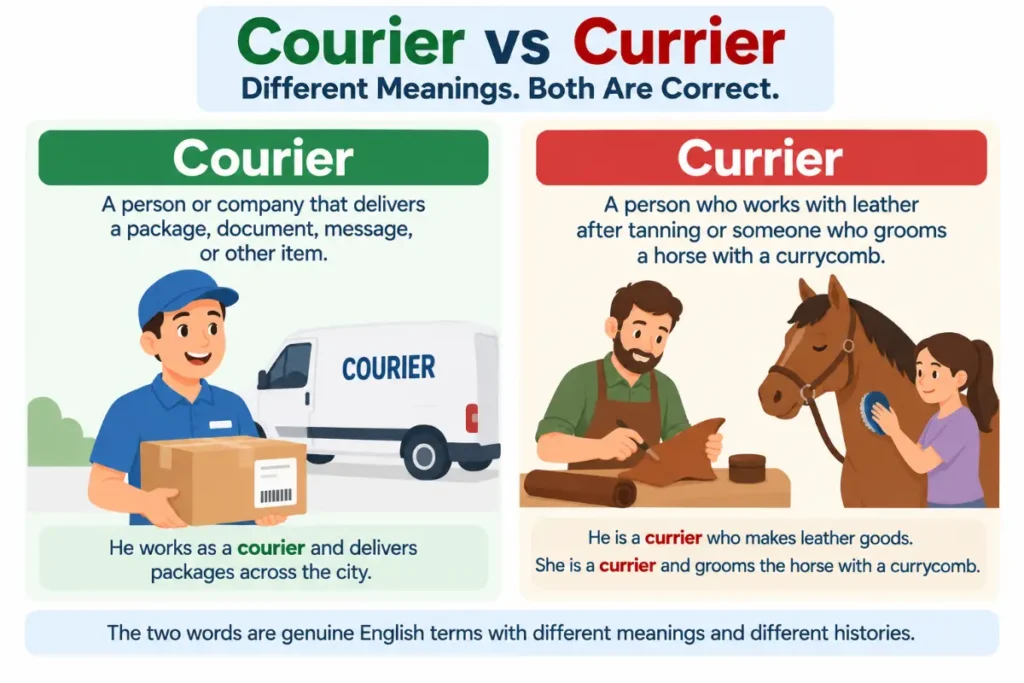
Use courier when you mean someone who delivers a package document message or other item. Use currier when you mean someone who works with leather after tanning or someone who grooms a horse with a currycomb. The two words are genuine English terms with different meanings and different histories.
If you’re writing something like The courier delivered my package this morning then courier is clearly the right choice. If you’re describing a traditional leather trade you might write The currier prepared the leather for the saddler.
Comparison Table
| Correct Form | Meaning | Part of Speech | Origin | Usage Frequency | Formality | Common Contexts | Example |
|---|---|---|---|---|---|---|---|
| Courier | A person or company that carries messages packages or documents | Noun | Middle French and Italian with roots in Latin | Very common | Neutral | Delivery services business travel diplomacy shipping | The courier delivered the package this morning. |
| Currier | A person who prepares and finishes tanned leather | Noun | Old French and Latin | Uncommon in everyday speech | Neutral and specialized | Leather work tanning traditional trades | The currier prepared the hides for finishing. |
Meaning and Definition
Meaning of Currier
Currier is a legitimate English word. It isn’t a misspelling of courier. A currier is traditionally a worker who treats leather after the tanning stage. The work can involve preparing dressing coloring smoothing and finishing hides so they become suitable for practical use.
The word belongs to an older vocabulary connected with leather production. You’re more likely to encounter it in historical writing leather industry discussions museum material family history or descriptions of traditional crafts than in ordinary everyday conversation.
For example:
The currier prepared the leather for the shoemaker.
The town once had several curriers working near the old tannery.
Currier can also refer to someone who grooms a horse with a currycomb. That meaning is much less familiar to modern readers but it appears in established English vocabulary.
The word can also occur as a surname. In that case it functions as a proper name rather than as the occupational noun.
The key point is simple. Currier is a real word but it doesn’t mean a delivery worker.
Meaning of Courier
Courier is much more common in modern English.
A courier is a person or company that transports messages letters documents packages or other items from one place to another. You might use the word for someone delivering an online order or for a specialized messenger carrying important documents.
You might say:
The courier delivered my order before noon.
We sent the contract by courier.
A motorcycle courier picked up the documents.
The word can also describe a messenger in diplomatic military or intelligence settings. So its meaning is broader than the modern image of someone bringing a package to your door.
Historically a courier could be someone trusted to carry important messages over a distance. The modern delivery industry has kept that central idea while applying it to packages and commercial services.
Key Differences Explained
- Spelling. The words are spelled differently because they are separate words. Courier contains our in the middle while currier contains urr.
- Meaning. Courier refers mainly to a messenger or delivery worker. Currier traditionally refers to a person who prepares and finishes leather.
- Grammar. Both words function primarily as nouns.
- Part of speech. Neither word needs a different grammatical category to create the basic distinction. The meaning changes because the words themselves are different.
- Pronunciation. The two words can sound quite similar in some accents. That similarity contributes to the confusion.
- Formality. Courier is completely normal in everyday and professional English. Currier is less common and tends to appear in specialized or historical contexts.
- Context. Package delivery points strongly toward courier. Leather preparation points strongly toward currier.
- Regional usage. English varieties in the United States Britain Canada and Australia recognize both words. The major difference is frequency rather than meaning.
- Standard usage. Both forms are standard English words when used with their proper meanings.
The easiest way to separate them is to think about the job.
A courier carries something to another place.
A currier works with leather.
That simple distinction does most of the work.
Which Form Is Correct
Both forms are correct because both words have established meanings in English.
The real question is which meaning your sentence requires.
If you’re talking about package delivery use courier.
If you’re talking about a traditional leather worker use currier.
This is an important distinction because many confusing word pairs involve one correct form and one misspelling. This pair works differently. Neither word is simply the incorrect version of the other.
Consider these sentences:
The courier delivered the parcel.
The currier prepared the leather.
Both are correct. Swapping the nouns would change the meaning completely.
A good editor checks meaning before judging spelling. An unfamiliar word can look wrong simply because it appears less often. Currier is a good example of this. It’s uncommon in modern everyday English but it remains a legitimate word.
Sentence Examples
Here are natural examples using courier.
- The courier left the package at the front desk.
- We need to send these documents by courier today.
- A courier arrived at the office just before lunch.
- The company uses a local courier for urgent deliveries.
- I received a message saying the courier was on the way.
- The courier picked up the return from my house.
- Please give the signed contract to the courier.
- The business hired a courier to deliver the equipment.
- She works as a courier and spends most of her day traveling around the city.
- The courier delivered the package safely despite the heavy rain.
Now look at examples using currier.
- The currier prepared the leather after the tanning process.
- The village once had a busy workshop run by a skilled currier.
- The currier worked carefully to give the leather a smooth finish.
- Historical records mention a currier who lived near the old tannery.
- The museum display explains how a currier prepared hides for craftsmen.
Notice how the surrounding context makes the intended meaning clear. You don’t need a complicated grammar rule. The subject matter usually tells you which word belongs in the sentence.
Common Mistakes and Misspellings
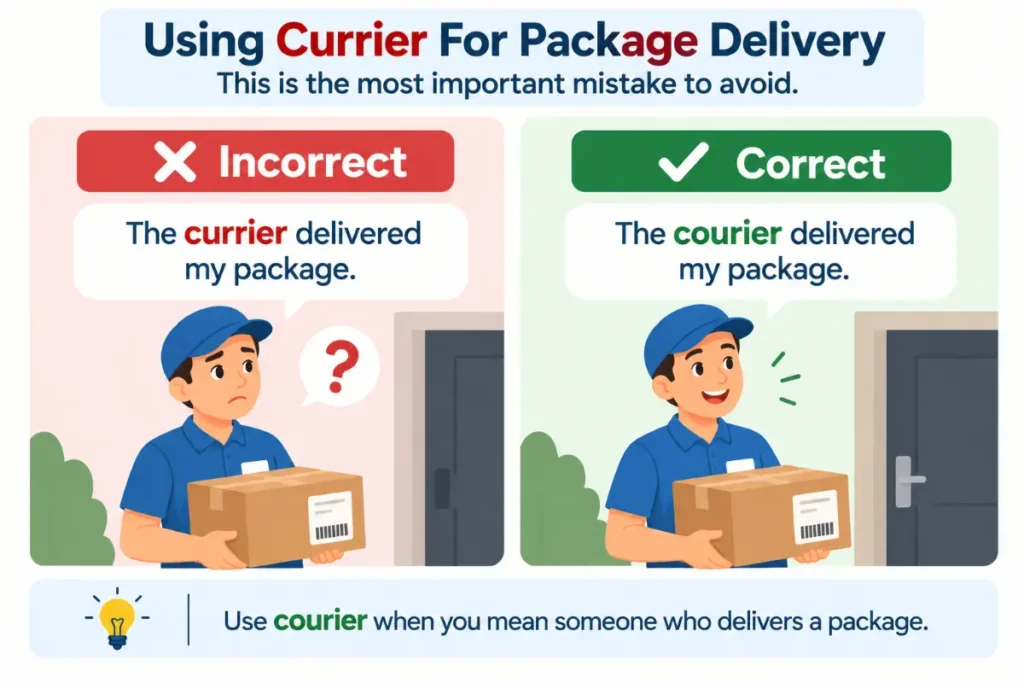
Using Currier For Package Delivery
This is the most important mistake to avoid.
Incorrect:
The currier delivered my package.
Correct:
The courier delivered my package.
The issue isn’t that currier is spelled incorrectly. The word itself is real. The problem is that it describes the wrong occupation.
Treating Currier As An Alternative Spelling
Some writers assume that currier and courier are two spelling variants of the same word. They aren’t.
They developed through different historical paths and acquired different meanings. Treating them as interchangeable can create a clear vocabulary error.
Confusing The Vowel Sounds
The words can sound similar in some accents. That means listeners may depend on context to understand which word someone intends.
For example if someone says I’m waiting for the courier you’ll probably think about a delivery because that is the common modern meaning.
If someone discusses a leather workshop then currier becomes much more likely.
Assuming Rare Words Are Incorrect
Currier sounds old fashioned to many modern readers. That doesn’t make it wrong.
English contains thousands of specialized words that appear less often than everyday vocabulary. A word can be uncommon without being incorrect.
This is especially useful to remember when reading historical material. Older occupations often have names that rarely appear in modern conversation.
Using Context Too Narrowly
Courier can mean more than someone delivering an online shopping order.
It can describe a messenger carrying documents or information. It can also appear in diplomatic military and other specialized contexts.
So if you encounter courier in a historical or formal text don’t assume the writer is talking about a modern package delivery company.
Pronunciation Guide
Courier is commonly pronounced something like KUR ee er in American English.
You can think of it as three sound groups:
KUR ee er.
The first part carries the strongest stress. The exact vowel quality can vary by accent but the general rhythm remains recognizable.
Currier can sound very similar.
A common approximation is:
KUR ee er.
Because the pronunciation can overlap so closely the context often provides the strongest clue.
That makes spelling especially useful when you’re writing. If you’re discussing a package delivery remember courier. If you’re describing someone who prepares leather remember currier.
A useful learning method is to connect each pronunciation with a mental picture.
Picture a package beside courier.
Picture a leather hide beside currier.
That association gives the spelling a meaning instead of making you memorize a string of letters.
Etymology and Word Origin
The histories of these words explain why their meanings are so different.
Courier ultimately connects to the Latin verb currere which means to run. The word passed through French and Italian forms before developing into the English term associated with a messenger.
The older sense makes intuitive sense. Before modern communication systems existed a messenger had to travel from one location to another to deliver news instructions documents or other information.
Over time courier gained additional meanings. The word became associated with people who carried messages and later with people who transported goods and documents.
Currier has a completely different history.
It comes through Old French from a Latin term connected with leather work. The Latin root is associated with hide or leather.
The historical meaning fits the occupation. A currier worked with leather after the tanning process and prepared it for later use.
So the similarity between the modern words is largely a coincidence.
Courier connects with movement.
Currier connects with leather.
That distinction also provides a useful memory tool.
Regional Usage
American English
Both words are recognized in American English but they appear with very different frequency.
Courier is common in everyday business and delivery language. Americans regularly encounter the word in connection with packages documents shipping services and urgent deliveries.
Currier is much less common. It tends to appear in historical writing traditional craft discussions leather production and specialized occupational contexts.
There is no special American spelling that changes the distinction.
British English
British English also uses courier for a messenger or delivery worker.
Currier remains a legitimate word for someone involved in leather preparation. It can appear in historical descriptions of traditional trades.
The main difference is frequency rather than correctness. Modern British readers are far more likely to encounter courier in daily life.
Australian English
Australian English uses courier in the ordinary sense of someone or a company that delivers goods documents or messages.
Currier remains a specialized term associated mainly with leather work and historical occupations.
Neither word has a special Australian spelling that changes its meaning.
Canadian English
Canadian English follows the same basic distinction.
Courier refers to delivery or messenger services.
Currier refers mainly to traditional leather preparation.
Again the difference comes from meaning rather than regional spelling.
Grammar Rules and Part Of Speech
Both courier and currier are nouns.
That means they normally name a person or occupation.
For example:
The courier arrived.
The currier finished the leather.
You can also use either noun with articles.
A courier delivered the package.
The courier delivered the package.
A currier prepared the hide.
The currier prepared the hide.
The plural forms are straightforward.
Couriers means more than one courier.
Curriers means more than one currier.
Courier commonly appears after verbs connected with delivery.
We hired a courier.
Send the documents by courier.
The company uses several couriers.
Currier tends to appear with verbs associated with leather work.
The currier prepared the hide.
The currier finished the leather.
Several curriers worked in the old district.
The phrase by courier is particularly common when describing a delivery method.
Please send the documents by courier.
We received the package by courier.
That pattern immediately points toward the delivery meaning.
Real Life Usage Examples
Daily Conversation
Courier is common in everyday conversations about packages and deliveries.
I’m waiting for the courier to arrive.
The courier already dropped off your order.
These sentences sound natural because courier is part of modern delivery vocabulary.
Currier is much less likely to appear in casual conversation unless the topic involves leather work history or traditional crafts.
The museum has a section about the work of a currier.
That sentence fits a historical or educational setting.
Email And Workplace Communication
Courier is common in professional communication.
We’ll send the signed agreement by courier this afternoon.
Please confirm when the courier has collected the documents.
The word works well because it clearly identifies the delivery method.
Currier can appear in workplace writing connected with leather production.
The currier inspected the finished leather before it moved to the next stage.
That use is specialized but completely valid.
Academic Writing
Academic writing may use courier in discussions of communication transportation diplomacy or logistics.
The diplomatic courier carried sensitive documents between the two offices.
The study examines how courier networks supported long distance communication.
Currier can appear in research about craft history industrial history or leather production.
The currier played an important role in preparing leather for manufacturing.
Historical sources describe the currier as a separate trade from the shoemaker.
News And Journalism
Courier is common in modern news writing.
Police said the courier delivered the package shortly after noon.
The company plans to expand its courier service across the region.
Currier is far less common but may appear in historical or cultural reporting.
The exhibition explores the work of the medieval currier.
The restored workshop shows how a currier once prepared leather for local craftsmen.
Literature And Storytelling
Both words can appear in stories but they create very different images.
The courier rode through the night carrying an urgent message.
The king sent a courier to warn the neighboring town.
For currier the setting is more likely to involve a workshop.
The old currier worked quietly beside the tanning yard.
The apprentice watched as the currier carefully finished the leather.
The difference becomes vivid once you picture the jobs. One person travels with a message. The other works with a material.
Related And Confused Terms
Messenger
Messenger is a broad word for someone who carries or communicates a message. Courier can describe a particular type of messenger but the two terms aren’t always identical.
Delivery Driver
A delivery driver transports goods to customers. The role overlaps with some modern courier work but the terms can describe different jobs.
Carrier
Carrier is a broad term for someone or something that carries goods people or information. A courier can function as a carrier in a practical sense.
Mail Carrier
A mail carrier delivers letters and packages through a postal system. A courier often works through a private delivery service.
Dispatch
Dispatch can refer to sending something quickly or to the item being sent. It commonly appears in delivery and communication contexts.
Delivery Service
A delivery service is a business or system that transports goods. A courier may be the person performing that delivery.
Tanner
A tanner processes animal hides and turns them into leather. Historically the tanner and currier performed different stages of leather production.
Leatherworker
Leatherworker is a broad term for someone who works with leather goods. Currier is more specific and traditionally refers to someone who prepares and finishes leather.
These related terms show why context matters. Words can share a general topic without being interchangeable.
Why The Two Words Get Confused
The spelling pattern creates much of the confusion.
Both words begin with cur and contain similar letters. They also have a similar ending. When people read quickly the brain often recognizes the overall visual shape instead of examining every letter.
Pronunciation can add another layer.
In some accents the two words sound close enough that listeners need context to identify the intended word. That’s perfectly normal. English has many words that are easier to distinguish in writing than in speech.
There’s also a major difference in modern exposure.
Most people encounter courier regularly because package delivery is part of everyday life.
Far fewer people encounter currier because traditional leather preparation is now a specialized field.
That imbalance can make currier feel like a spelling mistake even though it’s a legitimate English word.
This is a useful lesson for English learners. An unfamiliar word isn’t automatically an incorrect word. Frequency and familiarity are not the same thing as correctness.
A Simple Memory Trick
Use the meaning to remember the word.
Think courier equals carry.
A courier carries something from one place to another.
Think currier equals leather.
A currier works with leather after tanning.
You don’t need to memorize a complicated rule.
Just connect each word with its job.
If the sentence involves a package document message or delivery choose courier.
If it involves leather preparation choose currier.
For example:
The courier delivered the package.
The currier prepared the leather.
Once you associate each word with its role the difference becomes much easier to recall.
Expert Editor Insight
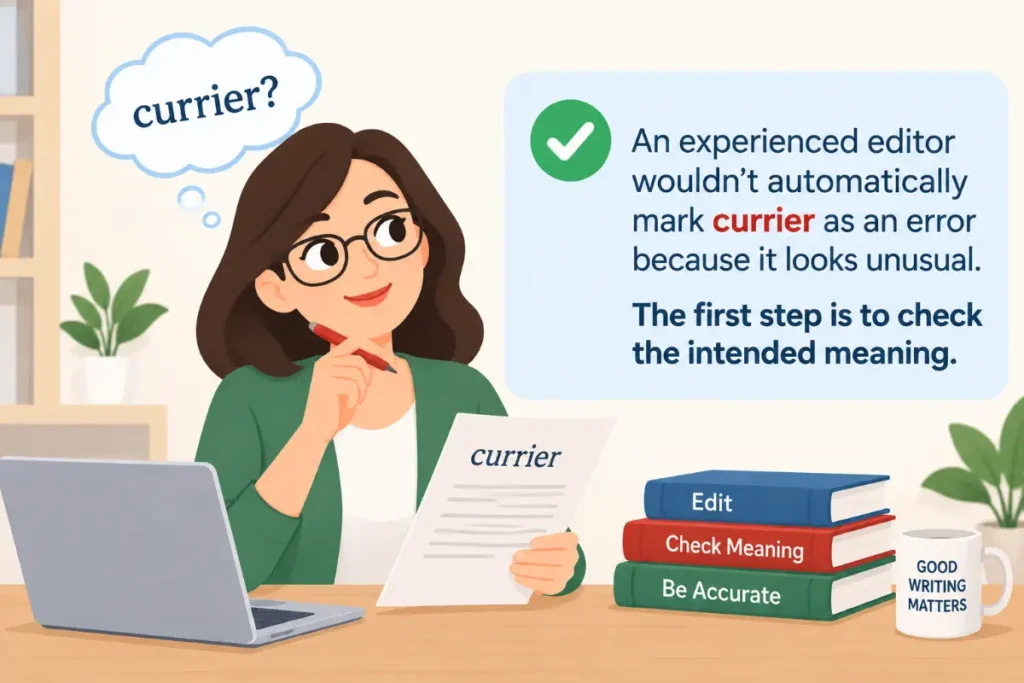
An experienced editor wouldn’t automatically mark currier as an error because it looks unusual. The first step is to check the intended meaning. If a sentence discusses a package delivery then courier is almost certainly the intended word. If the passage concerns leather history then currier may be exactly right. Professional spelling tools can flag unusual vocabulary because of low frequency but a less common word isn’t automatically wrong. Context remains the strongest test.
Conclusion
currier vs courier becomes much easier once you connect each word with its meaning. Courier is the standard choice for a person or company that delivers packages documents messages or other items. Currier is a legitimate but much less common noun for someone who prepares and finishes leather.
The words look similar but their histories and meanings are different. Courier developed through French and Italian forms connected with the idea of running while currier comes from older terms associated with leather. That historical difference helps explain why they should never be treated as interchangeable words.
The simplest memory trick is to think about the job. A courier carries something to a destination. A currier works with leather. Keep that distinction in mind and you’ll choose the right word with confidence.
FAQs
Is Currier A Real Word?
Yes. Currier is a legitimate English noun. It traditionally refers to a person who prepares and finishes tanned leather. The word can also refer to someone who grooms a horse with a currycomb. It appears less often than courier in modern everyday English but it remains a valid word. Its uncommon status doesn’t make it an error.
What Does Courier Mean?
Courier means a person or company that carries messages documents packages or other items from one place to another. The word is especially common in modern delivery services. It can also refer to diplomatic messengers and other specialized roles. The central idea remains the same. A courier carries something from one location to another.
Which Word Should I Use For Package Delivery?
Use courier for package delivery. For example you can write The courier delivered my package this morning. Currier has a different meaning and generally refers to a worker involved in leather preparation. Using currier in a package delivery sentence would create a meaning error rather than simply a spelling variation.
How Do You Pronounce Courier?
In American English courier is commonly pronounced roughly like KUR ee er. The exact vowel sounds can vary by accent. The word generally has three syllable units with the strongest stress near the beginning. Because currier can sound similar in some accents context becomes an important clue when listeners hear the words.
How Do You Pronounce Currier?
Currier is commonly pronounced roughly like KUR ee er. The pronunciation can overlap with courier in some varieties of English. That similarity probably contributes to some of the confusion between the words. When you’re unsure use the meaning and context as your guide. A package points toward courier while leather work points toward currier.
Is Currier Just An Old Spelling Of Courier?
No. Currier and courier are separate words with different meanings and different historical roots. Courier is connected with historical terms associated with running and carrying messages. Currier developed through older words associated with leather work. Their similar appearance today doesn’t mean one is simply an older spelling of the other.
Why Does Currier Seem Like A Spelling Mistake?
Currier can seem incorrect because courier is much more familiar to most modern readers. Package delivery has made courier an everyday word while currier belongs mainly to specialized vocabulary involving leather and traditional trades. Unfamiliarity can make a legitimate word look wrong. Context and a trusted dictionary can settle the question quickly.
Is Courier Appropriate In Formal Writing?
Yes. Courier is fully appropriate in formal writing when it accurately describes the person service or method involved. You can use it in business emails reports contracts academic writing journalism and professional documents. For example you might write The signed documents were sent by courier. The word is standard and widely understood.
