
Cubical vs cubicle can be confusing because the two words share most of the same letters and sound closely related. The good news is that cubical and cubicle are both legitimate English words. They aren’t simply two spellings of the same word. Their meanings and grammatical roles are different.
The word cubical is an adjective that means shaped like a cube or related to a cube. You might describe a small object as cubical because it has roughly the shape of a cube. Cubicle is a noun. It usually means a small enclosed space or partitioned area such as a workspace in an office or a private section in a changing room.
That small difference in spelling points to a much bigger difference in meaning. This guide explains how each word works what it means how to pronounce it and where you’ll see it in real writing. You’ll also learn common mistakes useful examples regional usage and a simple editing trick that makes the distinction easy to remember.
Quick Definition
Cubical and cubicle are both correct words but they have different meanings. Cubical is an adjective describing something shaped like a cube. Cubicle is a noun describing a small enclosed or divided space. Use cubical for shape and cubicle for a physical space such as an office workstation.
Quick Answer
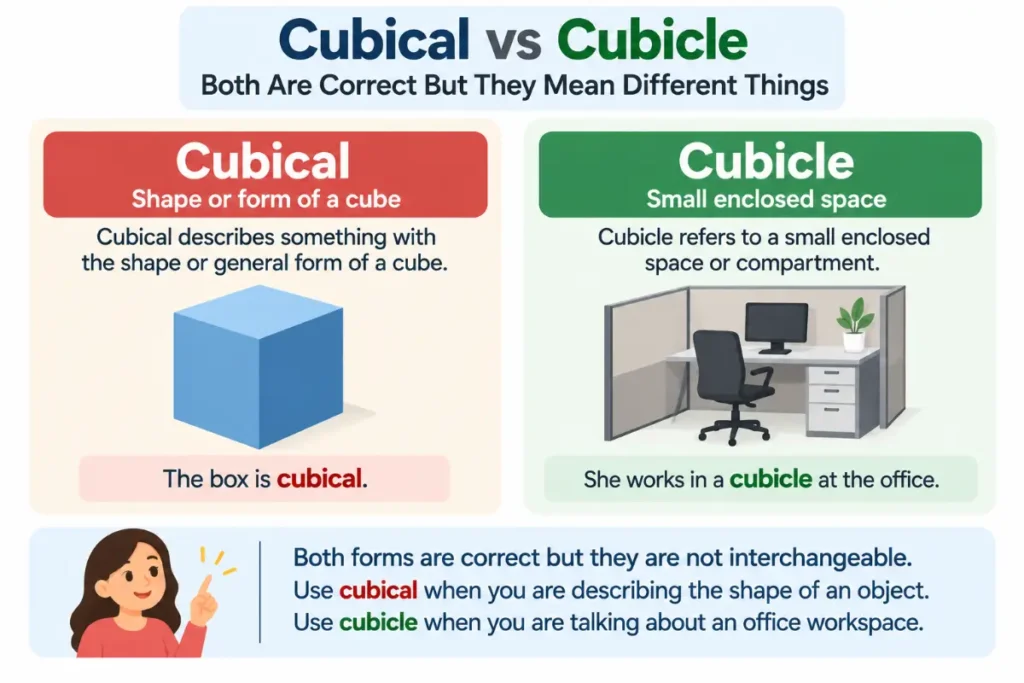
Both forms are correct but they aren’t interchangeable. Cubical describes something with the shape or general form of a cube. Cubicle refers to a small enclosed space or compartment. If you’re talking about an office workspace you need cubicle. If you’re describing the shape of an object you need cubical.
Comparison Table
| Word | Meaning | Part of Speech | Origin | Usage Frequency | Formality | Common Contexts | Example |
|---|---|---|---|---|---|---|---|
| Cubical | Having the shape of a cube | Adjective | From cube with the suffix al | Less common | Neutral | Geometry design architecture objects | The box has a cubical shape. |
| Cubicle | A small enclosed or divided space | Noun | From Latin cubiculum through French and English | Common | Neutral | Offices changing rooms schools hospitals | She works in a quiet cubicle. |
Meaning and Definition
Meaning of Cubical
Cubical is an adjective. It describes something that resembles a cube or has the form of a cube.
A cube has six equal square faces. In everyday writing though cubical can sometimes describe something that is roughly cube shaped rather than mathematically perfect.
For example:
The sculpture has a cubical form.
The container has a cubical shape.
The building contains several cubical structures.
In each case the word describes an object or structure. It doesn’t name the object itself.
That’s an important grammatical point. You wouldn’t normally say that someone is sitting inside a cubical when you mean an office workspace. You’d say they are sitting inside a cubicle.
Cubical can also appear in technical contexts involving geometry mathematics engineering architecture and design. In those settings the word can carry a more precise meaning related to three dimensional shape.
The suffix al is useful here because it often forms adjectives. The same pattern appears in words such as musical seasonal and personal.
Meaning of Cubicle
Cubicle is a noun. It refers to a small space that is separated from surrounding areas by walls partitions curtains or other barriers.
The most familiar example is an office cubicle. An office cubicle usually has partial walls that separate one worker’s area from another.
For example:
I left the report on your desk in the cubicle near the window.
Cubicle has other uses too. A changing room may contain small cubicles that give people privacy. A hospital can have patient cubicles. A school may use cubicles for private work or changing areas.
The central idea is space.
Think of cubicle as the name of a place or compartment. Think of cubical as a description of shape.
That distinction solves most confusion between the two words.
The Main Difference
The easiest way to understand these words is to ask a simple question.
Are you describing what something looks like or what something is?
If you’re describing its shape use cubical.
If you’re naming a small enclosed space use cubicle.
Consider these examples.
The box is cubical.
Here cubical describes the shape of the box.
The employee sits in a cubicle.
Here cubicle names the enclosed workspace.
This difference also explains why replacing one word with the other can create an awkward or completely incorrect sentence. A person can sit in a cubicle but describing the cubicle itself as cubical would mean you’re saying that the cubicle has a cube like shape.
The words may look like close relatives because they are. They come from related ideas involving cubes and enclosed spaces. Yet English has developed them into separate words with separate jobs.
Key Differences Explained
- Spelling. Cubical ends with al while cubicle ends with le. That final spelling difference helps signal their different grammatical roles.
- Meaning. Cubical relates to the shape of a cube. Cubicle refers to a small enclosed space or compartment.
- Part of speech. Cubical is an adjective. Cubicle is a noun.
- Pronunciation. The two words don’t have exactly the same ending sound. Cubical ends with a sound similar to kul while cubicle ends with a sound similar to kul plus a final l sound.
- Context. Cubical commonly appears in discussions of shape geometry design and physical objects. Cubicle appears often in workplaces changing rooms medical settings and other divided spaces.
- Formality. Both words are standard English. Neither is inherently informal.
- Grammar. Cubical normally modifies a noun. Cubicle can serve as a subject object or object of a preposition.
- Regional usage. American British Canadian and Australian English all recognize both words with essentially the same meanings.
The key is not to memorize a complicated rule. Remember the meaning first. Shape points to cubical. Enclosed space points to cubicle.
Which Form Should You Use
Neither word is an incorrect spelling. The correct choice depends on what you want to say.
Use cubical when you need an adjective describing something shaped like a cube.
Use cubicle when you need a noun referring to a small enclosed or divided space.
This distinction follows ordinary English word formation. The ending al commonly creates adjectives. The ending found in cubicle belongs to a noun that names a physical object or space.
A dictionary based approach also supports treating these as separate entries rather than spelling variants. Standard English dictionaries list them as different words with different definitions.
That matters because some spelling comparisons involve one correct word and one misspelling. This isn’t one of those cases. Both forms are real English words.
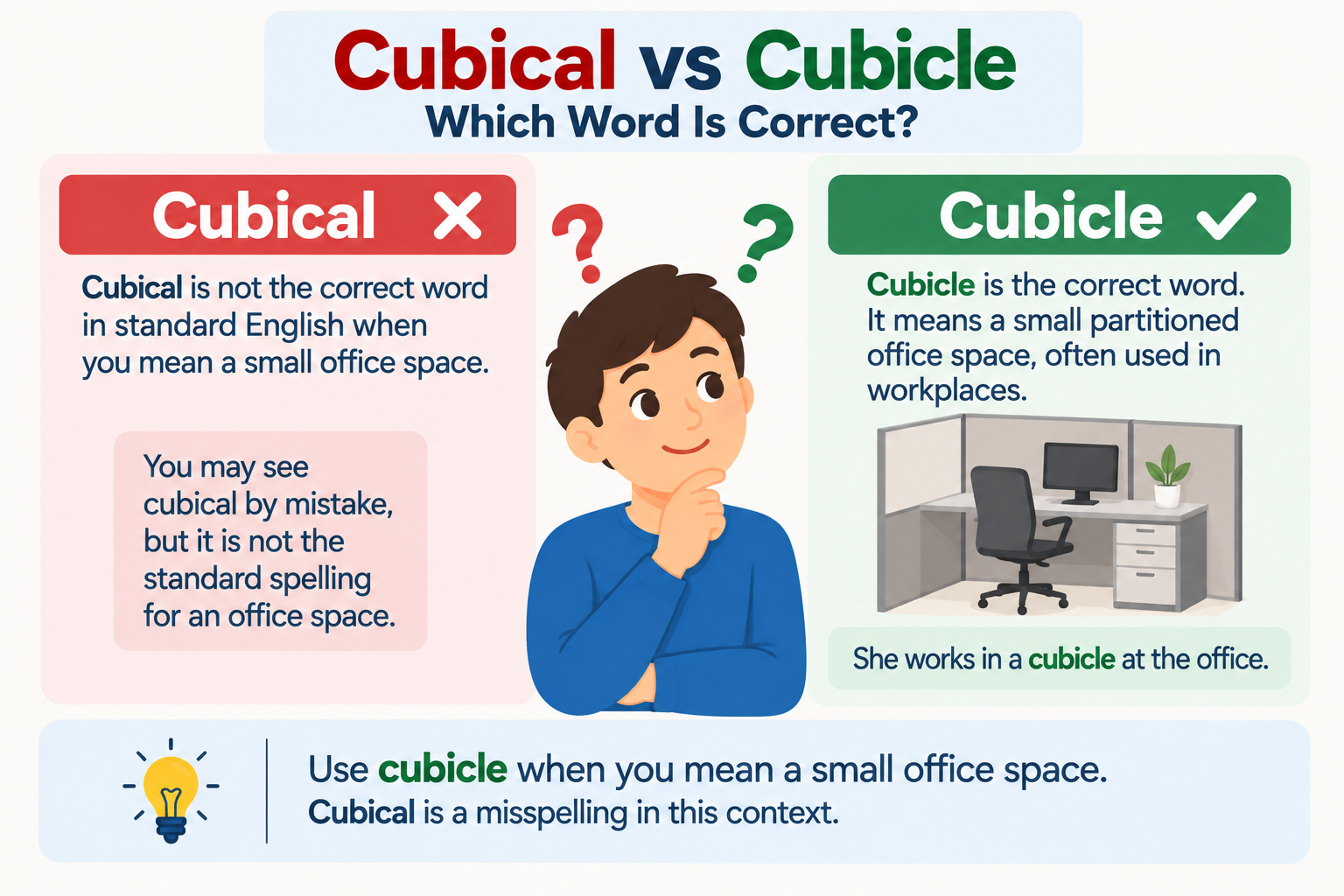
So if you write that someone works in a cubical because you mean an office partitioned workspace you’re using the wrong word. If you write that an object has a cubicle shape because you mean cube shaped you’re also choosing the wrong form.
Sentence Examples
Here are natural examples of cubical used correctly.
- The artist created a cubical sculpture from blocks of stone.
- The machine has a large cubical housing.
- The room contains a strange cubical structure near the entrance.
- The designer chose a simple cubical shape for the container.
- The building uses several cubical forms in its exterior design.
- The children stacked the blocks into a cubical tower.
- The model has a nearly perfect cubical shape.
- Engineers tested the material inside a small cubical chamber.
- The package was compact and almost cubical.
- The architect used several cubical forms to create a modern appearance.
Now look at natural examples of cubicle.
- My new cubicle is next to the conference room.
- She decorated her cubicle with a few family photos.
- He walked back to his cubicle after the meeting.
- The office has dozens of cubicles.
- I found him sitting quietly in his cubicle.
- Each changing area has a private cubicle.
- The nurse directed the patient to a nearby cubicle.
- She moved to a larger cubicle after joining the new team.
- The cubicle near the window gets plenty of natural light.
- He keeps his notebook in the top drawer of his cubicle.
Notice how naturally the two words separate once their functions become clear. One describes a shape. The other names a space.
Common Mistakes and Spelling Confusion
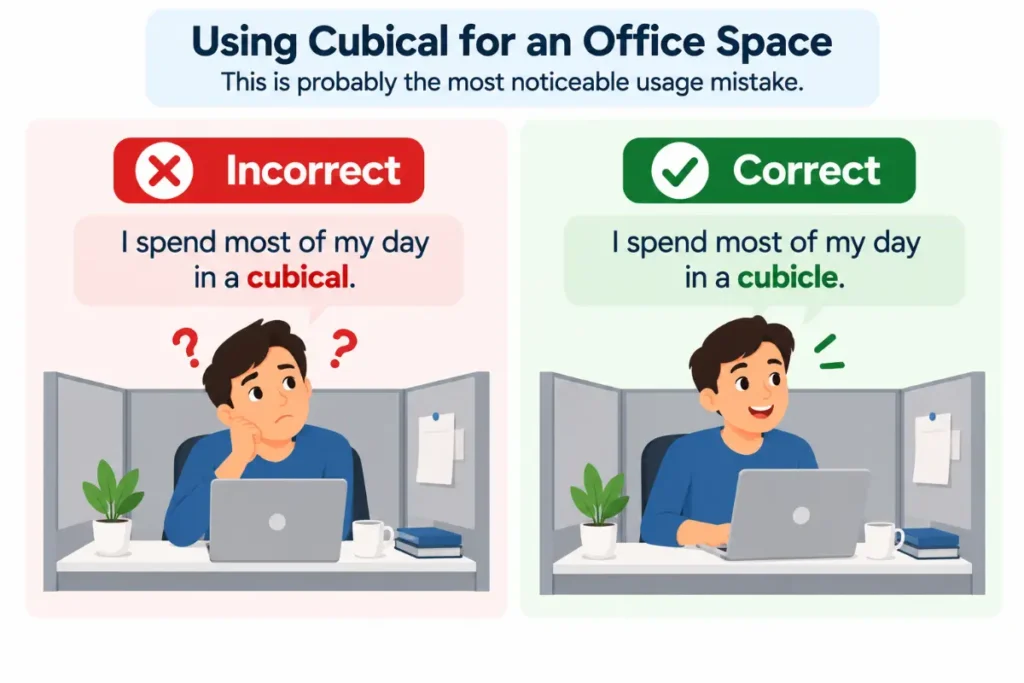
Using Cubical for an Office Space
This is probably the most noticeable usage mistake.
Incorrect:
I spend most of my day in a cubical.
Correct:
I spend most of my day in a cubicle.
The mistake happens because people connect the word with the shape of the workspace. Office partitions often create small rectangular areas that can feel box like. Still the standard noun for that space is cubicle.
Using Cubicle to Describe Shape
You may also see people write:
The object has a cubicle shape.
If you mean that the object resembles a cube the natural word is cubical.
Better:
The object has a cubical shape.
You can also simply say:
The object is cube shaped.
That option is especially clear for general readers.
Confusing the Endings
The endings can cause visual confusion. Cubical contains the familiar adjective ending al while cubicle contains a noun ending.
When you’re proofreading quickly your eyes may focus on the shared opening cubic and overlook the final letters.
Reading the whole word rather than recognizing only the first part can help.
Assuming Similar Words Must Have the Same Meaning
English contains many words that look closely related but perform different jobs. Similar spelling doesn’t guarantee identical meaning.
Historic and historical are a familiar example. Economic and economical are another. The same principle applies here.
Choosing a Word From Sound Alone
Speech can make the distinction harder because both words begin with the same basic sound pattern. If you aren’t sure which word belongs in your sentence ask what you’re describing.
If it’s a space use the noun.
That quick meaning check works better than trying to remember the spelling in isolation.
Pronunciation Guide
How to Pronounce Cubical
Cubical is commonly pronounced:
/ˈkjuːbɪkəl/
You can divide it into three syllables:
cu bi cal
An easy pronunciation guide is:
KYOO bih kul
The main stress falls on the first syllable.
The first part sounds like cue followed by a short bih sound and then a relaxed kul ending.
How to Pronounce Cubicle
Cubicle is commonly pronounced:
/ˈkjuːbɪkəl/
In many varieties of English the pronunciation is very similar to cubical. That’s one reason the words can be confusing in spoken language.
The spelling and grammatical function provide more useful clues than sound alone.
You can remember the meaning rather than relying entirely on pronunciation.
If you hear someone mention an office space you know they mean cubicle. If the conversation concerns shape geometry or design the adjective cubical may be the intended word.
Why Pronunciation Doesn’t Solve Everything
These words are a good reminder that English spelling and pronunciation don’t always provide enough information to distinguish related vocabulary.
Two words can sound extremely similar while performing different grammatical jobs.
That’s why strong vocabulary knowledge involves more than pronunciation. You also need to recognize meaning context and sentence structure.
Etymology and Word Origin
The history of these words helps explain why they look related.
Cube comes from Latin cubus which came from Greek kybos. The basic idea refers to a cube or a solid shape.
Cubical developed from cube with the adjective forming ending al. Its meaning therefore relates directly to the shape or properties of a cube.
Cubicle has a different historical path. It is connected to Latin cubiculum which referred to a chamber or sleeping room. That Latin word is related to cubare meaning to lie down.
Over time cubicle entered English as a word for a small compartment or room.
The modern meanings therefore make historical sense. Cubical remains closely tied to the geometry and form of a cube. Cubicle refers to a small space.
This is also a useful reminder that words with similar appearances can have overlapping historical roots without becoming interchangeable in modern English.
Regional Usage
American English
Both words are standard in American English. Cubicle is especially familiar in office vocabulary. Many Americans use it to describe a workstation surrounded by partial partitions.
Cubical is less common in everyday conversation but remains standard when describing shapes objects structures and geometric forms.
British English
British English uses both forms with essentially the same distinction. Cubicle can describe a small compartment in an office changing area or other setting. Cubical functions as an adjective describing something shaped like a cube.
There isn’t a major British spelling difference that changes this distinction.
Australian English
Australian English also recognizes both words. Context determines which one belongs in a sentence. Cubicle commonly refers to a divided workspace or private compartment while cubical describes shape.
Canadian English
Canadian English follows the same general distinction. Writers can use cubicle for a small enclosed area and cubical for something related to the shape of a cube.
The important point across these varieties is that the difference isn’t a regional spelling issue. It’s a difference in vocabulary and grammar.
Grammar Rules and Part of Speech
Cubical as an Adjective
Cubical is an adjective because it describes a noun.
For example:
The table has a cubical design.
The word cubical describes the design.
You can also use it after linking verbs.
The structure is cubical.
Here the adjective describes the subject.
Other common patterns include:
cubical shape
cubical container
The word generally carries a descriptive function rather than naming a thing.
Cubicle as a Noun
Cubicle is a countable noun.
You can write:
I have a cubicle.
She moved to another cubicle.
The office has several cubicles.
Because it’s a countable noun you can use articles and plural forms with it.
a cubicle
the cubicle
two cubicles
several cubicles
You can also use it after prepositions.
He is sitting in his cubicle.
The printer is beside my cubicle.
She walked past the cubicle.
This grammatical behavior clearly separates the noun from the adjective.
Punctuation
Neither word has special punctuation rules.
Punctuation depends on the sentence rather than the vocabulary item.
For example:
The cubical structure looked unusual.
The manager visited my cubicle.
No special comma or other punctuation is required simply because these words appear.
The bigger concern is choosing the word that matches the intended meaning.
Real Life Usage Examples
Daily Conversation
In ordinary conversation you’ll hear cubicle far more often than cubical because people commonly talk about offices and workspaces.
For example:
My cubicle is freezing today.
I moved to a different cubicle last week.
Cubical can appear in conversation when someone discusses an object’s shape.
That box looks almost cubical.
The building has a cubical design.
Workplace Communication
Cubicle is common in workplace conversations and emails.
Please leave the documents on my desk in the cubicle near reception.
The new employees will each have a cubicle.
Cubical may appear in workplace communication when discussing design engineering packaging or construction.
The new equipment has a compact cubical housing.
The product uses a cubical storage unit.
Academic Writing
Academic writing may use cubical in mathematics engineering architecture physics and related subjects.
The researchers examined the properties of a cubical structure.
The model assumes a cubical volume for the sample.
Cubicle can also appear in academic contexts when researchers discuss workplaces healthcare spaces or built environments.
The study examined employee satisfaction in open offices and traditional cubicles.
The hospital divided the treatment area into individual cubicles.
News and Journalism
News writing commonly uses cubicle when describing workplace culture.
Employees returned to their cubicles after the meeting.
The company plans to remove several rows of office cubicles.
Cubical can appear in reports about architecture design or unusual structures.
The new building features a series of cubical forms.
Literature and Storytelling
Story writers may use cubicle to establish a workplace or enclosed setting.
He sat alone in his cubicle and stared at the clock.
She stepped into the small cubicle and closed the curtain.
Cubical can help describe visual details.
A cubical tower rose above the surrounding buildings.
The room contained a strange cubical object.
These examples show why context matters. The words belong to different semantic categories even though they look and sound remarkably close.
Related and Confused Terms
Cube
A cube is a three dimensional solid with six square faces. It is the basic noun behind the adjective cubical.
Cube Shaped
Cube shaped is a simple phrase that means having the shape of a cube. It’s often easier for general readers than the more formal adjective cubical.
Cuboid
A cuboid is a three dimensional shape with six rectangular faces. A cube is a special type of cuboid in which the relevant dimensions are equal.
Compartment
A compartment is a separate section within a larger area. A cubicle can be viewed as one kind of small compartment.
Booth
A booth is a small enclosed or partly enclosed space used for activities such as dining work or changing. It can overlap with cubicle in some contexts but isn’t always interchangeable.
Workspace
A workspace is an area where someone works. An office cubicle can be one type of workspace.
Partition
A partition is a structure that divides one area from another. Office partitions can create cubicles.
Chamber
A chamber is a room or enclosed space. It can have a broader and sometimes more formal meaning than cubicle.
These related terms show the semantic difference clearly. Words connected with cube shape belong near cubical. Words connected with enclosed spaces belong near cubicle.
An Easy Memory Trick
Here’s a simple way to keep the words straight.
Think cubical equals cube shape.
Think cubicle equals little space.
You can also connect the endings with their jobs.
The al ending helps you recognize an adjective.
The noun cubicle names a thing or place.
Try this mental test before choosing the word:
Is it describing a shape? Use cubical.
Is it naming a small space? Use cubicle.
This method works because it focuses on meaning rather than visual similarity.
You don’t need to memorize a long spelling rule. You only need to identify what the sentence is talking about.

Expert Editor Insight
An experienced editor would rarely treat these words as simple spelling variants because context makes their meanings distinct. The most common problem is using the noun cubicle when the writer needs the adjective cubical or using cubical for an office workspace. Spellcheck tools may not catch every context error because both words are legitimate English forms. A useful editing habit is to replace the word temporarily with a plain phrase such as cube shaped or small enclosed space. If the sentence still makes sense with one of those meanings you can choose the correct word confidently.
Final Takeaway
Cubical vs cubicle becomes much easier once you focus on meaning instead of spelling. Cubical is an adjective that describes something shaped like a cube. Cubicle is a noun that names a small enclosed or divided space such as an office workspace. Both are correct English words but they serve different purposes.
If you’re talking about shape choose cubical. If you’re talking about a workspace or compartment choose cubicle. One practical editing trick can help you remember the distinction. Replace cubical with cube shaped and cubicle with small enclosed space. If the sentence still expresses your intended meaning you’ve probably chosen the right word.
FAQs
Is cubical a real word?
Yes. Cubical is a standard English adjective. It means shaped like a cube or related to the form of a cube. You might describe a container a building a sculpture or another object as cubical. It isn’t an incorrect version of cubicle. The two words are separate terms with different grammatical functions and meanings.
Is cubicle a real word?
Yes. Cubicle is a standard English noun that refers to a small enclosed or divided space. The word commonly describes office workspaces separated by partitions. It can also describe private spaces in changing rooms medical facilities and other settings. Unlike cubical it names a physical space rather than describing the shape of an object.
What is the difference between cubical and cubicle?
The main difference is meaning and grammar. Cubical is an adjective that describes something shaped like a cube. Cubicle is a noun that names a small enclosed or divided space. For example a box can have a cubical shape while an employee can work inside a cubicle. They aren’t interchangeable.
Which word should I use for an office workspace?
Use cubicle. An office cubicle is a small workspace separated from nearby areas by partitions or partial walls. For example you can say I work in a cubicle near the window. Using cubical for this meaning is incorrect in standard English because cubical describes shape rather than an office space.
How do you pronounce cubical?
Cubical is commonly pronounced /ˈkjuːbɪkəl/. You can think of it as three syllables that sound roughly like KYOO bih kul. The main stress falls on the first syllable. The pronunciation is very close to cubicle in many forms of English so meaning and context provide stronger clues than sound alone.
How do you pronounce cubicle?
Cubicle is commonly pronounced /ˈkjuːbɪkəl/. It has three syllables with stress on the first syllable. An easy pronunciation guide is KYOO bih kul. Because cubical and cubicle can sound extremely similar in ordinary speech it’s useful to focus on context. An office space is a cubicle while something shaped like a cube is cubical.
Can cubical and cubicle be used interchangeably?
No. They shouldn’t be treated as interchangeable because they have different meanings and grammatical roles. Cubical describes a shape while cubicle names a small enclosed space. You can describe a structure as cubical but you can’t normally use cubical as the noun for an office workspace. Likewise cubicle doesn’t mean cube shaped.
Are these words different in American and British English?
There is no major regional distinction in their core meanings. American British Canadian and Australian English all recognize cubical as an adjective related to cube shape and cubicle as a noun for a small enclosed space. The difference is therefore based on meaning and grammar rather than a regional spelling preference.
