
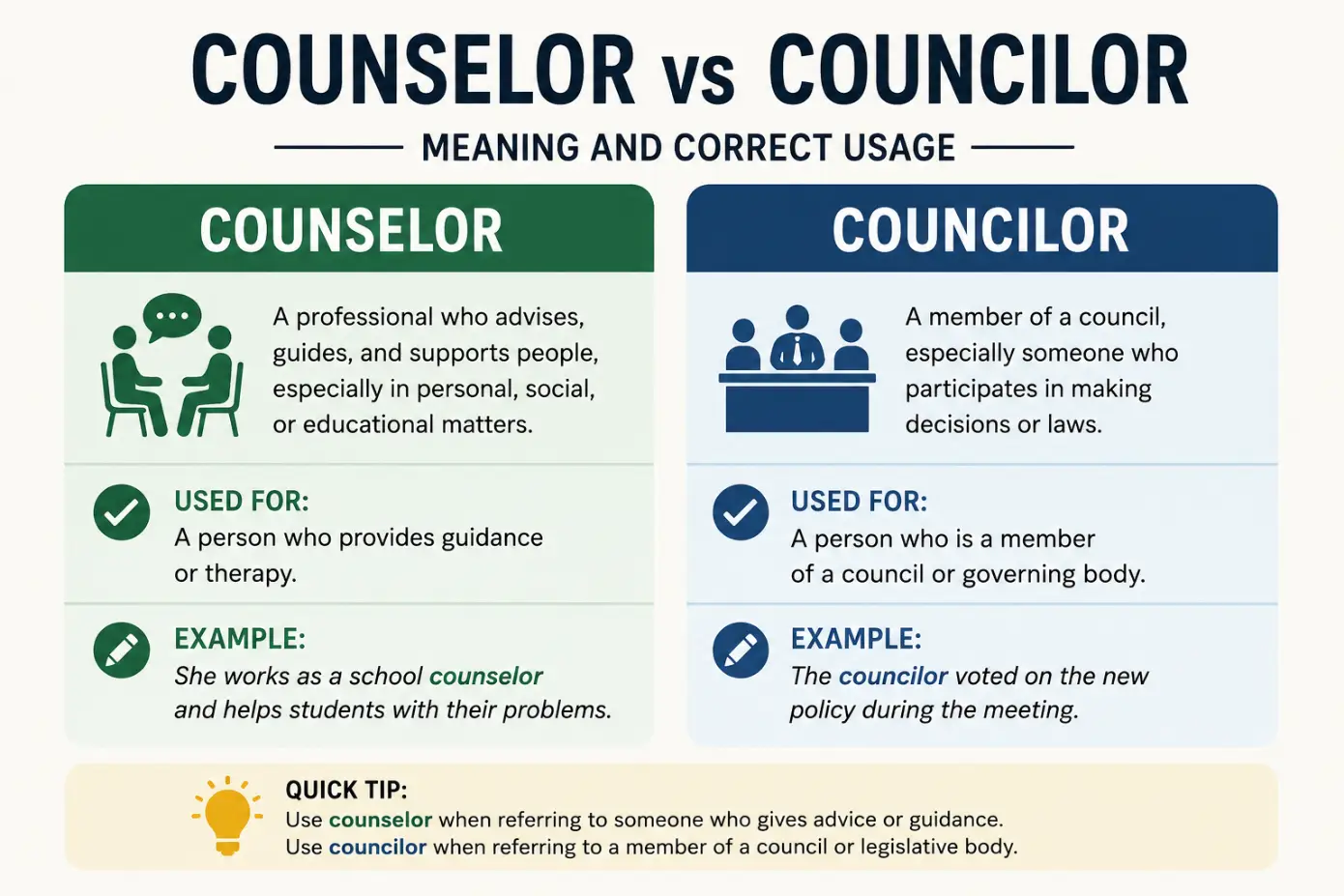
If you’re trying to choose between counselor vs councilor you’re dealing with two real English words rather than one correct spelling and one simple typo. The difference comes down to meaning. A counselor gives advice or guidance while a councilor serves as a member of a council.
The confusion makes sense because the words sound almost identical in American English. They also share most of their letters. That small spelling difference can easily slip past you when you’re writing quickly. The key is to connect the spelling with the person’s role.
Once you know that basic distinction the choice becomes much easier. This guide explains the meanings of both words their pronunciation grammar regional usage origins common mistakes and natural examples. You’ll also learn a simple editing trick that can help you choose the right form in seconds.
Quick Answer
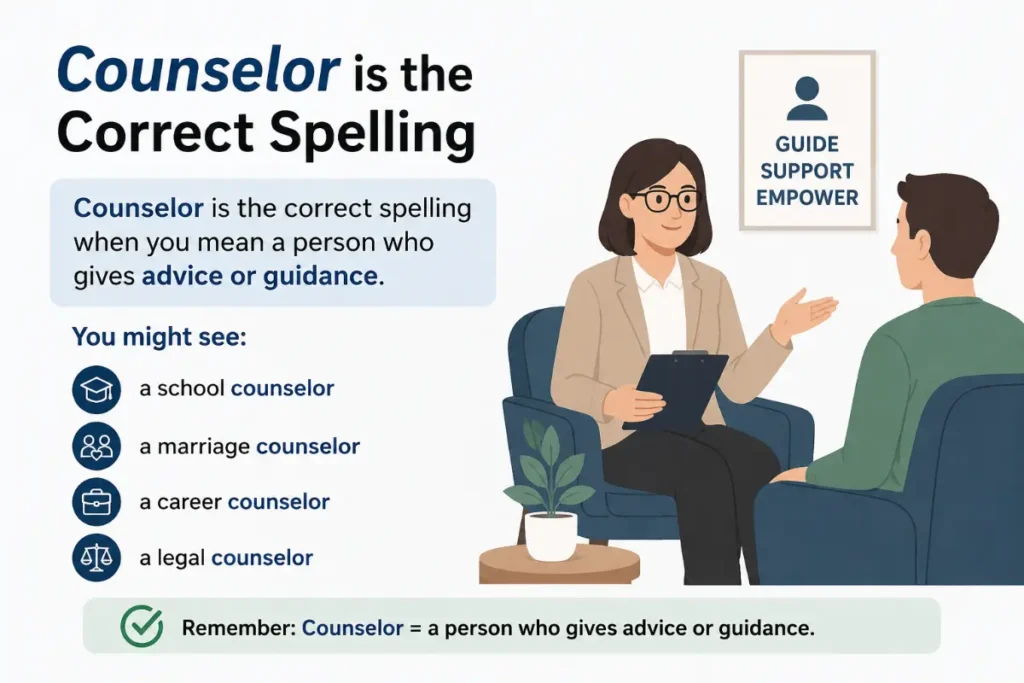
A counselor is a person who gives advice guidance or professional support. A councilor is a person who serves as a member of a council. Both spellings are correct but they have different meanings. In American English the two words are usually pronounced the same. The meaning of the sentence tells you which spelling to use.
Comparison Table
| Form | Meaning | Part of Speech | Origin | Usage Frequency | Formality | Common Contexts | Example |
|---|---|---|---|---|---|---|---|
| Counselor | A person who gives advice guidance or support | Noun | Related to counsel | Common | Neutral to formal | Schools therapy careers law camps and personal guidance | The school counselor helped Maya choose her classes. |
| Councilor | A member of a council | Noun | Related to council | Common in government contexts | Formal or civic | City councils local government public meetings and civic affairs | The councilor spoke during the city meeting. |
Meaning and Definition
The two words share a close spelling pattern but they point to different roles. Think of them as neighbors rather than twins. They look similar and sound similar but they do different jobs.
Meaning of Counselor
A counselor is someone who gives advice guidance or support.
The word has several common uses in American English. A school counselor helps students with academic plans personal concerns and future goals. A career counselor helps people make decisions about education or employment. A professional counselor may provide mental health support within the scope of their training and credentials.
The word can also appear in legal and professional settings. A lawyer may be called a counselor in formal legal language. In some contexts the term can also describe someone who advises another person or group.
The central idea remains the same: counsel involves advice or guidance.
Consider these examples.
- The school counselor helped the student plan her schedule.
- He met with a career counselor before applying for college.
- The counselor listened carefully and offered practical advice.
- She asked her counselor for help with the decision.
The person does not need to belong to a government body. The role centers on giving guidance.
Meaning of Councilor
A councilor is a person who belongs to a council.
In the United States the word commonly appears in local government. A city councilor may attend public meetings vote on proposals and represent people in a particular district or area.
The word connects to council which refers to a group that meets to discuss issues make decisions or govern.
For example:
- The councilor attended the public hearing.
- Residents asked their councilor about the proposed changes.
- The councilor voted in favor of the measure.
- Several councilors discussed the budget.
The important idea is membership in a council. A councilor may give advice during a meeting but the title comes from the person’s position on the council.
The Key Difference Explained
The easiest way to separate these words is to focus on the root idea behind each one.
Counselor relates to counsel.
Councilor relates to council.
Counsel means advice or guidance. Council means an organized group that meets to discuss or decide matters.
That gives you a simple mental shortcut.
- If the person gives counsel use counselor.
- If the person serves on a council use councilor.
This distinction works in most ordinary American English situations.
Spelling
The spelling difference is small but meaningful.
Counselor contains the word counsel.
Councilor contains the word council.
The letters after the initial coun create the distinction. One contains sel while the other contains cil.
That tiny difference carries the entire meaning.
Meaning
The meanings are not interchangeable.
A counselor advises or supports people.
A councilor serves on a council.
You could say that a councilor offers counsel during a meeting. You still wouldn’t normally call that person a counselor simply because they gave advice.
The title depends on the person’s role rather than the action they happen to perform at a particular moment.
Grammar
Both words are nouns.
They normally refer to people.
You can use them as singular nouns.
The counselor arrived early.
The councilor arrived early.
You can also make them plural.
The counselors met with the students.
The councilors met before the public session.
Possessive forms work normally too.
The counselor’s office was nearby.
The councilor’s proposal received support.
Pronunciation
In American English the two words are generally pronounced alike or extremely similarly. This makes the confusion much more understandable.
That means listening alone often won’t tell you which spelling belongs on the page.
You need to use meaning and context.
Formality
Both words can appear in formal writing.
Counselor is common in schools professional services legal contexts and guidance roles.
Councilor is common in government journalism public notices and civic writing.
Neither word is inherently informal.
The context determines how formal the sentence feels.
Regional Usage
The biggest regional spelling differences involve related British forms. American English generally uses counselor for an adviser and councilor for a member of a council.
British English often uses counsellor for an adviser and councillor for a member of a council.
So American English tends to use one l in both forms after the initial part of the word while British spelling commonly uses doubled letters.
This difference can make the words even more confusing for readers who encounter several varieties of English online.
Which Form Is Correct?
Both forms are correct.
The correct choice depends on the meaning you intend.
Use counselor when you mean someone who provides advice guidance or support.
Use councilor when you mean someone who serves as a member of a council.
This is not a case where one spelling is correct and the other is wrong. They are separate nouns with related historical backgrounds.
A useful editor’s test is to replace the word mentally.
If you can replace it with adviser or advisor then counselor may be the word you need.
If you can replace it with member of the council then councilor is the better choice.
For example:
The school counselor helped me.
You could say:
The school adviser helped me.
But:
The city councilor spoke to residents.
You could say:
The city council member spoke to residents.
That substitution test quickly exposes the difference.
Why People Confuse These Words
The confusion has a very practical explanation. English gives both words nearly the same visual shape and the same basic pronunciation in American speech.
The words also share a related history. Both connect to the idea of deliberation advice and organized decision making. That historical relationship helps explain their similar appearance even though modern English gives them different jobs.
There is another problem too. People often learn words through sound before they learn their spelling. If you hear someone say the word you may not know which letters belong on the page.
This happens often with homophones and near homophones.
The same issue appears in words such as:
- Principal and principle.
- Stationary and stationery.
- Advice and advise.
- Affect and effect.
- Complement and compliment.
The ear hears something familiar. The brain then has to select the correct written form based on context.
That’s exactly what happens here.
Sentence Examples
Here are natural examples that show how the distinction works in everyday American English.
- The school counselor helped me choose classes for next semester.
- I talked with a career counselor about changing fields.
- The counselor encouraged him to apply for the scholarship.
- Our guidance counselor sent an email about college applications.
- The counselor listened to the student before offering advice.
- The city councilor answered questions from local residents.
- The councilor proposed a new plan for improving public transportation.
- Several councilors attended the evening meeting.
- The councilor spoke with homeowners about the zoning issue.
- The councilor voted against the proposed ordinance.
Notice how the role determines the spelling. The first five examples involve advice guidance or support. The final five involve membership in a council.
Common Mistakes and Misspellings
Some mistakes happen because writers remember the sound but not the spelling. Others happen because the meanings overlap in real life.
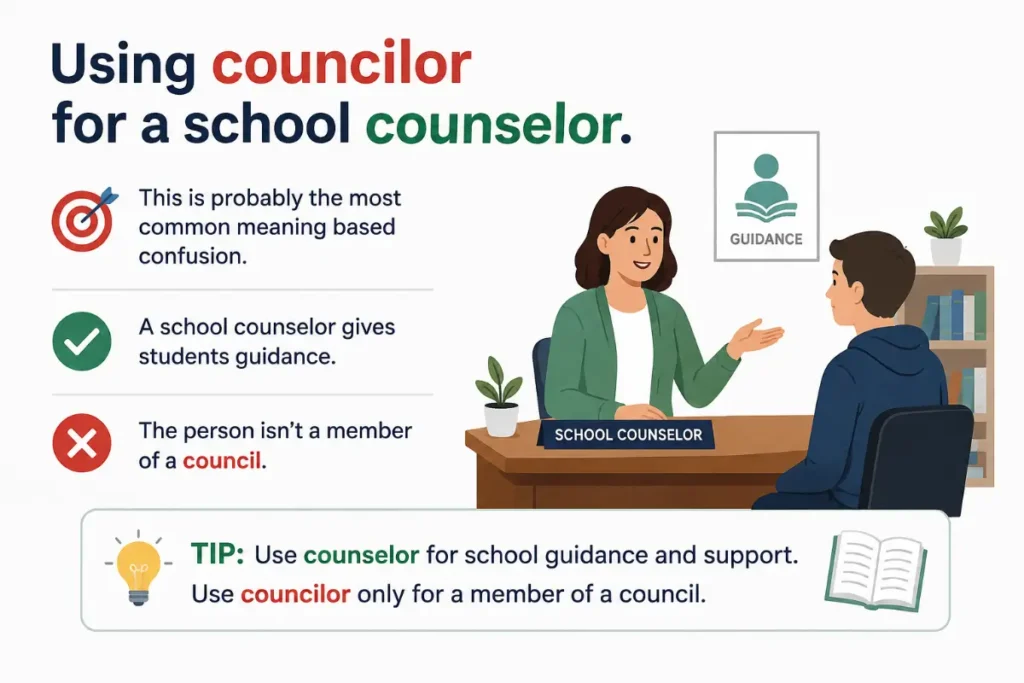
Using Councilor for an Adviser
Incorrect:
She made an appointment with a councilor at school.
Correct:
She made an appointment with a counselor at school.
A school adviser is a counselor. The person doesn’t belong to a government council simply because the job involves giving advice.
Using Counselor for a Government Official
Incorrect:
The city counselor voted on the proposal.
Correct:
The city councilor voted on the proposal.
The official serves on a council so councilor fits the meaning.
Assuming One Spelling Is Always Wrong
This is perhaps the biggest mistake.
Neither form should automatically be marked as incorrect. Both are established English words.
The important question is what the person does.
Confusing Counsel With Council
Counsel means advice or guidance.
Council means a group that meets to discuss or decide matters.
This distinction provides the best spelling clue.
If the sentence involves advice think counsel.
If the sentence involves a governing or advisory group think council.
Mixing American and British Forms
A writer may use counselor in one sentence and then use counsellor in another without realizing the spelling has changed.
That isn’t necessarily a grammar error. It can reflect different English varieties.
For American audiences keep your spelling consistent with American usage.
Pronunciation Guide
In American English both words are commonly pronounced with the same basic sound.
The usual pronunciation is represented approximately as:
Counselor: /ˈkaʊnsələr/
Councilor: /ˈkaʊnsələr/
The first syllable sounds like cown.
The second part sounds roughly like suh ler.
A simple pronunciation guide is:
COUN suh ler
The main stress falls on the first syllable.
Because the two words sound alike in many American contexts pronunciation cannot reliably tell you which spelling to choose. This is one reason the confusion survives even among fluent English speakers.
If you’re proofreading a document and only hear the sentence in your head you may miss the error. Look at the person’s role instead.
Etymology and Word Origin
The two words are closely related in history but developed around different ideas in modern English.
Counselor comes from the family of words related to counsel. Counsel traces back through Anglo French and Old French usage and ultimately connects to Latin roots associated with consultation and deliberation.
The English word counsel has long been associated with advice guidance consultation and professional advice. The ending or forms a noun for a person who performs a role connected with that action or function.
So counselor developed around the idea of a person who gives counsel.
Councilor comes from council. Council also traces through French to Latin roots associated with gathering or deliberation. In English it developed as a word for an organized group that meets to discuss matters or make decisions.
The ending or then identifies a person who belongs to that body.
The shared history explains why the words look so similar. Their modern meanings provide the practical distinction.
You don’t need to memorize the entire history to spell them correctly. Remembering the connection between counsel and advice and council and a governing group is far more useful in everyday writing.
Regional Usage
American English
American English commonly uses counselor for an adviser and councilor for a member of a council.
This distinction appears in schools government workplaces legal settings and many other contexts.
For American readers the one letter difference is worth preserving because the meaning changes with the spelling.
British English
British English commonly uses counsellor for a person who provides advice or professional guidance.
For a member of a council British English commonly uses councillor.
The extra l in both forms reflects a broader British spelling pattern.
The meaning distinction remains essentially the same.
Australian English
Australian English generally follows British spelling patterns in many formal contexts. As a result you may encounter counsellor and councillor.
The roles remain distinct.
A counsellor provides advice or support.
A councillor serves on a council.
Canadian English
Canadian English can show a mixture of British and American spelling conventions. In professional and institutional contexts you may encounter forms that reflect either tradition.
The safest approach is to follow the spelling standard used by the organization or publication you’re writing for.
For a US audience use counselor for an adviser and councilor for a council member.
Grammar Rules and Part of Speech
Both words function primarily as nouns.
They identify people rather than actions or qualities.
Counselor As A Noun
A counselor can appear after an article.
The counselor arrived.
It can also follow a possessive.
My counselor called today.
It can appear in a compound noun.
School counselor.
Career counselor.
Camp counselor.
Legal counselor.
The word can also take a plural ending.
Counselors help students make academic plans.
The spelling does not change when the noun becomes plural except for the normal addition of s.
Councilor As A Noun
Councilor also behaves like a regular countable noun.
The councilor arrived.
A councilor spoke first.
The councilor’s proposal passed.
Several councilors attended the meeting.
The plural form is created with s.
The possessive form also follows normal English rules.
The councilor’s office.
The councilors’ meeting.
Using Articles
Because both words are countable nouns you can use a or the with them depending on context.
A counselor called me.
The counselor called me.
A councilor attended the event.
The councilor attended the event.
Sentence Position
Both nouns can work as subjects or objects.
The counselor helped the student.
The student thanked the counselor.
The councilor introduced the proposal.
Residents thanked the councilor.
Their grammatical behavior is simple. The challenge lies mainly in choosing the right noun.
Real Life Usage Examples
The difference becomes much easier to understand when you see the words in realistic settings.
Daily Conversation
People often use counselor in conversations about schools careers personal guidance and support.
- I need to talk to my counselor before I register for classes.
- My counselor gave me some good advice about the interview.
Councilor appears less often in casual conversation unless the topic involves local government.
- I emailed my councilor about the traffic problem.
- The councilor came to our neighborhood meeting.
Workplace Communication
A counselor may appear in workplace settings involving employee support career planning or professional advice.
- The company connected employees with a career counselor.
- She spoke with a counselor before making the career change.
Councilor appears in civic or government communication rather than ordinary workplace communication.
- The councilor requested a report on the project.
- Our office sent the proposal to the councilor.
Academic Writing
Academic writing often uses counselor when discussing student services or guidance.
- School counselors can help students plan their academic goals.
- Students may meet with a counselor before choosing a major.
Councilor may appear in research about local government public policy or civic institutions.
- Each councilor represented a specific district.
- The study examined how councilors responded to public concerns.
News Writing
News reports frequently use councilor in stories about municipal government.
- The councilor addressed residents during Tuesday’s meeting.
- Councilors debated the proposed housing plan.
Counselor may appear in education health legal or social service reporting.
- A school counselor spoke about the importance of student support.
- The counselor recommended additional resources for the family.
Literature And Storytelling
Both words can appear naturally in fiction and narrative writing.
A character may visit a counselor after facing a difficult decision.
A story about local politics may feature a councilor attending a public meeting.
The surrounding action usually makes the intended meaning obvious.
Related And Confused Terms
Several words sit close to these terms in meaning or spelling.
Counsel
Counsel means advice or guidance. It can also refer to a lawyer in certain legal contexts.
The connection with counselor is direct.
Council
Council refers to an organized group that meets to discuss matters or make decisions.
Councilor comes directly from this word family.
Counselor
Counselor identifies a person who provides advice guidance or support.
Councilor
Councilor identifies a member of a council.
Adviser
Adviser means someone who gives advice. It can often replace counselor when the context involves general guidance.
Advisor
Advisor has the same basic meaning as adviser and is widely used in American English.
Councillor
Councillor is a common British spelling for a member of a council.
Counsellor
Counsellor is a common British spelling for a person who provides counsel or professional guidance.
The spelling differences can look complicated at first but the underlying pattern is fairly clean. Counsel connects with advice. Council connects with a group.
Counselor And Advisor
Counselor and advisor can overlap but they aren’t always perfect substitutes.
An advisor may provide specialized guidance in areas such as finance education business or academics.
A counselor can also provide guidance but the title often suggests a more defined professional or institutional role.
For example:
The academic advisor helped me choose courses.
The school counselor helped me create an academic plan.
Both sentences involve guidance. The exact title depends on the institution and role.
Counselor And Therapist
These words also overlap in some settings but they aren’t identical.
A counselor may provide mental health support. A therapist may also provide mental health treatment. The exact duties and professional titles depend on training licensing and the setting.
That means you shouldn’t assume every counselor is a therapist or every therapist is called a counselor.
In ordinary writing use the professional title that accurately describes the person’s role.
Councilor And Council Member
Councilor and council member often refer to the same basic civic role.
Council member is especially clear because it spells out the meaning.
For example:
The councilor voted for the proposal.
The council member voted for the proposal.
Both can work when referring to a person serving on a council.
If you’re worried that readers may confuse councilor with counselor using council member can remove the ambiguity.
A Simple Memory Trick
The easiest memory trick uses the middle letters.
Think:
Counsel = advice.
Council = group.
Then connect each noun to its source.
Counsel + or = counselor.
Council + or = councilor.
Imagine someone sitting across from you and giving advice. That person is your counselor.
Now imagine a person sitting around a table with other elected officials. That person is a councilor.
The mental picture makes the spelling easier to remember than memorizing isolated letters.
How Editors Catch The Difference
Experienced editors don’t rely only on spelling software for this distinction. A grammar checker may recognize both forms as valid words and therefore fail to identify a wrong choice.
Context is the real test.
Suppose an article says:
The counselor voted on the new parking rules.
A spell checker may accept the sentence because counselor is a correctly spelled word. But an editor will ask why an adviser is voting on a council proposal.
If the person is an elected member of a city council the intended word is probably councilor.
Now consider:
The councilor helped the student plan her classes.
Again the spelling may pass a basic grammar check. The editor needs to understand the role.
This is a useful lesson for all confusing word pairs. Spell check can tell you that a word exists. It can’t always tell you that you chose the wrong word for the sentence.
Expert Editor Insight
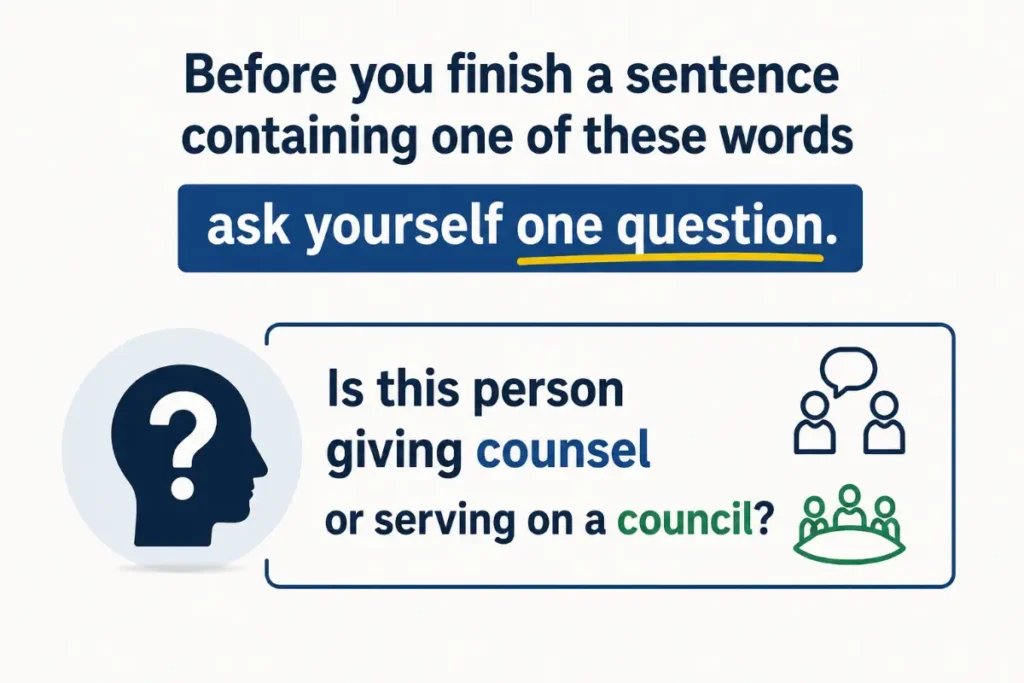
An experienced editor looks past spelling and checks meaning first. For these two nouns the best editing question is simple: Is this person giving counsel or serving on a council? That quick context check works better than relying on pronunciation because the American English forms sound the same. Automated spelling tools may accept both words because both are legitimate. Human proofreading still matters when two valid words carry different meanings.
Why Context Matters More Than Sound
English spelling often preserves distinctions that speech doesn’t.
That can feel unfair when you’re learning the language. You hear one sound but have to choose between two written forms.
The solution is to stop treating pronunciation as the deciding factor.
Ask what the sentence means.
If the person helps students with schedules goals or personal concerns you’re probably talking about a counselor.
If the person votes on local policies represents a district or participates in a council meeting you’re probably talking about a councilor.
This method works because meaning stays stable even when pronunciation doesn’t reveal the spelling.
When To Use Counselor
Use counselor when the person’s main role involves advice guidance or support.
Common contexts include:
- School counseling.
- Career counseling.
- Personal counseling.
- Professional guidance.
- Camp counseling.
- Legal counseling.
- Academic guidance.
The exact role can vary but the central idea remains advice or support.
For example:
The college counselor reviewed my application.
The camp counselor organized activities for the children.
The career counselor helped me prepare for the interview.
Each sentence describes someone whose role centers on helping or advising others.
When To Use Councilor
Use councilor when the person serves as a member of a council.
Common contexts include:
- City government.
- Municipal government.
- Local elections.
- Public meetings.
- District representation.
- Civic policy.
- Government committees connected to a council.
For example:
The councilor met with residents.
The councilor attended the public hearing.
In each case the word identifies a civic role.
Can The Same Person Be Both?
Yes. A person could technically hold roles that make both words applicable in different contexts.
For example a person might serve as a councilor and also work professionally as a counselor.
The two titles describe different roles.
Imagine someone named Jordan who works as a school counselor but later gets elected to a city council. You could write:
Jordan is a counselor at the local high school.
Later:
Jordan is a councilor representing the district.
The spelling changes because the role changes.
This example shows why the words should never be treated as interchangeable.
Is Councilor A Misspelling Of Counselor?
No.
Councilor is a legitimate English noun.
It refers to a member of a council.
Likewise counselor is a legitimate English noun referring to someone who provides counsel or guidance.
The confusion comes from their similar spelling and pronunciation rather than from one being an incorrect version of the other.
That distinction matters when proofreading. You shouldn’t automatically correct councilor to counselor or counselor to councilor.
First determine what the sentence means.
Is Counselor A Misspelling Of Councilor?
No.
The same principle applies in reverse.
Counselor is a standard English word with its own meaning. It isn’t a misspelling of councilor.
If someone works as a school counselor then changing the word to councilor would create a meaning error.
The spelling may look close but the replacement would describe a different role.
Final Takeaway
The difference between counselor vs councilor becomes easy once you connect each spelling with its meaning. A counselor provides advice guidance or support. A councilor serves as a member of a council. Both are correct words and neither should be treated as a simple spelling error.
The pronunciation can make the choice tricky because American speakers commonly pronounce the two forms alike. That means you should rely on context rather than sound when writing. Look at the person’s role and ask what they actually do.
A useful memory trick is to connect counsel with advice and council with a group. If the person gives counsel use counselor. If the person belongs to a council use councilor. That small distinction will keep your spelling accurate and your meaning clear.
FAQs
Which is correct counselor or councilor?
Both are correct English words. Counselor refers to someone who gives advice guidance or support. Councilor refers to a person who serves on a council. The right spelling depends on the person’s role. If the context involves counseling or advice use counselor. If it involves membership in a council use councilor.
Is councilor a real word?
Yes. Councilor is a standard noun in American English. It refers to a person who serves on a council. The word commonly appears in local government and civic contexts. A city councilor may represent residents participate in meetings debate proposals and vote on matters before the council.
What does counselor mean?
Counselor means a person who gives advice guidance or support. The word appears in many settings including schools careers professional services and counseling. A school counselor may help students with academic plans while a career counselor may help someone make decisions about education or employment.
Are counselor and councilor pronounced the same?
In American English they’re commonly pronounced the same or almost the same. Both are generally pronounced with stress on the first syllable. Because pronunciation doesn’t reliably distinguish them you need to use the meaning of the sentence to select the correct spelling.
Can counselor start a sentence?
Yes. Counselor can appear at the beginning of a sentence when it functions as the subject or part of a noun phrase. For example: Counselor Maria Lopez met with the student. In standard writing the word follows normal capitalization rules and doesn’t need a capital letter simply because it appears at the beginning.
What is a synonym for counselor?
Common alternatives include adviser and advisor. The best substitute depends on the context. Counselor can suggest a specific professional or institutional role while adviser may describe someone who gives guidance more generally. Always choose the term that accurately describes the person’s actual role.
Why do people confuse these two words?
People confuse them because they look and sound extremely similar. Both begin with the same letters and share related historical roots. In American English they can also sound identical. Since speech doesn’t reveal the spelling the writer has to use context to decide between the two forms.
Is counselor appropriate in formal writing?
Yes. Counselor is completely appropriate in formal writing when it accurately describes the role. It commonly appears in professional documents educational materials legal contexts workplace communication and journalism. The key is not formality but meaning. Use counselor for an adviser or guidance role and councilor for a member of a council.
