
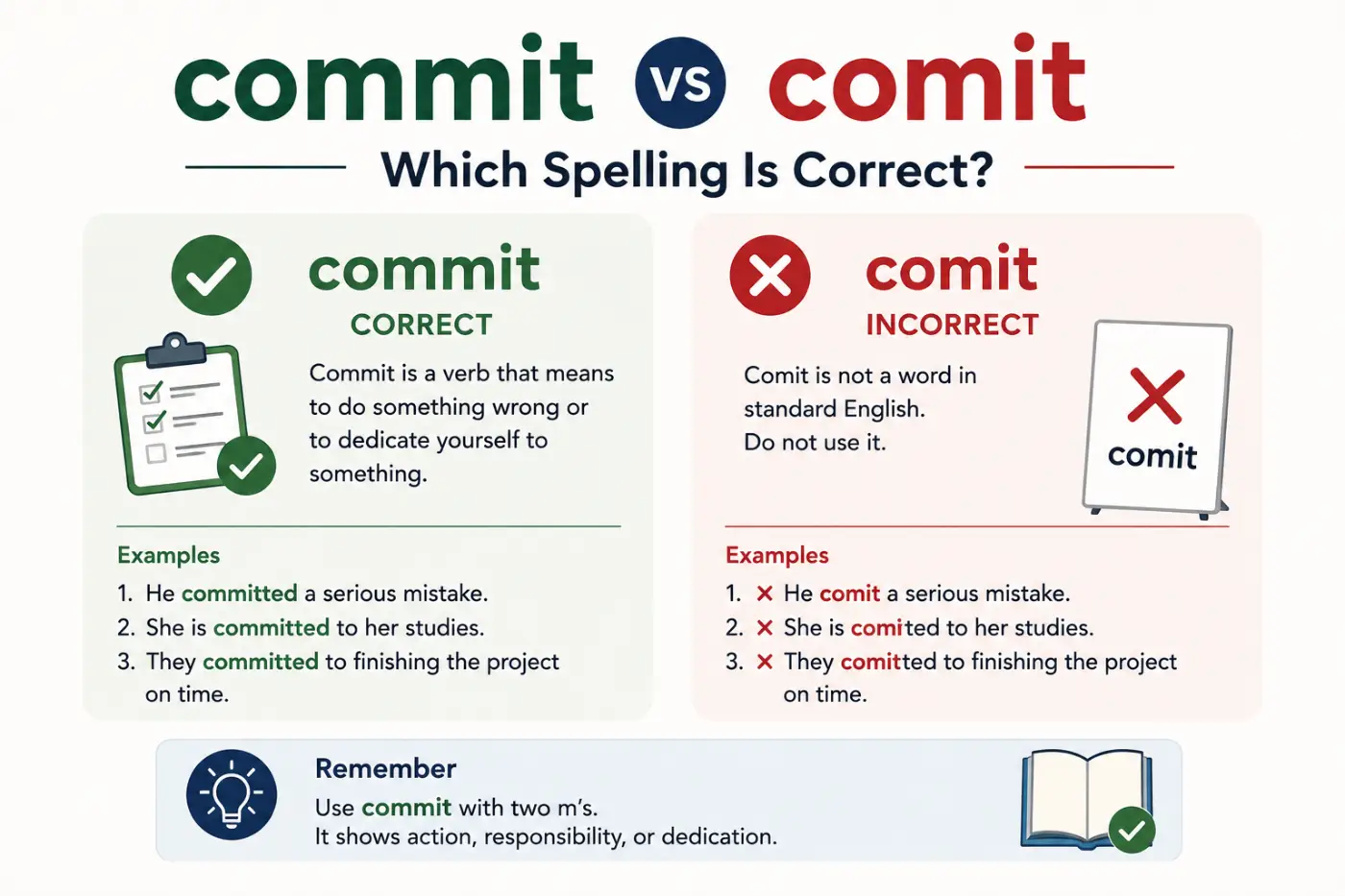
The confusion between commit vs comit is easy to understand because both forms look almost identical. The correct spelling is commit with two m letters. Comit is not the standard English spelling of the verb. If you are writing an email a school assignment a report or a professional document use commit.
The mistake usually happens because English spelling doesn’t always match pronunciation in a simple way. When you say the word aloud the two m sounds blend together. That can make the second m easy to miss when you type. The same spelling pattern also appears in related forms such as commitment and committed.
Once you know the basic rule the spelling becomes much easier to remember. This guide explains the meaning grammar pronunciation word history common mistakes and everyday uses of commit. You’ll also see why comit should normally be treated as a spelling error in standard American English.
Quick Answer
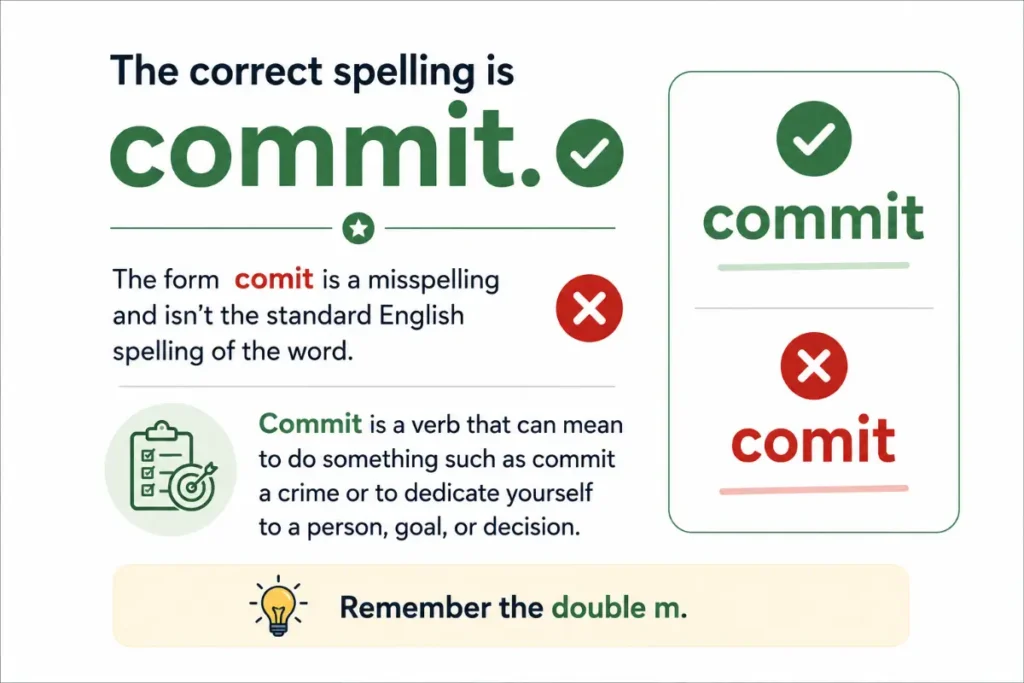
The correct spelling is commit. The form comit is a misspelling and isn’t the standard English spelling of the word. Commit is a verb that can mean to do something such as commit a crime or to dedicate yourself to a person goal or decision. Remember the double m.
Comparison Table
| Form | Meaning | Part of Speech | Origin | Usage Frequency | Formality | Common Contexts | Example |
|---|---|---|---|---|---|---|---|
| commit | To do something or dedicate yourself to something | Verb | Latin through French and Middle English | Very common | Standard | Work school relationships law decisions | She decided to commit to the plan. |
| comit | No standard English meaning as the intended form | Not a standard English verb | Not applicable as the intended English spelling | Not standard | Incorrect | Usually a spelling mistake | She decided to comit to the plan. |
Meaning and Definition
What Commit Means
Commit is a verb with several related meanings. At its core it involves doing something carrying out an action or giving yourself firmly to a person cause plan or decision.
One common meaning is to perform an action especially an action that is wrong or illegal.
For example:
He committed a serious crime.
The word can also describe a decision to dedicate yourself to something.
For example:
She committed herself to improving her writing.
Another common use involves accepting an obligation or making a firm decision.
For example:
The company committed to reducing waste.
You can also use the word when someone gives money time energy or resources to a particular purpose.
For example:
The organization committed more money to the project.
The meaning changes slightly with the context but the central idea remains clear. Someone commits an action or commits themselves to something.
What Comit Means
Comit isn’t the standard spelling of the English verb. In ordinary English writing it should be treated as a misspelling of commit.
You might see the incorrect form in a text message social media post school assignment draft or typed search query. Its appearance doesn’t give it a separate standard meaning.
That distinction matters. A spelling error can look like a real word because it follows a familiar pattern. In this case removing one m creates comit but English spelling requires the double m in the standard verb.
If you’re editing a sentence and see comit where the writer means the English verb meaning to dedicate perform or carry out an action change it to commit.
Why The Spelling Uses Two M Letters
The double m isn’t decorative. It belongs to the established spelling of the word.
English has many words where a consonant is doubled as part of the spelling pattern. Sometimes the doubling helps preserve pronunciation. Sometimes it comes from the history of the word. In the case of commit the spelling reflects the word’s long development through earlier forms of English and French from Latin.
The safest approach isn’t to invent a complicated spelling rule for every individual word. Some English spellings simply need to be learned as established forms.
Still you can use useful memory connections.
Think of these related forms:
- commit
- committed
- committing
- commitment
- recommit
The double m stays visible across this word family in several important forms. Seeing the family together makes the spelling easier to remember.
A useful mental picture is to imagine the word carrying two m letters like two small anchors. If you remove one the spelling loses its standard form.
Key Differences Explained
Spelling
The main difference is simple.
Commit is correct.
Comit is incorrect when you intend the standard English verb.
The extra m is the key spelling feature.
Meaning
Commit has several established meanings. It can describe performing an action especially a wrongdoing. It can also describe dedicating yourself to something or accepting an obligation.
Comit has no corresponding standard English meaning in this context.
Grammar
Commit is a verb.
You can use it with an object.
For example:
The player committed a foul.
You can also use it with a reflexive pronoun.
For example:
She committed herself to the project.
The word commonly appears with to when it means giving yourself firmly to something.
For example:
He committed to the training program.
Pronunciation
The two m letters do not create two separate m sounds in normal speech. The word is pronounced with the stress on the second syllable.
The pronunciation is roughly kuh MIT.
That pronunciation can make the spelling seem less obvious. You hear a short first syllable followed by the stressed second syllable. The written double m doesn’t stand out as clearly as it does on the page.
Formality
Commit is standard in both casual and formal English.
You can use it in conversation.
You can use it in school writing.
You can use it in professional emails.
You can use it in academic work.
You can use it in legal and journalistic writing.
There is no need to replace the word simply because the setting is formal.
Context
The context determines the meaning.
A person can commit a crime.
A person can commit to a goal.
A company can commit resources.
A government can commit money.
A writer can commit an idea to paper.
The same verb can therefore appear in many areas of life.
Regional Usage
The spelling remains commit across the major varieties of standard English discussed here. American English and British English don’t normally differ on this spelling.
Australian English and Canadian English also use commit as the standard spelling.
There isn’t a meaningful regional spelling choice that makes comit acceptable.
Which Form Is Correct?
Commit is the correct form in standard English.
The reason is straightforward. Commit is the established spelling of the English verb. It has been part of English for centuries and developed from the Latin verb committere through French and Middle English forms. The modern spelling preserves the double m.
The incorrect form often appears because writers hear the word more easily than they see it. The middle of the word can sound compressed in normal speech. When typing quickly a person may leave out one of the repeated letters.
That doesn’t make the spelling flexible. In edited English the standard form remains commit.
A good editor would correct the sentence:
She decided to comit to the project.
to:
She decided to commit to the project.
The correction doesn’t change the meaning. It simply restores the standard spelling.
Sentence Examples
Here are natural examples showing how the correct form works in different settings.
- I can’t commit to the trip until I know my work schedule.
- She decided to commit more time to her studies.
- The company committed additional resources to customer support.
- He admitted that he had committed a serious mistake.
- The student committed herself to finishing the research paper on time.
- Our team needs to commit to a clear plan before we begin.
- The organization committed funds to help local families.
- He wasn’t ready to commit to a long term contract.
- The athlete committed to practicing every morning.
- The writer wanted to commit the details to memory before the interview.
Notice how the word changes meaning slightly according to the object or phrase that follows it. In commit a crime the verb refers to carrying out an action. In commit to a goal it refers to dedication and firm intention.
Common Mistakes and Misspellings
Writing Comit Instead Of Commit
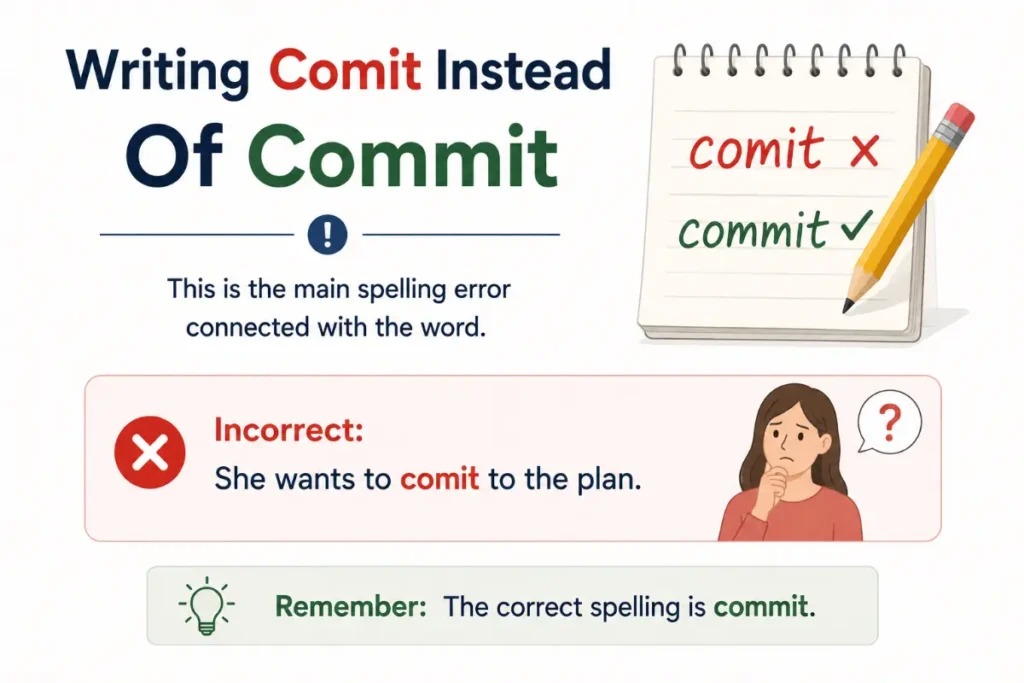
This is the main spelling error connected with the word.
Incorrect:
She wants to comit to the plan.
Correct:
She wants to commit to the plan.
The mistake happens because the repeated m can be easy to overlook.
Writing Commited Instead Of Committed
The past tense and past participle need two m letters before the ending.
Incorrect:
He commited to the project.
Correct:
He committed to the project.
The correct spelling is committed.
Writing Commiting Instead Of Committing
The present participle also keeps the double m and adds another m before the ing ending.
Incorrect:
She is commiting to the new schedule.
Correct:
She is committing to the new schedule.
This form can feel tricky because several letters appear close together. Looking at the base word first helps.
Forgetting The Double M In Related Words
Some writers learn the base verb but then lose a letter in a related form.
For example:
Incorrect:
The team showed strong committment.
Correct:
The team showed strong commitment.
The noun commitment has two m letters after the initial co. Seeing the complete word family can prevent this mistake.
Confusing Commitment With Committal
These words are related but they don’t serve the same purpose.
Commitment is a noun that often describes dedication an obligation or a promise.
For example:
Her commitment to education impressed the team.
Committal is a different noun and adjective with more specialized uses. It can relate to the act of committing something or someone to custody. It also appears in the expression noncommittal for someone who avoids giving a definite opinion or promise.
Knowing the word family helps you choose the right form instead of simply focusing on spelling.
Pronunciation Guide
The standard pronunciation of commit is commonly represented in IPA as /kəˈmɪt/.
You can think of it as:
kuh MIT
The second syllable carries the main stress.
The first vowel is weak. The second syllable contains the short i sound found in words such as sit and bit.
A common pronunciation mistake is putting too much stress on the first syllable. Native speakers normally emphasize the second syllable.
The spelling can also cause confusion because the two m letters don’t sound like two separate beats. You don’t pronounce it as though the word were split into two distinct m sounds.
When you hear the word quickly the spelling may feel less obvious than it looks on paper. That’s one reason the missing m mistake can happen during fast typing.
Etymology and Word Origin
The history of commit explains why the modern spelling may not feel completely intuitive.
The word entered English in the late fourteenth century from Latin committere through French. The Latin form carried ideas connected with joining bringing together entrusting and placing something in someone’s care. English later developed several meanings from that older sense.
Over time the English verb gained meanings connected with carrying out an action especially a wrongful action. It also developed senses involving placing someone in custody and dedicating oneself completely to something. These different meanings are still visible in modern English.
The related noun commitment developed later from the verb. Its modern sense of a promise obligation or personal dedication became established much later than the original legal and custodial meanings.
This history also explains why the word family contains several familiar forms. Words such as committed commitment committal and recommit all connect back to the same core verb.
You don’t need to memorize the Latin history to spell the word correctly. Still the history shows that the double m is part of a long established spelling tradition rather than a random modern convention.
Regional Usage
American English
In American English commit is the standard spelling.
You will see it in everyday speech writing education business communication journalism and legal contexts.
Examples include:
The company committed to the new policy.
He committed a serious offense.
She committed herself to the project.
The spelling comit should be corrected in edited American English.
British English
British English also uses commit.
There isn’t a standard British spelling that drops one of the m letters. The same basic spelling applies in both American and British English.
The meanings are also broadly the same although particular phrases can vary depending on context.
Australian English
Australian English uses commit as the standard form.
There is no established Australian spelling rule that makes comit acceptable.
Canadian English
Canadian English also uses commit.
The spelling doesn’t create the kind of regional difference you may see with words such as color and colour. This is simply a case where the standard spelling stays the same across these major English varieties.
Grammar Rules and Part of Speech
Commit is primarily a verb. It can be transitive or intransitive depending on the construction.
A transitive verb takes an object.
For example:
The suspect committed a crime.
Here crime receives the action of the verb.
The verb can also appear with a reflexive pronoun.
For example:
She committed herself to the cause.
The structure commit to is especially common when talking about dedication or agreement.
For example:
We committed to the new schedule.
You can also see commit to in professional and organizational writing.
For example:
The company committed to improving customer service.
The verb also forms several common grammatical patterns.
Commit Something
This pattern often describes an action.
For example:
He committed an error.
She committed a crime.
They committed an offense.
Commit To Something
This pattern often describes dedication or agreement.
For example:
He committed to the plan.
She committed to regular practice.
The team committed to the new approach.
Commit Yourself To Something
This structure puts stronger emphasis on personal dedication.
For example:
She committed herself to helping the community.
He committed himself to learning the skill.
Committed To Something
The past form is also common as an adjective or as part of a verb phrase.
For example:
She is committed to her work.
They remained committed to the goal.
The spelling changes to committed rather than simply adding ed to a single m form.
Real Life Usage Examples
Daily Conversation
In everyday conversation people often use commit when talking about plans decisions and personal goals.
“I don’t want to commit to anything yet.”
“She finally committed to taking the class.”
These sentences sound natural because the verb often appears when someone needs to make a firm choice.
Email And Workplace Communication
In professional communication the word can express responsibility or agreement.
“Our team is committed to meeting the revised deadline.”
“The department committed additional resources to the project.”
This usage is direct and professional without sounding overly formal.
Academic Writing
Students and researchers may use the word when describing dedication or actions.
“The researchers committed significant time to reviewing the evidence.”
“The author committed the central argument to a detailed written record.”
In academic writing context matters. If a sentence refers to a mistake or wrongdoing the verb may carry a different meaning.
News And Journalism
News writing often uses the word in reports about crime policy business and public decisions.
“The suspect was accused of committing the offense.”
“The organization committed additional funding to the program.”
The verb works well because it can describe both actions and formal commitments.
Literature And Storytelling
Writers can use commit to show a character making a serious decision.
“She knew she had committed herself to a difficult path.”
“He couldn’t commit to the promise he had made.”
In storytelling the word can carry emotional weight. It often suggests that a choice has consequences and isn’t easily reversed.
Related And Confused Terms
Several words connect naturally with commit. Understanding the differences can improve both spelling and word choice.
Commitment
Commitment is the noun form. It refers to dedication an obligation or a promise.
Example:
His commitment to the team never changed.
Committed
Committed is the past form of the verb and can also function as an adjective.
Example:
She committed to the plan.
She is committed to the plan.
Committing
Committing is the present participle and gerund form.
Example:
They are committing more resources to the project.
Recommit
Recommit means to commit again.
Example:
The team decided to recommit to its original goal.
The word has been used in English for centuries. Its historical formation is simply re plus commit.
Commitment To
This phrase commonly expresses dedication or agreement.
Example:
The company showed a strong commitment to quality.
Dedicate
Dedicate is a close synonym in some contexts. It often emphasizes giving time effort or attention to something.
Example:
She dedicated her career to teaching.
Promise
Promise can overlap with commitment when someone agrees to do something.
Example:
He promised to help.
A promise focuses more directly on giving one’s word.
Obligation
Obligation describes something a person is required or expected to do.
Example:
She had an obligation to report the issue.
A commitment can create an obligation but the two words aren’t identical.
Decide
Decide focuses on making a choice. Commit can go further by emphasizing firm dedication to that choice.
For example:
He decided to join the team.
He committed to the team.
The second sentence suggests stronger dedication.
Why People Misspell The Word
Spelling mistakes rarely happen for just one reason. Several factors can make this particular word easy to mistype.
First the pronunciation doesn’t clearly announce the spelling. The repeated consonant doesn’t create two separate syllables.
Second English contains many words with similar letter patterns. A writer may remember the general sound but not the exact spelling.
Third fast typing encourages people to skip repeated letters. The eye and brain often recognize a familiar word before every individual letter has been consciously checked.
Fourth related forms can create uncertainty. A writer who knows commit may still hesitate over committed, committing, or commitment.
Finally people often rely on sound when spelling unfamiliar words. English spelling rewards visual memory more than many learners expect.
The best solution isn’t to stare at the word repeatedly. Use it in meaningful sentences and learn the word family together.
A Simple Memory Trick
Use the phrase:
Commit needs two m letters.
Then connect it with the word family:
commit
committed
committing
commitment
The shared spelling pattern gives you a reliable visual cue.
You can also connect the word with commitment. Most people already recognize the noun because it appears frequently in everyday English. If you remember the double m in commitment you can use that memory to recall the spelling of the base verb.
Another useful trick is to slow down whenever the word appears before to.
For example:
commit to the plan
commit to the goal
commit to the schedule
That phrase is common enough to become a familiar visual pattern.
How To Use The Word Naturally
Good word choice depends on meaning.
Use commit when you mean that someone carries out an action.
For example:
He committed a serious offense.
Use it when someone dedicates themselves to a goal.
For example:
She committed to improving her skills.
Use it when an organization promises resources or support.
For example:
The company committed more money to research.
Use dedicate when you want to emphasize giving time effort or attention.
For example:
She dedicated her life to teaching.
Use promise when you want to emphasize a person’s word.
For example:
He promised to call tomorrow.
Use decide when the main idea is choosing between options.
For example:
They decided to move forward.
These distinctions make your writing more precise. Strong writing isn’t about choosing the most complicated word. It’s about choosing the word that fits the idea.
Expert Editor Insight
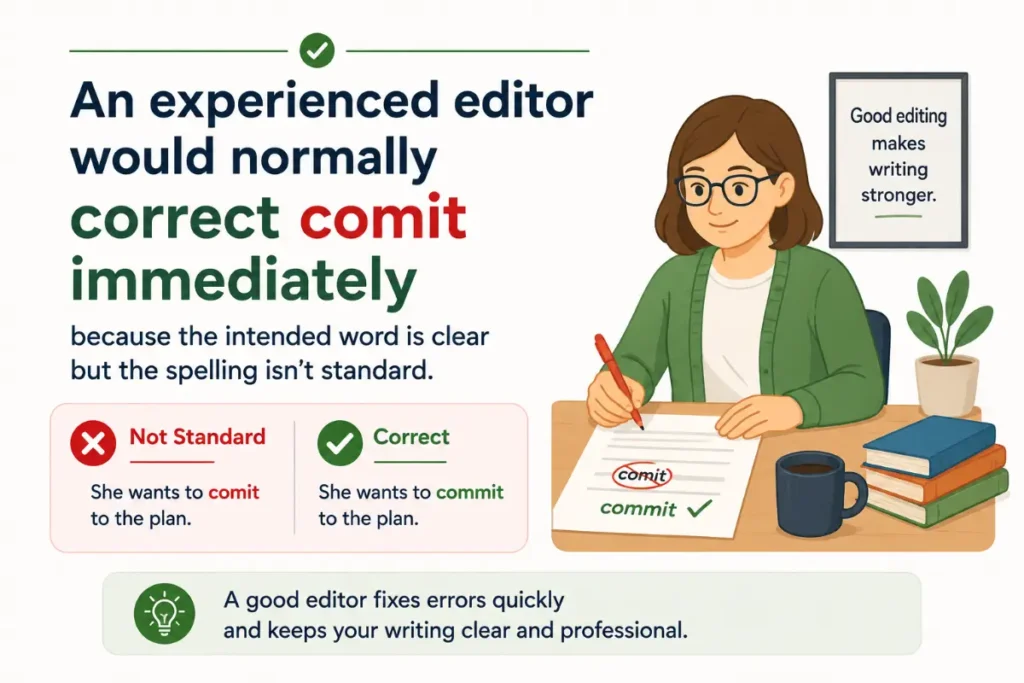
An experienced editor would normally correct comit immediately because the intended word is clear but the spelling isn’t standard. The useful editorial habit is to check the entire word family rather than memorizing one form in isolation. If you know commit, committed, committing, and commitment together the repeated m pattern becomes much easier to recognize. Spelling tools will usually flag the missing m because comit doesn’t match the expected standard form. The bigger lesson is simple: don’t trust pronunciation alone when a word contains repeated consonants. Let the written word family guide you.
Conclusion
The answer to commit vs comit is clear. Commit is the correct standard English spelling while comit is a misspelling. The word works as a verb and can describe carrying out an action or dedicating yourself firmly to a person goal plan or decision.
The spelling may cause trouble because the repeated m isn’t obvious in normal pronunciation. Still the written form stays consistent across important related words such as committed committing and commitment. That word family gives you a useful visual clue when you’re writing quickly.
For a simple editing habit remember this: commit needs two m letters. If you see comit in your writing change it before you publish send or submit the text. That small check can save an easy spelling mistake.
Common Questions About The Spelling
Is Comit A Real English Word?
No. Comit isn’t the standard spelling of the English verb people normally mean in this comparison. If you intend the verb meaning to carry out an action or dedicate yourself to something use commit. In edited writing treat comit as a spelling error and correct it.
What Does Commit Mean?
Commit is a verb with several meanings. It can mean to carry out an action especially something wrong or illegal. It can also mean to dedicate yourself firmly to a person goal plan or decision. The exact meaning depends on the words around it.
Which Spelling Should I Use In Formal Writing?
Use commit. It is the standard English spelling and works in formal writing as well as everyday communication. You can use it in school assignments professional emails reports academic writing journalism and other edited documents.
How Do You Pronounce Commit?
The standard pronunciation is commonly represented as /kəˈmɪt/. A simple guide is kuh MIT. The second syllable receives the main stress. The two m letters belong to the spelling but they don’t create two separate syllables.
Can Commit Start A Sentence?
Yes. Commit can start a sentence when the sentence structure calls for the verb in that position. For example: “Commit to the goal and give yourself enough time to succeed.” Starting a sentence with the verb is completely grammatical when you’re giving an instruction or using an imperative structure.
What Is A Synonym For Commit?
The best synonym depends on the meaning. Dedicate works when you mean giving yourself to something. Promise can work when you mean making a firm pledge. Perform can work in some contexts involving an action. Decide can overlap when the idea involves making a firm choice.
Why Do People Spell Commit Incorrectly?
People often leave out one m because the repeated consonant isn’t obvious in pronunciation. Fast typing can also cause the mistake. Related forms such as committed and committing add another layer of spelling complexity. Learning the complete word family makes the pattern easier to remember.
Is Commit Appropriate In Professional Writing?
Yes. Commit is completely appropriate in professional writing. It can clearly describe dedication responsibility agreement or an action. For example: “The company committed additional resources to the project.” The word is common in business communication and doesn’t sound overly casual.
