
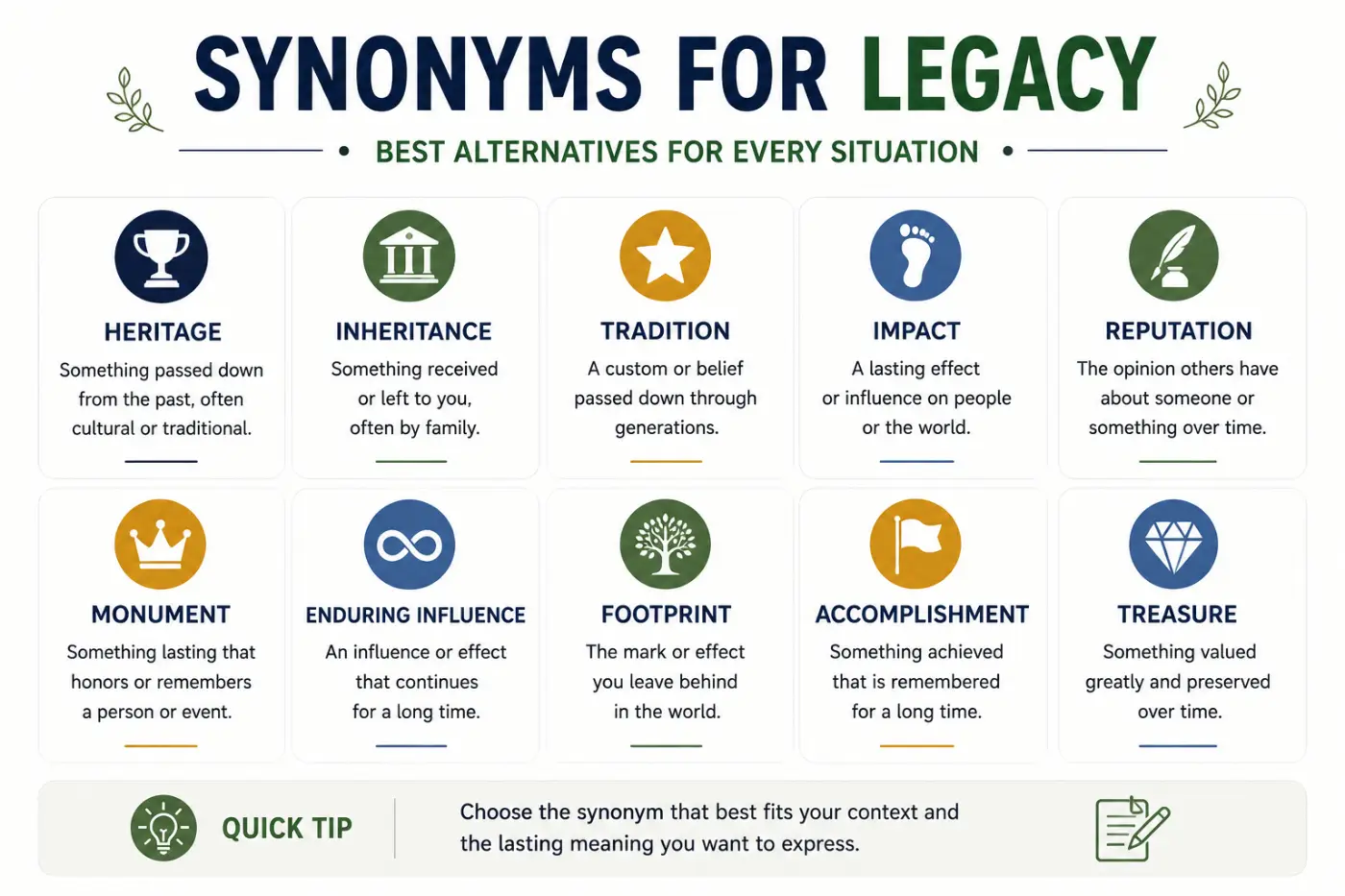
Writing an email, finishing a school essay, updating a resume, or posting on social media can make you stop and think. You want to talk about someone’s legacy, but using the same word again and again feels repetitive. That’s when learning synonyms for legacy can help you sound more natural and more precise.
Legacy is a flexible word. It can describe the lasting impact a person leaves behind, property passed to someone after death, a long standing tradition, or something inherited from the past. The best replacement depends on the meaning you want to express.
In this guide, you’ll learn what legacy really means, where the word came from, the best synonyms for different situations, how the meanings change, common mistakes to avoid, and plenty of real examples that help you pick the perfect word every time.
Short Answer
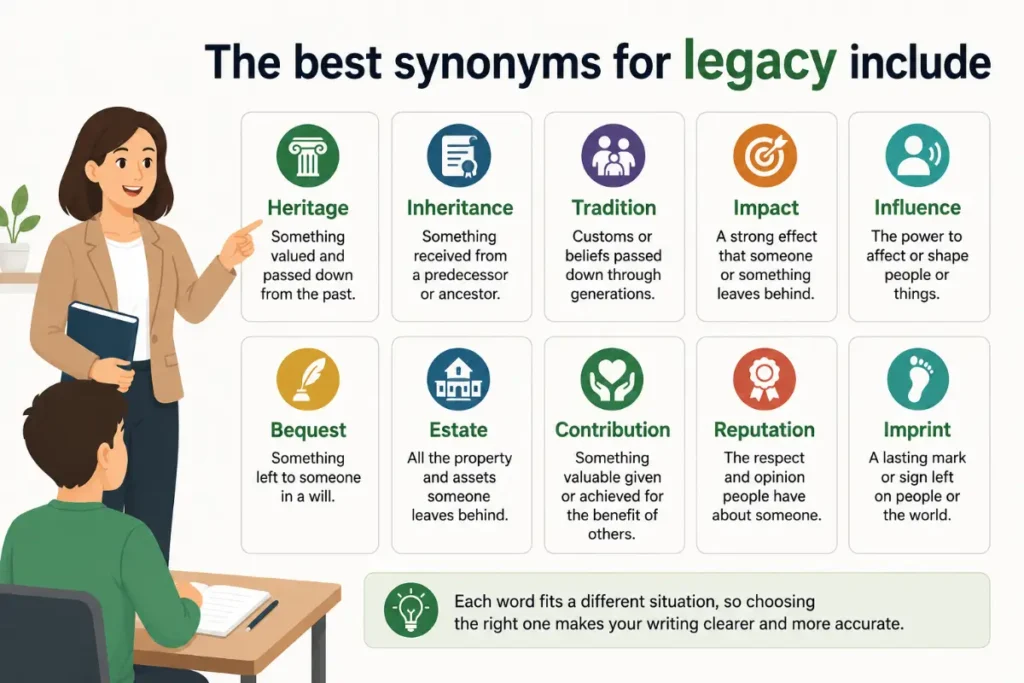
The best synonyms for legacy include heritage, inheritance, tradition, impact, influence, bequest, estate, contribution, reputation, and imprint. Each word fits a different situation, so choosing the right one makes your writing clearer and more accurate.
What Does Legacy Mean in Plain English?
Most people think of legacy as something that remains after someone is gone. That idea is correct, but the word has several meanings. Legacy can refer to something physical, like money or property left to family members. It can also describe ideas, achievements, values, memories, or traditions that continue to influence others.
Here are the most common meanings.
- Something valuable passed from one generation to another.
- A lasting influence created through actions or achievements.
- Money or property received after someone’s death.
- Traditions, beliefs, or customs inherited from earlier generations.
- Something from the past that continues to affect the present.
For example:
- Her kindness became her greatest legacy.
- The scientist left a legacy of groundbreaking research.
- The family inherited a large legacy from their grandfather.
- Ancient cultures left a rich legacy of art and architecture.
Although these examples all use the same word, the meaning changes slightly depending on the context.
What Are the Best Synonyms for Legacy?
| Synonym | Best Use | Example |
|---|---|---|
| Heritage | Family or cultural history | They preserved their heritage. |
| Inheritance | Property or traits received | She inherited a large inheritance. |
| Tradition | Long-standing custom | The tradition continues today. |
| Impact | Lasting effect | Her work had a lasting impact. |
| Influence | Power to shape others | His influence inspired many. |
| Contribution | Valuable addition | Her contribution changed the field. |
| Reputation | Public opinion | He built a strong reputation. |
| Imprint | Lasting mark | She left an imprint on the company. |
| Mark | Noticeable effect | He left his mark on history. |
| Footprint | Long-term effect | The project reduced its footprin |
Where Does the Word Legacy Come From?
Many articles jump straight into a list of alternatives. Knowing the history of the word helps you understand why it carries several meanings today. The word legacy comes from the Latin word legatus, meaning a person sent on behalf of someone else, and from legare, which meant to appoint, send, or leave by a legal will. Over time, the meaning shifted toward something officially left to another person after death. In Middle English, legacy mainly referred to an inheritance received through a will. As English evolved, people started using legacy in a broader way. Instead of talking only about money or property, writers began using it for lasting achievements, values, traditions, and influence. Today, all of these meanings are accepted, and context tells readers which one you mean.
These words are not interchangeable in every sentence. Choosing the one that matches your meaning makes your writing stronger.
Which Synonyms for Legacy Sound Simple and Natural?
Sometimes the easiest word is also the best choice. These everyday alternatives work well in conversations, school writing, blogs, and casual emails.
| Word | Best Used For |
|---|---|
| History | Talking about the past |
| Tradition | Family or cultural customs |
| Impact | Lasting effect |
| Influence | Affecting people |
| Mark | Leaving a lasting impression |
| Memory | Remembering someone |
| Gift | Something valuable passed on |
| Example | Inspiring others |
| Foundation | Building something lasting |
| Background | Earlier experiences |
These words sound natural because most readers already know them well.
Examples:
- Her impact is still felt throughout the organization.
- Their family tradition continues every December.
- His example inspired many students.
- She left wonderful memories for her children.
Which Formal Words Can Replace Legacy?
Professional writing often calls for more specific vocabulary. These formal alternatives work well in legal documents, business reports, biographies, and academic writing.
| Word | Best Situation |
|---|---|
| Bequest | Legal inheritance |
| Estate | Property after death |
| Endowment | Financial gifts |
| Heritage | Cultural discussions |
| Lineage | Family history |
| Birthright | Legal or moral rights |
| Contribution | Professional achievements |
| Reputation | Career and public image |
| Accomplishment | Career success |
| Inheritance | Legal or family property |
Examples:
- The foundation received a generous bequest.
- Her contribution transformed medical research.
- The estate included farmland and valuable artwork.
- The community celebrated its cultural heritage.
Formal words often sound more precise than legacy because they describe one specific meaning instead of several.
Are There Any Slang or Casual Alternatives?
Unlike many common words, legacy does not have many true slang replacements. People usually replace the idea instead of the word itself. Some casual expressions include:
| Expression | Common Use |
|---|---|
| Leave your mark | Personal success |
| Make history | Achieve something memorable |
| Change the game | Create major influence |
| Set the standard | Become an example |
| Leave something behind | General conversation |
| Pass it on | Share knowledge or traditions |
| Keep alive | Continue traditions |
| Carry the torch | Continue someone’s work |
Examples:
- She really left her mark on the company.
- They carried the torch after their coach retired.
- His work changed the game for modern designers.
- We should keep these traditions alive.
These expressions often sound more conversational than using legacy itself.
Synonyms for Legacy From Mild to Strong
Not every alternative carries the same emotional weight. Some simply describe something passed along. Others suggest lifelong influence or historical importance.
| Intensity | Word | Typical Meaning |
|---|---|---|
| Very Mild | History | Past events |
| Very Mild | Background | Earlier experiences |
| Mild | Tradition | Customs passed down |
| Mild | Memory | Things remembered |
| Mild | Example | Something worth following |
| Moderate | Influence | Ongoing effect |
| Moderate | Impact | Strong effect |
| Moderate | Mark | Lasting sign |
| Strong | Heritage | Cultural inheritance |
| Strong | Contribution | Valuable achievement |
| Strong | Reputation | Lasting public image |
| Very Strong | Bequest | Legal inheritance |
| Very Strong | Endowment | Long lasting financial gift |
| Very Strong | Legacy | Complete lasting influence |
Understanding intensity helps you avoid words that sound too weak or too dramatic.
For example:
- Calling a birthday party someone’s legacy would sound exaggerated.
- Calling decades of charitable work an impact may sound too small.
- In that situation, legacy or contribution communicates the idea much better.
Can Legacy Be Different Parts of Speech?
The word legacy is almost always used as a noun. It names something that is left behind, inherited, or remembered. There is no standard verb form of legacy in modern English. Instead, writers use verbs that express the same idea.
Noun
This is the most common use.
| Word | Example |
|---|---|
| Legacy | Her legacy continues to inspire young artists. |
| Heritage | They proudly celebrate their cultural heritage. |
| Inheritance | He received a large inheritance. |
| Tradition | The tradition has lasted for generations. |
| Reputation | She earned an excellent reputation. |
Verbs That Express the Same Idea
Instead of trying to turn legacy into a verb, choose one of these.
| Verb | Example |
|---|---|
| Leave | She left a lasting impact. |
| Inspire | His work inspired thousands of students. |
| Shape | Their ideas shaped modern education. |
| Pass on | Parents pass on values to their children. |
| Preserve | Volunteers preserved the historic building. |
| Influence | Her leadership influenced the entire team. |
Adjectives Related to Legacy
These words describe things connected to a lasting influence or inheritance.
| Adjective | Example |
|---|---|
| Lasting | They made a lasting contribution. |
| Historic | It was a historic achievement. |
| Enduring | She built an enduring reputation. |
| Influential | He became an influential leader. |
| Cultural | They protected their cultural heritage. |
Using the correct part of speech keeps your writing natural and avoids awkward wording.
Do US and UK English Use Legacy Differently?
For most writers, the answer is no. American English and British English both use legacy in nearly the same way. The meaning stays consistent across both varieties. The main difference appears in surrounding vocabulary rather than the word itself.
| Meaning | US English | UK English |
|---|---|---|
| Family traditions | Heritage | Heritage |
| Property after death | Estate or inheritance | Estate or inheritance |
| Lasting influence | Legacy | Legacy |
| Cultural history | Heritage | Heritage |
Both audiences understand sentences like these.
- Her legacy continues through her students.
- The organization hopes to preserve its legacy.
- The family values its heritage.
If you’re writing for an international audience, you usually don’t need to change the word legacy at all.
What’s the Best Word to Use on a Resume?
A resume should focus on achievements instead of sounding dramatic. In many cases, legacy feels too emotional or too broad. Employers usually prefer words that describe measurable results.
Better choices include:
- Contribution
- Impact
- Achievement
- Accomplishment
- Influence
- Improvement
- Results
Instead of writing: I created a lasting legacy for the company.
Write: I made lasting improvements that increased customer satisfaction.
Or: My contributions helped reduce operating costs by 20 percent.
More examples:
- Her leadership created lasting improvements across multiple departments.
- His contributions strengthened the company’s training program.
- Their work established a strong foundation for future growth.
These alternatives sound professional and focus on real accomplishments.
What’s the Best Word to Use in an Essay?
Essays often need a word that sounds thoughtful but not overly formal. The best choice depends on your topic.
| Essay Topic | Best Word |
|---|---|
| History | Heritage |
| Biography | Legacy |
| Literature | Influence |
| Society | Tradition |
| Science | Contribution |
| Politics | Impact |
| Culture | Heritage |
| Education | Achievement |
Examples:
- Abraham Lincoln’s legacy continues to influence American history.
- Ancient Rome left a remarkable cultural heritage.
- Marie Curie’s contributions changed modern science.
- The author’s influence can still be seen today.
Academic writing becomes stronger when each word matches the exact idea instead of repeating legacy every time.
What’s the Best Word to Use in an Email?
Emails usually sound better with simple language. Choose a word that matches the relationship and purpose of your message.
Professional email: Thank you for your lasting contribution to our team.
Retirement email: Your influence will continue long after your retirement.
Charity email: Your generosity created an impact that will benefit future generations.
School email: Your example has inspired many students.
Business emails often sound warmer when they focus on people’s contributions instead of using formal language.
What’s the Best Word to Use in a Text Message?
Text messages should sound natural. Most people don’t say legacy in everyday texting unless they’re discussing history, family, or someone’s life.
Better choices include:
- Impact
- Mark
- Example
- Memory
- Tradition
- Influence
Examples:
- Your advice really made an impact.
- Grandpa left us amazing memories.
- She’ll always be remembered for her kindness.
- They kept the family tradition alive.
Simple words usually feel more personal in casual conversations.
What’s the Best Word to Use While Speaking?
When speaking, shorter words often sound more natural. Instead of repeating legacy, try these depending on your audience.
For a speech:
- Influence
- Contribution
- Heritage
- Impact
In Everyday Speech
- Mark
- Memory
- Tradition
- Example
For a presentation:
- Achievement
- Foundation
- Reputation
- Contribution
These choices help your speech sound smoother and easier to understand.
Real Examples Using Legacy and Its Synonyms
Looking at real situations makes the differences much easier to understand.
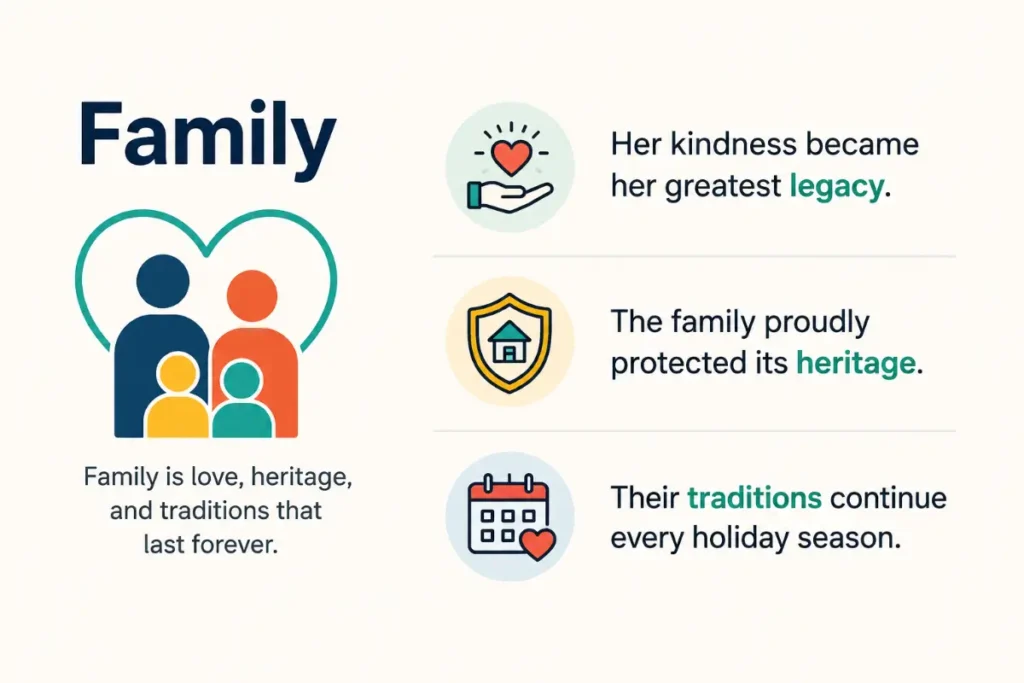
Family
- Her kindness became her greatest legacy.
- The family proudly protected its heritage.
- Their traditions continue every holiday season.
Education
- The teacher’s influence shaped thousands of students.
- His example encouraged everyone to work harder.
- Her contributions improved the entire school.
Business
- The founder left a strong reputation for honesty.
- Their achievements transformed the company.
- The project created a foundation for future success.
Sports
- The coach’s impact reached generations of athletes.
- She left her mark on women’s soccer.
- His accomplishments inspired young players.
History
- The empire left an architectural heritage that still attracts visitors.
- The leader’s legacy remains part of history.
- Their influence spread across several continents.
Community
- Volunteers created a lasting impact.
- The organization built a reputation for helping families.
- Their generosity became an example for others.
Personal Life
- Parents pass their values to their children.
- Grandparents leave precious memories.
- Every act of kindness becomes part of your story.
These examples show why one synonym cannot replace legacy in every sentence.
Legacy vs Heritage What’s the Difference?
These two words are closely related, but they aren’t identical.
| Legacy | Heritage |
|---|---|
| Often focuses on one person or organization | Usually refers to a family, culture, or nation |
| Can be physical or symbolic | Often cultural or historical |
| Can describe achievements | Usually describes traditions and history |
| Common in biographies | Common in history and culture |
Examples:
Legacy: Her scientific legacy continues today.
Heritage: Scotland has a rich cultural heritage.
A person’s work becomes a legacy. A country’s customs become its heritage. Knowing this difference helps you choose the more accurate word instead of treating them as exact synonyms.
Legacy vs Inheritance What’s the Difference?
Many people confuse these words because both involve something passed to another person. The difference is simple.
| Legacy | Inheritance |
|---|---|
| Can be physical or symbolic | Usually property, money, or legal assets |
| Emotional meaning is common | Legal meaning is common |
| Includes values and influence | Focuses on ownership |
| Broader meaning | Narrower meaning |
Examples:
Legacy: Her compassion became her greatest legacy.
Inheritance: He received his inheritance after the estate was settled.
Every inheritance can be part of someone’s legacy. Not every legacy is an inheritance.
What Are Common Mistakes When Using Legacy and Its Synonyms?
Even experienced writers sometimes choose the wrong alternative because many of these words overlap. A small change can make your sentence much clearer.
1. Using legacy for short term results
A legacy lasts for years or even generations.
❌ The new coffee machine is the team’s legacy.
✅ The new coffee machine is a useful improvement.
2. Using inheritance for ideas or influence
Inheritance usually refers to money, property, or traits received from family.
❌ Her inheritance inspired thousands of students.
✅ Her legacy inspired thousands of students.
3. Confusing heritage with legacy
Heritage usually refers to culture, traditions, or family history.
❌ The CEO’s heritage changed the company forever.
✅ The CEO’s legacy changed the company forever.
4. Choosing a word that’s too formal
Words like bequest and endowment sound natural in legal or financial writing but can feel out of place in everyday conversation.
Instead of: Grandma’s bequest of love…
Say: Grandma’s legacy of love…
5. Repeating the same word
Using legacy several times in one paragraph makes your writing sound repetitive.
Instead of this:
His legacy inspired others.
His legacy will never be forgotten.
Write:
His legacy inspired others. His influence changed the company, and his contributions will be remembered for years.
Mixing related words makes your writing smoother without changing the meaning.
What Are the Opposite Words for Legacy?
The opposite of legacy depends on the meaning of your sentence. If you’re talking about a lasting positive influence, these antonyms may fit.
| Antonym | Best Use |
|---|---|
| Failure | Lack of success |
| Loss | Something no longer exists |
| Forgetfulness | Being forgotten |
| Damage | Harm left behind |
| Decline | Becoming weaker over time |
| Neglect | Failure to care for something |
| Destruction | Complete ruin |
| Disgrace | Loss of respect |
| Shame | Negative reputation |
| Oblivion | Being forgotten completely |
Examples:
- Instead of leaving a positive legacy, the project ended in failure.
- Years of neglect damaged the historic building.
- The company worked hard to recover from its damaged reputation.
Unlike synonyms, antonyms usually depend heavily on context rather than replacing the word directly.
How Do You Choose the Right Synonym for Legacy?
A simple question can help you make the best choice.
Ask yourself: What exactly is being left behind?
Use this guide.
| If You Mean… | Best Word |
|---|---|
| Family customs | Heritage |
| Money or property | Inheritance |
| Property named in a will | Bequest |
| Long term influence | Legacy |
| Positive effect | Impact |
| Ability to shape others | Influence |
| Professional success | Contribution |
| Public opinion | Reputation |
| Long standing custom | Tradition |
| Success worth remembering | Achievement |
Thinking about the meaning first usually leads you to the best word.
Quick Tips for Choosing the Right Word
Keep these tips in mind whenever you’re looking for synonyms for legacy.
- Choose heritage when discussing culture, history, or family traditions.
- Choose inheritance for money, property, or qualities received from relatives.
- Choose impact when describing the effect of an action.
- Choose influence when someone changes the thoughts or actions of others.
- Choose contribution in resumes, workplaces, and professional writing.
- Choose reputation when discussing how people are known.
- Choose tradition for customs that continue across generations.
- Choose bequest only in legal or estate planning contexts.
- Choose legacy when you want to describe someone’s lasting achievements, values, or influence.
The closer your word matches the situation, the more natural your writing will sound.
Conclusion
Learning the best synonyms for legacy helps you write with more confidence and precision. While legacy remains the strongest choice for describing a lasting influence or something meaningful left behind, it isn’t always the perfect fit. Words like heritage, impact, influence, contribution, tradition, inheritance, and reputation each highlight a different part of the meaning.
When you think about your audience and the message you want to share, choosing the right word becomes much easier. Instead of repeating the same term in every sentence, vary your vocabulary naturally. Your writing will sound smoother, clearer, and more engaging, whether you’re working on an essay, a resume, an email, or an everyday conversation.
Frequently Asked Questions
What’s another way to say legacy?
Some of the best synonyms for legacy are heritage, impact, influence, contribution, inheritance, tradition, reputation, and achievement. The right choice depends on the meaning you want to express.
What’s the best synonym for legacy in an essay?
Heritage, influence, contribution, and legacy are excellent choices for essays. Pick the one that best matches your topic instead of using the same word repeatedly.
Is heritage the same as legacy?
No. Heritage usually refers to culture, traditions, or family history, while legacy often focuses on the lasting influence or achievements of a person, group, or organization.
Can I use inheritance instead of legacy?
Only when you’re talking about money, property, or something legally received after someone’s death. If you’re discussing values, achievements, or influence, legacy is usually the better choice.
What are the best synonyms for legacy on a resume?
For professional writing, words like contribution, achievement, accomplishment, impact, and results usually sound stronger than legacy because they focus on measurable success.
Is legacy always positive?
No. A legacy can be positive or negative. Someone can leave a legacy of kindness, innovation, or generosity, but they can also leave a legacy of conflict or poor decisions.
Which synonym sounds most natural in everyday conversation?
Words like impact, influence, tradition, memory, and mark often sound more natural than legacy in casual conversations because they’re simple and easy to understand.
