
You may need a better word than learned while writing an email, finishing an essay, updating a resume, or sending a quick text. Synonyms for learned can help you express the exact kind of knowledge, skill, or understanding you want to describe. Sometimes you want to show that someone studied a subject. Other times, you may want to show that a person developed a skill, discovered a fact, or became aware of an important idea.
The best alternative depends on the situation. Studied works well for academic learning, discovered fits new information, mastered suggests advanced ability, and picked up sounds natural for casual learning. Choosing the right word can make your writing more precise without making it sound forced or overly formal.
This guide explains the meaning and origin of learned and explores more than 30 useful alternatives grouped by tone and purpose. You’ll also find examples for resumes, essays, emails, texts, conversations, and formal writing, along with clear comparisons between close words such as learned and studied, learned and discovered, and learned and mastered.
What Does Learned Mean in Plain English
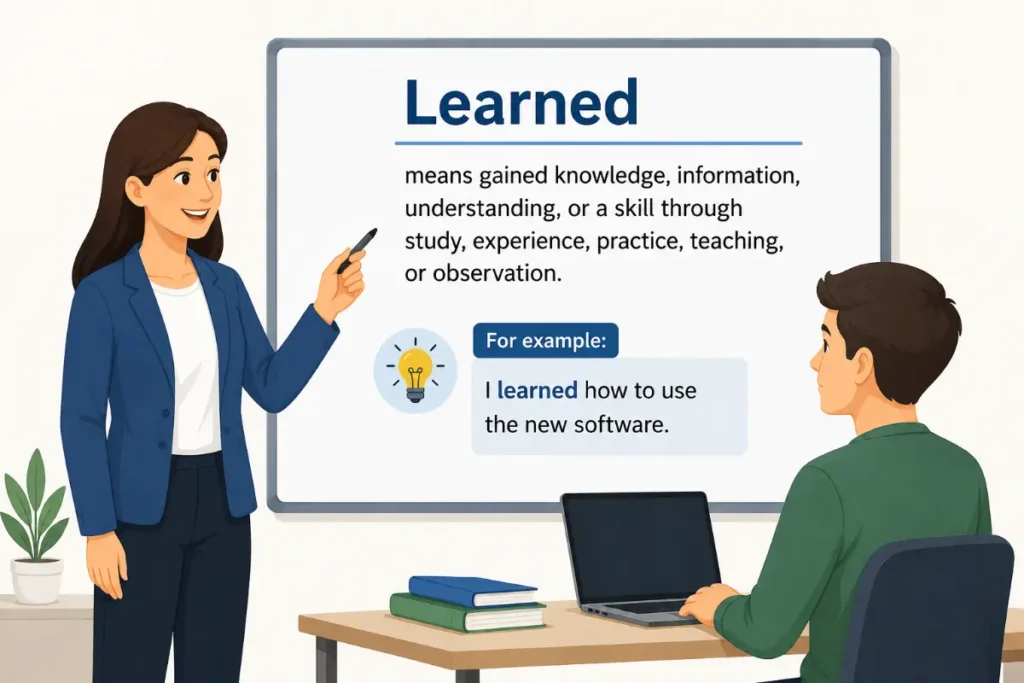
Learned means gained knowledge, information, understanding, or a skill through study, experience, practice, teaching, or observation.
For example:
I learned how to use the new software..
| Meaning | Example |
|---|---|
| Gained knowledge | She learned about American history. |
| Developed a skill | He learned to play the guitar. |
| Discovered information | I learned that the store had closed. |
| Understood an idea | The students learned why the rule matters. |
| Memorized information | She learned the poem by heart. |
| Gained knowledge through experience | He learned from his mistake. |
So, when you search for synonyms for learned, first ask what kind of learning you want to describe. A word that works perfectly for a school subject may sound wrong for a personal discovery or a professional skill.
Where Did Learned Come From
Learned comes from the Old English verb leornian, which meant to get knowledge, study, or become educated. The word developed through Middle English before becoming the modern English learn. The past tense and past participle of learn can appear as learned or learnt. In American English, learned appears far more often in everyday writing and speech: She learned Spanish in college. British English uses both learned and learnt. Learnt often appears in casual British English, while learned remains common in formal writing and in certain expressions.
The Best Synonyms for Learned at a Glance
The strongest alternative depends on the exact meaning you want. Use studied for formal education, discovered for new information, understood for comprehension, mastered for advanced skill, and picked up for casual learning.
| Meaning you want | Best alternative |
|---|---|
| Gained knowledge through school | Studied |
| Found out new information | Discovered |
| Became aware of information | Found out |
| Understood an idea | Understood |
| Developed a high level skill | Mastered |
| Learned casually | Picked up |
| Gained knowledge from experience | Gained insight |
| Memorized information | Memorized |
| Took in information | Absorbed |
| Learned a skill naturally | Acquired |
| Became familiar with something | Became familiar with |
| Realized a fact | Realized |
Master List of Synonyms for Learned
The following list gives you more than 30 useful alternatives. Each word has a slightly different meaning, level of formality, or emotional tone.
Simple Synonyms for Learned
These words work well in everyday English and clear general writing.
| Word | Meaning | Tone | Example |
|---|---|---|---|
| Studied | Spent time learning a subject | Neutral | She studied biology in college. |
| Understood | Gained a clear idea of something | Neutral | He understood the instructions. |
| Discovered | Found new information or knowledge | Neutral | We discovered a better solution. |
| Realized | Became aware of a fact | Neutral | I realized my mistake. |
| Found out | Learned new information | Casual | She found out about the change later. |
| Practiced | Repeated an activity to improve | Neutral | He practiced the piano every day. |
| Memorized | Learned something so you can remember it | Neutral | She memorized the speech. |
| Noticed | Became aware of something | Neutral | He noticed a pattern in the data. |
| Saw | Came to understand or recognize something | Casual | I finally saw why the plan failed. |
Everyday Synonyms for Learned
These options sound natural in conversations, messages, and informal writing.
| Word | Meaning | Tone | Example |
|---|---|---|---|
| Picked up | Learned casually or quickly | Casual | I picked up a few Spanish phrases. |
| Got the hang of | Learned how to do something | Casual | She got the hang of the new system. |
| Figured out | Found the answer through thought or effort | Casual | He figured out how to fix the printer. |
| Took in | Absorbed information | Casual | The students took in the lesson quickly. |
| Caught on | Began to understand | Casual | She caught on after a few examples. |
| Got to know | Became familiar with someone or something | Casual | He got to know the neighborhood. |
| Learned about | Gained information about a topic | Everyday | We learned about local wildlife. |
| Came to understand | Gradually developed understanding | Everyday | She came to understand the problem. |
Formal Synonyms for Learned
These words suit academic writing, professional documents, reports, and serious discussions.
| Word | Meaning | Tone | Example |
|---|---|---|---|
| Acquired | Gained knowledge or a skill | Formal | She acquired strong research skills. |
| Gained | Obtained knowledge or experience | Formal | He gained valuable experience. |
| Developed | Built a skill or understanding over time | Formal | The team developed a deeper understanding. |
| Mastered | Reached a high level of ability | Strong and formal | She mastered advanced statistical methods. |
| Comprehended | Understood something fully | Formal | The students comprehended the central concept. |
| Absorbed | Took in knowledge or information | Neutral to formal | He absorbed the material quickly. |
| Internalized | Made an idea part of your understanding | Formal | She internalized the lesson from the experience. |
| Familiarized yourself with | Became knowledgeable about something | Formal | The staff familiarized themselves with the new policy. |
| Gained insight into | Developed a deeper understanding | Formal | The study gave researchers insight into consumer behavior. |
| Educated yourself about | Learned independently | Formal | She educated herself about financial planning. |
Slang and Casual Synonyms for Learned
These choices work best in relaxed speech and informal messages.
| Word | Meaning | Tone | Example |
|---|---|---|---|
| Picked up | Learned without formal study | Casual | I picked up the skill from my brother. |
| Got it | Understood something | Very casual | Okay, I got it now. |
| Figured out | Solved or understood something | Casual | I figured out what went wrong. |
| Caught on | Started understanding | Casual | He caught on pretty fast. |
| Got the hang of | Learned how to manage something | Casual | She got the hang of driving quickly. |
| Cracked | Solved or understood something difficult | Informal | He finally cracked the code. |
| Nailed | Learned or performed something successfully | Informal | She nailed the presentation after practicing. |
| Picked up on | Noticed or understood a detail | Casual | He picked up on the hidden message. |
Synonyms for Learned From Mild to Strong
Not all learning has the same level of depth. The best word should show how much knowledge or skill someone gained.
Mild Learning
Use these words when someone gained basic awareness or a small amount of information.
- Noticed.
- Heard.
- Found out.
- Became aware.
- Picked up.
- Became familiar with.
Examples:
I found out about the schedule change this morning.
She picked up a few useful phrases during her trip.
These words do not suggest deep study or expert knowledge.
Moderate Learning
Use these alternatives when someone gained a solid understanding or useful ability.
- Studied.
- Understood.
- Acquired.
- Developed.
- Absorbed.
- Figured out.
- Gained insight into.
Examples:
He studied computer science for four years.
The training helped employees develop new skills.
Strong Learning
Use these words when someone reached a high level of knowledge or ability.
- Mastered.
- Internalized.
- Comprehended.
- Became proficient in.
- Became an expert in.
- Gained deep knowledge of.
Examples:
She mastered the technique after years of practice.
The researcher gained deep knowledge of the subject.
Be careful with strong words. Saying that someone mastered a skill suggests much more than saying they learned it.
Synonyms for Learned by Part of Speech
The word learned can function as a verb or an adjective. Your replacement should match its grammatical role.
Learned as a Verb
When learned describes an action, use a verb such as studied, discovered, understood, acquired, or mastered.
She learned French.
Possible alternatives include:
She acquired French language skills.
She mastered French.
Each sentence gives a different impression. Studied focuses on education. Acquired focuses on gaining the skill. Became proficient in focuses on ability. Mastered suggests a very high level.
Learned as an Adjective
When learned describes a knowledgeable person, use words such as educated, knowledgeable, scholarly, well informed, or intellectual.
He is a learned historian.
Possible alternatives include:
He is a knowledgeable historian.
He is a scholarly historian.
The best choice depends on the exact tone you want.
What Is the Best Synonym for Learned on a Resume
For a resume, acquired, developed, mastered, trained in, and gained experience in often work better than learned. The word learned can sound too basic on a professional document. Strong resume writing shows the skill you gained and the result you produced.
Instead of:
Learned how to use customer relationship management software.
Try:
Acquired proficiency in customer relationship management software.
Or:
Developed strong skills in customer relationship management software.
For a resume, choose the word that shows action and ability.
Best Resume Alternatives
- Acquired.
- Developed.
- Mastered.
- Gained proficiency in.
- Trained in.
- Built expertise in.
- Gained experience with.
- Became proficient in.
Example:
During my internship, I developed strong data analysis skills.
This sounds more specific and professional than:
During my internship, I learned data analysis.
What Is the Best Synonym for Learned in an Essay
For an essay, studied, discovered, understood, realized, found, and gained insight into usually work well.
The best choice depends on the type of essay.
For academic learning:
Students studied the effects of climate change.
For a personal essay:
I realized how important patience can be.
For research:
Scientists discovered a new pattern in the data.
What Is the Best Synonym for Learned in a Text
For texting, use simple and natural expressions such as found out, figured out, got it, picked up, or realized.
Examples:
I just found out about the party.
I finally figured out how to fix it.
Oh, I get it now.
I picked up some Italian while traveling.
Texting usually does not need formal words such as comprehended or internalized. They may sound overly serious in a casual conversation.
What Is the Best Synonym for Learned in an Email
The best word depends on the type of email. For a professional update, use acquired, developed, gained, or became familiar with. I recently became familiar with the company’s updated reporting system. For a polite email, learned remains completely natural: I learned a great deal from working with your team. The key is to match the word to the situation. A formal word does not automatically make an email better.
What Is the Best Synonym for Learned When Speaking
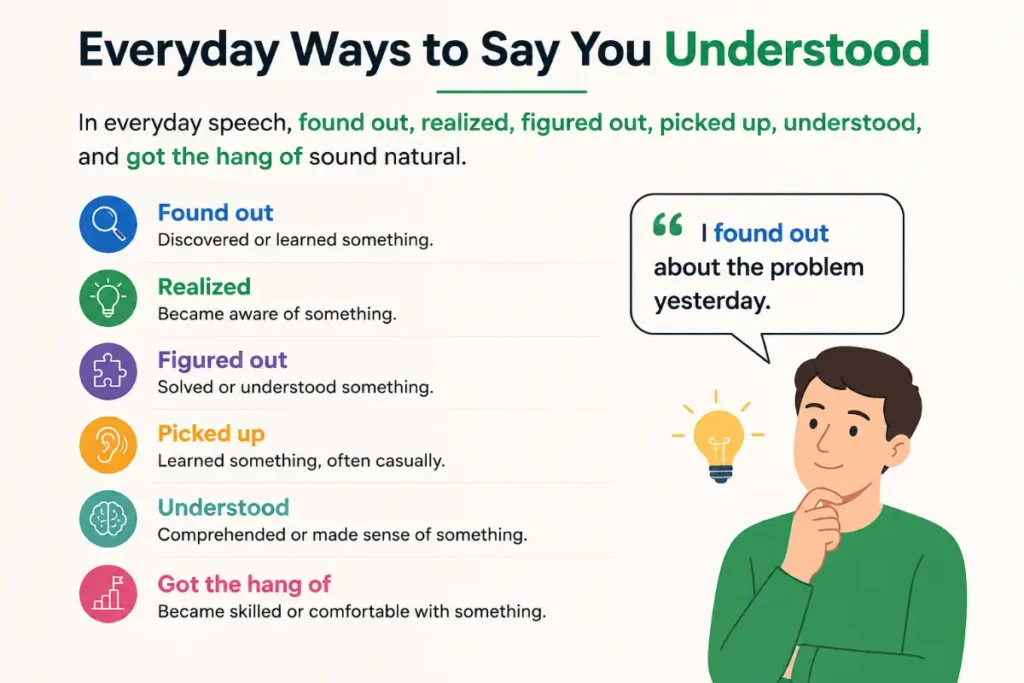
In everyday speech, found out, realized, figured out, picked up, understood, and got the hang of sound natural.
Examples:
I found out about the problem yesterday.
I finally figured out what happened.
She picked up the skill pretty quickly.
He got the hang of it after a few tries.
These choices sound more conversational than formal alternatives such as comprehended or internalized.
More Than 10 Original Examples in Real Situations
The best way to understand word differences is to see them in real sentences.
- I learned how to cook from my grandmother.
- She studied Spanish for three years before moving to Madrid.
- We discovered that the road had closed because of flooding.
- He realized that he had misunderstood the instructions.
- The new employee quickly picked up the company’s computer system.
- After several weeks of practice, Maya mastered the piano piece.
- The students absorbed the information during the hands on workshop.
- I found out about the meeting after everyone else had left.
- The training helped the staff develop better communication skills.
- He figured out how to repair the bicycle by watching a tutorial.
- The experience taught me to check important details twice.
- She gained valuable insight into how small businesses operate.
- The researcher acquired a deeper understanding of the problem.
- By the end of the course, the students had become proficient in basic coding.
- He memorized the speech before the competition.
- She came to understand why the decision mattered.
- The child caught on quickly after the teacher used a simple example.
- I became familiar with the software during my first week at work.
These examples show why one replacement cannot work in every sentence.
Studied vs Learned What Is the Difference
Learned and studied overlap, but they do not mean exactly the same thing.
Studied focuses on the activity of spending time with a subject. Learned focuses on the knowledge or ability gained from that activity.
| Studied | Learned |
|---|---|
| Focuses on the process | Focuses on the result |
| Often involves formal education | Can happen anywhere |
| Does not always prove understanding | Shows gained knowledge or skill |
| Example: She studied chemistry. | Example: She learned how chemicals react. |
You can study something without fully learning it.
I studied for the exam, but I still didn’t understand the topic.
You can also learn something without formally studying it.
I learned how to fix bikes by watching my father.
Learned vs Discovered What Is the Difference
Discovered usually means found information that was previously unknown to you. Learned has a broader meaning.
I learned about the history of the city.
This may involve reading, studying, or receiving instruction.
I discovered an old letter in the attic.
This suggests that you found something unexpected.
Use discovered when the information feels new or surprising. Use learned for general knowledge and skills.
Learned vs Mastered What Is the Difference
Mastered is much stronger than learned.
She learned to play tennis.
This only tells us that she gained the skill.
She mastered tennis.
This suggests a very high level of ability.
Mastered can sound exaggerated if the person has only basic knowledge. For example, a beginner should not usually say:
I mastered Spanish after two months.
A more accurate choice would be:
I learned some Spanish after two months.
Or:
I became familiar with basic Spanish phrases.
Learned vs Realized What Is the Difference
Learned can mean gained information through study, teaching, practice, or experience.
Realized means became aware of something or understood a fact, often suddenly.
I learned that the store closes at six.
This means someone gave me or I found information.
I realized that I had left my wallet at home.
This suggests a moment of awareness.
The words can sometimes overlap, but realized often highlights a change in awareness.
Learned vs Understood What Is the Difference
Learned means gained knowledge. Understood means grasped the meaning or idea.
She learned the rules.
This means she gained knowledge of the rules.
She understood the rules.
This means she knew what the rules meant and how they worked.
Someone can learn a fact without fully understanding it.
He learned the formula but didn’t understand how it worked.
This distinction matters in school, technical writing, and explanations.
Learned vs Memorized What Is the Difference
Memorized means stored information in your memory. Learned has a wider meaning.
She memorized the phone number.
This does not necessarily mean she understands anything about the number.
She learned how the phone system works.
This suggests understanding or knowledge.
Memorization can form part of learning, but the two words do not mean the same thing.
Common Mistakes With Learned Synonyms
Choosing a synonym only because it sounds more advanced can create awkward or inaccurate writing.
Using Mastered for Basic Knowledge
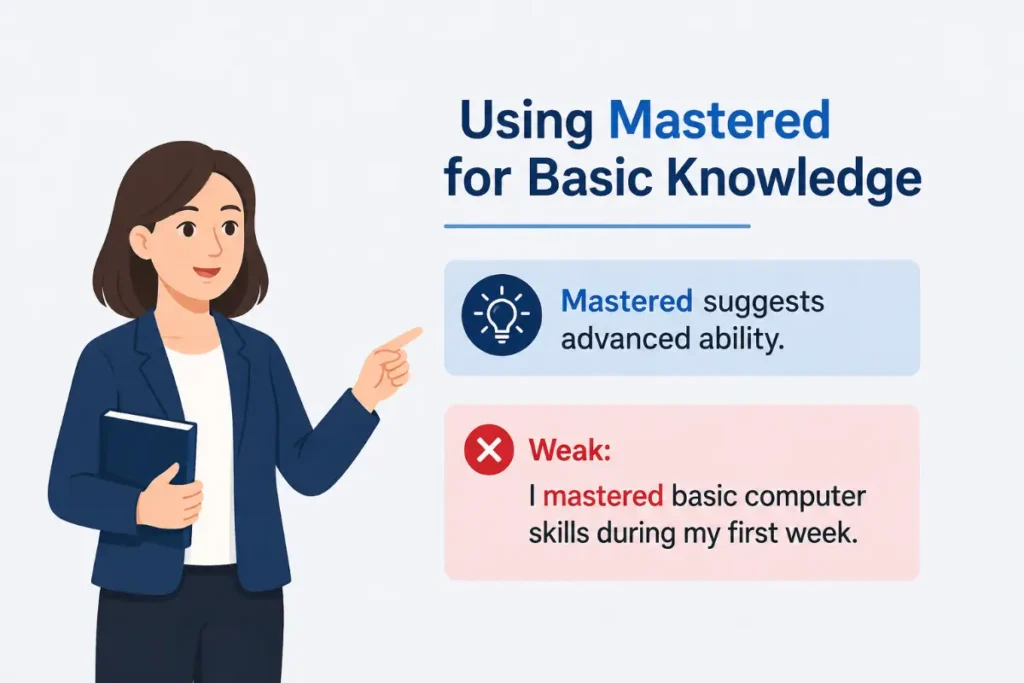
Mastered suggests advanced ability.
Weak:
I mastered basic computer skills during my first week.
Better:
I learned basic computer skills during my first week.
Or:
I became familiar with basic computer skills during my first week.
Using Studied When You Mean Discovered
If you suddenly find new information, discovered or found out may fit better.
Less natural:
I studied that the event had been canceled.
Better:
I learned that the event had been canceled.
Or:
I found out that the event had been canceled.
Using Realized for Formal Education
Realized does not usually describe completing a course of study.
Incorrect:
She realized biology at college.
Better:
She studied biology in college.
Or:
She learned biology in college.
Using Slang in Formal Writing
Words such as nailed, cracked, and got the hang of work well in casual conversation. They usually do not belong in a formal academic essay or professional report.
Casual:
I finally got the hang of the software.
Formal:
I became proficient in the software.
Repeating Learned Too Often
Repeated use of the same word can make writing feel flat.
Instead of writing:
I learned new skills.
I learned how the system works.
Try:
I developed new skills, gained insight into the company, and became familiar with the system. The writing sounds more precise and natural.
When Not to Replace Learned
You do not need to replace learned every time it appears.
Learned is often the clearest choice when you mean general knowledge or a skill gained through experience.
I learned a valuable lesson from the experience.
Replacing learned with a more complicated word could make the sentence less natural.
For example:
I internalized a valuable lesson from the experience.
This sounds more serious and abstract. It may work in a formal reflection, but learned sounds more natural for most readers. Clear writing matters more than using the most advanced synonym.
Regional Differences in Learned and Learnt
American English strongly prefers learned as the past tense and past participle of learn.
She learned a new skill.
British English uses both learned and learnt.
She learnt a new skill.
Learnt appears more often in British English, especially in informal contexts. Learned remains widely accepted in British English, particularly as an adjective and in formal writing. For a US audience, learned is the safest and most familiar choice.
Antonyms for Learned
The opposite of learned depends on the meaning.
| Antonym | Meaning |
|---|---|
| Forgot | Lost information from memory |
| Ignored | Chose not to pay attention |
| Misunderstood | Failed to understand correctly |
| Remained unaware | Did not gain awareness |
| Unlearned | Rejected or replaced an old belief or habit |
| Forgot how | Lost a previously learned skill |
Examples:
I learned the rule, but later forgot it.
She misunderstood the instructions.
He remained unaware of the change.
Unlearned has a special meaning. It often describes letting go of an old habit, belief, or assumption.
She had to unlearn several bad writing habits.
How to Choose the Right Synonym
Choosing the best word becomes easier when you ask five simple questions.
Did You Gain Knowledge Through Study
Use studied, educated yourself, or acquired knowledge. She studied environmental science.
Did You Find New Information
Use discovered, found out, or learned. We found out that the flight had been delayed.
Did You Understand an Idea
Use understood, comprehended, grasped, or figured out. He finally grasped the main idea.
Did You Gain a Practical Skill
Use developed, acquired, picked up, practiced, or mastered. She developed strong presentation skills.
Did You Become Aware of Something
Use realized, noticed, found out, or became aware. I realized that I had made the wrong choice. The most accurate word usually comes from the specific action behind the learning.
Quick Tips for Choosing the Right Word
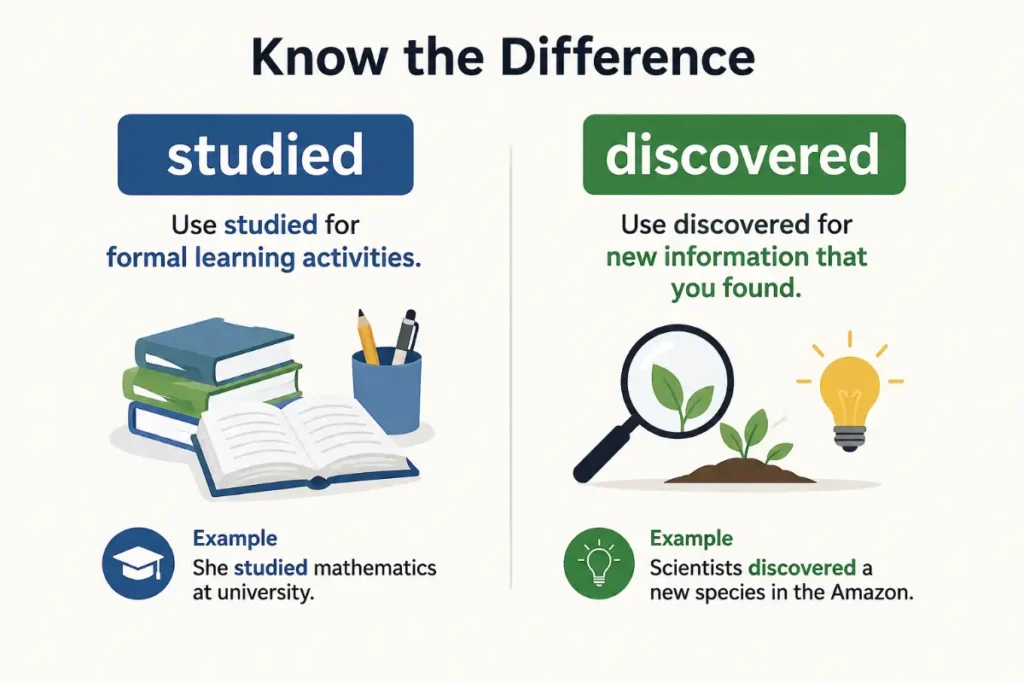
- Use studied for formal learning activities.
- Use discovered for new information that you found.
- Use found out for casual information.
- Use realized for a moment of awareness.
- Use understood when the focus involves meaning.
- Use mastered for advanced skill.
- Use picked up for casual or natural learning.
- Use acquired for professional or formal writing.
- Use developed for skills that grow over time.
- Use memorized when someone stores information in memory.
- Use absorbed when someone takes in a large amount of information.
- Use taught when a person or experience causes the learning.
- Keep learned when it sounds clearer than the alternatives.
The goal is not to avoid a common word. The goal is to choose the word that gives readers the most accurate picture.
Conclusion
The best synonym depends on the kind of learning you want to describe. Use studied for academic work, discovered for new information, understood for clear comprehension, realized for sudden awareness, picked up for casual learning, acquired for professional writing, and mastered for advanced ability. Each word adds a slightly different meaning.
The key is precision. A strong writer doesn’t replace a common word simply to sound more sophisticated. The right alternative should show exactly how someone gained knowledge, developed a skill, understood an idea, or became aware of new information.
Keep learned when it fits the sentence naturally. When you need a more specific meaning, choose the alternative that best matches the situation. The right word can make your writing clearer, more natural, and more effective.
Frequently Asked Questions
What’s another way to say learned?
Another way to say learned is studied, discovered, understood, realized, acquired, mastered, picked up, or found out. The best option depends on the exact meaning and level of formality.
What are the best synonyms for learned in a resume?
The best synonyms for learned in a resume include acquired, developed, mastered, gained proficiency in, and became proficient in. These choices can show professional growth more clearly.
Is studied the same as learned?
No, studied and learned have different focuses. Studied describes the process of spending time with a subject, while learned describes the knowledge or skill gained from that process.
What is a stronger word than learned?
Mastered is usually stronger than learned because it suggests a high level of skill or knowledge. Acquired and developed can also sound stronger in professional writing.
What is a casual word for learned?
Picked up, figured out, caught on, and got the hang of are casual alternatives to learned. They work best in conversations, texts, and informal writing.
Can discovered mean learned?
Yes, discovered can mean learned when someone finds new information or becomes aware of something previously unknown. It usually suggests a sense of finding or uncovering information.
What is the difference between learned and realized?
Learned usually means gained knowledge or information, while realized usually means became aware of a fact or understood something, often at a particular moment.
