
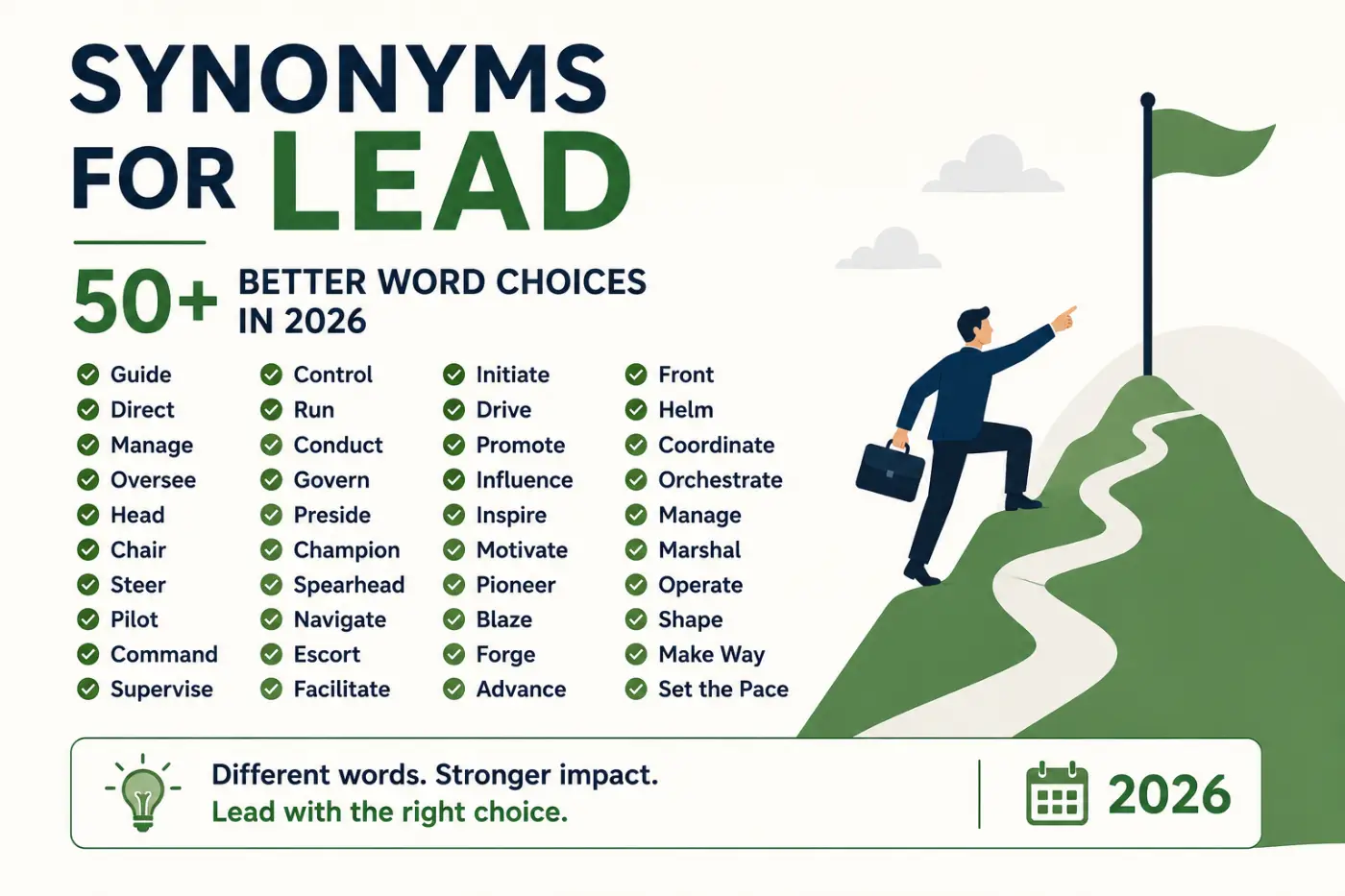
You are writing an email, updating your resume, or finishing an essay when you pause and ask yourself: is there a better word than lead? Finding the right synonyms for lead can make your writing clearer, more professional, and more natural. While lead is a useful word, it does not always express the exact meaning you want.
The word lead can describe many different ideas. A manager can lead a team, a teacher can guide students, a person can influence decisions, and a strategy can drive progress. Choosing the right alternative helps your readers understand the exact role, action, or result you want to describe.
In this guide, you’ll discover the meaning and origin of lead, the best alternatives for different situations, and how to choose the right word for resumes, essays, emails, conversations, and professional writing.
Short Answer
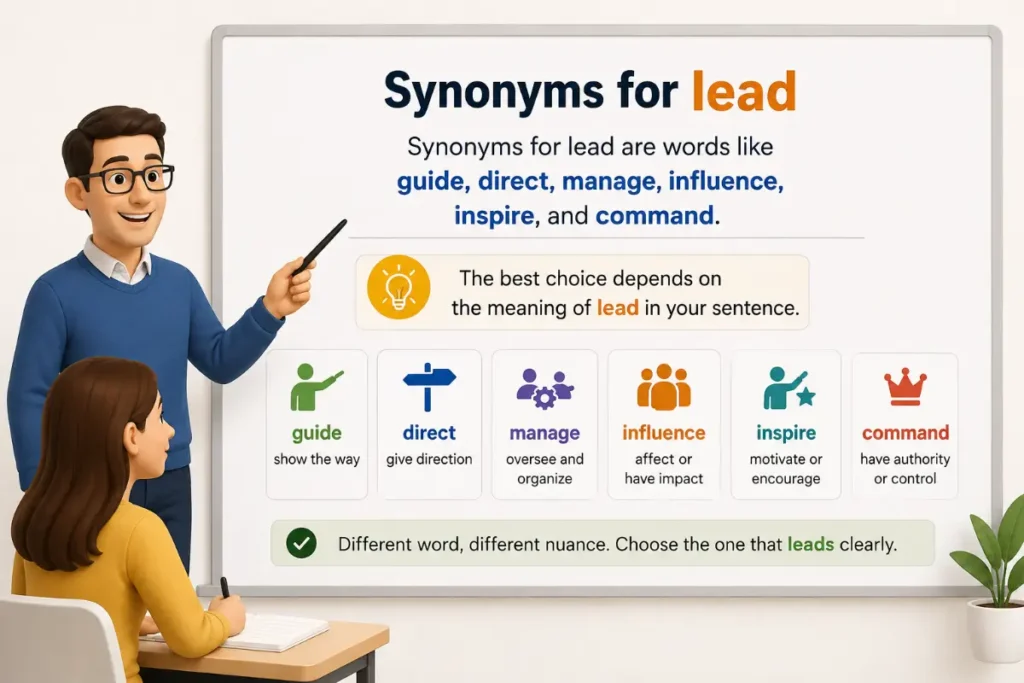
Synonyms for lead are words like guide, direct, manage, influence, inspire, and command. The best choice depends on the meaning of lead in your sentence.
What Does Lead Mean in Simple English?
The word lead has several meanings. The most common meaning is to show someone the way or help something move in a certain direction.
For example:
- A teacher leads students through a lesson.
- A manager leads a team at work.
- A scientist leads a research project.
- A road leads to a small town.
The word can describe physical movement, responsibility, influence, or being the first person in a group.
Lead can also mean causing a result.
Example:
“Poor planning led to delays.”
In this sentence, lead does not mean a person guiding others. It means something caused an outcome. The noun form has different uses too.
Examples:
- She has the lead in the competition.
- He plays the lead character in the movie.
- The team leader took the lead during the project.
Because lead has many meanings, choosing the right replacement requires understanding the exact idea behind the sentence.
Where Did the Word Lead Come From?
The word lead has been part of English for more than a thousand years. It comes from the Old English word lǣdan, which meant to guide, bring, or carry. Early English speakers used the word for physically showing someone a path or moving something from one place to another. Over time, the meaning expanded.
People started using lead for:
- Rulers guiding communities.
- Teachers helping students learn.
- Military figures directing groups.
- Experts influencing ideas and decisions.
Today, lead is one of the most flexible words in English. It can describe authority, support, influence, direction, and progress.
Why Do People Look for Another Word for Lead?
Many writers search for a replacement because lead appears everywhere. Using it repeatedly can make writing feel plain or repetitive.
For example:
“Sarah led the team. She led the meeting. She led the project.”
The meaning is clear, but the repeated word does not show the different skills Sarah used.
A stronger version:
“Sarah managed the team, coordinated the meeting, and directed the project.”
Each word adds a different detail.
The best replacement does not simply avoid repetition. It improves accuracy.
The Ultimate List of Synonyms for Lead
| Word | Meaning | Example |
|---|---|---|
| Guide | Give direction | She guided the team. |
| Direct | Give instructions | He directed the project. |
| Manage | Handle tasks | She managed the group. |
| Supervise | Watch over work | He supervised employees. |
| Oversee | Monitor activities | She oversaw operations. |
| Head | Be in charge | He heads the department. |
| Run | Control something | She runs the business. |
| Inspire | Encourage action | His story inspired people. |
| Influence | Affect decisions | Her ideas influenced change. |
| Motivate | Encourage effort | The coach motivated players. |
Simple Synonyms for Lead
Simple words work best when your goal is clear communication.
Guide
Guide is one of the closest replacements for lead.
It suggests helping someone move in the right direction without forcing them.
Example:
“Her experience guided the team through the challenge.”
Guide sounds supportive and positive.
Show
Show works when someone helps another person understand something or find a way.
Example:
“Can you show me how to complete this task?”
Help
Help is a broad replacement when leadership is not the main focus.
Example:
“She helped the group complete the project.”
Take
Take can replace lead when someone moves others forward.
Example:
“He took the team to a higher level of performance.”
Bring
Bring works when something causes a result.
Example:
“The new strategy brought major improvements.”
Everyday Synonyms for Lead
These words sound natural in normal conversations.
| Word | Meaning | Example |
|---|---|---|
| Guide | Provide direction | She guided the new employee. |
| Handle | Take responsibility | He handled the customer account. |
| Run | Be responsible for something | She runs the local store. |
| Support | Help someone succeed | He supported the team during the change. |
| Shape | Influence development | The experience shaped his career. |
These options work well in emails, conversations, and general writing.
Formal Synonyms for Lead
Professional and academic writing often needs stronger precision.
Direct
Direct suggests giving instructions or controlling the path of an activity.
Example:
“She directed the company’s expansion strategy.”
Use direct when someone actively controls a process.
Manage
Manage focuses on responsibility.
Example:
“He managed a team of twenty employees.”
It works especially well on resumes because it shows leadership experience.
Oversee
Oversee means watching and managing something.
Example:
“She oversaw the development of the new software.”
This word sounds professional without suggesting complete control.
Facilitate
Facilitate means making something easier.
Example:
“He facilitated communication between departments.”
It is useful when a person supports progress rather than commands others.
Strong Synonyms for Lead
Some situations require a word that shows more power or influence.
| Word | Strength | Example |
|---|---|---|
| Command | Very strong authority | The officer commanded the unit. |
| Control | Strong power over decisions | The company controls the process. |
| Govern | Official authority | The organization governs industry standards. |
| Drive | Strong influence toward a goal | Her ideas drove innovation. |
| Pioneer | First to create something | He pioneered new technology. |
Use these words carefully. Strong words can make your writing more powerful, but they can also sound too intense if the situation is simple.

Based on Intensity
The meaning of lead changes depending on the level of influence.
Mild Alternatives
These words show support and guidance.
- Help
- Guide
- Support
- Mentor
- Coach
Example:
“The advisor guided students through their career choices.”
Medium Strength Alternatives
These words show responsibility.
- Manage
- Coordinate
- Supervise
- Direct
- Oversee
Example:
“She managed the marketing department for five years.”
Strong Alternatives
These words show authority or major influence.
- Command
- Control
- Govern
- Drive
- Pioneer
Example:
“The scientist pioneered a new method of treatment.”
By Part of Speech
The word lead can work as both a verb and a noun. The best replacement changes depending on how you use it in a sentence.
Verb Alternatives for Lead
| Word | Meaning | Example |
|---|---|---|
| Guide | Help someone find the right path | The mentor guided the student toward a better career choice. |
| Direct | Point or control a movement or activity | She directed the team during the campaign. |
| Navigate | Help someone handle a situation | He navigated the company through difficult changes. |
| Show | Help someone understand or find something | The instructor showed the class a new method. |
| Take | Move someone forward | She took the group toward a successful outcome. |
| Word | Meaning | Example |
|---|---|---|
| Manage | Be responsible for people or tasks | He managed a team of developers. |
| Supervise | Watch over work and provide direction | She supervised new employees. |
| Oversee | Monitor and guide activities | He oversaw the construction project. |
| Head | Be the person responsible | She headed the research department. |
| Run | Control daily operations | They run a family owned business. |
| Word | Meaning | Example |
|---|---|---|
| Cause | Make something happen | The mistake caused confusion. |
| Create | Produce a result | The changes created new opportunities. |
| Produce | Bring about an outcome | The strategy produced positive results. |
| Result in | Cause something to happen | The decision resulted in higher costs. |
| Trigger | Cause a reaction | The announcement triggered excitement. |
Noun Alternatives for Lead
Lead as a noun has several meanings.
When Lead Means a Person in Charge
Use these words:
| Word | Meaning | Example |
|---|---|---|
| Leader | Person who guides others | She is a respected leader. |
| Manager | Person responsible for a team | He is the project manager. |
| Director | Person who controls a department | She is the marketing director. |
| Head | Main person in charge | He is the head of operations. |
| Supervisor | Person who monitors work | The supervisor checked the progress. |
When Lead Means First Place or Advantage
Use these words:
| Word | Meaning | Example |
|---|---|---|
| Advantage | A better position | Our team has the advantage. |
| Edge | Small advantage | The company has an edge over competitors. |
| Priority | Something most important | Safety is our top priority. |
| Front | Leading position | The runner stayed at the front. |
| Control | Power over a situation | The team gained control of the game. |
US vs UK Notes
English speakers in the United States and the United Kingdom use lead in similar ways. However, some replacement words may feel slightly different depending on region and context.
Head vs Run
In American English, people often use run in casual workplace conversations.
Example:
“She runs the department.”
In British English, head is very common in professional settings.
Example:
“She heads the department.”
Both are correct, but head often sounds more formal.
Manage vs Oversee
American workplaces frequently use manage for direct responsibility.
Example:
“He manages a sales team.”
Oversee often suggests higher level responsibility.
Example:
“She oversees several departments.”
British workplaces also use these words, but job titles may vary by company.
Coach and Mentor
These words are common in both American and British English.
Coach usually focuses on skill improvement.
Mentor usually focuses on long term personal or career guidance.
Example:
“A coach helps you improve performance.”
“A mentor helps you grow professionally.”
Different Situations
The right word depends on your audience and purpose. A resume needs strong action words, while a casual message needs natural language.
What Is the Best Synonym for Lead on a Resume?
A resume should show responsibility, results, and skills. The word lead is common, so stronger action verbs can make your experience stand out.
Best choices:
- Managed
- Directed
- Oversaw
- Coordinated
- Supervised
- Developed
- Guided
- Implemented
- Launched
- Delivered
Examples:
Weak:
“I led a customer service team.”
Stronger:
“I managed a customer service team of 15 employees and improved response times.”
Weak:
“I led a marketing campaign.”
Stronger:
“I directed a marketing campaign that increased website traffic.”
A good resume does more than show that you were in charge. It explains the value you created.
What Is the Best Synonym for Lead in an Essay?
Academic writing needs accuracy. The strongest choice depends on your meaning.
Use influence when something affects ideas or behavior.
Example:
“Social media influenced modern communication.”
Use cause when one thing creates another result.
Example:
“The policy caused major changes.”
Use shape when something gradually affects development.
Example:
“Early experiences shaped her personality.”
Use drive when something strongly pushes progress.
Example:
“Scientific discoveries drove technological growth.”
Avoid replacing lead with a stronger word if the sentence does not support that meaning.
What Is the Best Synonym for Lead in an Email?
Professional emails usually need polite and clear language.
Good choices include:
- Guide
- Coordinate
- Manage
- Oversee
- Support
- Organize
Examples:
Instead of:
“I will lead the meeting tomorrow.”
You can write:
“I will coordinate the meeting tomorrow.”
Instead of:
“She will lead the discussion.”
You can write:
“She will guide the discussion.”
The best choice depends on your role. A manager may lead a meeting, while a facilitator may guide it.
What Is the Best Synonym for Lead in Texting?
Text messages usually need simple words.
Natural options include:
- Run
- Handle
- Guide
- Take charge
- Manage
Examples:
“I’ll handle the project.”
“I’ll run the group chat.”
“She’s taking charge today.”
Formal words like govern or administer usually sound unnatural in casual messages.
What Is the Best Synonym for Lead in Speaking?
In conversation, people usually choose simple words.
Common choices:
- Guide
- Help
- Run
- Manage
- Handle
- Show
Examples:
“My coach guided me through the process.”
“She runs the company with her brother.”
“He helped us find a solution.”
Natural speech usually avoids overly formal words.
15 Real Life Examples of Lead Alternatives
The best way to understand word choices is to see them in realistic situations.
- The teacher guided students through the difficult lesson.
- The manager oversaw the project from the beginning to the final stage.
- The engineer designed a system that improved efficiency.
- The coach motivated players before the championship game.
- The director managed several departments.
- The researcher conducted a study on consumer behavior.
- The company founder pioneered a new approach to online education.
- Her advice influenced my final decision.
- The organization facilitated communication between communities.
- The captain commanded the team during the emergency.
- His vision drove the company toward innovation.
- She coordinated the entire event successfully.
- The mentor supported young professionals.
- The road guided travelers through the mountains.
- The new discovery created opportunities for future research.
Many words appear similar but carry different meanings. Understanding these differences helps you choose the right word.
Guide vs Direct
| Guide | Direct |
|---|---|
| Suggests support and help | Suggests giving instructions |
| Feels friendly and encouraging | Feels more authoritative |
| Used with people and learning | Used with projects and tasks |
Examples:
“She guided new employees during training.”
“She directed the project team.”
A teacher usually guides. A manager often directs.
Manage vs Supervise
| Manage | Supervise |
|---|---|
| Shows responsibility and decision making | Focuses on monitoring work |
| Often used for managers | Often used for team oversight |
| Suggests broader control | Suggests closer observation |
Examples:
“He manages the entire department.”
“She supervises five assistants.”
A manager may supervise employees, but supervision is only one part of management.
Influence vs Inspire
| Influence | Inspire |
|---|---|
| Means affecting thoughts or actions | Means encouraging positive action |
| Can be positive or negative | Usually positive |
| More neutral | More emotional |
Examples:
“The article influenced public opinion.”
“The speaker inspired students to follow their dreams.”
When Should You Not Use Lead?
Although lead is useful, it is not always the best choice.
Avoid using lead when the meaning is unclear.
Example:
“Her work led the company.”
This sentence creates confusion.
Did her work affect the company’s progress? “Did it strengthen the business?” Did it drive growth?
A more precise sentence:
“Her work helped the company grow.”
Avoid lead when a stronger specific verb exists.
Weak:
“He led the meeting.”
Better:
“He organized the meeting.”
Better:
“He facilitated the discussion.”
Avoid using lead repeatedly in the same paragraph.
Example:
“Maria led the team. She led the project. She led the presentation.”
Better:
“Maria managed the team, directed the project, and delivered the presentation.”
Specific words create stronger writing.
Common Mistakes
Choosing a Word That Sounds Too Powerful
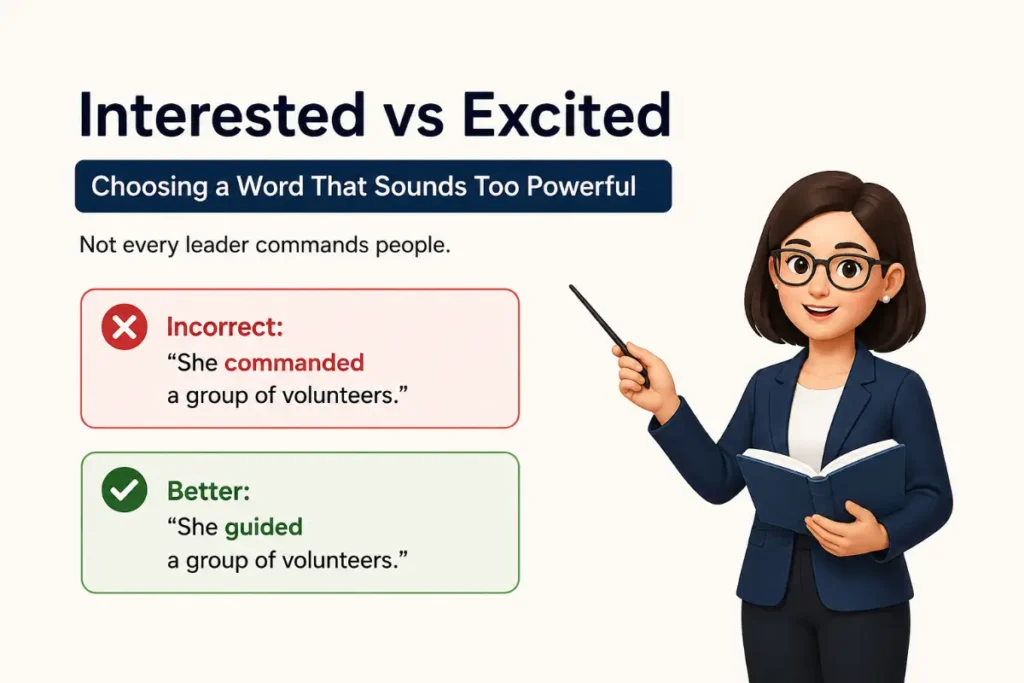
Not every leader commands people.
Incorrect:
“She commanded a group of volunteers.”
Better:
“She guided a group of volunteers.”
Command suggests strong authority.
Using Formal Words in Casual Situations
Incorrect:
“Can you facilitate me to the store?”
Better:
“Can you guide me to the store?”
Facilitate works in professional settings but sounds strange in everyday speech.
Confusing Cause With Leadership
Example:
“The accident led the driver.”
This is incorrect.
Better:
“The accident affected the driver.”
Lead can mean cause, but it does not always mean guide.
Antonyms of Lead
Antonyms are words with opposite meanings. The right opposite depends on which meaning of lead you are using.
| Antonym | Meaning | Example |
|---|---|---|
| Follow | Move behind someone else | The team followed the instructions. |
| Trail | Stay behind | The hikers trailed behind the group. |
| Lag | Fall behind | The project began to lag. |
| Obey | Follow someone’s commands | The workers obeyed the rules. |
| Antonym | Meaning | Example |
|---|---|---|
| Follow | Accept another person’s direction | He followed the manager’s plan. |
| Assist | Support instead of directing | She assisted the project leader. |
| Serve | Work under someone’s authority | He served as a team member. |
| Depend | Rely on another person | The team depended on its supervisor. |
| Antonym | Meaning | Example |
|---|---|---|
| Prevent | Stop something from happening | The safety system prevented accidents. |
| Avoid | Stay away from something | They avoided unnecessary delays. |
| Block | Stop progress | The mistake blocked development. |
Quick Tips for Choosing the Right Synonym for Lead
Choosing the right word becomes easier when you focus on the exact meaning behind your sentence.
Ask What Kind of Leadership You Mean
Different situations need different words.
Use guide when someone provides support.
Example:
“The counselor guided students through their choices.”
Use manage when someone is responsible for people or tasks.
Example:
“She managed a large sales team.”
Use direct when someone gives instructions.
Example:
“He directed the production process.”
Use inspire when someone motivates others.
Example:
“Her story inspired thousands of people.”
Use influence when someone affects opinions or decisions.
Example:
“The book influenced modern writers.”
Match the Word With Your Tone
Your audience matters.
Professional writing:
“I oversaw the development process.”
Casual conversation:
“I handled the project.”
Academic writing:
“The discovery influenced scientific research.”
Creative writing:
“Her courage inspired an entire generation.”
A strong writer does not just replace words. A strong writer chooses words that create the right feeling.
Avoid Replacing Simple Words With Complicated Ones
A longer or more formal word is not always better.
Compare:
“Sarah facilitated the team.”
“Sarah helped the team.”
The first sentence may sound professional, but it does not explain much. The second sentence is clearer.
Good writing is about precision, not complexity.
Use Results Instead of Only Leadership Words
In professional writing, showing results often creates a stronger impression.
Instead of:
“I led a successful project.”
Try:
“I managed a project that reduced costs by 20%.”
Instead of:
“I led a team.”
Try:
“I supervised a team of twelve employees and improved workflow.”
Specific details make your writing more convincing.
Think About the Relationship Between People
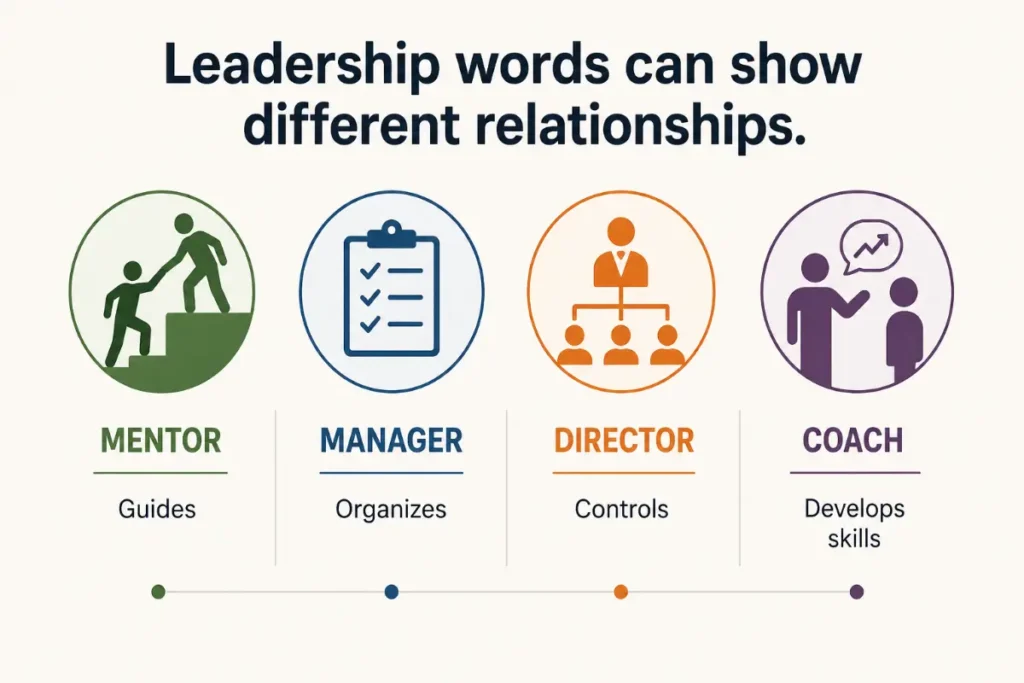
Leadership words can show different relationships. A mentor guides. A manager organizes. A director controls. A coach develops skills. A commander gives orders. A leader inspires action. Choosing the right word helps readers understand the type of role someone had.
Conclusion
The word lead is useful because it covers many ideas, from showing direction to managing people and creating change. However, choosing more specific words can make your writing clearer and more powerful.
The best synonyms for lead depend on your purpose. Use guide for support, manage for responsibility, direct for control, influence for impact, and inspire for motivation. A precise word helps readers understand your exact meaning without extra explanation.
Strong writing is not about using the biggest words. It is about choosing the word that fits the situation. When you select the right alternative, your emails, essays, resumes, and conversations become more natural and effective.
Frequently Asked Questions
What are the best synonyms for lead?
The best synonyms for lead include guide, direct, manage, oversee, influence, inspire, and command. The right choice depends on the meaning of lead in your sentence.
What’s another way to say lead?
Another way to say lead is guide, manage, direct, or oversee. For a professional setting, manage and oversee often sound natural.
What are professional synonyms for lead on a resume?
Professional replacements for lead on a resume include managed, directed, supervised, coordinated, oversaw, and developed. These words show responsibility and specific skills.
What is a stronger word than lead?
Stronger words than lead include command, direct, drive, and pioneer. These words suggest greater authority or influence.
What are the best synonyms for lead a team?
The best replacements for lead a team are manage a team, oversee a team, guide a team, coach a team, and direct a team.
Can guide and lead mean the same thing?
Guide and lead can have similar meanings, but guide usually sounds more supportive while lead can suggest responsibility or authority.
What is the difference between lead and manage?
Lead focuses on direction, vision, and influence. Manage focuses on organizing people, tasks, and resources to achieve a goal.
